change wheel AUDI A3 2015 User Guide
[x] Cancel search | Manufacturer: AUDI, Model Year: 2015, Model line: A3, Model: AUDI A3 2015Pages: 288, PDF Size: 71.46 MB
Page 229 of 288
Gross Vehicle Weight Rating ("GVWR")
means the maximum total loaded weight of
the vehicle .
Groove
means the space between two adjacent tread
ri bs.
Load rating (code)
means the maximum load that a tire is rated
to carry for a given inflat ion pressure . You
may not find this information on all tires be
cause it is not requ ired by law .
Ma ximum load rating
means the load rating for a t ire at the max i
mum permissible inflation pressure for that
tire .
Maximum loaded vehicle weight
means the sum of:
(a) Curb weight
(b) Accessory weight
(c) Vehicle capac ity weight, and
(d) Production opt ions weight
Ma ximum (permissible) inflation pressure
means the maximum co ld inf lation pressure
to which a tire may be inflated . Also called
"maximum inflation pressure."
Normal occupant weight
means 150 lbs. (68 k ilograms) times the
number of occupants seated in the vehicle up
to the tota l seating capacity of yo ur vehicle.
Occupant distribution
means distribution of occupants in a veh icle.
Outer diameter
means the overall diameter of an inflated new
tire .
Overall width
means the linear distance between the exteri
ors of the sidewalls of an inflated tire, includ
ing e levations due to labeling, decorations, or
protective bands or ribs .
Tires and wheels 22 7
Ply
means a layer of rubbe r-coated parallel cords.
Production options weight
means the combined weight of those installed
regular production opt ions we ighing over 5
lbs. (2.3 kg) in excess of those standa rd items
which they replace, not previously considered
in curb weight or accessory weight, including
heavy duty brakes, ride levelers, roof rack,
heavy duty battery, and special trim.
Radial ply tire
means a pneumatic tire in which the ply cords
that extend to the beads are laid at substan
tially 90 degrees to the centerl ine of the
tread.
Recommended inflation pressure
see ~ page 226, Cold tire inflation pressure .
Reinforced tire
means a tire design to operate at higher loads
and at higher inflation pressures than the cor
responding standard tire . Reinforced tires
may be identified as "XL", "xl", "EXTRA LOAD",
or "RF" on the sidewal l.
Rim
means a metal support for a tire or a tire and
tube assembly upon which the tire beads are
seated .
Rim diamete r
means nominal diameter of the bead seat. If
you change your wheel s ize, you wi ll have to
purchase new tires to match the new r im di
ameter.
Rim size designation
means rim diameter and width.
Rim width
means nominal distance between rim flanges.
Sidewall
means that portion of a tire between the
tread and bead .
•
•
•
Page 232 of 288
230 Tire s and wheel s
you have stored . The system does not recog
nize the load condition of your vehicle.
The effectiveness of the tire pressu re monito r
ing system w ill be impaired if you store nor
mal load pressures but then operate the vehi
cle at its maximum load¢.&. .
See the il lustration¢
fig. 156 for the location
of the label on dr iver's side 8-pillar (color of
the actua l labe l and exact location on the ve
hicle wi ll vary slightly).
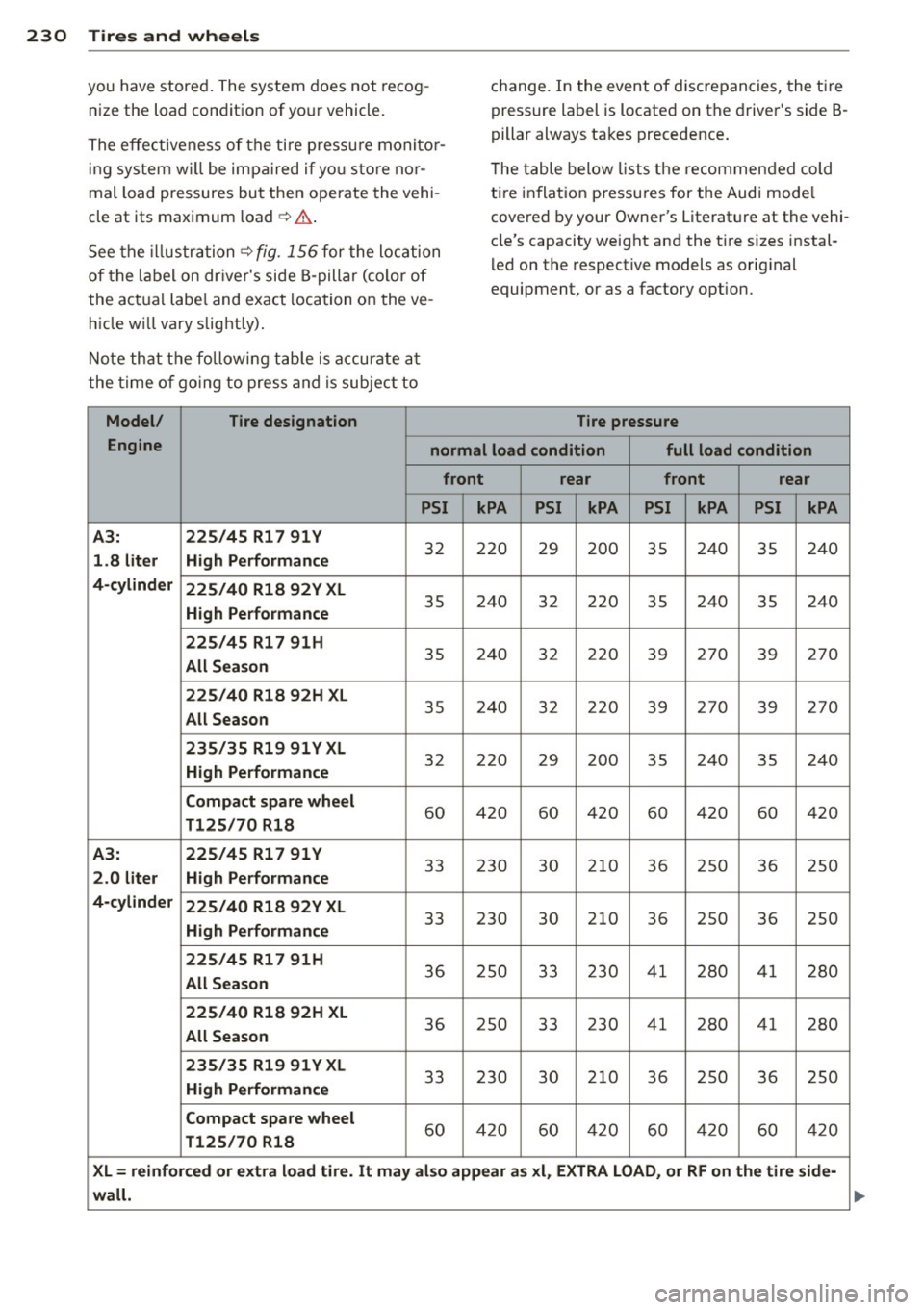
Note that the followi ng tab le is accurate at
the time o f go ing to press and is subject to
Model / Tire de
signation
change. In the event of discrepancies, the t ire
pressure label is located on the driver's side 8-
pillar always takes precedence .
T he table below lists the recommended cold
ti re inflation pressu res for the Audi mode l
covered by your Owner's Literature at the vehi
cle's capacity weight and the t ire sizes instal
l ed on the respective models as original
equipment, or as a factory option.
Tire pressure
Engine normal load condition full load condition
front rear front rear
PSI kPA PSI kPA PSI kPA PSI kPA
A3: 225 /45 Rl 7 91 Y
32 220 29 200 35 240 35 240 1
.8 lit er High P erform ance
4 -cy lind er
22 5/40 R18 92Y XL
Hi gh Perfo rmance
35 240 32 220
35 240
35 240
2
2 5/45 Rl 7 91H
35 240
32 220 39 270 39 270 All S
ea son
2 25 /40 R18 92H XL
35 240 32 220 39 270 39 270 All Season
2 35/35 Rl 9 91 Y XL
32 220 29 200 35 240
35 240 High Performan
ce
C o mp act spar e whe el
60 420 60 420
60 420 60 420 11
25/70 R 18
A 3: 225 /45 Rl 7 91Y
33 230 30 210 36 250 36 250 2.0 liter High Perfo rman ce
4 -cy linder
22 5/40 R18 92Y XL
High Performan ce
33 230 30 210 36 250 36 250
225 /45 R1 7 91H
36 250 33 230 41 280 41 280 All Seaso n
225 /40 R18 92H XL
36 250
33 230 41 280
41 280 All Seaso n
23 5/3 5 R1 9 9 1 Y XL
33 230 30 210 36 250 36 250 High P erformance
C o m pact spa re w heel
60 420 60 420 60 420 60 420 1125 /70 R18
X L= reinf orced or extra lo ad tir e. It m ay als o a ppe ar as x l, EX TRA L OAD , or RF on the ti re side-
wall .
Page 233 of 288
The correct tire pressure for the spare wheel is
l ocated on a label on the driver's side B-pillar.
Because tec hnical changes may be made to
vehicle equ ipment dur ing the model yea r, a l
ways compa re the tire size designation on the
tire pressure label on your vehicle wit h the
tires on your vehicle . Make s ure that the tire
size information on the veh icle label is the
same as the s ize of the tires on the vehicle.
This is especially important if the vehicle be
longs to someone else or you bought the veh i
cle with different rims/tires or you boug ht the
ve hicle as a previously owned vehicle.
Remember, your safety and that of your pas
sengers also depends on mak ing su re that
l oad limits are not exceeded. Vehicle load in
cludes everybody and everything in and on the
veh icle. These load limits are technically refer
red to as the vehicle's Gross Vehicle We ight
Rating ("GVWR") . The Gross Ax le Weight Rat
ing ("GAWR") is the maximum load that can
be app lied at each of the veh icle's two axles.
The Gross Vehicle Weight Rating and the
Gross Axle Weight Rating are listed on the
safety compliance st icker label located on the
driver's side B-p illa r. The t ire pressure label o n
your Aud i lists the maximum combined
weight of a ll of the occupants and luggage or
other cargo that the vehicle can carry. For the
l ocation of the tire pressure labe l~
fig. 156.
A WARNING
Overloading a vehicle can cause loss of ve
hicle control, a crash or other accident, se
rious personal injury, and even death.
- Carrying more weight than yo ur vehicle
was designed to carry will prevent the
vehicle from handling properly and in crease the risk of a loss of veh icle con
trol.
- The brakes on a veh icle that has been
overloaded may not be able to stop the
vehicle within a safe distance .
- Tires on a vehicle that has been overload
ed can fail suddenly causing loss of con
t rol and a crash.
Tire s an d wheel s 231
-Always make sure that the total load be
ing transported - includ ing the weight of
a trailer hitch and the tongue we ight of a
loaded trailer -does not make the vehi
cle heavier than the vehicles Gross Veh i
cle Weight Rating.
A WARNING
- Inco rrect tire pressures and/or underin
flation can lead to a ser ious or fatal acci
dent.
- Inco rrect tire pressures and/or underin
flation cause increased tire wear and can
affect the handling of the vehicle.
- Inco rrect tire pressures and/or underin
flation can a lso lead to sudden t ire fail
ure, including a blowou t and sudden de
flation, caus ing loss of veh icle contro l.
Checking tire pressure
The correct tire pressure for the tires original
ly installed on your vehicle is listed on the tire
pressvre label located on driver's side 8-pil
lar.
T he recommended tire pressures are on the
ti re pressure label and in the table
~ page 229, Cold tire inflation pressure . This
means that the pressure m ust be checked and
adjusted when the tire has not been dr iven for
more than a couple of miles (kilometers) at
low speeds during the previous three hours.
Air in the tires expands when the tire heats up
as a result of internal frict ion as it flexes in
use. The tire pressure is h igher when the tire
has warmed up t han when it is "cold."
It is the inflation pressure in a "cold" t ire that
counts. Therefore, you should never let a ir out
of a warm tire to match "Cold tire inflat ion
pressure" recommendat io ns ~
page 229 . Th e
ti res wo uld then be unde rinfl ated and co uld
fail suddenly.
T he tire pressure label on your Audi lists the
recommended co ld tire inflation pressures at
max imum capacity for the new, or ig inal
equipment tires that were on your vehi cle at
•
•
•
Page 235 of 288
-Only when all tires on the vehicle are fi l
led to the correct pressure, the tire pres
sure monitoring system can work cor rect ly.
- The use of incorrect tire pressure values
can lead to accidents or other damage.
Therefore it is essential that the driver
observe the specif ied tire pressure values
for the tires and the co rrect p ress ures for
the f unction of t he tire pressure mo nitor
ing system.
- Always inflate ti res to the recommended
and co rrec t tire pressu re befo re d rivi ng
off.
- Drivi ng with under inflated ti res bend
more, letti ng them get too ho t res ulting
in t read separation, sudden t ire fail ure
and loss of control.
- Excessive spee d and/ove rloading can
cause heat bui ld -up, sudden tire fa il u re
and loss of control.
- If the t ire pressure is too low or too high,
the tires w ill wea r prematurely and the
vehicle will not hand le we ll.
- If the t ire is no t flat and you do no t have
to change a w heel imme diate ly, drive at
reduced speed to the nearest service sta
t ion to check the tire pressure and add
air as required.
(D Note
Driving without va lve stem caps ca n cause
damage to the t ire va lves. To prevent this,
always make s ure that facto ry installed
valve stem caps on all wheels a re secure ly
mounted on the va lve .
@) For the sake of the environment
Underinflated tires will a lso increase the
fue l consumption .
Tires and vehicle load limits
There are limits to the amount of load or
weight that any veh icle and any t ire can carry .
A vehicle that is ove rloaded w ill not ha ndle
well and is more difficult to stop . Overload ing
can no t on ly lead to loss o f vehicle con tro l,
Tire s an d wheel s 233
but can also damage important parts of the
vehicle and ca n lead to sud den tire fai lure, in
clud ing a b lowout and s udden def lation that
can cause the vehicle to cras h.
Your safety and that of your passengers also depends on making sure that load limits are
not exceeded . Vehicle load includes everybody
and everything in and on the veh icle. These
load lim its are technically referred to as the
vehicle's
Gross Vehicle We ight Rating
("GVWR ") .
The "GVWR" includes the weight of the basic
vehicle, all factory installed accessories, a full
tank of fuel, o il, coo lant and other fluids plus
maximum load . The max imum load includes
the number of passenge rs that th e vehicle is
i n tended to car ry ("seat ing capa city") wi th an
ass umed we igh t of 150 lbs (68 kg) fo r each
passenger at a designated seating posi tion
and t he tota l weight of any luggage i n the ve
hicle . If you tow a trai ler, the weight of the
tra iler hitch and the tongue weight of the
loaded tra iler must be included as part of the
vehicle load.
T he
Gro ss Axle Weight Rating ("GAWR") is
the maximum load that can be applied at each
of the vehicle's two axles.
T he Gross Vehicle Weight Rating and the
G ross Axle Weig ht Rating are listed on the
safety comp liance sticker label located on the
driver's side B-pillar. Your Audi has 5 seat ing
pos itions, 2 in the front and 3 in the rea r for
total seating capacity of 5 . Each seating posi
t ion has a safety belt
~ page 131, Safety
belts.
The fact that there is an upper limit to your
vehicle's Gross Vehicle Weight Rating means
t h at the total weight of whatever is bei ng car
ried in the vehicle ( in cl ud ing t he weight of a
t ra ile r hi tc h a nd the tongue we ight of t he
l o ad ed tr ailer) is lim ited. The more p assen
gers in the vehicle or passengers who are
heavier than the standard weights assumed
mean that less weight can be carried as lug -
gage.
~
•
•
•
Page 246 of 288
24 4 T ire s and wheel s
signal low tire pressure as intended. TPMS
malfunctions may occur for a variety of rea
sons, includ ing the installat ion of replace
ment or a lternate tires or whee ls on the veh i
cle that prevent the TPMS from funct ioning
properly . Always check the TPMS malfunct ion
telltale after replacing one or more t ires or
wheels on your veh icle to ensure that the re
p lacement or a lternate tires and wheels allow
the TPMS to continue to function properly.
If the Tire Pressure Monitoring System
indicator appears
Applies to vehicles: with tire pressure monitoring system
The tire pressure indicator in the instrument
cluster informs you if the tire pressure is too
low or if there is a system malfunction.
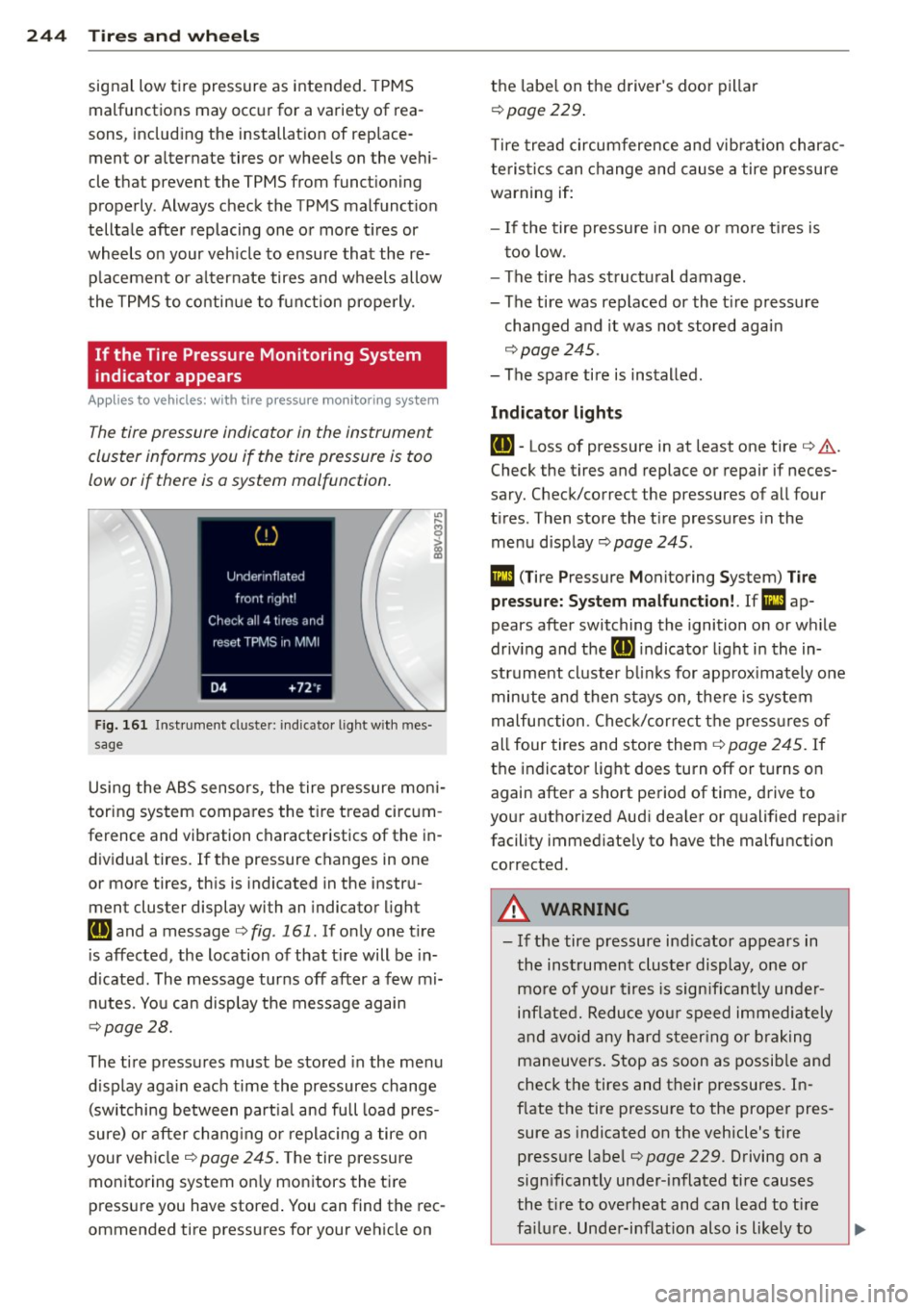
F ig. 161 Ins trumen t cluste r: ind icato r light w it h m es
s age
Using the ABS sensors, the tire pressure moni
toring system compa res the tire tread circum
ference and vibration characteristics of the in
dividual tires .
If the pressure changes in one
or more tires, th is is indicated in the instru
ment cluster display with an indicator light
IE and a message ¢ fig. 161 . If only one t ire
is affected, the location of that t ire will be in
d icated. The message turns off after a few mi
nutes. You can disp lay the message again
¢ page 28.
The tire pressures must be stored in the menu
d isplay aga in each time the pressures change
(switching between part ia l and full load pres
sure) or after chang ing or replac ing a tire on
your ve hicle ¢
page 245. The tire pressure
monitoring system on ly monitors the ti re
press ure you have stored . You can find the rec
ommended tire pressures for your vehicle on the
labe l on the driver's doo r pillar
¢ page 229 .
Tire tread circumference and vib ration charac
teristics can change and cause a tire pressure
warning if:
- I f the tire pressure in one or more ti res is
t oo low.
- The tire has structural damage.
- The tire was replaced or the t ire pressure
changed and it was not stored again
¢ page 245.
-The spare tire is installed .
Indicator lights
IE -Loss of pressure in at least one tire ¢ .&. .
Check the tires and replace or repair if neces
sary. Check/correct the pressures of all four
t ires . Then store the t ire pressures in the
menu display
¢ page 245.
Ill (T ire Pressure Monitoring System) T ire
pre ssure: S ystem mal function!. Ifm:!
ap
pears afte r switching the ignition on or w hile
driv ing and the [ti] indicato r light in the in
strument cluster b links for app rox imately one
minute and then stays on , the re is system
malfu nction . Check/cor rect the p ress ures of
all four tires and store them¢
page 245. If
t h e indicator lig ht does turn off or tu rns on
again after a short pe riod of time, drive to
your authori zed Aud i dea ler or qualified repair
facility immed iately to have the malfunction
corrected .
A WARNING
--- If the tire pressure ind icator appears in
the instrument cluster display , one or
mo re of your t ires is sign ifi cant ly unde r
i n flated. Reduce yo ur speed immedi ately
an d avoid any hard steer ing or b rak ing
maneuvers. Stop as soon as possib le and
check the tires and their pressures. In
f late the tire pressure to the proper pres
sure as indicated on the vehicle's tire
pressure labe l
¢page 229. Driving on a
significantly under-i nflated tire causes
the t ire to overheat and can lead to ti re
fa ilur e. Unde r-inflation also is li kely to
Page 247 of 288
impair the vehicle's handling and stop
ping ability.
- The driver is responsible for maintaining
the correct tire pressures. You must
check the t ire pressures regularly.
- Under certain conditions (such as a spor
ty driving style, w inter condit ions or un
paved roads), the pressure monitor ind i
cator may be de layed.
- Ask your authorized dealer if run-flat
tires may be used on your vehicle. You ve
hicle registrat ion becomes invalid if you
use these tires when not permitted .
Damage to your vehicle or accidents
c ou ld also resu lt.
(0 Tips
- The t ire pressure monitoring system can
also stop work ing when there is an ESC/
ABS malfunction.
- Using snow chains may result in a system malfunction .
- The t ires with the ident ificat ion "AO" or
"RO"¢ page 236 have been matched
with you r A udi tire p ressu re monito ring
system. We recommend that you use
these tires.
- The t ire pressure monitoring system can
on ly mon itor the t ire pressure of the
driving tires . C he ck the tire pressure of
the spare wheel in the luggage compart
ment so that if necessary it is ready for
u se .
Storing tire pressures
Applies to vehicles: with tire pressure monitoring system
A change in tire pressure or a change in tires
must be stored in the system.
The ti re p ress ure is s to red in the M MI.
~ Make sure befo re stor ing that the tire pres
su res of all fou r tires meet the specified val
ues and a re adapted to the load. Otherw ise
the system co uld mal function ~
page 229.
~ Switch the ignition on.
~ Select : Sys tem s control button or Car sy s
tems > Servic e
& control > Tire pressure
Tire s an d wheel s 245
monitor > Store tire pre ssure > Ye s, store
now .
(D Tips
Do not s to re the tire pressures if snow
chains a re installed.
•
•
•
Page 251 of 288
-Make sure that passengers wait in a safe
place away from the vehicle and well
away from the road and traffic.
- To help prevent the vehicle from moving
suddenly and possibly slipping off the
jack, always fully set the parking brake
and block the wheel diagonally opposite
the whee l being changed. When one
front whee l is lifted off the gro und, plac
ing the A utomat ic Transm iss ion in P
(Park) wi ll
not prevent t he vehi cle from
moving .
- Before you change a wheel, be su re the
ground is leve l and fi rm.
If necessary,
use a st urdy board under the jack.
- Always store the vehicle tool ki t, the jack
and the replaced ti re in the l uggage com
partment¢
page 12 7 .
Changing a wheel
When you change a wheel, follow these
quence described below step-by-step and in
exactly that order.
1. Remove the d ec orative wheel cov er* . For
more deta ils see also
c:>page 249, Deco
rative wheel covers
or ¢ page 2 50,
Wheels with wheel bolt caps.
2. Loosen the wheel bolt s c:> page 250.
3. Locate the proper mount ing point for the
jack and align the jack below that point
<=> page 251.
4. Raise the car w ith the jack c:> page 251.
5. Remove the wheel with the flat tire and
then install
the spare ¢ page 252 .
6. Tighten all wheel bo lts light ly.
7 .
Low er the ve hicle with the jack.
8. Use the wheel bolt wrenc h and
firmly
tighten all whee l bolts c:> page 250.
9. Replace the decorative wheel cov er*.
A WARNING
Always read and follow all WARNINGS and
information
c:> .&. in Raising the vehicle on
page251
and ¢page 253.
What do I d o now ? 249
After changing a wheel
A wheel change is not complete without the
doing the following.
.,. Always store the vehicle tool kit, the jack*
and the replaced tire in the luggage com
partment
c:> page 127.
.,. Check the tir e pr essure on the spare whee l
immed iate ly afte r mounting i t.
.,. As soon as poss ib le, have the
tight ening
torque s
on all wheel bolts checked w ith a
torque wrench . The correct tighten ing tor
que is 90 ft lb (120 Nm).
.,. Have the flat tire
replaced as soon as possi
ble.
@ Tips
- If you notice that the wheel bo lts a re
corroded and difficult to turn while
chang ing a tire, they should be replaced
before you c heck the tightening torque.
- Drive at reduced speed until you have the tightening torques checked.
- After changing a whee l, the ti re press ure
in all four tires must be checked/correct
ed and the tire pressure monitoring indi
cator must be stored in the M MI
c:>page245.
Decorative wheel covers
App lies to veh icles: w ith decorat ive w hee l cove rs
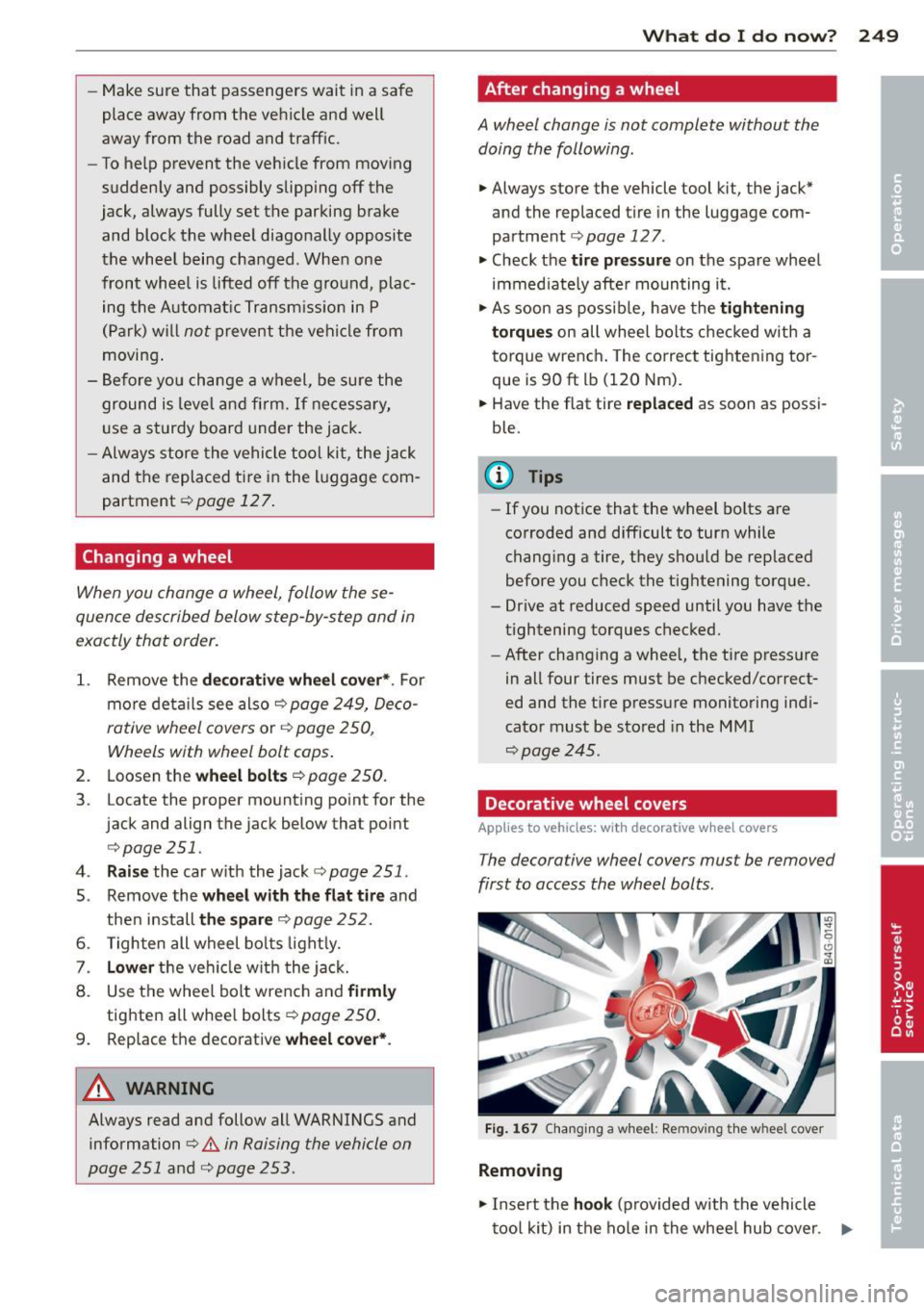
The decorative wheel covers must be removed
first to access the wheel bolts.
Fi g. 167 Chang ing a whee l: Removing th e w hee l cover
Removing
.,. Insert the hook (provided with the vehicle
t oo l kit) in the ho le in the whee l hub cover .
i,,.
Page 253 of 288
hold on to the ca r to keep your ba lance
and take care not to slip.
Raising the vehicle
Th e ve hicl e must be li~ed with the jack first
before the wheel can be removed.
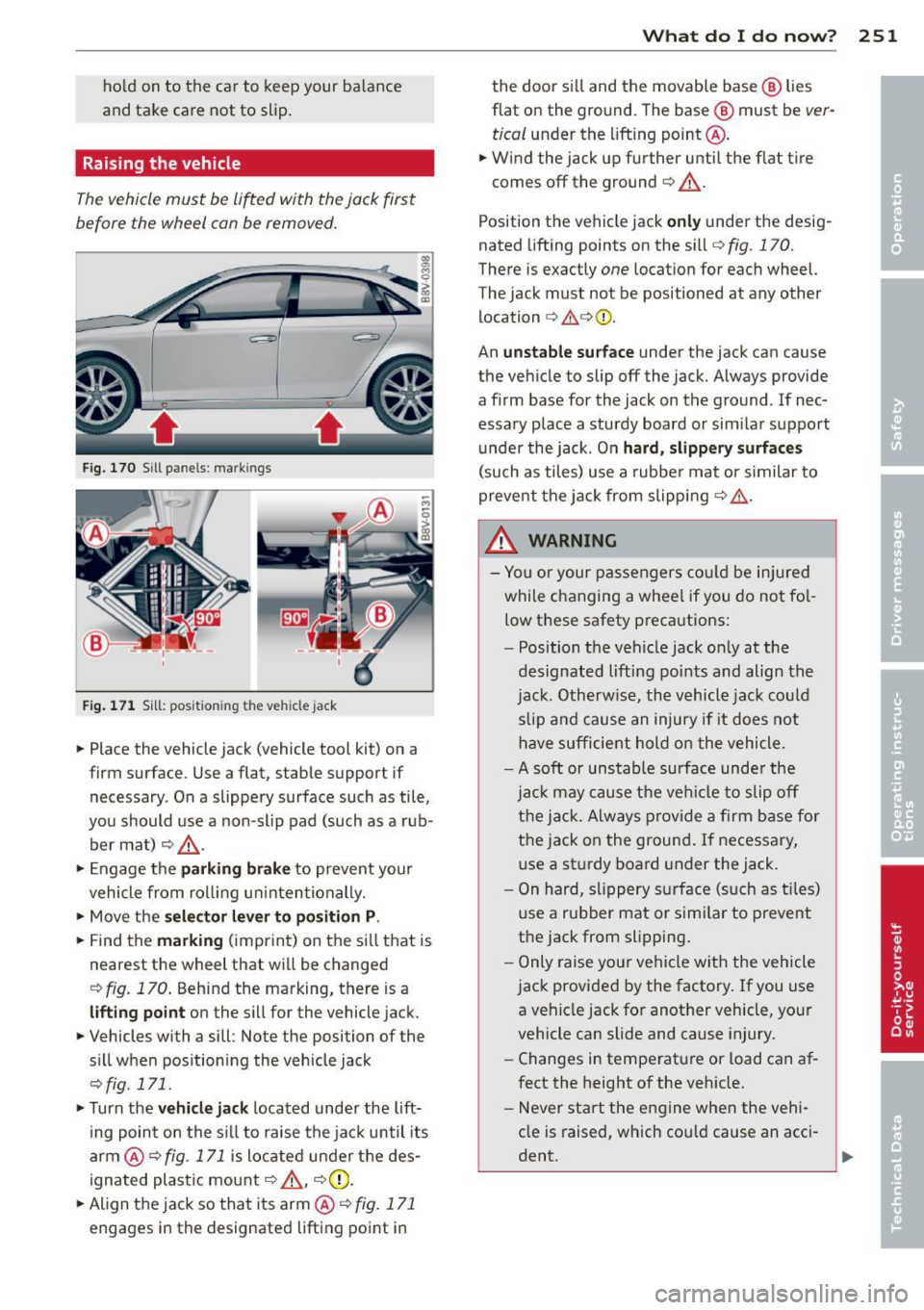
F ig. 170 Sill p anels : m arkin gs
Fig. 171 Sill: posi tioning th e vehicle jack
.. Place the vehicle jack (vehicle tool kit) on a
firm surface . Use a flat, stable support if
necessary . On a slippery surface such as tile,
you should use a non -slip pad (such as a rub
ber mat) ¢_& .
.. Engage the
p arking brak e to prevent your
vehicle from rol ling u ninten tionally.
.. Move the
se lector leve r to pos ition P.
.. Find the marki ng (imprint) on the si ll that is
nearest the wheel that wi ll be changed
¢ fig . 170 . Behind the marking, there is a
lifting point on the si ll for the vehicle jack.
.. Vehicles with a sill : Note the position of the
s ill when pos ition ing the vehicle jack
¢ fig . 171.
.. Turn the
ve hicle jack located under the lift
ing poin t on the s ill to raise the jac k until its
arm @
Q fig. 171 is located under the des
ignated plastic mount c:::>
A, ¢(D .
.. Align the jack so that its arm @c:::> fig. 171
engages in the designated lifting point in
What do I d o now ? 251
the door si ll and the movable base ® lies
flat on the ground. The base @ must be ver
tical under the lifting point @ .
.. Wind the jack up further until the flat t ire
comes off the ground
c:::> _& .
Position the vehicle jack
onl y under the desig
nated lifting points on the si ll
c:::> fig. 170.
There is exactly one locat ion for each wheel.
The jack must not be positioned at any other location ¢ 8 ¢(1).
An
uns table surface under the jack can cause
the vehicle to slip off the jack. Always provide a firm base for the jack on the ground . If nec
essary place a sturdy board or sim ilar support
under the jack . On
hard, slippery surfaces
(such as tiles) use a rubbe r mat or similar to
prevent the jack from slipping
Q & .
_&. WARNING
-You or your passengers co uld be in ju red
while changing a wheel if you do no t fo l
low these safety preca utions:
- Position the vehicle jack on ly at the
designated lifting points and align the
j ac k. Otherw ise, the vehicle jac k co uld
slip and cause an injury if it doe s not
h ave sufficient hold on the vehicle .
- A soft or unstable su rface unde r the
ja ck may cause the ve hicle to slip off
the jack . A lw ays p rov ide a firm b ase for
the j ack on the ground . If necessary,
u se a st urdy board under the jack .
- On hard, slippery surface (such as t iles)
u se a rubber mat or similar to prevent
the jack from slipping .
- Only raise your vehicle with the vehicle
j ack provided by the factory . If you use
a veh icle jack for another vehicle, you r
vehicle can slide and cause injury .
- Changes in tempe rature or load can af
fect the height of the veh icle .
- Never sta rt the engine when the vehi
cle is raised , which cou ld cause an acci-
dent.
~
Page 254 of 288

252 What do I do n ow ?
-Support the vehicle securely with ap
propriate stands if work is to be per
formed underneath the vehicle;
otherw ise, there is a potential risk for
in Jury .
- To help preven t injury to yourself and
your passengers:
- Do not raise the vehicle u nti l you a re
sure the jack is sec urely e ngaged .
- Passengers mus t not rema in in the ve
h icle when it is jacked up .
- Ma ke sure that passengers wait in a
safe p lace away from the vehicle and
well away from the road and traffic.
- Make sure jack posi tion is co rrect, ad
just as necess ary and then contin ue to
raise the jack .
- Changes in temperature or load can af
fect the height of the vehicle .
0 Note
Do not lift the vehicle by the s ill. Pos ition
the vehicle ja ck only at the designated lift
ing poi nts on the sill. Othe rwise, your vehi
cle will be damaged .
Taking the wheel off/installing the spare
Follow these instructions s tep-by-step for
c hanging the wheel.
Fig . 172 Chang ing a w hee l: u sing th e screw driver ha n
dl e (w it h th e bla de re mov ed) to t urn the bolts
Fig. 173 Ch ang ing a wheel : alignment p in in sid e th e
t op hole
After you have loos ened all wheel bo lts and
raised the vehicle off the ground, remove and
replace the wheel as follows :
Removing the wheel
.,. Use the hexagon al so cket in th e screwdri v
er handle
to completely remove the top
most whee l bolt and set it aside on a
clean
surfac e Q fig. 172 .
.,. Screw the threaded end of the al ignme nt
p in
from the tool k it hand-t ight into t he
empty bol t hole
Q fig . 173.
.,. Then remove the other wheel bolts as de
scr ibed above .
.,. Take off the whee l leaving the a lignment pin
in the bo lt ho le
Q (J) .
Putting on the comp act sp are wheel
.,. Lift the spare whee l and carefully slide it
over the alignment p in to guide it in place
Q (J) .
.,. Use the hexagonal socket i n the screwdriver
handle to screw in and tighten a ll whee l
bolts
slightly .
.,. Remove the alignment pin and insert and
tighten the rema ining whee l bolt slightly
like the rest .
.,. Turn the jack handle counter -clockwise to
lower the vehicle until the jack is fully re
leased .
.,. Use the wheel bolt wrench to tighten all
wheel bo lts fi rmly
Q page 250 . Tighten
them
crosswise , from one bolt to the (ap
proximately) opposite one, to keep the
wheel cente red.
Page 281 of 288
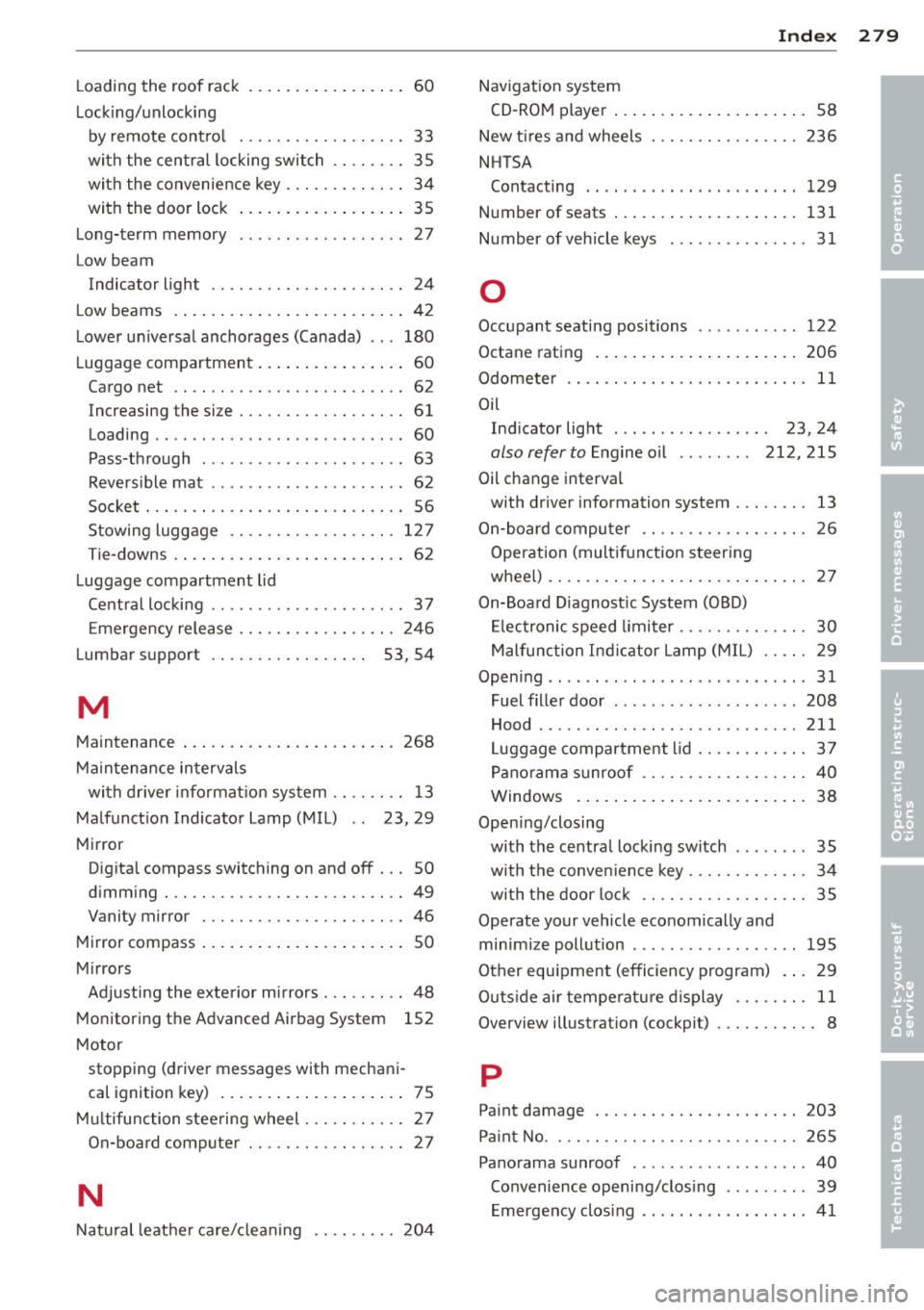
Loading the roof rack . . . . . . . . . . . . . . . . . 60
Lackin g/unlocking
by remote control .................. 33
with the central locking switch .. .. .. .. 35
with the convenience key . . . . . . . . . . . . . 34
with the door lock ............ .. .. .. 35
Long-term memory .................. 27
Low beam Indicator light . . . . . . . . . . . . . . . . . . . . . 24
Low beams . ................... ..... 42
Lower universal anchorages (Canada) .. . 180
Lugg age compartment ............ ... . 60
Cargo net .. ................. .. .... 62
Increasing the size ........ .... .. .. .. 61
Loading .. ... .................. .. .. 60
Pass-through . . . . . . . . . . . . . . . . . . . . . . 63
Reversible mat ..................... 62
Socket ... .. ................. .. .... 56
Stowing luggage .................. 127
Tie-downs . . . . . . . . . . . . . . . . . . . . . . . . . 62
Luggage compartment lid
Central locking . . . . . . . . . . . . . . . . . . . . . 3 7
Emergency release ........ .... .. .. . 246
Lumbar suppo rt . . . . . . . . . . . . . . . . . 53, 54
M
Maintenance ................. ..... . 268
Maintenance intervals
with driver information system ........ 13
Malfunction Indicator Lamp (MIL) . . 23, 29
Mirro r
Digital compass switching on and off . .. 50
dimming . .. ................. .. .... 49
Vanity mirror ............ ...... .... 46
Mirror compass .................. .... SO
Mirrors Adjusting the exte rior mirrors . .. .. .. .. 48
Monitoring the Advanced Airbag System 152
Motor
Index 279
Navigation system CD-ROM player . . . . . . . . . . . . . . . . . . . . . 58
New tires and wheels ................ 236
NHTSA Contacting .. .. .. .. ..... .......... 129
Number of seats ..... ............... 131
Number of vehicle keys ............... 31
0
Occupant seating positions ........... 122
Octane rating ... .... ............... 206
Odometer ...... .................... 11
Oil Ind icator light . . . . . . . . . . . . . . . . . 23, 24
also refer to Engine oil . . . . . . . . 212, 215
Oil change interva l
with driver information system . . . . . . . . 13
On-board computer . . . . . . . . . . . . . . . . . . 26
Operation (multifunction steering
wheel) ..... ..... .................. 27
On-Board Diagnost ic System (OBD)
Electronic speed limiter .............. 30
Malfunction Indicator Lamp (MIL) .. .. . 29
Opening ................. ........... 31
Fuel filler door ... .. . .. ... .... ..... 208
Hood ........ ... .. ............... 211
Luggage compartment lid ............ 37
Panorama sunroof .................. 40
Windows ......................... 38
Opening/closing with the central locking switch ........ 35
with the convenience key ........ .. .. . 34
with the door lock .................. 35
Operate your vehicle economically and
minimize pollution .................. 195
Other equipment (efficiency program) . .. 29
Outside air temperature display ........ 11
Overview illustration (cockpit) . . . . . . . . . . . 8
•
•
stopping (driver messages with mechani-p
cal ignition key) ................ .... 75
Multifunction steering wheel . .. .. .. .. .. 27 Paint damage
203
On-board computer ................. 27 Paint No
........................... 265
•
Panorama sunroof ... . .. .. ... ... .... . 40
N
Convenience opening/closing ......... 39
Emergency closing ................ .. 41
Natural leat her care/cleaning .. .. .. .. . 204