sport mode AUDI A3 2015 User Guide
[x] Cancel search | Manufacturer: AUDI, Model Year: 2015, Model line: A3, Model: AUDI A3 2015Pages: 288, PDF Size: 71.46 MB
Page 113 of 288
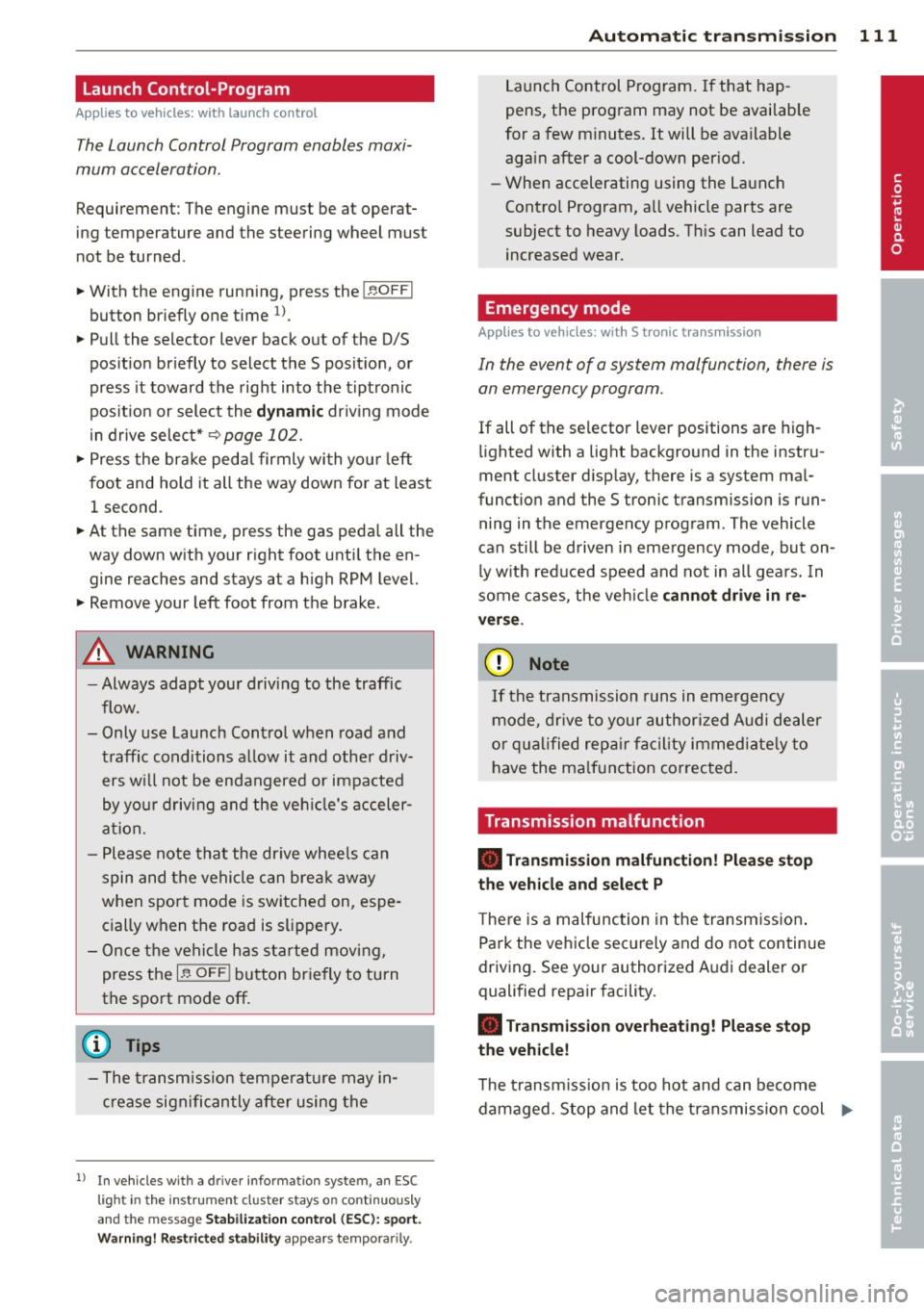
Launch Control-Program
App lies to vehicles: with launch control
The Launch Control Program enables maxi
mum acceleration.
Requirement : The engine must be at operat
ing temperature and the steering wheel must
not be turned .
.. With the engine running, press the
!~ OFFI
button briefly one time 1).
.. Pull the selector lever back out of the 0/S
position briefly to select the S position, or
press it toward the right into the tipt ronic
pos it ion or select the
d ynamic dr iv ing mode
i n drive select*
~page 102.
.. Press the brake peda l firmly with your left
f oot and hold it all the way down for at least
1 second.
.. At the same time, press the gas peda l all the
way down with your right foot unti l the en
gine reaches and stays at a high RPM level.
.. Remove your left foot from the brake.
A WARNING
- Always adapt your driving to the traffic
flow.
- Only use Launch Cont ro l when road and
t raff ic conditions a llow it and other driv
ers wi ll not be endangered or impacted
by you r driving and the veh icle's acceler
ation.
- Please note tha t the dr ive whee ls can
spin and the vehicle can break away
when sport mode is switched on, espe
c ially when the road is sl ippery.
- Once the vehi cle has started moving,
press the
I ~ OFF I button br iefly to turn
the sport mode off.
(j) Tips
- The transm ission tempe rat ure may in
crease significantly after using the
l ) In vehicles with a dr iver info rmat ion system, an ESC
light in the in stru m ent cl us ter stays on contin uo usly
and the m essage
Stabilizatio n cont rol (ESC): spor t.
Warning! Restricted stability
appears temporarily.
Automa tic tran sm iss ion 11 1
Launch Control Program . If that hap
pens, the program may not be availab le
for a few m inutes. It will be ava ilable
again after a cool-down per iod.
- When accelerating using the Launch
Contro l Program, all vehicle parts are
subject to heavy loads. Th is can lead to
increased wear .
Emergency mode
Applies to vehicles: with S tronic transm ission
In the event of a system malfunction, there is
an emergency program.
If all of the selector lever positions are high
li ghted with a light backgro und in the instru
ment cluster d isplay, there is a system mal
funct ion and the S tronic transmission is run
ning in the emergency program . The vehicle
can still be driven in emergency mode, but on
ly w ith reduced speed and not in all gears. In
some cases, the veh icle
c ann ot driv e in re
v e rs e .
(D Note
If the transmission runs in emergency
mode, drive to your author ized Audi dealer
or q ua lified repa ir facil ity immed iate ly to
have the ma lf u nction corrected.
Transmission malfunction
• Tran smiss ion malfuncti on! Please stop
the vehicle and select P
T here is a malfunction in the transmiss ion .
Park the vehicle securely and do not continue
driv ing. See your authorized A udi dealer or
qualified repair facility.
• Transmi ssion overh eatin g! Plea se stop
the vehicle!
The transm iss io n is too hot and can become
damaged . Stop and let the transmission cool .,.
•
Page 171 of 288
WARNINGS. Make certain that the chi ld and
chi ld restraint are correct ly recognized by the
capacitive passenger detect ion system in the
front passenger seat, that the front passenger
airbag is turned
off, and that the airbag status
is always correct ly signaled by the
PAS SEN
GER AIR BAG OFF
light .
Many types and models of child restra ints
have been ava ilable over the years, new mod
e ls are introduced regular ly incorporating new
and improved designs and older models are
taken out of production . Child restraints are
not standardized. Ch ild restra ints of the same
type typically have different we ights and s izes
and d ifferent "footprints", the size and shape
of the bottom of the child restraint that sits
on the seat, when they are installed on a vehi
cle seat. These differences make it virtually imposs ible to certify compliance w ith the re
qu irements for advanced a irbags with each
and every child restraint that has ever been
sold in the past or will be sold over the course
of the useful life of your vehicle.
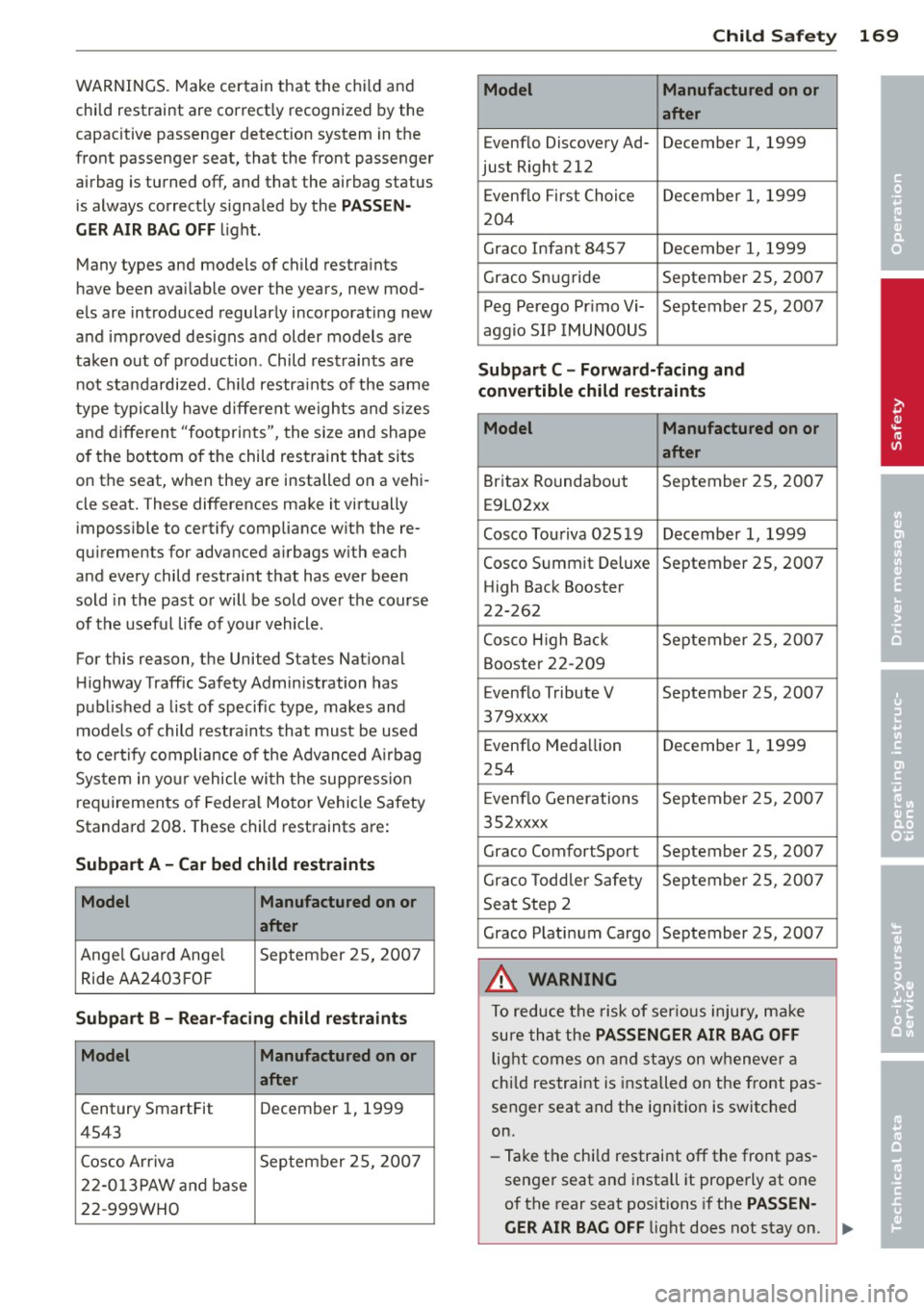
For this reason, the United States National
H ighway Traffic Safety Administration has
published a list of specific type, makes and
models of child restraints that must be used
to certify compliance of the Advanced Airbag
System in your vehicle with the supp ress io n
requirements of Federa l Motor Vehicle Safety
Standard 208 . These child restraints are:
Subpart A -Ca r bed child rest raints
Model Manufactured on or
after
Ange l Guard Ange l September 25, 200 7
Ride AA2403 FOF
Subpart B -Re ar-f a cing child re stra ints
Model Manufactured on or
after
Century SmartFit December 1, 1999
4543
Cosco Arriva September 25, 2007
22-013PAW and base
22-999WHO
Child Sa fet y 169
Model Manufactured on or
after
Evenflo Discovery Ad- December 1, 1999
just Right 212
E venflo First Choice December 1, 1999
204
Graco Infant 8457 December 1, 1999
Graco Snug ride September 25, 2007 Peg Perego Pr imo Vi- September 25, 2007
aggio SIP IMUNOOUS
Subpart C -Forw ard-facing an d
convertible child restraint s
Mod el Manufactu
red on or
after
Britax Roundabout September 25, 2007
E9L02xx
Cosco Touriva 025 19 December 1, 1999
Cosco Summit Deluxe September 25, 2007
High Back Booster
22-262
Cosco H igh Back September 25, 2007
Booster 22-209
Evenflo Tribute V September 25, 2007
379xxxx
Evenf lo Meda llion December 1, 1999
254
E venflo Generations September 25, 2007
352xxxx
Graco ComfortSport September 25, 2007
Graco Todd ler Safety September 25, 2007
Seat Step 2
Graco Platinum Cargo September 25, 2007
A WARNING
To reduce the risk of ser ious injury, make
sure that the
PA SSENGER AIR BAG OFF
light comes on and stays on whenever a
chi ld restraint is installed on the front pas
senger seat and the ignition is switched
on.
- Take the child restraint
off the front pas
senger seat and install it properly at one
of the rear seat positions if the
PASS EN-
GER AI R BA G OFF
light does not stay on. ~
•
•
•
Page 189 of 288
Smart Technology 187
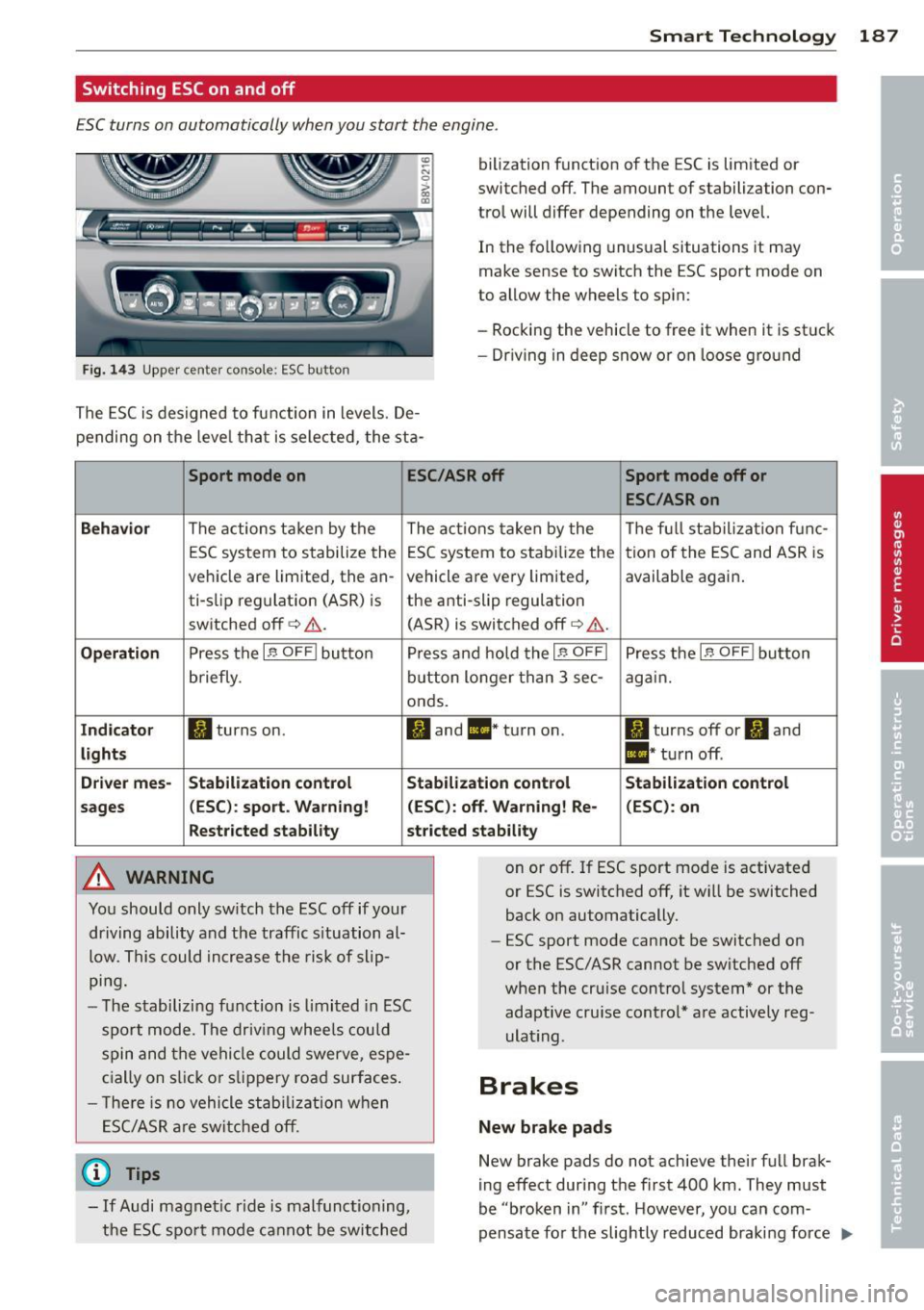
Switching ESC on and off
ESC turns on automatically when you start the engine .
Fig. 143 Upper center console: ESC button
bilization function of the ESC is limited or
switched off. The amount of stabilization con
tro l will differ depending on the level.
In the following unusual situations it may
make sense to switch the ESC sport mode on
to allow the wheels to spin:
- Rocking the vehicle to free it when it is stuck
- Dr iving in deep snow or on loose gro und
The ESC is designed to function in levels. De
pending on the leve l that is selected, the sta-
Sport mode on ESC
/ASR off
Sport mode off or
ESC /ASRon
Behavior
The actions taken by the
The actions taken by the Th
e fu ll stabilization fu nc-
ESC system to stabilize the ESC system to stab ilize the tion of the ESC and ASR is
vehicle are limited, the an- vehicle are very limited, available again.
ti-slip reg ulation (ASR) is the anti-slip regulation
sw itched off
q .&.. (ASR) is switched off q .&. .
Operation Press the If) OFF I button P ress and hold the If) OFFI Press the I.$ OFF I button
briefly. button longer than 3 sec- again.
onds.
Indicator II turns on. II and II * turn on . II turns off or II and
lights II* turn off.
Driver mes-
Stabilization control Stabilization control
Stabilization control
sages (ESC):
sport. Warning! (ESC): off. Warning! Re- (ESC): on
Restricted stability stricted stability
A WARNING
You should only sw itch the ESC off if your
driving ability and the traffic s ituation al
low. This could increase the risk of slip
ping.
- The stabilizing function is limited in ESC
sport mode. The driving wheels could
spin and the vehicle could swerve, espe
cially on slick o r slipp ery road surfaces .
- T here is no vehicle stabilizat ion when
ESC/ASR are switched off.
@ Tips
-If Audi magnet ic ride is malfunctioning,
the ESC sport mode cannot be switched on or off. If ESC sport mode is activated
or ESC is switched off, it w
ill be switched
back on automatically.
- ESC sport mode cannot be switched on
or the ESC/ASR cannot be switched off
when the cru ise contro l system* or the
adaptive cru ise contro l* are actively reg
ulat ing.
Brakes
New brake pads
New brake pads do not achieve their full brak
ing effect during the first 400 km. They must
be "broken in" first. However, you can com
pensate fo r the slightly reduced braking force ""
Page 200 of 288
198 Trailer towing
Trailer towing Driving with a trailer
General information
Your Audi was designed primarily for passen
ger transportation .
If you plan to tow a tra iler, p lease remember
that the addit ional load will affect durability,
economy and performance .
T railer towing not on ly places more stress on
the vehicle, it also calls for more concentra
tion from the driver.
F or this reason, always fo llow the operating
and drivi ng in str uctions provided and use
common sense.
@ Note
If you are going to tow a trai le r, you must
activate the trailer operation mode
c:::> page 198 , Operating instructions.
Technical requirements
Traile r hitch
Use a weight-carrying hitch conforming to the
gross trailer weight. The hitch must be suita
b le for your veh icle and trailer and must be
mo unted secure ly on the ve hicle's chassis at a
technically sound loca tion . Use only a trailer
hi tch with a removab le ball moun t. A lways
check with the tra ile r hitch manufac turer to
make sure that you are using t he cor rect
hitch.
Do not use a bumper hit ch .
The hitch must be installed in such a way that
i t does not interfe re with the impact-absorb
ing bumper system. No modifications should
be made to the vehicle exhaust and brake sys
tems . From time to time, check th at a ll hitch
mo unt ing bo lts remain securely fastened.
When you are not towing a trailer, remove the
tra iler hitch ball moun t. T his prevents the
h itch from causing damage sho uld your veh i
cle be str uck from be hind
c:::> A .
Trailer brake s
If your trailer is equipped wi th a b ra ki ng sys
tem, c heck to be sure t hat i t conforms to all
regulations .
T he trailer hyd rauli c brake system mus t not be
direc tly connec ted to the vehicle's hydraulic
brake system .
Safety chains
Always use safety chains between your veh icle
and the tra ile r.
Trailer lights
Trai ler lights must meet all regulations. Be
sure to check w ith your Audi dealer for correct
wiring, switches and relays .
Mirrors
If you are unable to see the traffic behind you
us ing the regular o utside mirrors, then you
must install extended mirrors. It is important
that you
always have clear v is ion to the rear.
A WARNING
--
Afte r removi ng the trailer hitch, do not
stor e it in your vehicle . In case of sudden
b raking, t he hitch co uld fly forwa rd and i n
j ur e you or your passengers.
Operating instructions
Maximum trailer weight
A tra ile r fo r your vehicle is limited to a typical
class 1 or class 2 tr ailer.
Trailer load distribution
Be sure the load in the tra ile r is held secure ly
i n place to p revent it from shift ing forward,
backward or sideways.
Ne ver allow a pa ssenger to ride in a trailer
c:::> A in Driving instructions on page 199 .
Engine cooling system
Towing a trailer makes the engine work hard
er . It is important that the cooling system's
performance is up to the additional load.
Page 233 of 288
The correct tire pressure for the spare wheel is
l ocated on a label on the driver's side B-pillar.
Because tec hnical changes may be made to
vehicle equ ipment dur ing the model yea r, a l
ways compa re the tire size designation on the
tire pressure label on your vehicle wit h the
tires on your vehicle . Make s ure that the tire
size information on the veh icle label is the
same as the s ize of the tires on the vehicle.
This is especially important if the vehicle be
longs to someone else or you bought the veh i
cle with different rims/tires or you boug ht the
ve hicle as a previously owned vehicle.
Remember, your safety and that of your pas
sengers also depends on mak ing su re that
l oad limits are not exceeded. Vehicle load in
cludes everybody and everything in and on the
veh icle. These load limits are technically refer
red to as the vehicle's Gross Vehicle We ight
Rating ("GVWR") . The Gross Ax le Weight Rat
ing ("GAWR") is the maximum load that can
be app lied at each of the veh icle's two axles.
The Gross Vehicle Weight Rating and the
Gross Axle Weight Rating are listed on the
safety compliance st icker label located on the
driver's side B-p illa r. The t ire pressure label o n
your Aud i lists the maximum combined
weight of a ll of the occupants and luggage or
other cargo that the vehicle can carry. For the
l ocation of the tire pressure labe l~
fig. 156.
A WARNING
Overloading a vehicle can cause loss of ve
hicle control, a crash or other accident, se
rious personal injury, and even death.
- Carrying more weight than yo ur vehicle
was designed to carry will prevent the
vehicle from handling properly and in crease the risk of a loss of veh icle con
trol.
- The brakes on a veh icle that has been
overloaded may not be able to stop the
vehicle within a safe distance .
- Tires on a vehicle that has been overload
ed can fail suddenly causing loss of con
t rol and a crash.
Tire s an d wheel s 231
-Always make sure that the total load be
ing transported - includ ing the weight of
a trailer hitch and the tongue we ight of a
loaded trailer -does not make the vehi
cle heavier than the vehicles Gross Veh i
cle Weight Rating.
A WARNING
- Inco rrect tire pressures and/or underin
flation can lead to a ser ious or fatal acci
dent.
- Inco rrect tire pressures and/or underin
flation cause increased tire wear and can
affect the handling of the vehicle.
- Inco rrect tire pressures and/or underin
flation can a lso lead to sudden t ire fail
ure, including a blowou t and sudden de
flation, caus ing loss of veh icle contro l.
Checking tire pressure
The correct tire pressure for the tires original
ly installed on your vehicle is listed on the tire
pressvre label located on driver's side 8-pil
lar.
T he recommended tire pressures are on the
ti re pressure label and in the table
~ page 229, Cold tire inflation pressure . This
means that the pressure m ust be checked and
adjusted when the tire has not been dr iven for
more than a couple of miles (kilometers) at
low speeds during the previous three hours.
Air in the tires expands when the tire heats up
as a result of internal frict ion as it flexes in
use. The tire pressure is h igher when the tire
has warmed up t han when it is "cold."
It is the inflation pressure in a "cold" t ire that
counts. Therefore, you should never let a ir out
of a warm tire to match "Cold tire inflat ion
pressure" recommendat io ns ~
page 229 . Th e
ti res wo uld then be unde rinfl ated and co uld
fail suddenly.
T he tire pressure label on your Audi lists the
recommended co ld tire inflation pressures at
max imum capacity for the new, or ig inal
equipment tires that were on your vehi cle at
•
•
•
Page 268 of 288
26 6 Techni cal data
designated s eating position) and luggage
w eight ¢.&, .
Gross Axle W eight Rating
The Gross Axle Weight Rating is the maximum
l oad that can be applied at each axle of the
vehicle ¢Lr!, .
Vehicle cap acit y weight
The vehicle capac ity we ight (max . load) is list
ed either on the dr iver's side B-pilla r or inside
the fuel filler flap.
_& WARNING
- T he actual Gross Axle Weight Rat ing at
the front and rear axles shou ld not ex
ceed the permissible weights, and their
combination must not exceed the Gross
Vehicle Weight Rating .
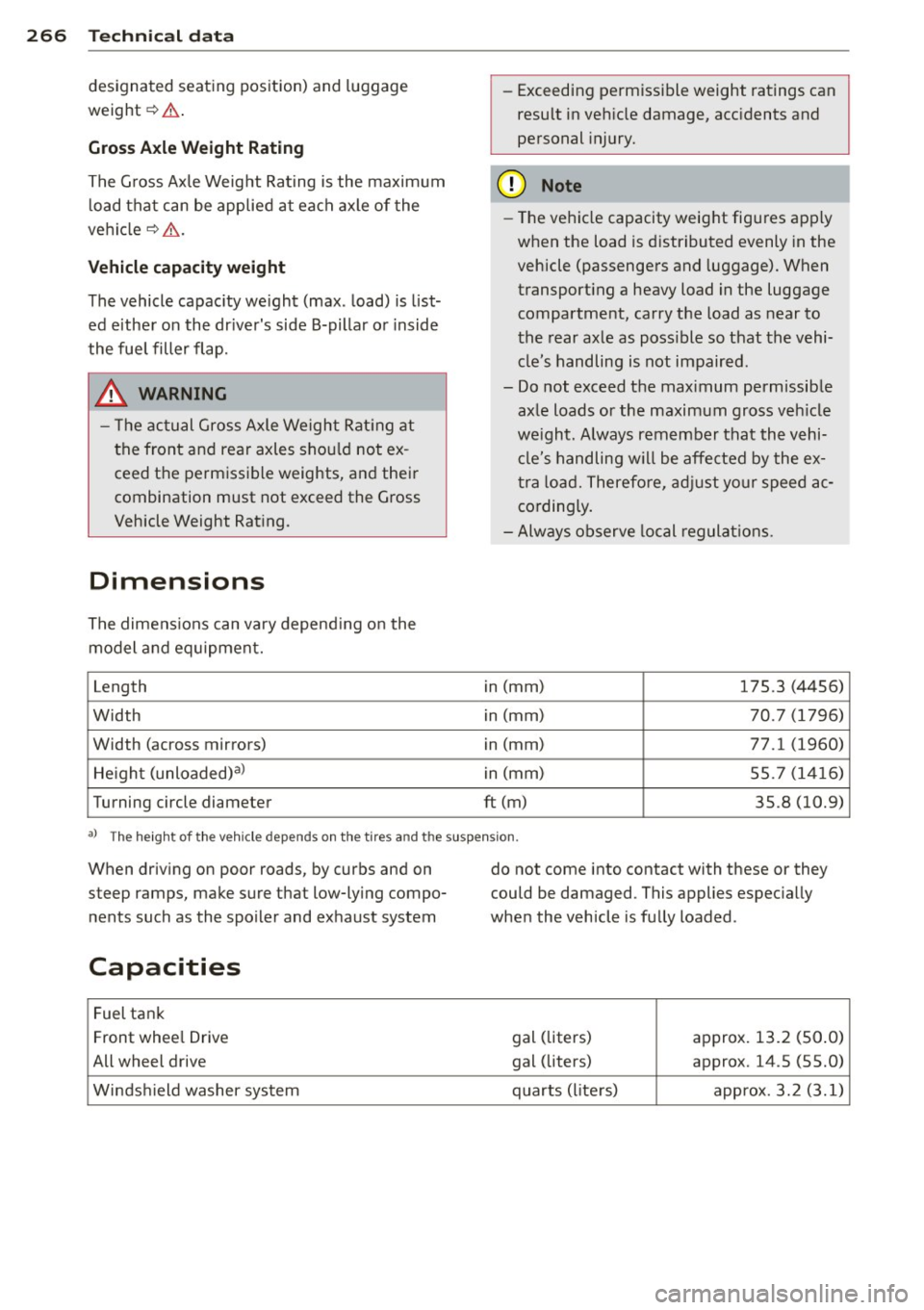
Dimensions
The dimensions can vary depend ing on the
model and equipment.
Length
Width
W idth (ac ross m irrors)
Height (unloaded) a)
Turn ing circle d iameter
-
- Exceeding permissible weight ratings can
result in veh icle damage, acc idents and
personal injury.
(D Note
- The vehicle capacity weight figures apply
when the load is distributed evenly in the
vehicle (passengers and luggage). When
transport ing a heavy load in the luggage
compartment, carry the load as near to
the rear axle as poss ible so that the vehi
cle's handling is not impaired .
- Do not exceed the maximum permissible axle loads or the maximum gross veh icle
we ight. Always remember that the vehi
cle's handling w il l be affected by the ex
tra load. Therefo re, adj ust your speed ac
cordingly.
- Always observe local regulat ions .
in (mm)
175 .3 (4456)
in (mm) 70 .7 (1796)
in (mm) 77 .l (1960)
in (mm) 55 .7 (1416)
ft (m) 35.8 (10.9)
al The he igh t o f th e ve hicle depe nds o n the tire s and the s usp en sion .
When driving on poor roads, by curb s and on
s teep ramp s, make sure tha t low-lying compo
nent s such as the spoiler and exhaust sy stem
Capacities
Fuel tank
Front whee l Drive
All wheel drive
Winds hield washer system do not
come into contact w ith these or they
could be dam aged. This applies espe cia lly
when the vehicle is fully loaded .
gal (liters) approx.
13.2 (50.0)
gal (lite rs) approx. 14.5 (55.0)
quarts (liters) approx. 3.2 (3.1)
Page 278 of 288
276 Index
E
ECO mode (automatic climate control sys -
tem) . ..... .. ................ ..... .. 67
EDL
refer to Electronic differentia l lock . .. . 185
Efficiency program . . . . . . . . . . . . . . . . . . . 28
Description . ...... .......... ... .. .. 28
Fuel economy messages . . . . . . . . . . . . . 29
Other equipment . . . . . . . . . . . . . . . . . . . 29
Electrical accessories
refer to Socket ............. .. .... .. 56
Electromechanical parking brake
refer to Parking brake ............... 76
Electromechanical steering .. .. .. .. .. . 189
I ndicator lights .......... .. .. .... . 189
Electronic differential lock ... .... .... . 185
Indicator light . . . . . . . . . . . . . . . . . . . . . 22
Electronic immobilizer ....... ... .... .. 36
also refer to Immobilizer . . . . . . . . . . . . 31
E lect ronic interaxle differential lock .... 185
Electronic speed limiter ..... .. .. .. .. . . 30
Electronic stabilization control (ESC)
Indicator light . . . . . . . . . . . . . . . . . . . . . 22
Electronic Stabilization Control (ESC) ... 185
Emergency assistance .......... .... . 246
Emergency flasher .......... ... .... .. 43
Emergency flashers
I ndicator light . . . . . . . . . . . . . . . . . . . . . 25
Emergency operation Emergency braking function .. .. .. .. . . 78
Front passenger's door/rear doors . . . . . 3 7
L uggage compartment lid ........ .. . 246
Panorama sunroof ........ .. .. ...... 41
with conven ience key .... .. .. .. .. .. . . 75
Emergency release Fuel filler door .............. ... ... 209
Selector lever . . . . . . . . . . . . . . . . . . . . . 112
Emergency starting ........ .. .. .. .. . 259
Emergency towing ......... .. .. .. .. . 261
Energy management . . . . . . . . . . . . . . . . 190
Indicator light . . . . . . . . . . . . . . . . . . . . . 20
Engine Coolant .. .. ..................... . 216
Starting with jumper cables .... .... . 259
starting (button) . .. ...... .. .. .. .. . . 73 Starting (driver messages with conven-
ience key) ..... .. ................ .. 75
starting (key) . ... ................ .. 70
stopping (button) ............. ..... 74
stopping (key) ................ ..... 72
Engine compartment
Closing the hood . . . . . . . . . . . . . . . . . . 211
Opening the hood ................ . 211
Overview .. .... .. ... .......... .... 212
Safety precautions ............... .. 210
Engine control (indicator light) . . . . . . . . . 23
Engine coolant .. .. .......... ... .. .. 216
Radiator fan ... .. ... .......... .... 218
Engine oil .. ................... .... 212
adding . .. .. .. .. ... .......... .... 215
Changing . ...... ... ......... ... .. 216
Checking the oil level ... ..... ... .. .. 215
Dipstick... .. .. .. .... .... .... 212, 215
Indicator light .................... . 20
Oil consumpt ion .. ............. .. .. 214
Oil grades ..... .. ............. .... 212
Specification and viscosity ........ ... 212
Use ..... ..... .. .. .............. . 215
Engine speed limitation ( indicator light) . 23
Environment Break -in per iod . .. ... ....... ... .. .. 193
Catalytic converter ....... ...... .. .. 194
Disposing of your vehicle battery ..... 223
Driving at high speeds .......... .... 195
Driving to minimize pollution and noise 195
Fuel economy .... ................ . 195
Letting the vehicle stand and warm up . 196
Proper disposal of drained brake fluid . 219
Proper disposal of drained engine oil .. 216
Unleaded fuel .... ... .......... .... 206
What should I do with an old battery? . 223
EPC (engine control) ................ .. 23
ESC Electronic stabilization control ... .. .. 185
Post-coll is ion brake assist ..... .. .. .. 186
Sport mode ... .. ................ . 187
ESP
refer to ESC ... .. ..... ..... ... .. .. 185
Event Data Recorder (EDR) ............ 185
Exhaust tail pipes cleaning ........... 202
Exterior lighting ... ..... ..... ... .. .. . 42
Page 284 of 288

282 Index
Selector leve r (automatic transmission)
Emergency operation . ... .. .. ... ... . 1 12
Position ... ... ... .... ... .. .. .... . 105
Service and disposal Safety belt p retens ioner ... .. .. .... . 138
Service in terval d isp lay
with d rive r info rmat ion system .. .. .... 13
Sett ing clock ... ............. .. .... .. 10
Sett ing da te ............ .. .. .. .. .. .. 10
Sett ing t he temperature
a utomatic cl ima te control system ... . . 67
Sett ing t ime ... .. ...... ... .. .. .... .. 10
SE TUP (basi c sett ing) ....... .. .. .... .. 10
Shift i ndicator .. ........... .. .. .... .. 12
Shift paddles (automatic transmiss ion) . 110
Short-te rm me mory ......... ... .. .. .. 27
Side airbags Descr ipt ion ................ .. .... . 160
H ow they work ............ ... .. .. . 161
Side assist . . . . . . . . . . . . . . . . . . . . . . . . . . 98
Ad justing the br ightness ... .. .. .... . 100
C leaning the sensors ...... .. .. .. .. . 202
Sensor range .............. .. .... .. 99
switch ing on and off ....... ..... .. . 100
Side curta in a irbags ..... ... .. .. .... . 163
Descript ion .. .. . ...... ... .. .. .... . 163
How they wo rk ........... .... .... . 164
Safety instructions ........ .. .. .. .. . 164
Sliding/ tilting sun roof
refer to Panorama sunroof ... .... .. . . 40
Snow chai ns . ... .. ..... ... .. .. .. .. . 241
All whee l dr ive ........... .. .. .... . 190
Socket .. .. .. ............... .. .... .. 56
Sources of in formation about chi ld re -
straints and their use . . . . . . . . . . . . . . . . 184
S peed li mite r ........... .. .. .. .. .. .. 30
Speedometer . . . . . . . . . . . . . . . . . . . 10, 26
Spee d rating let ter code ... .. .. .... .. . 23 7
Speed war ning system ... ... .. .. .. .. . . 79
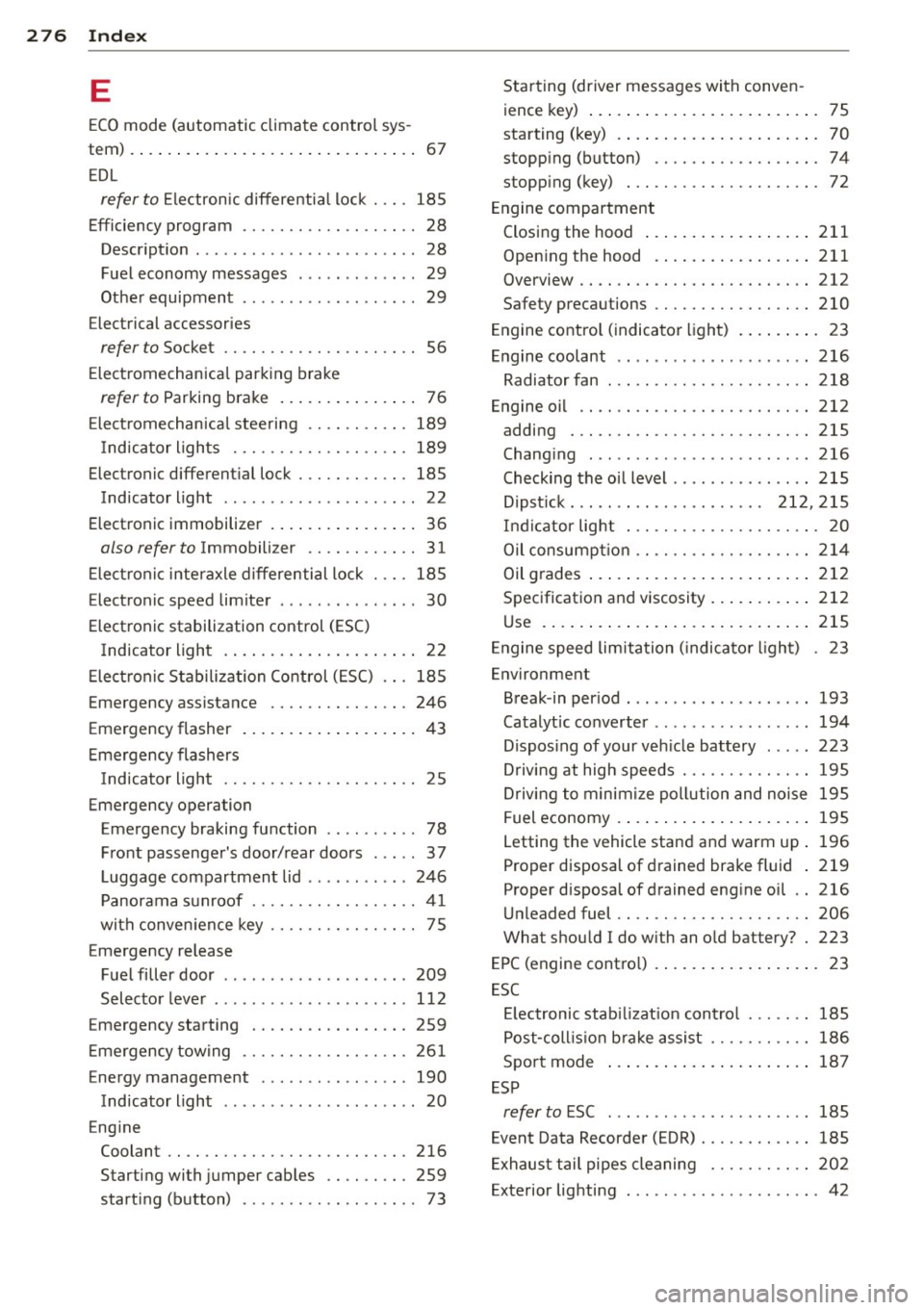
Sport mode .... ........... .. .. .... . 187
S tar bu tto n .. ............. .. .. .. .. .. 27
STAR T ENGINE STOP button (convenience
key) ...... .. ................ ... ... . 73
S TART ENGINE STOP (convenience key) ... 74
S tarti ng
H ill hold . ............... .. .. .... .. 78 Starting from a stop
Hill start assist ... .. ... ..... ... .. .. . 77
S tarting (eng ine)
A ut oma tic start (bu tton) ........ .. .. . 73
A utomati c start (key) . . . . . . . . . . . . . . . . 70
Malfunction (b utton) . . . . . . . . . . . . . . . . 73
Malfunction (key) .... .. ..... .... . .. . 71
with button . . . . . . . . . . . . . . . . . . . . . . . 73
with key .. .... .. .. ........... .... . 70
Stee ring
El ec tromec hanical s teer ing . . . . . . . 189, 0
I nd icator light ... .. .... .... ... .. .. . 21
Locking steering (ignition key) .... . .. . 72
Locking the steering (button) .... .. .. . 74
locking (mecha nica l ignition key) . .... . 70
also refer to Electromechanical steer-
ing ........ ... .. .. ... ........... . 189
Stee ring wheel
adjusting . .... .. ............. .... . 70
Buttons . .. .. .. .. ............. .. .. . 27
Mult ifunct ion steer ing whee l .. .. .... . 26
S hift paddles (automatic transmission) 110
Steps for determining cor rect load limit . 234
Stoppi ng (engi ne)
wi th bu tton . . . . . . . . . . . . . . . . . . . . . . . 7 4
wi th key . ..... .. .. .... .... ... .. .. . 72
Storage compa rtments . . . . . . . . . . . 57, 58
S tronic transmission
refer to Aut omatic transmission .. .. .. 105
Su bwoofer .. .... .. ............. .... 2 48
Su n visors .. ... ... .. .............. .. 46
Switching dayt ime ru nning lights on and
off .... .... .... .. ............. .... . 44
S wi tching the igni tion on and off (w ith
key) ... .. .. .... .. .. ... ..... ... .. .. . 70
Symbols
refer to I ndicator ligh ts . . . . . . . . . . . . . . 14
T
Tachometer . . . . . . . . . . . . . . . . . . . . . 10, 11
T ail lights cleaning .... .. ..... ... .. .. 202
T echnical data ... .. ............. .... 265
Technical modificati ons .......... .... 270
T emperature display
Coolant ... .... .. .. ... ..... ... .. .. . 10
Outside air tempe ratu re ..... .... . .. . 11