air condition AUDI A3 2015 Owner's Manual
[x] Cancel search | Manufacturer: AUDI, Model Year: 2015, Model line: A3, Model: AUDI A3 2015Pages: 288, PDF Size: 71.46 MB
Page 197 of 288
can reach the catalytic converter . This
could result in overheating of the con
verter, requ iring its replacement.
- To assure efficient operation of the Emis
sion Control System :
- Have your veh icle ma inta ined properly
and in accordance with the service rec
ommendations in your Wa rranty
&
Ma intenance booklet.
- Lac k of proper maintenance as well as
improper use of the vehicle will impa ir
t he funct ion of the emission control
system and cou ld lead to damage.
@) For the sake of the environment
Even when the Emission Cont ro l System is
operating properly, t he exhaus t gas can
have a s ulfu r-like exhaust gas smell unde r
some operating states. This depends on
the s ulfur content of the fue l being used .
Using a different brand of fuel may help,
or filling the tank w ith lead-free super
grade gasoline.
Placing your vehicle
out of service.
I f you wou ld like to take your vehicle out of
service for a longer t ime, contact your aut hor
iz ed A udi dealer or qualified repair facility .
They will advise you o f important meas ures,
such as cor rosion protection, maintenance
and storage procedures. Also follow the infor
mat ion about the battery¢
page 220.
Operate your vehicle
economically and
minimize pollution
General
Your personal style of driving will determine
the economy of your vehicle , as well as ex
haust and noise levels.
F ue l economy, environmental impact, and
wear on your engine, brakes and t ires largely
depend on three factors:
Dri ving and the en vironm ent 195
-your personal d riving s tyle
- operati ng conditions
- technical limitat io ns
If you ant ic ipate what you need to do next and
drive econom ically , yo u can easily cut your
fuel consumpt ion by 10-15 percent . This sec
tion w ill give you some tips on how you can
help the env ironment and your po cketbook.
(D Tips
The consumption estimates as published
by ENVIRO NM EN TAL PROT ECTI ON AG ENC Y
( E PA) and Transpo rt Canada may no t cor re
spond to your actual consump tion on the
r oad, which will va ry depending upon vehi
cle load and speed, road and weather con
ditions, trip length, etc.
Drive smoothly and keep a lookout
ahead
Vehicles use the most fuel when they are ac
celerating.
.. Avo id u nnecessary accelerating and brak ing.
Vehicles use the mos t fu e l when they are ac
ce lerating. If you anticipate what is going to
happe n next, you will need to brake less and,
th us, acce lerate less. Let the vehicle coast
whenever possible -for examp le when you see
that the next traff ic light is red.
Avoid full throttle
Driving at moderate speeds saves fuel and
improves your mileage.
.. Try and keep well below your car's maximum
speed.
Acce le rat ing gently re duces fue l cons ump
tion, eng ine wear, and does not disturb the
environment .
Fuel consumpt ion, exhaust em iss ions an d en
gine noise inc rease disproportionate ly at high
speeds . If you drive at approximately three
quarte rs of top speed, fuel consumption wi ll
be reduced by one ha lf. Never drive faster
IJ,-
•
•
•
Page 198 of 288
196 Driving and the environment
than the posted speed limit and weather con
ditions permit.
Reducing unnecessary idling
Even wh en your car is just idling it burns up
fuel.
,.. Shu t the engine off when you a re not dr iv ing
the vehi cle.
... Do not warm up the vehicle by letting the
engine run at idle.
It is efficien t to switch off the engine when
stopped at railroad crossings and long red
lights. Turning the engine
off for j ust 30-40
seconds saves mo re f uel than is burned by
start ing the engine again.
It takes a long time fo r the engine to wa rm up
fu lly when it is running at idle. However , wear
and noxious emissions are especially high
when the engine is warming up. So you should
drive away as soon as you start the engine and
avoid ru nning at h igh rpms while the engine is
still warming up.
{[) Note
Do not leave engine idling unattended af
ter starting. If warning lights s hould come
on to indicate improper operation, they
wou ld go unheeded . E xtended idling also
produces heat, which cou ld resu lt in over
heat ing or o ther da mage to the vehicle or
o ther prope rty.
Regular maintenance
A badly tuned engine unnecessarily wastes a
lot of fuel .
... Have your vehicle serv iced at regular inter-
vals.
H aving your vehicle regular ly serviced by an
author ized Audi dealer helps to ensure that it
runs properly and economically . T he condition
of yo ur vehicle not only affects its safety and
ab ility to hold its value, it also affec ts
fuel
con sumption. Check
your oil each t ime you fill your tank.
T he amou nt of oi l used is re lated to engine
lo ad a nd speed.
It is normal fo r the oil consumption of a new
engine to reach its lowest valu e after a c erta in
mileage has bee n driven.
You must drive your veh icle about 3,000 m iles
(5,000 kilometers) before you can properly
assess oil consumpt io n.
This also app lies to fue l consumption and en
gine output .
(0 Note
- Have your veh icle ma inta ined properly
and in accordance with the service rec
ommendations in your Wa rranty
& Ma in
tenance boo klet . Lack of proper ma inte
nance as well as improp er use of the ve
hicle will impair the fu nction of the
em iss io n con trol system and cou ld lead
t o dam age.
- Do not alte r or remove any component of
t he Emis sio n Control Sys tem unless ap
proved by the manufacturer .
- Do not alter or remove any device, such
as hea t sh ie lds, swi tches, ig nitio n w ires,
valves, which are designed to p rotec t
your vehicle's Emission Control System
and other impo rtant vehicle compo
nents.
' Fewer short trips
Fuel consumption will always be relatively
high on short trips.
... Try to avoid dr iv ing sho rt distances w it h a
cold engine .
T he eng ine and cat alytic conver ter h ave to
re ach their opt imal
operating t emperature to
reduce fuel consumpt io n and nox ious em is
sions effectively.
Jus t aft er s tarti ng, a c old eng ine in a mid-s ize
ca r on ly achieves a fuel economy of 6-8 m iles
per gallon (30 -40 l/100 km) . After about a
half a mile , fu el economy climbs to 12 mpg .,..
Page 206 of 288
204 Caring and cle aning
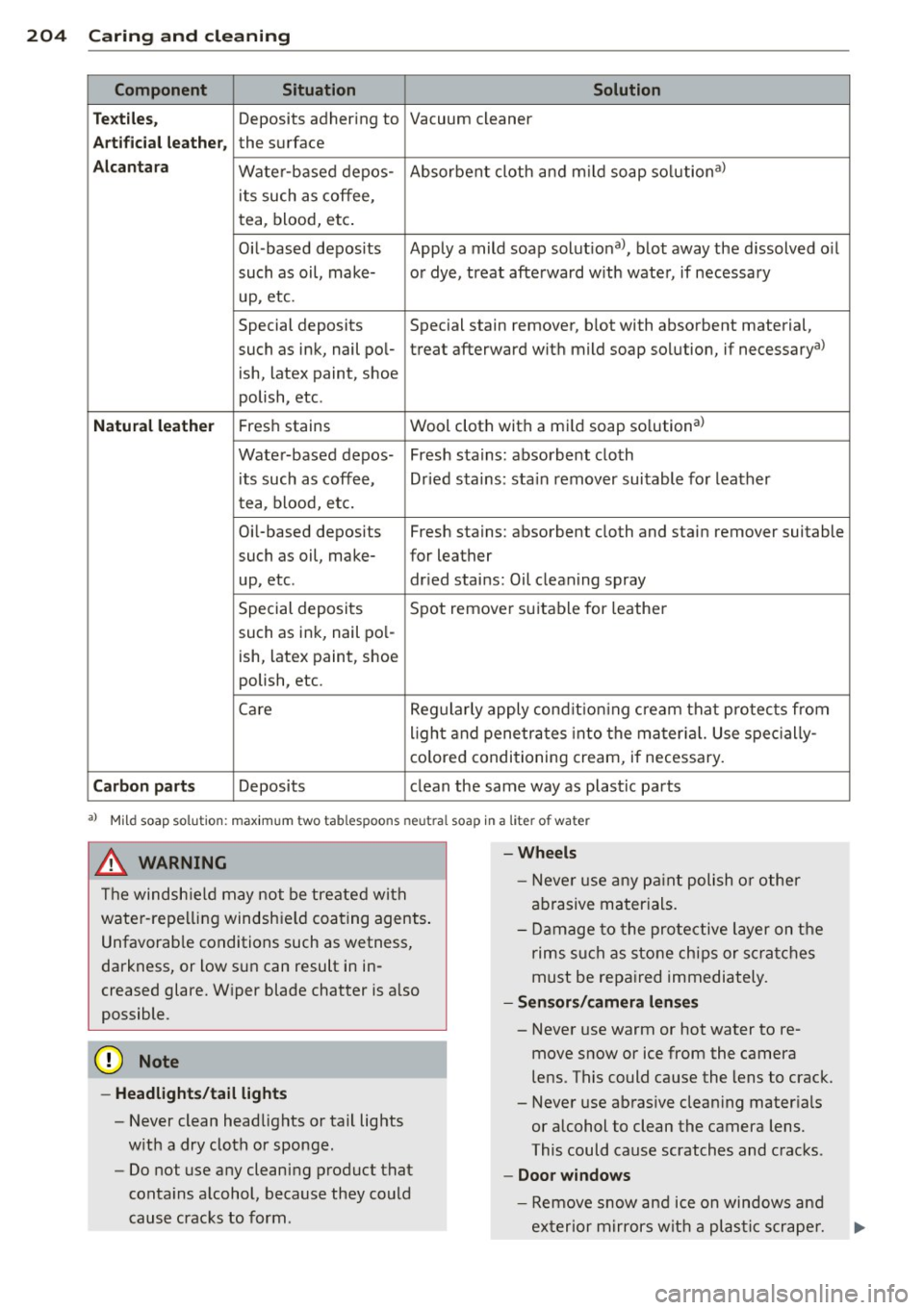
Component Situ ation Solution
Tex tile s,
Deposits adhering to Vacuum cleaner
Art ifi cial leat her, the surface
Alcan ta ra Water-based depos- Absorbent cloth and m
ild soap so lution a>
its such as coffee,
tea, blood, etc.
Oil-based deposits Apply
a mild soap solutiona >, blot away the dissolved o il
such as oil, make- o r dye, treat afterward w ith water, if necessary
up, etc.
Special deposits Special stain remover, blot with absorbent material,
such as ink, nail pol-treat afterward with mild soap so lution, if necessarya>
ish, latex paint, shoe
polish, etc.
Natura l leathe r Fresh stains Wool
cloth with a mild soap so lution a>
Water-based depos- Fresh stains: absorbent cloth its such as coffee, Dr ied stains: stain remover suitable for leather
tea, blood, etc.
Oi l-based deposits Fresh stains: absorbent cloth and stain remover suitable
such as oil, make- for leather
up, etc . dried stains: Oil clean ing spray
Special deposits Spot remover suitable for leathe r
such as ink, nail pol-
ish, latex paint, shoe
polish, etc.
Care Regularly apply condit ion ing cream that protects from
light and penetrates into the mater ial. Use spec ially-
co lored! conditioning cream, if necessary.
Carb on p art s Deposits clean th e same way as plastic parts
a) Mild soap solution: maximu m two tablespoons neutral soap in a liter of water
_& WARNING
The windsh ie ld may not be treated with
water-repelling windshield coating agents .
Unfavorab le conditions such as wetness,
darkness, or low sun can result in in
creased glare. Wiper blade chatter is also
possible.
([) Note
-Headlight s/tail li ght s
-Never clean headlights or tail lights
w ith a dry cloth or sponge.
- Do not use any cleaning product that
conta ins alcohol, because they could
cause cracks to form.
-
- Whee ls
- Never use any pa int polish or other
abrasive materials.
- Damage to the protective layer on the
rims s uch as stone chips or scratches
must be repaired immediately.
- Sen sors/ cam era len ses
-Never use warm or hot water to re-
move snow or ice from the camera
lens. This could cause the lens to crack.
- Never use abrasive cleaning mater ials
or alcohol to clean the camera lens.
This could cause scratches and cracks.
-Door windo ws
-Remove snow and ice on windows and
exter ior mirrors with a plastic scrape r.
Page 215 of 288
smoothly and reliably. Choosing the right oil
and changing oil within the time and mileage intervals printed in your vehicle's Warranty
&
Maintenance booklet matters a lot more to
day than it did years ago . Audi has developed
a special quality standard for engine oil that
will help assure that your vehicle's engine will get the lubrication it needs for proper opera
tion .
Modern engine lubrication has taken a quan
tum leap in the last few years. Many synthetic
oils available today provide better engine lu
brication that can outlast traditional petrole
um-based oils , making them a smart choice
for use throughout the life of your Audi.
Whether you use synthetic or petroleum based engine oil , the oil that you use must
conform to Audi's oil quality standard
VW 502 00 to help keep your vehicle's engine
running smoothly and help prevent the for
mation of harmful deposits, sometimes called
"sludge", that over time can lead to expensive
repairs .
At the time of printing, engine oils available in
the U.S. and Canada that meet the exacting
specifications of Audi oil standard VW 502 00
are synthetic engine oils. This does not mean, however, that every synthetic engine oil will
meet Audi oil standard VW 502 00 . So always
be sure that you use an approved oil.
To help prevent the formation of harmful de posi ts use only oil with the following specifi
cations printed on the oil container:
Audi oil standard VW 502 00
Oil container labels may carry the specifica
tion singly or in combination with other desig
nations and oil quality standards.
Viscosity
Engine oils are graded according to their vis
cosity . The proper viscosity grade oil for your
engine depends on climactic or seasonal con
ditions where you drive. You can use oil with a
viscosity grade of SAE 5W40 across all tem
perature ranges for normal driving conditions.
Checking and Filling 213
However, if engine oil viscosity grade SAE
5W40 is not available , you can also use viscos
ity grade SAE 5W -30 or SAE OW-40 as long as
it meets Audi oil quality standard VW 502 00
specifications.
Because engine oil that meets the Audi oil
standard may not be available everywhere
when you need it, we strongly recommend
that you always carry with you an extra quart
(liter) of oil that expressly conforms to the
VW 502 00 spec ificat ion, in case you have to
top off the oil while on the road .
Only if the level of the oil is at or below the
minimum mark -and no oil that expressly
conforms to Audi oil standard VW 502 00
specifications is available - may you top off
with a high quality engine oil , preferably syn
thetic-based, that meets ACEA A3 or API SM specifications, but even then, only in viscosity
grades SAE 5W-40 , SAE SW-30, or SAE
OW-40. However, during the entire time be
tween oil change intervals, never top off with
more than a total of 0.5 qt/liter engine oil
that does not conform to Audi oil specification
vw 502 00.
For more information about engine oil that
has been approved for your vehicle, please
contact either your authorized Audi dealer or
Audi Customer Relations at 1 (800) 822 -2834
or v isit our web site at www.audiusa .com or
www .audicanada .ca. Here you will also find a
current list of oils (manufacturers, brand
names etc.) that conform to Audi oil standard
vw 502 00.
Changing the engine oil
The engine oil and oil filter must be changed
according to the mileage (kilometers) and
time intervals specified in your veh icle's War
ranty
& Maintenance booklet. Do not exceed
these intervals -harmful deposits from old
engine oil can reduce engine performance and
can lead to expensive engine repairs.
Changing the oil at the recommended inter-
vals is so very important because the lubricat
ing properties of oil decrease gradually during
normal vehicle use. If you are not sure when .,..
•
•
•
Page 216 of 288
214 Checking and Filling
you have your oil changed, ask your author
ized Audi Service Advisor.
Under some circumstances the engine oil
should even be changed more frequently .
Change oil more often if you drive mostly
short distances, operate the vehicle in dusty
areas or mostly under stop-and-go traffic con
ditions, or when you use your vehicle where
temperatures stay below freezing point for
long periods .
Detergent additives in the o il wi ll make fresh
oil look dark after the engine has been run
ning for a short time. This is normal and is not
a reason to change the oil more often than recommended .
Damage or malfunctions due to lack of
maintenance
It is essential that you change your oil at the
recommended interva ls using only engine oil
that complies with Audi oil standard
VW 502 00. Your Lim ited New Vehicle War
ranty does not cover damage or malfunctions
due to fa ilure to follow recommended mainte
nance and use requ irements as set forth in
the Audi Owner's Manual and Warranty
&
Maintenance booklet . Your dea ler will have to
deny warranty coverage un less yo u present to
the dea ler proof in the form of Service or Re
pair Orders that all schedu led maintenance
was performed in a timely manner.
Engine oil consumption
The engine in your vehicle depends on on ade
quate amount of oil to lubricate and cool all
of its moving ports.
In order to provide effective lubrication and
cooling of internal engine components , a ll in
ternal combustion eng ines consume a certain
amount of o il. Oil consumption var ies from
engine to engine and may change significantly
over the life of the eng ine . Typically, engines
with a specif ied break-in period (see
¢
page 193) consume more oil during the
b reak-in period than they consume after oil
consumption has stabilized. Under
normal conditions, the rate o f oil con
s u mption depends on the quality and viscosity
of the oil, the RPM (revolut ions per minute) at
which the engine is operated, the ambient
temperature and road conditions. Further fac
tors are the amount of oil dilut ion from water
co nd ensat ion or fuel residue and the oxida
t ion level of the oil. As any engine is subject to
wea r as mileage builds up, the oil consump
tion may increase over time until replacement
of worn components may become necessary.
With a ll these variab les coming into play, no
standard ra te of oil consumpt io n can be es
tablished or specified. There is no alternative
to regu lar and frequent check ing of the oil lev
el , see
Note.
If the yellow engine oil leve l warning symbo l
Ill in the instr ument cl uster light s up, you
shou ld check the oil leve l as soon as possible
¢
page 215. Top off the oil at your earliest
convenience
~ page 215.
A WARNING
-~
Before you check anything in the engine
compartment, always read and heed all
WARNINGS¢
page 210.
(D Note
Driving wit h an insufficient oil level is like
l y to cause severe damage to the engine.
(D Tips
-The oil pressure warning display. is
not an indicator of the oil level. Do not
rely on it. Instead, check the oil level in
your engine at regular intervals, pref
erably each time you refuel, and always
before going on a long trip .
-If you have the impression your engine
consumes excessive amounts of oil, we
recommend that you consult an author
ized Aud i dea ler to have the cause of
your concern properly diagnosed. Keep in
mind that the accurate measurement of
oil consumption requ ires great care and
may take some time. An authorized Audi ..,.
Page 217 of 288
dealer has instructions about how to measure oil consumption accurately.
Checking the engine oil level
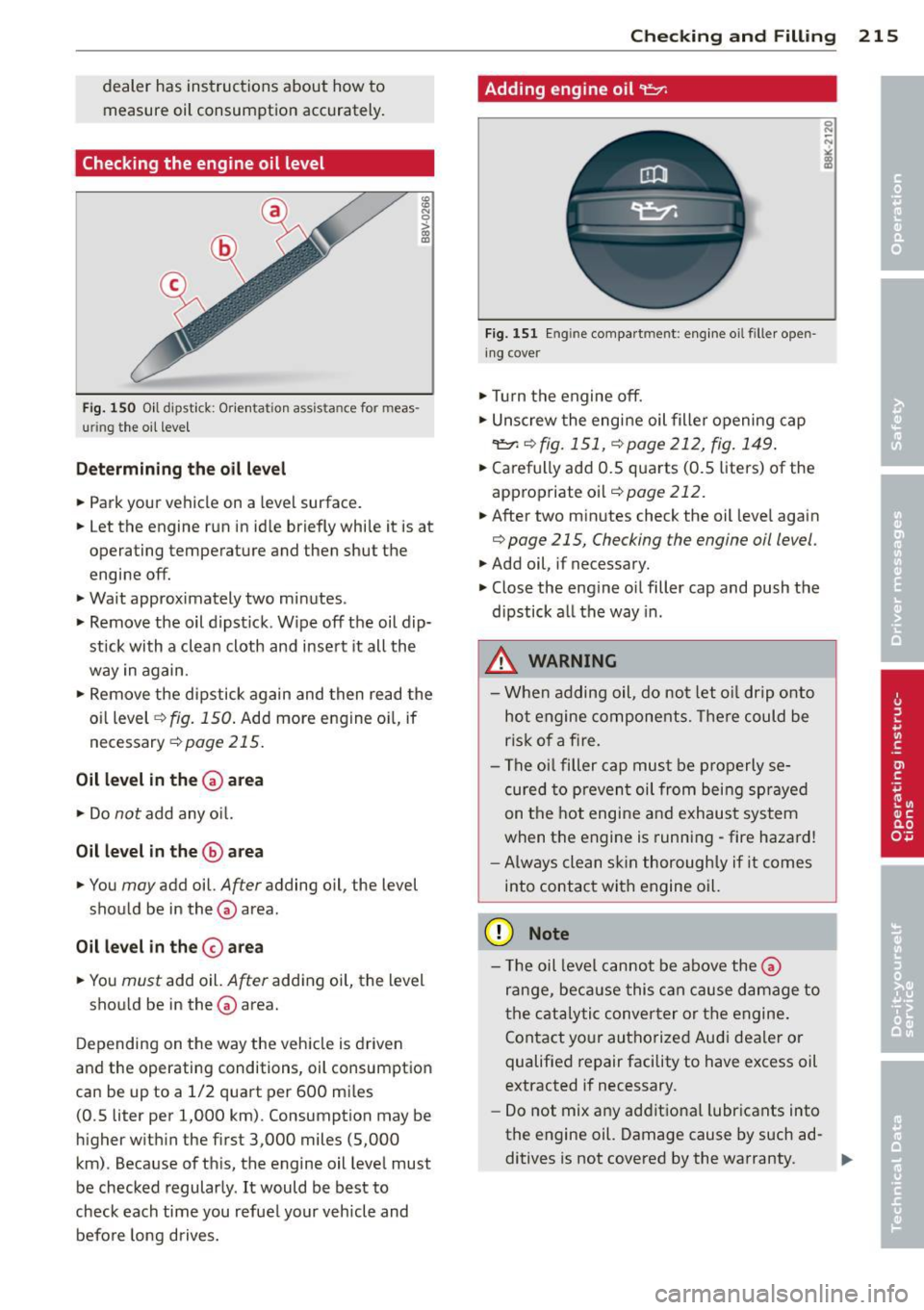
Fi g. 150 O il dip stick: O rienta ti on ass ist an ce for mea s·
ur ing t he oil leve l
Dete rmining th e oil l evel
• Park your vehicle on a level surface.
• Let the engine run in id le briefly while it is at
operating temperature and then shut the
engine off.
• Wait approximately two minutes .
• Remove the oil dipst ick. W ipe off the oil dip·
stick with a clean cloth and inse rt it all the
way in again.
• Remove the dipstick again and then read the
oi l level ¢
fig. 150 . Add more engine o il, if
necessary ¢
page 215.
Oil level in the G) area
• Do not add any o il.
Oil level in the @area
• You may add oil. After adding oil , the level
shou ld be in the@area.
Oil l evel in th e@ area
• You must add oil. After adding oil, the level
shou ld be in the@area.
D epending on the way the vehicle is driven
and the operating conditions, oil consumptio n
can be up to a 1/2 quart per 600 mi les
(0.5 liter per 1,000 km) . Consumption may be
h igher with in the first 3,000 miles (5,000
km) . Because of th is, the engine oil leve l must
be checked regularly . It would be best to
check each time you refue l your veh icle and
befo re long drives.
Che cking and Fillin g 215
Adding engine oil 'i=:1:
Fig. 151 E ng in e compa rtm en t: en gin e o il fil ler o pen ·
in g cover
• Tur n the engine off.
• Unscrew the engi ne oil filler opening cap
~ ¢ fig.151, ¢page 212, fig. 149 .
• Carefully add 0.5 q ua rts (0.5 liters) of the
appropriate oil¢
page 212 .
• After two m inutes check the oil leve l again
¢ page 215, Checking the engine oil level .
• Add oil, if necessa ry.
• Close the eng ine o il filler cap and push the
d ipstick al l the way in.
A WARNING
- When adding oil, do no t let o il drip o nto
hot engine components. There could be
ris k of a f ire.
- T he o il filler cap mus t be p roperly se·
cured to preven t oil from bei ng sprayed
on t he hot engine a nd exhaust system
when t he engine is running -fire haza rd!
- Always clean s kin th oroughly if it comes
into contac t with engine oil.
(D Note
- T he oil level cannot be above the@
range, beca use thi s ca n cause damage to
t he cat alytic conve rter or the engine .
Contact yo ur autho rize d Audi deale r o r
qualified repair facility to have excess oil
extracted if necessary.
- Do not mix any addit io na l lubr icants into
the engine oil. Damage cause by such ad·
ditives is not covered by the warranty .
1i1J>
Page 219 of 288
The cooling system has been filled at the fac
tory with a permanent coolant which does not need to be changed. The coolant consists of a
mixture of spec ia lly conditioned water and the
manufacturer's glycol-based coolant addi-
tive Gl3 antifreeze with anticorros ion addi
tives (50% fo r USA models; 60% for Canadian
models) . This mixture both assures th e neces
sary frost protect ion a nd p rotects me tal com
ponents in the engine 's coo ling system from
corrosion and scaling.
It al so raises the boil
ing po int o f the coo lant .
D o no t reduce the concentration of t he coo l
an t in the summer by ad ding plain w ate r.
The
proportion of coolant additive must be at
lea st 50 % but not more than 60%
to main
tain ant ifreeze protection and cooling efficien
cy. If the coolant frost protect ion is too low ,
the coolant cou ld free ze and damage the veh i
cle heating and eng ine cooling system.
F or yea r-round driv ing, antifreeze is added at
the facto ry for temperatures down to:
- -3 1 °F ( -3 5°C) USA
- -4 0°F ( -4 0°C) Canada.
If you must add coolant, use a m ixture of wa
ter and coolant addit ive. M ixing the coolant
addi tive wi th dist illed wate r is recom mend ed.
_& WARNING
Bef ore yo u check any thing in the e ngine
comp artme nt, alw ays re ad and hee d all
WARN INGS
¢page 210.
(D Note
- B efo re winter sets in, have the coolant
c hec ked to see if the c oolan t ad dit ive i n
you r vehi cle is su fficient t o mee t the cl i
mate cond itions. This is especially impor
tant if yo u live in a region whe re the win
ter is extremely cold. If necessary, in
crease the proport ion of coolant additive
to 60%.
- W hen addi ng coolant additive to your
cooling system, remember:
- We recommend using only coolant ad
ditive Gl2 ++ o r Gl3 ( check t he label)
-
Che cking and Fillin g 21 7
for you r vehi cle. This coolan t additive is
avai lab le at authorize d Audi dea le rs .
Ot her types of antifreeze ca n sig nifi
cantly reduce corros io n protection. The
res ulting corrosion can cause a loss of
coolant and serio us e ngine da mage .
- Do not add any type of rad iator leak seal
ant to you r vehicle's engine coolant .
Add ing radiator repair flu id may adverse
ly affect t he function and performanc e of
yo ur cooling sys tem and co uld resu lt i n
damage not covered by yo ur New Ve hicle
L imi ted W arranty.
Adding coolant
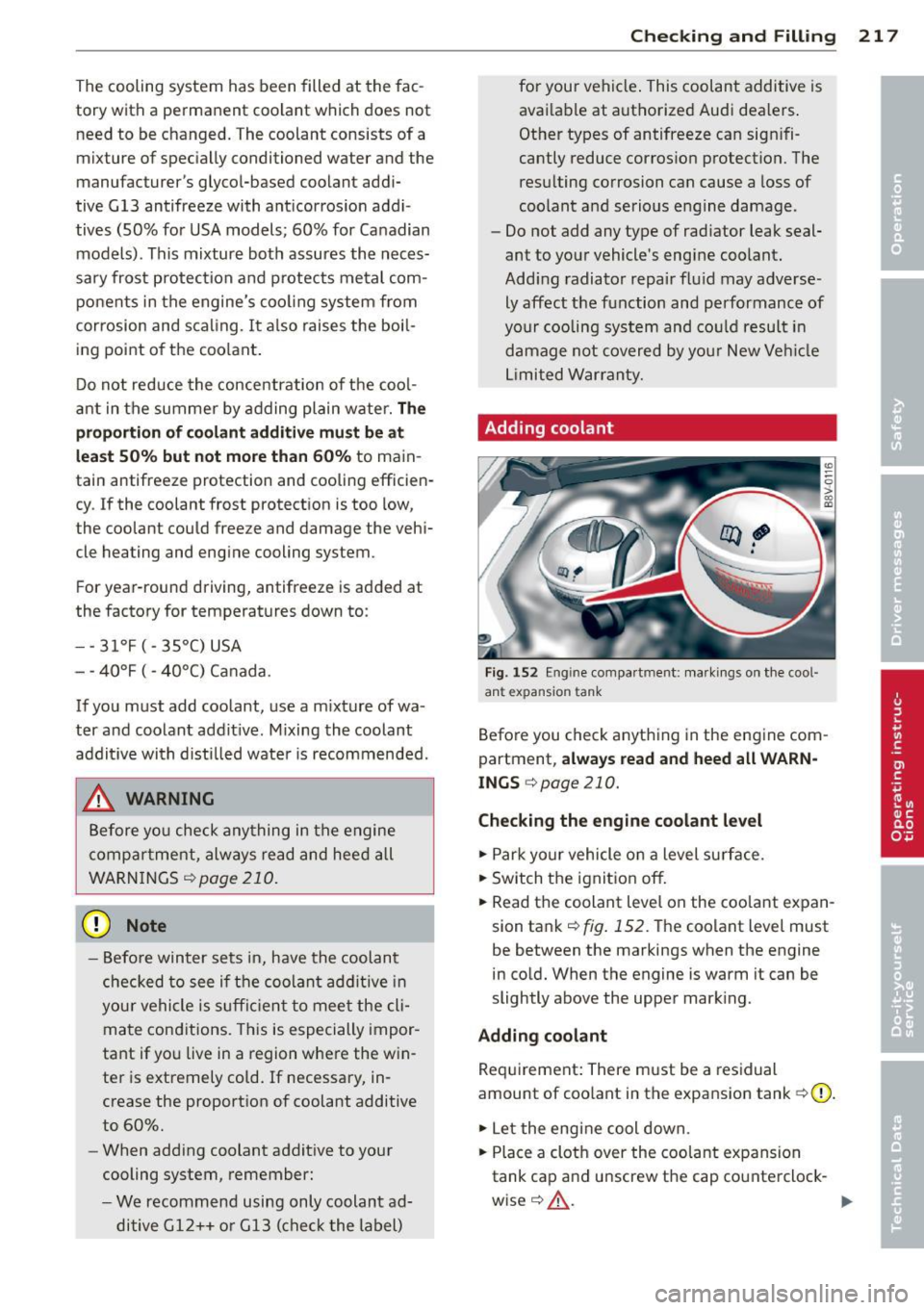
Fi g. 152 En gine co mpa rtment: markin gs on t he coo l
an t e xpan sio n t ank
Befo re you check a nyt hing in the eng ine com
partment ,
alway s read and heed all WARN
INGS ¢ page 210.
Checking the engine coolant level
.,. Park yo ur vehicle o n a level su rf a ce .
.,. Switch t he ignition off.
.,. Read t he coolant leve l on the coo lant expan
sion tank ¢
fig. 152. The coolant leve l must
be between the markings when the engine
in cold. When the engine is warm it can be
slightly above the upper mark ing .
Adding coolant
Req uirement : There m ust be a res idual
amount of coo lant in the expansion tank
c::> Q) .
.,. Le t the engine cool down.
.,. Place a clot h over the coo lant expans ion
tank cap a nd u nscrew the cap co unterclock-
wise
c::> _& . ..,.
Page 222 of 288

220 Checking and Filling
Battery
General information
Under normal operating conditions, the bat
tery in your Audi does not need any mainte
nance. With
high outs ide temperatu res or
long daily drives we recommend that you have
the electro lyte level checked by a service fa
cility. The e lectrolyte level shou ld also be
checked each time the battery is charged
c:>page222.
Have the battery checked when you take your
vehicle in for service. You are well advised to replace a battery that is older than 5 years.
With certain types o f airbag deployment, the
battery is disconnected from the vehicle elec
trica l system for safety reasons
c;, .&. in Re
pair , care and disposal of the airbags on
page 156.
Disconnecting the battery terminals
Some vehicle functions such as power win
dows are unavai lable if the battery termina ls
are d isconnected. These functions have to be
relearned after the battery terminals are con
nected again. To prevent this, the battery
should only be disconnected from the vehicle
electrical system when absolutely necessary
for repairs .
To reprogram the functions, proceed as fol lows:
Function Reprogramming
Power window one-c;, page 40, Correcting
touch up/down power window mal-
function functions
Remote control key If the vehicle does not
or react to the key, it
convenience key must be synchroni zed
c:>page 33
Digital clock c:>page 10
ESC indicator light The indicator light
goes out after driving
a few meters
Vehicles not driven for long periods
If you do not drive your vehicle over a period
of severa l days or weeks, e lectrica l compo
nents are gradually sca led back or switched
off. This reduces energy consumption and
maintains starting capability over a longer pe
riod
c;, page 190. Some of the conven ience
functions may not operate, such as the interi
or lights or power seat adjustment. The con
venience functions will be availab le aga in
when you switch on the ignition and start the
engine.
Winter operation
During the winter months, battery capacity
tends to decrease as temperatures drop. This
is because more power is also consumed wh ile
sta rting, and the headlights, rear window de
fogger, etc. , are used more often.
Avoid unnecessary power consumpt ion, par
ticularly in city traffic or when traveling only
short distances. Let your authorized Aud i
dealer check the capacity of the vehicle bat
tery before winter sets in ~ page 222. A well
charged battery will not on ly prevent starting
problems when the weather is cold, but will
also last longer.
A WARNING -
-Work on the battery requ ires expert
know ledge. Contact your authorized Audi
dealer qualified repair facility for infor
mat ion regarding the vehicle battery.
There is a risk for chemical burns or ex
p losions.
- Never open the vehicle batte ry . Do not
try to change the battery electrolyte lev
el. Otherwise explosive gas will escape
from the battery and increase the risk of
an explosion .
(i) Tips
If your vehicle is left standing for several
weeks at extremely low temperatures, the
vehicle battery should be removed and
stored where it w ill not freeze. This will ..,.
Page 232 of 288
230 Tire s and wheel s
you have stored . The system does not recog
nize the load condition of your vehicle.
The effectiveness of the tire pressu re monito r
ing system w ill be impaired if you store nor
mal load pressures but then operate the vehi
cle at its maximum load¢.&. .
See the il lustration¢
fig. 156 for the location
of the label on dr iver's side 8-pillar (color of
the actua l labe l and exact location on the ve
hicle wi ll vary slightly).
Note that the followi ng tab le is accurate at
the time o f go ing to press and is subject to
Model / Tire de
signation
change. In the event of discrepancies, the t ire
pressure label is located on the driver's side 8-
pillar always takes precedence .
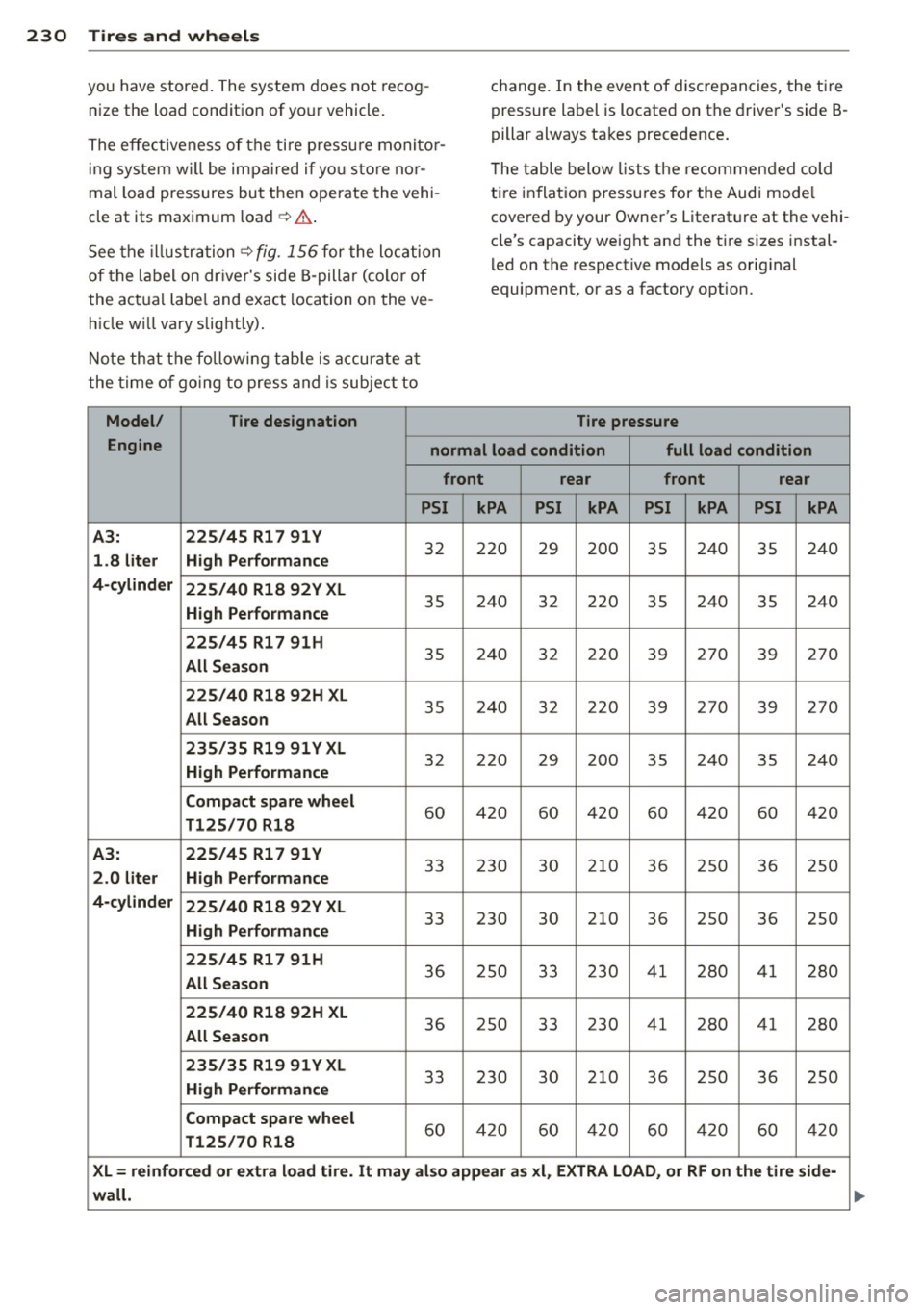
T he table below lists the recommended cold
ti re inflation pressu res for the Audi mode l
covered by your Owner's Literature at the vehi
cle's capacity weight and the t ire sizes instal
l ed on the respective models as original
equipment, or as a factory option.
Tire pressure
Engine normal load condition full load condition
front rear front rear
PSI kPA PSI kPA PSI kPA PSI kPA
A3: 225 /45 Rl 7 91 Y
32 220 29 200 35 240 35 240 1
.8 lit er High P erform ance
4 -cy lind er
22 5/40 R18 92Y XL
Hi gh Perfo rmance
35 240 32 220
35 240
35 240
2
2 5/45 Rl 7 91H
35 240
32 220 39 270 39 270 All S
ea son
2 25 /40 R18 92H XL
35 240 32 220 39 270 39 270 All Season
2 35/35 Rl 9 91 Y XL
32 220 29 200 35 240
35 240 High Performan
ce
C o mp act spar e whe el
60 420 60 420
60 420 60 420 11
25/70 R 18
A 3: 225 /45 Rl 7 91Y
33 230 30 210 36 250 36 250 2.0 liter High Perfo rman ce
4 -cy linder
22 5/40 R18 92Y XL
High Performan ce
33 230 30 210 36 250 36 250
225 /45 R1 7 91H
36 250 33 230 41 280 41 280 All Seaso n
225 /40 R18 92H XL
36 250
33 230 41 280
41 280 All Seaso n
23 5/3 5 R1 9 9 1 Y XL
33 230 30 210 36 250 36 250 High P erformance
C o m pact spa re w heel
60 420 60 420 60 420 60 420 1125 /70 R18
X L= reinf orced or extra lo ad tir e. It m ay als o a ppe ar as x l, EX TRA L OAD , or RF on the ti re side-
wall .
Page 238 of 288
236 Tires and wheels
unbalanced, resulting in vibrations you can
usually feel through the steering whee l.
Unbalanced wheels must be rebalanced to
avoid excessive wea r on steer ing, suspension
and tires . A wheel must a lso be rebalanced
when a new tire is installed.
Incorrect wheel alignment
I ncorrect wheel alignment can cause exces
sive tire wear, impair ing the safety of the veh i
cle. If tires show excess ive wear, have the
wheel alignment checked by an authorized
Audi dealer or qualified workshop.
All-wheel drive
Vehicles w ith quattro must a lways have tires
of the same size, construction and tread type.
F or details see
<=> page 190 .
A WARNING
Sudden tire failure can lead to loss of con
trol, a crash and ser ious persona l injury!
- Never drive a vehicle when the tread on
any tire is worn down to the wear indica
tors.
- Worn tires are a safety hazard, they do
not grip well on wet roads and increase
your risk of "hydroplaning" and loss of
control.
- Always keep chemicals that can cause
tire damage, such as grease, oil, gasoline
and brake fluid away from t ires.
- Tires age even if they are not being used
and can fail suddenly, especially at high
speeds. Tires that are more than 6 years
old can only be used in an emergency
and then with special care and at lower
speeds.
- Never mount used tires on your vehicle if
you are not sure of their "previous histo
ry." Old used tires may have been dam
aged even though the damage cannot be
seen that can lead to sudden tire failure
and loss o f vehicle control.
New tires and replacing tires and wheels
New tires and wheels have ta be broken in .
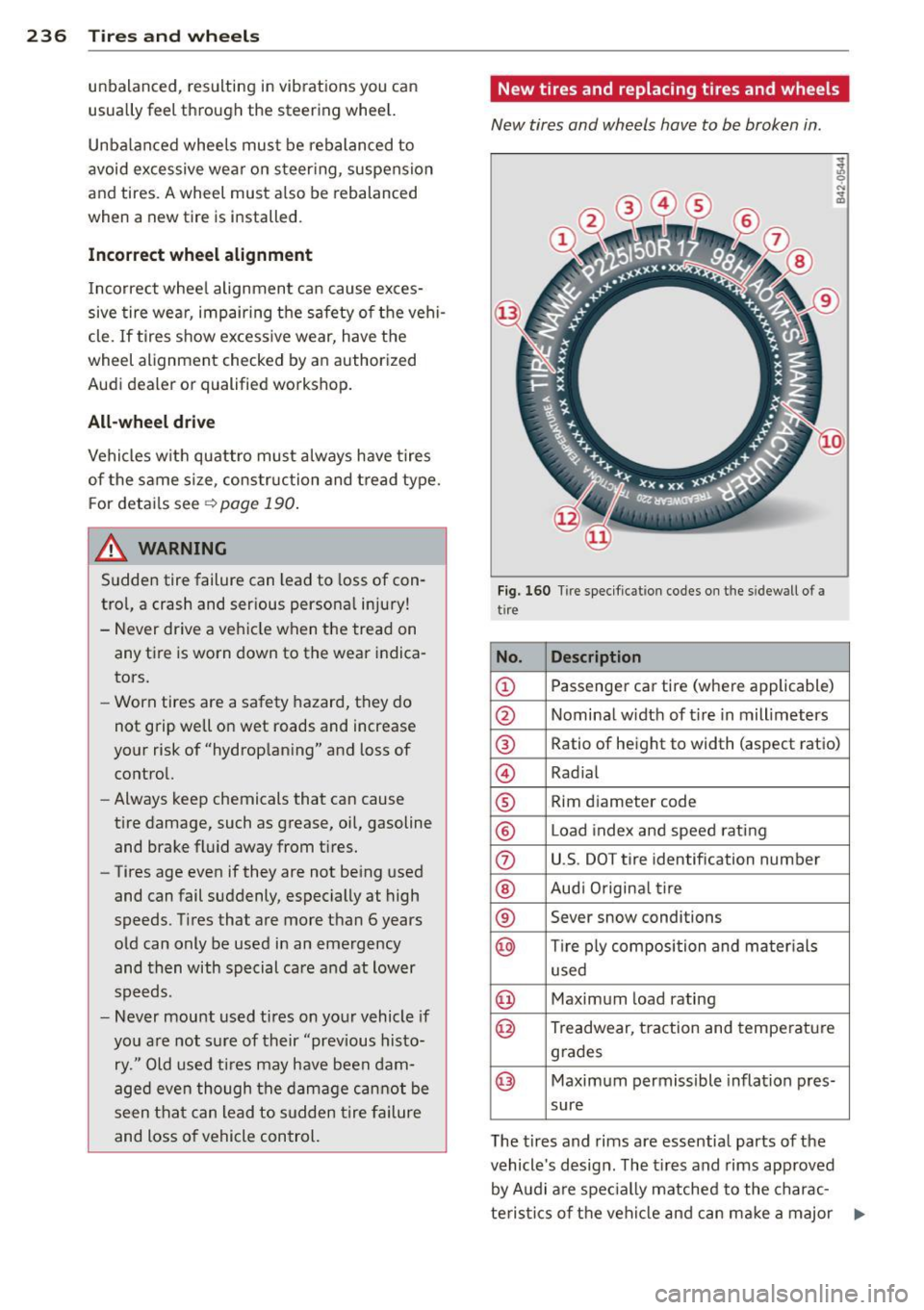
Fig. 160 Tire specificat ion codes on the s idewall of a
tire
No. Description
® Ratio of height to width (aspect ratio)
© Radial
® Rim diameter code
® L oad index and speed rating
(J) U.S . DOT tire identification number
® Audi Origina l tire
® Sever snow conditions
@ T ire ply composition and materials
used
@ Maximum load rating
@ Treadwear, traction and temperature
grades
@ Maximum permissible inflation pres-
sure
T he tires and rims are essential parts of the
vehicle 's design . The tires and rims approved
by Audi are spec ially matched to the charac
te ristics of the vehicle and can make a major .,..