fuel AUDI A3 2015 Owner's Manual
[x] Cancel search | Manufacturer: AUDI, Model Year: 2015, Model line: A3, Model: AUDI A3 2015Pages: 288, PDF Size: 71.46 MB
Page 210 of 288
208 Checking and Filling
snow blower, etc., be very careful and al
ways observe local and state laws regard
ing the use, transportation and storage of
such fuel containers . Make certain the con
tainer meets industry standards (ANSI/
ASTM F852 -86) .
(D Note
Never drive your vehicle until the fuel tank
is completely empty . The irregular supply
of fuel can cause misfiring. Gasoline could
enter the exhaust system and damage the
catalytic converter.
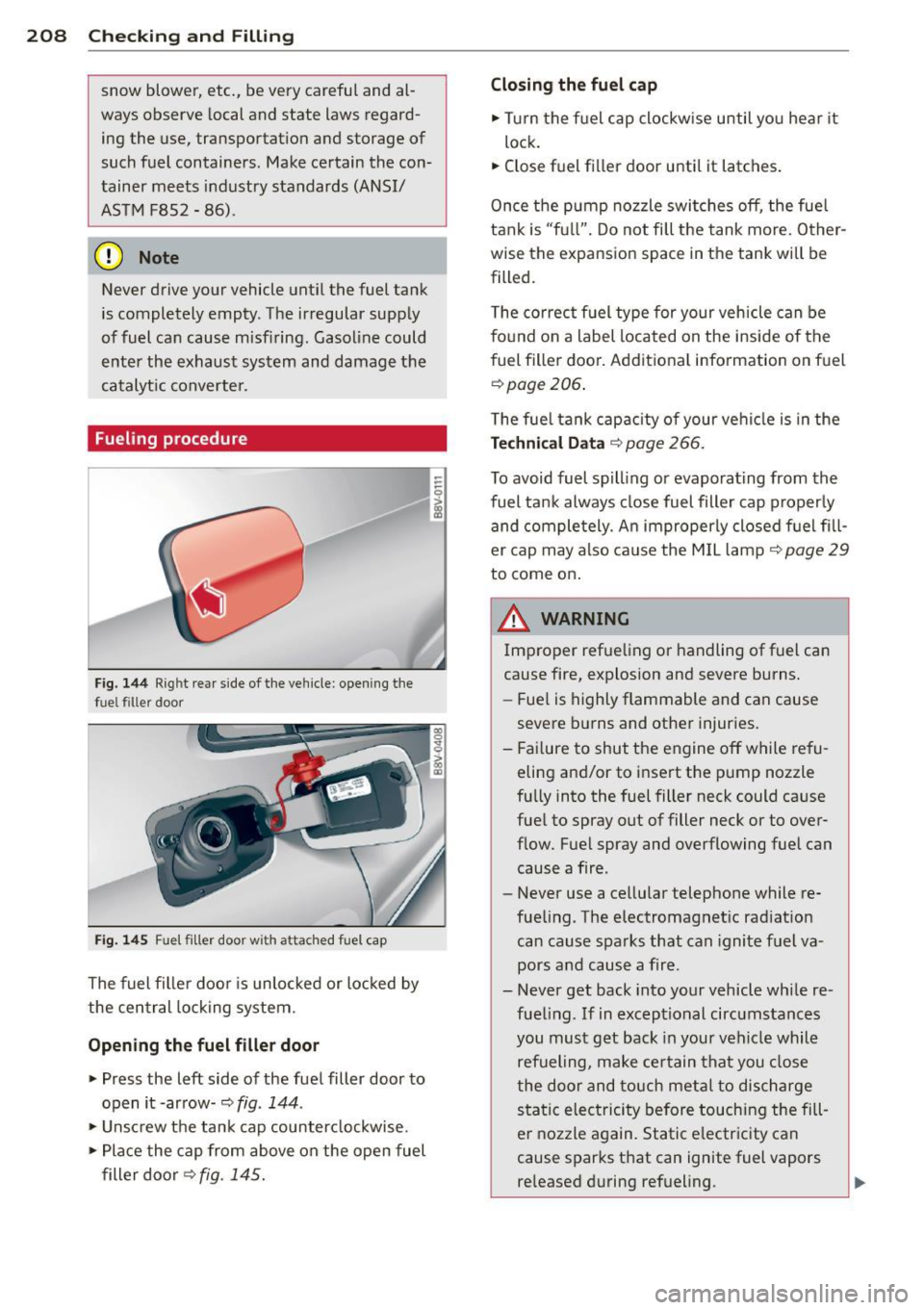
Fueling procedure
Fig. 144 Rig ht rear side of the vehicle: opening the
fue l filler door
Fig. 145 Fu el filler door w ith atta ched fuel cap
The fuel filler door is unlocked or locked by
the central locking system.
Opening the fuel filler door
.,. Press the left side of the fuel filler door to
open it -arrow-
c::> fig . 144 .
• Unscrew the tank cap counterclockwise.
• Place the cap from above on the open fuel
filler door
c::> fig . 145. Closing the fuel cap
.,.
Turn the fuel cap clockwise until you hear it
lock.
.,. Close fuel filler door until it latches.
Once the pump nozzle switches off , the fuel
tank is "full". Do not fill the tank more. Other
wise the expansion space in the tank will be
filled.
The correct fuel type for your vehicle can be
found on a label located on the inside of the
fuel filler door. Additional information on fuel
c::>page206.
The fuel tank capacity of your vehicle is in the
Technical Data c::> page 266.
To avoid fuel spilling or evaporating from the
fuel tank always close fuel filler cap properly
and completely. An improperly closed fuel fill
er cap may also cause the MIL lamp
c::> page 29
to come on.
A WARNING
Improper refueling or handling of fuel can
cause fire, explosion and severe burns.
- Fuel is highly flammable and can cause
severe burns and other injuries.
- Failure to shut the engine off while refu
eling and/or to insert the pump nozzle
fully into the fuel filler neck could cause
fuel to spray out of filler neck or to
over
flow. Fuel spray and overflowing fuel can
cause a fire .
- Never use a cellular telephone while re
fueling. The electromagnetic radiation can cause sparks that can ignite fuel va
pors and cause a fire .
- Never get back into your vehicle while re
fueling . If in exceptional circumstances
you must get back in your vehicle while
refueling, make certain that you close
the door and touch metal to discharge
static electricity before touching the fill
er nozzle again. Static electricity can
cause sparks that can ignite fuel vapors released during refueling .
Page 211 of 288
-Never smoke or have an open flame any
where in or near your vehicle when refu
eling or filling a portable fuel container.
- For your safety, we strongly recommend
that you do not travel with a portable
fuel container in your vehicle. The con
tainer, full or empty may leak and could
cause a fire, especially in a crash.
- If, under exceptional circumstances, you
must transport a portable fuel container,
please observe the following:
- Never fill a portable fuel container while it is anywhere in or on the vehicle
(for example, in the luggage compart
ment, or on the trunk). Static electrici
ty can build up while filling and can ig
nite fuel vapors causing a fire .
- Always place a portable fuel container
on the ground before filling .
- Always keep the filler nozzle complete
ly inside the portable container before
and during filling.
- If filling a portable container made of
metal, the filler nozzle must always be
in contact with the container . This will
help prevent static electricity from dis
charging and cause a fire.
- Never spill fuel inside the vehicle or
luggage compartment. Fuel vapors are
highly flammable.
- Always observe local and state/provin
cial laws regarding the use, storage
and transportation of fuel containers.
- Make certain the fuel container meets
industry standards (ANSI/ ASTM
F852-86).
(D Note
If any fuel has spilled onto the car, it
should be removed immediately to prevent
damage to the paint.
@ For the sake of the environment
As soon as the correctly operated nozzle
switches off automatically for the first
time, the tank is full. Do not try to add
more fuel because fuel may spill out. In
Checking and Filling 209
addition, the expansion space in the fuel
tank will be filled -causing the fuel to
overflow when it becomes warm and pol
lute the environment.
@ Tips
-Running your engine while refuelling
may cause vapors to escape or even
cause fuel to spill out of the tank. This
would then shut off the fuel nozzle be
fore the tank is full.
- Do not refuel your vehicle with the igni
tion switched on. The fuel gauge may
otherwise not indicate the correct fuel
level after refuelling .
- The fuel filler flap of your vehicle is not
locked when you lock the vehicle from
the inside.
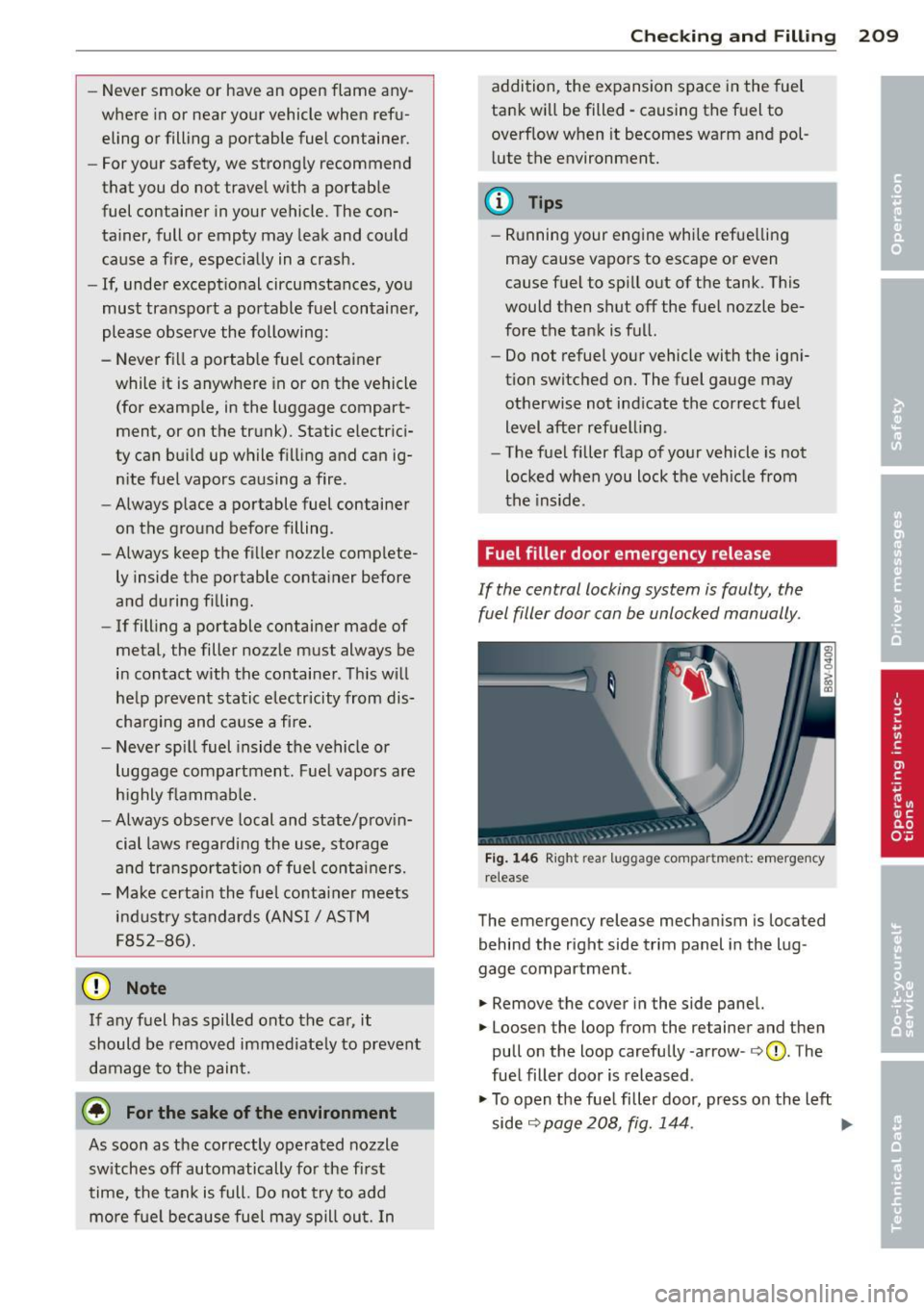
Fuel filler door emergency release
If the central locking system is faulty, the
fuel filler door can be unlocked manually .
Fig. 146 Rig ht rea r lu g g ag e compar tme nt: emergency
release
The emergency release mechanism is located
behind the right side trim panel in the lug
gage compartment .
.,. Remove the cover in the side panel.
.,. Loosen the loop from the retainer and then
pull on the loop carefully -arrow -
c:>(D . The
fuel filler door is released .
.,. To open the fuel filler door, press on the left
side
c:> page 208, fig. 144 . i,..
Page 212 of 288
210 Check ing and F illin g
Only pull on the loop until you fee l resist
ance. You will not hear it release . Other
w ise you could damage the emergency re
lease mechanism .
Hood
Working in the engine compartment
Special care is required if you are working in
the engine compartment
F o r w ork in th e engine co mpartm ent such as
c h ec king an d filling fluids, there i s a ri sk of
inj ury, sca lding, a ccid ent s, and b urn s. For
t hi s re ason , fo llow all th e followin g lis te d
warn in gs a nd ge neral safe ty pr eca utions.
Th e e ngine compartment is a d ange rous
area .¢ .& .
&_ WARNING
To reduce the risk of injury, before you
check anyth ing under the hood:
- Turn the engine off.
- Set the parking brake.
- Place the selector leve r in the P position.
- Remove the ignit io n key .
- Let the engine coo l down.
- To reduce the r isk of being burned, never
open the hood if you see or hear steam
or coolant escaping from the engine
compartment . Wait until no steam or
coolant can be seen or hea rd before ca re
fully opening the hood.
- Keep chi ldren away from the engine com
partment .
- Never spill flu ids on a hot engine. These
fluids (such as the freeze protection con
tained in the coolant) can catch fi re.
- Avoid short circuits in the electrical sys
tem, especially the battery.
- When working in the engine compart
ment, remembe r that the radiator fan
can switch on even if the ignition is
switched off, which increases the risk of
persona l injury . -
Never open the cap on the coolant ex
pans ion tank when the eng ine is warm.
The coolant system is under pressure.
- To protect your face, hands, and arms
from hot steam or coolant, cover the cap
with a large cloth when opening.
- Do not remove the engine cover under
any circumstances . This increases the
risk of burns .
- If tests need to be performed with the
engine runn ing , there is add itional dan
ger due to moving components (such as
the ribbed belt, generator and radiator
fan) and from the high voltage ignit ion
system.
- Never touch the rad iator fan . The auxili
ary electric fan is temperature controlled
and can switch on suddenly.
- Pay attention to the fo llow ing warnings
listed when wo rk on the fuel system or
on the e lectr ica l equipment is req uired.
-A lways disconnect the vehicle battery
from the vehicle electr ical system
- Do not smoke
- Never work near open flames
- Always have a wo rk ing fire exting uisher
nearby
- To avo id e lectr ica l sho ck and pe rsonal in
jury whi le the engine is running or being
started, never touch:
- Ign it ion cables
- Other components of the high voltage
electronic ignition system.
- If you must perform a check or repair
with the eng ine running:
- First, fully app ly the parking brake,
move selector lever to P (Park).
- Always use extreme caut io n to prevent
cl othing, jewelry, or long hair from get
ting caught in the radiator fan, V-be lts
o r other moving parts, o r from contact
ing hot parts. Tie back hair before
starting, and do not wear clothing that
will hang or droop into the engine.
- Minimize exposure to emission and
chemical hazards¢,& . ..,.
Page 216 of 288
214 Checking and Filling
you have your oil changed, ask your author
ized Audi Service Advisor.
Under some circumstances the engine oil
should even be changed more frequently .
Change oil more often if you drive mostly
short distances, operate the vehicle in dusty
areas or mostly under stop-and-go traffic con
ditions, or when you use your vehicle where
temperatures stay below freezing point for
long periods .
Detergent additives in the o il wi ll make fresh
oil look dark after the engine has been run
ning for a short time. This is normal and is not
a reason to change the oil more often than recommended .
Damage or malfunctions due to lack of
maintenance
It is essential that you change your oil at the
recommended interva ls using only engine oil
that complies with Audi oil standard
VW 502 00. Your Lim ited New Vehicle War
ranty does not cover damage or malfunctions
due to fa ilure to follow recommended mainte
nance and use requ irements as set forth in
the Audi Owner's Manual and Warranty
&
Maintenance booklet . Your dea ler will have to
deny warranty coverage un less yo u present to
the dea ler proof in the form of Service or Re
pair Orders that all schedu led maintenance
was performed in a timely manner.
Engine oil consumption
The engine in your vehicle depends on on ade
quate amount of oil to lubricate and cool all
of its moving ports.
In order to provide effective lubrication and
cooling of internal engine components , a ll in
ternal combustion eng ines consume a certain
amount of o il. Oil consumption var ies from
engine to engine and may change significantly
over the life of the eng ine . Typically, engines
with a specif ied break-in period (see
¢
page 193) consume more oil during the
b reak-in period than they consume after oil
consumption has stabilized. Under
normal conditions, the rate o f oil con
s u mption depends on the quality and viscosity
of the oil, the RPM (revolut ions per minute) at
which the engine is operated, the ambient
temperature and road conditions. Further fac
tors are the amount of oil dilut ion from water
co nd ensat ion or fuel residue and the oxida
t ion level of the oil. As any engine is subject to
wea r as mileage builds up, the oil consump
tion may increase over time until replacement
of worn components may become necessary.
With a ll these variab les coming into play, no
standard ra te of oil consumpt io n can be es
tablished or specified. There is no alternative
to regu lar and frequent check ing of the oil lev
el , see
Note.
If the yellow engine oil leve l warning symbo l
Ill in the instr ument cl uster light s up, you
shou ld check the oil leve l as soon as possible
¢
page 215. Top off the oil at your earliest
convenience
~ page 215.
A WARNING
-~
Before you check anything in the engine
compartment, always read and heed all
WARNINGS¢
page 210.
(D Note
Driving wit h an insufficient oil level is like
l y to cause severe damage to the engine.
(D Tips
-The oil pressure warning display. is
not an indicator of the oil level. Do not
rely on it. Instead, check the oil level in
your engine at regular intervals, pref
erably each time you refuel, and always
before going on a long trip .
-If you have the impression your engine
consumes excessive amounts of oil, we
recommend that you consult an author
ized Aud i dea ler to have the cause of
your concern properly diagnosed. Keep in
mind that the accurate measurement of
oil consumption requ ires great care and
may take some time. An authorized Audi ..,.
Page 228 of 288
226 Tire s and wheel s
-Never mount used tires on yo ur vehicle if
you are not sure of their "previous histo
ry." Old used tires may have been dam
aged even though the damage cannot be
seen that can lead to sudden t ire failure
and loss of vehicle control.
- If you notice unusual vibration or if the
vehicle pulls to one side when driving, al
ways stop as soon as it is safe to do so
and check the wheels and tires for dam
age.
(D Note
- Please note that summer and winter
tires are designed for the cond itions that
a re typ ica l in those seasons. Aud i recom
mends using w inter t ires d uring the win-
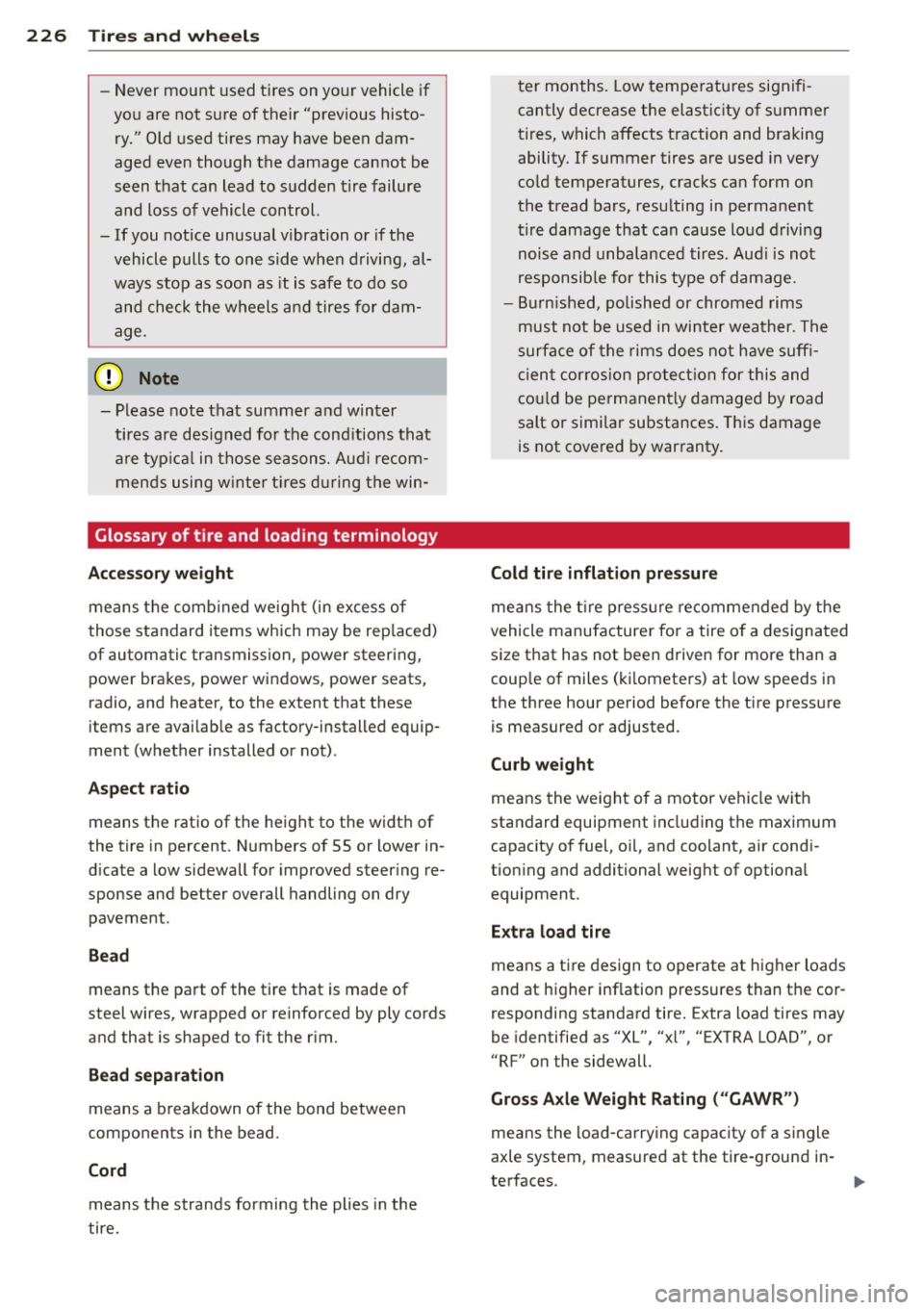
Glossary of tire and loading terminology
Accessory weight
means t he comb ined we ight (in excess of
those standard items which may be rep laced)
of automatic transmission, power steering,
power brakes, power windows, power seats,
radio, and heater, to the extent that these
items are availab le as factory-installed equip
ment (whether installed or not).
A spect ratio
means th e ratio of the height to the width of
the tire in percent. Numbers of 55 or lower in
d icate a low sidewall for improved steer ing re
sponse and better overall handling on dry
pavement .
Bead
means the part of the tire th at is made of
steel wires, wrapped or reinforced by ply cords
and that is shaped to fit the rim.
Bead s eparation
means a breakdown of the bond between
components in the bead.
Cord
means t he strands forming the plies in the
tire. ter months.
Low tempe ratu res signifi
cantly decrease the elasticity of summer
tires, which affects traction and braking ability. If summer tires are used in very
co ld temperatures, cracks can form on
the tread bars, resu lting in permanent
tire damage that can cause loud driving
noise and unbalanced tires. Aud i is not
responsib le for this type of damage.
- Burn ished, polished or chromed rims
must not be used in winter weather. The
surfa ce of the rims does not have suff i
c ien t cor rosion prote ct io n for this and
co uld be pe rmanen tly damaged by road
salt or simi lar substances. This damage
is not cove red by war ranty.
Cold tire inflat ion pre ssure
mea ns the t ire press ure recommended by the
vehicle manufacturer for a tire o f a des ignated
size that has not bee n driven for more than a
coup le of miles (ki lometers) at low speeds in
the three hour period before the tire press ure
is measured or adjusted.
Curb weight
means the weight of a motor vehicle w ith
standard equipment including the maximum
capacity of fuel, o il, and coolant, air condi
tion ing and additional weight of optional
equipment.
E x tra load tire
means a tire design to operate at higher loads
and at higher inflation pressures than the cor
responding standard tire. Extra load tires may
be identified as "XL", "xl", "EXTRA LOAD", or
"RF" on the sidewall.
Gross A xle Weight Rating ("GAWR")
means the load-carrying capacity of a single
axle system, measured at the tire-ground in-
terfaces.
IJ>,
Page 235 of 288
-Only when all tires on the vehicle are fi l
led to the correct pressure, the tire pres
sure monitoring system can work cor rect ly.
- The use of incorrect tire pressure values
can lead to accidents or other damage.
Therefore it is essential that the driver
observe the specif ied tire pressure values
for the tires and the co rrect p ress ures for
the f unction of t he tire pressure mo nitor
ing system.
- Always inflate ti res to the recommended
and co rrec t tire pressu re befo re d rivi ng
off.
- Drivi ng with under inflated ti res bend
more, letti ng them get too ho t res ulting
in t read separation, sudden t ire fail ure
and loss of control.
- Excessive spee d and/ove rloading can
cause heat bui ld -up, sudden tire fa il u re
and loss of control.
- If the t ire pressure is too low or too high,
the tires w ill wea r prematurely and the
vehicle will not hand le we ll.
- If the t ire is no t flat and you do no t have
to change a w heel imme diate ly, drive at
reduced speed to the nearest service sta
t ion to check the tire pressure and add
air as required.
(D Note
Driving without va lve stem caps ca n cause
damage to the t ire va lves. To prevent this,
always make s ure that facto ry installed
valve stem caps on all wheels a re secure ly
mounted on the va lve .
@) For the sake of the environment
Underinflated tires will a lso increase the
fue l consumption .
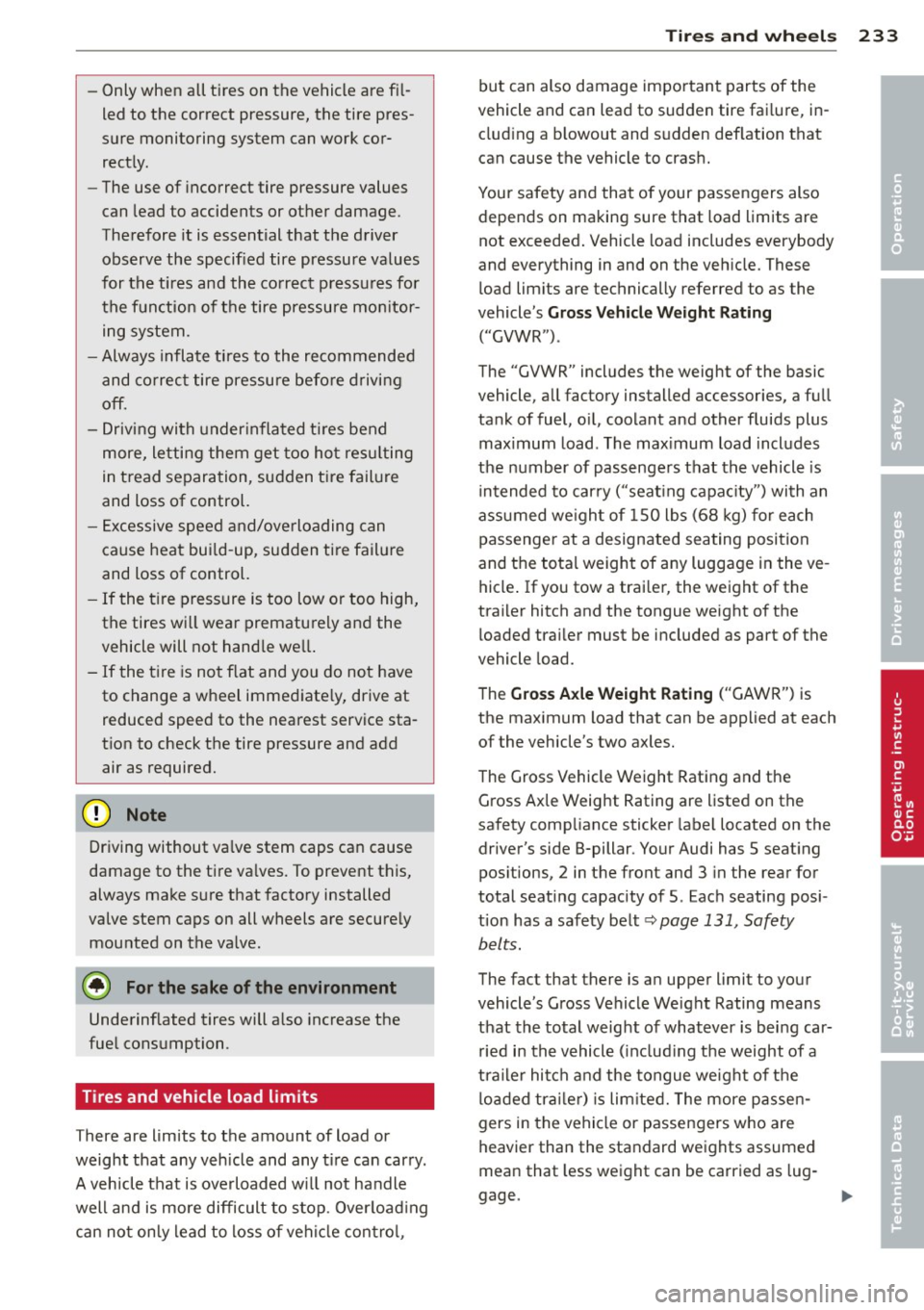
Tires and vehicle load limits
There are limits to the amount of load or
weight that any veh icle and any t ire can carry .
A vehicle that is ove rloaded w ill not ha ndle
well and is more difficult to stop . Overload ing
can no t on ly lead to loss o f vehicle con tro l,
Tire s an d wheel s 233
but can also damage important parts of the
vehicle and ca n lead to sud den tire fai lure, in
clud ing a b lowout and s udden def lation that
can cause the vehicle to cras h.
Your safety and that of your passengers also depends on making sure that load limits are
not exceeded . Vehicle load includes everybody
and everything in and on the veh icle. These
load lim its are technically referred to as the
vehicle's
Gross Vehicle We ight Rating
("GVWR ") .
The "GVWR" includes the weight of the basic
vehicle, all factory installed accessories, a full
tank of fuel, o il, coo lant and other fluids plus
maximum load . The max imum load includes
the number of passenge rs that th e vehicle is
i n tended to car ry ("seat ing capa city") wi th an
ass umed we igh t of 150 lbs (68 kg) fo r each
passenger at a designated seating posi tion
and t he tota l weight of any luggage i n the ve
hicle . If you tow a trai ler, the weight of the
tra iler hitch and the tongue weight of the
loaded tra iler must be included as part of the
vehicle load.
T he
Gro ss Axle Weight Rating ("GAWR") is
the maximum load that can be applied at each
of the vehicle's two axles.
T he Gross Vehicle Weight Rating and the
G ross Axle Weig ht Rating are listed on the
safety comp liance sticker label located on the
driver's side B-pillar. Your Audi has 5 seat ing
pos itions, 2 in the front and 3 in the rea r for
total seating capacity of 5 . Each seating posi
t ion has a safety belt
~ page 131, Safety
belts.
The fact that there is an upper limit to your
vehicle's Gross Vehicle Weight Rating means
t h at the total weight of whatever is bei ng car
ried in the vehicle ( in cl ud ing t he weight of a
t ra ile r hi tc h a nd the tongue we ight of t he
l o ad ed tr ailer) is lim ited. The more p assen
gers in the vehicle or passengers who are
heavier than the standard weights assumed
mean that less weight can be carried as lug -
gage.
~
•
•
•
Page 245 of 288
In o rder to minimize the occu rrence o f impact
damage to the tires of your vehicle, we recom mend that you observe the following precau
tions :
- Always maintain recommended inflation
pressures. Check your tire pressure every
2,000 miles (3,000 km) and add a ir if neces
sary.
- Drive carefu lly on roads with potholes, deep
gullies or ridges. The impact from driving
t h rough or over such obstacles can damage
your tires. Impact with a curb may also
cause damage to your tires .
- After any impact, immediately inspect your
tires or have them inspected by the nearest
authorized Aud i dealer . Replace a damaged
t ire as soon as poss ible .
- In spect your t ires every 2,000 miles (3,000
km) for damage and wear . Damage is not al
ways easy to see. Damage can lead to loss of
air and unde rinflation, wh ic h could eventu
ally cause t ire fail ure.
If yo u be lieve that a
tire may have been damaged , replace the
tire as soon as possible.
- These tires may wear more qui ck ly than oth
ers.
- Please a lso remembe r that, whi le these t ires
deliver respons ive handling, they may ride
less comfortably and make more noise than
other choices.
Reduced p erformance in winter /cold
sea son condit ion s
All tires are designed for certain purposes .
The low aspect ratio, ultra hig h performance
tires originally installed on your vehicle are in
tended for max imum dry and wet road per
f ormance and handling . They are not suitable
for cold, snowy or icy weather cond it ions .
If
you dr ive under those circumstances, you
should equip your vehicle with all-season or
winter tires, which offer better traction under
those cond it io ns . We suggest you use the rec
ommended snow or all -season tires specified
for your ve hicle, or their equiva lent .
Refe r to ~
page 240 for mo re deta iled info r
ma tion regarding w in ter t ires.
Tire s an d wheel s 243
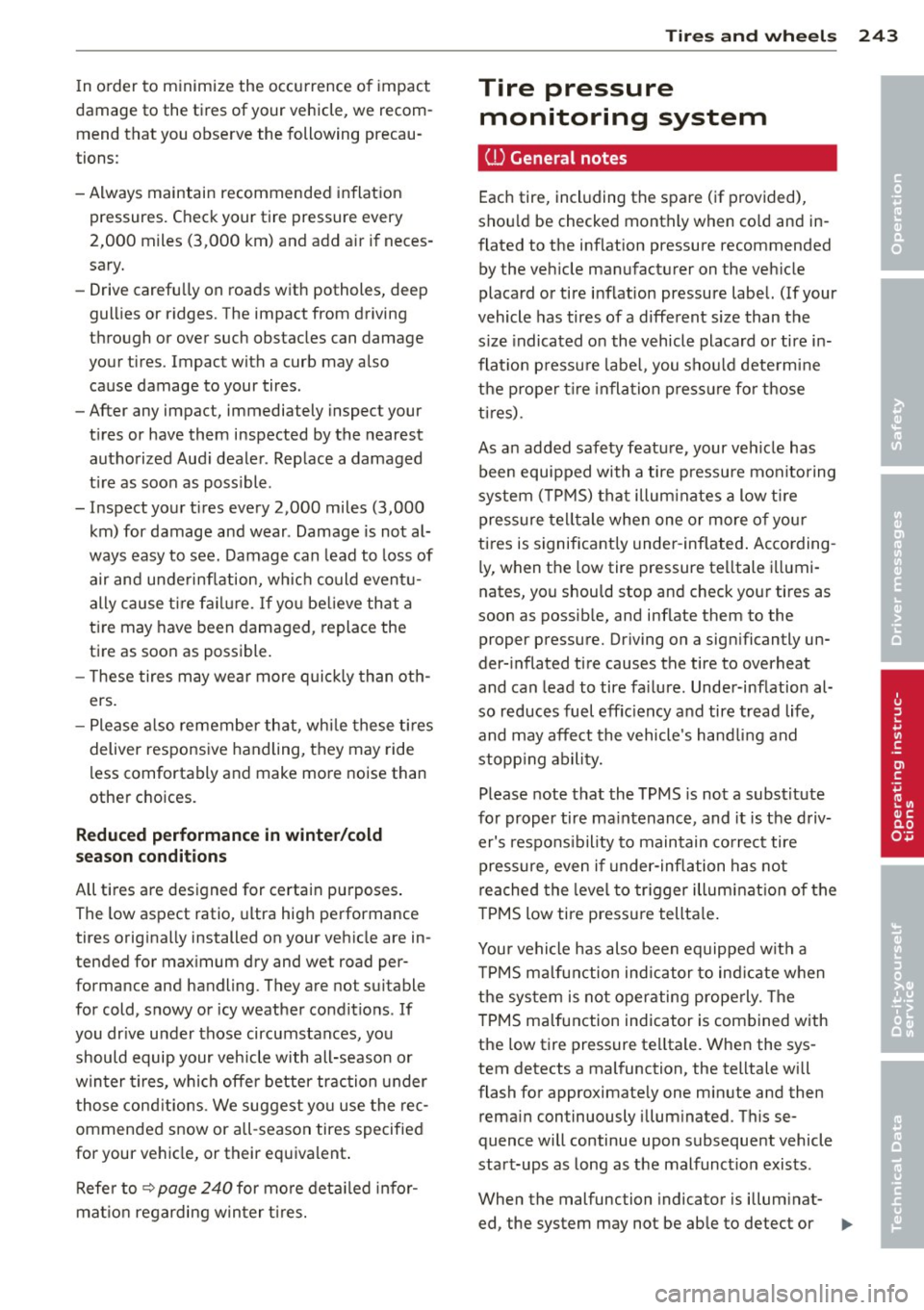
Tire pressure
monitoring system
ill General notes
Each tire, incl uding the spare (if provided),
shou ld be checked monthly when co ld and in
flated to the inflation pressure recommended by the veh icle manufac turer on the veh icle
placard or tire inflation pressure label. (If your
vehicle has tires of a different size than the
s ize indicated on the vehicle placard or tire i n
flat io n pressu re labe l, you shou ld dete rm ine
the p roper t ire inflation p ress ure fo r those
t i r es).
As an added safety feature , your veh icle has
been equipped with a tire pressure mon ito ring
system ( TPMS) that illum inates a low ti re
pressure te lltale when one or more o f your
t ires is significant ly under -inflated . Acco rding
l y, when the low tire pressure te lltale i llumi
nates, you should stop and check your tires as
soon as possib le, and inflate them to the
proper pressure. Driving on a sign ificantly un
der- inflated tire causes the tire to overheat
and can lead to tire fa ilure. Under-inflation al
so reduces fuel eff ic iency and tire tread life,
and may affe ct the vehicle's hand ling and
stopp ing ability.
Please note that the TPMS is not a substitute
fo r proper tire ma intenance, and it is the driv
er's respons ibility to maintain co rrect tire
pressure, even if under -inflation has not
rea ched the leve l to tr igger illuminat ion of the
TPMS low tire p ressure tellta le .
You r vehicle has also been equipped with a
T PMS ma lfunction indicator to ind icate when
the sys tem is not operating properly . T he
TPMS ma lfunction indicator is combined with
the low tire pressure te lltale. When the sys
tem detects a malfunction, the telltale will
flash for approximate ly one min ute and then
rema in continuously illum inated . Th is se
quence will continue upon subsequent vehicle
start-ups as long as the malfunct io n exists.
When the malfunction indicator is illum inat-
ed, the system may not be ab le to detect or
lilJ,
•
•
Page 259 of 288
No. Equ ipment Ampere
F49 Starter, clutch sensor
5
FS3 Rear window defogger 30
The power seats* are protected v ia
circ uit
br ea ker s
that automatically sw itch on after a
few seconds after the overload has been re
d uced.
(D Tips
Note that the following table was accurate
at the time of pr int ing and is subject to
change.
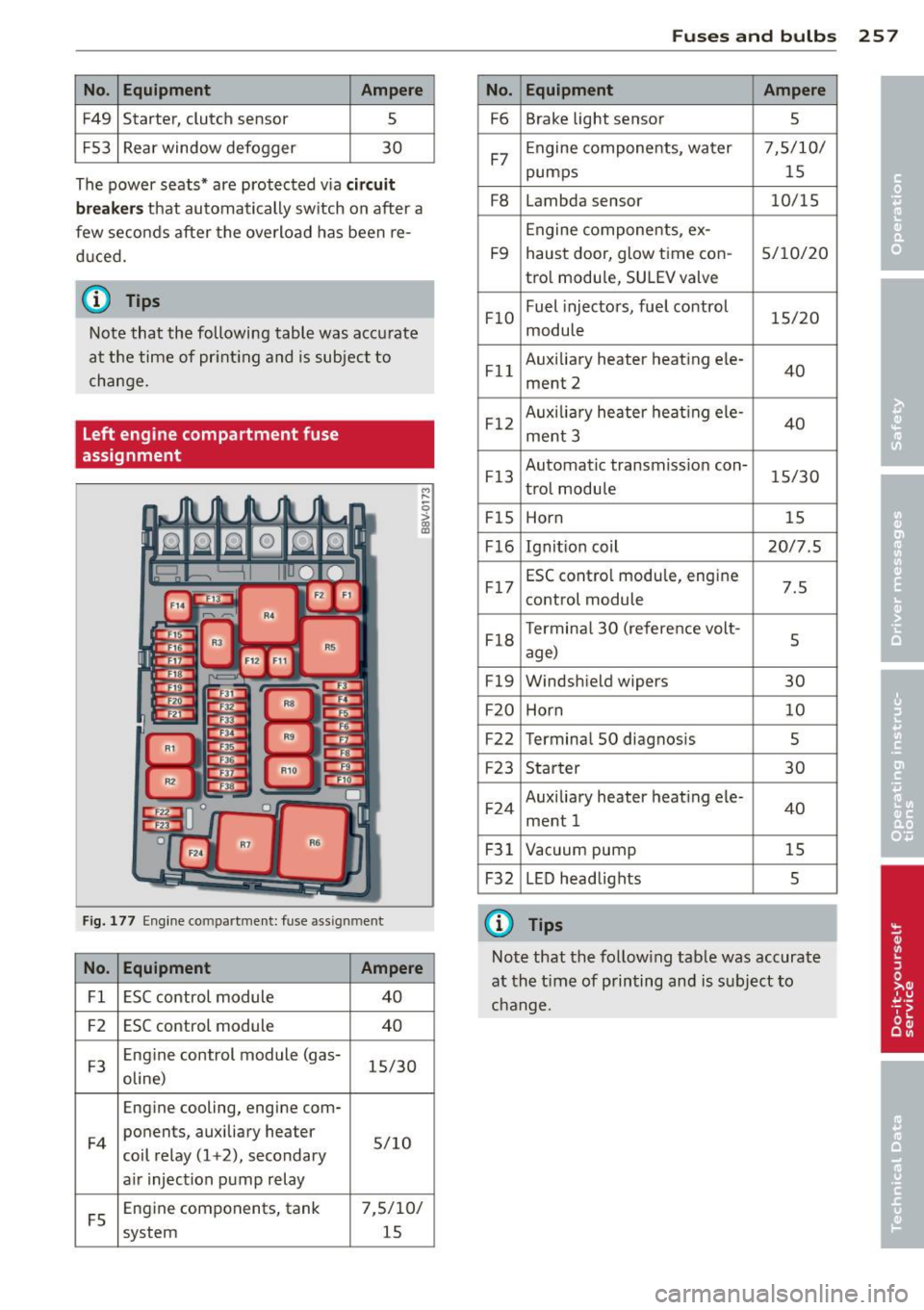
Left engine compartment fuse
assignment
F ig. 177 Eng ine compartment: fuse assignment
M ,.._
-0
!
No. Equ ipment Ampere
Fl ESC control module 40
F2 ESC control module
40
F3 Eng
ine control module (gas-
15/30
oline)
Engine cooling, engine com-
F 4 ponents, auxiliary heater
5/10
coil relay (1 +2), secondary
a ir injection pump relay
FS Eng
ine components, tank
7,5/10/
system 15
Fuse s and bulb s 257
No. Equipment Ampere
F6 Brake light sensor
5
F7 Engine components, water 7,5/10/
pumps
15
F8 Lambda sensor 10/15
Engine components, ex-
F9 haust door, glow time con-
5/10/20
tro l module, SU LEV valve
FlO Fuel
injectors, fuel control
15/20
module
Fl l Auxiliary heater heating ele
-
40
ment 2
F12 Auxilia
ry heater heat ing ele-
40
ment 3
F13 Automatic transmiss
ion con-
15/30
trol module
FIS Horn 15
F16 Ignit ion coil 20/7.5
F17 ESC contro
l modu le, engine
7.5
control module
F18 T
ermina l 30 (reference volt-
5
age)
F19 Windshield wipers
30
F20 Horn 10
F22 Termina
l SO diagnosis
5
F23 Starter 30
F24 Auxiliary heater heating ele-
ment 1 40
F31 Vacuum pump 15
F32 L ED head lights
5
(i} Tips
Note that the follow ing tab le was accurate
at the time of printing and is subject to
change.
Page 267 of 288
Technical data
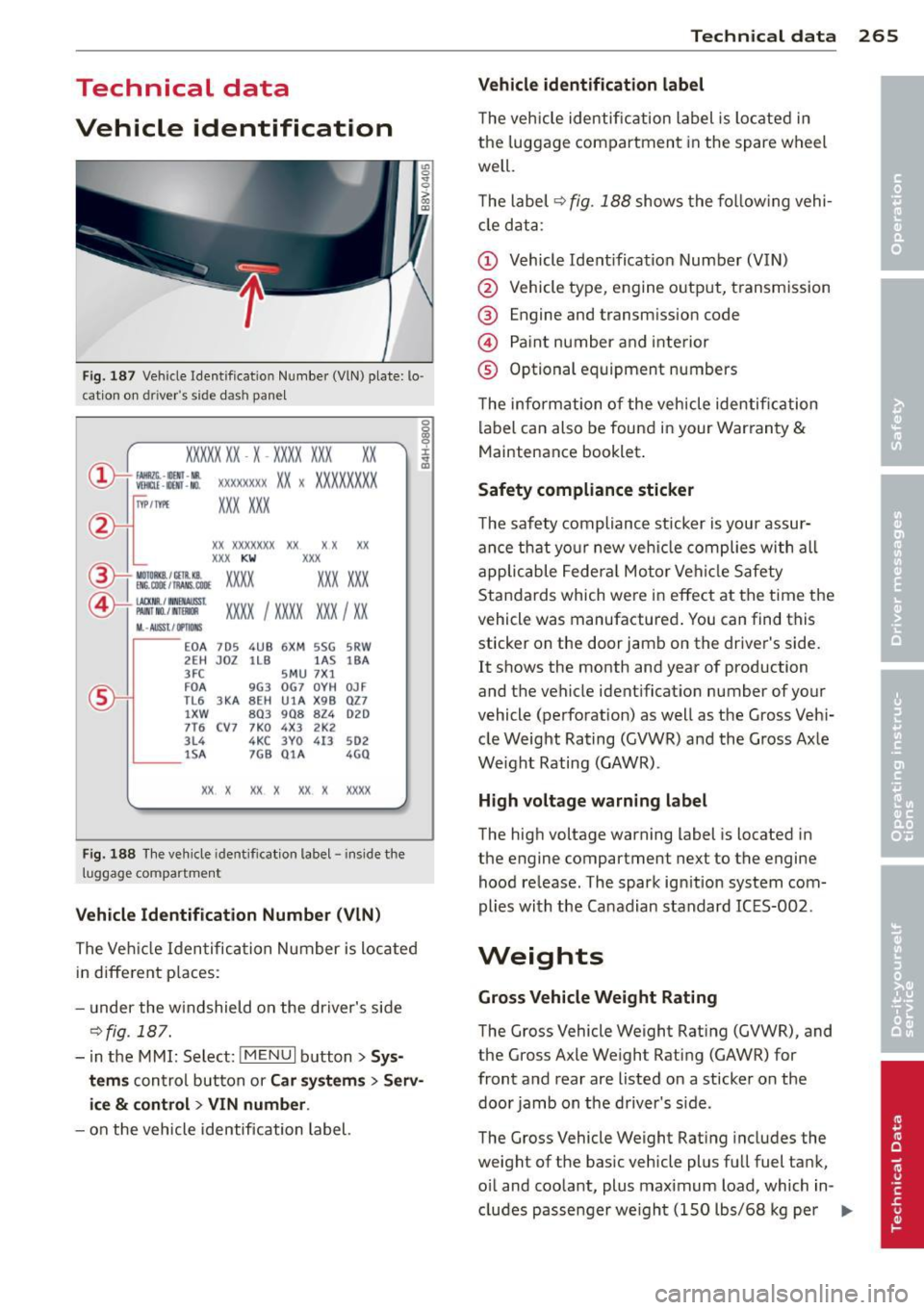
Vehicle identification
F ig. 187 Veh icle Identificat ion Number (VlN) plate: lo·
cat ion on driver's side dash pane l
XXXXX XX · X -XXXX XXX
~ fAllftlli. -llllll · NR. ~ W!ru -llllll -NO.
xx
XXXX XXXX XX X XXXXXXXX
XXX XXX
IYP /TYPE
XX XXXX XXX XX X X XX
XXX
KW XXX
®i ~W.::·f :l~~ XXXX XXX XXX
©+ ::rw= xxxx I xxxx XXX I xx
M. · AUSSt I IJ'IIDIIS
EOA 7D5 4UB 6XM SSG SR W
2EH JOZ 1LB lAS
18A
3FC SMU 7Xl
FDA 9G3 OG7 OYH
OJF
TL6 3KA 8EH
UlA X98 027
l XW 803 908 824 D2D
7T6 CV7 7KO 4X3 2K2
3L4 4KC 3YO 413 502
1SA 7GB 01A 4GO
XX . X XX X XX X XXXX
Fig. 188 The vehicle identification label- in side the
l uggag e compartme nt
Vehicle Identification Number (VlN)
The Veh icle Identifica tion Number is located
in different p laces :
- under the w indshield on the driver's side
¢fig. 187.
- in the MMI: Select: !MENUI button> Sys
tems
control button or Car systems > Serv
i ce
& co ntrol > VIN number .
-on the vehicle identification label.
Technical data 265
Vehicle identification label
The vehicle identification label is located in
the luggage compartment in the spare wheel
well.
T he label¢
fig. 188 shows the following vehi
cle data:
(D Vehicle Identification Number (VIN)
@ Vehicle type, engine output, transmission
® Engine and transmission code
© Paint number and interior
® Optional equipment numbers
The information of the veh icle identification
label can also be found in your Warranty
&
Maintenance booklet .
Safety compliance sticker
The safety compliance sticker is your assur
ance that your new vehicle complies with all
applicable Federal Motor Vehicle Safety
Standards which were in effect at the time the
vehicle was manufactured . You can find this
sticker on the door jamb on the driver's side.
It shows the month and year of production
and the vehicle ident ification number of your
vehicle (perforation) as well as the Gross Vehi
cle Weight Rating (GVWR) and the Gross Axle
Weight Rating (GAWR) .
High voltage warning label
The high voltage warning label is located in
the engine compartment next to the engine
hood release. The spark ignition system com
plies with the Canadian standard ICES-002 .
Weights
Gross Vehicle Weight Rating
The Gross Vehicle Weight Rating (GVWR), and
the Gross Axle Weight Rating (GAWR) for
front and rear are listed on a sticker on the
door jamb on the driver's side.
The Gross Vehicle Weight Rating includes the
weight of the basic vehicle plus full fuel tank,
o il and coolant, plus maximum load, which in
cludes passenger we ight (150 lbs/68 kg per
II>--
Page 268 of 288
26 6 Techni cal data
designated s eating position) and luggage
w eight ¢.&, .
Gross Axle W eight Rating
The Gross Axle Weight Rating is the maximum
l oad that can be applied at each axle of the
vehicle ¢Lr!, .
Vehicle cap acit y weight
The vehicle capac ity we ight (max . load) is list
ed either on the dr iver's side B-pilla r or inside
the fuel filler flap.
_& WARNING
- T he actual Gross Axle Weight Rat ing at
the front and rear axles shou ld not ex
ceed the permissible weights, and their
combination must not exceed the Gross
Vehicle Weight Rating .
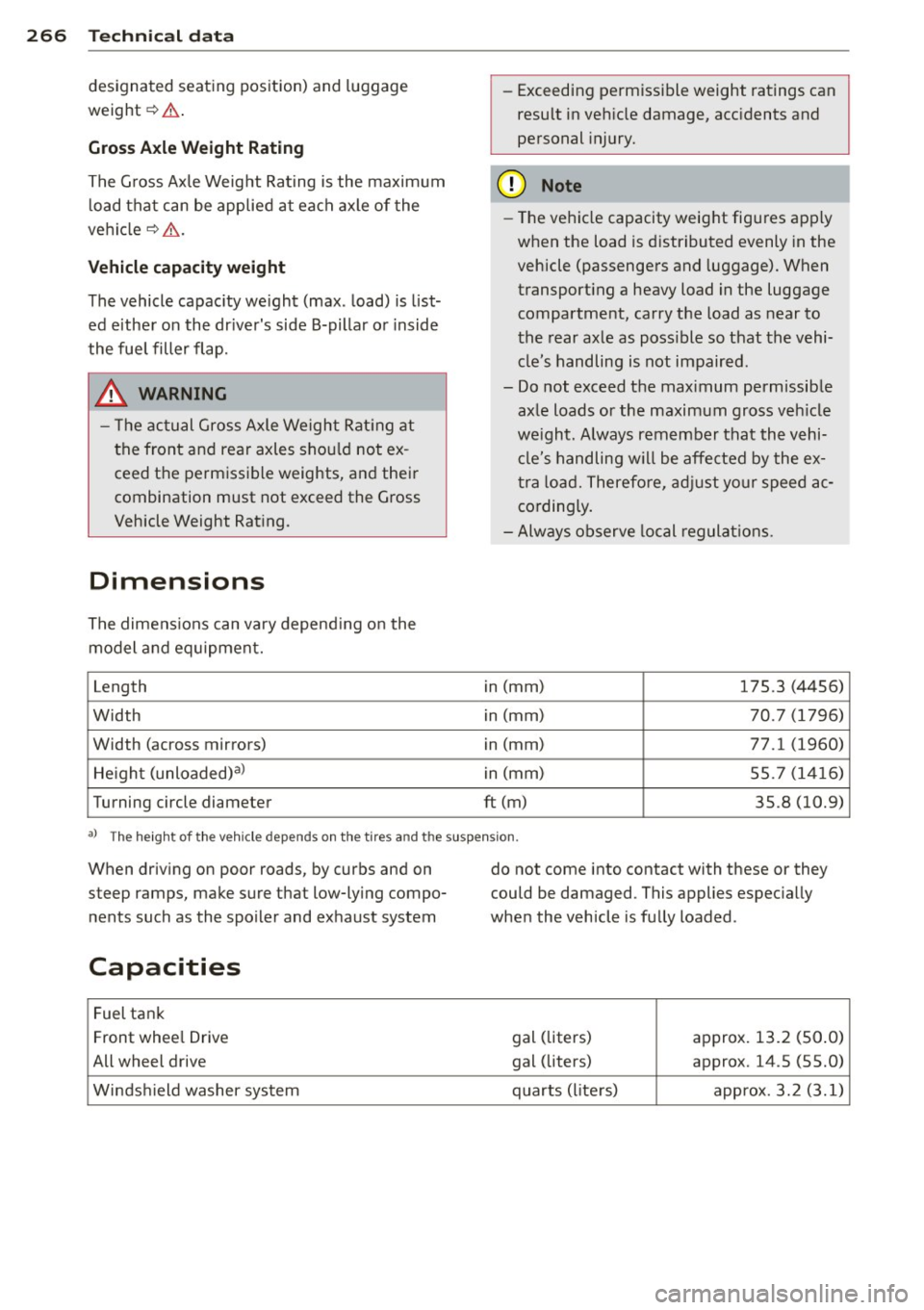
Dimensions
The dimensions can vary depend ing on the
model and equipment.
Length
Width
W idth (ac ross m irrors)
Height (unloaded) a)
Turn ing circle d iameter
-
- Exceeding permissible weight ratings can
result in veh icle damage, acc idents and
personal injury.
(D Note
- The vehicle capacity weight figures apply
when the load is distributed evenly in the
vehicle (passengers and luggage). When
transport ing a heavy load in the luggage
compartment, carry the load as near to
the rear axle as poss ible so that the vehi
cle's handling is not impaired .
- Do not exceed the maximum permissible axle loads or the maximum gross veh icle
we ight. Always remember that the vehi
cle's handling w il l be affected by the ex
tra load. Therefo re, adj ust your speed ac
cordingly.
- Always observe local regulat ions .
in (mm)
175 .3 (4456)
in (mm) 70 .7 (1796)
in (mm) 77 .l (1960)
in (mm) 55 .7 (1416)
ft (m) 35.8 (10.9)
al The he igh t o f th e ve hicle depe nds o n the tire s and the s usp en sion .
When driving on poor roads, by curb s and on
s teep ramp s, make sure tha t low-lying compo
nent s such as the spoiler and exhaust sy stem
Capacities
Fuel tank
Front whee l Drive
All wheel drive
Winds hield washer system do not
come into contact w ith these or they
could be dam aged. This applies espe cia lly
when the vehicle is fully loaded .
gal (liters) approx.
13.2 (50.0)
gal (lite rs) approx. 14.5 (55.0)
quarts (liters) approx. 3.2 (3.1)