brake AUDI A3 2015 Repair Manual
[x] Cancel search | Manufacturer: AUDI, Model Year: 2015, Model line: A3, Model: AUDI A3 2015Pages: 288, PDF Size: 71.46 MB
Page 228 of 288
226 Tire s and wheel s
-Never mount used tires on yo ur vehicle if
you are not sure of their "previous histo
ry." Old used tires may have been dam
aged even though the damage cannot be
seen that can lead to sudden t ire failure
and loss of vehicle control.
- If you notice unusual vibration or if the
vehicle pulls to one side when driving, al
ways stop as soon as it is safe to do so
and check the wheels and tires for dam
age.
(D Note
- Please note that summer and winter
tires are designed for the cond itions that
a re typ ica l in those seasons. Aud i recom
mends using w inter t ires d uring the win-
Glossary of tire and loading terminology
Accessory weight
means t he comb ined we ight (in excess of
those standard items which may be rep laced)
of automatic transmission, power steering,
power brakes, power windows, power seats,
radio, and heater, to the extent that these
items are availab le as factory-installed equip
ment (whether installed or not).
A spect ratio
means th e ratio of the height to the width of
the tire in percent. Numbers of 55 or lower in
d icate a low sidewall for improved steer ing re
sponse and better overall handling on dry
pavement .
Bead
means the part of the tire th at is made of
steel wires, wrapped or reinforced by ply cords
and that is shaped to fit the rim.
Bead s eparation
means a breakdown of the bond between
components in the bead.
Cord
means t he strands forming the plies in the
tire. ter months.
Low tempe ratu res signifi
cantly decrease the elasticity of summer
tires, which affects traction and braking ability. If summer tires are used in very
co ld temperatures, cracks can form on
the tread bars, resu lting in permanent
tire damage that can cause loud driving
noise and unbalanced tires. Aud i is not
responsib le for this type of damage.
- Burn ished, polished or chromed rims
must not be used in winter weather. The
surfa ce of the rims does not have suff i
c ien t cor rosion prote ct io n for this and
co uld be pe rmanen tly damaged by road
salt or simi lar substances. This damage
is not cove red by war ranty.
Cold tire inflat ion pre ssure
mea ns the t ire press ure recommended by the
vehicle manufacturer for a tire o f a des ignated
size that has not bee n driven for more than a
coup le of miles (ki lometers) at low speeds in
the three hour period before the tire press ure
is measured or adjusted.
Curb weight
means the weight of a motor vehicle w ith
standard equipment including the maximum
capacity of fuel, o il, and coolant, air condi
tion ing and additional weight of optional
equipment.
E x tra load tire
means a tire design to operate at higher loads
and at higher inflation pressures than the cor
responding standard tire. Extra load tires may
be identified as "XL", "xl", "EXTRA LOAD", or
"RF" on the sidewall.
Gross A xle Weight Rating ("GAWR")
means the load-carrying capacity of a single
axle system, measured at the tire-ground in-
terfaces.
IJ>,
Page 229 of 288
Gross Vehicle Weight Rating ("GVWR")
means the maximum total loaded weight of
the vehicle .
Groove
means the space between two adjacent tread
ri bs.
Load rating (code)
means the maximum load that a tire is rated
to carry for a given inflat ion pressure . You
may not find this information on all tires be
cause it is not requ ired by law .
Ma ximum load rating
means the load rating for a t ire at the max i
mum permissible inflation pressure for that
tire .
Maximum loaded vehicle weight
means the sum of:
(a) Curb weight
(b) Accessory weight
(c) Vehicle capac ity weight, and
(d) Production opt ions weight
Ma ximum (permissible) inflation pressure
means the maximum co ld inf lation pressure
to which a tire may be inflated . Also called
"maximum inflation pressure."
Normal occupant weight
means 150 lbs. (68 k ilograms) times the
number of occupants seated in the vehicle up
to the tota l seating capacity of yo ur vehicle.
Occupant distribution
means distribution of occupants in a veh icle.
Outer diameter
means the overall diameter of an inflated new
tire .
Overall width
means the linear distance between the exteri
ors of the sidewalls of an inflated tire, includ
ing e levations due to labeling, decorations, or
protective bands or ribs .
Tires and wheels 22 7
Ply
means a layer of rubbe r-coated parallel cords.
Production options weight
means the combined weight of those installed
regular production opt ions we ighing over 5
lbs. (2.3 kg) in excess of those standa rd items
which they replace, not previously considered
in curb weight or accessory weight, including
heavy duty brakes, ride levelers, roof rack,
heavy duty battery, and special trim.
Radial ply tire
means a pneumatic tire in which the ply cords
that extend to the beads are laid at substan
tially 90 degrees to the centerl ine of the
tread.
Recommended inflation pressure
see ~ page 226, Cold tire inflation pressure .
Reinforced tire
means a tire design to operate at higher loads
and at higher inflation pressures than the cor
responding standard tire . Reinforced tires
may be identified as "XL", "xl", "EXTRA LOAD",
or "RF" on the sidewal l.
Rim
means a metal support for a tire or a tire and
tube assembly upon which the tire beads are
seated .
Rim diamete r
means nominal diameter of the bead seat. If
you change your wheel s ize, you wi ll have to
purchase new tires to match the new r im di
ameter.
Rim size designation
means rim diameter and width.
Rim width
means nominal distance between rim flanges.
Sidewall
means that portion of a tire between the
tread and bead .
•
•
•
Page 233 of 288
The correct tire pressure for the spare wheel is
l ocated on a label on the driver's side B-pillar.
Because tec hnical changes may be made to
vehicle equ ipment dur ing the model yea r, a l
ways compa re the tire size designation on the
tire pressure label on your vehicle wit h the
tires on your vehicle . Make s ure that the tire
size information on the veh icle label is the
same as the s ize of the tires on the vehicle.
This is especially important if the vehicle be
longs to someone else or you bought the veh i
cle with different rims/tires or you boug ht the
ve hicle as a previously owned vehicle.
Remember, your safety and that of your pas
sengers also depends on mak ing su re that
l oad limits are not exceeded. Vehicle load in
cludes everybody and everything in and on the
veh icle. These load limits are technically refer
red to as the vehicle's Gross Vehicle We ight
Rating ("GVWR") . The Gross Ax le Weight Rat
ing ("GAWR") is the maximum load that can
be app lied at each of the veh icle's two axles.
The Gross Vehicle Weight Rating and the
Gross Axle Weight Rating are listed on the
safety compliance st icker label located on the
driver's side B-p illa r. The t ire pressure label o n
your Aud i lists the maximum combined
weight of a ll of the occupants and luggage or
other cargo that the vehicle can carry. For the
l ocation of the tire pressure labe l~
fig. 156.
A WARNING
Overloading a vehicle can cause loss of ve
hicle control, a crash or other accident, se
rious personal injury, and even death.
- Carrying more weight than yo ur vehicle
was designed to carry will prevent the
vehicle from handling properly and in crease the risk of a loss of veh icle con
trol.
- The brakes on a veh icle that has been
overloaded may not be able to stop the
vehicle within a safe distance .
- Tires on a vehicle that has been overload
ed can fail suddenly causing loss of con
t rol and a crash.
Tire s an d wheel s 231
-Always make sure that the total load be
ing transported - includ ing the weight of
a trailer hitch and the tongue we ight of a
loaded trailer -does not make the vehi
cle heavier than the vehicles Gross Veh i
cle Weight Rating.
A WARNING
- Inco rrect tire pressures and/or underin
flation can lead to a ser ious or fatal acci
dent.
- Inco rrect tire pressures and/or underin
flation cause increased tire wear and can
affect the handling of the vehicle.
- Inco rrect tire pressures and/or underin
flation can a lso lead to sudden t ire fail
ure, including a blowou t and sudden de
flation, caus ing loss of veh icle contro l.
Checking tire pressure
The correct tire pressure for the tires original
ly installed on your vehicle is listed on the tire
pressvre label located on driver's side 8-pil
lar.
T he recommended tire pressures are on the
ti re pressure label and in the table
~ page 229, Cold tire inflation pressure . This
means that the pressure m ust be checked and
adjusted when the tire has not been dr iven for
more than a couple of miles (kilometers) at
low speeds during the previous three hours.
Air in the tires expands when the tire heats up
as a result of internal frict ion as it flexes in
use. The tire pressure is h igher when the tire
has warmed up t han when it is "cold."
It is the inflation pressure in a "cold" t ire that
counts. Therefore, you should never let a ir out
of a warm tire to match "Cold tire inflat ion
pressure" recommendat io ns ~
page 229 . Th e
ti res wo uld then be unde rinfl ated and co uld
fail suddenly.
T he tire pressure label on your Audi lists the
recommended co ld tire inflation pressures at
max imum capacity for the new, or ig inal
equipment tires that were on your vehi cle at
•
•
•
Page 236 of 288
234 Tires and wheels
The tire pressure label on your Audi also lists
the maximum combined weight of all of the
occupants and luggage or other cargo that
the vehicle can carry. For the location of the label
c::;,page 229, fig. 156.
& WARNING
Overloading a vehicle can cause loss of ve
hicle control, a crash or other accident, se
rious personal injury, and even death.
- Carrying more weight than your vehicle was designed to carry will prevent the
vehicle from handling properly and in
crease the risk of the loss of vehicle con
trol.
- The brakes on a vehicle that has been
overloaded may not be able to stop the
vehicle within a safe distance.
- Tires on a vehicle that has been overload
ed can fail suddenly , including a blowout
and sudden deflation, causing loss of
control and a crash.
- Always make sure that the total load be
ing transported -including the weight of
a trailer hitch and the tongue weight of a
loaded trailer -does not make the vehi
cle heavier than the vehicles Gross Vehi
cle Weight Rating.
Determining correct load limit
Use the example below to cal
culate the total weight of the
passengers and luggage or oth
er things that you plan to trans
port so that you can make sure
that your vehicle will not be
overloaded.
Steps for Determining
Correct Load Limit
1 . Locate the statement "THE
COMBINED WEIGHT OF QC- CU PANTS AND CARGO
SHOULD NEVER EXCEED XXX
KG OR XXX LBS" on your ve
hicle's placard (tire inflation
pressure label)
¢ page 229,
fig. 156.
2. Determine the combined weight of the driver and pas
sengers that will be riding in
your vehicle.
3. Subtract the combined weight of the driver and pas
sengers from
"XXX" kilo
grams or
"XXX" pounds
shown on the sticker
¢ page 229, fig. 156.
4. The resulting figure equals
the available amount of car go and luggage load capaci
ty. For example, if the
"XXX"
amount equals 1400 lbs.
and there will be five 150 lbs. passengers in your vehi
cle, the amount of available
cargo and luggage load ca pacity is 650 lbs. (1400-7 50
(5
X 150) = 650 lbs.)
5. Determine the combined weight of luggage and cargo
being loaded on the vehicle.
That weight may not safely exceed the available cargo
Page 238 of 288
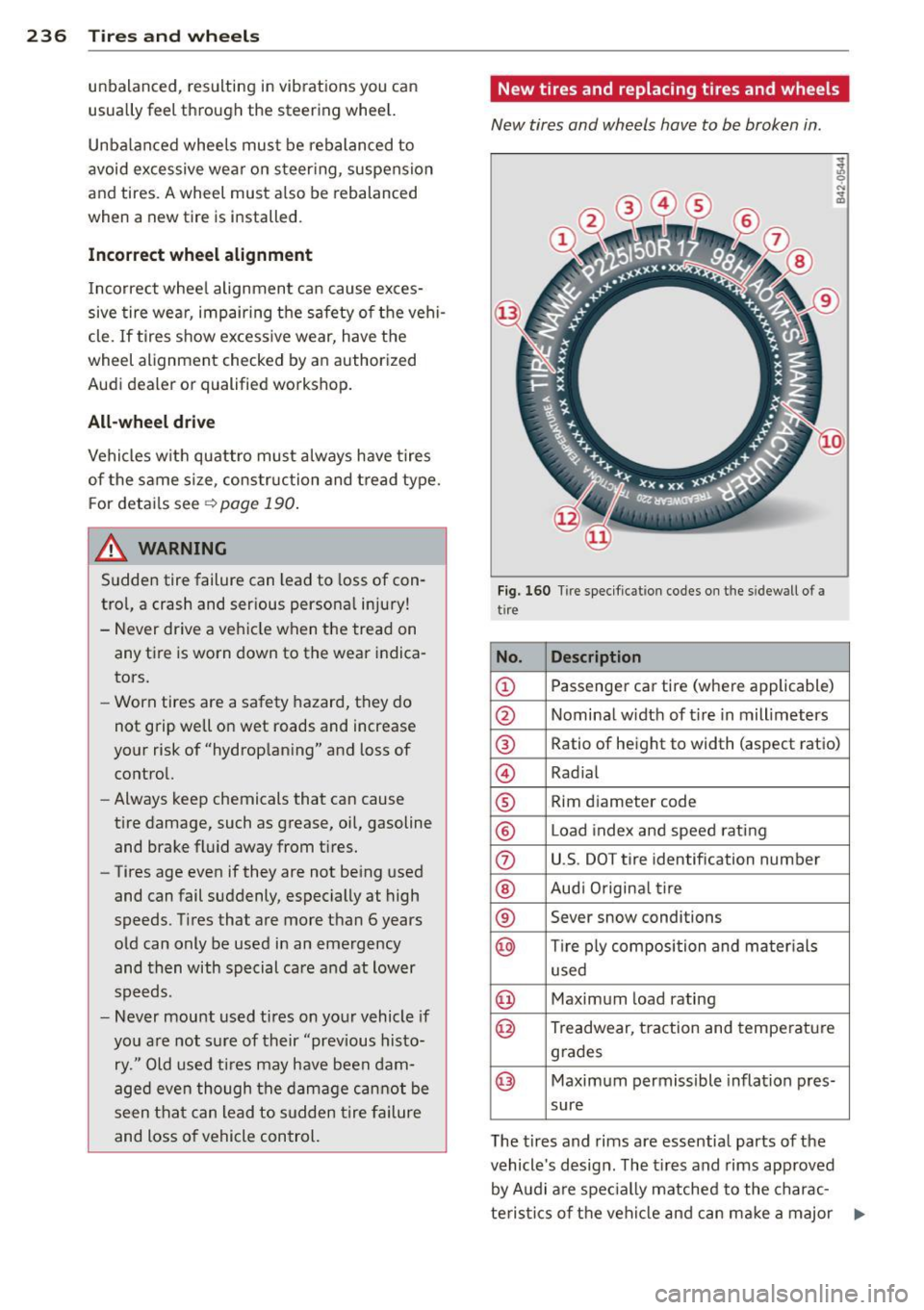
236 Tires and wheels
unbalanced, resulting in vibrations you can
usually feel through the steering whee l.
Unbalanced wheels must be rebalanced to
avoid excessive wea r on steer ing, suspension
and tires . A wheel must a lso be rebalanced
when a new tire is installed.
Incorrect wheel alignment
I ncorrect wheel alignment can cause exces
sive tire wear, impair ing the safety of the veh i
cle. If tires show excess ive wear, have the
wheel alignment checked by an authorized
Audi dealer or qualified workshop.
All-wheel drive
Vehicles w ith quattro must a lways have tires
of the same size, construction and tread type.
F or details see
<=> page 190 .
A WARNING
Sudden tire failure can lead to loss of con
trol, a crash and ser ious persona l injury!
- Never drive a vehicle when the tread on
any tire is worn down to the wear indica
tors.
- Worn tires are a safety hazard, they do
not grip well on wet roads and increase
your risk of "hydroplaning" and loss of
control.
- Always keep chemicals that can cause
tire damage, such as grease, oil, gasoline
and brake fluid away from t ires.
- Tires age even if they are not being used
and can fail suddenly, especially at high
speeds. Tires that are more than 6 years
old can only be used in an emergency
and then with special care and at lower
speeds.
- Never mount used tires on your vehicle if
you are not sure of their "previous histo
ry." Old used tires may have been dam
aged even though the damage cannot be
seen that can lead to sudden tire failure
and loss o f vehicle control.
New tires and replacing tires and wheels
New tires and wheels have ta be broken in .
Fig. 160 Tire specificat ion codes on the s idewall of a
tire
No. Description
® Ratio of height to width (aspect ratio)
© Radial
® Rim diameter code
® L oad index and speed rating
(J) U.S . DOT tire identification number
® Audi Origina l tire
® Sever snow conditions
@ T ire ply composition and materials
used
@ Maximum load rating
@ Treadwear, traction and temperature
grades
@ Maximum permissible inflation pres-
sure
T he tires and rims are essential parts of the
vehicle 's design . The tires and rims approved
by Audi are spec ially matched to the charac
te ristics of the vehicle and can make a major .,..
Page 241 of 288
Driving with different tires reduces vehi
cle handling and can lead to a loss of
control.
- If the spare ti re is not the same as the
tires that are mounted on the vehicle -
for example with winter tires -only use
the spare tire for a short period of time and drive with extra care. Refit the nor
mal road wheel as soon as safely possi
ble.
- Never drive faster than the maximum
speed for which the tires on your vehicle
are rated because tires that are driven
faster than their rated speed can fail
suddenly.
- Overloading tires cause heat build-up,
sudden tire failure, including a blowout
and sudden deflation and loss of control.
- Temperature grades apply to tires that
are properly inflated and not over or un
derinflated.
- For technical reasons it is not always
possible to use wheels from other
vehicles -in some cases not even wheels
from the same vehicle model.
- If you install wheel trim discs on the ve
hicle wheels, make sure that the air flow
to the brakes is not blocked. Reduced air
flow to the brakes can them to overheat, increasing stopping distances and caus
ing a collision.
- Run flat tires may only be used on
vehicles that were equipped with them at the factory. The vehicle must have a
chassis designed for run flat tires. Incor
rect use of run flat tires can lead to vehi
cle damage or accidents. Check with an
authorized Audi dealer or tire specialist
to see if your vehicle can be equipped
with run flat tires. If run flat tires are used, they must be installed on all four
wheels. Mixing tire types is not permit
ted.
(D Note
- For technical reasons, it is not generally
possible to use the wheel rims from oth-
Tires and wheels 239
er vehicles. This can hold true for wheels
of the same vehicle type.
- If the spare tire is different from the
tires that you have mounted on your ve
hicle (for example winter tires or wide
profile tires), then use the spare tire for a
short period of time only and drive with
extra care. Replace the flat tire with the
tire matching the others on your vehicle as soon as possible.
- Never drive without the valve stem cap .
The valves could get damaged .
(® For the sake of the environment
Dispose of old tires in accordance with the
local requirements.
Uniform tire quality grading
-Tread wear
- Tract ion AA A B C
- Temperature AB C
Quality grades can be found where applicable
on the tire side wall between tread shoulder
and maximum section width
c;, page 236,
fig. 160.
For example: Tread wear 200, Traction AA,
Temperature A.
All passenger car tires must conform to Feder
al Safety Requirements in addition to these
grades.
Tread wear
The tread wear grade is a comparative rating
based on the wear rate of the tire when tested
under controlled conditions on a specified
government test course.
For example, a tire graded ISO would wear
one and one half (11/2) times as well on the
government course as a tire graded 100.
The relative performance of tires depends upon the actual conditions of their use, how
ever, and may depart significantly from the
norm due to variations in driving habits, serv
ice practices and differences in road character-
istics and climate.
ll-
•
•
•
Page 244 of 288
24 2 T ire s and wheel s
Where snow chains are mandatory oncer
tain roads, this normally also applies to
veh icles with all-wheel dr ive.
Wheel bolts
Wheel bolts must always be tightened to the
correct torque.
The design o f whee l bolts is matched to the
factory installed rims . If different rims are fit
ted, the correct wheel bolts with the right
length and correctly shaped bolt heads must
be used. This ensures that wheels are fitted
securely and that the brake system functions
correctly .
In certain circumstances, you may not use
wheel bolts from a different vehicle -even if it
is the same model
r=> page 270.
A WARNING
Improperly tightened or maintained wheel
bolts can become loose caus ing loss of
c ont ro l, a co llision and serious persona l in
Jury .
- Always keep the wheel bolts and the
threads in the wheel hubs clea n so the
wheel bolts can turn easily and be prop er ly t igh tened .
- Never grease or oil the wheel bo lts and
the threads in the wheel hubs. They can
become loose while d riving if greased or
oiled, even if tightened to the specified
torque.
- Only use wheel bolts that belong to the
rim being installed.
- Never use different whee ls bolts on your
vehicle.
- Always maintain the co rrect tighten ing
torq ue fo r th e wheel bo lts to reduce the
risk of a wheel loss . If the tightening tor
que of the wheel bo lts is too low, they
can loosen and come out w hen the veh i
cle is moving. If the tighteni ng torque is
too high, the whee l bolts and threads can be damaged and the whee
l can be
come loose.
@ Note
The specified torque for the whee l bolts is
90 ft lb (120 Nm) with a tolerance of± 7,4
ft lb(± 10 Nm) . Torque wheel bolts diago
nally. After changing a whee l, the torque
must be checked as soon as possible with a
torque w rench -preferably by an author
i zed Audi dealer or qualified workshop .
Low aspect ratio tires
Your Audi is factory-eq uipped w it h low aspect
ra tio tires. These tires have been tho roughly
tested and been se lected specifically fo r your
model for their superb perfo rmance, road fee l
and handling under a variety of d riving condi
t ions . Ask your author ized A udi dealer for
more details.
T he low aspect ratio of these tires is ind icated
by a numera l of
55 or less in the tire's s ize
designation. The n umera l represents the ratio
of the tire's sidewall height in relation to its
tread width expressed in percentage. Conven
t iona l tires have a he ight/w idth ratio of 60 or
more .
The performance of low-aspect -ratio tires is
particularly sens iti ve to imp roper inflation
pressure. It is therefore important that low
a spect ratio tires are inflat ed to the specified
pre ssure and that the inflation pressure i s
regularly ch ecked and maintain ed. Tire pre s·
sure s should be checked at lea st once a
m onth and always bef ore a long trip
r=> page 231, Checking tire pressure .
What you can do to avoid tire and rim
damage
Low aspect ratio tires can be d amage d more
easily by impact w ith potholes, curbs, gull ies
or ridges on t he road, particularly if the tire is
u nd eri nflated.
Page 248 of 288
246 What do I do now?
What do I do now?
Luggage compartment
lid emergency release
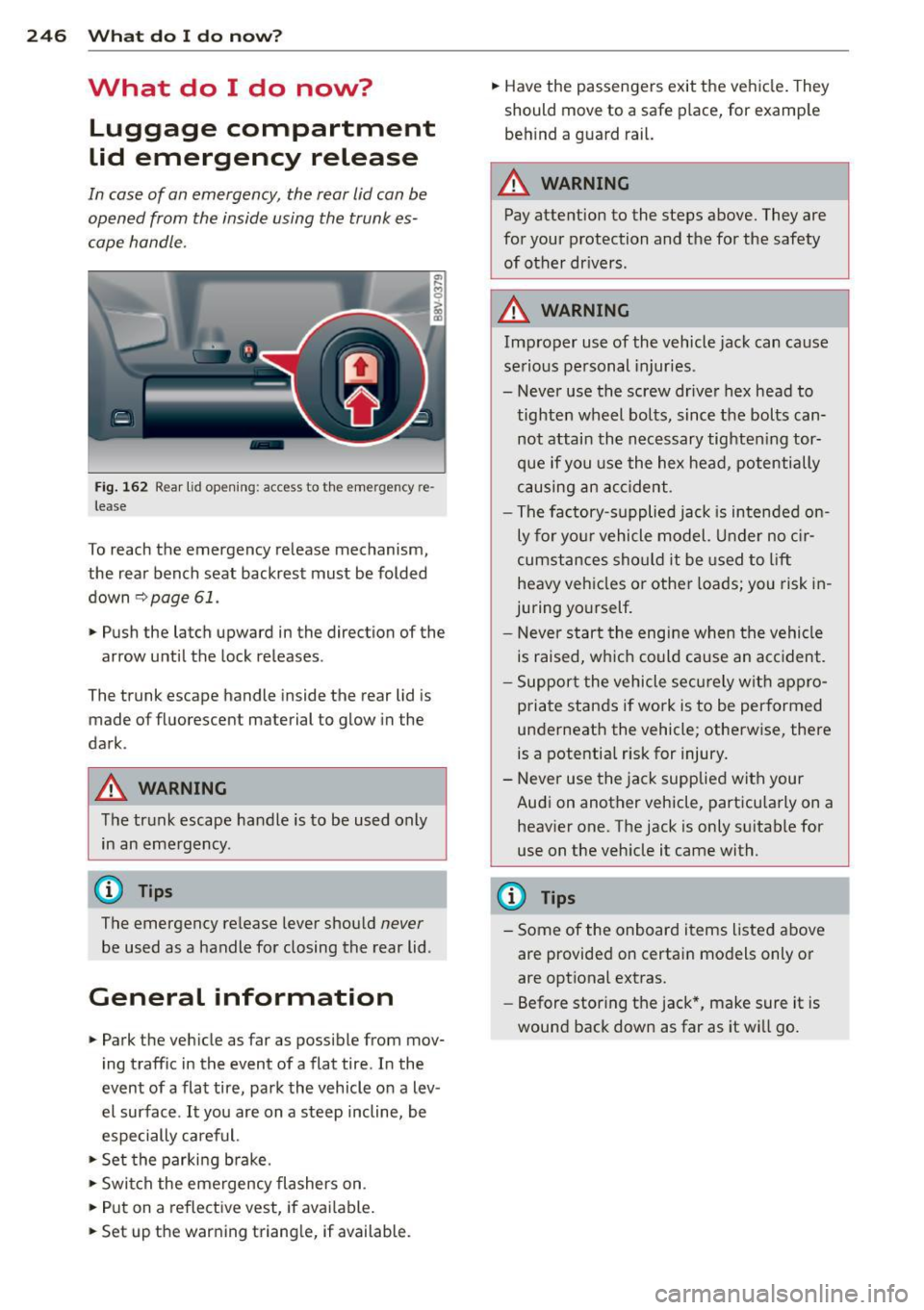
In case of an emergency , the rear lid can be
opened from the inside using the trunk es
cape handle .
Fig. 162 Re ar lid op ening : access to th e e merg en cy re
l ease
To reach the emergency release mechanism,
the rear bench seat backrest must be folded down
~ page 61 .
,. Push the latch upward in the direction of the
arrow until the lock releases .
The trunk escape handle inside the rear lid is
made of fluorescent material to glow in the
dark .
A WARNING
The trunk escape handle is to be used only
m an emergency .
@ Tips
The emergency release lever should never
be used as a handle for closing the rear lid.
General information
,. Park the vehicle as far as possible from mov
ing traffic in the event of a flat tire. In the
event of a flat tire, park the vehicle on a lev
el surface .
It you are on a steep incline, be
especially careful.
,. Set the parking brake.
,. Switch the emergency flashers on.
• Put on a reflective vest, if available.
• Setup the warning triang le, if available . •
Have the passengers exit the vehicle. They
should move to a safe place, for examp le
behind a guard rail.
A WARNING
-
Pay attention to the steps above. They are
for your protection and the for the safety of other drivers.
A WARNING
Improper use of the vehicle jack can cause
serious personal injuries .
- Never use the screw driver hex head to tighten wheel bolts, since the bolts cannot attain the necessary tightening tor
que if you use the hex head, potentially
causing an accident .
- The factory-supplied jack is intended on
ly for your vehicle model. Under no cir
cumstances should it be used to
lift
heavy vehicles or other loads; you risk in
juring yourself.
- Never start the engine when the vehicle
is raised, which could cause an accident.
- Support the vehicle securely with appro
priate stands if work is to be performed
underneath the vehicle; otherwise, there
is a potential risk for injury.
- Never use the jack supplied with your
Audi on another vehicle, particularly on a
heavier one. The jack is only suitable for
use on the veh icle it came with.
(D Tips
- Some of the onboard items listed above
are provided on certain models only or
are optional extras.
- Before storing the jack*, make sure it is
wound back down as far as it wil l go.
Page 250 of 288
248 What do I do now?
-Do not drive faster than 50 mph (80 km/
h) . You risk having an acc ident.
- Avoid full-throttle acce le ration, heavy
braking, and fast corner ing. You risk hav
ing an acc ident.
- Never drive us ing more than one spare
wheel and tire. You risk having an acci
dent .
- Norma l summer or winter tires must not
be mounted on the compact spare whee l
rim.
- For technical reasons, the use o f ti re
chains on the spare tire is not permitted.
If it is necessary to drive with tire chains,
the spare whee l must be mounted on the
front axle in the eve nt of a flat in a rear
t ir e. Th e newly ava ilable front w heel
must the n be installed in pla ce of the
re ar wheel wi th the flat ti re. Ins tal ling
the ti re chai n befo re mo unt ing the wheel
and tire is recommen ded .
- L oose items in the p assenge r comp art
ment can ca use serio us personal inj ury
dur ing hard braking or in an acc ident.
N ever sto re the inf latable spare tire or
jack and t ools in the passenger c ompart
me nt.
- No rma l summer or wi nte r tires must not
be m ounted on the compact spare wheel
rim .
Removing the subwoofer
App lies to vehicles: with subwoofer
The subwoofer must be removed before the
spare wheel* can be removed.
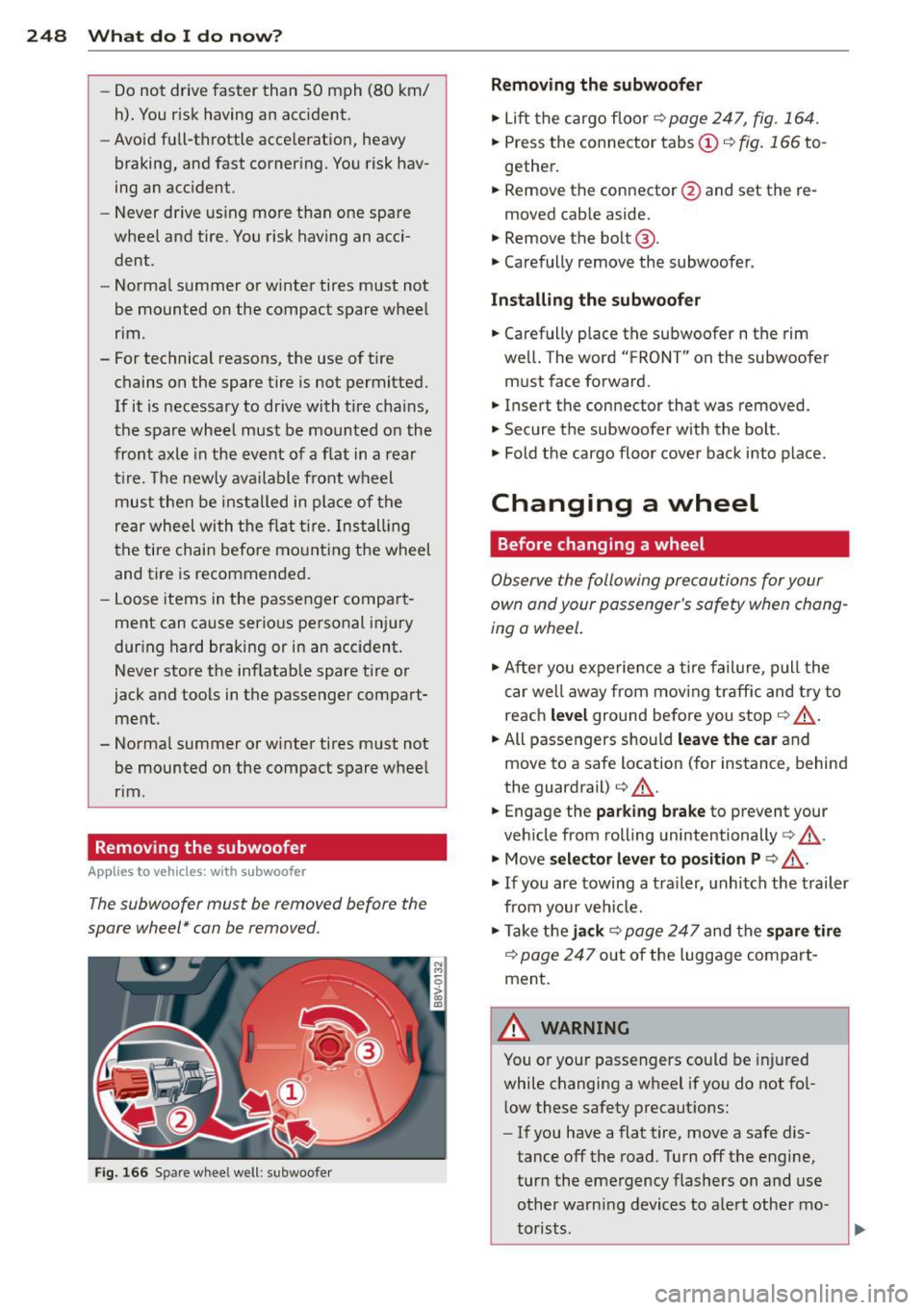
F ig . 166 Spare w hee l well : subwoofe r
Removing the subwoofer
.,. Lift the c argo floor i=:> page 247, fig . 16 4.
.. Press the connector tabs (!) i=:> fig. 16 6 to-
gether .
.. Re move the connector @and set the re-
moved cab le aside .
.,. Remove the bo lt @ .
.. Carefully remove the subwoofe r.
Installing the subwoofer
.. Carefully place the subwoofer n the rim
we ll. The word "FRONT" on the subwoofer
m ust face forward.
.. Insert the con nector that was removed.
.. Secure t he subwoofer w ith the bolt .
.. Fold the cargo floo r cover back into place.
Changing a wheel
· Before changing a wheel
O bserve the following prec au tions f or your
own and your p assenger's safety when chang
ing a wheel .
.. Afte r you ex perie nce a ti re fail ure, p ull the
car we ll away from mov ing tr affic and try to
reach level ground before you stop
¢ ,&.
.. All passengers should leave the car and
move to a safe location ( for instance, behind
the guardrail)¢ ,&.
.. Engage the parking brake to prevent your
veh icle from rolling unintentionally <=>,& .
.. Move selector lever to position Pi=:> ,& .
.. If you are towing a t railer, unhitch the trailer
from your ve hicl e.
.. Ta ke t he ja ck ¢
page 247 and the spare tire
¢ page 247 out of the luggage compart
ment .
A WARNING
You o r you r passengers could be inj ured
while c hanging a w heel if you do not fo l
l ow these safety precaut io ns:
- If you have a flat tire, move a safe d is
tance off the road. Turn off t he engine,
tur n the eme rgency flashers on and use
other warni ng devices to a le rt other mo
torists.
-
Page 251 of 288
-Make sure that passengers wait in a safe
place away from the vehicle and well
away from the road and traffic.
- To help prevent the vehicle from moving
suddenly and possibly slipping off the
jack, always fully set the parking brake
and block the wheel diagonally opposite
the whee l being changed. When one
front whee l is lifted off the gro und, plac
ing the A utomat ic Transm iss ion in P
(Park) wi ll
not prevent t he vehi cle from
moving .
- Before you change a wheel, be su re the
ground is leve l and fi rm.
If necessary,
use a st urdy board under the jack.
- Always store the vehicle tool ki t, the jack
and the replaced ti re in the l uggage com
partment¢
page 12 7 .
Changing a wheel
When you change a wheel, follow these
quence described below step-by-step and in
exactly that order.
1. Remove the d ec orative wheel cov er* . For
more deta ils see also
c:>page 249, Deco
rative wheel covers
or ¢ page 2 50,
Wheels with wheel bolt caps.
2. Loosen the wheel bolt s c:> page 250.
3. Locate the proper mount ing point for the
jack and align the jack below that point
<=> page 251.
4. Raise the car w ith the jack c:> page 251.
5. Remove the wheel with the flat tire and
then install
the spare ¢ page 252 .
6. Tighten all wheel bo lts light ly.
7 .
Low er the ve hicle with the jack.
8. Use the wheel bolt wrenc h and
firmly
tighten all whee l bolts c:> page 250.
9. Replace the decorative wheel cov er*.
A WARNING
Always read and follow all WARNINGS and
information
c:> .&. in Raising the vehicle on
page251
and ¢page 253.
What do I d o now ? 249
After changing a wheel
A wheel change is not complete without the
doing the following.
.,. Always store the vehicle tool kit, the jack*
and the replaced tire in the luggage com
partment
c:> page 127.
.,. Check the tir e pr essure on the spare whee l
immed iate ly afte r mounting i t.
.,. As soon as poss ib le, have the
tight ening
torque s
on all wheel bolts checked w ith a
torque wrench . The correct tighten ing tor
que is 90 ft lb (120 Nm).
.,. Have the flat tire
replaced as soon as possi
ble.
@ Tips
- If you notice that the wheel bo lts a re
corroded and difficult to turn while
chang ing a tire, they should be replaced
before you c heck the tightening torque.
- Drive at reduced speed until you have the tightening torques checked.
- After changing a whee l, the ti re press ure
in all four tires must be checked/correct
ed and the tire pressure monitoring indi
cator must be stored in the M MI
c:>page245.
Decorative wheel covers
App lies to veh icles: w ith decorat ive w hee l cove rs
The decorative wheel covers must be removed
first to access the wheel bolts.
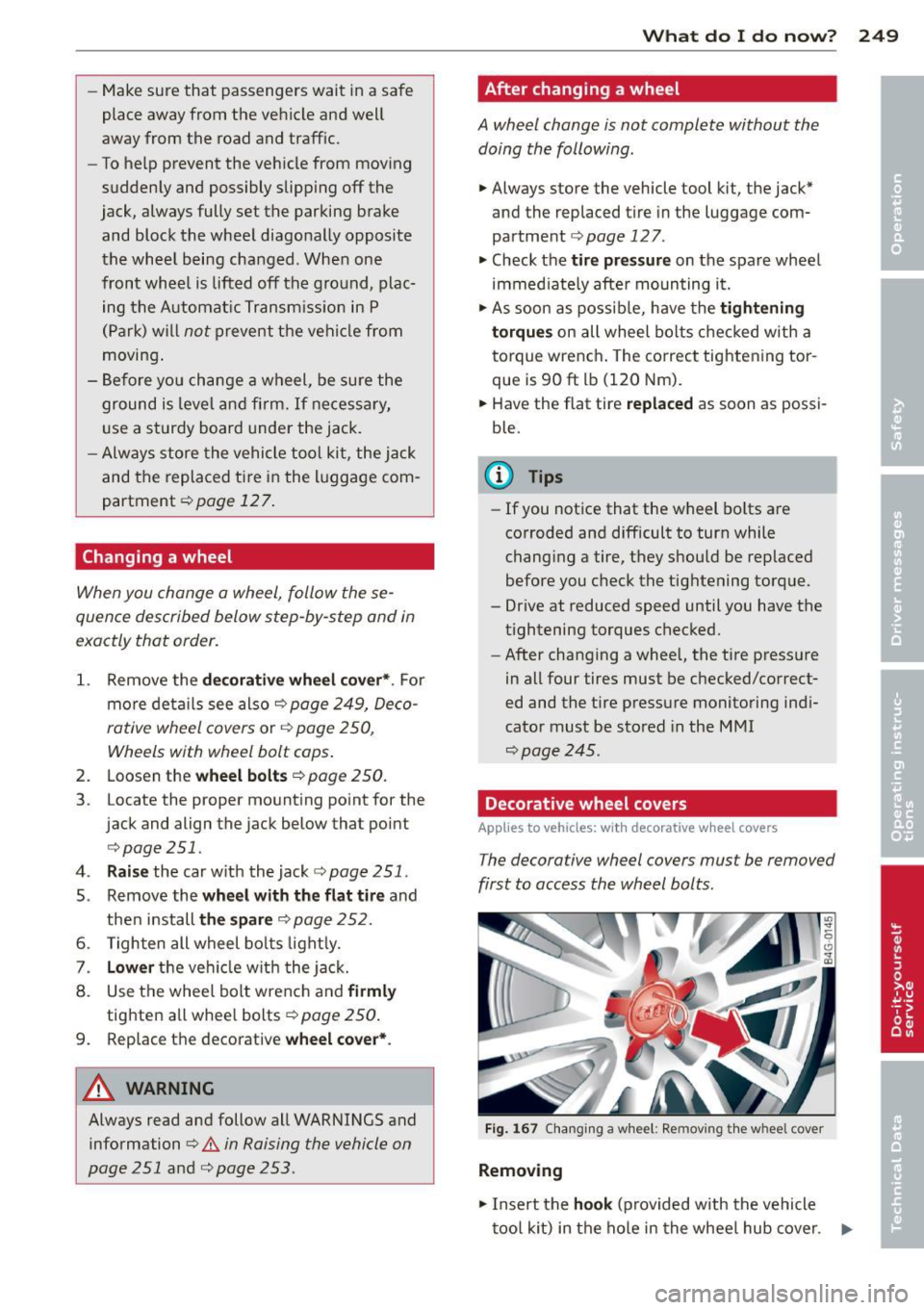
Fi g. 167 Chang ing a whee l: Removing th e w hee l cover
Removing
.,. Insert the hook (provided with the vehicle
t oo l kit) in the ho le in the whee l hub cover .
i,,.