brake AUDI A3 2015 Workshop Manual
[x] Cancel search | Manufacturer: AUDI, Model Year: 2015, Model line: A3, Model: AUDI A3 2015Pages: 288, PDF Size: 71.46 MB
Page 196 of 288
194 Driving and the environment
Driving through water
on roads
Note the following to avoid vehicle damage
when driving through water, for example on
flooded roads:
- The water must not be any higher than the
bottom of the vehicle body.
- Do not drive faster than wa lking speed.
A WARNING
After driving through water or mud, the
braking effect can be reduced due to mois
ture on the brake discs and brake pads. A
few careful brake applications should dry off the brakes.
@) Note
Vehicle components such as the engine, transmiss ion, suspension or electrical sys
tem can be severely damaged by driving
through water.
- Determ ine the depth before driving
through water.
- Do not stop the vehicle, drive in reverse
or switch the engine off when driving
through water .
- Keep in mind that oncoming vehicles may create waves that raise the water
level and make it too deep for your vehi
cle to drive through safely.
- Avoid dr iving through salt water (corro
s ion).
Catalytic converter
App lies to vehicles: with gasoline engine
It is very important that your emission con
trol system (catalytic converter) is function
ing properly to ensure that your vehicle is run
ning in an environmentally sound manner.
> Always use lead-free gaso line¢ page 206,
Fuel supply .
> Never run the tank down all the way to emp-
ty.
> Never put too much motor o il in your engine
¢ page 215, Adding engine oil
The catalytic converter is an efficient "clean
up" device built into the exhaust system of
the vehicle . The cata lytic converter burns
many of the pollutants in the exhaust gas be
fore they are released into the atmosphere.
The exclusive use of unleaded fuel is critica lly
important for the life of the catalytic convert
er and proper functioning of the engine.
A WARNING
-
The temperature of the exhaust system is high, both when driv ing and after stopping
the eng ine .
- Never touch the exhaust tail pipes once
they have become hot . This could result
in burns.
- Do not park or operate the vehicle in
areas where the hot exhaust system may
come in contact with dry grass, brush,
fue l spill or other material wh ich can
cause a fire.
- Do not app ly additional undercoating or
rustproofing on or near the exhaust manifold, exhaust pipes, catalytic con
verter or heat shields . Dur ing driving, the
substance used for undercoating could
overheat and cause a fire.
(D Note
- Be aware that just one tank filling with
leaded fuel will already seriously de
grade the performance of the catalytic
converter.
- Do not exceed the correct engine oil level
¢page 215.
-Do not drive until the fuel tank becomes
completely empty. The engine could mis
fire . Unburned fuel could also get into
the exhaust system and this cou ld cause
the catalytic converter to overheat.
- Do not switch off the ignition while the
vehicle is moving.
- Do not continue to operate your vehicle
under these conditions, as otherwise fuel
IIJ,,
Page 197 of 288
can reach the catalytic converter . This
could result in overheating of the con
verter, requ iring its replacement.
- To assure efficient operation of the Emis
sion Control System :
- Have your veh icle ma inta ined properly
and in accordance with the service rec
ommendations in your Wa rranty
&
Ma intenance booklet.
- Lac k of proper maintenance as well as
improper use of the vehicle will impa ir
t he funct ion of the emission control
system and cou ld lead to damage.
@) For the sake of the environment
Even when the Emission Cont ro l System is
operating properly, t he exhaus t gas can
have a s ulfu r-like exhaust gas smell unde r
some operating states. This depends on
the s ulfur content of the fue l being used .
Using a different brand of fuel may help,
or filling the tank w ith lead-free super
grade gasoline.
Placing your vehicle
out of service.
I f you wou ld like to take your vehicle out of
service for a longer t ime, contact your aut hor
iz ed A udi dealer or qualified repair facility .
They will advise you o f important meas ures,
such as cor rosion protection, maintenance
and storage procedures. Also follow the infor
mat ion about the battery¢
page 220.
Operate your vehicle
economically and
minimize pollution
General
Your personal style of driving will determine
the economy of your vehicle , as well as ex
haust and noise levels.
F ue l economy, environmental impact, and
wear on your engine, brakes and t ires largely
depend on three factors:
Dri ving and the en vironm ent 195
-your personal d riving s tyle
- operati ng conditions
- technical limitat io ns
If you ant ic ipate what you need to do next and
drive econom ically , yo u can easily cut your
fuel consumpt ion by 10-15 percent . This sec
tion w ill give you some tips on how you can
help the env ironment and your po cketbook.
(D Tips
The consumption estimates as published
by ENVIRO NM EN TAL PROT ECTI ON AG ENC Y
( E PA) and Transpo rt Canada may no t cor re
spond to your actual consump tion on the
r oad, which will va ry depending upon vehi
cle load and speed, road and weather con
ditions, trip length, etc.
Drive smoothly and keep a lookout
ahead
Vehicles use the most fuel when they are ac
celerating.
.. Avo id u nnecessary accelerating and brak ing.
Vehicles use the mos t fu e l when they are ac
ce lerating. If you anticipate what is going to
happe n next, you will need to brake less and,
th us, acce lerate less. Let the vehicle coast
whenever possible -for examp le when you see
that the next traff ic light is red.
Avoid full throttle
Driving at moderate speeds saves fuel and
improves your mileage.
.. Try and keep well below your car's maximum
speed.
Acce le rat ing gently re duces fue l cons ump
tion, eng ine wear, and does not disturb the
environment .
Fuel consumpt ion, exhaust em iss ions an d en
gine noise inc rease disproportionate ly at high
speeds . If you drive at approximately three
quarte rs of top speed, fuel consumption wi ll
be reduced by one ha lf. Never drive faster
IJ,-
•
•
•
Page 200 of 288
198 Trailer towing
Trailer towing Driving with a trailer
General information
Your Audi was designed primarily for passen
ger transportation .
If you plan to tow a tra iler, p lease remember
that the addit ional load will affect durability,
economy and performance .
T railer towing not on ly places more stress on
the vehicle, it also calls for more concentra
tion from the driver.
F or this reason, always fo llow the operating
and drivi ng in str uctions provided and use
common sense.
@ Note
If you are going to tow a trai le r, you must
activate the trailer operation mode
c:::> page 198 , Operating instructions.
Technical requirements
Traile r hitch
Use a weight-carrying hitch conforming to the
gross trailer weight. The hitch must be suita
b le for your veh icle and trailer and must be
mo unted secure ly on the ve hicle's chassis at a
technically sound loca tion . Use only a trailer
hi tch with a removab le ball moun t. A lways
check with the tra ile r hitch manufac turer to
make sure that you are using t he cor rect
hitch.
Do not use a bumper hit ch .
The hitch must be installed in such a way that
i t does not interfe re with the impact-absorb
ing bumper system. No modifications should
be made to the vehicle exhaust and brake sys
tems . From time to time, check th at a ll hitch
mo unt ing bo lts remain securely fastened.
When you are not towing a trailer, remove the
tra iler hitch ball moun t. T his prevents the
h itch from causing damage sho uld your veh i
cle be str uck from be hind
c:::> A .
Trailer brake s
If your trailer is equipped wi th a b ra ki ng sys
tem, c heck to be sure t hat i t conforms to all
regulations .
T he trailer hyd rauli c brake system mus t not be
direc tly connec ted to the vehicle's hydraulic
brake system .
Safety chains
Always use safety chains between your veh icle
and the tra ile r.
Trailer lights
Trai ler lights must meet all regulations. Be
sure to check w ith your Audi dealer for correct
wiring, switches and relays .
Mirrors
If you are unable to see the traffic behind you
us ing the regular o utside mirrors, then you
must install extended mirrors. It is important
that you
always have clear v is ion to the rear.
A WARNING
--
Afte r removi ng the trailer hitch, do not
stor e it in your vehicle . In case of sudden
b raking, t he hitch co uld fly forwa rd and i n
j ur e you or your passengers.
Operating instructions
Maximum trailer weight
A tra ile r fo r your vehicle is limited to a typical
class 1 or class 2 tr ailer.
Trailer load distribution
Be sure the load in the tra ile r is held secure ly
i n place to p revent it from shift ing forward,
backward or sideways.
Ne ver allow a pa ssenger to ride in a trailer
c:::> A in Driving instructions on page 199 .
Engine cooling system
Towing a trailer makes the engine work hard
er . It is important that the cooling system's
performance is up to the additional load.
Page 201 of 288
Make sure that the cooling system has enough
f luid .
Tire pressure
When tow ing a trai ler, inflate the t ires of your
veh icle to the cold tire pressure listed under
"Full load" on the label located on the driver's
side B-pillar (visible when the door is open) .
Inflate trailer tires to trai ler and tire manufac
turers' specifications.
Lights
Check to make sure both veh icle and trailer
lights are working properly.
Safety chains Be sure tra iler safety cha ins are properly con
nected from the trailer to the hitch on the ve
hicle. Leave enough slack in the chains to per
mit turning corners . When you install safety
chains, make sure they wi ll not drag on the
road when you are driving.
The chains should cross under the trailer
tongue to prevent it from dropping in case of
sepa ration from the hitch.
Driving instructions
Driving with a trailer always requires extra
care and consideration.
To obta in the best poss ible handling of vehicle
and trai le r, p lease note the following:
.. Do not tow a loaded tra iler when your car it
self is not loaded .
.. Be especially carefu l when passing other
vehicles.
.. Observe speed limits.
.. Do not drive at the maximum permissible
speed .
.. Always apply brakes early.
.. Monitor the temperature gauge.
Weight distribution
Tow ing a loaded trailer with an empty ca r re
sults in a high ly unstable distribution of
weight . If this cannot be avoided, drive at very
Trailer towing 199
low speeds on ly to avoid the risk of losing
steering contro l.
A "balanced " rig is easier to operate and con
trol. This means that the tow vehicle should
be loaded to the extent possible and permissi
ble, while keeping the trailer as light as possi
ble under the c ircumstances. Whenever poss i
ble, transfer some cargo to the luggage com
partment of the tow vehicle while observing
tongue load requirements and vehicle loading
considerations.
Speed
The higher the speed, the more difficu lt it be
comes for the driver to control the rig. Do not
drive at the maximum permissible speed. Re
duce your speed even more if load, weather or
wind conditions are unfavorable -particularly
when going downhill .
Reduce vehicle speed
immediately if the trail
er shows the slightest sign of swaying .
Do not
try to stop the swaying by accelerating .
Observe speed limits. In some areas, speeds
for vehicles towing tra ilers are lower than for
regular veh icles .
Always apply brakes early. When driving
downhill, shift into a lower gear to use the en gine braking effect to slow the vehicle . Use of
the brakes alone ca n cause them to overheat
and fail.
Coolant tempe rature
The coo lant temperature gauge¢
page 12
must be observed carefully. The coolant tem
perature can increase if you drive on long in
cli nes in a low gear at high engine speeds . Re
duce your speed immediately if the LEDs in
the top part of the display turn on.
For more information about ind icator lights,
refer to. ¢
page 20 .
A WARNING
Anyone not properly restrained in a mov
ing vehicle is at a much greate r risk in an
accident. Never let anyone ride in yo ur car
-
•
•
•
Page 202 of 288
200 Trailer towing
who is not properly wearing the restraints
provided by Aud i.
Trailer towing tips
Important to know
Your vehicle hand les different ly when tow ing
a trailer because of the additional weight and
different weight distribution. Safety, perform
ance and economy wi ll greatly depend on how
carefully you load your trailer and operate
your rig.
Before you actually tow your trailer, practice
turning, stopp ing and backing up in an area
away from traffic. Keep practicing until you have become completely familiar with the way
your vehicle-trailer combination behaves and responds.
Backing up is difficult and requires practice.
Backing up with a trai ler genera lly requires
steering action opposite to that when backing up your vehicle without a trailer.
Maintain a greater distance between your ve
hicle and the one in front of you. You will need
more room to stop. To compensate for the
trailer, you will need a larger than normal
turn ing radius .
When passing, remember that you cannot ac
celerate as fast as you normally would be
cause of the added load. Make sure you have
enough room to pass . After passing, allow
plenty of room for your tra iler before chang
ing lanes aga in.
Avoid jerky starts, sharp turns or rapid lane
changes .
(D Tips
-Do not tow a tra iler during the break-in
period of your vehicle.
- If you tow a trailer, your Audi may re
quire more frequent maintenance due to
the extra load
q page 268.
Parking on a slope
Do not park on a slope with a trailer . If it can
not be avoided, do so only after doing the fol lowing:
When parking:
.. App ly the foot brake.
.. Have someone place chocks under both the
vehicle and the trailer wheels .
.,. With chocks in place, slowly release the
brakes until the wheel chocks absorb the
load.
.. Turn the whee ls towards the curb.
.. App ly the parking brake.
.. Select the P selector lever position.
When restarting after parking:
.. Apply the foot brake .
.. Start the engine .
.. Select the D/S selector lever position.
.. Release the parking brake and s lowly pull
out and away from the wheel chocks .
.. Stop and have someone retrieve the wheel
chocks .
(D Tips
If you move the selector lever of the auto
matic transmission to P before applying
the parking brake and before blocking the
whee ls, you may have to use more force
later to move the lever out of the P posi
tion.
Page 204 of 288
202 Caring and cle aning
_& WARNING
- Only wash the vehicle when the ignition
is off and follow the instructions from
the car wash operator to reduce t he risk
of accidents.
- To reduce the risk of cuts, protect your
self from sharp meta l components when
wash ing the underbody or the inside of
the wheel housings.
- After washing the vehicle, the braking ef
fect may be de layed due to mo isture on
the brake rotors or ice in the winter. The
brakes must be dried first with a few
careful brake applicat ions .
@ Note
- If you wash t he vehicle in an automatic
ca r wash, you must fold the exterior m ir
r o rs in to reduce the r isk of damage to
t h e m irrors. Power foldi ng exterior m ir
r o rs* must on ly be folded in and o ut us
i ng the p ower folding function.
- To prevent pa int damage, do not wash
t h e ve hicle in direc t sunli ght. -
To reduce the ris k of damage to the sur
face, do not use insect removing spong
es, kitchen sponges or similar items.
- Matte finish painted veh icle compo
nents:
- To reduce the risk of damage to the
surface, do not use polishi ng agents or
h a rd wax.
- Never use protect ive wax. It can de
stroy the matte fi nish effec t.
- Do not place any stickers o r mag net ic
s igns on vehicle parts painted w ith
matte fi nish pa int. The paint cou ld be
d amaged when the sticke rs o r mag nets
ar e removed. @ For the sake of the environment
Only wash the ve hicl e in facilities spec ia lly
de signed for that purpose. This will red uce
the r is k of dirty w ate r contam ina ted with
oi l from entering the sewer sys tem.
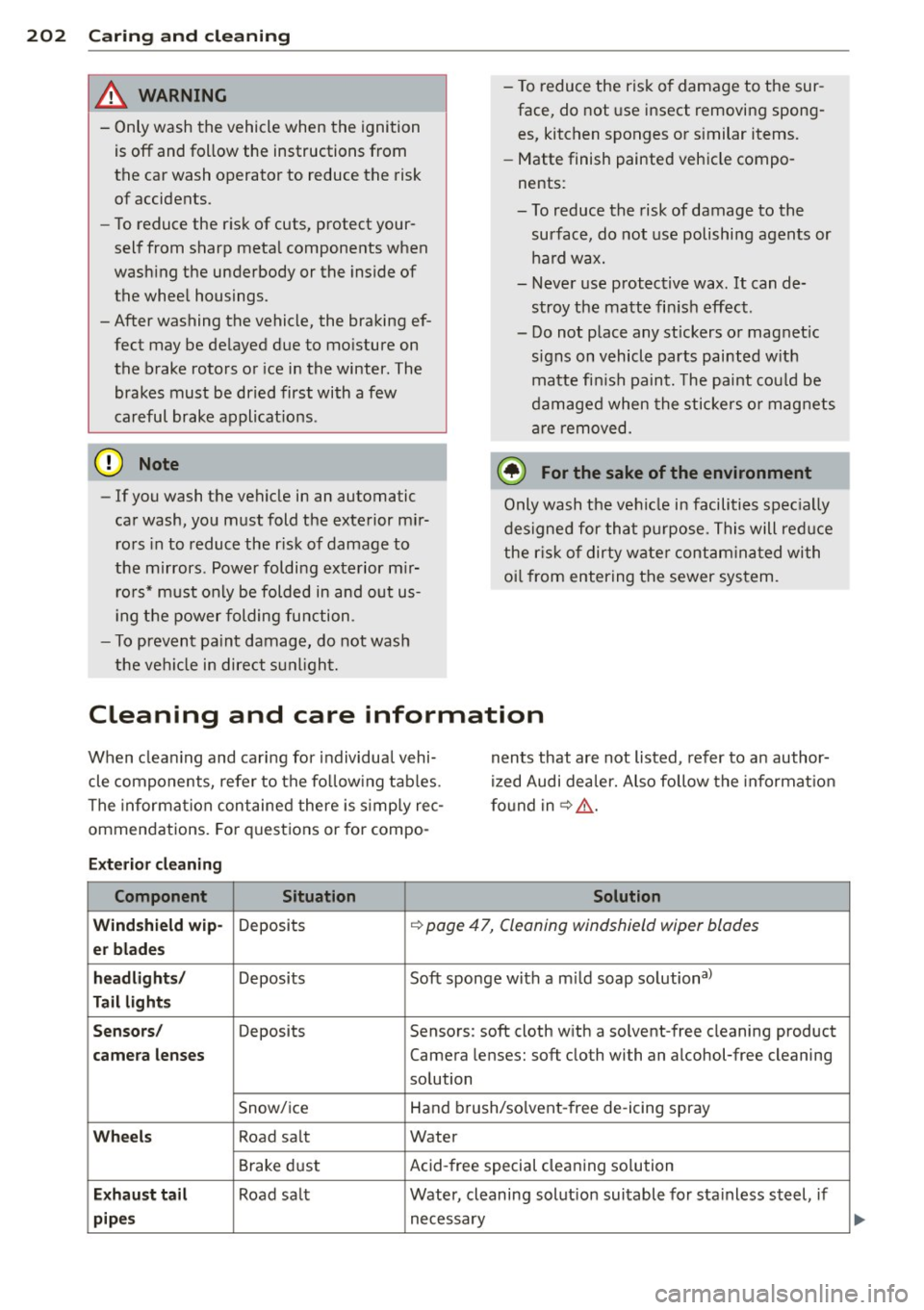
Cleaning and care information
When clea ning and ca rin g for individua l vehi
cle components, refer to the fo llow ing tab les.
The informa tion con taine d there is s imp ly rec
ommendations. Fo r quest ions or for compo -nents that ar
e not listed, refer to an author
i z ed Audi dea ler. Also follow the in format io n
f o und in¢ ,&..
Exterior cleaning
Component Situation Solution
Wind shield wip-
Deposi ts ¢ page 47, Cleaning windshield wiper blades
er blades
headlights /
Deposits Soft sponge with a m ild soap solutiona>
Tail lights
Sensors /
Deposits Sensors: soft cloth with a so lvent-free cleaning product
camera lenses Camera lenses: soft cloth with an alcohol-free cleaning
so lution
Snow/ ice Hand brush/solvent -free de -icing spray
Wheels Road sa lt Water
Brake d ust Acid-free special cleaning so lution
E x haust ta il Road sa lt Water, cleaning solut ion suitable fo r sta inless steel, if
pipes necessary
Page 212 of 288
210 Check ing and F illin g
Only pull on the loop until you fee l resist
ance. You will not hear it release . Other
w ise you could damage the emergency re
lease mechanism .
Hood
Working in the engine compartment
Special care is required if you are working in
the engine compartment
F o r w ork in th e engine co mpartm ent such as
c h ec king an d filling fluids, there i s a ri sk of
inj ury, sca lding, a ccid ent s, and b urn s. For
t hi s re ason , fo llow all th e followin g lis te d
warn in gs a nd ge neral safe ty pr eca utions.
Th e e ngine compartment is a d ange rous
area .¢ .& .
&_ WARNING
To reduce the risk of injury, before you
check anyth ing under the hood:
- Turn the engine off.
- Set the parking brake.
- Place the selector leve r in the P position.
- Remove the ignit io n key .
- Let the engine coo l down.
- To reduce the r isk of being burned, never
open the hood if you see or hear steam
or coolant escaping from the engine
compartment . Wait until no steam or
coolant can be seen or hea rd before ca re
fully opening the hood.
- Keep chi ldren away from the engine com
partment .
- Never spill flu ids on a hot engine. These
fluids (such as the freeze protection con
tained in the coolant) can catch fi re.
- Avoid short circuits in the electrical sys
tem, especially the battery.
- When working in the engine compart
ment, remembe r that the radiator fan
can switch on even if the ignition is
switched off, which increases the risk of
persona l injury . -
Never open the cap on the coolant ex
pans ion tank when the eng ine is warm.
The coolant system is under pressure.
- To protect your face, hands, and arms
from hot steam or coolant, cover the cap
with a large cloth when opening.
- Do not remove the engine cover under
any circumstances . This increases the
risk of burns .
- If tests need to be performed with the
engine runn ing , there is add itional dan
ger due to moving components (such as
the ribbed belt, generator and radiator
fan) and from the high voltage ignit ion
system.
- Never touch the rad iator fan . The auxili
ary electric fan is temperature controlled
and can switch on suddenly.
- Pay attention to the fo llow ing warnings
listed when wo rk on the fuel system or
on the e lectr ica l equipment is req uired.
-A lways disconnect the vehicle battery
from the vehicle electr ical system
- Do not smoke
- Never work near open flames
- Always have a wo rk ing fire exting uisher
nearby
- To avo id e lectr ica l sho ck and pe rsonal in
jury whi le the engine is running or being
started, never touch:
- Ign it ion cables
- Other components of the high voltage
electronic ignition system.
- If you must perform a check or repair
with the eng ine running:
- First, fully app ly the parking brake,
move selector lever to P (Park).
- Always use extreme caut io n to prevent
cl othing, jewelry, or long hair from get
ting caught in the radiator fan, V-be lts
o r other moving parts, o r from contact
ing hot parts. Tie back hair before
starting, and do not wear clothing that
will hang or droop into the engine.
- Minimize exposure to emission and
chemical hazards¢,& . ..,.
Page 214 of 288
212 Checking and Filling
- When you close the engine hood, check it
to make sure the safety catch has proper
ly engaged. The hood should be flush
with the surrounding vehicle body parts.
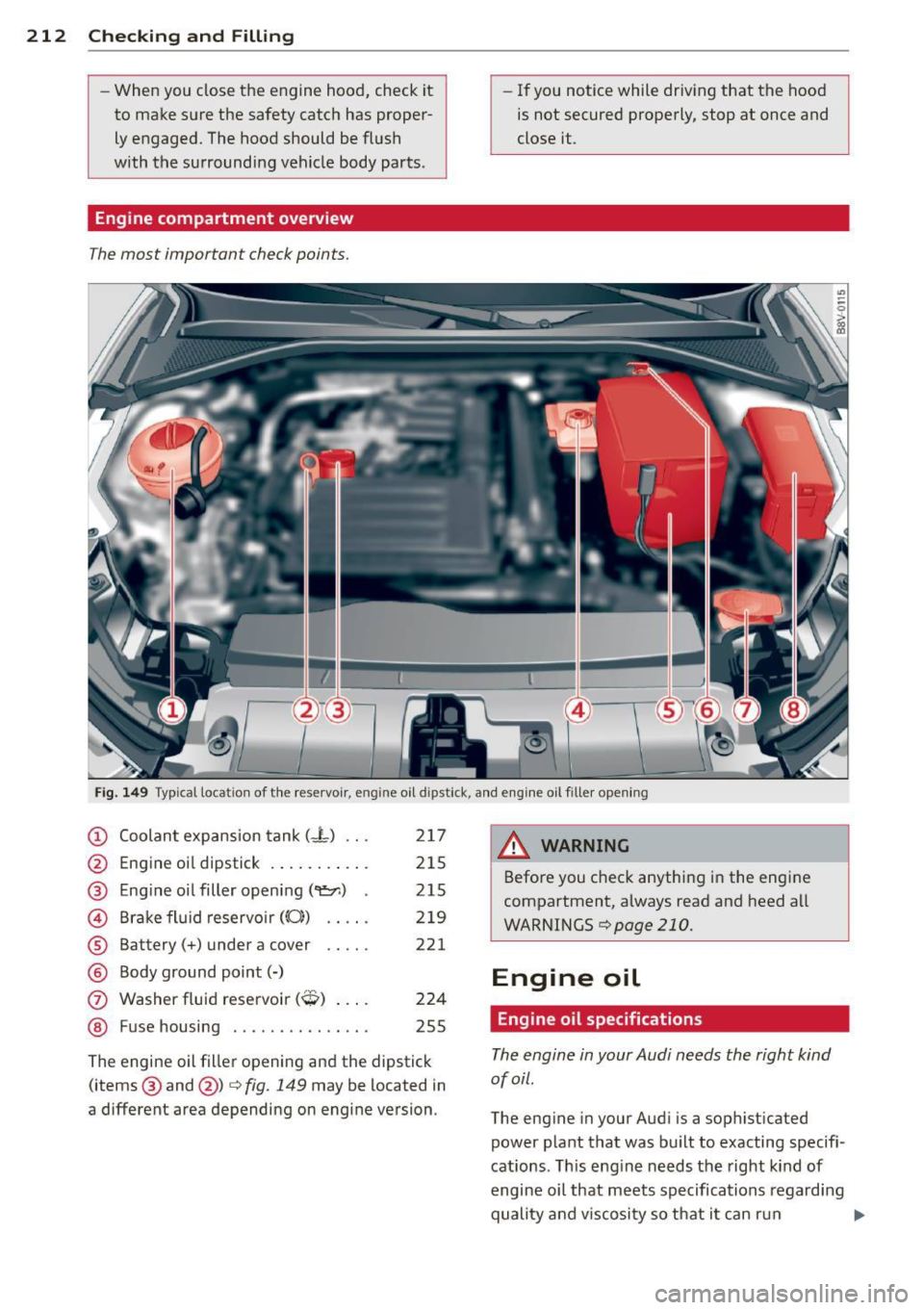
Engine compartment overview
The most important check points.
- If you notice while driv ing that the hood
is not secured properly, stop at once and
close it.
Fig. 149 Typ ica l locat ion of the reservoir, en g in e oil d ipstick, and engine o il filler opening
(D Coolant expansion tank (- L) .. .
@ Engine oi l dipstick ... .... .. . .
® Engine oil filler opening (~) .
@ Brake fluid reservo ir ((0)) .. .. .
® Battery(+) under a cover .. .. .
@ Body ground point(-)
0 Washer f luid reservoir (~) ... .
@ Fuse housing ....... .... ... .
2 17
215
215
219
221
224
255
The engine oil filler opening and the dipstick (items ® and @)
c::> fig. 149 may be located in
a different area depending on engine version .
A WARNING ,...,___ -
Before you check anything in the engine
compartment, always read and heed all
WARNINGS
c::> page 210.
Engine oil
Engine oil specifications
The engine in your Audi needs the right kind
of oil.
The eng ine in your Audi is a sophisticated
power plant that was built to exacting specifi
cations . This engine needs the right kind of
engine oil that meets specifications regarding
quality and v iscosity so that it can run
II>-
Page 221 of 288
Brake fluid
Checking brake fluid level
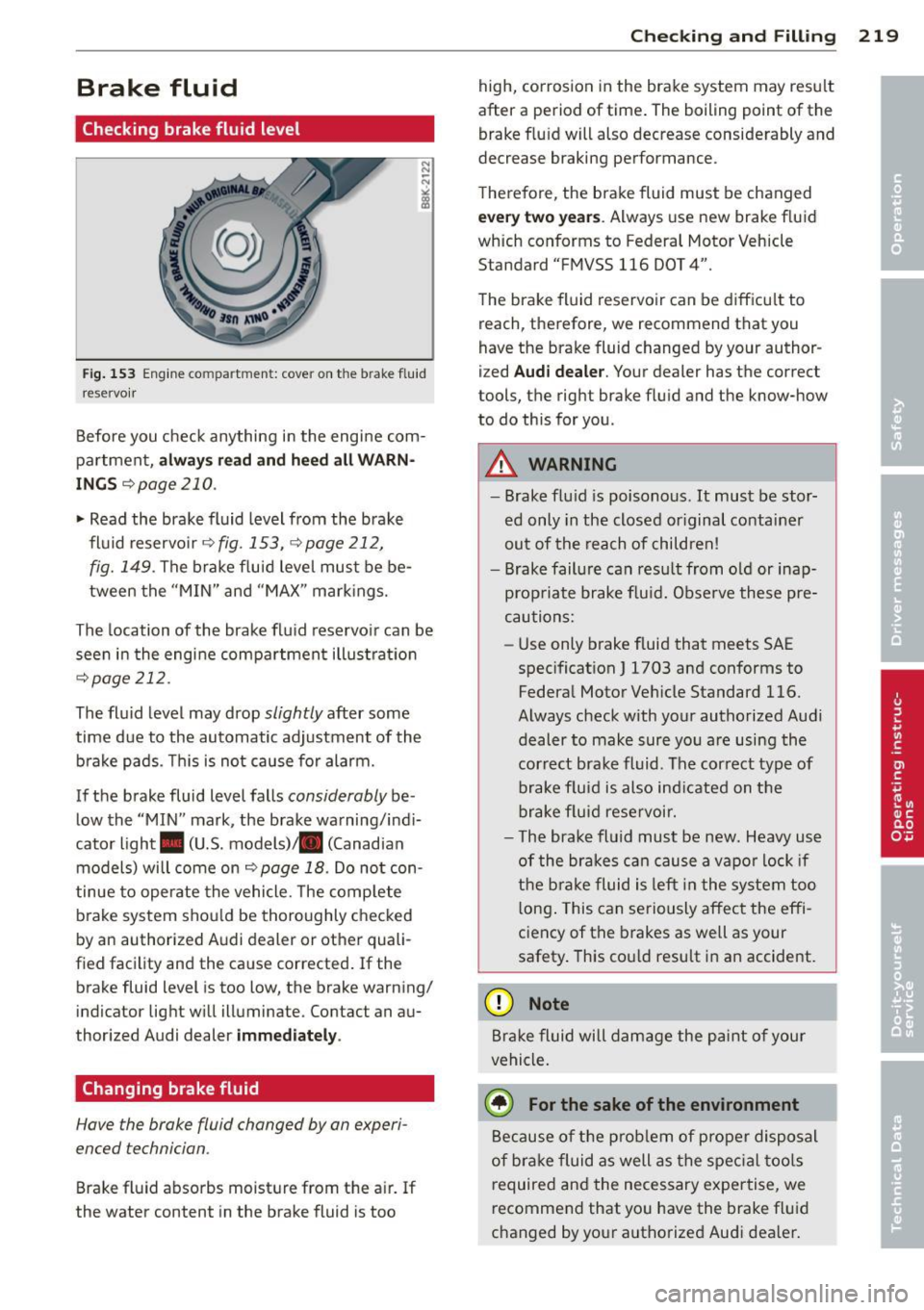
Fig . 153 Engine co mpa rtment: cove r on the b rake f lu id
reservo ir
B efore you check anything in the engi ne com
partment,
alwa ys read and heed all WARN ·
INGS r:=:,page 210 .
~ Read the brak e fluid level from the brake
fluid reservo ir
r:=;, fig . 153, r:=:, page 212,
fig. 149 .
The brake f luid leve l mus t be be
tween the "MIN" and "MAX " ma rkings.
The location of the brake flu id reservo ir can be
seen in the engi ne compa rtment illust ra ti on
¢ page 212 .
The fluid level may drop slightly after some
time due to the automatic adjustment of the b rake pads . Thi s is not cause for alarm.
If the brake fluid level falls
considerably be
low the "MIN" mark, the b rake wa rning/ind i
cato r light . (U .S . models)/ . (Canadian
models) will come on
r:=;, page 18 . Do not con
tinue to operate the vehicle. The comp lete
brake system should be thoroughly checked
by an authorized A udi dealer or other quali
f ied fac ility and the ca use corrected . If the
br ake fluid level is too low, the brake warning/
indica tor light w ill illuminate. Contact an au·
thor ized Audi dealer
immediately .
Changing brake fluid
Have the brake fluid changed by an experi
enced technician .
Brake fluid abso rbs moist ure from the air. If
the water content in the brake fluid is too
Che cking and Fillin g 219
high, co rrosion in the brake system may resu lt
after a period of time . The boiling point of the
brake f lu id will also decrease conside rably and
decrease braking performance.
T herefore, the brake fluid must be changed
eve ry two year s. Always use new brake f luid
which conforms to Federal Motor Veh icle
Standard "FMVSS 116 DOT 4".
The brake fluid reservoi r can be difficu lt to
reach, therefore, we recomm end that you
have the brake fluid changed by your author
i z ed
Audi dealer . Your dealer has the correct
tools, the right brake flu id and the know-how
to do this for you .
A WARNING
-
-Brake flu id is poisonous. It must be stor-
ed only in the closed or iginal containe r
out of the rea ch of children!
- Brake failure can resu lt from o ld or inap
p rop riate brake f lu id. Observe these pre
cautions:
- Use only brake f luid that meets SAE
spec ificat ion
J 1703 and conforms to
Federa l Motor Ve hicle Standard 116.
Always check with your authorized Audi
dealer to make sure yo u are using the
cor rect bra ke fluid. The cor rect type of
brake f luid is also i nd icated on t he
brake f lui d rese rvoir.
- The bra ke flu id must be new. Heavy us e
of the brake s can cause a vapo r lock if
the b ra ke fluid is left i n the system too
l ong . This can se riously affect the effi
ciency of the brakes as we ll as your
safety . This co uld resu lt i n an accident .
(D Note
Brak e fluid will dam age the pa int of your
vehicle .
@ For the sake of the environment
Because of the p rob lem of proper disposal
o f bra ke fluid as well as the spec ial too ls
r equired and the necessary exper tise, we
recommend that yo u have the brake flu id
changed by yo ur authorized Audi dea ler.
Page 227 of 288
Tires and wheels
Tires
General notes
Tires may be the least appreciated and most
abused parts of a motor vehicle .
Tires may be the least appreciated and most
abused parts of a motor vehicle . Tires are,
however, one of the most important parts of a
veh icle, particularly considering the compara
tively small patch of rubber on each tire that
assures that a ll- important contact between
you, your vehicle and the road.
Maintaining the correct tire pressure, mak ing
sure that your vehicle and its tires do not have
to carry mo re weight than they can safely han
d le, avoiding damage from road hazards and
r eg ularly inspect ing t ires for damage includ
ing cuts, slashes irregu la r wear and overall
condition are the most important things that
you can do to he lp avoid sudden tire failure in
cluding tread separation and blowouts.
Avoiding damage If you have to d rive over a curb or similar ob
stacle, drive very slow ly and as close as possi
b le at a right angle to the curb.
A lways keep chemicals includ ing grease, o il ,
gasoline and brake fluid off the t ires .
I nspect the t ires regularly for damage (cuts,
cracks or b listers, etc.). Remove any fo reign
bod ies embedde d in the treads.
Storing tires Mark t ires when you remove them to indicate
the direction of rotation . T his ensures you to
be ab le to mount them correctly when you re
i nstall them .
When removed, the whee ls or t ires should be
sto red in a cool, d ry and preferably dark place .
Store tires in a vertical pos ition if they are not
mounted on rims, in a horizontal pos ition if
they are mounted on rims .
Tires an d wheel s 225
New tires
New ti res h ave to be broken in¢& .
The tread depth of new t ires may vary, accord
ing to the type a nd make of t ire and the tread
pa tte rn.
H idden damage
Damage to tires and rims is ofte n not readily
visible . If you notice unusual v ib rat ion or the
vehicle pulls to one s ide, th is may ind icate
that one of the t ires has been damaged . T he
ti res m ust be chec ked immed iate ly by an au
thorized Audi dea le r or q ua lified wor kshop .
Unidirectional tires
A un idirectional tire can be identified by ar
rows on the sidewa ll, that po int in the direc
tion the t ire is designed to rotate. You mus t
f ol low the specified di rection o f rotation . T his
is necessary so that these tires can develop
their optimum characteristics regarding grip, road noise, wear and hydrop laning resistance.
For more information
¢page 253.
A WARNING
New tires or t ires that are old, worn or
damaged cannot provide maximum con
trol and braking ability .
-
-New tires tend to be slippery and must
also be b roken-in. To reduce the risk of
losing control , a collision and serious
pe rsonal injuries, drive w it h special care
for the first 350 miles (560 km).
- Driving with worn or damaged tires can
lead to loss of control, sudden tire fail
ure, including a blowout and sudden de
fl ation, cras hes and se riou s personal in
juries . Have wo rn or damaged t ires re
placed immediate ly.
- Ti res age even if they are not being used
and can fai l sudden ly, especially at hig h
spee ds. Tires that are more than 6 years
old can only be used in an emergency
and then w ith special care and at low
speed.
•
•
•