light AUDI A3 2016 Owner´s Manual
[x] Cancel search | Manufacturer: AUDI, Model Year: 2016, Model line: A3, Model: AUDI A3 2016Pages: 328, PDF Size: 81.78 MB
Page 243 of 328
Using the proper engine oil is important for the
functionality and service life of the engine. Your
engine was factory-filled with a high -quality oil
which can usually be used throughout the entire
yea r.
Note
Your Limited New Vehicle Warranty does not
cover damage or malfunctions d ue to failure
to follow rec ommended maintenance and use
requireme nts as s et forth in the Audi Owner's
Manual and Warranty & Maintenance booklet.
- Use only a high quality engine oi l that ex-
pressly complies with the Au di oil quality
standard specified for your vehicle's engine.
Using any o ther oil can cause serious engine
damage.
- Do not mix any lubricants o r other additives
into the engine oil. Doing so can cause en
gine damage.
@ Tips
If you need to add oil and there is none availa
ble that meets the Audi o il quality standard
your eng ine requ ires, you may add a total of
no more than 0 .5 quart/li ter of a h igh-quality
"synthet ic"oil that meets the following speci
fications.
- Vehicles with gasoline eng ine: ACEA A3 o r
API SM with a viscosity grade of SAE OW-30,
SAE SW-30 or SAE SW-40.
- Vehicles with diesel eng ine: ACEA C3 or
API CF with a viscosity grade of SAE OW-30
or SAE SW -30.
- For more information about engine oil that
has been approved for your vehicle, please
contact e ither your authorized Audi dea ler
or Audi Customer Relat ions at
1 (800) 822-2834 or visit our web site at
www.audiusa.com or www.aud icanada.ca.
Engine oil consumption
The engine in your vehicle depends on an ode-
;::: quote amount of oil to lubricate and cool all of
~ its moving parts . co ,....,
~ In order to provide effective lubr ication and cool-,....,
:=: ing of internal engine components, all internal
Ch eck ing and Filling
combustion engines consume a certain amo unt
of oil. Oil consumption varies from engine to en
gine and may change s ignificantly over the life of
the engine. Typ ically, engines w ith a specified
break-in period (see¢
page 77) consume more
o il during the break-in per iod than they consume
after o il consumption has stab il ized.
Under normal cond itions, the rate of oil con
sumption depends on the quality and viscos ity of
the oil, the RPM (revolutions per minute) at
wh ich the engine is operated, the amb ient tem
perature and road co ndit ions. Further facto rs a re
the amount of oi l di lution from wate r condensa
tion or fuel resid ue and the oxidat ion level of the
o il. As any engine is subject to wear as mileage
builds up, the oil consumption may increase over
time unti l replacement of worn components may
become necessary.
With a ll these variab les coming into play, no
standard rate of oil consumption can be estab
li shed or specified. There is no alternative to reg
u lar and frequent checking of the oi l level, see
Note .
If the yellow engine oil leve l warning symbo l l!I
in the instrument cluster lights up, you should
check the oi l level as soon as possible
¢
page 242. Top off the o il at your earliest con
venience ¢
page 242.
A WARNING
-Before you check anyt hing in the engine com-
partment, always read and heed all WARN
INGS
¢page 236.
(D Note
Driving wit h an insufficient oil level is likely to
cause severe damage to the eng ine.
(D Tips
- The oil pressu re wa rning display. is not
an indicator of the oi l le vel. Do not rely on
i t. In stead , check th e oil level in your en
gine at regular intervals, preferably each
time you refuel, and alway s before goi ng
on a long trip .
241
Page 247 of 328

.... N
0 > CX)
.... I.Cl U"I
.... I.Cl ....
corrosion can cause a loss of coolant and
serious engine damage .
- Do not add any type of radiator leak sealant
to your vehicle's engine coolant . Adding ra
diator repair fluid may adversely affect the
function and performance of your cooling
system and could result in damage not cov
ered by your New Vehicle Limited Warranty.
Adding coolant
F ig . 198 Engine compa rtment: mark in gs on t he coo lant
expa nsion tank
Read and follow the WARNINGS before check
ing anything in the engine compartment
¢ page 236, Working in the engine compart
ment.
Checking the engine coolant level
• Park your vehicle on a level surface .
• Switch the ignition off .
• Read the coolant level on the coolant expansion
tank
¢ fig. 198 . The coolant level must be be
tween the markings when the engine in cold .
When the engine is warm it can be slightly above the upper marking.
Adding coolant
Plug-in hybrid drive*: your vehicle has two cool
ant expansion tanks that are separate from each
other. The smaller of the two expansion tanks
must not be opened
¢ page 108. Read and fol
low the important safety precautions ¢
A in
Coolant on page 109.
Requirement: there must be a residual amount of
coolant in the expansion tank ¢(D .
• Let the engine cool down .
Checking and Filling
• Place a cloth over the coolant expansion tank
cap and unscrew the cap counterclockwise
¢ A .
• Add coolant mixed in the correct ratio
¢
page 244 up to the upper marking.
• Make sure that the fluid level remains stable.
Add more coolant if necessary.
• Close the cap securely .
A coolant loss suggests a leak. Immediately drive
your vehicle to an authorized Audi dealer or au
thorized Audi Service Facility and have the cool
i ng system inspected. If the cooling system is not
leak ing, a loss can come from the coolant boiling
through overheat ing and being pushed out of the
cooling system .
,&_ WARNING
-= -The cooling system is pressurized and can be
come very hot. To reduce the risk of burns
from hot coolant:
- Do not open the coolant expansion tank cap
with the engine hot. There is a risk of burns.
- Stop the engine and allow it to cool.
- Protect your face, hands and arms from es-
caping coolant and steam by covering the
coo lant tank cap with a large, thick cloth.
- Turn the coolant tank cap counterclockwise
slowly and keep light pressure on the cap.
- To reduce the risk of burns, do not allow any
antifreeze or coolant to drip onto the ex
haust system or hot engine components.
The ethylene glycol in engine coo lant can
catch fire under certain circumstances .
- The coolant additive and the coolant can be
dangerous to your health . For th is reason,
keep the coolant in the original container
away from children. There is a risk of poi
soning .
- When working in the engine compartment,
remember that the radiator fan can switch
on even if the ignition is switched off, wh ich
increases the risk of persona l injury.
(J) Note
Do not add coolant if the expansion tank is
empty . Air could enter the cooling system and
damage the eng ine.
If this is the case, do not ..,_
245
Page 248 of 328

Checking and Filling
cont inue driving. See an authorized Audi deal
er or authorized Audi Service Facility for assis
tance .
Radiator fan
The radiator fan switches on outomotico/ly by it
self.
An auxiliary elect ric radiator fan sw itches on and
off depend ing on coolant temperature and other
vehicle operating conditions.
After you switch the engine off, the auxiliary fa n
can cont inue runn ing fo r up to 10 minutes -even
with the ignition off . It ca n even switch on again
later by itself¢.&. , if
- the temperature of the engine coolant r ises due
to the heat bu ild -up from the engine in the e n
gine compartment, or
- the engine compartment heats up because the
vehicle is parked in intense sunlight .
A WARNING
-To reduce the risk of pe rsonal injury never
touch the radiator fan .
- The auxiliary electric fan is temperature
controlled and can switch on suddenly even
when the eng ine is not running.
- The auxiliary radiator fan switches on auto
matically when the engine coo lant reaches a
certain tempe rature and w ill cont inue to run
until the coolant temperature drops.
Brake fluid
Checking brake fluid level
F ig . 19 9 Engine co mpar tment: cove r o n t he b rake fluid
r e servo ir (example)
246
-
Before yo u check any thing in the engine compart
ment,
always read and heed all WARNINGS
¢ page 236, Working in the engine comport
ment .
.,. Read the brake fluid level from the brake f luid
reservoir ¢
fig. 199, ¢ page 239, fig. 193 (ga
soil engine) or ¢
page 240, fig. 194 (diesel en
gine). The brake fluid level must be between
the "MIN" and "MAX" markings .
The location of the brake fl u id reservoir can be
seen in the engine compartment i llustration
q page239.
The fluid level may drop slightly after some time
due to t he automatic adjustment of the brake
pads. This is not ca use for a larm.
If t he brake fluid level falls considerably below
the "M IN" mark, the brake warning/indicator
li ght ~ (U.S. models)
I. (Canadian models)
will come on
q page 18 . Do not continue to oper
ate the vehicle . The complete brake system
shou ld be thorough ly checked by an authorized
Audi dealer or other qualified fac ility and the
cause corrected .
If the brake fl uid level is too
l ow, the bra ke war ning/ indicato r light w ill illumi
na te. Cont act an a uthor ized Audi dealer
immedi
atel y.
Changing brake fluid
Have the brake fluid changed by an experienced
technician.
B rake fl uid abso rbs moistu re from the air. If the
wa ter con ten t in the brake fluid is too high, cor
r osion in the bra ke system may res ult after ape
riod of time. The boi ling po int of the brake fluid
will a lso decrease considerably and decrease
bra king performance.
Therefore, the bra ke fluid m ust be changed
every
two year s. Always use new brake f luid which con
forms to Federa l Motor Vehicle Standard " FMVSS
116 DO T 4" .
The brake fluid reservoir can be diffic ult to reac h,
the refore, we recommend that you have t he
brake fluid changed by your author ized
Audi
dealer .
Your dealer has the correct tools, the
Page 249 of 328
,....,
N
0 > co ,....,
you.
A WARNING
- Brake fluid is poisonous. It must be stored
only in the closed original container out of
the reach of chi ldren!
- Brake failure can resu lt from old or inappro
priate brake fluid. Observe these precau
t ions:
- Use only brake flu id that meets SA E speci
fication
J 1703 and conforms to Federal
Motor Vehicle Standard 116. Always check
with your authorized Audi dealer to make
sure you are using the correct brake fluid.
The correct type of brake fluid is also indi
cated on the brake flu id reservoir.
- The brake fluid must be new. Heavy use of
the brakes can cause a vapor lock if the
brake fluid is left in the system too long.
This can ser iously affect the efficiency of
the brakes as well as your safety. This
could result in an acc ident.
(D Note
Brake fluid w ill damage the pa int of your vehi
cle.
For the sake of the environment
Because of the prob lem of proper disposal of
brake flu id as well as the special tools re
quired and the necessary expertise, we rec
ommend that you have the brake fluid
changed by your author ized Audi dealer.
Battery
General information
All work on the battery requires expert knowl
edge.
Read and foll ow t he WARNING S before check
ing anything in the engine compartment
¢ page 236, Working in the engine comport
ment.
Ch eck ing and Filling
Plug -in hybrid drive* : you can find important in
formation about the high -vo ltage battery under
¢ page 98.
The battery in yo ur Audi does not need any ma in
tenance under
normal operating conditions . Audi
recommends having the electrolyte level check
by an authorized Audi dealer or author ized Audi
Service Facility when there are
high outside tem
peratures or when dr iving all day. The e lectrolyte
level should also be checked each time the bat
tery is charged¢
page 249.
Have the battery checked when you bring your ve
hicle in for an inspection. It is a good idea to re
place the battery if it is more than 5 years old.
D uring certa in types of a irbag deployments, the
battery is d isconnected from the veh icle electri
cal system for safety reasons¢
& in Repair, core
and disposal of the airbags on page 199.
Di sco nnecting the battery te rminal s
The battery should not be disconnected. Several
vehicle functions (power windows, for example)
will be lost when the battery is disconnected. The
funct ions must be reprogrammed after connect
ing the battery. To avoid this, the battery should
only be disconnected from the vehicle electrical
system when it is absolutely necessary.
To reprogram the functions, proceed as follows:
Function Reprogramming
Power window one-¢ page 44, Correcting
touch up/down func-power window molfunc-
tion tions
Remote control key or
If the vehicle does not
Convenience key react to the key, it must
be synchronized
¢page 37
Dig ita l clock ¢page 10
ESC indicator light The indicator light goes
out after driving a few
meters
247
Page 250 of 328
Check ing and F illing
Not running th e vehicle for long p eriod s of
t im e
If you do not drive your vehicle for several days or
weeks, electrical components are gradually re duced or sw itched off. Th is reduces energy con
sumpt io n and maintains the vehicle's ability to
start over a long period of time
c:::, page 164 .
Some convenience functions, such as interior
lighting or power seats* may not work . These
convenience functions will be available again
once yo u sw itch the ignition on and start the en
gine.
Winter operation
During the winter months, it is common for the
battery capacity to decrease as the temperatures
become lowe r. This is because mo re power is
needed to sta rt the veh icle and components s uch
as the headlights and the rear window defogger
are used more frequently .
Avoid using power unnecessar ily, especially in
ci ty driving or on sho rt trips. Have yo ur author
ized Audi dealer or authorized Audi Service Facili
ty check the battery capacity before the start of
winter c:::, page 249. A well-charged battery will
not on ly reduce starting problems in cold weath
er, but it will also last longer .
A WARNING
-Work on the battery requires expert knowl
edge. Contact an authorized Audi dealer or
autho rized Aud i Service Facility for informa
t ion regarding the vehicle battery. There is a
risk for chemical burns or explosions.
- Never open the vehicle battery. Do not t ry to
c hange the batte ry electro lyte level. Othe r
wise explosive gas wi ll escape from the bat
te ry and increase the risk of an explos ion .
(D Tips
If your vehicle is not driven for several weeks
in very cold temperatu res, remove the batte ry
and sto re it in a pla ce where it wi ll not freeze.
This prevents the battery from being dam
aged and needing to be replaced.
248
· Working on the battery
Be especially careful when working on or near
the battery.
Plug- in hybrid drive*: For important informat ion
about the high-voltage battery, refer to
c:::, page 98 .
The battery is located in the engine compart
ment . Before you check anything in the engine
compartment,
r e ad and heed all WARNING S
¢,&. .
Always heed the safe ty wa rnings , when working
on the vehicle battery or the veh icle electrical
system to prevent injury .
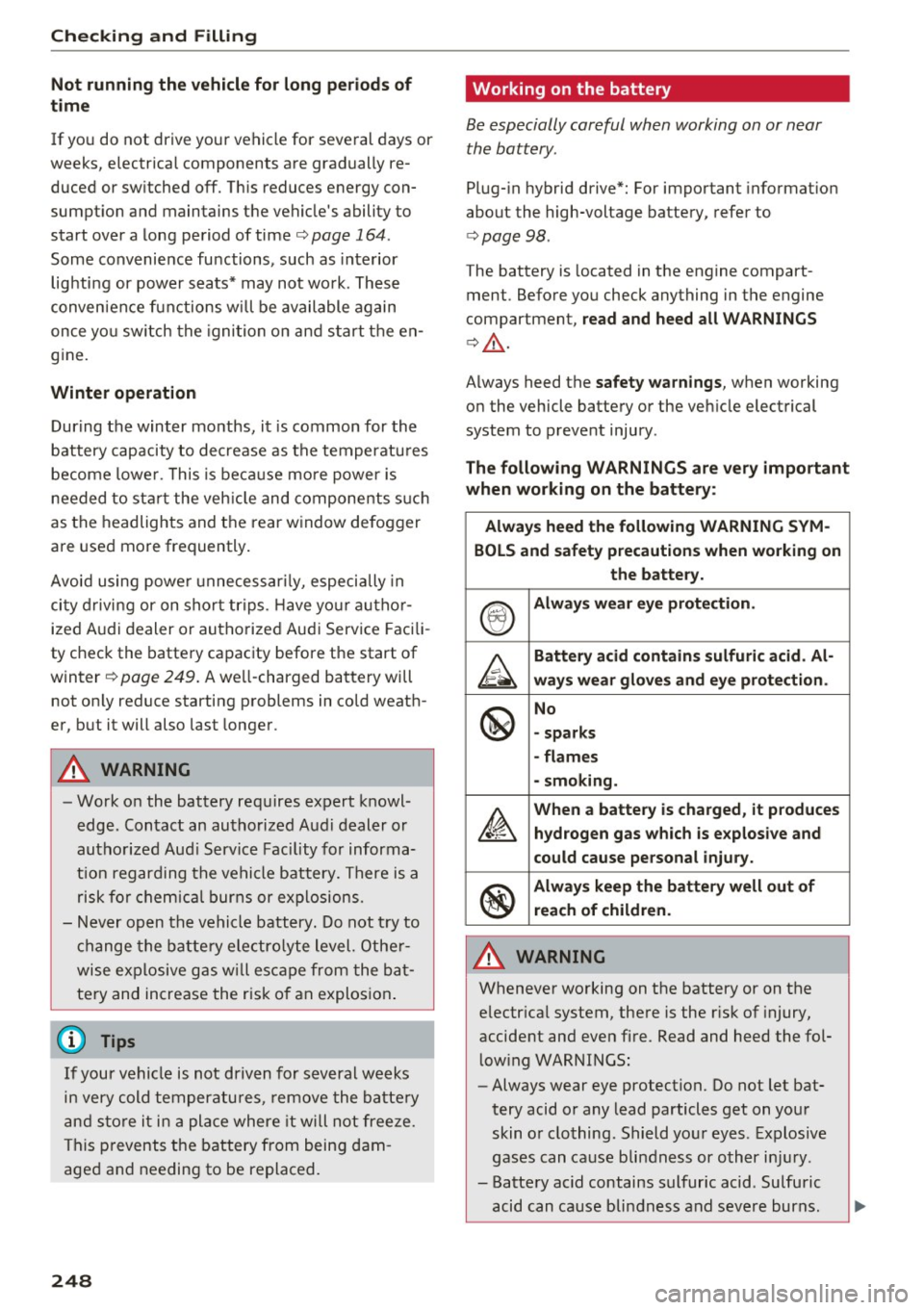
The following WARNINGS are very important
w hen wor king on the batter y:
Alwa ys heed the following WARNING S YM-
BOLS and safet y precaut ions when wo rking on
the batte ry.
®
Alwa ys wear e ye protection .
&
Batt ery ad d co ntains sulfu ric acid . Al-
way s w ear glove s and ey e prot ect ion .
@
No
-spark s
- flame s
- smoking .
~
When a battery is cha rged , it p roduce s
h yd rog en gas which is e xplo siv e and
could cause personal in jur y.
®
Alway s kee p the ba tter y w ell out of
r each of children.
A WARNING
Whenever working on the battery or on the
e lectr ical system, there is the r isk of injury,
accident and even fire. Read and heed the fol low ing WARNINGS:
- Always wear eye protection. Do not let bat
tery acid or any lead particles get on your
skin or clothing . Shield your eyes. Explosive
gases can cause blindness or other in ju ry .
- Battery acid contains sulfuric acid . Sulfuric
acid can cause blindness and severe burns .
Page 251 of 328
.... N
0 > CX)
.... I.Cl U"I
.... I.Cl ....
-Always wear gloves and eye protection. Do
not tilt the battery because acid could leak
out of the ventilation openings.
- If you get battery acid in your eyes or on
your skin, immediately rinse with cold wa
ter for several minutes and get medical at
tention .
- If you should ingest any battery acid, seek
medical attention immediately.
- Do not expose the battery to an open flame,
electric sparks or an open light.
- Do not smoke.
- Do not interchange the positive and nega-
tive cab les.
- When working on the battery, be sure not to
short-circuit the terminals with tools or oth
er metal objects. This wou ld cause the bat
tery to heat up very quickly, which could
lead to damage or explosion and personal
injury.
- When a battery is charged, it produces hy
drogen gas which is explosive and could
cause personal injury.
- Always keep the battery well out of the
reach of children.
- Before work is done on the electrical sys
tem, disconnect the negative ground cable.
- Before performing any work on the electri
cal system, switch off the engine and igni
tion as well as any electrical equipment . The
negative cable on the battery must be dis
connected. If you are just going to replace a
light bulb, then it is enough to switch off
the lights.
- Before disconnecting the battery, switch off
the anti-theft alarm system! Otherwise you
will set off the a larm.
- When disconnecting the battery, first dis
connect the negative cable and then the
posit ive cab le.
- Before reconnecting the battery, make sure
all electrical consumers are switched off.
Reconnect the positive cab le first and then
the negative cable . Never interchange the
cables - th is could start a fire!
- Never charge a frozen o r a thawed-out bat
tery. It could explode! If a battery has fro-
Checking and Filling
zen, then it must be replaced. A discharged
battery can freeze over at 32 °F (0 °C).
- Make sure the vent hose is always attached
to the opening on the side of the battery.
- Never use batteries which are damaged.
There is the danger of an exp losion! Always
replace a damaged battery.
_8 WARNING ~
California Proposition 65 Warning:
- Battery posts, term inals and related acces
sories contain lead and lead compounds,
chemicals known to the State of California
to cause cancer and reproductive problems.
Wash hands after handling.
(D Note
-Do not disconnect the vehicle battery when
the ignition is on or when the engine is run
ning, otherwise, you will damage electronic
components in the electrical system.
- If your vehicle is going to stand for a long
period of time without being driven, protect
the battery from "freezing", otherwise it
w ill be damaged and will then have to be re
placed .
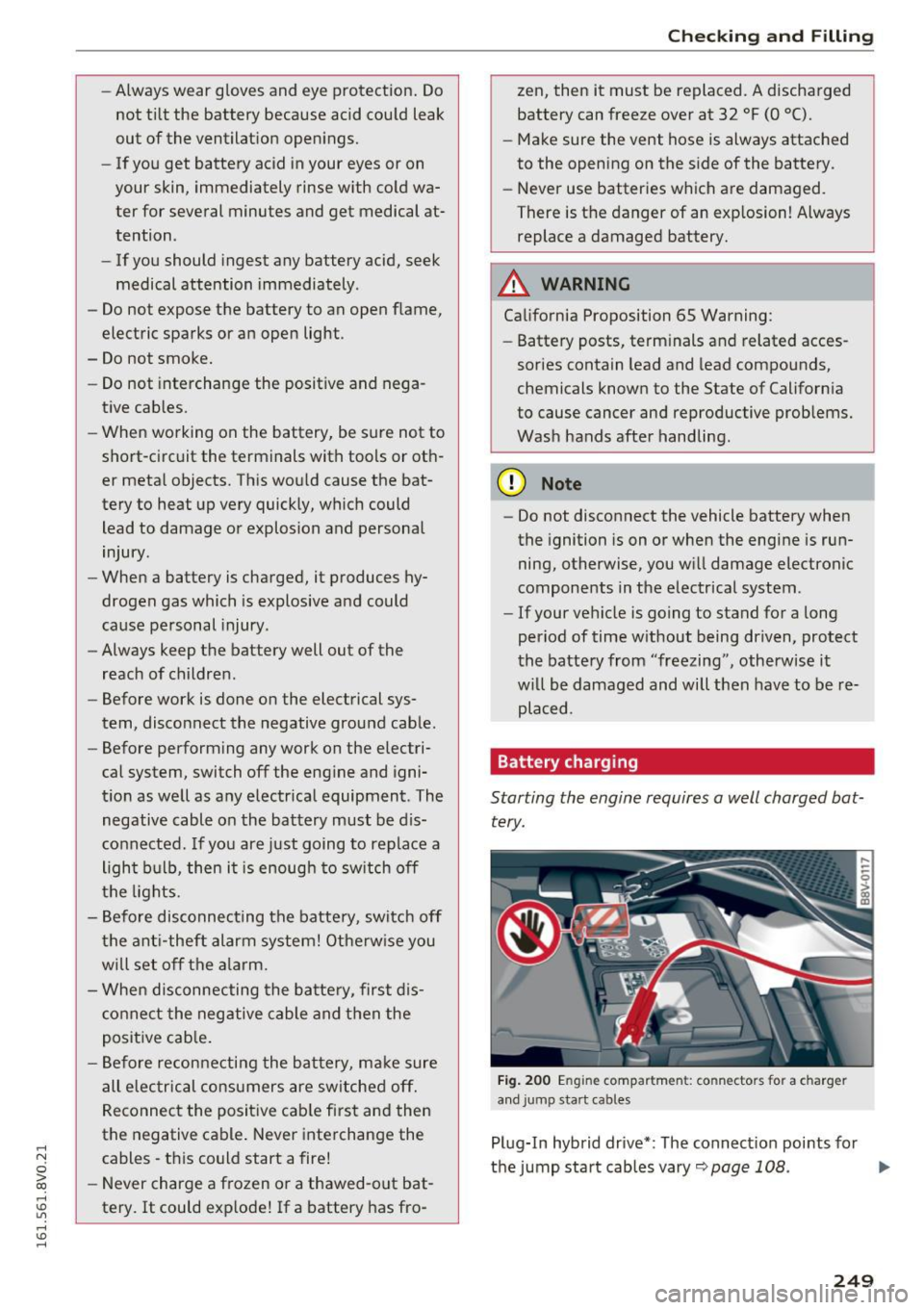
Battery charging
Starting the engine requires a well charged bat
tery.
Fig. 200 Eng ine compartmen t: co nnectors fo r a charger
a n d jump start cab les
Plug-In hybrid drive* : The connect ion points for
the jump start cables vary~
page 108. .,.
249
Page 253 of 328
,....,
N
0 > co ,....,
gent energy management system wi ll keep the
engine battery charged better than veh icles w ith
out this system . To make sure the additional
e lectrical energy is avai lab le once again after you
have changed the battery, we recommend that
you install batteries of the same type and manu
facture on ly (the same as those installed at the
time your veh icle was de livered). Specifications
are listed on the battery housing. Your author
ized dealer must code the battery in the energy
management system to enable you to use the en
ergy management functions correctly after re p lacing the battery.
The new battery must have the same capacity,
voltage (12 -volts), amperage, construction and
p lug sealing .
When insta lling the battery, ma ke sure the igni
tion and all e lectrical consumers are switched
off .
(D Note
Ma ke sure the ventilation hose on the side of
the battery is connected, otherw ise fumes o r
battery acid can leak out .
@ For the sake of the environment
Because of the prob lem of proper disposal of
a ba ttery, we recommend your author ized
Audi dea ler change the battery for you . Bat
teries contain su lf u ric acid and lead and must
always be disposed of properly in compliance
w ith all environmental regulations. D isposing
of vehicle batteries improperly is very danger
ous to the env ironment.
Ch eck ing and Filling
Windshield washer
system
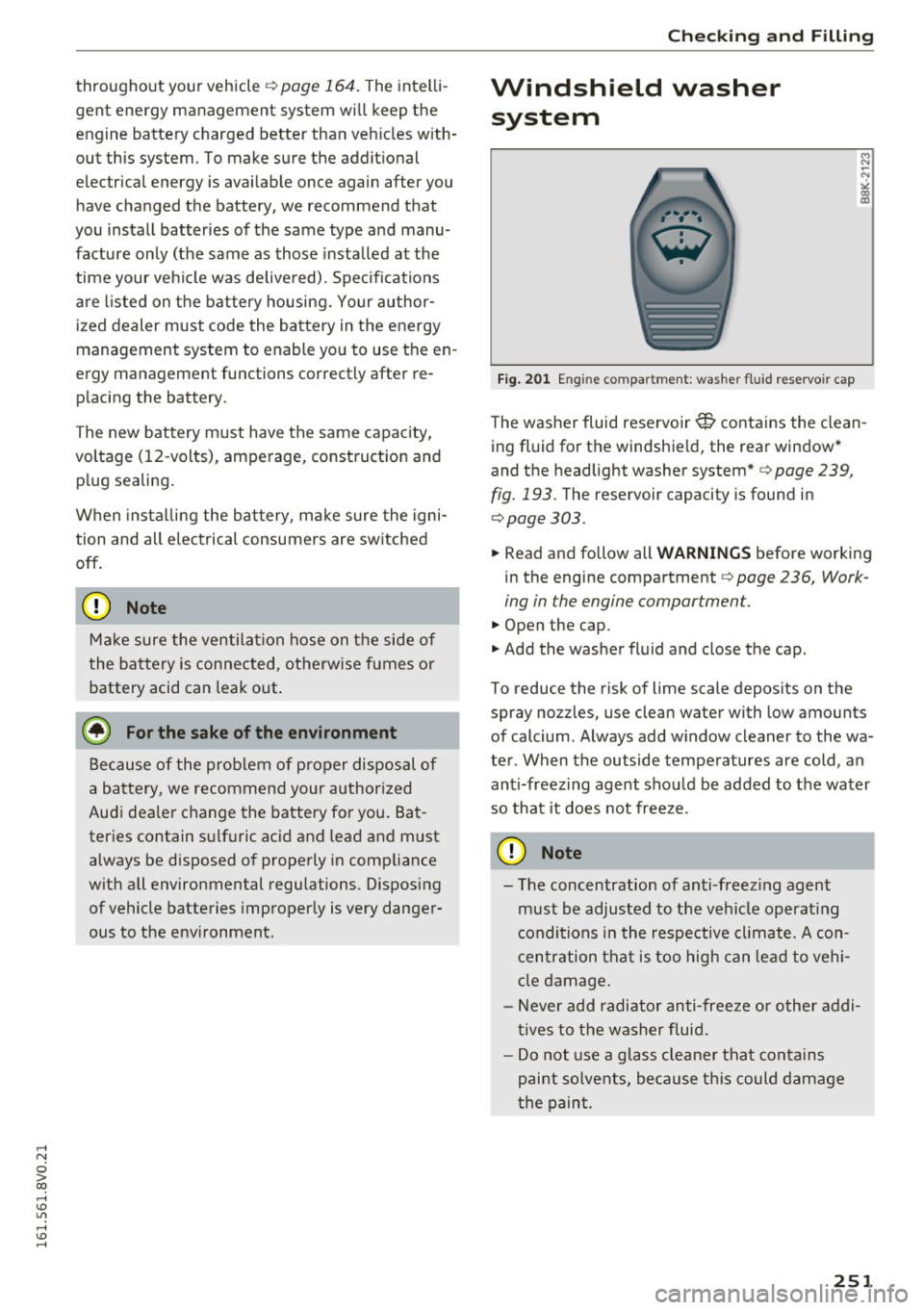
F ig . 201 E ngin e compar tmen t: was her flui d reservo ir cap
M N
-N ~
"' m
The washer fluid reservoir W contains the clean
ing fluid for the windshield, the rear window *
and the headlight washer system*¢
page 239,
fig. 193 .
The reservoir capacity is found in
¢ page 303.
.,. Read and follow all WARNING S before working
in the engine compartment <=>
page 236, Work
ing in the engine compartment .
.,. Open the cap.
.,. Add the washer fluid and close the cap .
To reduce the risk of lime scale deposits on the
spray nozzles, use clean water with low amounts
of calcium. Always add w indow cleaner to the wa
ter . When the outside temperatures are cold, an
anti-freez ing agent should be added to the water
so that it does not free ze.
(D Note
- The concentration of ant i-freez ing agent
must be adjusted to the vehicle operat ing
conditions in the respective cl imate. A con
c entration that is too high can lead to vehi
cle damage.
- Never add radiator an ti-free ze or other addi
tives to the washer fluid.
- Do not use a glass cleane r that contains
pai nt solvents, because t his could damage
t he paint.
251
Page 255 of 328
,..., N 0 > 00 ,..., \D Ln ,..., \D ....
Tires and wheels
Wheels
General information
... Check your tires regularly for
damage (punctures, cuts, cracks
and bulges). Remove foreign ob
jects from the tire tread.
.,. If driving over c urbs or similar
obstacles, drive slowly and ap
proach the curb at an angle.
.,.Have faulty tires or rims re
placed immediately.
... Protect your tires from oil,
grease and fuel.
.,.Mark tires before removing
them so that the same running direction can be maintained if
they are reinstalled .
... Lay tires flat when storing and
store them in a cool, dry location
with as little exposure to light as possible.
(D Note
-Please note that summer and winter tires are designed for
the conditions that are typical in those seasons. Audi recom
mends using winter tires dur
ing the winter months. Low
temperatures significantly de
crease the elasticity of summ
er tires, which affects traction
Tires and wheels
and braking ab ility. If summer
tires are used in very cold
temperatures, cracks can form on the tread bars, result ing in
permanent tire damage that
can cause loud driving noise
and unbalanced tires.
-Burnished, polished or chromed rims must not be
used in winter driving condi
tions. The surface of the rims does not have sufficient corro
sion protection for this and
could be permanently dam
aged by road salt or sim ilar
substances.
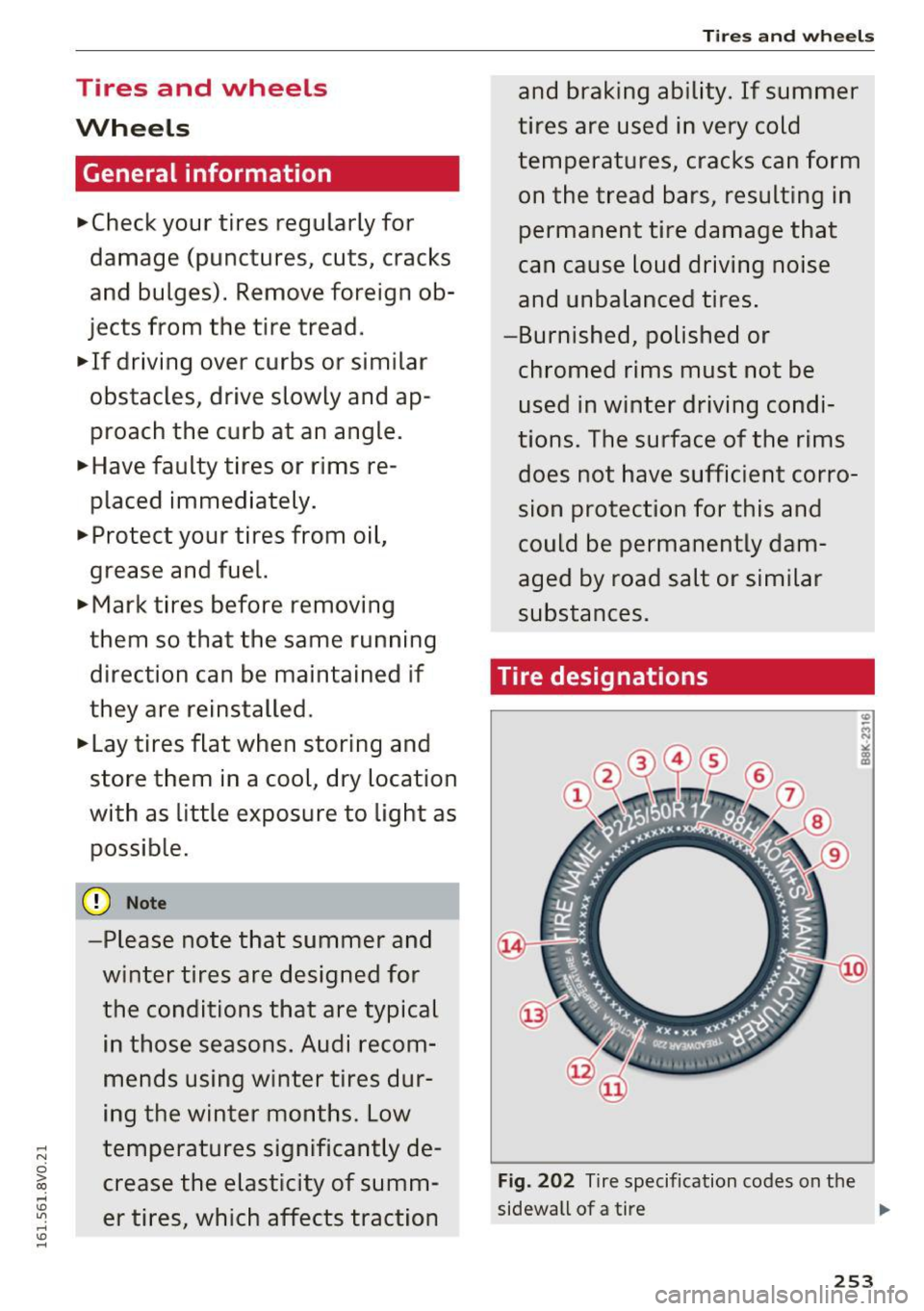
Ti re designations
Fig. 202 Tire specification codes on the
sidewall of a tire .,.
253
Page 274 of 328

Tires and wheels
the vehicle placard or tire inflation pressure la
bel, you should determine the proper tire
inflation pressure for those tires).
As an added safety feature, your vehicle has been
equipped with a tire pressure monitoring system
(TPMS) that illuminates a low tire pressure tell
tale when one or more of your tires is significant ly under-inflated. Accordingly, when the low tire
pressure telltale illuminates, you should stop and
check your tires as soon as possible, and inflate
them to the proper pressure . Driving on a signifi
cantly under-inflated tire causes the tire to over
heat and can lead to tire failure. Under-inflation
also reduces fuel efficiency and tire tread life,
and may affect the vehicle's handling and stop
ping ability.
Please note that the TPMS is not a substitute for
proper tire maintenance, and it is the driver's re
sponsibility to maintain correct tire pressure,
even if under-inflation has not reached the level
to trigger illumination of the TPMS low tire pres
sure telltale.
Your vehicle has also been equipped with a TPMS
malfunction indicator to indicate when the sys
tem is not operating properly. The TPMS mal
function indicator is combined with the low tire
pressure telltale. When the system detects a
malfunction, the telltale will flash for approxi
mately one minute and then remain continuously
illuminated. This sequence will continue upon
subsequent vehicle start-ups as long as the mal
function exists .
When the malfunction indicator is illuminated,
the system may not be able to detect or signal
low tire pressure as intended. TPMS malfunctions
may occur for a variety of reasons, including the
installation of replacement or alternate tires or
wheels on the vehicle that prevent the TPMS
from functioning properly. Always check the
TPMS malfunction telltale after replacing one or
more tires or wheels on your vehicle to ensure
that the replacement or alternate tires and
wheels allow the TPMS to continue to function
properly .
272
· If the Tire Pressure Monitoring System
indicator appears
Applies to vehicles: with tire pressure monitoring system
The tire pressure indicator in the instrument
cluster informs you if the tire pressure is too low
or if there is a system malfunction.
Fig. 206 Instrument cl uster: i ndic ator lig ht with message
Using the ABS sensors, the tire pressure monitor
ing system compares the tire tread circumfer
ence and vibration characteristics of the individu
al tires . If the pressure changes in one or more
tires , this is indicated in the instrument cluster
display with an indicator light
Rt] and a message
¢fig. 206. If only one tire is affected, the loca
tion of that tire will be indicated. The message
turns off after a few minutes. You can display the
message again¢
page 30.
The tire pressures must be stored in the menu
display again each time the pressures change
(switching between partial and full load pres
sure) or after changing or replacing a tire on your
vehicle
¢ page 273. The tire pressure monitor
ing system only monitors the tire pressure you
have stored . You can find the recommended tire
pressures for your vehicle on the label on the
driver's door pillar¢
page 263.
Tire tread circumference and vibration character
istics can change and cause a tire pressure warn
ing if:
- If the tire pressure in one or more tires is too
low,
- the tire has structural damage,
- The tire was replaced or the tire pressure
changed and it was not stored again
¢page 273.
-the spare tire is installed.
Page 275 of 328
,....,
N
0 > co ,....,
IE-Loss of pressure in at least one tire c::> ,&.
Check the tires and replace or repair if necessary.
Check/correct the pressures of all four tires. Then
store the tire pressures in the MMI
c::> page 2 73 .
mm (Tire Pressure Monitoring System) Tire
pressure: System malfunction!.
If m appears
after switching the ignition on or whi le driving
and the
IE indicator light in the instrument clus
ter blinks for approximately one minute and then
stays on, there is system malfunction. Try to
store the correct tire pressures
c::> page 2 73. If
the indicator light does not turn off or turns on
again after a short period of time, drive to an au
thor ized Audi dealer or authorized Audi Service
Facility immediately to have the malfunction cor
rected.
A WARNING
- If the tire pressure warning light IE in the
instrument cluster turns on, the pressure in
one or more tires is too low . Reduce the ve
hicle speed immediately and avoid any hard
steering or braking maneuvers. Stop as soon
as possible, check the tire and inflate the
t ir e to the correct pressure, which is speci
fied on the tire pressure label on the veh icle
c::> page 263. Driving with a ti re with low
pressure causes the tire to overheat and can
result in failure of the tire. Low pressure can
also have a negative effect on the driving
and braking behavior of the vehicle .
- Th e driver is responsible for maintaining the
correct tire pressures. You must check the
tire pressures regularly.
- Under certain conditions (such as a sporty
driv ing style, winter conditions or unpaved
roads), the pressure monitor indicator may
be delayed.
- Do not use run-flat tires on your vehicle . Us
ing them when not permitted can lead to
vehicle damage or accidents.
(D Tips
- The tire pressure monitoring system can al
so stop working when there is an ESC mal
function.
Tires and wheels
-Using snow chains may result in a system
ma lfunction.
- The tires with the identification "AO" or
"RO"
c::> page 260 have been matched with
your Audi tire pressure monitoring system .
We recommend that you use these tires.
- The tire pressure monitoring system can on
ly monitor the tire pressure of the driving
tires. Check the tire pressure of the spare
wheel in the luggage compartment so that if necessary it is ready for use.
Storing tire pressures
Applies to vehicles: with tire pressure mon itor ing system
A change in tire pressure or a change in tires
must be stored in the system.
The tire pressure is stored in the MMI.
.,. Make sure befo re storing that the tire pressures
of all four tires meet the specified va lues and
are adapted to the load. Otherwise the system
could malfunction
c::> page 263.
.. Switch on the ign ition.
.,.. Select: the I MENU I button> Car> Systems "
control button > Service & control > Tire pres
sure monitor > Store tire pressure > Yes, store
now .
(D Tips
Do not store the tire pressures if snow chains
a re installed . Otherwise the system could
malfunction.
273