warning AUDI A3 2016 Owner´s Manual
[x] Cancel search | Manufacturer: AUDI, Model Year: 2016, Model line: A3, Model: AUDI A3 2016Pages: 328, PDF Size: 81.78 MB
Page 238 of 328
Checking and Filling
CJ) Note
-Only use Ad Blue that conforms to the
standard ISO 22241-1. Do not mix any addi
tives with the AdBlue and do not dilute it
with water.
- Only use refill bottles that are approved for your vehicle. Using other systems can cause Ad Blue to leak.
- Do not add Ad Blue to the diesel tank or add diesel fuel to the Ad Blue tank. Do not start
the engine under any circumstances if the
wrong fuel is filled in the tank . There is a
risk of damaging the fuel tank system and
the engine . See an authorized Audi dealer or
authorized Audi Service Facility for assis
tance.
- AdBlue attacks surfaces such as painted ve
hicle components, plastic and carpet. Re
move the fluid as quickly as possible with a
damp cloth and plenty of cold water. If the
Ad Blue has already crystallized, use warm
water and a sponge. AdBlue residue that is
not removed will crystallize and can damage
the affected surface .
- Do not store the refill bottle in the vehicle.
If it leaks, the escaping Ad Blue could dam
age the vehicle interior .
- Do not allow Ad Blue to come into contact
with clothing. If there is contact with the
fluid, flush immediately with plenty of wa
ter .
(D Tips
-You can obtain refill bottles from an author
ized Audi dealer or authorized Audi Service
Facility .
- Follow the Ad Blue manufacturer's instruc
tions for use and storage .
- A permitted refill bottle contains approxi
mately 1.9 liters of AdBlue .
- Ad Blue can freeze at very low temperatures.
If this happens, the system will not detect
that the Ad Blue was refilled and it will con
tinue to inform you of the low AdBlue level.
The message turns off as soon as the tank
thaws out again.
236
Engine compartment
Working in the engine compartment
Special care is required if you are working in the
engine compartment
For work in the engine compartment such as
checking and filling fluids, there is a risk of in
jury, scalding, accidents, and burns. For this
reason, follow all the following listed warnings
and general safety precautions. The engine
compartment is a dangerous area.
¢ .&. .
.8, WARNING
To reduce the risk of injuries, complete the
following steps before opening the hood:
- Turn the engine off.
- Switch the ignition off.
- Set the parking brake.
- Place the selector lever in the P position.
- Let the engine cool down.
- Never open the hood when you see that
steam or coolant drips from the engine
compartment- there is a danger of burns!
Wait until no steam or coolant flows out.
- Keep children away from the engine com
partment.
- Never spill fluids on a hot engine. These flu
ids (such as the freeze protection contained in the coolant) can catch fire.
- Avoid short circuits in the electrical system,
especially the battery.
- When working in the engine compartment,
remember that the radiator fan can switch
on even if the ignition is switched off, which
increases the risk of personal injury.
- Never open the cap on the coolant expan
sion tank when the engine is warm . The
cooling system is under pressure.
- To protect your face, hands, and arms from
hot steam or coolant, cover the cap with a
large cloth when opening.
- Do not remove the engine cover under any
circumstances . This increases the risk of
burns.
- If tests need to be performed with the en-
-
gine running, there is additional danger due ~
Page 239 of 328
.... N
0 > CX)
.... I.Cl U"I
.... I.Cl ....
to moving components (such as the ribbed belt, alternator and radiator fan) and from
the high-voltage ignition system.
- Never reach into the radiator fan. The elec
tric auxiliary fan is controlled by tempera
ture and can switch on suddenly.
- Pay attention to the following warnings list ed when work on the fuel system or on the
electrical equipment is required.
- Always d isconnect the vehicle battery
from the vehicle electrical system
- Do not smoke
- Never work near open flames
- Always have a working fire extinguisher nearby
- To reduce the risk of electric shock and in
jury, never touch the following components when the eng ine is running or is being start
ed:
- Ignition cable
- Other components in the electronic h igh -
voltage ignition system
- If you must check or perform work on the engine while it is running:
- Set the parking brake and place the selec
tor lever in the P (park) position first .
- Always proceed with extreme caution so
that clothing, jewelry or long ha ir do not
become caught in the radiator fan, fan
be lt or other moving components or do
not come into contact with hot compo
nents. Tie back long hair before beginning
work and do not wear cloth ing that can
hang down into the engine.
- L imit your exposure to exhaust and chemi
cals to as short a time as possible~&.
_& WARNING
California Proposition 65 Warning:
- Engine exhaust, some of its constituents,
and certain vehicle components contain or
em it chem icals known to the State of Cali
fornia to cause cancer and birth defects and reproductive harm. In addition, certain flu
ids contained in vehicles and certain prod
ucts of component wear contain or emit
chemicals known to the State of California
C hecki ng an d Fill in g
to cause cancer and birth defects or other
reproductive harm.
- Battery posts, terminals and related acces
sories contain lead and lead compounds,
chemicals known to the State of California
to cause cancer and reproductive harms.
Wash hands after handling.
(D Note
When filling fluids, be sure not to mix the f lu
i ds up. Otherwise severe malfunctions and en
gine damage will occur.
@ For the sa ke of the environment
You should regularly check the ground under
your vehicle in order to detect leaks quickly. If there are visible spots from oil or other fluids, bring your veh icle to an authorized Audi deal
er or authorized Aud i Serv ice Facility to be
checked.
Opening the hood
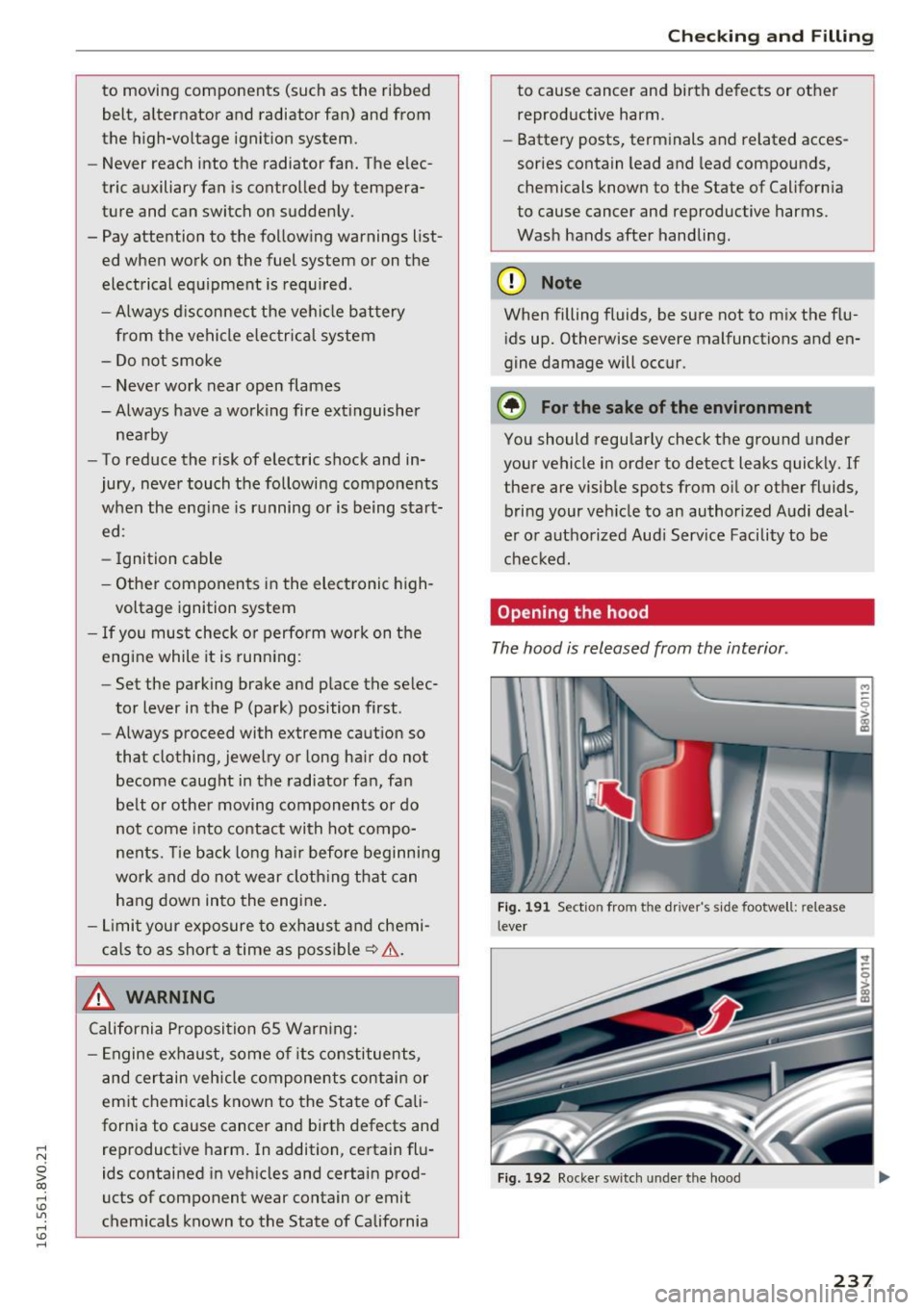
The hood is released from the interior .
Fig. 191 Sectio n from t he driver 's side footwell: release
lever
Fig. 192 Rocker switch under the hood
237
Page 240 of 328

Check ing and F illing
Read and follo w the WARN IN GS before check
ing anything in the engine compartment
c::> page 236, Working in the engine compart
ment.
Make sure the wiper arms are not raised up from
the windshield. Otherwise the paint could be
damaged .
Applies to vehi cles w ith p lug-in hybrid dr ive* :
switch the ignition off before re leasing the hood
so that the gasoline engine does not start auto mat ica lly.
... With the driver's door open, pull the lever be
low the instrument panel in the direction of the
arrow
c::> fig. 191 .
... Raise the hood s lightly c::> ,&. .
... Press the rocker switch under the hood upward
c::> fig. 192. This releases the catch.
... Open the hood .
A WARNING
Never open the hood when you see that steam
or coolant drips from the engine compart-
238
ment- there is a dange r of bu rns! Wait unt il
no steam or coolant flows out.
Closing the hood
... Push the hood down until the force of the strut
is overcome.
... Let the hood fall lightly into the latch .
Do not
press it in .
c::> ,&..
A WARNING
If the hood is not latched complete ly, it could
f ly up wh ile you are dr iving and obst ruct your
vision .
- For safety reasons, the hood m ust always be
closed securely while driv ing. Because o f
this, always chec k the hood after closing it
to make sure it is latched correctly. The
hood is latched if the front corners cannot
be lifted.
- If you notice that the hood is not latched
while you are driving, stop immed iate ly and
close it, because this increases the risk of an
accident.
Page 241 of 328
.... N
0 > CX)
.... I.Cl U"I
.... I.Cl ....
Checking and Filling
Gasoline engine compartment overview
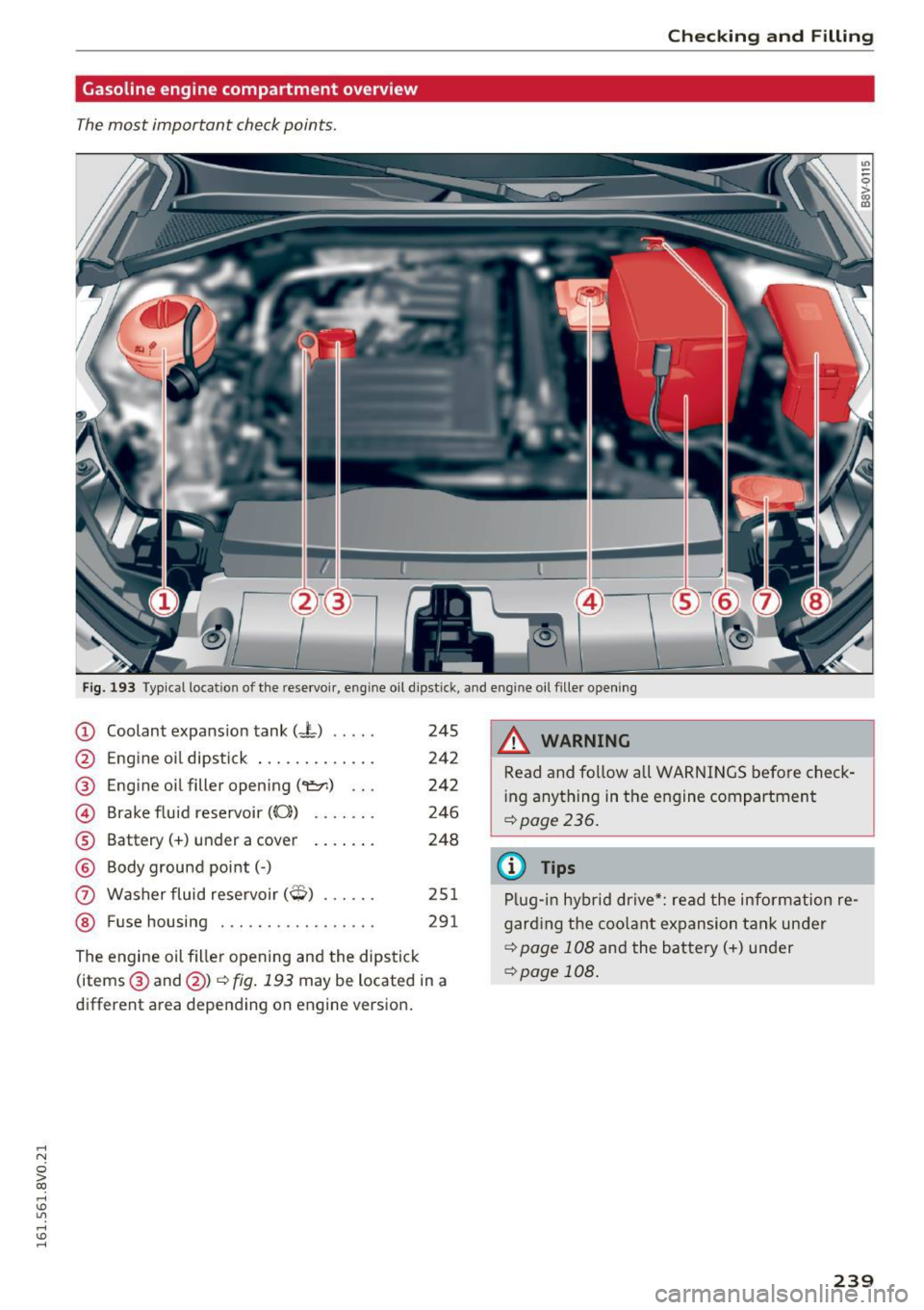
The most important check points .
Fig. 193 Typical location of the rese rvoir , engine oil dipst ick, and engine oil filler opening
CD
@
®
©
®
©
(J)
®
Coolant expansion tank (-L) .... .
Engine oil dipstick ............ .
Engine oil filler opening(~) .. .
Brake fluid reservoir (0))
Battery(+) under a cover ..... . .
Body ground point(-)
Washer fluid reservoir
(O) ..... .
Fuse housing . .... .... ....... .
245
242
242
246
248
251 291
The engine oil filler opening and the dipstick
(items ® and @)
q fig. 193 may be located in a
different area depending on engine version .
_& WARNING
=
Read and follow all WARNINGS before check-
i ng anything in the engine compartment
¢page 236.
(D Tips
Plug-in hybrid drive*: read the information re
garding the coolant expansion tank under
¢page 108 and the battery(+) under
¢ page 108 .
239
Page 242 of 328
Checking and Filling
Diesel engine compartment overview
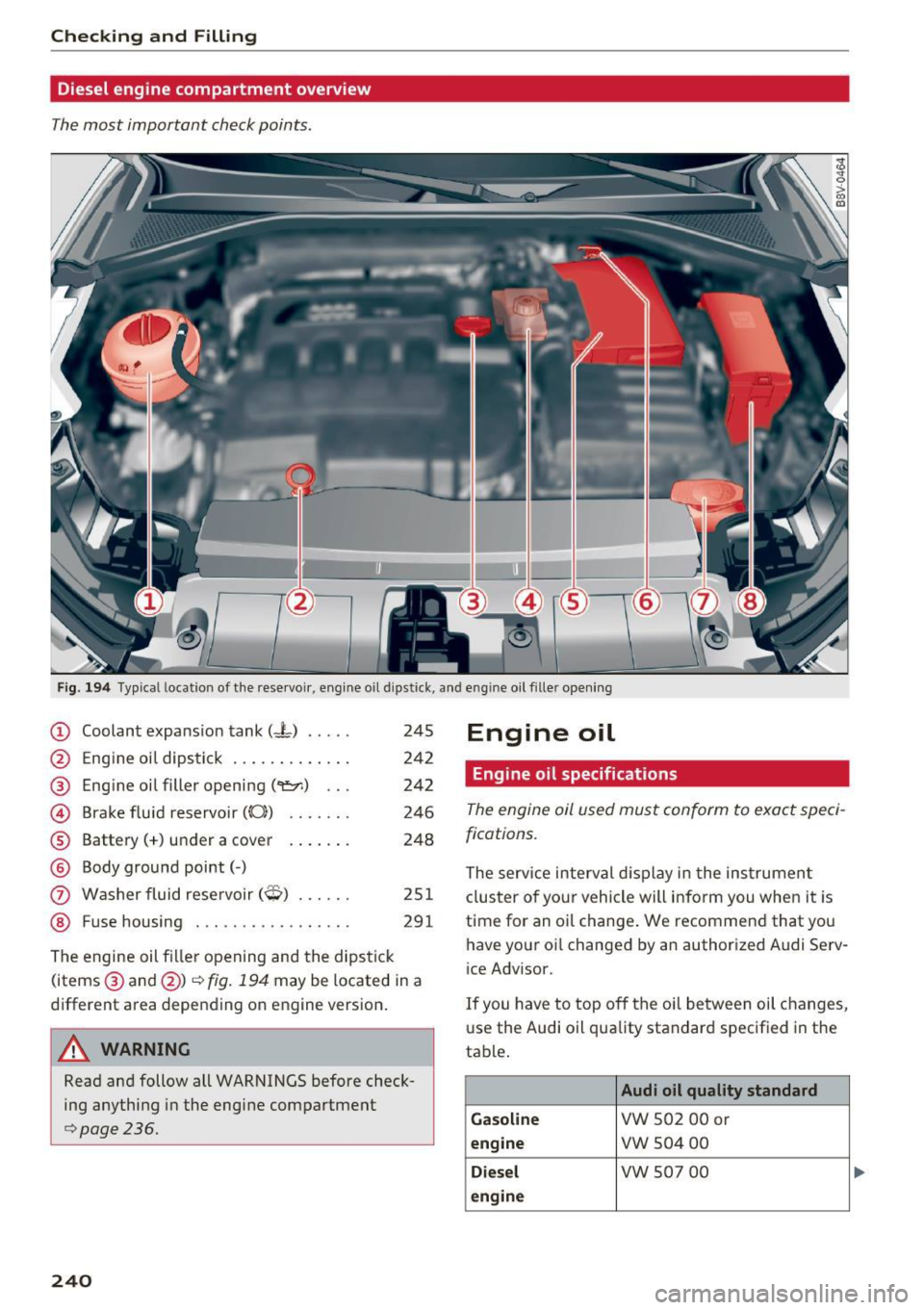
The most important check points.
Fig. 194 Typical location of the rese rvoir, engine o il dipstick, and engine oil fille r opening
(D Coolant expansion tank (- L) .. ...
@
®
©
®
®
0
®
Engine oil dipstick ............ .
Engine oil filler opening
(9=:r.) .. .
Brake fluid reservoir ((0))
Battery(+) under a cover
Body ground point( -)
Washer fluid reservoir
(q) ..... .
Fuse housing .. .............. .
245
242
242
246
248
251 291
The engine oil fi ller opening and the dipstick
(items @ and @)¢
fig. 194 may be located in a
different area depending on engine version.
,& WARNING
Read and follow all WARNINGS before check
ing anything in the engine compartment
¢page 236.
240
Engine oil
Engine oil specifications
The engine oil used must conform to exact speci
fications.
The service interval display in the instrumen t
cluster of your vehicle will inform you when it is
time for an oi l change. We recommend that you
have your oi l changed by an authorized Audi Serv
ice Advisor.
If you have to top off the oil between oil changes,
use the Audi oil quality standard specified in the
table .
Audi oil quality standard
Gasoline
VW 502 00 or
engine vw 504 00
Diesel vw 507 00
engine
Page 243 of 328
Using the proper engine oil is important for the
functionality and service life of the engine. Your
engine was factory-filled with a high -quality oil
which can usually be used throughout the entire
yea r.
Note
Your Limited New Vehicle Warranty does not
cover damage or malfunctions d ue to failure
to follow rec ommended maintenance and use
requireme nts as s et forth in the Audi Owner's
Manual and Warranty & Maintenance booklet.
- Use only a high quality engine oi l that ex-
pressly complies with the Au di oil quality
standard specified for your vehicle's engine.
Using any o ther oil can cause serious engine
damage.
- Do not mix any lubricants o r other additives
into the engine oil. Doing so can cause en
gine damage.
@ Tips
If you need to add oil and there is none availa
ble that meets the Audi o il quality standard
your eng ine requ ires, you may add a total of
no more than 0 .5 quart/li ter of a h igh-quality
"synthet ic"oil that meets the following speci
fications.
- Vehicles with gasoline eng ine: ACEA A3 o r
API SM with a viscosity grade of SAE OW-30,
SAE SW-30 or SAE SW-40.
- Vehicles with diesel eng ine: ACEA C3 or
API CF with a viscosity grade of SAE OW-30
or SAE SW -30.
- For more information about engine oil that
has been approved for your vehicle, please
contact e ither your authorized Audi dea ler
or Audi Customer Relat ions at
1 (800) 822-2834 or visit our web site at
www.audiusa.com or www.aud icanada.ca.
Engine oil consumption
The engine in your vehicle depends on an ode-
;::: quote amount of oil to lubricate and cool all of
~ its moving parts . co ,....,
~ In order to provide effective lubr ication and cool-,....,
:=: ing of internal engine components, all internal
Ch eck ing and Filling
combustion engines consume a certain amo unt
of oil. Oil consumption varies from engine to en
gine and may change s ignificantly over the life of
the engine. Typ ically, engines w ith a specified
break-in period (see¢
page 77) consume more
o il during the break-in per iod than they consume
after o il consumption has stab il ized.
Under normal cond itions, the rate of oil con
sumption depends on the quality and viscos ity of
the oil, the RPM (revolutions per minute) at
wh ich the engine is operated, the amb ient tem
perature and road co ndit ions. Further facto rs a re
the amount of oi l di lution from wate r condensa
tion or fuel resid ue and the oxidat ion level of the
o il. As any engine is subject to wear as mileage
builds up, the oil consumption may increase over
time unti l replacement of worn components may
become necessary.
With a ll these variab les coming into play, no
standard rate of oil consumption can be estab
li shed or specified. There is no alternative to reg
u lar and frequent checking of the oi l level, see
Note .
If the yellow engine oil leve l warning symbo l l!I
in the instrument cluster lights up, you should
check the oi l level as soon as possible
¢
page 242. Top off the o il at your earliest con
venience ¢
page 242.
A WARNING
-Before you check anyt hing in the engine com-
partment, always read and heed all WARN
INGS
¢page 236.
(D Note
Driving wit h an insufficient oil level is likely to
cause severe damage to the eng ine.
(D Tips
- The oil pressu re wa rning display. is not
an indicator of the oi l le vel. Do not rely on
i t. In stead , check th e oil level in your en
gine at regular intervals, preferably each
time you refuel, and alway s before goi ng
on a long trip .
241
Page 245 of 328
,....,
N
0 > co ,....,
ing anything in the engine compartment
c::> page 236, Working in the engine compart
ment.
.. Turn the engine off.
.. Unscrew the engine oil filler opening cap~
c::>fig.197, c::>page239, fig.193 .
.. Carefully add 0.5 quart (0.5 liter) of the appro
priate oil
c::> page 240.
.. Check the oil level again after two minutes
c::> page 242, Checking the engine oil level .
.,. Add o il, if necessary.
.. Close the engine oil filler cap and push the dip
stick all the way in .
A WARNING ,--
- When adding oil, do not let oil drip onto hot
engine components . There could be risk of a
fire.
- You must secure the cap on the oi l filler
opening correctly so that oil does not leak
out onto the hot engine and exhaust system
when the eng ine is running, because this is
a fire hazard.
- Always clean skin thoroughly if it comes into contact with engine oil.
(D Note
-Applies to vehicles with a gasoline engine:
the oil level cannot be above the
0 range
c> page 242, fig. 195 or else yo u risk dam
aging the catalytic converter and the en
gine . Contact an authorized Audi dealer or
authorized Audi Serv ice Facility to have ex
cess oil extracted if necessary .
-Applies to vehicles with a diesel eng ine: the
oil level must not be in the
G) range
c::>page 242, fig. 196-The oil must not be
extracted or else you risk damaging the en
gine. Drive to an authorized Aud i dealer or
authorized Audi Service Facility immediate
l y.
- Do not mix any additional l ubricants into
the engine o il. Damage cause by such addi
tives is not covered by the warranty.
Checking and Filling
{® For the sake of the environment
-Oil shou ld never enter the sewer system or
come into contact with the ground.
- Pay attention to lega l requirements when
disposing of empty oil containers .
Changing the engine oil
We recommend that have your oil changed by an
authorized Audi dealer or a qualified service sta
tion .
Before you check anything in the engine compart
ment,
always read and heed all WARNINGS
c::> page 236.
The engine o il must be changed according to the
intervals specified in your Warranty
& Mainte
nance book let. This is very important because the
lubricating properties of oil diminish gradua lly
during norma l vehicle use.
Under some circumstances the engine oil shou ld
be changed more frequent ly. Change oil more of
ten if you drive mostly short distances, operate
the vehicle in dusty areas or under predominantly
stop-and-go traff ic conditions, or have your vehi
cle where temperatures remain below freezing
for extended periods.
Detergent additives in the oi l will make fresh oil
look dark after the engine has been running for a
short time. This is normal and is not a reason to
change the oil more often than recommended.
Because of the problem of proper disposal, along
with the special tools and necessary expertise re
quired, we strongly recommend that you have
your o il changed by an authorized
Audi dealer or
a qualified service stat ion.
If you choose to change your oil yourself, please
note the following important information:
A WARNING ,-~
To reduce the risk of personal injury if you
must change the engine oil in your vehicle
yourself:
- Wear eye protection.
243
Page 246 of 328
Checking and Filling
-To reduce the risk of burns from hot engine
oil, let the engine cool down to the touch.
- When removing the oil drain plug with your
fingers, stay as far away as possible. Always
keep your forearm parallel to the ground to
help prevent hot oil from running down your
arm.
- Drain the oil into a container designed for
this purpose, one large enough to hold at least the total amount of oil in your engine .
- Engine oil is poisonous. Keep it well out of
the reach of children .
- Continuous contact with used engine oil is
harmful to your skin. Always protect your
skin by washing oil off thoroughly with soap
and water .
CD Note
Never mix oil additives with your engine oil.
These additives can damage your engine and
adversely affect your Audi Limited New Vehi
cle Warranty.
@ For the sake of the environment
-Before changing your oil, first make sure
you know where you can properly dispose of
the used oil.
- Always dispose of used engine oil properly.
Do not dump it on garden soil, wooded
areas, into open streams or down sewage
drains.
- Recycle used engine oil by taking it to a used
engine oil collection facility in your area, or
contact a service station.
Cooling system
Coolant
The engine coolant performs two functions: it
keeps the engine from overheating and it pro tects the engine from freezing in the winter.
The cooling system is sealed and generally re
quires little attention.
The cooling system has been filled at the factory
with a permanent coolant which does not need to
be changed. The coolant consists of a mixture of
244
specially conditioned water and the manufactur
er's glycol-based coolant additive Gl3 antifreeze
with anticorrosion additives (50% for USA mod els; 60% for Canadian models). This mixture
both assures the necessary frost protection and
protects metal components in the engine's cool
ing system from corrosion and scaling. It also
raises the boiling point of the coolant.
Do not reduce the concentration of the coolant in
the summer by adding plain water.
The propor
tion of coolant additive must be at least 50%
but not more than 60%
to maintain antifreeze
protection and cooling efficiency. If the coolant
frost protection is too low, the coolant could
freeze and damage the vehicle heating and en
gine cooling system.
For year-round driving, antifreeze is added at the
factory for temperatures down to:
--31°F(-35°C)USA
- - 40 °F ( - 40 °C) Canada.
If you must add coolant, use a mixture of water
and coolant additive. Mixing the coolant additive
with distilled water is recommended.
A WARNING
Before you check anything in the engine com
partment, always read and heed all WARN
INGS
~ page 236.
CD Note
- Before winter sets in, have the coolant
checked to see if the coolant additive in your
vehicle is sufficient to meet the climate con ditions. This is especially important if you
live in a region where the winter is extreme
ly cold.
If necessary, increase the proportion
of coolant additive to 60%.
- When adding coolant additive to your cool
ing system, remember:
- We recommend using only coolant addi
tive Gl2++ or G13 (check the label) for
your vehicle. This coolant additive is avail
able at authorized Audi dealers. Other
types of antifreeze can significantly re
duce corrosion protection. The resulting
Page 247 of 328

.... N
0 > CX)
.... I.Cl U"I
.... I.Cl ....
corrosion can cause a loss of coolant and
serious engine damage .
- Do not add any type of radiator leak sealant
to your vehicle's engine coolant . Adding ra
diator repair fluid may adversely affect the
function and performance of your cooling
system and could result in damage not cov
ered by your New Vehicle Limited Warranty.
Adding coolant
F ig . 198 Engine compa rtment: mark in gs on t he coo lant
expa nsion tank
Read and follow the WARNINGS before check
ing anything in the engine compartment
¢ page 236, Working in the engine compart
ment.
Checking the engine coolant level
• Park your vehicle on a level surface .
• Switch the ignition off .
• Read the coolant level on the coolant expansion
tank
¢ fig. 198 . The coolant level must be be
tween the markings when the engine in cold .
When the engine is warm it can be slightly above the upper marking.
Adding coolant
Plug-in hybrid drive*: your vehicle has two cool
ant expansion tanks that are separate from each
other. The smaller of the two expansion tanks
must not be opened
¢ page 108. Read and fol
low the important safety precautions ¢
A in
Coolant on page 109.
Requirement: there must be a residual amount of
coolant in the expansion tank ¢(D .
• Let the engine cool down .
Checking and Filling
• Place a cloth over the coolant expansion tank
cap and unscrew the cap counterclockwise
¢ A .
• Add coolant mixed in the correct ratio
¢
page 244 up to the upper marking.
• Make sure that the fluid level remains stable.
Add more coolant if necessary.
• Close the cap securely .
A coolant loss suggests a leak. Immediately drive
your vehicle to an authorized Audi dealer or au
thorized Audi Service Facility and have the cool
i ng system inspected. If the cooling system is not
leak ing, a loss can come from the coolant boiling
through overheat ing and being pushed out of the
cooling system .
,&_ WARNING
-= -The cooling system is pressurized and can be
come very hot. To reduce the risk of burns
from hot coolant:
- Do not open the coolant expansion tank cap
with the engine hot. There is a risk of burns.
- Stop the engine and allow it to cool.
- Protect your face, hands and arms from es-
caping coolant and steam by covering the
coo lant tank cap with a large, thick cloth.
- Turn the coolant tank cap counterclockwise
slowly and keep light pressure on the cap.
- To reduce the risk of burns, do not allow any
antifreeze or coolant to drip onto the ex
haust system or hot engine components.
The ethylene glycol in engine coo lant can
catch fire under certain circumstances .
- The coolant additive and the coolant can be
dangerous to your health . For th is reason,
keep the coolant in the original container
away from children. There is a risk of poi
soning .
- When working in the engine compartment,
remember that the radiator fan can switch
on even if the ignition is switched off, wh ich
increases the risk of persona l injury.
(J) Note
Do not add coolant if the expansion tank is
empty . Air could enter the cooling system and
damage the eng ine.
If this is the case, do not ..,_
245
Page 248 of 328

Checking and Filling
cont inue driving. See an authorized Audi deal
er or authorized Audi Service Facility for assis
tance .
Radiator fan
The radiator fan switches on outomotico/ly by it
self.
An auxiliary elect ric radiator fan sw itches on and
off depend ing on coolant temperature and other
vehicle operating conditions.
After you switch the engine off, the auxiliary fa n
can cont inue runn ing fo r up to 10 minutes -even
with the ignition off . It ca n even switch on again
later by itself¢.&. , if
- the temperature of the engine coolant r ises due
to the heat bu ild -up from the engine in the e n
gine compartment, or
- the engine compartment heats up because the
vehicle is parked in intense sunlight .
A WARNING
-To reduce the risk of pe rsonal injury never
touch the radiator fan .
- The auxiliary electric fan is temperature
controlled and can switch on suddenly even
when the eng ine is not running.
- The auxiliary radiator fan switches on auto
matically when the engine coo lant reaches a
certain tempe rature and w ill cont inue to run
until the coolant temperature drops.
Brake fluid
Checking brake fluid level
F ig . 19 9 Engine co mpar tment: cove r o n t he b rake fluid
r e servo ir (example)
246
-
Before yo u check any thing in the engine compart
ment,
always read and heed all WARNINGS
¢ page 236, Working in the engine comport
ment .
.,. Read the brake fluid level from the brake f luid
reservoir ¢
fig. 199, ¢ page 239, fig. 193 (ga
soil engine) or ¢
page 240, fig. 194 (diesel en
gine). The brake fluid level must be between
the "MIN" and "MAX" markings .
The location of the brake fl u id reservoir can be
seen in the engine compartment i llustration
q page239.
The fluid level may drop slightly after some time
due to t he automatic adjustment of the brake
pads. This is not ca use for a larm.
If t he brake fluid level falls considerably below
the "M IN" mark, the brake warning/indicator
li ght ~ (U.S. models)
I. (Canadian models)
will come on
q page 18 . Do not continue to oper
ate the vehicle . The complete brake system
shou ld be thorough ly checked by an authorized
Audi dealer or other qualified fac ility and the
cause corrected .
If the brake fl uid level is too
l ow, the bra ke war ning/ indicato r light w ill illumi
na te. Cont act an a uthor ized Audi dealer
immedi
atel y.
Changing brake fluid
Have the brake fluid changed by an experienced
technician.
B rake fl uid abso rbs moistu re from the air. If the
wa ter con ten t in the brake fluid is too high, cor
r osion in the bra ke system may res ult after ape
riod of time. The boi ling po int of the brake fluid
will a lso decrease considerably and decrease
bra king performance.
Therefore, the bra ke fluid m ust be changed
every
two year s. Always use new brake f luid which con
forms to Federa l Motor Vehicle Standard " FMVSS
116 DO T 4" .
The brake fluid reservoir can be diffic ult to reac h,
the refore, we recommend that you have t he
brake fluid changed by your author ized
Audi
dealer .
Your dealer has the correct tools, the