child AUDI A3 2016 Owner´s Manual
[x] Cancel search | Manufacturer: AUDI, Model Year: 2016, Model line: A3, Model: AUDI A3 2016Pages: 328, PDF Size: 81.78 MB
Page 223 of 328
,....,
N
0 > co ,....,
has been designed and certified by its man
ufacturer for use on a front seat with a pas
senger front and side airbag.
- Never put the forward-facing child restraint
up, against or very near the instrument pan
el.
- Always move the passenger seat into its
rearmost position in the seat's fore and aft
adjustment range, as far away from the air
bag as possib le before installing the for
ward-facing child restra int. The backrest
must be adjusted to an up right posit ion.
- Make sure that the
PASSEN GER AI R BA G
OFF
light comes on and stays on all the time
whenever the ignition is switched on.
_& WARNING
Rearwa rd-facing child restra ints:
- A ch ild in a rea rwa rd-facing child safety seat
installed on the front passenger seat wi ll be
seriously injured and can be killed if the
front airbag inflates - even with an Ad
vanced Airbag System .
- The inflating airbag will hit the child safety
seat or infant carrier with great force and
will smash the chi ld safety seat and chi ld
against the backrest, center armrest, door
or roof.
- Always be especially careful if you must in
stall a rearward facing child safety seat on
the front passenger seat in exceptional c ir
cumstances.
- Make sure that the
PA SSEN GER AIR BA G
OFF
light comes on and stays on all the time
whenever the ignition is switched on .
- If the
PASSEN GER A IR BAG OFF light does
not come on and stay on, immediately in
stall the rear-fac ing ch ild safety seat in a
rear seat ing pos ition and have the airbag
system inspected by your Aud i deale r.
Ch ild safety
Activating the convertible locking retractor
Use the convertible locking retractor to secure a
child restraint .
Always heed the ch ild safety seat manufacturer's
instruct ions when installing a child restraint in
your vehicle. To activate the convertible locking retractor:
.. Place the child restraint on a seat, preferably
on the rear seat.
.. Slowly pull the belt
all the w ay out .
.. Route it around or through the child restra int
be lt path
¢ & .
.. Push the ch ild safety seat down with you r full
weight to get the safety belt really tight.
.. Insert the belt tongue into the buckle for that
seating position.
.. Guide the safety belt back into the retractor un
til the belt lies flat and snug on the child safety
seat.
.. You should hear a ''cl icking" noise as the belt
w inds back into the inertia reel. Test the con
vert ible lock ing retractor by pull ing on the belt.
You shou ld no longer be able to pull the belt
out of the retractor. The convertib le loc kin g re
t ractor is now activated.
.. Make sure that the red release button is facing
away from the c hild restraint so that it can be
unbuckled quickly .
.. Pull on the belt to make sure the safety belt is
properly tight and fastened so that the seat
cannot move forward or sideways more than
one inch (2 .5 cm) .
_& WARNING
Using the wrong ch ild rest raint o r an improp
e rly inst alled child restra int can cause se rious
personal injury or death in a crash.
- Always make sure that the safety be lt re
tr actor is locked when installing a child
safety seat . An un locked safety be lt retrac
tor cannot hold the ch ild safety seat in p lace
during normal driving or in a crash.
- Always buckle the child safety seat fi rm ly in
p lace even if a child is not sitting in it. A
loose child safety seat can fly a round during
a sudden stop or in a crash. .,.
221
Page 224 of 328
Child safety
-Always make sure the seat backrest to which
the child restraint is installed is in an up
right position and securely latched into
place and cannot fold forward. Otherwise,
the seatback with the child safety seat at
tached to it could fly forward in the event of
an accident or other emergency situation.
- Always read and heed all WARNINGS when
ever using a child restrained in a vehicle is
being used
¢ page 209 . Special precautions
apply when installing a child safety seat on
the front passenger seat¢
page 185, Child
restraints on the front seat -some impor
tant things to know.
Deactivating the convertible locking
retractor
The convertible Locking retractor for child re
straints will be deactivated automatically when
the belt is wound all the way bock into the re
tractor .
~ Press the red button on the safety belt buckle.
Th@ belt tongue will pop out of the buckle.
~ Guide the safety belt all the way back into its
stowed position .
Always let the safety belt retract completely into
its stowed position . The safety belt can now be
used as an ordinary safety belt without the con
vertible locking retractor for child restraints .
If the convertible locking retractor should be ac
tivated inadvertently, the safety belt must be un
fastened and guided completely back into its
stowed position to deactivate this feature. If the
convertible lock ing retractor is not deactivated,
the safety belt will gradually become tighter and
uncomfortable to wear.
A WARNING
-
Improperly installed child safety seats in
crease the risk of serious personal injury and
death in a collision.
- Never unfasten the safety belt to deactivate
the convertible locking retractor for child re straints while the vehicle is moving . You
222
would not be restrained and could be seri
ously injured in an accident.
- Always read and heed all WARNINGS when
ever using a child restrained in a vehicle is
being used¢
page 209. Special precautions
apply when installing a child safety seat on
the front passenger seat
<=:> page 185, Child
restraints on the front seat -some impor
tant things to know.
LATCH system (Lower
anchorages and tethers
for children)
' Child Restraint System anchors and how
are they related to child safety
To provide a simpler and more practicable way to
attach the child restraint on the vehicle seat, Federal regulations require special lower ancho
rages in vehicles and devices on new child re
straints to attach to the vehicle anchorages .
In the United States, the combination of the
tether anchorages and the lower anchorages is
now generally called the LATCH system for
"Lower Anchorages and Tethers for Children" . In
Canada, the terms "top tether" with "lower uni
versal anchorages" (or "lower universal anchor
age bars") are used to describe the system .
In other countries the term "ISOFIX" is used to
describe the lower anchorages .
Forward-facing child restraints manufactured af
ter September 1, 1999, are required by U.S. fed
eral regulations to comply with new child head
movement performance requirements . These
new performance requirements make a tether
necessary on most new child seats.
Installing a child restraint that requires a top
tether without one can seriously impair the per
formance of the child restraint and its ab ility to
protect the child in a collision. Installing a child
restraint that requires a top tether without the
top tether may be a violation of state law.
Child restraint manufacturers offer LATCH lower
anchorages on their child seats with hook-on or ...
Page 225 of 328
push-on connectors attached to adjustable
straps .
I n addition to the LATCH lower anchorages, these
child restraint systems usually require the use of
tether straps to h elp keep the child restraint
firm ly in place.
A WARNING
Improper installation of child restraints will
increase the risk of injury and death in a
crash.
- Always follow the instructions provided by the manufacturer of the child restra int you
intend to install in your veh icle.
- Never install a child restra int w ithout a
properly attached top tether strap if the
child restraint manufacturer's instruct ions
requ ire the top tether strap to be used .
- Improper use of child restra int LATCH lower
anchorage po ints can lead to injury in a colli
sion. The LATCH lower anchorage points are designed to withstand only those loads im
posed by correc tly fit ted child res traints .
- Never mount two chi ld restraint systems on
one LATCH lower anchorage poin t.
- Never secure or attach any luggage or other
item to the LATCH lower anchorages .
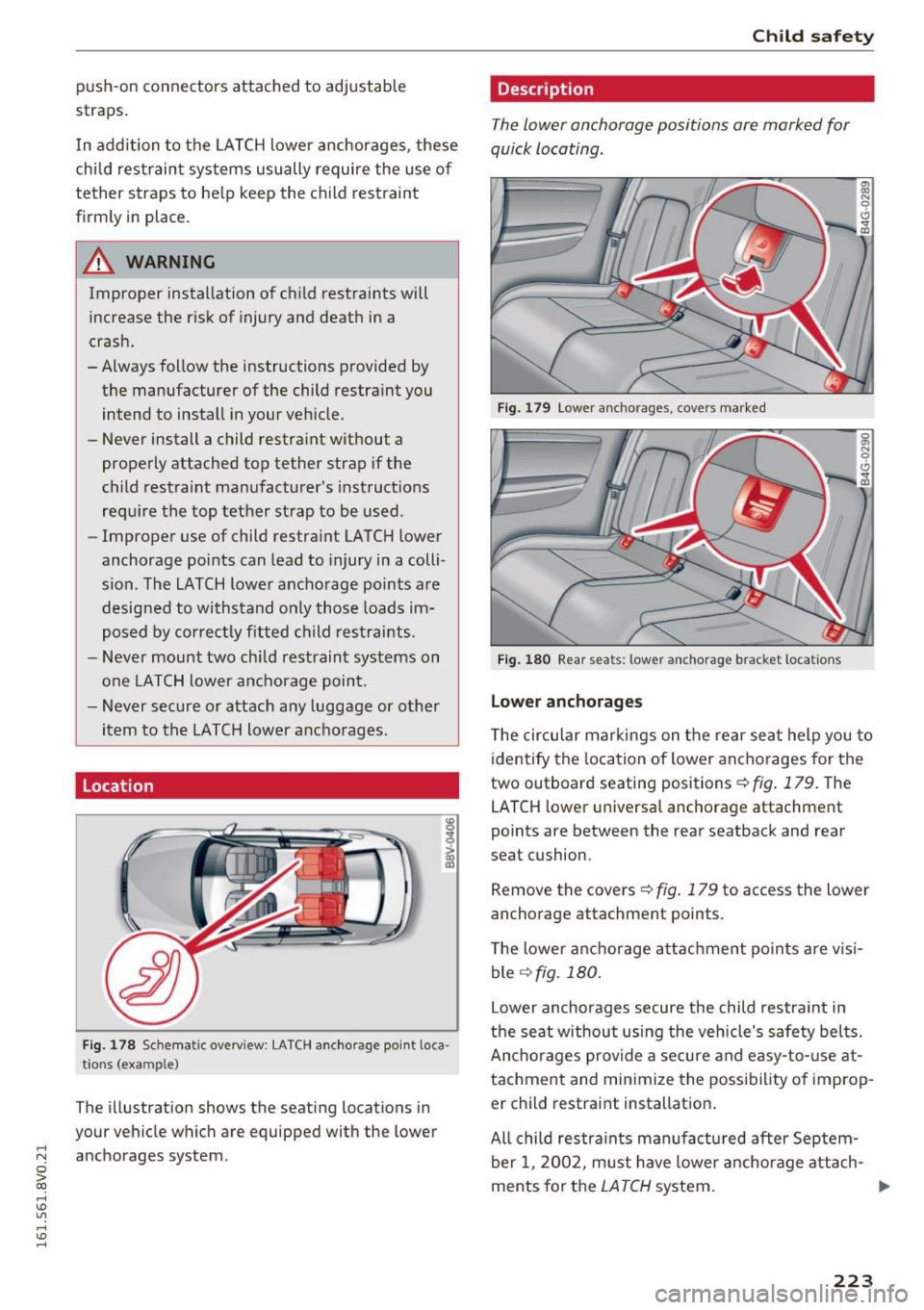
Location
F ig . 178 Schematic overv iew: LATCH a ncho rage po int loca
t io ns (ex ampl e)
The illustration shows the seating locations in
your veh icle which are equipped with the lower
.....
"' anchorages system .
0 > CX)
..... I.Cl U"I
..... I.Cl .....
Child sa fety
Description
The lower anchorage positions are marked for
quick locating .
Fig . 1 79 Low er an cho ra g es, cov ers marked
Fig . 18 0 Rear s eats: l ower an chorag e brac ket lo ca tions
Lower anchorages
T he circular markings on the rear seat help you to
identify the location of lower anchorages for the
two outboard seating pos itions ¢
fig. 179. The
LATCH lower univ ersal anchorage attachment
points are between the rear seatba ck and rear
seat cushion .
Remove the covers¢
fig. 179 to access the lower
anchorage attachment points.
T he lower anc horage a ttac hment po ints a re v is i
ble ¢
fig. 180.
Lower anchorages secure the child restra int in
the seat without us ing the vehicle's safety belts.
Anchorages provide a secure and easy-to- use at
tachment and minimize the possibility of improp
er child restraint installation .
All child restra in ts man ufact ured after Septem
ber 1 , 2002, must have lower anchorage attach-
ments for the
LATCH system. ..,.
223
Page 226 of 328
Child safety
Please remember that the lower anchorage
points are only intended for installation and at
tachment of child restraints specifically certified
for use with
LATCH lower anchorages. Child re
straints that are not equipped with the lower an
chorage attachments can still be installed in
compliance with the child restraint manufactur
er's instructions on using vehicle safety belts .
A WARNING
Improper use of LATCH lower anchorages can
cause serious personal injury in an accident.
- Always carefully follow the child restraints
manufacturer's instructions for proper in
stallation of the child restraint and proper
use of the lower anchorages or safety belts
in your vehicle.
- Never secure or attach any luggage or other
items to the
LATCH lower anchorages.
- Always read and heed the important infor
mation about child restraints in this chapter
and WARNINGS
¢ page 209, Child safety.
Installing a child restraint with LATCH
lower anchorages
Applies to veh icles: w ith Top Tether
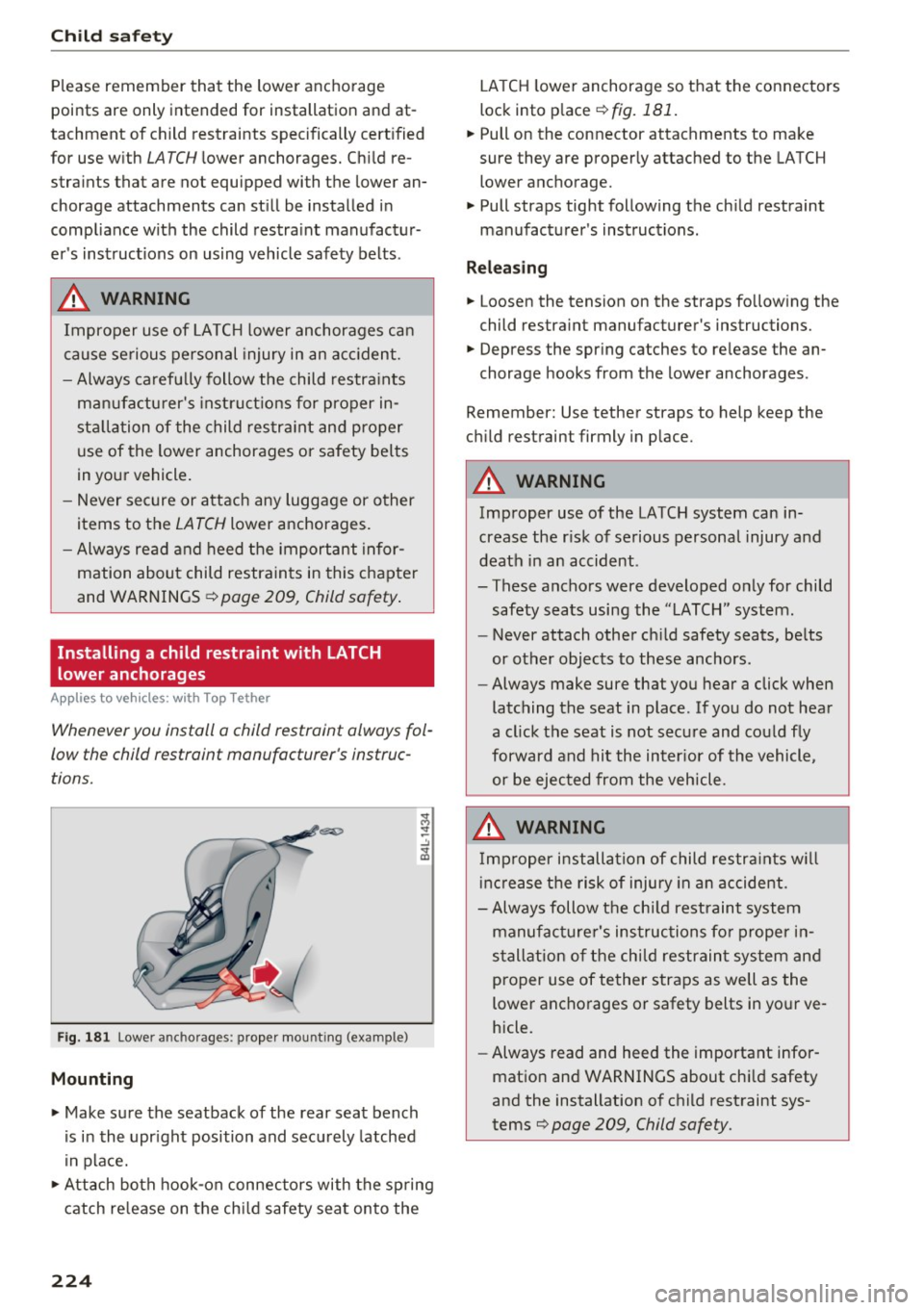
Whenever you install a child restraint always fol
low the child restraint manufacturer 's instruc
tions.
Fig. 181 L owe r an ch orage s: proper mou nting (examp le)
Mounting
.. Make sure the seatback of the rear seat bench
is in the upright position and securely latched
in place .
.. Attach both hook-on connectors with the spring
catch release on the child safety seat onto the
224
LATCH lower anchorage so that the connectors
lock into place
¢ fig. 181.
.. Pull on the connector attachments to make
sure they are properly attached to the LATCH
lower anchorage.
.. Pull straps tight following the child restraint
manufacturer's instructions.
Releasing
.. Loosen the tension on the straps following the
child restraint manufacturer's instructions.
.. Depress the spring catches to release the an
chorage hooks from the lower anchorages .
Remember: Use tether straps to help keep the
child restraint firmly in place.
A WARNING
-
Improper use of the LATCH system can in
crease the risk of serious personal injury and
death in an accident .
- These anchors were developed only for child safety seats using the "LATCH" system.
- Never attach other child safety seats, belts
or other objects to these anchors .
- Always make sure that you hear a click when
latching the seat in place. If you do not hear
a click the seat is not secure and could fly
forward and hit the interior of the vehicle,
or be ejected from the vehicle.
A WARNING
Improper installation of child restraints will
increase the risk of injury in an accident.
- Always follow the child restraint system
manufacturer's instructions for proper in
stallation of the child restraint system and
proper use of tether straps as well as the lower anchorages or safety belts in your ve
hicle.
- Always read and heed the important infor
mation and WARNINGS about child safety
and the installation of child restraint sys
tems
¢ page 209, Child safety.
-
Page 227 of 328
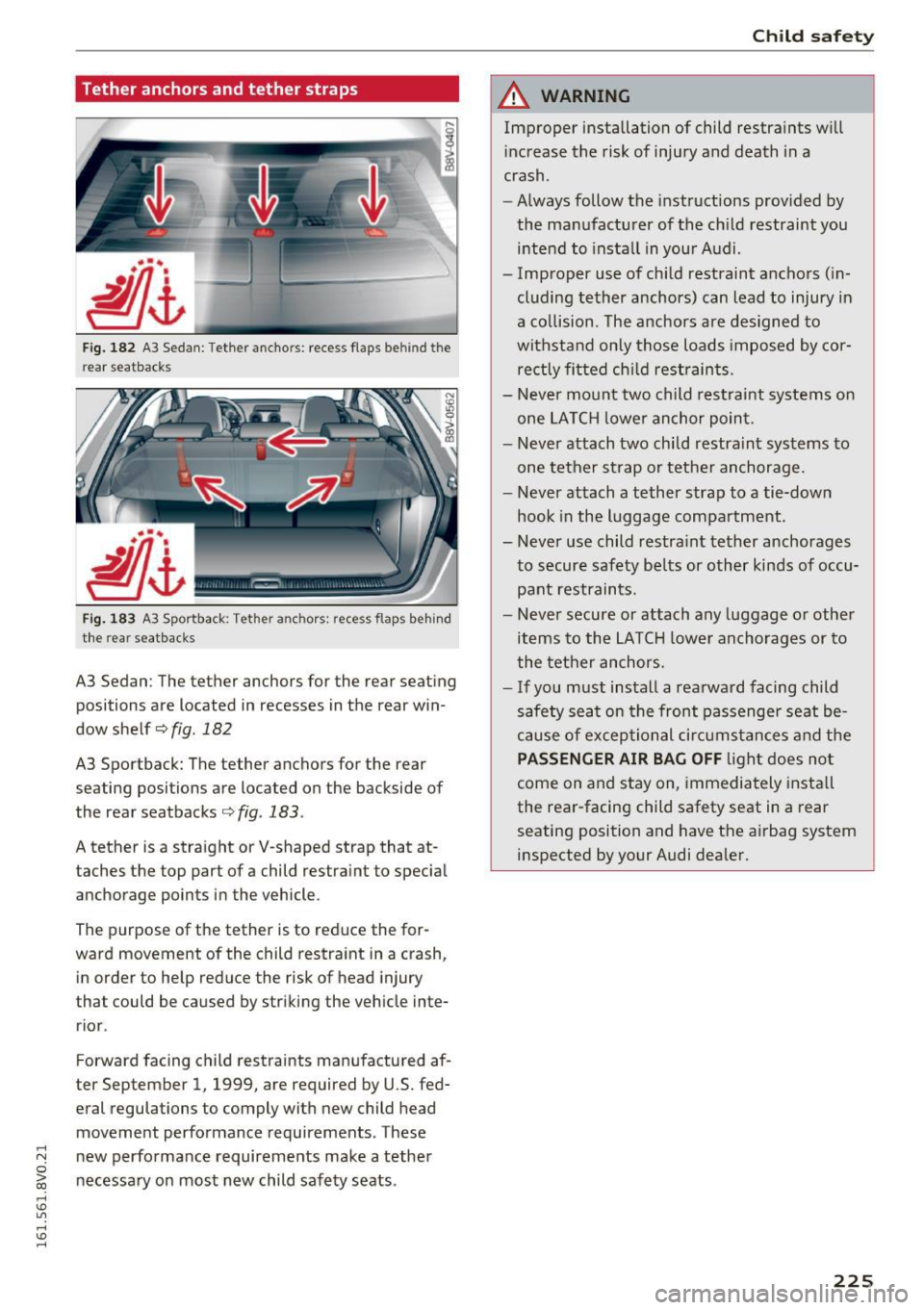
Tether anchors and tether straps
Fig. 182 A3 Sedan: Tether anchors: recess flaps behind the
rear seatbacks
Fig. 183 A3 Sportback : Tether anchors : recess flaps behind
the rear seatbacks
A3 Sedan : The tether anchors for the rear seating
positions are located in recesses in the rear win
dow she lf
r::;, fig . 182
A3 Sportback: The tether anchors for the rear
seating positions are located on the backside of
the rear seatbacks
r::;, fig . 183.
A tether is a straight or V-shaped strap that at
taches the top part of a child restraint to special
anchorage points in the vehicle .
The purpose of the tether is to reduce the for
ward movement of the child restraint in a crash,
in order to help reduce the risk of head injury
that could be caused by striking the vehicle inte
rior .
Forward facing child restraints manufactured af
ter September 1, 1999, are required by U.S. fed
eral regulations to comply with new child head
movement performance requirements . These
.... "' new performance requirements make a tether 0
iii necessary on most new child safety seats .
.... I.Cl U"I
.... I.Cl ....
Child sa fety
A WARNING
-Improper installation of child restra ints wi ll
i ncrease the risk of injury and death in a
crash .
- Always follow the instructions prov ided by
the manufactu rer of the ch ild restraint you
intend to insta ll in you r A udi .
- Improper use of chi ld restraint anchors (in
cluding tether anchors) can lead to injury in
a co llision . The anchors are designed to
withstand on ly those loads imposed by co r
rectly fi tted ch ild res traints.
- Never mo unt two child rest raint systems on
one LA TC H lowe r anchor point.
- Neve r attach two child restraint systems to
one tether st rap or tethe r anchorage.
- Never attach a tether strap to a tie-down
hook in the luggage compa rtment.
- Never use child restra int tether anchorages
to secure safety be lts or other kinds of occu
pant restrain ts.
- Never secure or attach any luggage or othe r
items to the LA TCH lower anchorages or to
the tether anchors.
- If you must install a rearwa rd facing child
safety seat on the front passenger seat be
cause of excep tional ci rcumstance s and the
PASSENGER AIR BAG OFF light does not
come on and stay on, immediately install
the rear -facing child safety seat in a rear
seating position and have the a irbag system
inspected by your Audi dealer.
225
Page 228 of 328
Child safety
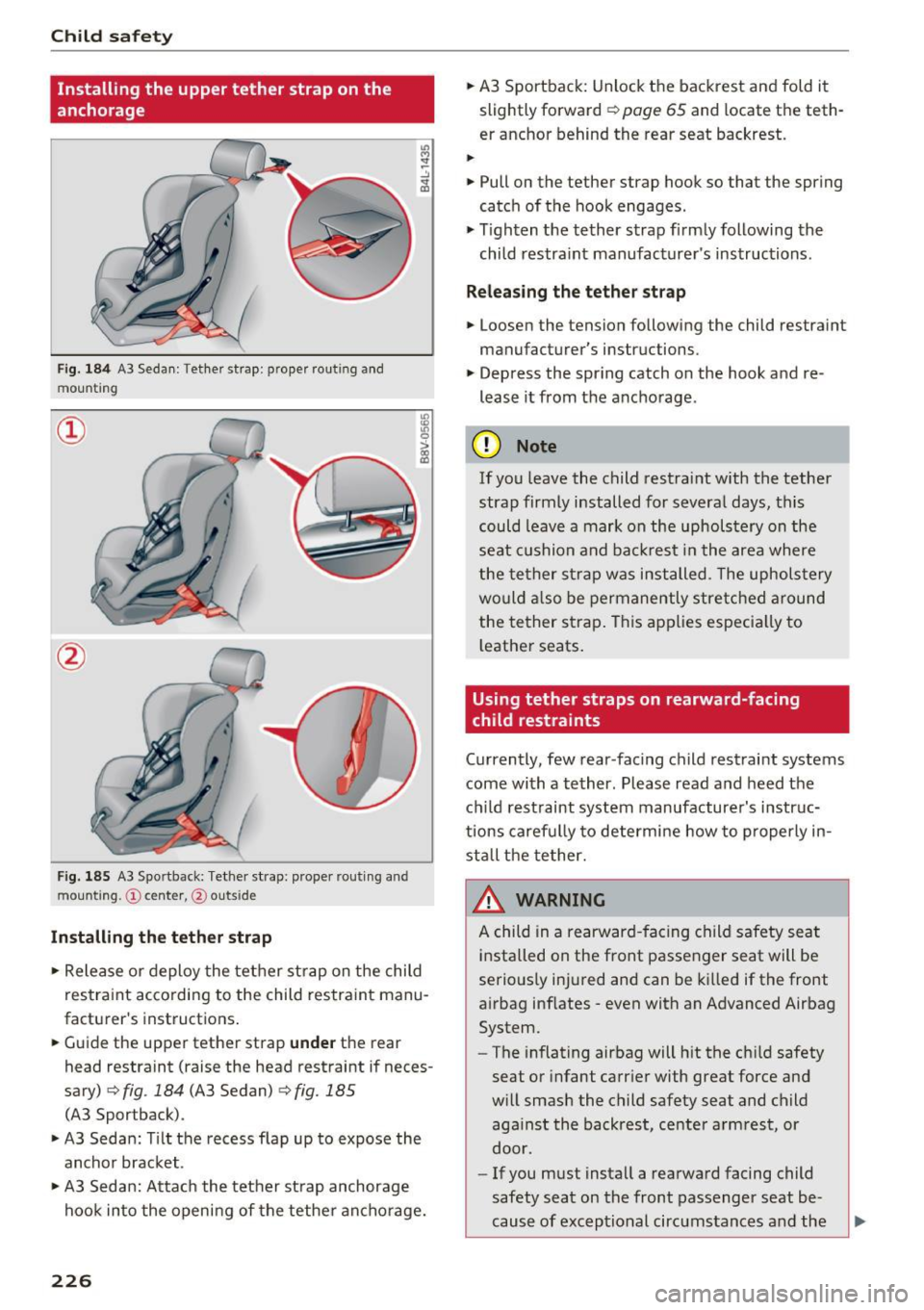
Installing the upper tether strap on the
anchorage
Fig. 184 A3 Sedan : Tethe r strap : prope r rout ing and
m oun ting
F ig . 185 A3 Sportback: Tet her st rap: p roper rout ing an d
m oun ting. (!) cent er, @ outs ide
Inst all ing th e teth er strap
"' ' ~ I 0 :> gi
,... Release or deploy the tether strap on the child
restra int according to the child restraint manu
facturer's instructions .
,... Guide the upper tether strap
unde r the rear
head restraint (raise the head restraint if neces
sary) ¢
fig. 184 (A3 Sedan) ¢ fig. 185
(A3 Sportback) .
,... A3 Sedan: T ilt the recess flap up to expose the
anchor bracket .
,... A3 Sedan: Attach the tether st rap anchorage
hook into the opening of the tether anchorage.
226
,... A3 Sportback: Unlock the backrest and fold it
slightly forward ¢
page 65 and locate the teth
er anchor behind the rear seat backrest .
..
,... Pull on the tether strap hook so that the spring
catch of the hook engages .
,... Tighten the tether strap f irmly following the
child restra int manufacturer's instructions .
Releasing the tether str ap
,... Loosen the tension following the child restraint
manufacturer's instructions.
,... Depress the spr ing catch on the hook and re
lease it from the anchorage .
(D Note
If you leave the child restraint with the tether
strap firmly installed for several days, this
could leave a mark on the upholstery on the
seat cushion and backres t in the area where
the tether s trap was installed . T he upholstery
would a lso be permanently stretc hed around
the tether strap. This applies especially to
l eather seats .
Using tether straps on rearward-facing
child restraints
Currently, few rear -facing child restraint systems
come with a tether. Please read and heed the
ch ild rest raint system manufacturer's instruc
tions carefully to determi ne how to p roperly in
stall the te ther.
_.6 WARNING
A child in a rearward -facing ch ild safety seat
installed on the front passe nger seat will be
serious ly injured and can be killed if the front
airbag inflates - even with an Advanced Airbag
System.
- The inflating airbag will h it the ch ild safety
seat or infant carr ier with great force and
w ill smash the child safety seat and child
against the backrest , center arm rest, or
door.
- If you must install a rearward facing child
safety seat on the front passenger seat be
cause of exceptional circumstances and the
Page 229 of 328
,....,
N
0 > co ,....,
come on and stay on, immed iate ly install
the rear-facing child safety seat in a rear
seating pos it ion and have the airbag system
inspected by your A udi dealer.
Additional information
Sources of information about child
restraints and their use
There are a number of sources of addit ional in
formation about child restraint selection, instal l ation and use:
NHTSA advises that the best child safety seat is
the one that fits your ch ild and f its in your vehi
cle, and that you will use correctly and consis
tently .
Try before you buy!
U .S National Highway Traffic Safety Administra
tion
Tel.: 1-888-327-4236 (TTY: 1-800-424-9153)
www.nhtsa.gov
National SAFE KIDS Campaign
Tel.: (202) 662-0600
www .safekids.org
Safety BeltSafe U.S.A
Tel. : (800) 745-SAFE ( English)
Tel.: (800) 747 -SANO (Spanish)
www .carseat.org
Transport Canada Information Centre
Tel.: 1-800-333-0371 or call 1-613-998-8616 if
you are in the Ottawa area
http ://www .tc.gc .ca/ eng/roadsafety/menu.htm
Audi Customer Relations
Tel. : (800) 822-2834
Child safety
227
Page 238 of 328
Checking and Filling
CJ) Note
-Only use Ad Blue that conforms to the
standard ISO 22241-1. Do not mix any addi
tives with the AdBlue and do not dilute it
with water.
- Only use refill bottles that are approved for your vehicle. Using other systems can cause Ad Blue to leak.
- Do not add Ad Blue to the diesel tank or add diesel fuel to the Ad Blue tank. Do not start
the engine under any circumstances if the
wrong fuel is filled in the tank . There is a
risk of damaging the fuel tank system and
the engine . See an authorized Audi dealer or
authorized Audi Service Facility for assis
tance.
- AdBlue attacks surfaces such as painted ve
hicle components, plastic and carpet. Re
move the fluid as quickly as possible with a
damp cloth and plenty of cold water. If the
Ad Blue has already crystallized, use warm
water and a sponge. AdBlue residue that is
not removed will crystallize and can damage
the affected surface .
- Do not store the refill bottle in the vehicle.
If it leaks, the escaping Ad Blue could dam
age the vehicle interior .
- Do not allow Ad Blue to come into contact
with clothing. If there is contact with the
fluid, flush immediately with plenty of wa
ter .
(D Tips
-You can obtain refill bottles from an author
ized Audi dealer or authorized Audi Service
Facility .
- Follow the Ad Blue manufacturer's instruc
tions for use and storage .
- A permitted refill bottle contains approxi
mately 1.9 liters of AdBlue .
- Ad Blue can freeze at very low temperatures.
If this happens, the system will not detect
that the Ad Blue was refilled and it will con
tinue to inform you of the low AdBlue level.
The message turns off as soon as the tank
thaws out again.
236
Engine compartment
Working in the engine compartment
Special care is required if you are working in the
engine compartment
For work in the engine compartment such as
checking and filling fluids, there is a risk of in
jury, scalding, accidents, and burns. For this
reason, follow all the following listed warnings
and general safety precautions. The engine
compartment is a dangerous area.
¢ .&. .
.8, WARNING
To reduce the risk of injuries, complete the
following steps before opening the hood:
- Turn the engine off.
- Switch the ignition off.
- Set the parking brake.
- Place the selector lever in the P position.
- Let the engine cool down.
- Never open the hood when you see that
steam or coolant drips from the engine
compartment- there is a danger of burns!
Wait until no steam or coolant flows out.
- Keep children away from the engine com
partment.
- Never spill fluids on a hot engine. These flu
ids (such as the freeze protection contained in the coolant) can catch fire.
- Avoid short circuits in the electrical system,
especially the battery.
- When working in the engine compartment,
remember that the radiator fan can switch
on even if the ignition is switched off, which
increases the risk of personal injury.
- Never open the cap on the coolant expan
sion tank when the engine is warm . The
cooling system is under pressure.
- To protect your face, hands, and arms from
hot steam or coolant, cover the cap with a
large cloth when opening.
- Do not remove the engine cover under any
circumstances . This increases the risk of
burns.
- If tests need to be performed with the en-
-
gine running, there is additional danger due ~
Page 246 of 328
Checking and Filling
-To reduce the risk of burns from hot engine
oil, let the engine cool down to the touch.
- When removing the oil drain plug with your
fingers, stay as far away as possible. Always
keep your forearm parallel to the ground to
help prevent hot oil from running down your
arm.
- Drain the oil into a container designed for
this purpose, one large enough to hold at least the total amount of oil in your engine .
- Engine oil is poisonous. Keep it well out of
the reach of children .
- Continuous contact with used engine oil is
harmful to your skin. Always protect your
skin by washing oil off thoroughly with soap
and water .
CD Note
Never mix oil additives with your engine oil.
These additives can damage your engine and
adversely affect your Audi Limited New Vehi
cle Warranty.
@ For the sake of the environment
-Before changing your oil, first make sure
you know where you can properly dispose of
the used oil.
- Always dispose of used engine oil properly.
Do not dump it on garden soil, wooded
areas, into open streams or down sewage
drains.
- Recycle used engine oil by taking it to a used
engine oil collection facility in your area, or
contact a service station.
Cooling system
Coolant
The engine coolant performs two functions: it
keeps the engine from overheating and it pro tects the engine from freezing in the winter.
The cooling system is sealed and generally re
quires little attention.
The cooling system has been filled at the factory
with a permanent coolant which does not need to
be changed. The coolant consists of a mixture of
244
specially conditioned water and the manufactur
er's glycol-based coolant additive Gl3 antifreeze
with anticorrosion additives (50% for USA mod els; 60% for Canadian models). This mixture
both assures the necessary frost protection and
protects metal components in the engine's cool
ing system from corrosion and scaling. It also
raises the boiling point of the coolant.
Do not reduce the concentration of the coolant in
the summer by adding plain water.
The propor
tion of coolant additive must be at least 50%
but not more than 60%
to maintain antifreeze
protection and cooling efficiency. If the coolant
frost protection is too low, the coolant could
freeze and damage the vehicle heating and en
gine cooling system.
For year-round driving, antifreeze is added at the
factory for temperatures down to:
--31°F(-35°C)USA
- - 40 °F ( - 40 °C) Canada.
If you must add coolant, use a mixture of water
and coolant additive. Mixing the coolant additive
with distilled water is recommended.
A WARNING
Before you check anything in the engine com
partment, always read and heed all WARN
INGS
~ page 236.
CD Note
- Before winter sets in, have the coolant
checked to see if the coolant additive in your
vehicle is sufficient to meet the climate con ditions. This is especially important if you
live in a region where the winter is extreme
ly cold.
If necessary, increase the proportion
of coolant additive to 60%.
- When adding coolant additive to your cool
ing system, remember:
- We recommend using only coolant addi
tive Gl2++ or G13 (check the label) for
your vehicle. This coolant additive is avail
able at authorized Audi dealers. Other
types of antifreeze can significantly re
duce corrosion protection. The resulting
Page 247 of 328

.... N
0 > CX)
.... I.Cl U"I
.... I.Cl ....
corrosion can cause a loss of coolant and
serious engine damage .
- Do not add any type of radiator leak sealant
to your vehicle's engine coolant . Adding ra
diator repair fluid may adversely affect the
function and performance of your cooling
system and could result in damage not cov
ered by your New Vehicle Limited Warranty.
Adding coolant
F ig . 198 Engine compa rtment: mark in gs on t he coo lant
expa nsion tank
Read and follow the WARNINGS before check
ing anything in the engine compartment
¢ page 236, Working in the engine compart
ment.
Checking the engine coolant level
• Park your vehicle on a level surface .
• Switch the ignition off .
• Read the coolant level on the coolant expansion
tank
¢ fig. 198 . The coolant level must be be
tween the markings when the engine in cold .
When the engine is warm it can be slightly above the upper marking.
Adding coolant
Plug-in hybrid drive*: your vehicle has two cool
ant expansion tanks that are separate from each
other. The smaller of the two expansion tanks
must not be opened
¢ page 108. Read and fol
low the important safety precautions ¢
A in
Coolant on page 109.
Requirement: there must be a residual amount of
coolant in the expansion tank ¢(D .
• Let the engine cool down .
Checking and Filling
• Place a cloth over the coolant expansion tank
cap and unscrew the cap counterclockwise
¢ A .
• Add coolant mixed in the correct ratio
¢
page 244 up to the upper marking.
• Make sure that the fluid level remains stable.
Add more coolant if necessary.
• Close the cap securely .
A coolant loss suggests a leak. Immediately drive
your vehicle to an authorized Audi dealer or au
thorized Audi Service Facility and have the cool
i ng system inspected. If the cooling system is not
leak ing, a loss can come from the coolant boiling
through overheat ing and being pushed out of the
cooling system .
,&_ WARNING
-= -The cooling system is pressurized and can be
come very hot. To reduce the risk of burns
from hot coolant:
- Do not open the coolant expansion tank cap
with the engine hot. There is a risk of burns.
- Stop the engine and allow it to cool.
- Protect your face, hands and arms from es-
caping coolant and steam by covering the
coo lant tank cap with a large, thick cloth.
- Turn the coolant tank cap counterclockwise
slowly and keep light pressure on the cap.
- To reduce the risk of burns, do not allow any
antifreeze or coolant to drip onto the ex
haust system or hot engine components.
The ethylene glycol in engine coo lant can
catch fire under certain circumstances .
- The coolant additive and the coolant can be
dangerous to your health . For th is reason,
keep the coolant in the original container
away from children. There is a risk of poi
soning .
- When working in the engine compartment,
remember that the radiator fan can switch
on even if the ignition is switched off, wh ich
increases the risk of persona l injury.
(J) Note
Do not add coolant if the expansion tank is
empty . Air could enter the cooling system and
damage the eng ine.
If this is the case, do not ..,_
245