safety AUDI A3 2016 Owner´s Manual
[x] Cancel search | Manufacturer: AUDI, Model Year: 2016, Model line: A3, Model: AUDI A3 2016Pages: 328, PDF Size: 81.78 MB
Page 196 of 328
Airbag system
More important things to know about front
airbags
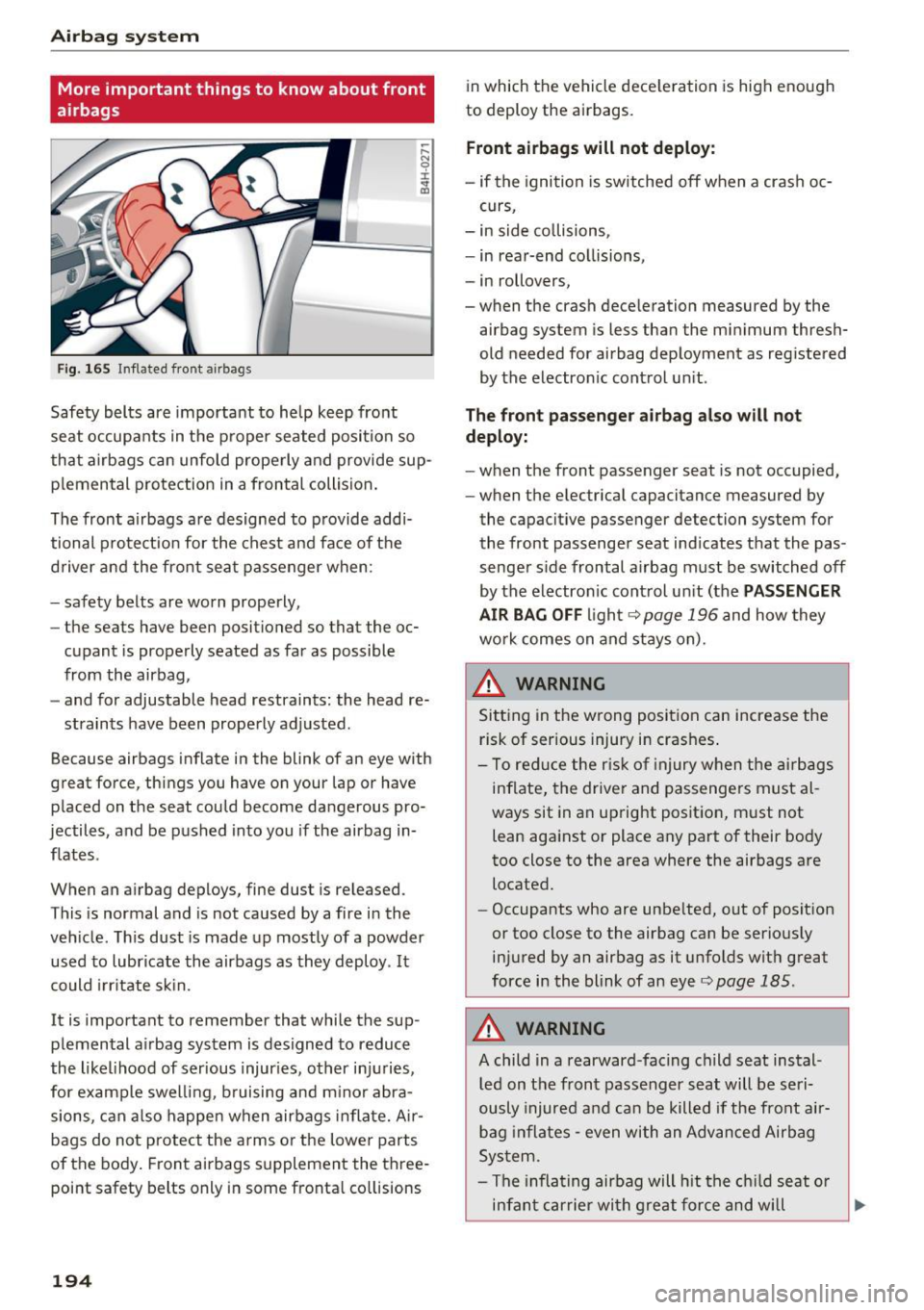
Fig. 165 In fla ted fro nt airb ags
Safety belts are important to help keep front
seat occupants in the proper seated position so
that airbags can unfold properly and provide sup p lemental protection in a frontal collision.
The front airbags are designed to provide addi
tional protection for the chest and face of the
driver and the front seat passenger when:
- safety belts are worn properly ,
- the seats have been positioned so that the oc-
cupant is properly seated as far as possible
from the airbag,
- and for adjustable head restraints: the head re-
straints have been properly adjusted .
Because airbags inflate in the blink of an eye with
great force, thing s you have on your lap or have
placed on the seat could become dangerous pro
jectiles , and be pushed into you if the airbag in
flates .
When an airbag deploys, fine dust is released.
This is normal and is not caused by a fire in the
veh icle. This dust is made up mostly of a powder
used to lubricate the airbags as they deploy . It
could irritate sk in .
It is important to remember that while the sup
plemental a irbag system is designed to reduce
the likel ihood of serious injur ies , other injuries,
for example swel ling , bruising and m inor abra
sions, can a lso happen when airbags inflate. Air
bags do not protect the arms or the lower parts
of the body. Front airbags supplement the three
point safety belts only in some fronta l co llisions
194
in which the vehicle decele ration is high enough
to deploy the airbags.
Front airbags will not deploy:
- if the igni tion is sw itched off when a crash oc-
curs,
- in side collisions ,
- in rear-end co llisions,
- in rollovers,
- when the crash deceleration measured by the
airbag system is less than the minimum thresh
old needed for airbag deployment as registered
by the electronic control un it .
The front passenger airbag also will not
deploy:
- when the front passenger seat is not occupied,
- when the electrical capacitance measured by
the capacit ive passenger detection system for
the front passenger seat ind icates that the pas
senger s ide frontal a irbag must be switched off
by the electronic control un it (the
PASSENGER
AIR BAG OFF
light ~ page 196 and how they
work comes on and stays on).
.&, WARNING
Sitting in the wrong position can increase the
risk of serious injury in cras hes .
- To reduce the risk of in jury w hen the airbags
inflate, the driver and passengers must al
ways sit in an upright position, must not
lean against or place any part of their body
too close to the area where the airbags are
located.
- Occupants who are unbe lted, out of posit ion
or too close to the airbag can be seriously injured by an airbag as it unfolds with great
force in the blink of an eye
c?) page 185 .
A WARNING
A child in a rearward-facing child seat instal
led on the front passenger seat will be seri
ously injured and can be killed if the front air
bag inflates -
even with an Advanced Airbag
System.
- The inflating airbag will hit the child seat or
infant carrier with great force and will
Page 199 of 328
,....,
N
0 > co ,....,
the front passenger seat . Always make sure that
the safety belt for the front passenger seat is
properly fastened.
Th e PASSENGER AIR BAG OFF light will show
the status of the front seat p assenger' s fr ontal
Ad vanced Airbag a few se cond s after the igni·
tion i s swit ched on and the ai rbag in d icator
light goes off . The PA SSEN GER AIR BA G OFF
light :
-will stay on if the front passenger seat is not
occupied;
- wi ll stay on if the electrical ca pacita nee meas
ured by the capacit ive passenger detection sys
tem for the front passenger seat equals the combined capacitance of an infant up to about
one year of age and one of the rearward-facing
o r fo rwa rd-facing ch ild restraints listed in Fed
era l Moto r Vehicle Safety Standard 208 w it h
wh ich the Advanced Airbag System in your veh i
cl e was certified; Fo r a listing of the child re
straints that were used to certify you r vehicle 's
compliance with the U.S. Safety Standard
¢ page 211 .
-will go out if the front passenger seat is occu
pied by an adult as registered by the capacitive
passenger detection system .
- The
PASSENGER AIR BAG OFF light must come
on and stay on if the ignition is on and ...
- a car bed has been insta lled on the front pas
senger seat, or
- a rearward-facing child restrai nt has been in
sta lled on the front passenger seat, or
- a forwa rd-facing child restra int has bee n instal
l ed on the front passenge r seat,
- and if the e lectr ic al capaci tance registered on
the front passenger seat is equal to or less than
the combined capacitance of a typical 1 year o ld infant and one of the rearward-facing or
forward -facing chi ld restraints listed in Federal
Motor Vehicle Safety Standard 208 w ith which
the Advanced Airbag System in your vehicle was
certified.
If the front passenger seat is not occupied, the
front airbag w ill not deploy, and the
PA SSENGER
AIR BAG OFF
light will stay on. Never install a
rearward -fac ing ch ild restraint on the front pas-
Airb ag sys tem
senger seat, the safest place for a chi ld in any
kind of child restraint is at one of the seating po
s itions on the rear seat¢
page 185, Child re
straints on the front seat -some important
things to know
and ¢ page 209, Child safety .
If the PASSENGER AIR BAG light comes
on ...
If the PA SSEN GER AIR BAG OFF light comes on
when one of the conditions listed above is met,
be sure to check the light regu larly to make cer
ta in that the
PASSENGER AIR BAG OFF l ight
stays on continuously whenever the ignition is
on. If the
PASSENGER AIR BAG OFF li ght does
not appear on and does no t stay on a ll the time,
stop as soon as it is safe to do so and
- react ivate the system by turning the ignit ion
off for more than 4 seconds a nd then turn ing it
on again;
- remove and re insta ll the chi ld restraint. Make
sure that the chi ld restraint is properly insta l
led and that the safety belt for the front pas
senger seat has been correct ly routed through
the child restraint as described in the c hild re
straint manufacturer's instructions;
- make sure that the convertible locking retrac
tor on the safety belt for the front passenge r
seat has been activated and that the safety belt has been pulled tight.
- make sure that no e lectr ica l device (such as a
laptop, CD player, e lectron ic games device,
power inverter or seat heater for ch ild seats) is
placed or used on the fro nt passenger seat if
the device is connected to the 12-volt socket or
the c igarette lighter socket;
- make sure that no seat heater has been retro
fitted or othe rw ise added to the front passen
ger seat;
- make sure that not hing can inte rfere with the
safety belt buckles and that they are not ob
structed;
- make sure that there are no wet objects (such
as a wet towe l) and no water or other liquids on
the front passenge r seat cushion. .,..
197
Page 200 of 328
Airbag system
If the PASSENGER AIR BAG light still does
not come on ...
If the PASSENGER AIR BAG OFF light still does
not come on and does not stay on continuously
(when the ignition is switched on),
- take the child restraint off the front passenger
seat and install it properly at one of the rear
seat positions. Have the airbag system inspect
ed by your Audi dealer immediately .
- move the chi ld to a rear seat position and make
sure that the child is properly restrained in a
child restraint that is appropriate for its size
and age .
The PASSENGER AIR BAG light should NOT
come on ...
The PASSENGER AIR BAG OFF light should NOT
come on when the ignition is on and an adult is
sitting in a proper seating position on the front
passenger seat. If the
PASSENGER AIR BAG OFF
light comes on and stays on or flashes for about
S seconds while driving, under these circumstan
ces, make s ure that:
- the adult on the front passenger seat is proper
ly seated on the center of the seat cushion with
his or her back up against the backrest and the
backres t is not recl ined,
- the adu lt is not taking weight off the seat by
holding on to the passenger assist handle
above the front passenger door or supporting
their weight on the armrest,
- the safety belt is being properly worn and that
there is not a lot of slack in the safety belt web
bing,
- there are no aftermarket seat covers or cush
ions or other things (such as blankets) on the
front passenger seat that might cause the ca
pacitive passenger detection system to miscal
culate electrical capacitance.
Important safety instructions on
monitoring the Advanced Airbag System
A WARNING
- If the status of the Adv a need Airbag System
has changed while the vehicle is moving, the
PASSENGER AIR BAG OFF light blinks for
198
about S seconds to catch the driver's atten
tion. If this happens, always stop as soon as
it is safe to do so and check the steps descri
bed above .
- If the
PASSENGER AIR BAG OFF light does
not go off when an adult who is not very
small is sitting on the front passenger seat
after taking the steps described above, make sure the adult is properly seated and
restrained at one of the rear seating posi
tions. Have the airbag system inspected by
your authorized Audi dealer befo re trans
porting anyone on the front passenger seat.
A WARNING
An airbag system that is not functioning prop
erly cannot provide supplemental protection in a fronta l crash.
- If the airbag indicator light~
page 21
comes when the vehicle is being used, have
the system inspected immediately by your
authorized Audi dealer.
It is possible that
the airbag will inflate when it is not sup
posed to, or wi ll not inflate when it should.
A WARNING
If the front airbag inflates, a ch ild without a
chi ld restraint, or in a rearward-facing child
safety seat, or in a forward-fac ing ch ild re
straint that has not been properly insta lled
will be seriously injured and can be killed.
- Even though you r vehicle is equipped with
an Advanced A irbag System, make certain
that a ll children, especially 12 years and
younger, always ride on the back seat prop
erly restrained for their age and size.
-Always install forward or rear-facing child seats on the rear seat -even with an Ad
vanced Airbag System.
- If you must install a rearward-facing child
seat on the front passenger seat because of
except ional circumstances and the
PASSEN·
GER AIR BAG OFF
light does not appear and
stay on, immediately install the rear-facing
child seat in a rear seat ing position and have
the airbag system inspected by your Audi
dea le r.
~
Page 202 of 328
Airbag syste m
must be performed by qualified workshops
only. Make sure that any airbag service ac
tion is entered in your Aud i Warranty
&
Maintena nce booklet under AIRBAG RE
PLACEMENT RECORD.
- For safety reasons in severe accidents, the
alternator and starter are separated from
the vehicle battery with a pyrotechn ic circuit
in terrupter.
- Work on the pyrotechnic circuit interrupt
er must only be performed by a qualified
technicians who have the experience, in
formation and special tools necessary to
perform the work safely.
- If the vehicle or the circuit interrupter is
scrapped, all applicab le safety precautions
must be followed .
@ For the sake of the environment
Undeployed airbag modu les and pretension
ers might be classified as Perch lorate Materi
al -special handling may apply, see
www.dtsc.ca.gov/hazardouswaste/perchlo rate . When the veh icle o r parts of the re
stra int system including airbag modules and
safety belts w it h pretensioners are scrapped,
all applicable laws and regu lations must be
observed. Your authorized Audi dealer is fa
m iliar with these requirements and we recom
mend that you have your dealer perform this
serv ice for you.
Other things that can affect Advanced
Airbag performance
Changing the vehicle's suspension system can
change the way that the Advanced A irbag System
pe rforms in a crash. For e xamp le, using t ire -r im
comb inations no t approved by Audi, lowering t he
veh icle, chang ing the stiffness o f the suspe nsio n,
i n cluding the springs, suspension struts, shock
absorbers etc . can change the forces that are
measured by the airbag sensors and sent to the
electronic contro l unit . Some suspens ion changes
can, for example, increase the force levels meas
ured by the sensors and make the airbag system
deploy in c rashes in w hich it would not deploy if
the changes had not been made. Other ki nds of
200
changes may reduce the force levels measured by
the sensors and prevent the airbag from deploy
i ng when it should .
_& WARNING
Changing the vehicle's suspension including
use of unapproved tire-rim comb inations can
change Advanced Airbag performance and in
crease the r isk of serious personal injury in a
crash .
- Never install suspension components that do not have the same performance charac
ter istics as the components origina lly instal
led on your vehicle.
- Never use tire-r im combinations that have
not been approved by Aud i.
Knee airbags
Description of knee airbags
Applies to vehicles: with knee airbags
The knee airbag system can provide supplemen
tal protection to properly restrained front seat
occupants .
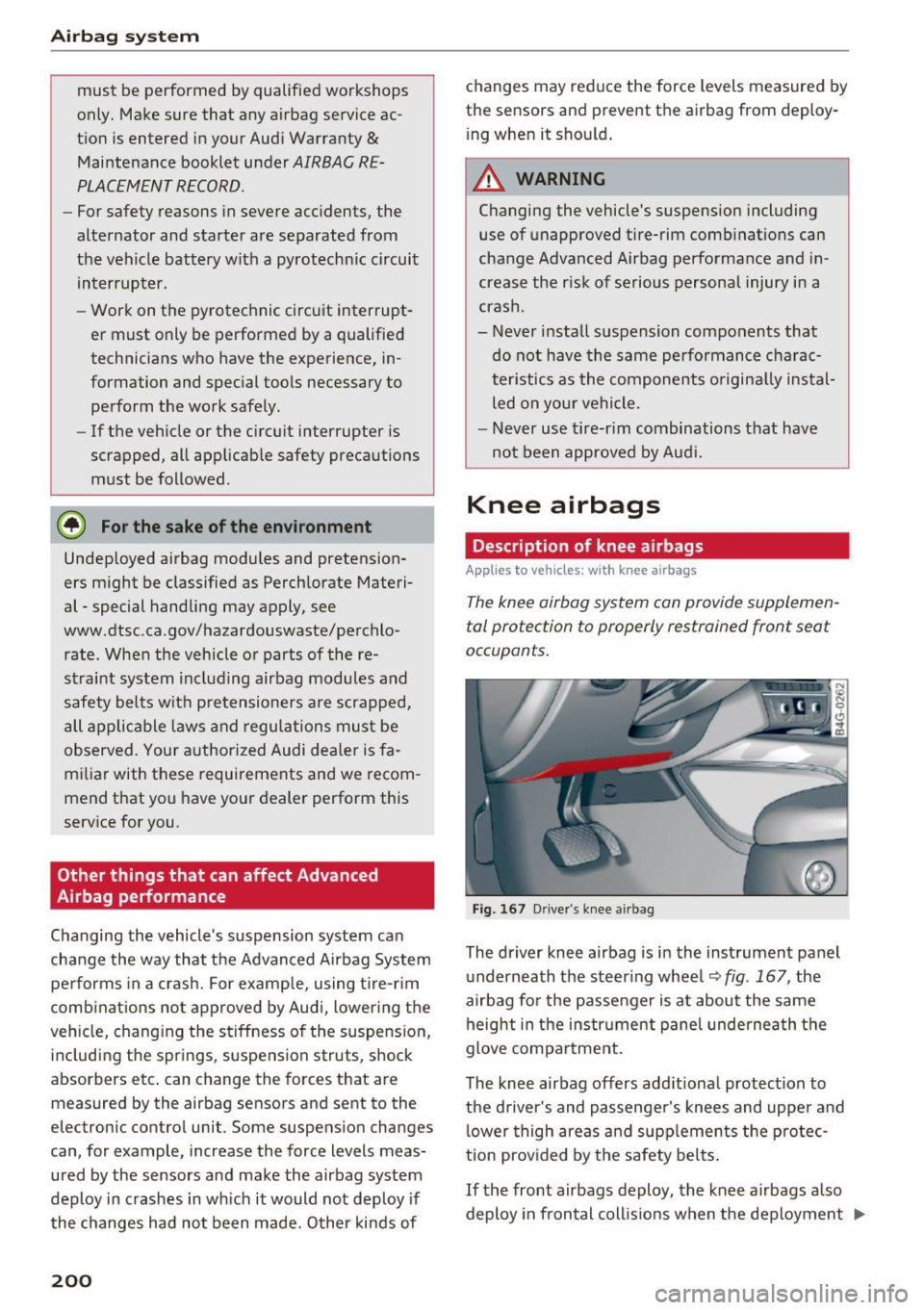
Fig . 16 7 D river 's knee a irbag
The driver knee airbag is in the instrument panel
u nderneath the s teer ing whee l¢
fig. 167, the
airbag fo r the passenger is at about the same
height in the i nstr ument panel underneath the
glove compa rtment.
The knee airbag offers add itiona l protect ion to
the d river's and passenge r's knees and uppe r and
l ower thigh areas a nd sup plements the p rotec
t ion prov ided by the safety belts .
If the front airbags deploy, the knee a irbags also
deploy in fron tal coll is ions when t he deployment ..,_
Page 203 of 328
.... N
0 > CX)
.... I.Cl U"I
.... I.Cl ....
threshold stored in the control unit is met
¢ page 194, More important things to know
about front airbags .
In addition to their normal safety function, safe
ty belts help keep the driver or front passenger in
posit ion in a frontal collision so that the airbags
can prov ide supplemental protection.
The airbag system is not a subst itute for your
safety belt. Rather, it is part of the overall occu
pant restraint system in your vehicle. Always re
member that the airbag system can only help to
protect you if you are wearing your safety belt
and wear ing it properly . This is why you should
always wear your safety belt, not just because
the law requires you to do so ¢
page 176, Gener
al notes .
Remember too, airbags will deploy only once and
only in certain k inds of accidents -your safety
be lts are always there to offer protection in those
accidents in which airbags are not supposed to
deploy or when they have a lready deployed, for
example when yo ur vehicle str ikes or is str uck by
anothe r after t he f irst collision .
This is just one of the reasons why an airbag is
n ot a substi tute for the safety belt. The airbag
system works most effectively when used with
the safety belts . Therefore , a lways wear your
safety be lts correct ly .
It is important to remember that while the sup
p lemen tal knee a irb ag sys tem is designed to re
duce the like lihood of serious injur ies, other inju
ries, for example, swelling, bruising and minor
abrasions and friction burns can also occur when
an airbag inf lates.
The kn ee airbag sy stem basically con sist s of :
- T he elec tronic contro l module
- Two inflatab le airbags (airbag and gas genera -
tor), one for the drive r and one fo r the front
passenge r
- The airbag indicator light in the instrument
panel
The knee airbag s ystem will not deploy:
- when the ign ition is switched off
Airb ag sys tem
-in frontal co llisions when the deceleration
measured by the control unit is too low
- in side co llisions
- in rear-end collisions
- in rollovers
- in the event of a system malfunction (warn ing/
ind icator light is on)
¢ page 21.
.&, WARNING
- Safety belts and the airbag system can only
provide protect io n when occupants are i n
the proper seat ing position ¢
page 194.
- If the a irbag ind icator light¢ page 21
comes when the veh icle is being used, have
the system inspected immediately by your
authorized Audi dealer. It is possib le that
the airbag will inflate when it is not sup posed to, or w ill not inflate when it should.
How knee airbags work
Applies to vehicles: wit h knee airbags
The risk of injury to the leg area can be reduced
by fully inflated knee airbags.
Fi g. 168 Inflated a irbags protect ing in a frontal coll is ion
The knee airbag system has been des igned so
that the airbags for the driver and front passen
ger dep loy in certain but not all fronta l co llisions .
If the front airbags deploy, the knee airbags also
deploy in frontal coll is io ns when the deployment
threshold stored in the cont rol un it is met .
When the system deploys, the airbags fill with a compressed propellant gas, and inflate between
the lower part of the instrument panel and the driver and the lower part of the instrument panel
and the front passenger
¢ page 194, fig. 165 . .,.
201
Page 204 of 328
Airbag syste m
Although they are not a soft pillow, they can
"cushion" the impact and in this way they can
he lp to reduce the risk of injury to the lower ex
tremities .
All of this takes place in the blink of an eye, so
fast that many people don't even realize that the airbags have deployed. The a irbags also inflate
with a great deal of force and it is important for
occupant safety that nothing should be in their
way when they deploy .
Fully inflated airbags in comb ination with proper
ly worn safety belts slow down and limit the oc
cupant's forward movement and help to reduce
the risk of inju ry.
Important safety instructions on the knee
airbag system
App lies to veh icles : with knee a irbags
Airbags are only supplemental restraints . Always
wear safety belts correctly and ride in a proper
seating position.
There is a lot that you and your passengers must
know and do to help the safety belts and airbags
to provide supplemental protection .
,&. WARNING
An inflating knee airbag can cause ser ious in
jury. Wearing safety bel ts incorrectly and im
proper seating positions increase the r isk of
serious personal injury and death whenever a
vehicle is being used.
- The knee airbag system cannot protect you properly if you are seated too close to any of
the airbag locat ions. When adjusting their
seat positions, it is important that both the driver and the front passenger keep their
upper bodies and knees at the following
min imum safe distances:
- at least 10 inches (25 cm) between the
chest and the steering wheel/instrument panel.
- at least 4 inches (10 cm) between the
knees and the lower part of the instru ment panel.
- The risk of persona l injury increases if you
lean forward or to the s ide, or if the seat is
202
improperly positioned and you are not wear
ing your safety belt. The risk increases even
more should the airbag deploy.
- Always make sure that the knee a irbag can
inflate w ithout interference. Objects be
tween you and the airbag can increase the
r isk of injury in an accident by interfering
w ith the way the airbag deploys or by being
pushed i nto you as the a irbag deploys.
- Never let anybody, especia lly children or
anima ls ride in the footwell in front of the
passenger seat. If the airbag deploys, this
can result in serious or fatal injuries .
- Never carry objects of any kind in the foot
well area in front of the driver's or pas senger's seat. Bulky objects (shopp ing
bags, for example) can interfere with or
prevent proper dep loyment of the a irbag.
Small objects can be thrown through the
vehicle if the airbag deploys and injure you
or your passengers.
- Ma ke sure there are no crac ks, deep scratch
es o r other damage in the area of the i nst ru
ment panel where the knee airbags are lo
cated .
- If children are incorrec tly seated, their risk
of injury increases in a coll is ion
c:::> page 209, Child safety.
Side airbags
Description of side airbags
The airbag system can provide supplemental
protection to properly restrained occupants .
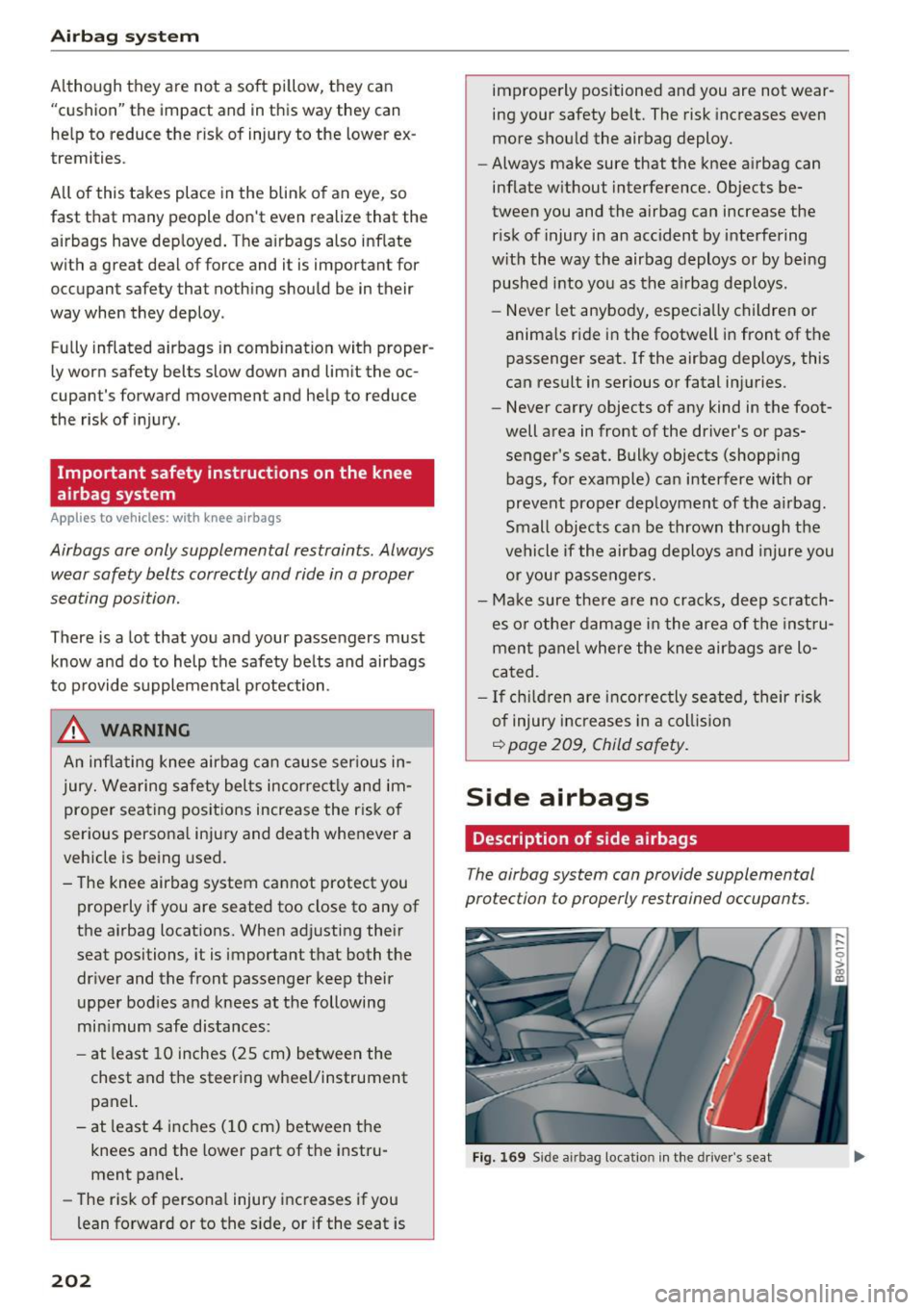
Fig. 169 S ide a irbag locatio n in the driver 's seat
Page 205 of 328

,....,
N
0 > co ,....,
front seat backrests¢
fig. 169 and the rear back
rest facing the doors.
The s ide airbags installed for the front seating
positions have been designed and certified to
he lp reduce the risk of injury that can be caused
by airbags when they inflate, part icular ly when
the occupant sitt ing next to it is not seated prop
erly. The s ide airbag for the front passenger seat
can be used with properly insta lled child re
stra ints . Please be sure to read the important in
formation and warnings whenever using a child rest raint in a ve hicle: Safety belts ¢
page 176,
Airbag system ¢page 184, Child s afety
¢ page 209.
The side airbag system basically con sists of:
-the e lectron ic control modu le and externa l side
impact sensors
- the two airbags located in the sides of the front
backrests and the two airbags* located in the
rear backrest
- the a irbag warning light in the instrument clus-
ter .
T he airbag system is monitored electronically to
make certain that it is functioning properly at all
times. Each time you switch on the ign ition, the
airbag system indicato r light will come on for a
few seconds (self diagnostics).
The s ide airbag system supplements the safety
belts and can help to reduce the risk of injury to
the dr iver 's, front and rear passenger's upper tor
so on the side of the veh icle that is struck in a
side coll is ion . T he a irbag dep loys only i n side im
pacts and o nly when the vehi cle acceleration reg
i stered by the cont rol un it is h igh enough .
If this
rate is below the refe rence value programmed in
to the cont rol unit, the side airbags wi ll not be
triggered , even thoug h the car may be bad ly
damaged as a result of the collision. It is not pos
sib le to define an airbag tr igger ing range that
will cover every possib le ang le of impact, s ince
the circumsta nces wi ll vary considerably between
one collision and another . Important fac to rs in
clude, for example, the nature (hard or soft) of
the impact ing object, the angle of impact, vehicle
Airb ag sys tem
speed, etc. ¢ page 204, Important safety in
structions on the side airbag system .
Aside from the ir no rm al safety funct io n, safety
belts work to he lp keep the dr iver o r front pas
senger in posi tion in the event o f a side co llision
so that the side airbags can provide protectio n.
T he airbag system is
not a substi tute for you r
sa fety belt. Ra ther, i t is par t of the ove rall occ u
pant restraint system in your vehicle . Always re
member that the side airbag system can only
help to protect you if you are wear ing you r safety
belt and wear ing it properly . This is another rea
son why you should a lways wear your safety
belts, not just because the law requires you to do
so ¢
page 176, General notes .
It is important to remember that while the sup
plementa l side airbag system is designed to re
duce the likelihood of ser ious injuries, other i nju
ries, for example, swelling, bru is ing, friction
burns and m ino r abras ions can also be assoc iated
with deployed s ide airbags. Remember too, s ide
airbags will deploy only once and only in certa in
ki nds of accidents -your safety belts are always
there to offer p rotection .
Vehicle damage, repair costs o r even the lack of
vehicle damage a re not necess aril y an ind ic a tion
of over-sens it ive or fa iled airbag ac tiva tion . In
some collisions, both front and side airbags may
inflate. Remember too, that airbags wi ll dep loy
only once and only in certain kinds of collisions -
your safety belts are always there to offer protec
t ion in those accidents in which airbags are not
supposed to deploy or when they have already deployed .
The side airbag system will not deploy :
-when the ignit ion is switched off
- in side co llisions when the acceleration meas -
ured by the sensor is too low
- in front-end collisions
- in rear -end co llisions
- in rollovers .
In some types of accidents the front a irbags, side
curtain airbags and side a irbags may be triggered
togethe r. .,..
203
Page 206 of 328
Airbag syste m
_& WARNING
-Safety belts and the a irbag system w ill only
provide protection when occupants are in
the proper seating position
¢ page 204 .
-If the airbag indicator light r::!;> page 21
comes when the vehicle is being used, have
the system inspected immediate ly by your
authorized Audi dealer. It is possible that
the airbag will inflate when it is not sup posed to, or will not inflate when it should.
How supplemental side airbags work
Side airbags deploy instantly and can help re
duce the risk of upper torso injuries for occu
pants who are properly restrained .
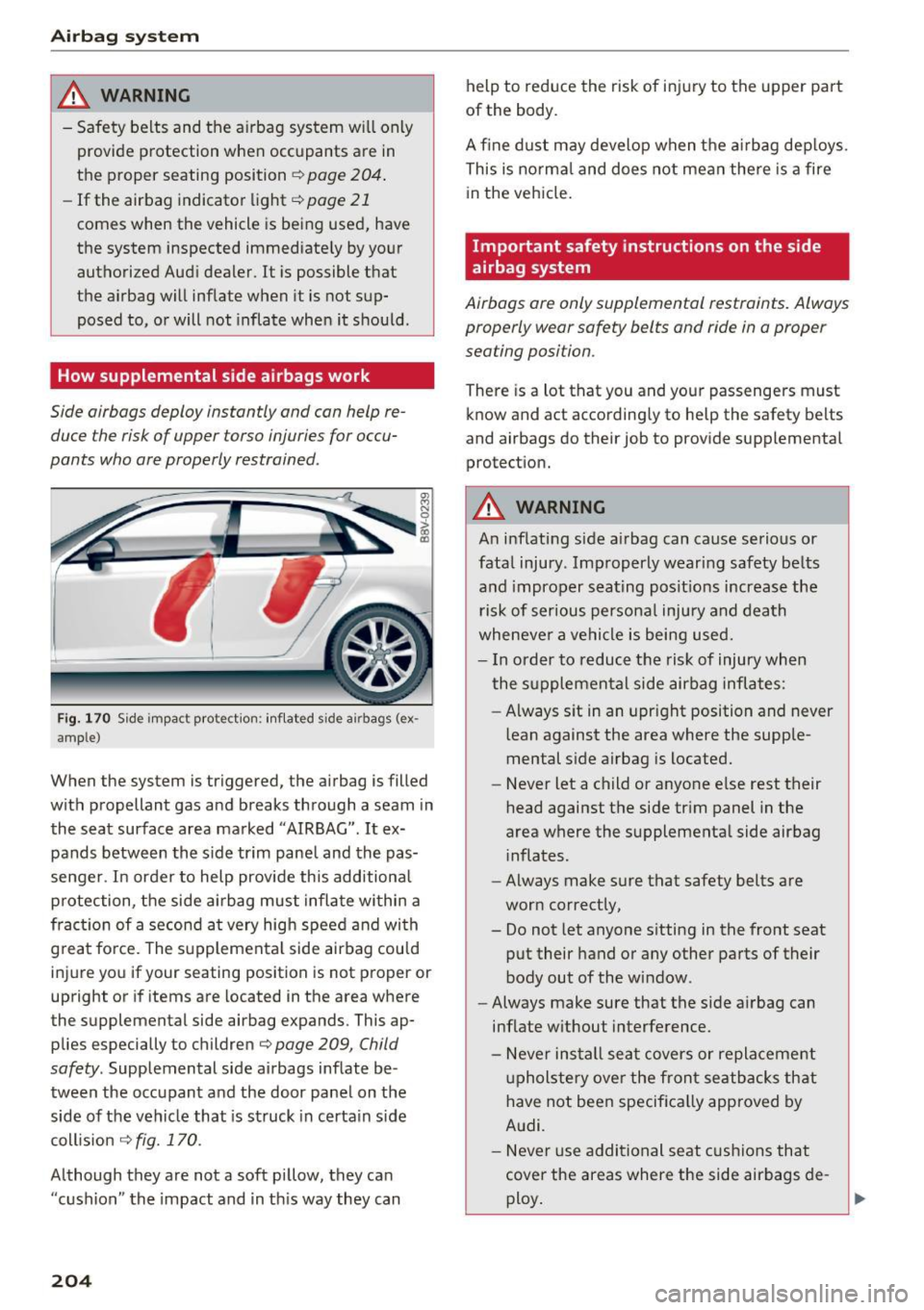
Fig. 170 Side impact protect ion : inflated s ide a irbags (ex
amp le)
When the system is triggered, the airbag is filled
with propellant gas and breaks through a seam in the seat surface area marked "AIRBAG" .
It ex
pands between the s ide trim panel and the pas
senger . In order to help provide this additional
protection, the side airbag must inflate within a
fract ion of a second at very high speed and with
great fo rce. The supplementa l side airbag could
injure you if your seating position is not proper or
upright or if items are located in the area where
the supplemental side airbag expands. This ap plies especially to children
¢ page 209, Child
safety .
Supplemental side airbags inflate be
tween the occupant and the door pane l on the
side of the vehicle that is struck in certa in side
coll is ion
r::!;> fig. 170.
Although they are not a soft pillow, they can
"cushion" the impact and in th is way they can
204
help to reduce the risk of injury to the upper part
of the body.
A fine d ust may develop when the a irbag dep loys.
This is norma l and does not mean there is a fire
in the vehicle.
Important safety instructions on the side
airbag system
Airbags are only supplemental restraints. Always
properly wear safety belts and ride in a proper
seating position .
There is a lot that you and your passengers must
know and act according ly to he lp the safety belts
and airbags do their job to provide supplemental protect ion.
_& WARNING
An inflating side a irbag can cause serious or
fata l injury. Improperly wearing safety belts
and improper seating posit ions increase the
risk of serious persona l injury and death
whenever a vehicle is being used.
- In order to reduce the risk of injury when
the supplemental side airbag inflates:
- Always s it in an upr ight position and never
l ean against the area where the supple-
mental side airbag is located.
- Never let a child or anyone e lse rest their
head against the side trim panel in the
area where the supplementa l side airbag
i nflates .
- Always make sure that safety belts are
worn correctly,
- Do not let anyone s itting in the front seat
put their hand or any other parts of their
body out of the window .
- Always make sure that the side a irbag can
inflate without interference.
- Never ins tall sea t covers or replacement
u pholstery ove r the fron t seatbacks that
have not been specifica lly approved by
Audi.
- Never use additional seat c ushions that
cover the areas where the side airbags de- ploy . ..,.
Page 207 of 328

.... N
0 > CX)
.... I.Cl U"I
.... I.Cl ....
-Damage to the original seat covers or to
the seam in the area of the side airbag
module must always be repaired immedi
ately by an authorized Audi dealer.
- Objects between you and the airbag can in
crease the risk of injury in an accident by in
terfering with the way the airbag unfolds or by being pushed into you as the airbag in
flates.
- Never place or attach accessories or other
objects (such as cup holders, telephone
brackets, or even large, bulky objects) on
the doors, over or near the area marked
"AIRBAG" on the seat backrests.
- Such objects and accessories can become
dangerous projectiles and cause injury
when the supplemental side airbag de ploys .
- Never carry any objects or pets in the de
ployment space between them and the
airbags or allow children or other passen
gers to travel in this position.
-Always use the built-in coat hooks only for
lightweight clothing. Never leave any heavy
or sharp-edged objects in the pockets that may interfere with side airbag deployment
and can cause personal injury in an accident.
- Always prevent the side airbags from being
damaged by heavy objects knocking against
or hitting the sides of the seatbacks.
- The airbag system can only be triggered
once. If the airbag has been triggered, the
system must be replaced by an authorized
Audi dealership.
- Damage (cracks, deep scratches etc.) to the
original seat covers or to the seam in the
area of the side airbag module must always
be repaired immediately by an authorized
Audi dealer.
- If children are seated improperly, their risk
of injury increases in the case of an accident
Q page 209, Child safety.
- Never attempt to modify any components of
the airbag system in any way.
- In a side collision, side airbags will not func
tion properly if sensors cannot correctly measure increasing air pressure inside the
Airbag system
doors when air escapes through larger, un
closed openings in the door panel.
- Never drive with interior door trim panels
removed.
- Never drive when parts have been re
moved from the inside door panel and the
openings they leave have not been proper
ly closed.
- Never drive when loudspeakers in the
doors have been removed unless the
speaker holes have been properly closed.
- Always make certain that openings are
covered or filled if additional speakers or
othe r equipment is installed in the inside
door panels.
- Always have work on the doors done by an
authorized Audi dealer or qualified work
shop.
Side curtain airbags
Description of side curtain airbags
The side curtain airbag system can provide sup
plemental protection to properly restrained oc
cupants.
Fig. 171 Sid e curta in airbags, driver's side : sid e curta in air
bag locat ion (example)
The side curtain airbags are located on both sides
of the interior above the front and rear side win
dows
Q fig. 171 . They are identified by the word
"AIRBAG" on the windshield frame and the cen
ter roof pillar.
The side curtain airbags contain features that
provide ejection mitigation to help prevent vehi-
cle occupants or parts of their bodies from being
completely or partially ejected from the vehicle ..,.
205
Page 208 of 328

Airbag syste m
interior in certain side impacts and vehicle
rollovers.
The s ide curta in a irbag system supplements the
safety belts and can he lp to reduce the r is k of in
jury for occupants' heads and upper torso on the
side of the vehicle that is struck in a side co lli
sion. The side curtain airbag inflates in side im
pacts and on ly when the vehicle acceleration reg
istered by the control unit is h igh enough . If this
rate is below the reference value programmed in
to the control un it, the side curta in a irbag w ill
not be triggered, even though the car may be
badly damaged as a result of the collision.
It is
not possib le to define an airbag trigger ing range
that will cover every poss ible angle of impact,
since the circumstances will vary considerab ly be
tween one collision and another . Important fac
tors incl ude, for example, the nature (hard or
soft) of the impacting object, the ang le of im
pact, vehicle speed, etc .
q page 207, How side
curtain airbags work .
Aside from their normal safety function, safety
be lts work to help keep the driver or front pas
senger in posit ion in the event of a collision so
that the side curtain airbags can provide protec
tion .
The airbag system is not a substitute for your safety belt. Rather, it is part of the overall occu
pant restraint system in your vehicle . Always re
membe r th at the airbag system can only help to
protect you if you a re wearing your safety belt
and wear ing it properly . T his is anothe r reason
why you should a lways wear your safety belts,
not just because the law requires you to do so
q page 176, General notes.
It is important to remember that whi le the s ide
curtai n airbag system is des igned to he lp red uce
the likelihood of serious injuries, other injuries,
for example, swe lling, b ruising, friction burns
and minor abrasions can also be assoc iated with
these airbags upon deployment . Remember too,
these airbags will deploy only once and only in
certa in kinds of acc idents -your safety be lts are
always there to offer protection .
206
The side curtain airbag system basically
consists of :
-The e lectronic cont ro l mod ule and externa l side
impact sensors
- The side curtain airbags above the front and
rear side windows with ejection mitigat ion fea
tures
- The ai rbag indicator light in the instrument
panel
The airbag system is mon itored e lectron ica lly to
make certain it is functioning properly at all
times. Each t ime you switch on the ignition, the
airbag system ind icator light will come on for a
few seconds (se lf diagnostics) .
The side curtain airbag is not activated:
-if the ignition is switched off,
- in side collisions whe n the accele ration meas -
ured by the sensor is too low,
- in rea r-end co llisions .
.&_ WARNING
-Safety belts and the air bag system will only
provide protect ion when occupants are in
the proper seating position
q page 58,
Front seats.
- I f the airbag ind icator light q page 21
comes when the vehicle is being used, have
the system inspected immediately by your
author ized Audi dealer. It is possib le that
the airbag will inflate when it is not sup
posed to, or wi ll not inflate when it should.