maintenance AUDI A3 2020 Owner´s Manual
[x] Cancel search | Manufacturer: AUDI, Model Year: 2020, Model line: A3, Model: AUDI A3 2020Pages: 400, PDF Size: 107.47 MB
Page 339 of 400
8V2012721BK
Wheels
tests, and does not include acceleration, cor-
nering, hydroplaning or peak traction charac-
teristics.
ZA WARNING
The temperature grade for this tire is estab-
lished for a tire that is properly inflated and
not overloaded. Excessive speed, underinfla-
tion, or excessive loading, either separately or
in combination, can cause heat buildup and
possible tire failure.
Z\ WARNING
Temperature grades apply to tires that are
properly inflated and not over or underinflat-
ed.
Tire Pressure Monitoring
System indicator
(1) General notes
Each tire, including the spare (if provided),
should be checked monthly when cold and inflat-
ed to the inflation pressure recommended by the
vehicle manufacturer on the vehicle placard or
tire
inflation pressure label. (If your vehicle has
tires of a different size than the size indicated on
the vehicle placard or tire inflation pressure la-
bel, you should determine the proper tire infla-
tion pressure for those tires).
As an added safety feature, your vehicle has been
equipped with a tire pressure monitoring system
(TPMS) that illuminates a Low tire pressure tell-
tale when one or more of your tires is significant-
ly under-inflated. Accordingly, when the low tire
pressure telltale illuminates, you should stop and
check your tires as soon as possible, and inflate
them to the proper pressure. Driving on a signifi-
cantly under-inflated tire causes the tire to over-
heat and can lead to tire failure. Under-inflation
also reduces fuel efficiency and tire tread life,
and may affect the vehicle's handling and stop-
ping ability.
Please note that the TPMS is not a substitute for
proper tire maintenance, and it is the driver's re-
sponsibility to maintain correct tire pressure,
even if under-inflation has not reached the level
to trigger illumination of the TPMS low tire pres-
sure telltale.
Your vehicle has also been equipped with a TPMS
malfunction indicator to indicate when the sys-
tem is not operating properly. The TPMS mal-
function indicator is combined with the low tire
pressure telltale. When the system detects a
malfunction, the telltale will flash for approxi-
mately one minute and then remain continuously
illuminated. This sequence will continue upon
subsequent vehicle start-ups as long as the mal-
function exists.
When the malfunction indicator is illuminated,
the system may not be able to detect or signal
low
tire pressure as intended. TPMS malfunctions
may occur for a variety of reasons, including the
installation of replacement or alternate tires or
wheels on the vehicle that prevent the TPMS
from functioning properly. Always check the
TPMS malfunction telltale after replacing one or
more tires or wheels on your vehicle to ensure
that the replacement or alternate tires and
wheels allow the TPMS to continue to function
properly.
If the Tire Pressure Monitoring System
indicator appears
Applies to: vehicles with Tire Pressure Monitoring System in-
dicator
The tire pressure indicator in the instrument
cluster informs you if the tire pressure is too low
or if there is a system malfunction.
Using the ABS sensors, the tire pressure monitor-
ing system compares the tire tread circumference
and vibration characteristics of the individual
tires. If the pressure changes in one or more
tires, this is indicated in the instrument cluster
display with an @ indicator light and a message.
If only one tire is affected, the location of that
tire will be indicated.
The tire pressures must be stored in the menu
display again each time the pressures change
(switching between partial and full load pres-
sure) or after changing or replacing a tire on your
vehicle > page 338. The tire pressure monitoring >
337
Page 341 of 400
8V2012721BK
Wheels
Tire pressure monitoring
system
(1) General notes
Each tire, including the spare (if provided),
should be checked monthly when cold and inflat-
ed to the inflation pressure recommended by the
vehicle manufacturer on the vehicle placard or
tire
inflation pressure label. (If your vehicle has
tires of a different size than the size indicated on
the vehicle placard or tire inflation pressure la-
bel, you should determine the proper tire infla-
tion pressure for those tires).
As an added safety feature, your vehicle has been
equipped with a tire pressure monitoring system
(TPMS) that illuminates a Low tire pressure tell-
tale when one or more of your tires is significant-
ly under-inflated. Accordingly, when the low tire
pressure telltale illuminates, you should stop and
check your tires as soon as possible, and inflate
them to the proper pressure. Driving ona signifi-
cantly under-inflated tire causes the tire to over-
heat and can lead to tire failure. Under-inflation
also reduces fuel efficiency and tire tread life,
and may affect the vehicle's handling and stop-
ping ability.
Please note that the TPMS is not a substitute for
proper tire maintenance, and it is the driver's re-
sponsibility to maintain correct tire pressure,
even if under-inflation has not reached the level
to trigger illumination of the TPMS low tire pres-
sure telltale.
Your vehicle has also been equipped with a TPMS
malfunction indicator to indicate when the sys-
tem is not operating properly. The TPMS mal-
function indicator is combined with the low tire
pressure telltale. When the system detects a
malfunction, the telltale will flash for approxi-
mately one minute and then remain continuously
illuminated. This sequence will continue upon
subsequent vehicle start-ups as long as the mal-
function exists.
When the malfunction indicator is illuminated,
the system may not be able to detect or signal
low tire pressure as intended. TPMS malfunctions
may occur for a variety of reasons, including the
installation of replacement or alternate tires or
wheels on the vehicle that prevent the TPMS
from functioning properly. Always check the
TPMS malfunction telltale after replacing one or
more tires or wheels on your vehicle to ensure
that the replacement or alternate tires and
wheels allow the TPMS to continue to function
properly.
Applies to: vehicles with tire pressure monitoring system
The tire pressure monitoring system monitors
the pressure in the four tires when driving.
The system uses sensors that measure the tem-
perature and pressure in the tires. The data is
sent from these sensors to the control module by
radio frequency.
The tire pressure monitoring system shows the
current pressures and temperatures of the tires
in the Infotainment system while driving
= page 340. It also compares the current tire
pressures with the stored tire pressures and gives
a warning if the tire pressure is different from
what is stored > page 340.
The system does not detect if the stored tire
pressures match the recommended tire pres-
sures. You must store the tire pressures again in
each of the following situations > page 341:
— Each time the tire pressures change, for exam-
ple when the load in the vehicle changes
— After replacing a tire
— If wheels with new wheel sensors are used
Z\ WARNING
—The tire pressure monitoring system assists
the driver in monitoring tire pressures. The
driver is responsible for having the tires in-
flated to the correct pressure.
— Do not change the tire pressure when the
temperature of the tire is extremely high.
This could result in serious damage to the
tire and even cause the tire to burst, increas-
ing the risk of an accident.
— A tire with low pressure flexes more. This
heats the tire up too much. This could cause |>
339
Page 365 of 400
8V2012721BK
Fuses and bulbs
long term damage from water that can enter
housings that have not been properly resealed.
For your safety, we recommend that you have
your authorized Audi dealer replace any bulbs for
you, since your dealer has the proper tools, the
correct bulbs and the expertise.
Gas discharge lamps (Xenon lights)
Due to the high electrical voltage, have the bulbs
replaced by a qualified technician. Headlights
with Xenon light are identified by the high volt-
age sticker.
LED headlights*
LED headlights require no maintenance. Please
contact your authorized Audi dealer if a bulb
needs to be replaced.
ZA\ WARNING
Changing Xenon lamps without the necessary
equipment can cause serious personal injury.
— Bulbs are pressurized and can explode when
being changed. Potential risk of injury!
— On vehicles equipped with gas discharge
bulbs (Xenon light) life-threatening injuries
can result from improper handling of the
high-voltage portions of such lamps!
— Only your authorized Audi dealer or quali-
fied workshop should change the bulbs in
gas discharge lamps. There are parts with
sharp edges on the openings and on the
bulb holders that can cause serious cuts. If
you are uncertain about what to do, have the
work performed by an authorized Audi deal-
er or qualified workshop. Serious personal
injury may result from improperly per-
formed work.
@ Tips
—If you still prefer to replace the light bulbs
yourself, be aware that the engine compart-
ment is a hazardous area to work in > A\ in
General information on page 304.
—Itis best to ask your authorized Audi dealer
whenever you want to change a bulb.
363
Page 376 of 400
Accessories and technical changes
Accessories and
technical changes
Warranty
Your vehicle is covered by various warranties:
— New Vehicle Limited Warranty
— Limited Warranty Against Corrosion Perforation
— Emissions Control System Warranties: Federal
Emissions Control System Defect Warranty,
Federal Emissions Performance Warranty
— Applies to: USA models: Kansas Safety Belt
Limited Warranty
— Applies to: USA models: California Emissions
Control Warranties: Short-term Emissions De-
fects Warranty, Long-term Emissions Defects
Warranty, TZEV models Emissions Defects
Warranty, California Emissions Performance
Warranty
You can find detailed information in your Warran-
ty & Maintenance Booklet and in the California
Emissions Booklet*.
Audi Literature Shop
Service information is made available as soon as
possible after a model is introduced and can be
ordered in the Audi Literature Shop: http://
literature.audiusa.com
Driving in other
countries
Government regulations in the United States and
Canada require motor vehicles to comply with
emissions regulations and safety standards.
Therefore, vehicles that were produced for the
U.S. and Canadian markets are different from
vehicles produced for other countries.
If you plan to use your vehicle outside of the
United States or Canada, it is possible that:
— Fuel may have a significantly lower octane rat-
ing. Unsuitable fuels can cause engine damage.
— Proper maintenance and repair work may not
be possible because special service equipment,
tools, or measuring devices needed for your ve-
hicle may not be available.
374
— Replacement parts may not always be availa-
ble.
— Navigation systems for vehicles built for the
U.S.A. and Canada will not necessarily work in
Europe, and may not work in other countries.
() Note
Audi is not liable for damage to the vehicle re-
sulting from these country-specific differen-
ces.
Maintenance, repairs,
and technical modifi-
cations
Note the safety precautions > page 304, General
information and > page 354, Raising the vehicle.
General information
Due to the increasing complexity of technology in
these vehicles, as well as the safety and environ-
mental standards that apply, you can only per-
form a very limited amount of repairs and modifi-
cations to the vehicle yourself.
Proof of maintenance work may be required to
submit a claim within the warranty period.
We recommend that you have your vehicle serv-
iced by an authorized Audi dealer or authorized
Audi Service Facility and that Audi Genuine Parts
and Audi Genuine Accessories are used. This
helps to ensure that your vehicle's functionality,
performance, and safety are not impaired.
Maintenance and repairs
Your vehicle was designed to help keep mainte-
nance requirements to a minimum. Some regular
maintenance is required to help ensure that your
vehicle runs in a safe, economical, and reliable
manner. Please refer to your Warranty & Mainte-
nance Booklet for more detailed information
about vehicle maintenance.
When operating the vehicle under more extreme
operating conditions, for example when outside
temperatures are very low or in very dusty envi-
ronments, certain maintenance should be per-
formed between the specified intervals.
Page 377 of 400

8V2012721BK
Accessories and technical changes
Usually maintenance and repair work requires
special tools, measuring devices, and other
equipment that is available to trained vehicle
technicians in order to help ensure that your vehi-
cle and all of its systems operate correctly, relia-
bly, and safely. Performing work on the vehicle
incorrectly can impair the operation and reliabili-
ty of your vehicle and may void one or more of
your vehicle's warranties.
Technical Modifications
Interference with electronic components, their
software, the wiring, and data transfer may cause
malfunctions. Because of the way electronic com-
ponents are interconnected, such malfunctions
can also impair systems that are not directly in-
volved. This means that you risk both a substan-
tial reduction in the operational safety of your ve-
hicle and increased wear of vehicle components.
Some convenience functions, such as the conven-
ience turn signal function, individual door open-
ing function, and displays, can be reprogrammed
using special workshop equipment. If functions
are reprogrammed, the information and descrip-
tions about these functions in this Owner's Man-
ual may no longer apply to the changed func-
tions. Audi recommends that an authorized Audi
dealer or authorized Audi Service Facility perform
and verify any reprogramming procedures.
carry out the job and have the correct tech-
nical information and the correct tools.
— If you are uncertain about what to do, have
the work performed by an authorized Audi
dealer, an authorized Audi Service Facility,
or another qualified workshop. Serious per-
sonal injury may result from improperly per-
formed work.
ZA WARNING
Maintenance procedures, repairs, or technical
modifications that are performed incorrectly
increase the risk of an accident and can lead
to serious injuries.
ZA WARNING
The engine compartment of any motor vehicle
is a potentially dangerous area and can cause
serious personal injury.
— Always use extreme caution when doing any
work in the engine compartment. Always
follow commonly accepted safety practices
and use common sense. Never risk personal
injury.
— Never perform any work in the engine com-
partment unless you know exactly how to
@) Note
— Maintenance procedures, repairs or techni-
cal modifications that are performed incor-
rectly can cause damage to the vehicle, such
as corrosion.
— If emergency repairs must be performed,
take your vehicle to an authorized Audi deal-
er or authorized Audi Service Facility as soon
as possible.
— Audi is not liable for damage to the vehicle
resulting from failure to comply with these
guidelines.
@) For the sake of the environment
— Regular maintenance can help protect the
environment.
— Technical modifications to the vehicle can
have a negative impact on fuel consumption
and vehicle emissions.
(@) For the sake of the environment
Undeployed airbag modules and pretension-
ers are classified as Perchlorate Material -
special handling may apply, See www.dtsc.ca.
gov/hazardouswaste/perchlorate. When the
vehicle or parts of the restraint system includ-
ing airbag modules and safety belts with pre-
tensioners are scrapped, all applicable laws
and regulations must be observed. Your au-
thorized Audi dealer is familiar with these re-
quirements and we recommend that you have
your dealer perform this service for you.
G) Tips
Because of your vehicle's aluminum body de-
sign, all service and repair procedures affect-
ing the body should be performed by an au-
thorized Audi dealer or authorized Audi
375
Page 381 of 400
8V2012721BK
Technical data
Technical data
Identification data
Vehicle identification label
XXX X= HKNK WOK XX
(Hae wrccnce XX XNKKKNKK
Frm XXX XX
2
XX XXKKXKK XK KX XK
3 }—— MOTORS / GET. 8
eco au cone XXX
XXX KW XXX
XXX WX
CQ -ASRAINER YyNX XXX NOK
M. - AUSST. / OPTIONS
EOA 7D5 4UB 6XM 5SG SRW
2EH JOZ 1LB 1AS_ 1BA
3FC SMU 7X1
FOA 9G3 0G7 OYH OJF
SG TLE 3KA 8EH U1A X9B QZ7
1XW 8Q3 9Q8 8Z4 D2D
716 CV7 7KO 4X3 2K2
34 4KC 3Y0 413 5D2
1SA 7GB QIA 4GQ
RAZ-0668
ee
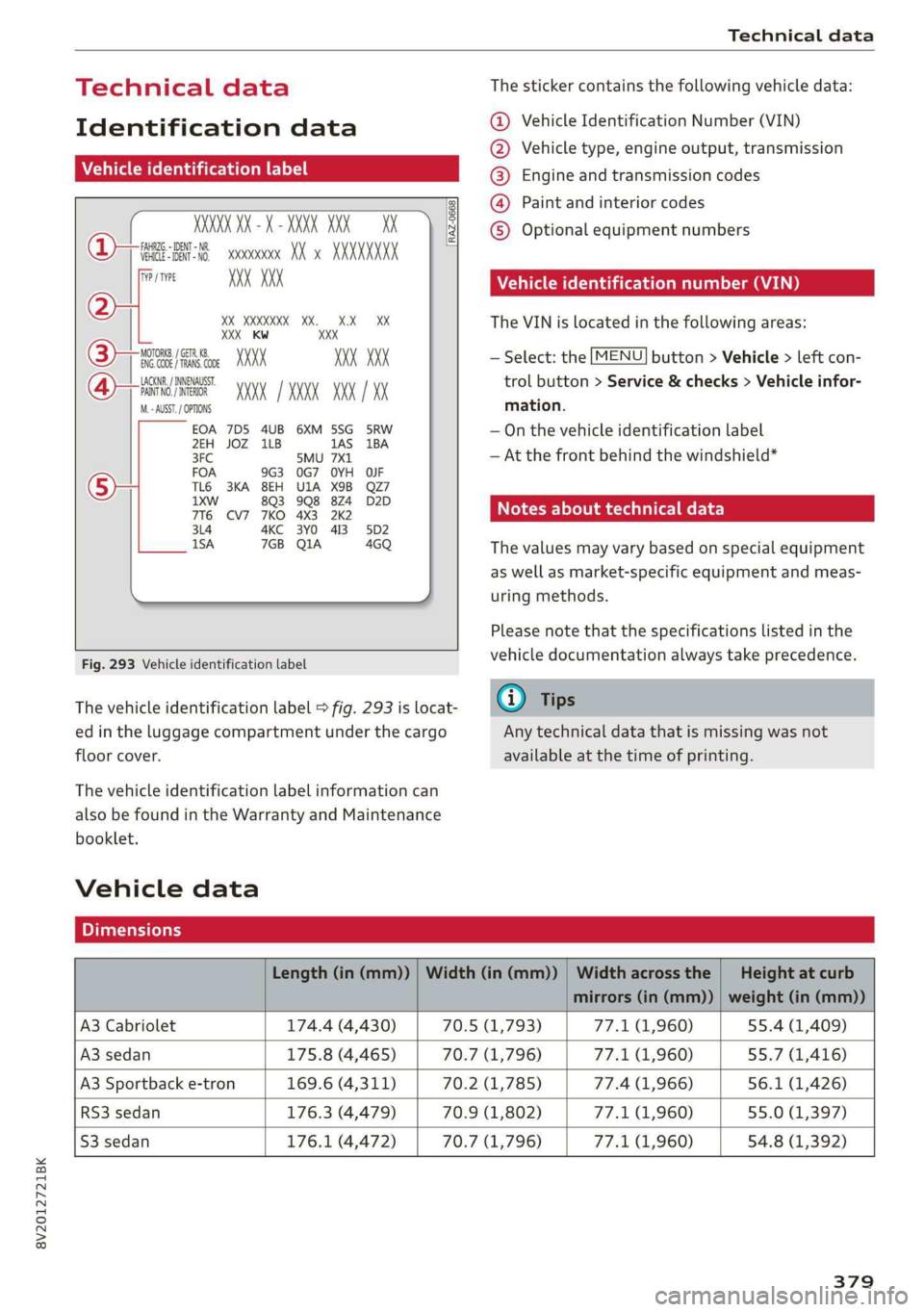
Fig. 293 Vehicle identification label
The vehicle identification label > fig. 293 is locat-
ed in the luggage compartment under the cargo
floor cover.
The vehicle identification label information can
also be found in the Warranty and Maintenance
booklet.
Vehicle data
The sticker contains the following vehicle data:
@® Vehicle Identification Number (VIN)
@ Vehicle type, engine output, transmission
® Engine and transmission codes
@) Paint and interior codes
© Optional equipment numbers
Vehicle identification number (VIN)
The VIN is located in the following areas:
— Select: the [MENU] button > Vehicle > left con-
trol button > Service & checks > Vehicle infor-
mation.
— On the vehicle identification label
— At the front behind the windshield*
Notes about technical data
The values may vary based on special equipment
as well as market-specific equipment and meas-
uring methods.
Please note that the specifications listed in the
vehicle documentation always take precedence.
G) Tips
Any technical data that is missing was not
available at the time of printing.
Length (in (mm)) | Width (in (mm)) | Width across the | Height at curb
mirrors (in (mm)) | weight (in (mm))
A3 Cabriolet 174.4 (4,430) 70.5 (1,793) 77.1 (1,960) 55.4 (1,409)
A3 sedan 175.8 (4,465) 70.7 (1,796) 77.1 (1,960) 55.7 (1,416)
A3 Sportback e-tron 169.6 (4,311) 70.2 (1,785) 77.4 (1,966) 56.1 (1,426)
RS3 sedan 176.3 (4,479) 70.9 (1,802) 77.1 (1,960) 55.0 (1,397)
S3 sedan 176.1 (4,472) 70.7 (1,796) 77.1 (1,960) 54.8 (1,392)
379
Page 390 of 400
Index
License plate bracket................... 376
Licensing agreements (MMI)............. 235
Lifting jacks + seas a = sees so pars ye saws ee 354
Light/rain sensor
Automatic headlights .................. 43
Switching the rain sensor on/off.......... 49
Lighting
EXt@HiON's « ies.a « econ a 3 Haven § ¢ Haken F naTSS 43
ENCOVION seosins & 6 saewws 2 o omens 7 0 oem ooo BESOIN oo 46
LiGhts = sess ¢ y sews ¥ = eewe Fe eee FE wee Ee 43
Interior/reading lights .............2000 46
Listening to music
refer to Media.................-- 211, 219
LOA s, sncisoss % siesenein x euassene a 5 xaneee mayen 8 4 ox 380
Locking and unlocking
By remote control..............-.000-5 27
With the convenience key.............0. 28
Low beam headlights..................6- 43
Lowering the cargo floor...............-. 62
Luggage compartment.................. 60
COVED ss « 2 acer ¢ sees 9 4 BeeR GE awe GF HS 61
POWEPSOUNGCES cscs « siesecs oo mneven o eas Xv 0 59
Tie-dOWns .. 0.0... eee eee eee 62
also refer to Luggage compartment...... 60
Luggage compartment lid
Mechanically unlocking..............0.. 32
Opening and closing................... 31
Luggage compartment net............... 62
Lumbar'SupPorts wscin so cose se waa oe orice 54
M
Maintenance’: « siws ¢ o ccen so owen ee ween es 374
Maintenance intervals...............005 318
Making an emergency call............... 175
Malfunction Indicator Lamp (MIL)........ 303
Manual shifting................02--0005 76
Map
Opetating: : sacs « : acme ss meme sp eee sys 199
Setting ass + savin ae eae se ease we ee 200
Update... . eee eee eee ee 189
Map update................0 2.0... 202
Massage function...............ee ee eee 54
Media sccsins so covers « 7 sernese © x awcowse © setae 211,.219
Drives... cece eee 212
Supported formats...............00-. 224
Media center...............0 eee eee 220
388
Memory capacity
Directory... 2... cece eee eee eee 179
JUKEBOX’: « eeay « & eee & Mores ¢ Bee Fe aS 213
Memory card
SD card reader (MMI) os. 2 esws oo eew 2 oe 212
Supported types and formats........... 224
MENU, Buttons. oo scence « 6 sovnass 2 @ weansine « 0 cones 146
Menu language
refer to Setting the language........... 230
Menu paths (Owner's Manual)............ 148
Menus/symbolsiecwis se sven + onrwe ¥ a omer 155
MeSSaQ@Siics 6 5 corns oo airs ao ese oo eee a L175
MIPCOTS seers a & mean 2s news oe eee e eReE ae BE 47
COMPASS: ores « « wesene » 4 vamens 4 4 comers a « comme 5 52
Dimming... 0.2.0.0 cece cece eee 48
MMI
refer to Multi Media Interface.......... 146
MMI search
refer to Free text search........... 154, 221
MMI touch): s ssa = s sews = x eee so eee e 149
Mobile device
refer to Telephone...........-..2-.00. 169
Mobile device reminder signal............ 230
MODE. button: ; « sess seen u s pea ee eee ee 20
Monitoring the Advanced Airbag System... 265
MOUNTAIN PASSES’: « saan cs Knee Gs Rees oF KE 89
Mountain roads.......... 0... cee eee eee 89
MP3
refer to Jukebox........-..0-- eee ee eee 213
Multifunction steering wheel
GChanginigwieWStss ¢ s sean so ween 4 & wows « 2 17
OPCKabings, « « wiemus «x seams » 0 weene x a seers 17, 20
Switching tabs..................004 17,20
Voice recognition system............... 19
Multi Media Interface.................. 146
Music
collection
refer'to Jukebox. « « cvs ss ean ce ween ee 213
MUG cco, » © seuss 2 5 eeees ¢ 2 eee eo eee ge eee 234
MYAUGI': x eee s were s Ree oe eR es 183, 193
N
NAV/MAP/BULEOM ss ¢ : eerws 5 2 oes 5 2 eee 189
Navigation. ..... 0... cece cece eee 189
ANNOUNCEMENTS « saws + acum « + eeon & x eee 198
Charging stations.................... 192