parking brake AUDI A3 2020 Owner´s Manual
[x] Cancel search | Manufacturer: AUDI, Model Year: 2020, Model line: A3, Model: AUDI A3 2020Pages: 400, PDF Size: 107.47 MB
Page 306 of 400
Checking and Filling
or authorized Audi Service Facility to have the
malfunction corrected.
The indicator light can also turn on if the fuel fill-
er cap is not closed correctly > page 2991).
ZA\ WARNING
Incorrect use of the connection port for the
On Board Diagnostic System can cause mal-
functions, which can then result in accidents
and serious injuries.
— Only allow an authorized Audi dealer or au-
thorized Audi Service Facility to read out the
engine data.
Engine compartment
(ee eel)
Special care is required if you are working in the
engine compartment
For work in the engine compartment, such as
checking and filling fluids, there is a risk of in-
jury, scalding, accidents, and burns. For this
reason, follow all the warnings and general
safety precautions provided in the following in-
formation. The engine compartment is a dan-
gerous area. > /\.
Z\ WARNING
— Turn the engine off.
— Switch the ignition off.
— Set the parking brake.
— Select the “P” (Park) selector lever position.
— Allow the engine to cool.
— Keep children away from the engine com-
partment.
— Never spill fluids on a hot engine. These flu-
ids (such as the anti-freezing agent con-
tained in the coolant) can ignite.
— Avoid short circuits in the electrical system.
— Never reach into the radiator fan. The fan is
temperature-controlled and can turn on
suddenly, even when the ignition is switched
off.
1) Depending on the engine and country
304
— Never open the hood when there is steam or
coolant escaping from the engine compart-
ment, because there is a risk that you could
be burned. Wait until no steam or coolant is
escaping.
Plug-in hybrid drive: the coolant expansion
tank cap is equipped with a seal that must
never be removed under any circumstances
=> page 312, fig. 251. If the coolant expan-
sion tank for the high-voltage system is not
sealed, please contact an authorized Audi
dealer or authorized Audi Service Facility.
Plug-in hybrid drive: the sealed cap must on-
ly be opened by an authorized Audi dealer or
authorized Audi Service Facility.
The cap on the coolant expansion tank must
never be opened as long as the coolant is
hot. The cooling system is under pressure.
There is a risk of burns
To protect your face, hands, and arms from
hot steam or coolant, cover the cap with a
thick cloth when opening.
Do not remove the engine cover under any
circumstances. This increases the risk of
burns.
Due to the risk of electric shock, never touch
the ignition cable or other components in
the electronic high-voltage ignition system
when the engine is running or is starting.
If a gear is engaged while the vehicle is sta-
tionary and the engine is running, do not
press the accelerator pedal inadvertently.
Pressing the accelerator pedal will cause the
vehicle to move, and this could result in an
accident.
If inspections or repairs must be performed
while the engine is running, moving compo-
nents (such as the ribbed belt, generator,
and radiator fan) pose an additional risk.
— Set the parking brake first and select the
“p” (Park) selector lever position.
— Always make sure that no parts of the
body, jewelry, ties, loose clothing, and
long hair can be caught in moving engine
Page 350 of 400

Emergency assistance
sistance Equipment
Trunk escape latch
Applies to: vehicles with trunk escape latch (Sedan and Cab-
riolet)
In case of an emergency, the rear lid can be
opened from the inside using the trunk escape
latch.
2 3 S
ne = & yo
B8V-0379
Fig. 262 Luggage compartment: vehicle tool kit, tire mobi-
lity kit and vehicle jack* placement
Fig. 261 Luggage compartment: Trunk escape latch
B8V-0609
> Push the latch in the direction of the arrow un-
til the lock releases.
The trunk escape latch inside the rear lid is made
of fluorescent material to glow in the dark.
Z\ WARNING
The trunk escape latch is to be used only in an
emergency.
General information
> Park the vehicle as far as possible from moving
traffic in the event of a breakdown. In the event
of a flat tire, park the vehicle on a level surface.
If you are ona steep hill, be especially careful.
» Set the parking brake. Fig. 263 Luggage compartment: cargo floor folded up
> Place the selector lever in the “P” position. (versions 1 and 2)
> Switch the emergency flashers on.
> Have the passengers exit the vehicle. They
should move to a safe place, for example be-
hind a guard rail.
Vehicle tool kit, cargo floor cover and side
panel
Applies to: vehicles with version 1
_ The vehicle tool kit, tire mobility kit* and the
A WARNING compressor® are located in the luggage compart-
ment, separated in the side panels @)
) > fig. 262.
Pay attention to the steps above. They are for
your protection and the for the safety of other
drivers. > To open the side panel, turn the lock and re-
move the cover @)* / (
der the cargo floor cover (
348
Page 351 of 400

8V2012721BK
Emergency assistance
> Lift the cargo floor using the plastic handle @)
until the cargo floor engages behind the tabs
@ in both side panels > fig. 263 (upper image).
> Fold the cargo floor back before closing the
luggage compartment lid.
Vehicle tool kit and cargo floor cover
Applies to: vehicles with version 2
The vehicle tool kit, tire mobility kit* and com-
pressor* are stored in the luggage compartment
under the cargo floor cover @) > fig. 262.
> Engage the plastic hook () in the luggage com-
partment seal > fig. 263.
> Fold the cargo floor back before closing the
luggage compartment lid.
Z\ WARNING
Applies to: vehicles with jack
Improper use of the vehicle jack can cause se-
rious personal injuries.
— Never use the screw driver hex head to tight-
en wheel bolts, since the bolts cannot attain
the necessary tightening torque if you use
the
hex head, potentially causing an acci-
dent.
— The factory-supplied jack is intended only
for your vehicle model. Under no circum-
stances
should it be used to lift heavy
vehicles or other loads; you risk injuring
yourself.
— Never start the engine when the vehicle is
raised, which could cause an accident.
— Support the vehicle securely with appropri-
ate stands if work is to be performed under-
neath the vehicle; otherwise, there is a po-
tential risk for injury.
— Never use the jack supplied with your Audi
on another vehicle, particularly on a heavier
one. The jack is only suitable for use on the
vehicle it came with.
G) Tips
The vehicle jack* does not require any mainte-
nance.
Vehicle tool kit/tire mobility kit/
eyes
Applies to: vehicles with plug-in hybrid drive
0) Bb + 3
> i a
Fig. 264 Luggage compartment: side trim panel
The vehicle tool kit, tire mobility kit and the com-
pressor are located in the side trim panel @) and
in the luggage compartment.
G) Tips
The vehicle must not be operated without the
tire repair set.
Tire mobility kit
Applies to: vehicles with tire mobility kit
> Read and follow the important safety precau-
tions in > page 348.
> Set the parking brake.
> Move the selector lever into the "P" position.
> Check if a repair with the tire mobility kit is pos-
sible > page 349.
Using the tire mobility kit
Applies to: vehicles with tire mobility kit
B8K-1475
Fig. 265 Tire: tire damage that cannot be repaired
349
Page 354 of 400
Emergency assistance
Replacing wheels
Before changing a wheel
Observe the following precautions for your own
and your passenger's safety when changing a
wheel.
>» After you experience a tire failure, pull the car
well away from moving traffic and try to reach
level ground before you stop > A\.
> All passengers should leave the car and move
toa safe location (for instance, behind the
guardrail) > A\.
> Engage the parking brake to prevent your vehi-
cle from rolling unintentionally > A\.
> Move selector lever to position P > /\.
> If you are towing a trailer, unhitch the trailer
from your vehicle.
> Take the jack* > page 348 and the spare tire*
=> page 357 out of the luggage compartment.
ZA\ WARNING
You or your passengers could be injured while
changing a wheel if you do not follow these
safety precautions:
— If you have a flat tire, move a safe distance
off the road. Turn off the engine, turn the
emergency flashers on and use other warn-
ing devices to alert other motorists.
— Make sure that passengers wait in a safe
place away from the vehicle and well away
from the road and traffic.
—To help prevent the vehicle from moving
suddenly and possibly slipping off the jack*,
always fully set the parking brake and block
the front and back of the wheel diagonally
opposite the wheel being changed. When
one front wheel is lifted off the ground,
placing the Automatic Transmission in P
(Park) will not prevent the vehicle from mov-
ing.
— Before you change a wheel, be sure the
ground is level and firm. If necessary, use a
sturdy board under the jack”.
— Always store the vehicle tool kit, the jack*
and the replaced tire in the luggage com-
partment > page 60.
352
G) Tips
Obey all laws.
Changing a wheel
When you change a wheel, follow the sequence
described below step-by-step and in exactly that
order.
1. Remove the decorative wheel cover*. For
more details see also > page 353, Decorative
wheel covers or > page 353, Wheels with
wheel bolt caps.
2. Loosen the wheel bolts > page 353.
3. Locate the proper mounting point for the
jack* and align the jack* below that point
=> page 354.
4. Raise the car with the jack* > page 354.
Remove the wheel with the flat tire and then
install the spare > page 355.
6. Tighten all wheel bolts lightly.
Lower the vehicle with the jack*.
8. Use the wheel bolt wrench and firmly tighten
all wheel bolts > page 353.
9. Replace the decorative wheel cover*.
wn
=
ZA WARNING
Always read and follow all WARNINGS and in-
formation > A\ in Raising the vehicle on
page 355 and > page 356.
After changing a wheel
A wheel change is not complete without the do-
ing the following.
> Always store the vehicle tool kit, the jack* and
the replaced tire in the luggage compartment
=> page 60.
> Check the tire pressure on the spare wheel im-
mediately after mounting it.
> As soon as possible, have the tightening tor-
ques on all wheel bolts checked with a torque
wrench. The correct tightening torque is
90 ft lb (120 Nm).
> Have the flat tire replaced as soon as possible.
Page 356 of 400

Emergency assistance
Loosening
> Slide the wheel wrench onto the wheel bolt as
far as it will go.
> Take tight hold of the end of the wrench handle
and turn the wheel bolts counter-clockwise
about one single turn in the direction of arrow
> fig. 270.
Tightening
> Slide the wheel wrench onto the wheel bolt as
far as it will go.
> Take tight hold of the end of the wrench handle
and turn each wheel bolt clockwise until it is
seated.
Z\ WARNING
— Do not use force or hurry when changing a
wheel - you can cause the vehicle to slip off
the jack* and cause serious personal injuries.
— Do not loosen the wheel bolts more than
one turn before you raise the vehicle with
the jack*. - You risk an injury.
@® Tips
— Never use the hexagonal socket in the han-
dle of the screwdriver to loosen or tighten
the wheel bolts.
— If a wheel bolt is very tight, you may find it
easier to loosen by carefully pushing down
on the end of the wheel bolt wrench with
one foot only. As you do so, hold on to the
car to keep your balance and take care not
to slip.
354
Raising the vehicle
Applies to: vehicles with jack
The vehicle must be lifted with the jack first be-
fore the wheel can be removed.
Fe) D 8
<4 = @
oO
Fig. 272 Sill: positioning the vehicle jack
> Engage the parking brake to prevent your vehi-
cle from rolling unintentionally.
> Move the selector lever to position P.
>» Find the marking (imprint) on the sill that is
nearest the wheel that will be changed
=> fig. 271. Behind the marking, there is a lift-
ing point on the sill for the vehicle jack.
> Vehicles with a sill: Note the position of the sill
when positioning the vehicle jack > fig. 272.
>» Place the vehicle jack (vehicle tool kit) on a firm
surface. Use a flat, stable support if necessary.
On a slippery surface such as tile, you should
use a non-slip pad (such as a rubber mat) > A\.
> Turn the vehicle jack located under the lifting
point on the sill to raise the jack until its arm @)
> fig. 272 is located under the designated plas-
tic mount > A\, >@.
> Align the jack so that its arm @) ® fig. 272 en-
gages in the designated lifting point in the door
sill and the movable base (8) lies flat on the
ground. The base (8) must be vertical under the
lifting point @).
Page 363 of 400
8V2012721BK
Fuses and bulbs
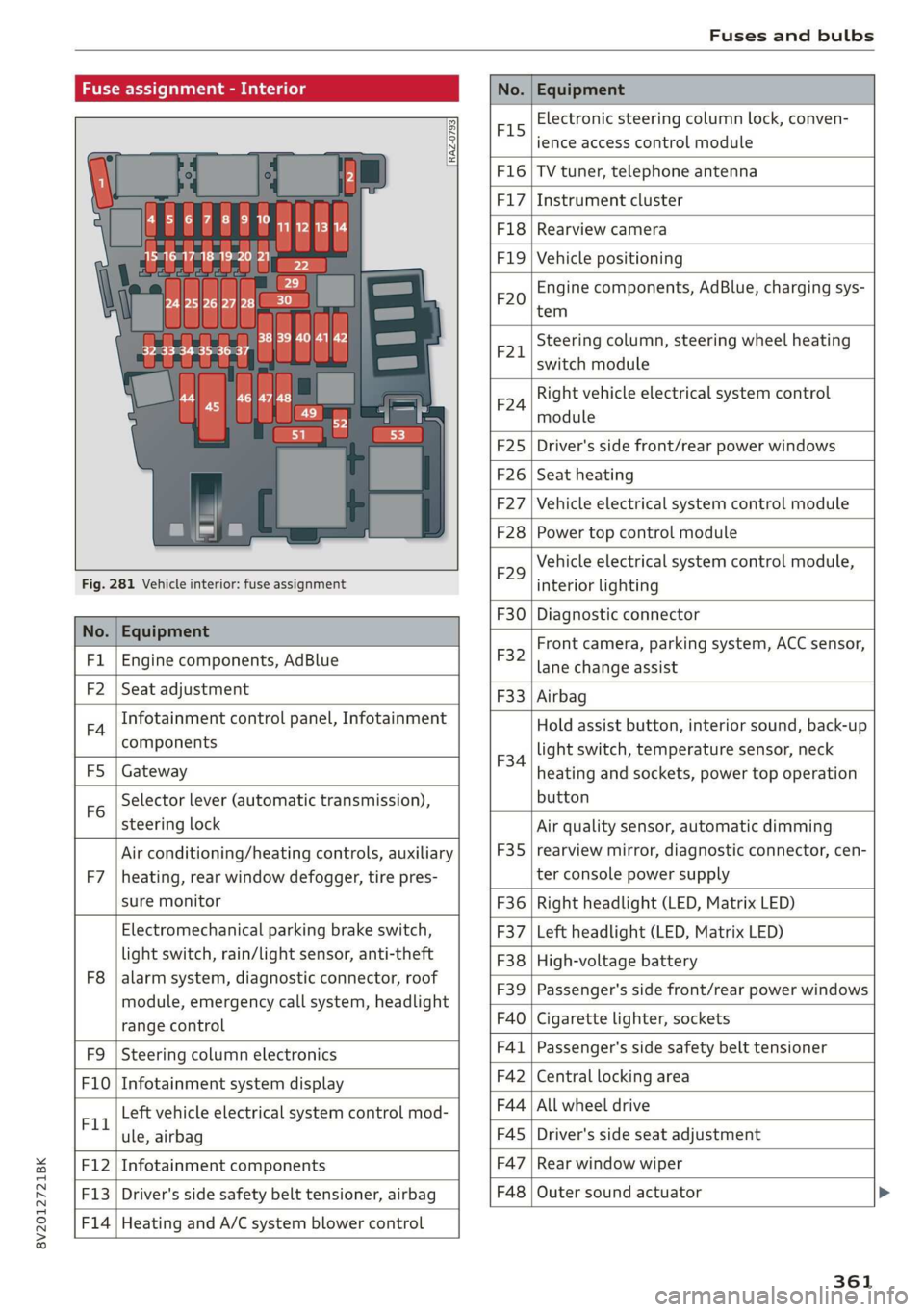
Fuse assignment - Interior
No. Equipment
RAZ-0793,
PO ee
15°16°17-18 19 20 21
PZ ply lip y ips}
ei Hes ole” So}
32°33 34 35 36 37
F15
Electronic steering column lock, conven-
ience access control module
F16 TV tuner, telephone antenna
F17 Instrument cluster
F18 Rearview camera
F1I9 Vehicle positioning
F20
Engine components, AdBlue, charging sys-
tem
F221
Steering column, steering wheel heating
switch module
F24
Right vehicle electrical system control
module
F25 Driver's side front/rear power windows
F26 Seat heating
F27 Vehicle electrical system control module
F28 Power top control module
Fig. 281 Vehicle interior: fuse assignment
F29
Vehicle electrical system control module,
interior lighting
No. Equipment
F30 Diagnostic connector
FL Engine components, AdBlue
F2 Seat adjustment
F32
Front camera, parking system, ACC sensor,
lane change assist
F4
Infotainment control panel, Infotainment
components
F33 Airbag
FS Gateway
Fo
Selector lever (automatic transmission),
steering lock
F34
Hold assist button, interior sound, back-up
light switch, temperature sensor, neck
heating and sockets, power top operation
button
Air conditioning/heating controls, auxiliary F35
Air quality sensor, automatic dimming
rearview mirror, diagnostic connector, cen-
F7 |heating, rear window defogger, tire pres- ter console power supply
sure monitor F36 | Right headlight (LED, Matrix LED)
Electromechanical parking brake switch, F37 | Left headlight (LED, Matrix LED)
light switch, rain/light sensor, anti-theft F38 | High-voltage battery
ae ene eee dent F39 | Passenger's side front/rear power windows
range control F40 | Cigarette lighter, sockets
F9 |Steering column electronics F41 | Passenger's side safety belt tensioner
F10 | Infotainment system display F42 | Central locking area
Tl Left vehicle electrical system control mod- F44 al ee
ule, airbag FAS | Driver's side seat adjustment
F12 | Infotainment components F47 | Rear window wiper
F13 | Driver's side safety belt tensioner, airbag F48 | Outer sound actuator
F14 | Heating and A/C system blower control
361
Page 364 of 400
Fuses and bulbs
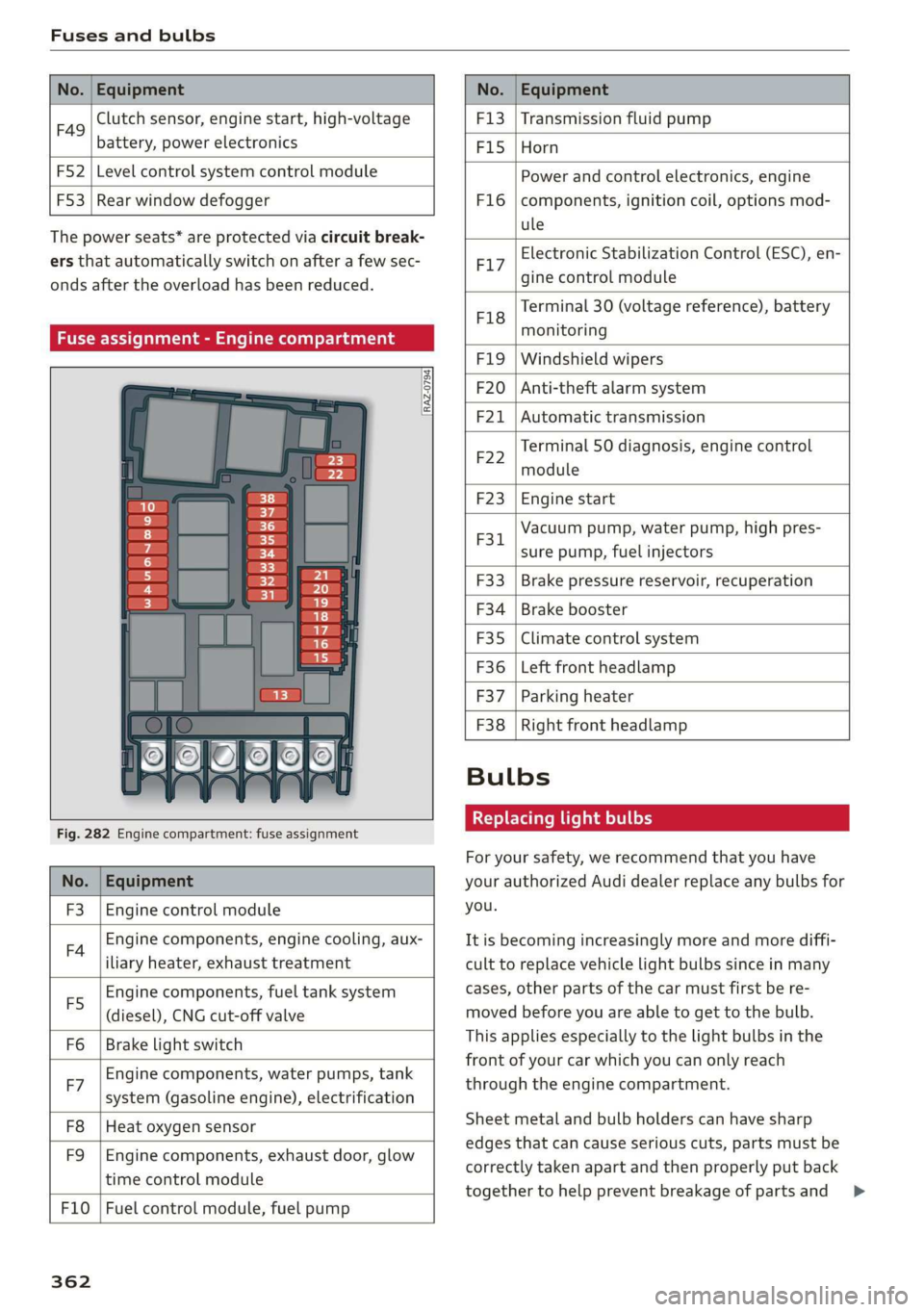
No. | Equipment No. | Equipment
Clutch sensor, engine start, high-voltage
F49 3
battery, power electronics
F52 F53 Level control system control module
Rear window defogger
The power seats* are protected via circuit break-
ers that automatically switch on after a few sec-
onds after the overload has been reduced.
Fuse assignment - Engine compartment
RAZ-0794)
1 0
&
F:}
vi
6
5
4
5}
Fig. 282 Engine compartment: fuse assignment
No. | Equipment
F3 | Engine control module
FA Engine components, engine cooling, aux-
iliary heater, exhaust treatment
Engine components, fuel tank system
(diesel), CNG cut-off valve
Brake light switch
E5
Fo
Engine components, water pumps, tank
F7 ; . ee cae
system (gasoline engine), electrification
F8
F9
Heat oxygen sensor
Engine components, exhaust door, glow
time control module
F10 | Fuel control module, fuel pump
362
F13 | Transmission fluid pump
F15 |Horn
Power and control electronics, engine
components, ignition coil, options mod-
ule
F1l6
Electronic Stabilization Control (ESC), en-
F17
gine control module
Terminal 30 (voltage reference), battery
F18
es
monitoring
FIO F20
F21
Windshield wipers
Anti-theft alarm system
Automatic transmission
Terminal 50 diagnosis, engine control
F22
module
F23 | Engine start
Vacuum pump, water pump, high pres-
F31. 2
sure pump, fuel injectors
F33
F34
F35
F36
F37
Brake pressure reservoir, recuperation
Brake booster
Climate control system
Left front headlamp
Parking heater
F38 | Right front headlamp
Bulbs
Replacing light bulbs
For your safety, we recommend that you have
your authorized Audi dealer replace any bulbs for
you.
It is becoming increasingly more and more diffi-
cult to replace vehicle light bulbs since in many
cases, other parts of the car must first be re-
moved before you are able to get to the bulb.
This applies especially to the light bulbs in the
front of your car which you can only reach
through the engine compartment.
Sheet metal and bulb holders can have sharp
edges that can cause serious cuts, parts must be
correctly taken apart and then properly put back
together to help prevent breakage of parts and >
Page 367 of 400

8V2012721BK
Emergency situations
Jump start
Applies to: vehicles with plug-in hybrid drive
The
term "vehicle battery" refers to the 12 volt
battery in your vehicle.
rr B z
BS 3 & C3
1 = AT
Fig. 283 Engine compartment: connectors for a charger
and jump start cables
The vehicle is equipped with one vehicle battery
and one high-voltage battery.
If the vehicle battery is drained, it can be charged
with a charger or you can jump start the vehicle
using another vehicle's battery in the same way
as a conventional vehicle.
Read the information about charging the vehicle
battery > page 316 and for jump starting the ve-
hicle > page 364.
> Open the hood > page 305.
» Remove the fuse box cover (8) to access the
positive terminal (4) > page 307.
> Clamp the terminal clamps from the charging
device or jump start cable to the positive termi-
nal @) and to the body ground point @).
(@) Note
You must not give a jump start with your vehi-
cle. This could cause significant damage to
the electrical system in your vehicle.
A3 models: jump starting
Applies to: vehicles with conventional drive system
Both jump start cables must be connected in the
correct order.
Fig. 284 Engine compartment: connecting the jump start
cable
The vehicle battery is located on the left front
side of the engine compartment. Open the cover
to access the positive terminal of the vehicle bat-
tery. The procedure for connecting jump start ca-
bles that is described next is designed to help
jump start your vehicle.
Follow the information about the vehicle battery
> page 315.
Preparations
1. Read the following carefully > page 364,
Preparation.
2. Set the parking brake and place the selector
lever in the "P" position.
3. Turn the ignition and electrical equipment off
in both vehicles.
Connecting/disconnecting the jump start
cable
4. Fold the battery cover upward.
5. Clamp the end of the red jump start cable to
the positive terminal @ > fig. 284 on your
vehicle >(@) in Preparation on page 364.
6. Clamp the other end of the red jump start ca-
ble to the positive terminal 2) on the vehicle
battery providing the current.
7. Clamp the black end of the jump start cable
preferably to the ground point, or to the
negative terminal of the vehicle battery @)
on the vehicle providing the current.
365
>
Page 369 of 400
8V2012721BK
Emergency situations
Follow the information about the vehicle battery
=> page 315.
Preparations
1. Read the following carefully > page 364,
Preparation.
2. Set the parking brake and place the selector
lever in the "P" position.
3. Turn the ignition and electrical equipment off
in both vehicles.
Connecting/disconnecting the jump start
cable
4. Open the cover on the positive terminal.
5. Clamp the end of the red jump start cable to
the positive terminal @ > page 365, fig. 284
on your vehicle >@) in Preparation on
page 364.
6. Clamp the other end of the red jump start ca-
ble to the positive terminal (2) on the vehicle
battery providing the current.
7. Clamp the black end of the jump start cable
preferably to the ground point, or to the
negative terminal of the vehicle battery @)
on the vehicle providing the current.
8. Clamp the other end of the black jump start
cable only to the ground point (4) on your ve-
hicle.
9. Route the jump start cables so they cannot
get caught in the moving parts in the engine
compartment.
Starting the engine
10. First start the engine in the vehicle giving the
charge and let it run at idle.
11. Now start the engine in the vehicle with the
drained vehicle battery and wait two to three
minutes until it “runs smoothly”.
12. If the engine does not start, stop the starting
procedure after 10 seconds and then repeat
it after approximately 30 seconds.
13. In the vehicle that is being jump started,
switch the heater fan and rear window de-
froster on to reduce any voltage peaks that
may occur when disconnecting the jumper ca-
bles. The headlights must be switched off.
14. While the engines are running, remove the
cables in reverse order from the way they
were installed, as described in > page 365.
Make sure the cables do not get caught in
moving engine components.
15. Close the cap on the positive terminal.
16. Switch the heater fan and rear window de-
froster off.
ZA\ WARNING
— Never connect the jump start cable directly
to your vehicle battery. Only use the connec-
tions in the engine compartment.
— Do not touch the non-insulated parts of the
terminal clamps. The cable must also not
come into contact with vehicle components
that conduct electricity when it is connected
to the positive vehicle battery terminal. This
can cause a short circuit.
— The plugs on the battery cells must not be
opened.
— Keep ignition sources (such as open flames,
burning cigarettes, etc.) away from the vehi-
cle batteries to reduce the risk of an explo-
sion.
— Route the jump start cables so they cannot
get caught in the moving parts in the other
vehicle's engine compartment.
@) Note
Please note that the connecting process previ-
ously described for the jump start cables is in-
tended for when your vehicle is being jump
started.
(i) Tips
Make sure that the connected jump start ca-
bles have sufficient contact with metal.
Towing with a tow truck
General hints
Your Audi requires special handling for towing.
The following information is to be used by com-
mercial tow truck operators who know how to op-
erate their equipment safely.
— Never tow your Audi. Towing will cause dam-
age to the engine and transmission. >
367
Page 387 of 400

8V2012721BK
Index
Dynamic volume
refer to System volume........---.00-5 235
E
E-mail...............0000 000 c eee eee 177
eco mode (climate control system)......... 66
Economical route wives so aicava a a wsnsens a 6 aienaie 197
EDL
refer to Electronic Differential Lock....... 93
EDR
refer to Event Data Recorder........... 371
Efficiency program... ... eee eee eee eee 23
Electrical system. .......2.-.0 ee eee eee 314
Electromechanical parking brake.......... 87
Electronic Differential Lock............... 94
Electronic immobilizer..............00005 26
Electronic Stabilization Control............ 93
Embedded)SIM Cat wavy. s waves » x eee 3 5 ee 183
Emergency assistance ............0 eee 348
Emergency braking function.............. 87
Emergency flashers.............0.000005 45
Emergency mode...................2005 77
Emergency operation
DOOrs 0... eee eee 30
Fuebfillerdoor's » = sry : 4 sews s eae s pee 301
Luggage compartment lid............... 32
Panoramic glass roof................-. 35
Emergency starting..................-. 364
Emissions control system..............- 303
Energy CONSUMENS « « sick 4 este oo weirs oo ave 22
Energy management............eceeeeee 82
Energy recovery
refer to Recuperation.................. 78
Engine
Breakingin.............2..2.02020020005 78
GCoGlaiitiowen: « 2 wage « 2 germs gz eee ge EE EE 311
Emerqeney:stops « sesscc x 2 same a v answes vv ase 71
Jump starting ........ cee cece eee eee 364
Jump starting (plug-in hybrid drive)...... 365
Start/Stop'SySteM sei os wes eo sosnene o + wore 83
Starting and stopping.................. 71
Engine braking effect
refer to Recuperation..............000. 78
Engine compartment
Opening and closing the hood.......... 305
OVERVIEW ecu 3 2 cows « @ eos ¢ eae go re 307
Safety precautions.................04. 304
Engine data
refer to Sport displays............000005 24
Engine oil
Adding ......... 00. c cee ee eee eee ee 307
CHANGING ox « « caw « paawy s mews oo Romy s & 310
Checking oil:leveli. . « csscie «0 vce wn meee a 307
Consumption...........0..-0.0 eee eee 307
DiPStick:: s sees = x ween 2 2 Bowe 2 ze eees Bae 307
Indicator light & cscs. x x wow xo coon ea menos 308
Replacement interval................. 318
Temperature display................0.. 23
Engine start system. ..............0..0-. 73
Engine stop
Goastings: « sss + ¢ sees + ¢ ceeie oo ews = 78, 83
Enhanced VieW « ase > mee s soem es eee ee 19
Entering characters/numbers (speller)... .. 153
Entering letters (speller)................ 153
Entertainment sliding menu............. 151
Entry/exit lighting. ............. 0... eee 45
Entry assistance
refer to Seats... 2... eee ee 55
Environment
Unleaded gasoline................205. 298
EPB
refer to Electromechanical parking brake.. 87
eSIM
refer to Embedded SIM card............ 183
Event: Data Recorder's « «sci. e s sxcciws 2 a eon © 371
Exterior lighting: < swe « = sews sy eee = 5 oes 43
Exterior MUrrOtScs: = = seus « 2 ees ae ween eo: 47
FOldin Qian 3 5 soane vx wens 2 ¥ anewens oo shea a 2 ae 47
Folding settings................0e ee eee 29
External voice operation................ 168
F
Factory default settings
Multi Media Interface................. 231
Fader (sound) ...........- 0c eee eee eee ee 234
Fastening
Booster seats..............0-00-0000. 287
Convertible child safety seats........... 285
Infant seats.......... 0... cee eee eee ee 284