warning lights AUDI A3 2020 Owner´s Manual
[x] Cancel search | Manufacturer: AUDI, Model Year: 2020, Model line: A3, Model: AUDI A3 2020Pages: 400, PDF Size: 107.47 MB
Page 188 of 400
Audi connect
the price of Audi connect vehicle control
services. The cell phone network, for exam-
ple, must be available to use these services.
Applies to: vehicles with plug-in hybrid drive and Audi connect
Requirement: your mobile devices must be com-
patible.
> An authorized Audi dealer must complete a
one-time activation of Audi connect e-tron serv-
ices for your vehicle before you can register on-
line.
> Register at etron.audiusa.com
If you require assistance with your Audi connect
e-tron services, please contact an authorized
Audi dealer or authorized Audi Service Facility.
Using the myAudi app
— Install the myAudi app on your mobile device
and log in with your access information.
Services
Applies to: vehicles with plug-in hybrid drive and Audi connect
Depending on the country and the vehicle equip-
ment, the following services may be available:
Trip data
Depending on the vehicle equipment, certain
driver information system data is transmitted to
a server. An overview of your trips with the values
from the short-term memory/long-term memory
can be displayed, for example, the driving dura-
tion. The values may differ from the values dis-
played in the vehicle.
Vehicle status report
This service transfers driver information system
data to a server. Depending on the vehicle equip-
ment, certain data may be accessed, such as the
remaining range or mileage. The values may dif-
fer from the values displayed in the vehicle.
Car Finder
This service transmits the parking location to a
server when the ignition is switched off. The vehi-
cle location, your location, or the route to your
186
vehicle can be displayed. The new parking loca-
tion cannot be determined with this service if the
vehicle is moved after shutting the vehicle off
and without switching the ignition on and off
again, for example if the vehicle is towed or sto-
len.
Remote charging
Requirement: the ignition must be switched off
when changing the charging mode.
You can control and monitor the charging process
remotely with the service.
— Charging mode: immediate charging or delayed
charging (timer)
— Program the timer
— Deactivate or activate the timer
For additional information, see > page 101,
Charging the battery with the Audi charging sys-
tem.
Temperature control
Requirement: the ignition must be switched off
when starting or stopping climate control.
You can control the climate control in your vehi-
cle remotely using these services.
— Start or stop climate control
— Program the timer
— Deactivate or activate the timer
For additional information, see > page 101,
Charging the battery with the Audi charging sys-
tem.
ZA\ WARNING
— Do not ignore messages and warning or indi-
cator lights that turn on in the vehicle be-
cause of the information in the vehicle sta-
tus report. This could lead to break downs in
on the road, accidents and serious injuries.
— Only perform the climate control functions
if your vehicle was shut off correctly and the
ignition is switched off.
— Only perform charging functions on the
high-voltage battery if the vehicle is shut off
correctly, is connected to a suitable socket
and if the ignition is switched off.
Page 239 of 400
8V2012721BK
Driving safety
Driving safety
Basics
SER Nails mali
Please remember - safety first!
The individual safety features of your vehicle can
work together as a system to help protect you
and
your passengers in a wide range of accidents.
These features cannot work as a system if they
are not always correctly adjusted and correctly
used.
This chapter contains important information,
tips, instructions and warnings that you need to
read and observe for your own safety, the safety
of your passengers and others. We have summar-
ized here what you need to know about safety
belts, airbags, child restraints as well as child
safety. Your safety is for us priority number 1. Al-
ways observe the information and warnings in
this section - for your own safety as well as that
of your passengers.
The information in this section applies to all
model versions of your vehicle. Some of the fea-
tures described in this sections may be standard
equipment on some models, or may be optional
equipment on others. If you are not sure, ask
your authorized Audi dealer.
ZA WARNING
— Always make sure that you follow the in-
structions and heed the WARNINGS in this
Manual. It is in your interest and in the in-
terest of your passengers.
— Always keep the complete Owner's Litera-
ture in your Audi when you lend or sell your
vehicle so that this important information
will always be available to the driver and
passengers.
— Always keep the Owner's literature handy so
that you can find it easily if you have ques-
tions.
Important things to do before driving
Safety is everybody's job! Vehicle and occupant
safety always depends on the informed and care-
ful driver.
For
your safety and the safety of your passen-
gers, before driving always:
> Make sure that all lights and signals are operat-
ing correctly.
> Make sure that the tire pressure is correct.
> Make sure that all windows are clean and afford
good visibility to the outside.
> Secure all luggage and other items carefully
= page 60, > page 60.
> Make sure that nothing can interfere with the
pedals.
> Adjust front seat, head restraint and mirrors
correctly for your height.
> Instruct passengers to adjust the head re-
straints according to their height.
> Make sure to use the right child restraint cor-
rectly to protect children > page 278, Child
safety.
» Sit properly in your seat and make sure that
your passengers do the same > page 54, Front
seats.
> Fasten your safety belt and wear it properly. Al-
so instruct your passengers to fasten their safe-
ty belts properly > page 245.
What impairs driving safety?
Safe driving is directly related to the condition of
the vehicle, the driver as well as the driver’s abili-
ty to concentrate on the road without being dis-
tracted.
The driver is responsible for the safety of the ve-
hicle and all of its occupants. If your ability to
drive is impaired, safety risks for everybody in the
vehicle increase and you also become a hazard to
everyone else on the road > /\. Therefore:
> Do not let yourself be distracted by passengers
or by using a cellular telephone.
> NEVER drive when your driving ability is im-
paired (by medications, alcohol, drugs, etc.).
> Observe all traffic laws, rules of the road and
speed limits and plain common sense.
237
Page 247 of 400
8V2012721BK
Safety belts
Safety belts
General notes
OCEANS Lae 15 aes
Wearing safety belts correctly saves lives!
This chapter explains why safety belts are neces-
sary, how they work and how to adjust and wear
them correctly.
> Read all the information that follows and heed
all of the instructions and WARNINGS.
ZA WARNING
Not wearing safety belts or wearing them im-
properly increases the risk of serious personal
injury and death.
— Safety belts are the single most effective
means available to reduce the risk of serious
injury and death in automobile accidents.
For your protection and that of your passen-
gers, always correctly wear safety belts
when the vehicle is moving.
— Pregnant women, injured, or physically im-
paired persons must also use safety belts.
Like all vehicle occupants, they are more
likely to be seriously injured if they do not
wear Safety belts. The best way to protect a
fetus is to protect the mother - throughout
the entire pregnancy.
NT Tae met)
Applies to: vehicles without power top: Your Audi
has a total of five seating positions: two in the
front and three in the rear. Each seating position
has a safety belt.
Applies to: vehicles with power top: Your Audi
has a total of four seating positions: two in the
front and two in the rear. Each seating position
has a safety belt.
ZA WARNING
Not wearing safety belts or wearing them im-
properly increases the risk of serious personal
injury and death.
— Never strap more than one person, including
small children, into any belt. It is especially
dangerous to place a safety belt over a child
sitting on your lap.
— Never let more people ride in the vehicle
than there are safety belts available.
— Be sure everyone riding in the vehicle is
properly restrained with a separate safety
belt or child restraint.
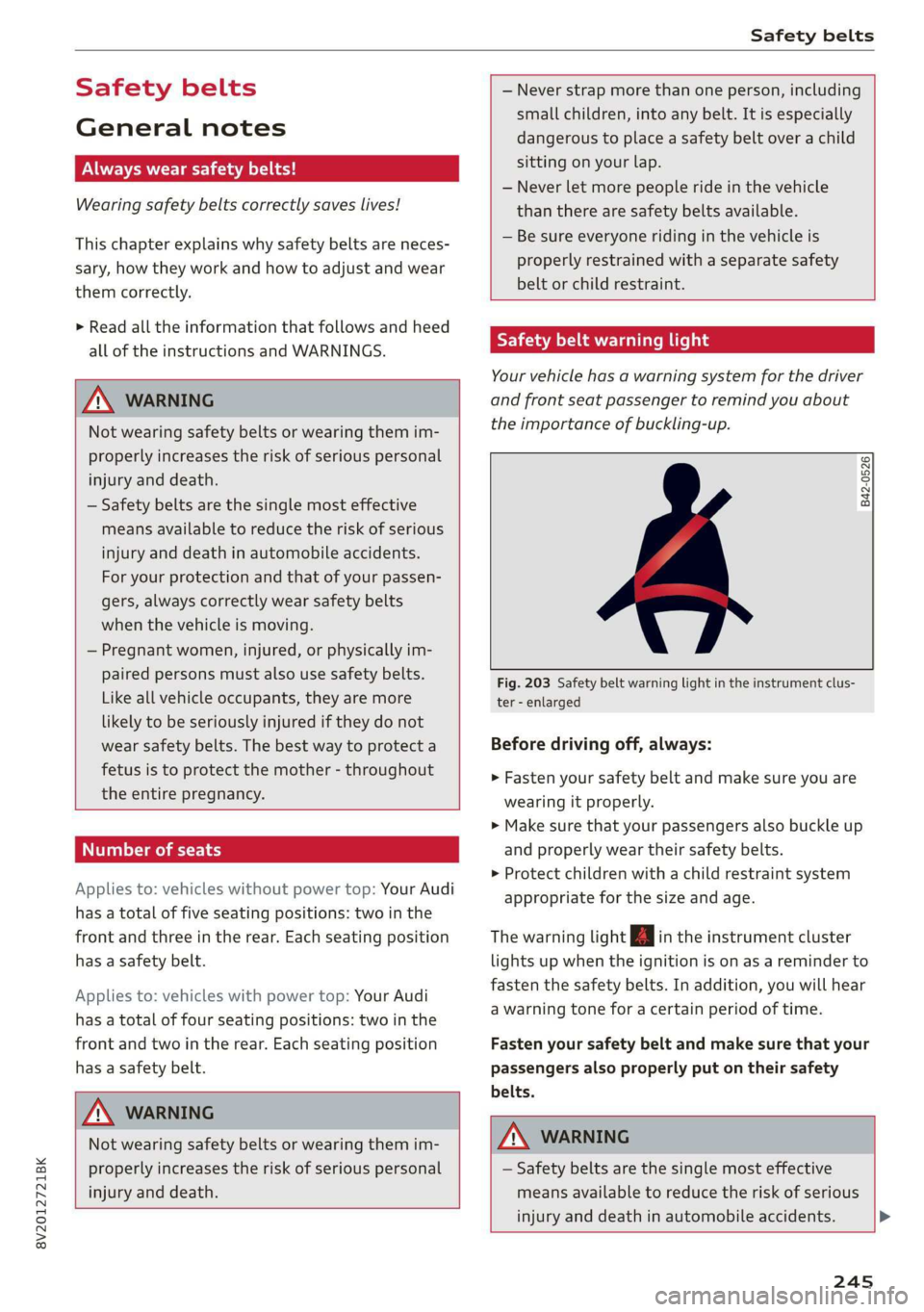
Safety belt warning light
Your vehicle has a warning system for the driver
and front seat passenger to remind you about
the importance of buckling-up.
B42-0526
Fig. 203 Safety belt warning light in the instrument clus-
ter - enlarged
Before driving off, always:
> Fasten your safety belt and make sure you are
wearing it properly.
> Make sure that your passengers also buckle up
and properly wear their safety belts.
> Protect children with a child restraint system
appropriate for the size and age.
The warning light in the instrument cluster
lights up when the ignition is on as a reminder to
fasten the safety belts. In addition, you will hear
a warning tone for a certain period of time.
Fasten your safety belt and make sure that your
passengers also properly put on their safety
belts.
Z\ WARNING
— Safety belts are the single most effective
means available to reduce the risk of serious
injury and death in automobile accidents. >
245
Page 340 of 400
Wheels
system only monitors the tire pressure you have
stored. Refer to the tire pressure label for the
recommended tire pressure for your vehicle
=> page 330, fig. 260.
Tire tread circumference and vibration character-
istics can change and cause a tire pressure warn-
ing if:
— The tire pressure in one or more tires is too low
—The tire has structural damage
— The tire was replaced or the tire pressure was
changed and it was not stored > page 338
— One side of the vehicle is more heavily loaded
than the other
— The wheels on one axle are more heavily loaded
than the others (for example, when towing a
trailer or when driving up and down hills)
— Snow chains are installed
— The spare tire* is installed
— Only one tire was replaced on each axle
Indicator lights
@ - loss of pressure in at least one tire > A\.
Check the tires and replace or repair if necessary.
Check/correct the pressures of all four tires. Then
store the tire pressures in the menu > page 338.
is (Tire Pressure Monitoring System) Tire pres-
sure: malfunction! See owner's manual. If
appears after switching the ignition on or while
driving and the @ indicator light in the instru-
ment cluster blinks for approximately one minute
and then stays on, there is system malfunction.
Check/correct the pressures on all four tires and
store the pressures > page 338. If the indicator
light does turn off or turns on again after a short
period of time, drive to an authorized Audi dealer
or authorized Audi Service Facility immediately to
have the malfunction corrected.
ZX WARNING
— If the tire pressure indicator appears in the
instrument cluster display, reduce your
speed immediately and avoid any hard steer-
ing or braking maneuvers. Stop as soon as
possible and check the tires and their pres-
sures.
338
— The driver is responsible for maintaining the
correct tire pressures. You must check the
tire pressures regularly.
— Under certain conditions (such as a sporty
driving style, winter conditions or unpaved
roads), the pressure monitor indicator may
be delayed.
— Do not use run-flat tires on your vehicle. Us-
ing them when not permitted can lead to ve-
hicle damage or accidents.
(i) Tips
—The tire pressure monitoring system can al-
so stop working when there is an ESC/ABS
malfunction.
— Using snow chains may result in a system
malfunction.
— The tire pressure monitoring system in your
Audi was calibrated with “Audi Original
Tires” > page 326. Using these tires is rec-
ommended.
—The tire pressure monitoring system can on-
ly monitor the tire pressure of the driving
tires. Check the tire pressure of the spare
wheel in the luggage compartment so that
if necessary it is ready for use.
Storing tire pressures
Applies to: vehicles with Tire Pressure Monitoring System in-
dicator
A change in tire pressure or a change in tires
must be stored in the system.
Before storing the tire pressures, make sure the
tire pressures in all four tires meet the specified
values and are adapted to the load > page 328.
> Select in the Infotainment system: [MENU] but-
ton > Vehicle > left control button > Service &
checks > Tire pressure monitoring > Store tire
pressure > Yes, store now.
(i) Tips
Do not store the tire pressures if snow chains
are installed.
Page 345 of 400
8V2012721BK
Care and cleaning
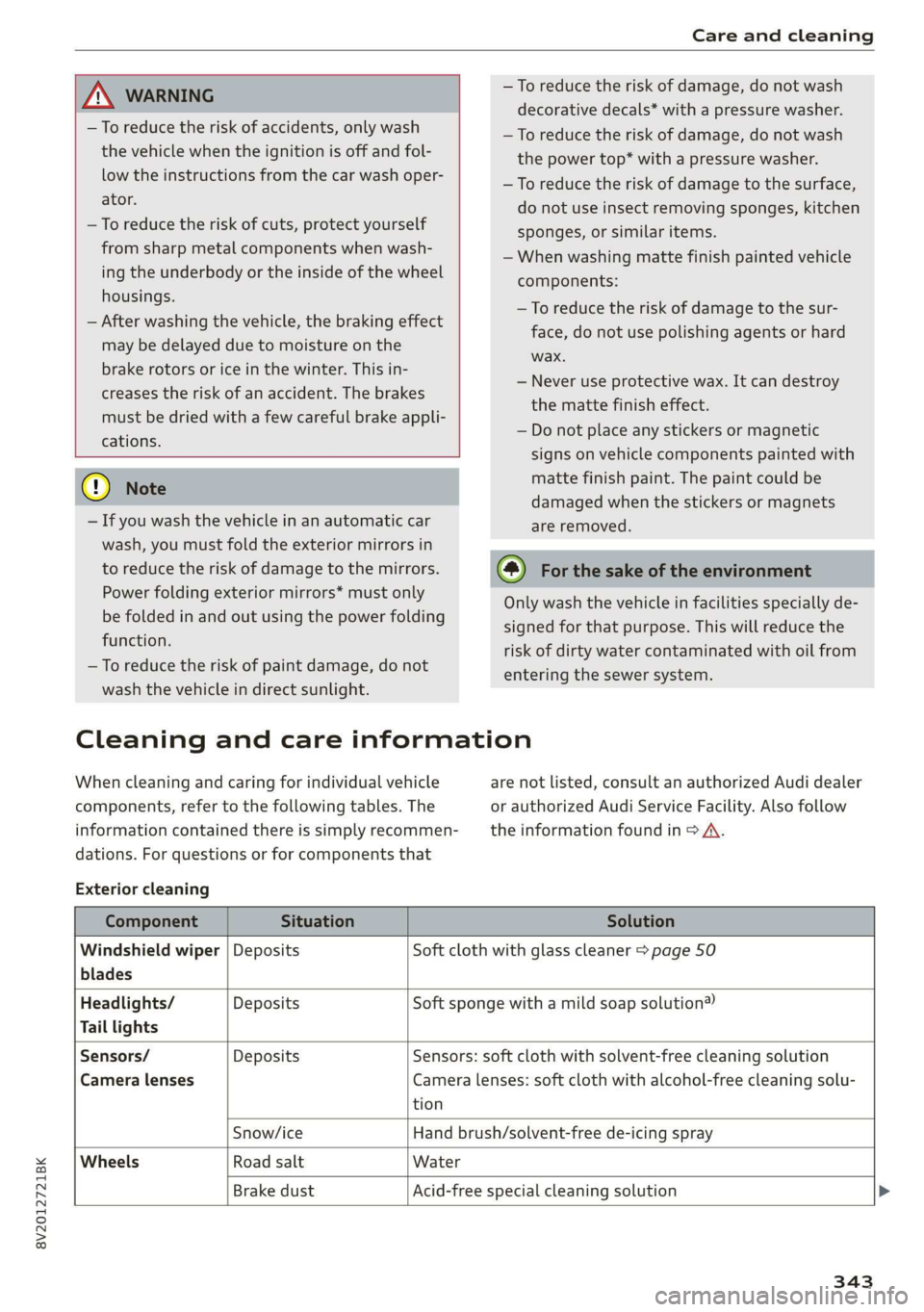
ZA\ WARNING
—To reduce the risk of accidents, only wash
the vehicle when the ignition is off and fol-
low the instructions from the car wash oper-
ator.
—To reduce the risk of cuts, protect yourself
from sharp metal components when wash-
ing the underbody or the inside of the wheel
housings.
— After washing the vehicle, the braking effect
may be delayed due to moisture on the
brake rotors or ice in the winter. This in-
creases the risk of an accident. The brakes
must be dried with a few careful brake appli-
cations.
() Note
— If you wash the vehicle in an automatic car
wash, you must fold the exterior mirrors in
to reduce the risk of damage to the mirrors.
Power folding exterior mirrors* must only
be folded in and out using the power folding
function.
—To reduce the risk of paint damage, do not
wash the vehicle in direct sunlight.
—To reduce the risk of damage, do not wash
decorative decals* with a pressure washer.
—To reduce the risk of damage, do not wash
the power top* with a pressure washer.
—To reduce the risk of damage to the surface,
do not use insect removing sponges, kitchen
sponges, or similar items.
— When washing matte finish painted vehicle
components:
— To reduce the risk of damage to the sur-
face, do not use polishing agents or hard
wax.
— Never use protective wax. It can destroy
the matte finish effect.
— Do not place any stickers or magnetic
signs on vehicle components painted with
matte finish paint. The paint could be
damaged when the stickers or magnets
are removed.
(@) For the sake of the environment
Only wash the vehicle in facilities specially de-
signed for that purpose. This will reduce the
risk of dirty water contaminated with oil from
entering the sewer system.
Cleaning and care information
When cleaning and caring for individual vehicle
components, refer to the following tables. The
information contained there is simply recommen-
dations. For questions or for components that
Exterior cleaning
are not listed, consult an authorized Audi dealer
or authorized Audi Service Facility. Also follow
the information found in > A.
Component Situation Solution
Windshield wiper | Deposits Soft cloth with glass cleaner > page 50
blades
Headlights/ Deposits Soft sponge with a mild soap solution®
Tail lights
Sensors/ Deposits Sensors: soft cloth with solvent-free cleaning solution
Camera lenses Camera lenses: soft cloth with alcohol-free cleaning solu-
tion
Snow/ice Hand brush/solvent-free de-icing spray
Wheels Road salt Water
Brake dust Acid-free special cleaning solution >
343
Page 348 of 400
Care and cleaning
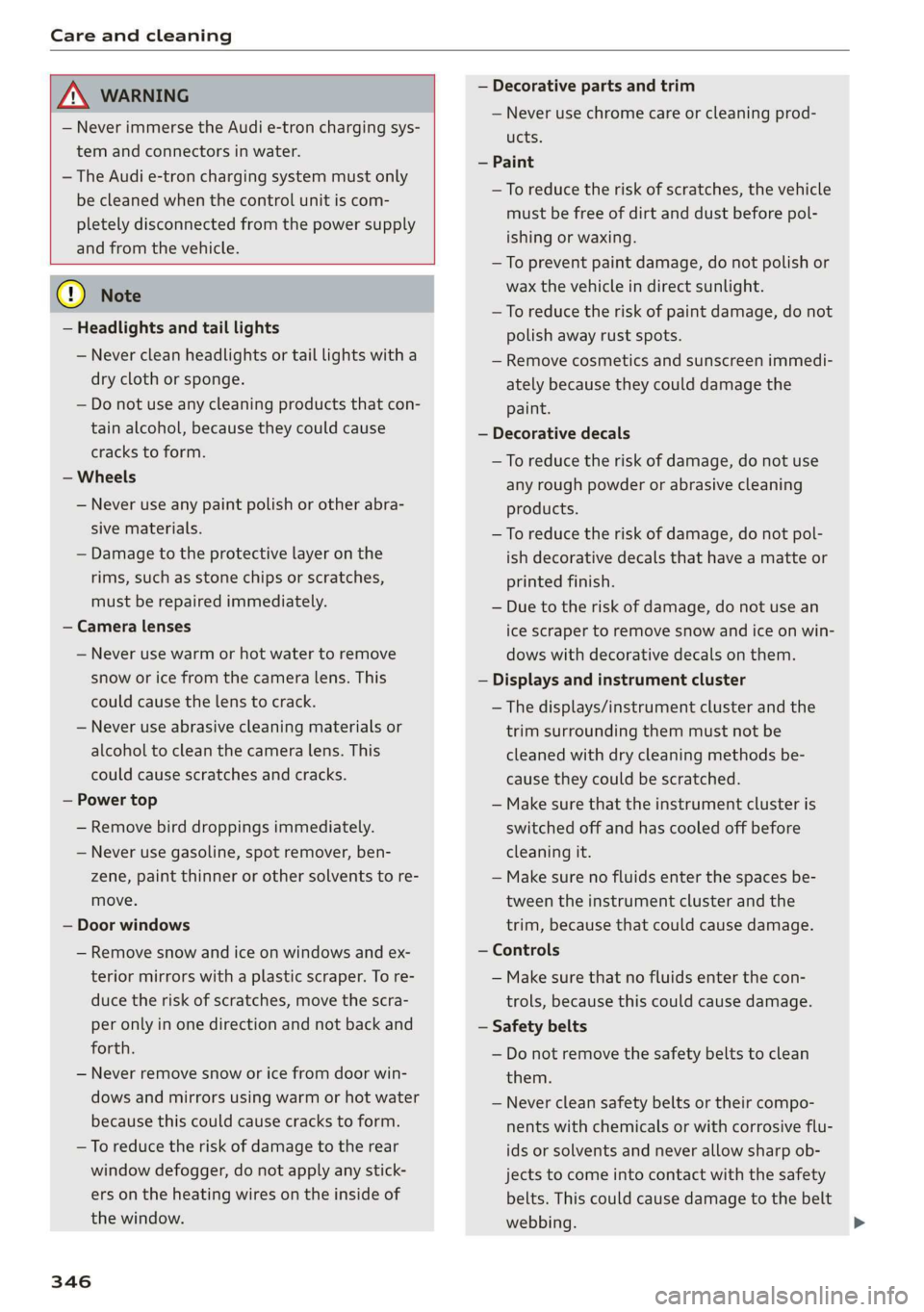
ZA WARNING
— Never immerse the Audi e-tron charging sys-
tem and connectors in water.
— The Audi e-tron charging system must only
be cleaned when the control unit is com-
pletely disconnected from the power supply
and from the vehicle.
@) Note
— Headlights and tail lights
— Never clean headlights or tail lights with a
dry cloth or sponge.
— Do not use any cleaning products that con-
tain alcohol, because they could cause
cracks to form.
— Wheels
— Never use any paint polish or other abra-
sive materials.
— Damage to the protective layer on the
rims, such as stone chips or scratches,
must be repaired immediately.
— Camera lenses
— Never use warm or hot water to remove
snow or ice from the camera lens. This
could cause the lens to crack.
— Never use abrasive cleaning materials or
alcohol to clean the camera lens. This
could cause scratches and cracks.
— Power top
— Remove bird droppings immediately.
— Never use gasoline, spot remover, ben-
zene, paint thinner or other solvents to re-
move.
— Door windows
— Remove snow and ice on windows and ex-
terior mirrors with a plastic scraper. To re-
duce the risk of scratches, move the scra-
per only in one direction and not back and
forth.
— Never remove snow or ice from door win-
dows and mirrors using warm or hot water
because this could cause cracks to form.
—To reduce the risk of damage to the rear
window defogger, do not apply any stick-
ers on the heating wires on the inside of
the window.
346
— Decorative parts and trim
— Never use chrome care or cleaning prod-
ucts.
— Paint
— To reduce the risk of scratches, the vehicle
must be free of dirt and dust before pol-
ishing or waxing.
—To prevent paint damage, do not polish or
wax the vehicle in direct sunlight.
—To reduce the risk of paint damage, do not
polish away rust spots.
— Remove cosmetics and sunscreen immedi-
ately because they could damage the
paint.
— Decorative decals
—To reduce the risk of damage, do not use
any rough powder or abrasive cleaning
products.
—To reduce the risk of damage, do not pol-
ish decorative decals that have a matte or
printed finish.
— Due to the risk of damage, do not use an
ice scraper to remove snow and ice on win-
dows with decorative decals on them.
— Displays and instrument cluster
— The displays/instrument cluster and the
trim surrounding them must not be
cleaned with dry cleaning methods be-
cause they could be scratched.
— Make sure that the instrument cluster is
switched off and has cooled off before
cleaning it.
— Make sure no fluids enter the spaces be-
tween the instrument cluster and the
trim, because that could cause damage.
— Controls
— Make sure that no fluids enter the con-
trols, because this could cause damage.
— Safety belts
— Do not remove the safety belts to clean
them.
— Never clean safety belts or their compo-
nents with chemicals or with corrosive flu-
ids or solvents and never allow sharp ob-
jects to come into contact with the safety
belts. This could cause damage to the belt
webbing.
Page 365 of 400
8V2012721BK
Fuses and bulbs
long term damage from water that can enter
housings that have not been properly resealed.
For your safety, we recommend that you have
your authorized Audi dealer replace any bulbs for
you, since your dealer has the proper tools, the
correct bulbs and the expertise.
Gas discharge lamps (Xenon lights)
Due to the high electrical voltage, have the bulbs
replaced by a qualified technician. Headlights
with Xenon light are identified by the high volt-
age sticker.
LED headlights*
LED headlights require no maintenance. Please
contact your authorized Audi dealer if a bulb
needs to be replaced.
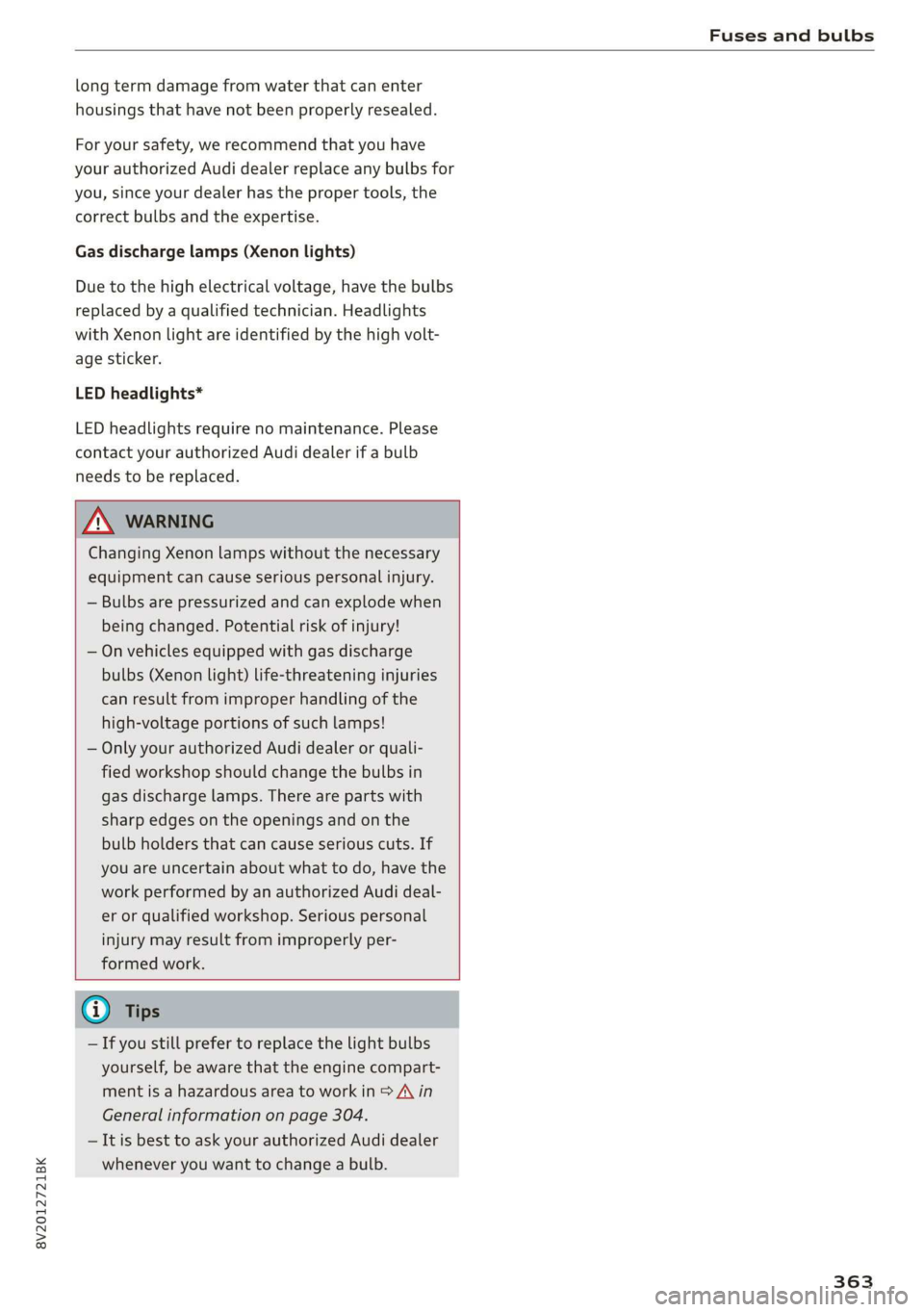
ZA\ WARNING
Changing Xenon lamps without the necessary
equipment can cause serious personal injury.
— Bulbs are pressurized and can explode when
being changed. Potential risk of injury!
— On vehicles equipped with gas discharge
bulbs (Xenon light) life-threatening injuries
can result from improper handling of the
high-voltage portions of such lamps!
— Only your authorized Audi dealer or quali-
fied workshop should change the bulbs in
gas discharge lamps. There are parts with
sharp edges on the openings and on the
bulb holders that can cause serious cuts. If
you are uncertain about what to do, have the
work performed by an authorized Audi deal-
er or qualified workshop. Serious personal
injury may result from improperly per-
formed work.
@ Tips
—If you still prefer to replace the light bulbs
yourself, be aware that the engine compart-
ment is a hazardous area to work in > A\ in
General information on page 304.
—Itis best to ask your authorized Audi dealer
whenever you want to change a bulb.
363
Page 368 of 400
Emergency situations
8. Clamp the other end of the black jump start
cable only to the ground point @) on your ve-
hicle >@.
9. Route the jump start cables so they cannot
get caught in the moving parts in the engine
compartment.
Starting the engine
10. First start the engine in the vehicle giving the
charge and let it run at idle.
11. Now start the engine in the vehicle with the
drained vehicle battery and wait two to three
minutes until it “runs smoothly”.
12.
procedure after 10 seconds and then repeat
it after approximately 30 seconds.
13. In the vehicle that is being jump started,
switch the heater fan and rear window de-
froster on to reduce any voltage peaks that
may occur when disconnecting the jumper ca-
bles. The headlights must be switched off.
While the engines are running, remove the
cables in reverse order from the way they
were installed, as described in > page 365.
Make sure the cables do not get caught in
moving engine components.
Fold the cover back on the battery correctly.
Switch the heater fan and rear window de-
froster off.
14.
15. 16.
If the engine does not start, stop the starting
ZX WARNING
— Do not touch the non-insulated parts of the
terminal clamps. The cable must also not
come into contact with vehicle components
that conduct electricity when it is connected
to the positive terminal. This can cause a
short circuit.
— The plugs on the battery cells must not be
opened.
— Keep ignition sources (such as open flames,
burning cigarettes, etc.) away from the vehi-
cle batteries to reduce the risk of an explo-
sion.
— Route the jump start cables so they cannot
get caught in the moving parts in the other
vehicle's engine compartment.
366
C@) Note
Do not use the negative terminal on the vehi-
cle battery for jump starting. A malfunction
could occur in the vehicle electrical system.
— Please note that the connecting process de-
scribed below for the jump start cables is in-
tended for when your vehicle is being jump
started.
G) Tips
Make sure that the connected positive termi-
nal clamps have sufficient contact with metal.
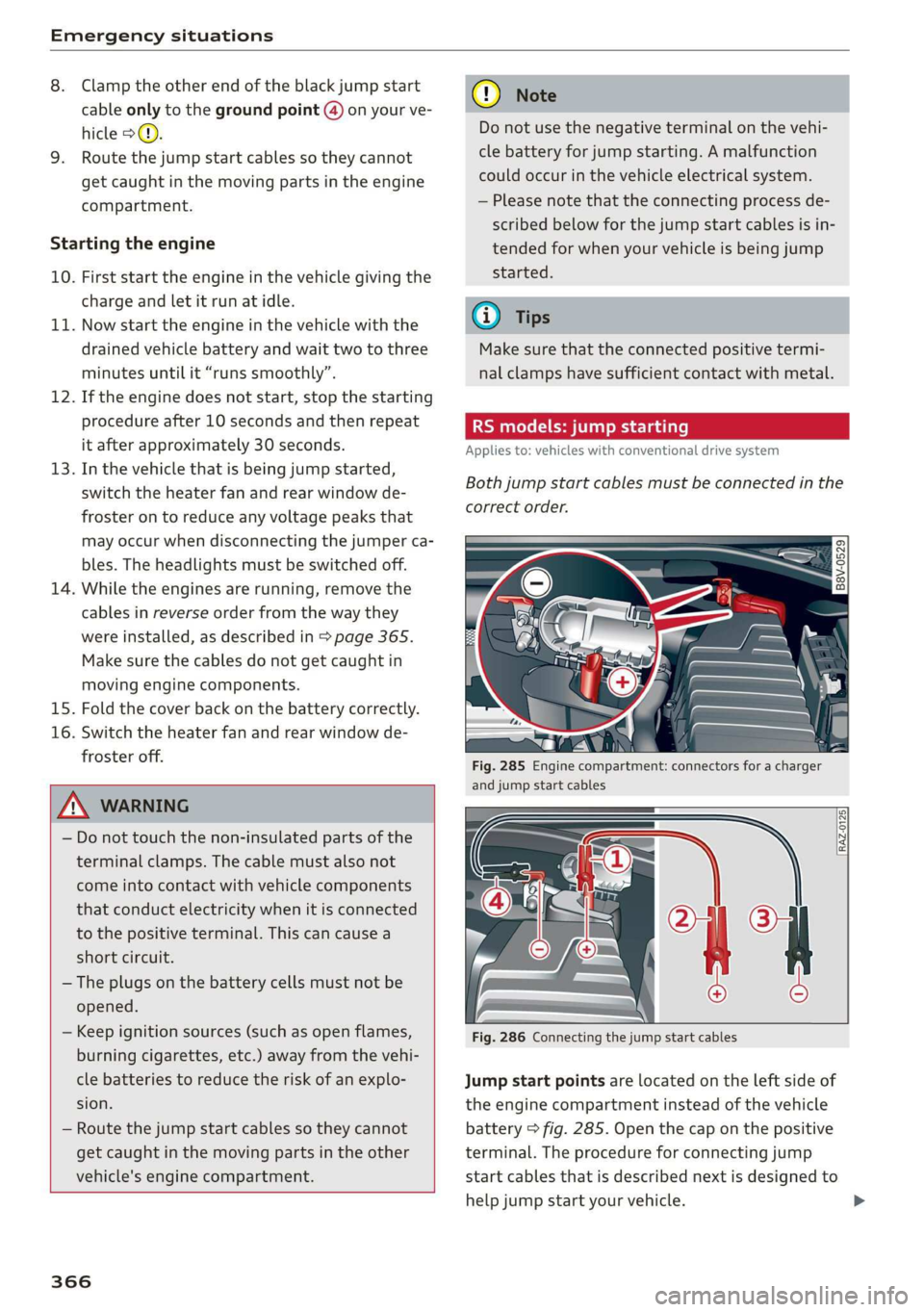
RS models: jump starting
Applies to: vehicles with conventional drive system
Both jump start cables must be connected in th
correct order.
Fig. 285 Engine compartment: connectors for a charger
and jump start cables
Fig. 286 Connecting the jump start cables
ie
2 a rte}
S| 3 & co
Jump start points are located on the left side of
the engine compartment instead of the vehicle
battery > fig. 285. Open the cap on the positive
terminal. The procedure for connecting jump
start cables that is described next is designed to
help jump start your vehicle.
>
Page 369 of 400
8V2012721BK
Emergency situations
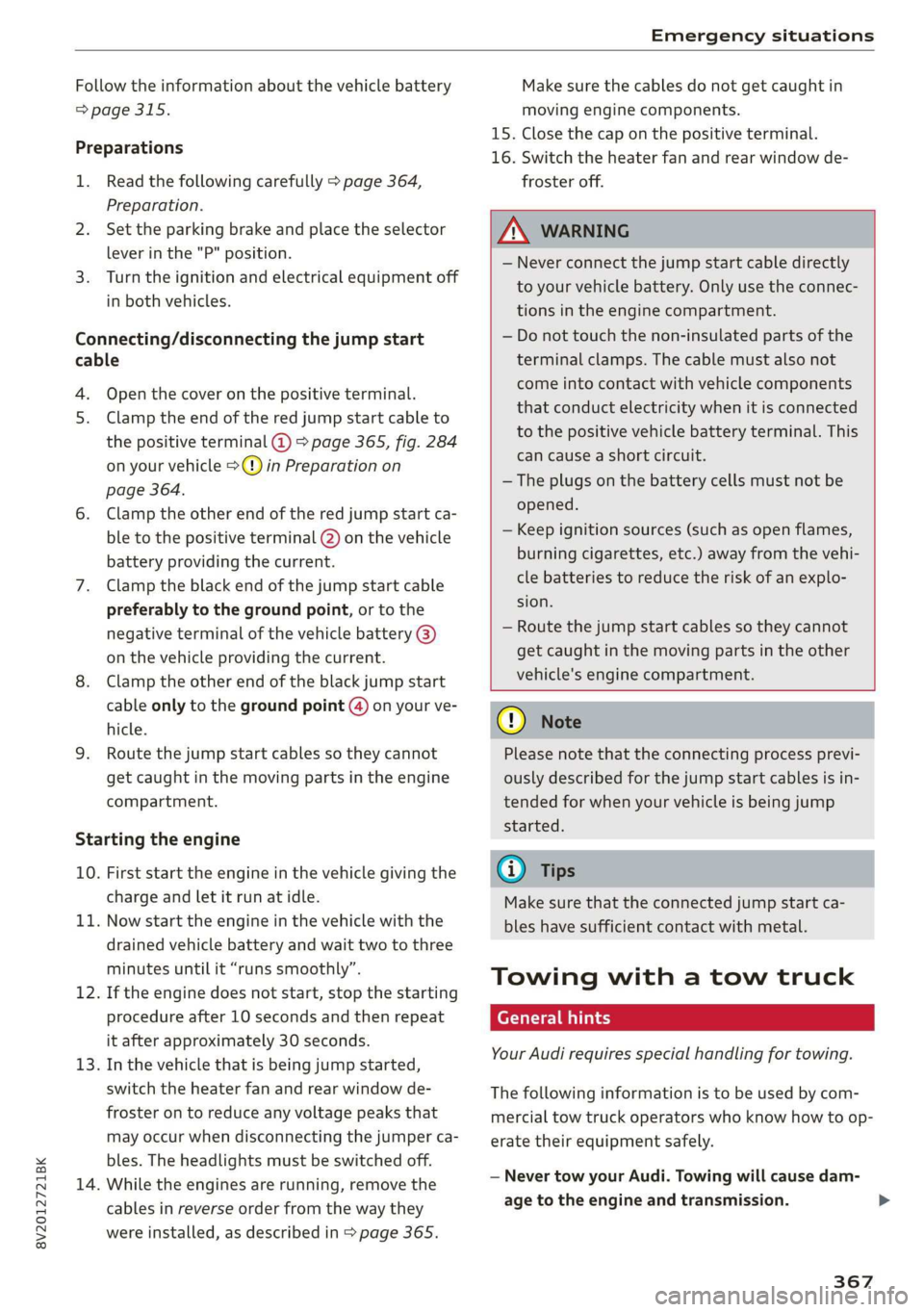
Follow the information about the vehicle battery
=> page 315.
Preparations
1. Read the following carefully > page 364,
Preparation.
2. Set the parking brake and place the selector
lever in the "P" position.
3. Turn the ignition and electrical equipment off
in both vehicles.
Connecting/disconnecting the jump start
cable
4. Open the cover on the positive terminal.
5. Clamp the end of the red jump start cable to
the positive terminal @ > page 365, fig. 284
on your vehicle >@) in Preparation on
page 364.
6. Clamp the other end of the red jump start ca-
ble to the positive terminal (2) on the vehicle
battery providing the current.
7. Clamp the black end of the jump start cable
preferably to the ground point, or to the
negative terminal of the vehicle battery @)
on the vehicle providing the current.
8. Clamp the other end of the black jump start
cable only to the ground point (4) on your ve-
hicle.
9. Route the jump start cables so they cannot
get caught in the moving parts in the engine
compartment.
Starting the engine
10. First start the engine in the vehicle giving the
charge and let it run at idle.
11. Now start the engine in the vehicle with the
drained vehicle battery and wait two to three
minutes until it “runs smoothly”.
12. If the engine does not start, stop the starting
procedure after 10 seconds and then repeat
it after approximately 30 seconds.
13. In the vehicle that is being jump started,
switch the heater fan and rear window de-
froster on to reduce any voltage peaks that
may occur when disconnecting the jumper ca-
bles. The headlights must be switched off.
14. While the engines are running, remove the
cables in reverse order from the way they
were installed, as described in > page 365.
Make sure the cables do not get caught in
moving engine components.
15. Close the cap on the positive terminal.
16. Switch the heater fan and rear window de-
froster off.
ZA\ WARNING
— Never connect the jump start cable directly
to your vehicle battery. Only use the connec-
tions in the engine compartment.
— Do not touch the non-insulated parts of the
terminal clamps. The cable must also not
come into contact with vehicle components
that conduct electricity when it is connected
to the positive vehicle battery terminal. This
can cause a short circuit.
— The plugs on the battery cells must not be
opened.
— Keep ignition sources (such as open flames,
burning cigarettes, etc.) away from the vehi-
cle batteries to reduce the risk of an explo-
sion.
— Route the jump start cables so they cannot
get caught in the moving parts in the other
vehicle's engine compartment.
@) Note
Please note that the connecting process previ-
ously described for the jump start cables is in-
tended for when your vehicle is being jump
started.
(i) Tips
Make sure that the connected jump start ca-
bles have sufficient contact with metal.
Towing with a tow truck
General hints
Your Audi requires special handling for towing.
The following information is to be used by com-
mercial tow truck operators who know how to op-
erate their equipment safely.
— Never tow your Audi. Towing will cause dam-
age to the engine and transmission. >
367
Page 383 of 400
8V2012721BK
Numbers and
Symbols
2-zone deluxe automatic climate control.... 66
A
BIG 6 evens a: acavivi oo sano i aaness oan 8 oe 66
A/C cooling Mode: «6 vive seein 6s wiewe ss ven 66
Accélerator pedals sii « 2 casos x o ware a & ewes 76
also refer to Accelerator pedal........... 76
ACGOSSONIES « ssezens on cesses © weame a» oremwes o 59,376
Active lane assist
refer to Audi active lane assist.......... 128
Active rollover protection system......... 242
Retracting rollover protection.......... 243
Adaptive cruise control
refer to Audi adaptive cruise control..... 118
Adaptive dampers........... 000 eee eae 92
Adjusting the additional display........... 19
Adjusting the air distribution............. 67
Adjusting the sound.................00- 234
Adjusting the temperature..............- 66
Adjusting the vents...............-0000- 68
Ait DaGjrce « 2 roses © & eoccses 2s vasene 8m meee 2 wee 253
Airbag system. ...........2.-0000- 253,273
Advanced Airbag System components.... 260
Care ee ee 268
ChILAIE iss + ¢ exes + © eaws s © ees + © ees 280
Childirestraints:: « csssccns a o ssowias o awaene © ws 280
Components (front airbags)............ 260
Danger of fitting a child seat on the front
PASSENGEN SCA cen. os wwe sv wrwew we eRe & e 254
Disposal... ... 2. cece eee 268
Front ‘airbags: = sess» » ene : een ey eee < 258
How do the front airbags work?......... 263
How many airbags does my vehicle have? . 260
How the Advanced Airbag System compo-
nents work together.............0000- 262
Important safety instructions on the knee
airbagisystem « « cscs ss ecies se eee bs eee 271
Kneeairbagsixs « 2 sco es sews ewan 2 ¥ wes 269
Monitoring.......... 0. cece e eee 265
PASSENGER AIR BAG OFF light.......... 265
REPA@INS:: = wssus 2 waune s § nous 5 2 ER 3 a 268
Safety instructions.............-..00- 267
Side airbags ............. 0. cece ee eee 271
Warning/Indicator lights.............. 265
When must the system be inspected?.... 265
Air pressure
Tire Pressure Monitoring System indicator . 337
Airtransport.... 2.0... eee eee eee eee 97
Alarm system
refer to Anti-theft alarm system.......... 30
Alignment pin (tire change).............-. 348
Allseason tires... 0.0.2.0... cece eee eee 335
All weather lights... . 0.0.0... c cece ee eee 43
All wheel drive
refer to quattro...............--0 eee ee 93
AMI
refer to Audi music interface........... 217
Android Auto
refer to Audi smartphone interface...... 228
Anti-freeze
Windshield washer system............. 317
Anti-lock braking system. .............0-. 93
Anti-Slip Regulation. ...............00005 93
Anti-theft alarm system .............0000- 30
Apple CarPlay
refer to Audi smartphone interface...... 228
ASR
refer to Anti-Slip Regulation............. 93
Audi active lane assist................04 128
Cleaning the camera area.............. 343
MESSAGES were 5 o sees & & EER § Oo Howes 5 eee 130
Audi adaptive cruise control............. 118
Cleaning the:senson « suis ss saw a 8 wens ss 343
Distance display, distance warning....... 124
M@SSAQES cerns & 2 sews 5 o SoG Fo ew E Bo ee 124
Audi adaptive light.................00008 43
Audi connect
(fer tO CONNECEs « x ees + x ewe + RoR BE 182
Audi connect Infotainment
Services overview... 0.0.6.0 6 cece ee ee 184
Audi connect Remote & Control
refer to Vehicle control services......... 185
Audidriveselect:.:. 2. isco es mune ee eens ev oe 91
Audi e-tron compact charging system.... . 105
Audi music interface................--- 217
Audi music stream
Weferito WIE bs + secs so womwne 3 ¥ eewves 187,214
AUGIO TICS ccs 2 same yo sanwes a o arene «eR 219
381