weight AUDI A3 2020 Owner´s Manual
[x] Cancel search | Manufacturer: AUDI, Model Year: 2020, Model line: A3, Model: AUDI A3 2020Pages: 400, PDF Size: 107.47 MB
Page 325 of 400
8V2012721BK
Wheels
Gross Axle Weight Rating
(“GAWR”)
means the load-carrying capacity
of a single axle system, measured
at the tire-ground interfaces.
Gross Vehicle Weight Rating
(“GVWR”)
means the maximum total loaded
weight of the vehicle.
Groove
means the space between two ad-
jacent tread ribs.
Load rating (code)
means the maximum load that a
tire is rated to carry for a given in-
flation pressure. You may not find
this information on all tires be-
cause it is not required by law.
Maximum load rating
means the load rating fora tire at
the maximum permissible infla-
tion pressure for that tire.
Maximum loaded vehicle
weight
means the sum of:
(a) Curb weight
(b) Accessory weight
(c) Vehicle capacity weight, and
(d) Production options weight
Maximum (permissible)
inflation pressure
means the maximum cold infla-
tion pressure to which a tire may
be inflated. Also called “maxi-
mum inflation pressure.”
Normal occupant weight
means 150 lbs. (68 kilograms)
times the number of occupants
seated in the vehicle up to the to-
tal seating capacity of your vehi-
cle.
Occupant distribution
means distribution of occupants
in a vehicle.
Outer diameter
means the overall diameter of an
inflated new tire.
Overall width
means the linear distance be-
tween the exteriors of the side-
walls of an inflated tire, including
elevations due to labeling, deco-
rations, or protective bands or
ribs.
Ply
means a layer of rubber-coated
parallel cords.
323
Page 326 of 400
Wheels
Production options weight
means the combined weight of
those installed regular production
options weighing over 5 lbs.
(2.3 kg) in excess of those stand-
ard items which they replace, not
previously considered in curb
weight or accessory weight, in-
cluding heavy duty brakes, ride
levelers, roof rack, heavy duty
battery, and special trim.
Radial ply tire
means a pneumatic tire in which
the ply cords that extend to the
beads are laid at substantially
90 degrees to the centerline of
the tread.
Recommended inflation
pressure
see > page 322, Cold tire infla-
tion pressure.
Reinforced tire
means a tire designed to operate
at higher loads and at higher in-
flation pressures than the corre-
sponding standard tire. Rein-
forced tires may be identified as
“XL”, “xl”, “EXTRA LOAD”, or “RF”
on the sidewall.
324
Rim
means a metal support for a tire
ora tire and tube assembly upon
which the tire beads are seated.
Rim diameter
means nominal diameter of the
bead seat. If you change your
wheel size, you will have to pur-
chase new tires to match the new
rim diameter.
Rim size designation
means rim diameter and width.
Rim width
means nominal distance between
rim flanges.
Sidewall
means that portion of a tire be-
tween the tread and bead.
Speed rating (letter code)
means the speed at which a tire is
designed to be driven for extend-
ed periods of time. The ratings
range from 93 mph (150 km/h)
to 186 mph (298 km/h) > table
on page 320. You may not find
this information on all tires be-
cause it is not required by law.
The speed rating letter code,
where applicable, is molded on
the tire sidewall and indicates the >
Page 328 of 400
Wheels
by the tire manufacturer. This in-
formation is used to contact con-
sumers if a tire defect requires a
recall.
Vehicle capacity weight
means the rated cargo and lug-
gage load plus 150 lbs. (68 kilo-
grams) times the vehicle's desig-
nated seating capacity.
Vehicle maximum load on the
tire
means that load on an individual
tire that is determined by distrib-
uting to each axle its share of the
maximum loaded vehicle weight
and dividing by two.
Vehicle normal load on the tire
means that load on an individual
tire that is determined by distrib-
uting to each axle its share of the
curb weight, accessory weight,
and normal occupant weight (dis-
tributed in accordance with > ta-
ble on page 331) and dividing by
two.
Occupant loading and distri-
bution for vehicle normal load
for various designated seating
capacities
Refer to the tire inflation pressure
label > page 330, fig. 260 for the
326
number of seating positions. Re-
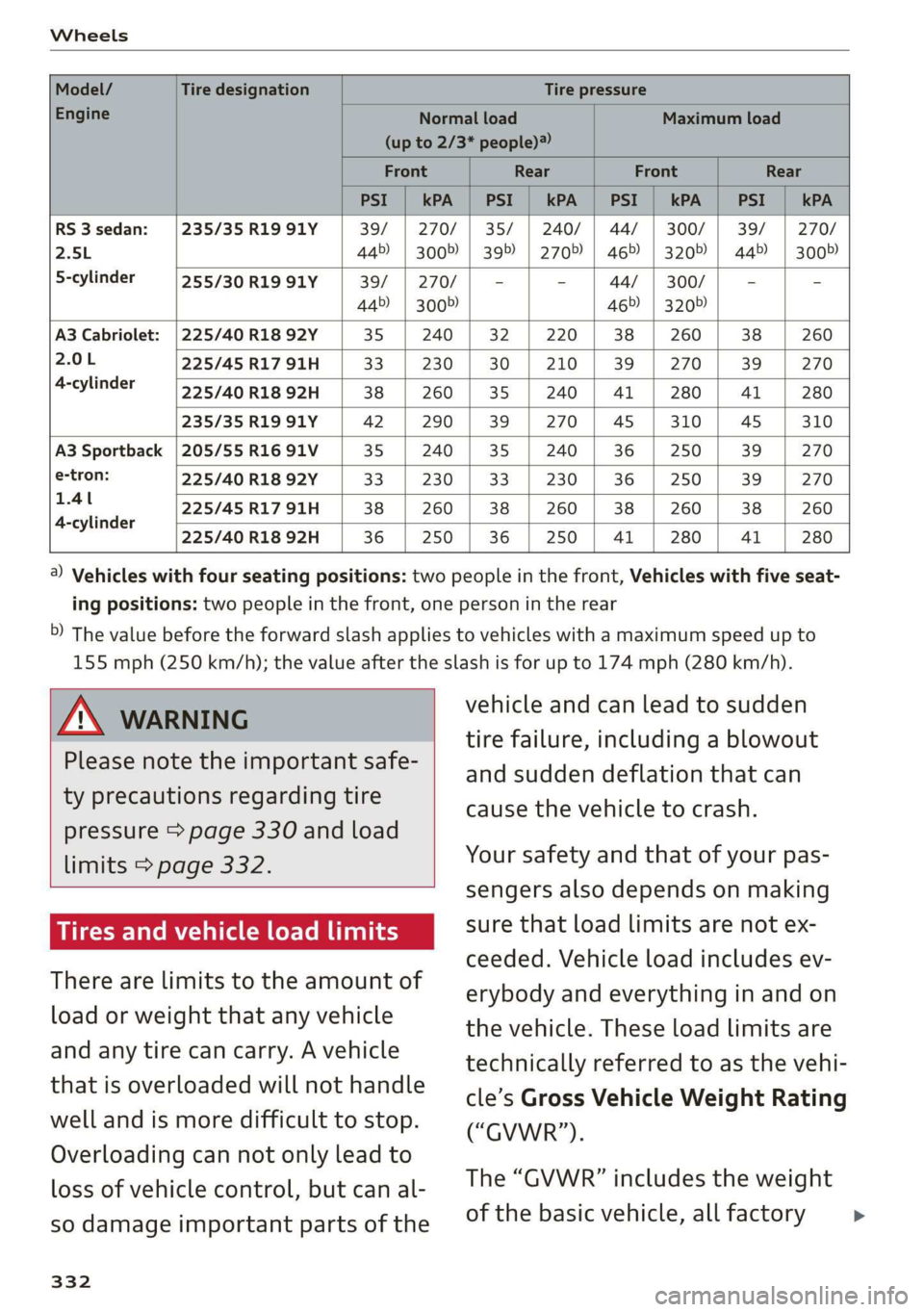
fer to the table > table on
page 331 for the number of peo-
ple that correspond to the vehicle
normal load.
New tires or wheels
Audi recommends having all work
on tires or wheels performed by
an authorized Audi dealer or au-
thorized Audi Service Facility.
These facilities have the proper
knowledge and are equipped with
the required tools and replace-
ment parts.
>New tires do not yet have the
optimum gripping properties.
Drive carefully and at moderate
speeds for the first 350 miles
(500 km) with new tires.
> Only use tires with the same de-
sign, size (rolling circumfer-
ence), and as close to the same
tread pattern as possible on all
four wheels.
> Applies to: RS models: Only use
tires with the same design and
the same tread pattern on all
four wheels.
>Do not replace tires individually.
At least replace both tires on the
same axle at the same time. >
Page 334 of 400
Wheels
Model/ Tire designation Tire pressure
Engine Normal load Maximum load
(up to 2/3* people)?
Front Rear Front Rear
PSI | kPA | PSI kPA | PSI | kPA | PSI | kPA
RS 3sedan: /|235/35R1991Y 39/ | 270/ | 35/ | 240/ | 44/ | 300/ | 39/ | 270/
2.5L 44>) | 300%) | 395) | 2705) | 46>) | 3205) | 445) | 3005)
5-cylinder 255/30 R19 91Y 39/ | 270/ | - - 44/ | 300/ - -
445) | 3005) 465) | 320»)
A3 Cabriolet: |225/40 R18 92Y 35 | 240 | 32 | 220 | 38 | 260 38 260
2.0L 225/45 R17 91H 33. | 230 | 30 | 210 | 39 | 270 | 39 | 270
4-cylinder 225/40 R18 92H 38 | 260 | 35 | 240 | 41 | 280 | 41 | 280
235/35 R19 91Y 42 | 290 | 39 | 270 | 45 | 310 | 45 310
A3 Sportback | 205/55 R16 91V 35 | 240 | 35 | 240 | 36 | 250 39 270
e-tron: 225/40 R18 92Y 33 | 230 | 33 | 230 | 36 | 250 39 270
ae 225/45R1791H | 38 | 260 | 38 | 260 | 38 | 260 | 38 | 260
4-cylinder
225/40 R18 92H 36 | 250 | 36 | 250 | 41 | 280 | 41 280
@) Vehicles with four seating positions: two people in the front, Vehicles with five seat-
ing positions: two people in the front, one person in the rear
5) The value before the forward slash applies to vehicles with a maximum speed up to
155 mph (250 km/h); the value after the slash is for up to 174 mph (280 km/h).
Z\ WARNING
Please note the important safe-
ty precautions regarding tire
pressure > page 330 and load
limits > page 332.
Tires and vehicle load limits
There are limits to the amount of
load or weight that any vehicle
and any tire can carry. A vehicle
that is overloaded will not handle
well and is more difficult to stop.
Overloading can not only lead to
loss of vehicle control, but can al-
so damage important parts of the
332
vehicle and can lead to sudden
tire failure, including a blowout
and sudden deflation that can
cause the vehicle to crash.
Your safety and that of your pas-
sengers also depends on making
sure that load limits are not ex-
ceeded. Vehicle load includes ev-
erybody and everything in and on
the vehicle. These load limits are
technically referred to as the vehi-
cle’s Gross Vehicle Weight Rating
(“GVWR”).
The “GVWR” includes the weight
of the basic vehicle, all factory >
Page 335 of 400
8V2012721BK
Wheels
installed accessories, a full tank
of fuel, oil, coolant and other flu-
ids plus maximum load. The max-
imum Load includes the number
of passengers that the vehicle is
intended to carry (“seating ca-
pacity”) with an assumed weight
of 150 lbs. (68 kg) for each pas-
senger at a designated seating
position and the total weight of
any luggage in the vehicle. If you
tow a trailer, the weight of the
trailer hitch and the tongue
weight of the loaded trailer must
be included as part of the vehicle
load.
The Gross Axle Weight Rating
(“GAWR”) is the maximum load
that can be applied at each of the
vehicle’s two axles.
The fact that there is an upper
limit to your vehicle’s Gross Vehi-
cle Weight Rating means that the
total weight of whatever is being
carried in the vehicle (including
the weight of a trailer hitch and
the tongue weight of the loaded
trailer) is limited. The more pas-
sengers in the vehicle or passen-
gers who are heavier than the
standard weights assumed mean
that less weight can be carried as
luggage.
The Gross Vehicle Weight Rating
and the Gross Axle Weight Rating
are listed on the safety compli-
ance sticker label located on the
driver’s side B-pillar.
Z\, WARNING
Overloading a vehicle can cause
loss of vehicle control, a crash
or other accident, serious per-
sonal injury, and even death.
—Carrying more weight than
your vehicle was designed to
carry will prevent the vehicle
from handling properly and in-
crease the risk of the loss of
vehicle control.
—The brakes on a vehicle that
has been overloaded may not
be able to stop the vehicle
within a safe distance.
—Tires ona vehicle that has
been overloaded can fail sud-
denly, including a blowout and
sudden deflation, causing loss
of control and a crash.
—Always make sure that the to-
tal load being transported -
including the weight of a trail-
er hitch and the tongue
weight of a loaded trailer -
does not make the vehicle
333
Page 336 of 400
Wheels
heavier than the vehicle’s
Gross Vehicle Weight Rating.
Determining correct load
Tani
Use the example below to calcu-
late the total weight of the pas-
sengers and luggage or other
things that you plan to transport
so that you can make sure that
your vehicle will not be overload-
ed.
Steps for Determining Correct
Load Limit
1. Locate the statement “THE
COMBINED WEIGHT OF OCCU-
PANTS AND CARGO SHOULD
NEVER EXCEED XXX KG OR XXX
LBS” on your vehicle’s placard
(tire inflation pressure label)
=> page 330, fig. 259.
2. Determine the combined
weight of the driver and pas-
sengers that will be riding in
your vehicle.
3. Subtract the combined weight
of the driver and passengers
from “XXX” kilograms or “XXX”
pounds shown on the sticker
=> page 330, fig. 259.
4. The resulting figure equals the
available amount of cargo and
334
luggage load capacity. For ex-
ample, if the “XXX” amount
equals 1400 lbs. and there will
be five 150 lbs. passengers in
your vehicle, the amount of
available cargo and luggage
load capacity is 650 lbs.
(1400-750 (5 x 150) =
650 lbs.)
5. Determine the combined
weight of luggage and cargo
being loaded on the vehicle.
That weight may not safely ex-
ceed the available cargo and
luggage load capacity calculat-
ed in Step 4.
6. If your vehicle will be towing a
trailer, load from your trailer
will be transferred to your vehi-
cle. Consult this manual to de-
termine how this reduces the
available cargo and luggage
load capacity of your vehicle.
> Check the tire sidewall
(=> page 320, fig. 257) to deter-
mine the designated load rating
for a specific tire.
Wheel bolts and rims
Wheel bolts
Wheel bolts must be clean and loosen/tighten
easily.
Page 371 of 400

8V2012721BK
Emergency situations
Loading the vehicle onto a flatbed truck
BaV-0402
|
a
Fig. 289 Vehicle on flatbed truck (example)
Front hook up
> Align the vehicle with the centerline of the car
carrier ramp.
> Attach the winch hook to the front towline eye
previously installed.
Rear hook up
> Align the vehicle with the centerline of the car
carrier ramp.
> Attach the winch hook to the rear towline eye
previously installed.
@) Tips
Check carefully to make sure the hook-up is
secure before moving the car up the flatbed
truck ramp.
Raising the vehicle
Lifting with workshop hoist and with floor
jack
The vehicle may only be lifted at the lifting
points illustrated.
oO S zt 6
> a a
Fig. 290 Front lifting point (example)
= Ss z
ba > i} oO
/
Fig. 291 Rear lifting point (example)
> Read and heed WARNING © A\.
> Locate lifting points > fig. 290 and > fig. 291.
> Adjust lifting arms of workshop hoist or floor
jack to match vehicle lifting points.
> Insert a rubber pad between the floor jack/
workshop hoist and the Lifting points.
If you must lift your vehicle with a floor jack to
work underneath, be sure the vehicle is safely
supported on stands intended for this purpose.
Front lifting point
The lifting point is located on the floor pan rein-
forcement about at the same level as the jack
mounting point > fig. 290. Do not lift the vehi-
cle at the vertical sill reinforcement.
Rear lifting point
The lifting point is located on the vertical rein-
forcement of the lower sill for the on-board jack
> fig. 291.
Lifting with vehicle jack
Refer to > page 354.
Z\ WARNING
—To reduce the risk of serious injury and vehi-
cle damage.
— Always lift the vehicle only at the special
workshop hoist and floor jack lift points il-
lustrated > fig. 290 and > fig. 291.
— Failure to lift the vehicle at these points
could cause the vehicle to tilt or fall from a
lift if there is a change in vehicle weight
distribution and balance. This might hap-
pen, for example, when heavy components |>
369
Page 372 of 400
Emergency situations
such as the engine block or transmission
are removed.
— When removing heavy components like
these, anchor vehicle to hoist or add corre-
sponding weights to maintain the center of
gravity. Otherwise, the vehicle might tilt or
slip
off the hoist, causing serious personal
injury.
@ Note
— Be aware of the following points before Lift-
ing the vehicle:
— The vehicle should never be lifted or
jacked up from underneath the engine oil
pan, the transmission housing, the front
or rear axle or the body side members.
This could lead to serious damage.
—To avoid damage to the underbody or
chassis frame, a rubber pad must be in-
serted between the floor jack and the lift
points.
— Before driving over a workshop hoist,
check that the vehicle weight does not
exceed the permissible lifting capacity of
the hoist.
— Before driving over a workshop hoist, en-
sure that there is sufficient clearance be-
tween the hoist and low parts of the ve-
hicle.
370
Page 381 of 400
8V2012721BK
Technical data
Technical data
Identification data
Vehicle identification label
XXX X= HKNK WOK XX
(Hae wrccnce XX XNKKKNKK
Frm XXX XX
2
XX XXKKXKK XK KX XK
3 }—— MOTORS / GET. 8
eco au cone XXX
XXX KW XXX
XXX WX
CQ -ASRAINER YyNX XXX NOK
M. - AUSST. / OPTIONS
EOA 7D5 4UB 6XM 5SG SRW
2EH JOZ 1LB 1AS_ 1BA
3FC SMU 7X1
FOA 9G3 0G7 OYH OJF
SG TLE 3KA 8EH U1A X9B QZ7
1XW 8Q3 9Q8 8Z4 D2D
716 CV7 7KO 4X3 2K2
34 4KC 3Y0 413 5D2
1SA 7GB QIA 4GQ
RAZ-0668
ee
Fig. 293 Vehicle identification label
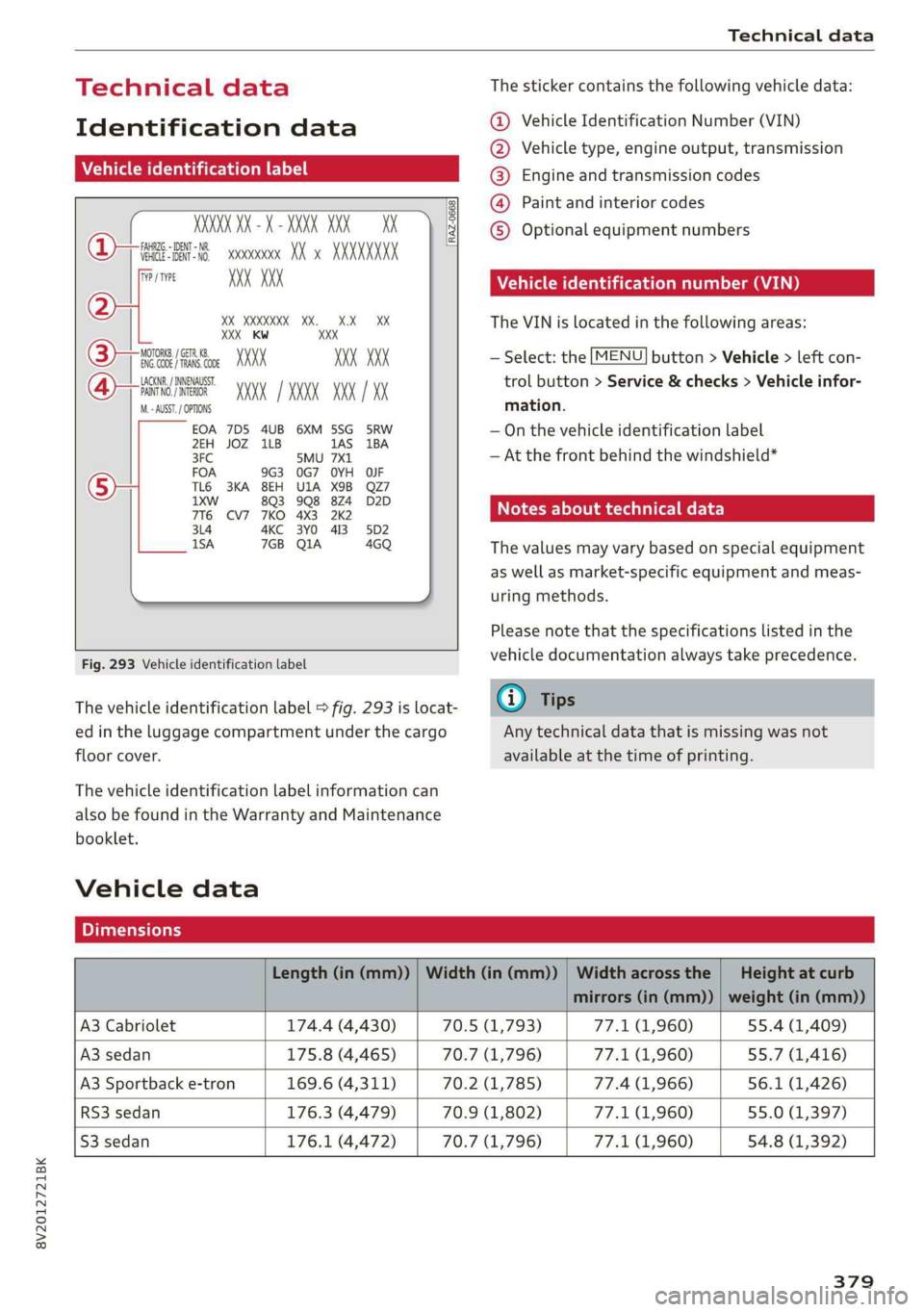
The vehicle identification label > fig. 293 is locat-
ed in the luggage compartment under the cargo
floor cover.
The vehicle identification label information can
also be found in the Warranty and Maintenance
booklet.
Vehicle data
The sticker contains the following vehicle data:
@® Vehicle Identification Number (VIN)
@ Vehicle type, engine output, transmission
® Engine and transmission codes
@) Paint and interior codes
© Optional equipment numbers
Vehicle identification number (VIN)
The VIN is located in the following areas:
— Select: the [MENU] button > Vehicle > left con-
trol button > Service & checks > Vehicle infor-
mation.
— On the vehicle identification label
— At the front behind the windshield*
Notes about technical data
The values may vary based on special equipment
as well as market-specific equipment and meas-
uring methods.
Please note that the specifications listed in the
vehicle documentation always take precedence.
G) Tips
Any technical data that is missing was not
available at the time of printing.
Length (in (mm)) | Width (in (mm)) | Width across the | Height at curb
mirrors (in (mm)) | weight (in (mm))
A3 Cabriolet 174.4 (4,430) 70.5 (1,793) 77.1 (1,960) 55.4 (1,409)
A3 sedan 175.8 (4,465) 70.7 (1,796) 77.1 (1,960) 55.7 (1,416)
A3 Sportback e-tron 169.6 (4,311) 70.2 (1,785) 77.4 (1,966) 56.1 (1,426)
RS3 sedan 176.3 (4,479) 70.9 (1,802) 77.1 (1,960) 55.0 (1,397)
S3 sedan 176.1 (4,472) 70.7 (1,796) 77.1 (1,960) 54.8 (1,392)
379
Page 382 of 400
Technical data
(er) Fah a(t)
Fuel tank, front wheel drive 13.2 gal (50.0 L)
Fuel tank, all wheel drive 14.5 gal (55.0 L)
Plug-in hybrid drive fuel tank 10.5 gal (40.0 L)
Windshield washer system 3.2 qt (3.0L)
Windshield and headlight washer system* 5.0 qt (4.7 L)
Windshield and headlight washer system*, S models 4.2 qt (4.0 L)
Windshield and headlight washer system*, RS models 3:7 qt3B5D
Weights
Le I Le
FANNON A
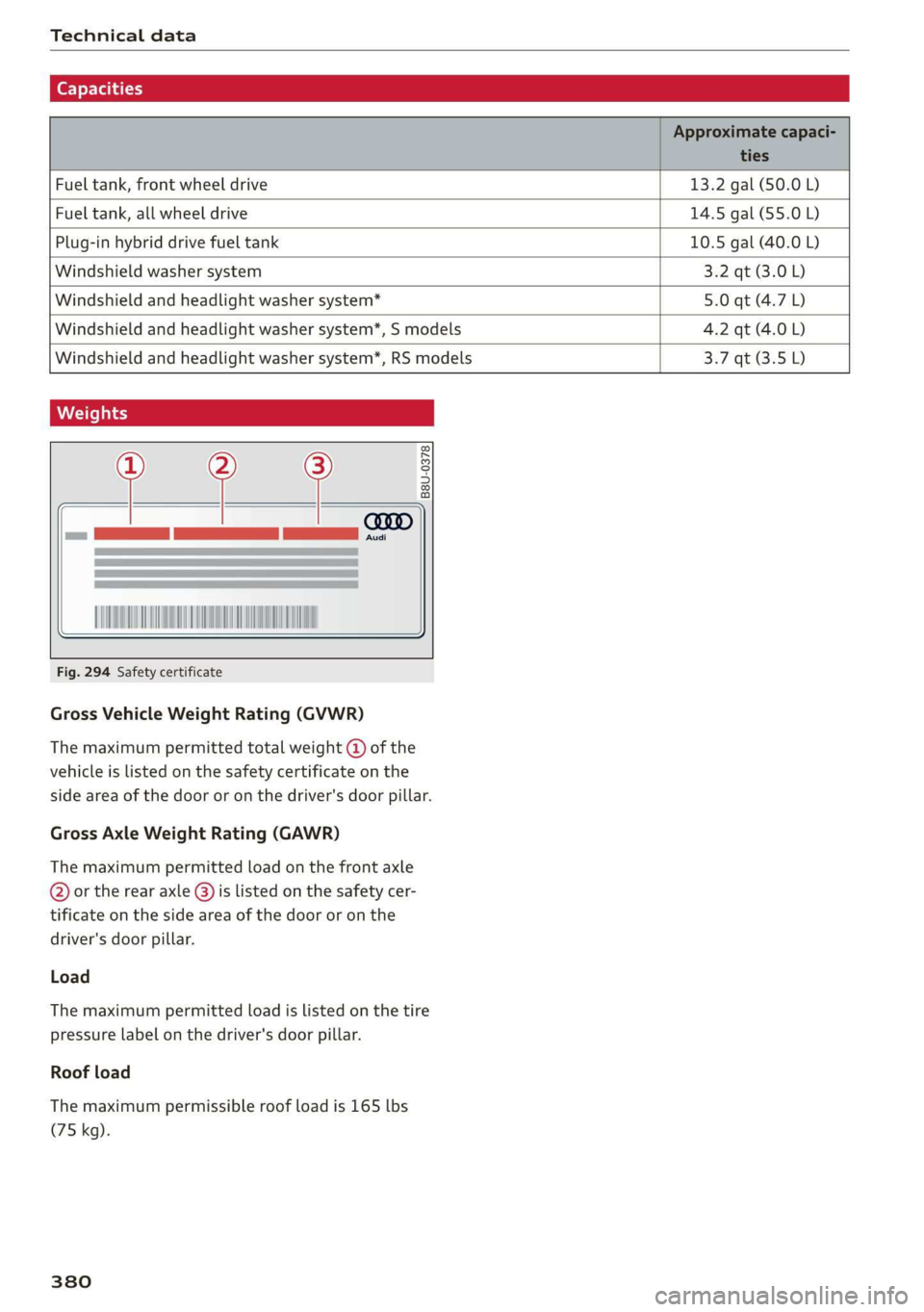
Fig. 294 Safety certificate
Gross Vehicle Weight Rating (GVWR)
The maximum permitted total weight @ of the
vehicle is listed on the safety certificate on the
side area of the door or on the driver's door pillar.
Gross Axle Weight Rating (GAWR)
The maximum permitted load on the front axle
@ or the rear axle @) is listed on the safety cer-
tificate on the side area of the door or on the
driver's door pillar.
Load
The maximum permitted load is listed on the tire
pressure label on the driver's door pillar.
Roof load
The maximum permissible roof load is 165 lbs
(75 kg).
380