weight AUDI A3 2020 Owner´s Manual
[x] Cancel search | Manufacturer: AUDI, Model Year: 2020, Model line: A3, Model: AUDI A3 2020Pages: 400, PDF Size: 107.47 MB
Page 278 of 400
Airbag system
How side curtain airbags work
Applies to: vehicles with side curtain airbags
Side curtain airbags can work together with side
airbags to help reduce the risk of head and upper
torso injuries for occupants who are properly re-
strained.
©.
=
<| = & a
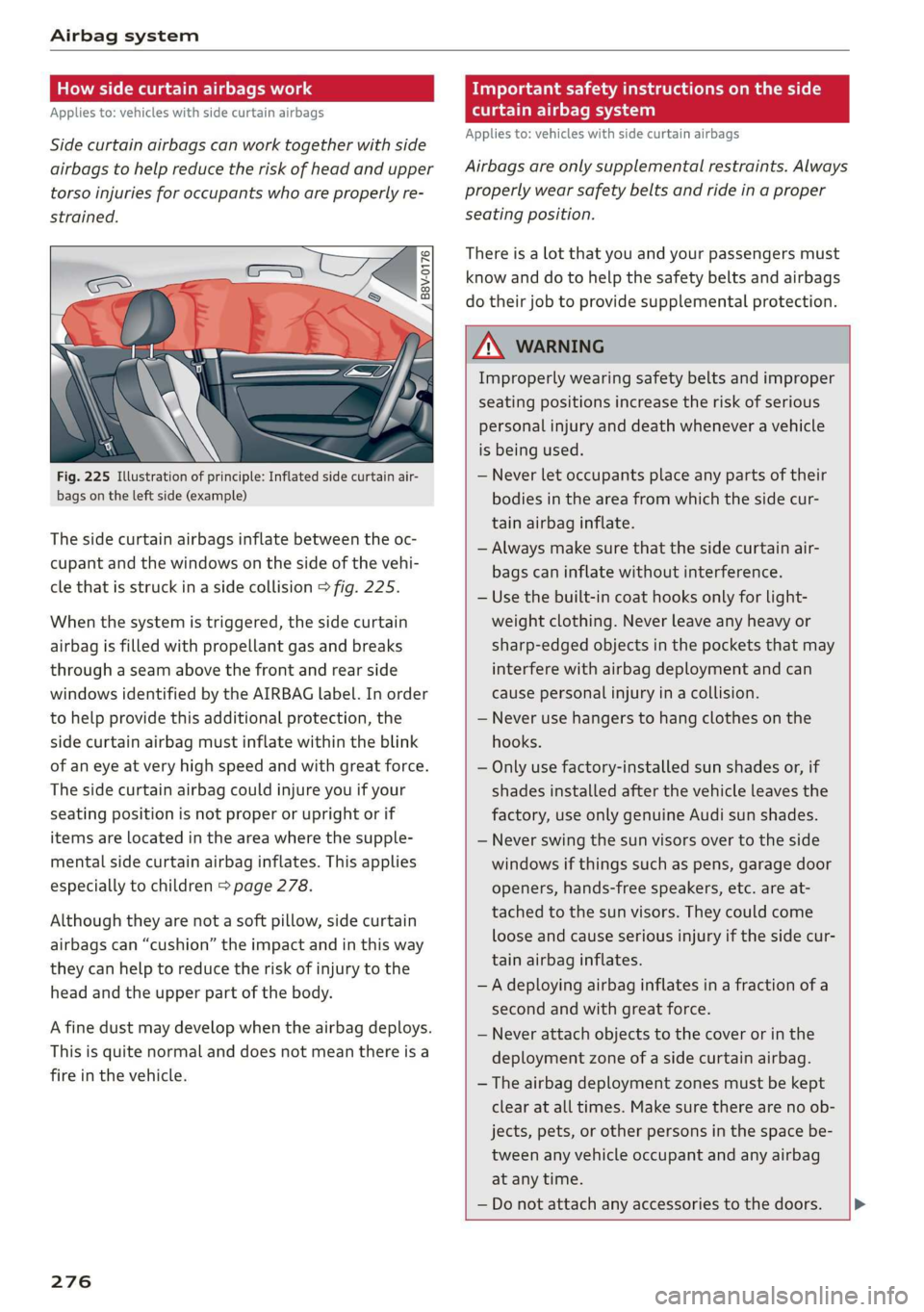
Fig. 225 Illustration of principle: Inflated side curtain air-
bags on the left side (example)
The side curtain airbags inflate between the oc-
cupant and the windows on the side of the vehi-
cle that is struck in a side collision > fig. 225.
When the system is triggered, the side curtain
airbag is filled with propellant gas and breaks
through a seam above the front and rear side
windows identified by the AIRBAG label. In order
to help provide this additional protection, the
side curtain airbag must inflate within the blink
of an eye at very high speed and with great force.
The side curtain airbag could injure you if your
seating position is not proper or upright or if
items are located in the area where the supple-
mental side curtain airbag inflates. This applies
especially to children > page 278.
Although they are not a soft pillow, side curtain
airbags can “cushion” the impact and in this way
they can help to reduce the risk of injury to the
head and the upper part of the body.
A fine dust may develop when the airbag deploys.
This is quite normal and does not mean there is a
fire in the vehicle.
276
Important safety instructions on the side
curtain airbag system
Applies to: vehicles with side curtain airbags
Airbags are only supplemental restraints. Always
properly wear safety belts and ride in a proper
seating position.
There is a lot that you and your passengers must
know and do to help the safety belts and airbags
do their job to provide supplemental protection.
ZA WARNING
Improperly wearing safety belts and improper
seating positions increase the risk of serious
personal injury and death whenever a vehicle
is being used.
— Never let occupants place any parts of their
bodies in the area from which the side cur-
tain airbag inflate.
— Always make sure that the side curtain air-
bags can inflate without interference.
— Use the built-in coat hooks only for light-
weight clothing. Never leave any heavy or
sharp-edged objects in the pockets that may
interfere with airbag deployment and can
cause personal injury in a collision.
— Never use hangers to hang clothes on the
hooks.
— Only use factory-installed sun shades or, if
shades installed after the vehicle leaves the
factory, use only genuine Audi sun shades.
— Never swing the sun visors over to the side
windows if things such as pens, garage door
openers, hands-free speakers, etc. are at-
tached to the sun visors. They could come
loose and cause serious injury if the side cur-
tain airbag inflates.
— A deploying airbag inflates in a fraction of a
second and with great force.
— Never attach objects to the cover or in the
deployment zone of a side curtain airbag.
— The airbag deployment zones must be kept
clear at all times. Make sure there are no ob-
jects, pets, or other persons in the space be-
tween any vehicle occupant and any airbag
at any time.
— Do not attach any accessories to the doors.
Page 280 of 400
Child safety
Child safety
Important information
Introduction
The rear seat is generally the safest place ina
collision.
The physical principles of what happens when
your vehicle is in a crash apply also to children
= page 246, What happens to occupants not
wearing safety belts?. But unlike adults and
teenagers, their muscles and bones are not fully
developed. In many respects children are at
greater risk of serious injury in crashes than
adults.
Because children's bodies are not fully developed,
they require restraint systems especially de-
signed for their size, weight, and body structure.
Many countries and all states of the United
States and provinces of Canada have laws requir-
ing the use of approved child restraint systems
for infants and small children.
Ina frontal crash at a speed of 20-35 mph
(30-56 km/h) the forces acting on a 13-pound
(6 kg) infant will be more than 20 times the
weight of the child. This means the weight of the
child would suddenly be more than 260 pounds
(120 kg). Under these conditions, only an appro-
priate child restraint properly used can reduce
the risk of serious injury. Child restraints, like
adult safety belts, must be used properly to be
effective. Used improperly, they can increase the
risk of serious injury in an accident.
All children, especially those 12 years and young-
er must always ride in the back seat properly re-
strained for their age and size. If you must install
a child restraint on the front passenger seat in
exceptional circumstances, be sure to read and
heed the important information and warnings
= page 254. Infants and other children who are
properly restrained in an appropriate child re-
straint that is for their size and age can benefit
from the protection that supplemental side air-
bags provide in some kinds of crashes.
For more information please see information pro-
vided by the:
278
— National Highway Traffic Safety Administration
(NHTSA), currently at : http://www.safercar.gov
(for the USA)
— Transport Canada Information Centre, currently
at: http://www.tc.gc.ca (for Canada)
Consult the child safety seat manufacturer's in-
structions in order to be sure the seat is right for
your child's size > page 282, Important safety
instructions for using child safety seats. Please
be sure to read and heed all of the important in-
formation and WARNINGS about child safety, Ad-
vanced Airbags, and the installation of child re-
straints in this chapter.
There is a lot you need to know about the Ad-
vanced Airbags in your vehicle and how they work
when infants and children in child restraints are
on the front passenger seat. Because of the large
amount of important information, we cannot re-
peat it all here. We urge you to read the detailed
information in this owner's manual about airbags
and the Advanced Airbag System in your vehicle
and the very important information about trans-
porting children on the front passenger seat.
Please be sure to heed the WARNINGS - they are
extremely important for your safety and the safe-
ty of your passengers, especially infants and
small children.
ZA WARNING
— Accident statistics have shown that children
are generally safer in the rear seat area than
in the front seating position. Always restrain
any child age 12 and under in the rear.
— All vehicle occupants and especially children
must be restrained properly whenever riding
in a vehicle. An unrestrained or improperly
restrained child could be injured by striking
the interior or by being ejected from the ve-
hicle during a sudden maneuver or impact.
An unrestrained or improperly restrained
child is also at greater risk of injury or death
through contact with an inflating airbag.
— A suitable child restraint properly installed
and used at one of the rear seating positions
provides the highest degree of protection
for infants and small children in most acci-
dent situations.
Page 283 of 400
8V2012721BK
Child safety
Safety Standards and has been certified by its
manufacturer for use with an airbag. Always be
sure that the child restraint is properly installed
at one of the rear seating positions. If in excep-
tional circumstances you must use it on the front
passenger seat, carefully read all of the informa-
tion on child safety and Advanced Airbags and
heed all of the applicable WARNINGS. Make cer-
tain that the child and child restraint are correct-
ly recognized by the capacitive passenger detec-
tion system in the front passenger seat, that the
front passenger airbag is turned off, and that the
airbag status is always correctly signaled by the
PASSENGER AIR BAG OFF light.
Many types and models of child restraints have
been available over the years, new models are in-
troduced regularly incorporating new and im-
proved designs and older models are taken out of
production. Child restraints are not standardized.
Child restraints of the same type typically have
different
weights and sizes and different “foot-
prints”, the size and shape of the bottom of the
child restraint that sits on the seat, when they
are installed on a vehicle seat. These differences
make it virtually impossible to certify compliance
with the requirements for advanced airbags with
each and every child restraint that has ever been
sold in the past or will be sold over the course of
the useful life of your vehicle.
For this reason, the United States National High-
way Traffic Safety Administration has published a
list of specific type, makes and models of child
restraints that must be used to certify compli-
ance of the Advanced Airbag System in your vehi-
cle with the suppression requirements of Federal
Motor Vehicle Safety Standard 208. These child
restraints are:
Subpart A - Car bed child restraints
Subpart B - Rear-facing child restraints
Model Manufactured on or
after
Century SmartFit 4543 | December 1, 1999
Cosco Arriva
22-013PAW and base
22-999WHO
September 25, 2007
Evenflo Discovery Ad-
just Right 212
December 1, 1999
Evenflo First Choice
204
December 1, 1999
Graco Infant 8457 December 1, 1999
Graco Snugride September 25, 2007
Peg Perego Primo Viag-
gio SIP IMUNOOUS
September 25, 2007
child restraints
Subpart C - Forward-facing and convertible
Model Manufactured on or
after
Britax Roundabout
ESLO2xx
September 25, 2007
Cosco Touriva 02519 December 1, 1999
Cosco Summit Deluxe
High Back Booster
22-262
September 25, 2007
Cosco High Back Boos-
ter 22-209
September 25, 2007
Evenflo Tribute V
379Xxxxx
September 25, 2007
Evenflo Medallion 254 December 1, 1999
Evenflo Generations
352xxxx
September 25, 2007
Graco ComfortSport September 25, 2007
Graco Toddler Safety
Seat Step 2
September 25, 2007
Graco Platinum Cargo
September 25, 2007
Model Manufactured on or
after
Angel Guard Angel September 25, 2007
Ride AA2403FOF
Z\ WARNING
To reduce the risk of serious injury, make sure
that the PASSENGER AIR BAG OFF light
comes on and stays on whenever a child re-
straint is installed on the front passenger seat
and the ignition is switched on.
281
Page 284 of 400
Child safety
— Take the child restraint off the front passen- child restraint increases the risk of serious
ger seat and install it properly at one of the personal injury and death.
rear seat positions if the PASSENGER AIR — All vehicle occupants and especially children
BAG OFF light does not stay on. must be restrained properly whenever riding
— Have the airbag system inspected by your in a vehicle. An unrestrained or improperly
authorized Audi dealer immediately. restrained child could be injured by striking
the interior or by being ejected from the ve-
@ Tips hicle during a sudden maneuver or impact.
An unrestrained or improperly restrained
child is also at greater risk of injury or death
through contact with an inflating airbag.
The child seats listed in categories A to C have
been statically tested by Audi only for the Ad-
vanced Airbag function.
— Commercially available child safety seats are
oe required to comply with U.S. Federal Motor
mae ee Vehicle Safety Standard (FMVSS) 213 (in
Canada CMVSS 213).
Correct use of child safety seats substantially re- —When buying a child restraint, select one
duces the risk of injury in an accident! that fits your child and the vehicle.
— Only use child restraint systems that fully
contact the flat portion of the seat cush-
ion. The child restraint must not tip or
As the driver, you are responsible for the safety of
everybody in the vehicle, especially children:
> Always use the right child safety seat for each lean to either side. Audi does not recom-
child and always use it properly page 284. mend using child safety seats that rest on
> Always carefully follow the child safety seat legs or tube-like frames. They do not pro-
manufacturer's instructions on how to route vide adequate contact with the seat.
the safety belt properly through the child safe- — Always heed all legal requirements per-
ty seat. taining to the installation and use of child
> When using the vehicle safety belt to install a safety seats and carefully follow the in-
child safety seat, you must first activate the structions provided by the manufacturer
convertible locking retractor on the safety belt of the seat you are using.
to prevent the child safety seat from moving mi evenallowchildrentundensi. niches
page 289. (1.45 meters) to wear a normal safety belt.
> Push the child safety seat down with your full They must always be restrained by a proper
weight to get the safety belt really tight so that child restraint system. Otherwise, they
the seat cannot move forward or sideways more could sustain injuries to the abdomen and
than one inch (2.5 cm). neck areas during sudden braking maneu-
> Secure unused safety belts on the rear seat Werstionaccicental
> page 284. — Never let more than one child occupy a child
safety seat.
— Never let babies or older children ride ina
vehicle while sitting on the lap of another
Always remember: Even though your vehicle is
equipped with an Advanced Airbag system, all
children, especially those 12 years and younger,
should always ride in the back seat properly re- paecegel
strained for their age and size. — Holding a child in your arms is never a sub-
stitute for a child restraint system.
A WARNING — The strongest person could not hold the
child with the forces that exist in an acci-
dent. The child will strike the interior of
the vehicle and can also be struck by the
passenger.
Not using a child safety seat, using the wrong
child safety seat or improperly installing a
282
Page 286 of 400
Child safety
— Have the airbag system inspected by your
authorized Audi dealer immediately.
STM emt Camel heel ae Lees
B4G-0466
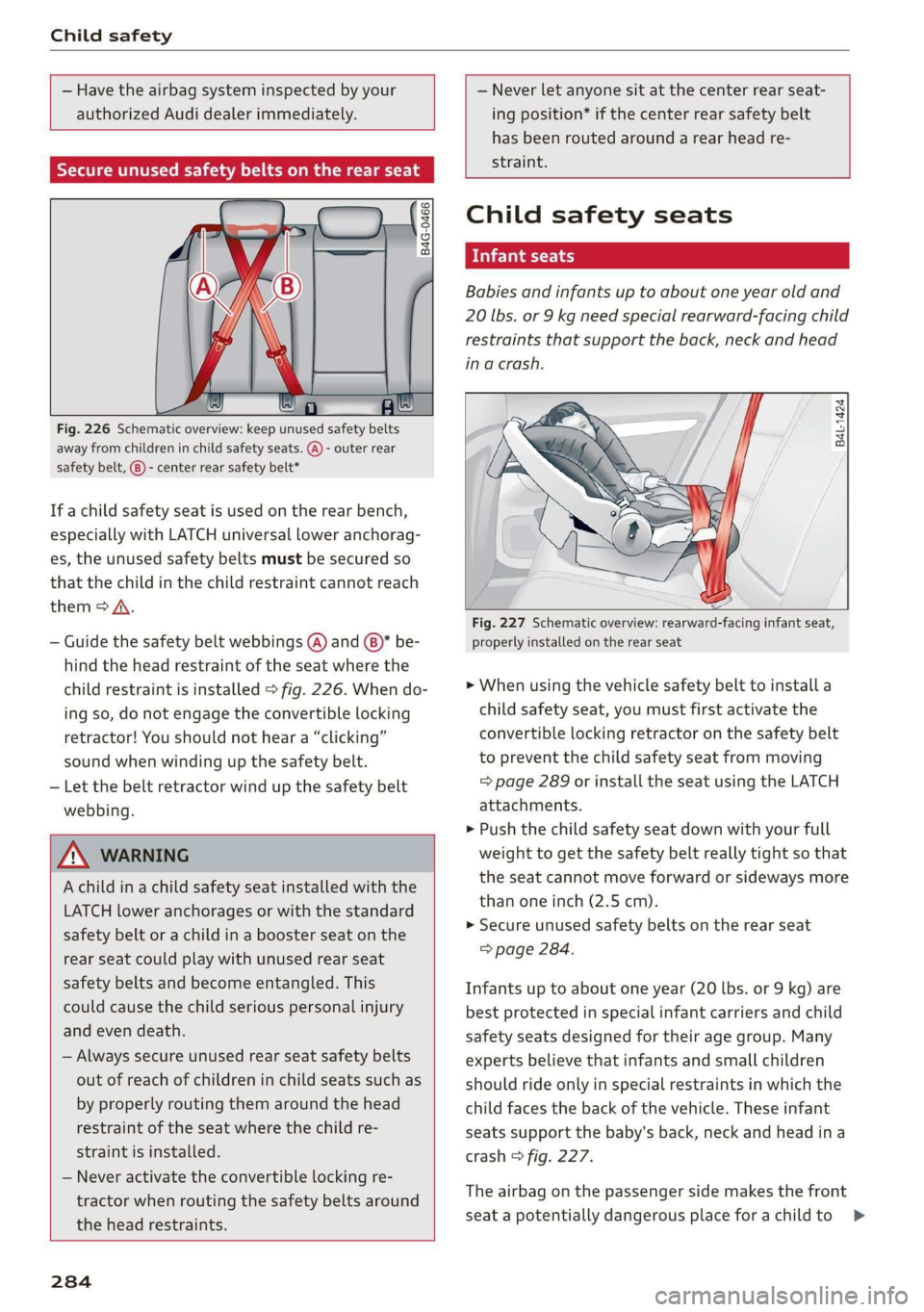
Fig. 226 Schematic overview: keep unused safety belts
away from children in child safety seats. @) - outer rear
safety belt, (@) - center rear safety belt*
If a child safety seat is used on the rear bench,
especially with LATCH universal lower anchorag-
es, the unused safety belts must be secured so
that the child in the child restraint cannot reach
them>A.
— Guide the safety belt webbings @ and ()* be-
hind the head restraint of the seat where the
child restraint is installed > fig. 226. When do-
ing so, do not engage the convertible locking
retractor! You should not hear a “clicking”
sound when winding up the safety belt.
— Let the belt retractor wind up the safety belt
webbing.
ZA WARNING
A child in a child safety seat installed with the
LATCH lower anchorages or with the standard
safety belt or a child in a booster seat on the
rear seat could play with unused rear seat
safety belts and become entangled. This
could cause the child serious personal injury
and even death.
— Always secure unused rear seat safety belts
out of reach of children in child seats such as
by properly routing them around the head
restraint of the seat where the child re-
straint is installed.
— Never activate the convertible locking re-
tractor when routing the safety belts around
the head restraints.
284
— Never let anyone sit at the center rear seat-
ing position* if the center rear safety belt
has been routed around a rear head re-
straint.
Child safety seats
Maer h cy
Babies and infants up to about one year old and
20 lbs. or 9 kg need special rearward-facing child
restraints that support the back, neck and head
inacrash.
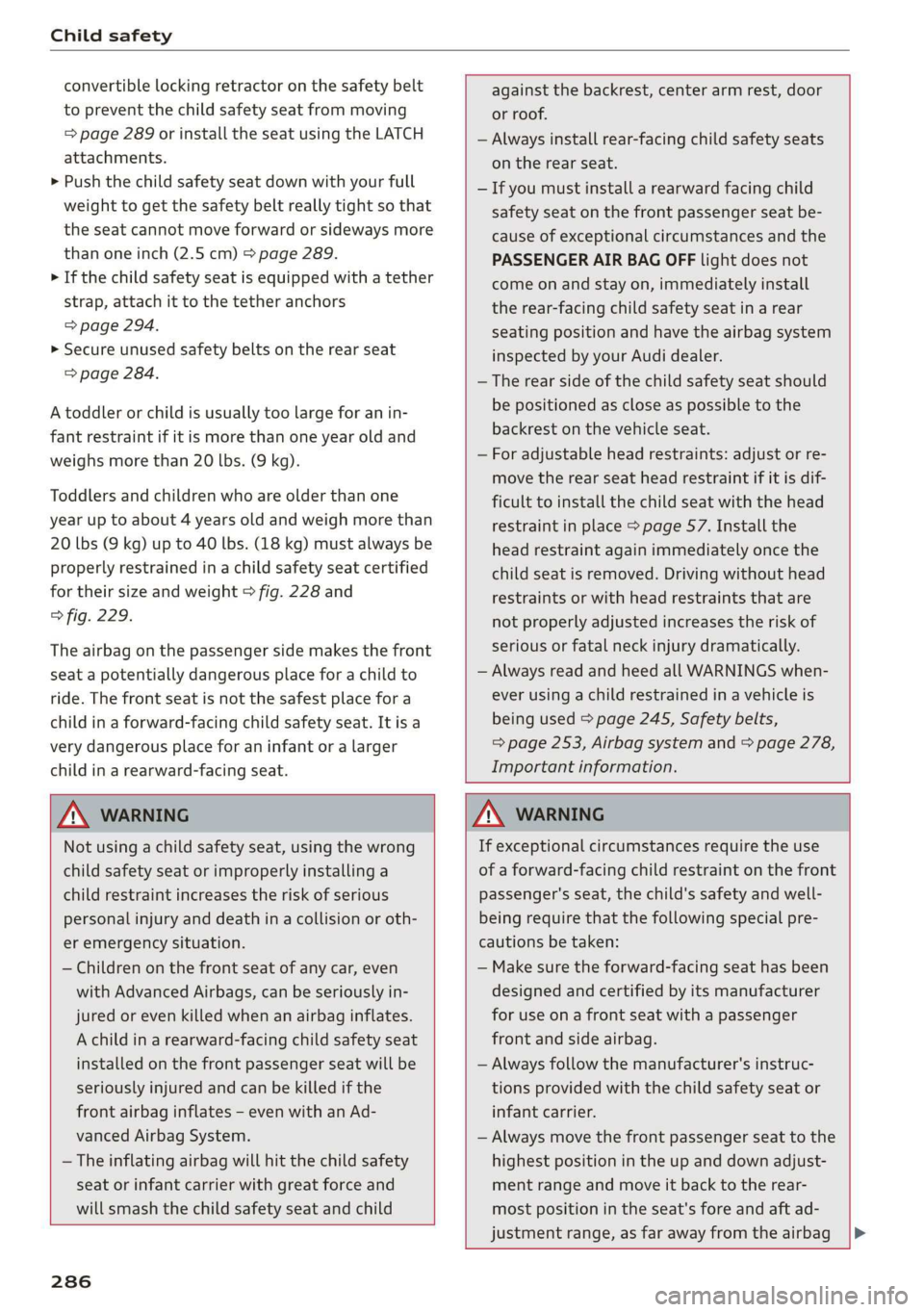
B4l-1424
Fig. 227 Schematic overview: rearward-facing infant seat,
properly installed on the rear seat
> When using the vehicle safety belt to install a
child safety seat, you must first activate the
convertible locking retractor on the safety belt
to prevent the child safety seat from moving
=> page 289 or install the seat using the LATCH
attachments.
> Push the child safety seat down with your full
weight to get the safety belt really tight so that
the
seat cannot move forward or sideways more
than one inch (2.5 cm).
> Secure unused safety belts on the rear seat
=> page 284.
Infants up to about one year (20 lbs. or 9 kg) are
best protected in special infant carriers and child
safety seats designed for their age group. Many
experts believe that infants and small children
should ride only in special restraints in which the
child faces the back of the vehicle. These infant
seats support the baby's back, neck and head ina
crash © fig. 227.
The airbag on the passenger side makes the front
seat a potentially dangerous place for a child to >
Page 288 of 400
Child safety
convertible locking retractor on the safety belt
to prevent the child safety seat from moving
=> page 289 or install the seat using the LATCH
attachments.
> Push the child safety seat down with your full
weight to get the safety belt really tight so that
the seat cannot move forward or sideways more
than one inch (2.5 cm) > page 289.
> If the child safety seat is equipped with a tether
strap, attach it to the tether anchors
=> page 294.
> Secure unused safety belts on the rear seat
=> page 284.
A toddler or child is usually too large for an in-
fant restraint if it is more than one year old and
weighs more than 20 lbs. (9 kg).
Toddlers and children who are older than one
year up to about 4 years old and weigh more than
20 lbs (9 kg) up to 40 lbs. (18 kg) must always be
properly restrained in a child safety seat certified
for their size and weight > fig. 228 and
> fig. 229.
The airbag on the passenger side makes the front
seat a potentially dangerous place for a child to
ride. The front seat is not the safest place for a
child in a forward-facing child safety seat. Itisa
very dangerous place for an infant or a larger
child in a rearward-facing seat.
against the backrest, center arm rest, door
or roof.
— Always install rear-facing child safety seats
on the rear seat.
— If you must install a rearward facing child
safety seat on the front passenger seat be-
cause of exceptional circumstances and the
PASSENGER AIR BAG OFF light does not
come on and stay on, immediately install
the rear-facing child safety seat in a rear
seating position and have the airbag system
inspected by your Audi dealer.
—The rear side of the child safety seat should
be positioned as close as possible to the
backrest on the vehicle seat.
— For adjustable head restraints: adjust or re-
move the rear seat head restraint if it is dif-
ficult to install the child seat with the head
restraint in place > page 57. Install the
head restraint again immediately once the
child seat is removed. Driving without head
restraints or with head restraints that are
not properly adjusted increases the risk of
serious or fatal neck injury dramatically.
— Always read and heed all WARNINGS when-
ever using a child restrained in a vehicle is
being used > page 245, Safety belts,
= page 253, Airbag system and > page 278,
Important information.
ZA WARNING
Not using a child safety seat, using the wrong
child safety seat or improperly installing a
child restraint increases the risk of serious
personal injury and death in a collision or oth-
er emergency situation.
— Children on the front seat of any car, even
with Advanced Airbags, can be seriously in-
jured or even killed when an airbag inflates.
A child in a rearward-facing child safety seat
installed on the front passenger seat will be
seriously injured and can be killed if the
front airbag inflates —- even with an Ad-
vanced Airbag System.
— The inflating airbag will hit the child safety
seat or infant carrier with great force and
will smash the child safety seat and child
286
ZA, WARNING
If exceptional circumstances require the use
of a forward-facing child restraint on the front
passenger's seat, the child's safety and well-
being require that the following special pre-
cautions be taken:
— Make sure the forward-facing seat has been
designed and certified by its manufacturer
for use on a front seat with a passenger
front and side airbag.
— Always follow the manufacturer's instruc-
tions provided with the child safety seat or
infant carrier.
— Always move the front passenger seat to the
highest position in the up and down adjust-
ment range and move it back to the rear-
most position in the seat's fore and aft ad-
justment range, as far away from the airbag
Page 289 of 400

8V2012721BK
Child safety
as possible, before installing the forward-
facing child restraint.
— Always make sure that the safety belt upper
anchorage is behind the child restraint and
not next to or in front of the child restraint
so that the safety belt will be properly posi-
tioned.
— Always make sure that nothing prevents the
front passenger's seat from being moved to
the rearmost position in its fore and aft ad-
justment range.
— Always make sure the backrest is in an up-
right position.
— Never place or use any electrical device
(such as a laptop, CD player, electronic
games device, power inverter or seat heater
for child seats) on the front passenger seat
if the device is connected to the 12-volt
socket or the cigarette lighter socket.
— If a seat heater has been retrofitted or oth-
erwise added to the front passenger seat,
never install any child restraint system on
this seat.
— Make sure that there are no wet objects
(such as a wet towel) and no water or other
liquids on the front passenger seat cushion.
— Never place objects on the seat (such as a
laptop, CD player, electronic games device,
power inverter or seat heater for child
seats). These may influence the electrical
capacitance measured by the capacitive pas-
senger detection system and can also fly
around in an accident and cause serious per-
sonal injury.
— Make sure that the PASSENGER AIR BAG
OFF light comes on and stays on all the time
whenever the ignition is switched on.
— If the PASSENGER AIR BAG OFF light does
not come on and stay on, immediately in-
stall the forward-facing child seat at a seat-
ing position on the rear seat and have the
airbag system inspected by your authorized
Audi dealer.
— Take the child restraint off the front passen-
ger seat and install it properly at one of the
rear seat positions if the PASSENGER AIR
BAG OFF light does not stay on whenever
the ignition is switched on.
Booster seats and safety belts
Properly used booster seats can help protect
children weighing between about 40 lbs. and 80
lbs. (18 kg and 36 kg) who are less than 4 ft. 9
in. (57 inches/1.45 meters) tall.
B4H-0275
Fig. 230 Rear seat: child properly restrained in a booster
seat
The vehicle's safety belts alone will not fit most
children until they are at least 4 ft. 9 in. (57 in-
ches/1.45 meters) tall and weigh about 80 lbs.
(36 kg). Booster seats raise these children up so
that the safety belt will pass properly over the
stronger parts of their bodies and the safety belt
can help protect them in a crash.
> Do not use the convertible locking retractor
when using the vehicle's safety belt to restrain
a child on a booster seat.
> The shoulder belt must lie as close to the cen-
ter of the child's collar bone as possible and
must lie flat and snug on the upper body. It
must never lie across the throat or neck. The
lap belt must lie across the pelvis and never
across the stomach or abdomen. Make sure the
belt lies flat and snug. Pull on the belt to tight-
en if necessary.
> Applies to: vehicles with safety belt height ad-
justment: If you must transport an older child
in a booster seat on the front passenger seat,
you can use the safety belt height adjustment
to help adjust the shoulder portion properly.
> Secure unused safety belts on the rear seat
=> page 284.
Children up to at least 8 years old (over 40 Lbs or
18 kg) are best protected in child safety seats de-
signed for their age and weight. Experts say that
the skeletal structure, particularly the pelvis, of >
287
Page 293 of 400
8V2012721BK
Child safety
your vehicle. To activate the convertible locking
retractor:
> Place the child restraint on a seat, preferably on
the rear seat.
> Slowly pull the belt all the way out.
> Route it around or through the child restraint
belt path > A\.
» Push the child safety seat down with your full
weight to get the safety belt really tight.
> Insert the belt tongue into the buckle for that
seating position.
> Guide the safety belt back into the retractor un-
til the belt lies flat and snug on the child safety
seat.
> You should hear a “clicking” noise as the belt
winds back into the inertia reel. Test the con-
vertible locking retractor by pulling on the belt.
You should no longer be able to pull the belt
out of the retractor. The convertible locking re-
tractor is now activated.
> Make sure that the red release button is facing
away from the child restraint so that it can be
unbuckled quickly.
> Pull on the belt to make sure the safety belt is
properly tight and fastened so that the seat
cannot move forward or sideways more than
one inch (2.5 cm).
ZA WARNING
Using the wrong child restraint or an improp-
erly installed child restraint can cause serious
personal injury or death in a crash.
— Always make sure that the safety belt retrac-
tor is locked when installing a child safety
seat. An unlocked safety belt retractor can-
not hold the child safety seat in place during
normal driving or in a crash.
— Always buckle the child safety seat firmly in
place even if a child is not sitting in it. A
loose child safety seat can fly around during
a sudden stop or ina crash.
— Always make sure the seat backrest to which
the child restraint is installed is in an up-
right position and securely latched into
place and cannot fold forward. Otherwise,
the seatback with the child safety seat at-
tached to it could fly forward in the event of
an accident or other emergency situation.
— Always read and heed all WARNINGS when-
ever using a child restrained in a vehicle is
being used > page 278. Special precautions
apply when installing a child safety seat on
the front passenger seat > page 254, Child
restraints on the front seat - some impor-
tant things to know.
Deactivating the convertible locking
retractor
The convertible locking retractor for child re-
straints will be deactivated automatically when
the belt is wound all the way back into the re-
tractor.
>» Press the red button on the safety belt buckle.
The belt tongue will pop out of the buckle.
> Guide the safety belt all the way back into its
stowed position.
Always let the safety belt retract completely into
its stowed position. The safety belt can now be
used as an ordinary safety belt without the con-
vertible locking retractor for child restraints.
If the convertible locking retractor should be ac-
tivated inadvertently, the safety belt must be un-
fastened and guided completely back into its
stowed position to deactivate this feature. If the
convertible locking retractor is not deactivated,
the safety belt will gradually become tighter and
uncomfortable to wear.
ZA WARNING
Improperly installed child safety seats in-
crease the risk of serious personal injury and
death ina collision.
— Never unfasten the safety belt to deactivate
the convertible locking retractor for child re-
straints while the vehicle is moving. You
would not be restrained and could be seri-
ously injured in an accident.
— Always read and heed all WARNINGS when-
ever using a child restrained in a vehicle is
being used > page 278. Special precautions
apply when installing a child safety seaton |>
291
Page 323 of 400

8V2012721BK
Wheels
@) US DOT number (TIN) and
manufacture date
The manufacture date is listed on
the tire sidewall (it may only ap-
pear on the inner side of the tire):
DOT... 2219...
means, for example, that the tire
was produced in the 22nd week of
the year 2019.
Audi Original Tires
Audi Original equipment tires
with the designation “AO” have
been specially matched to your
Audi. When used correctly, these
tires meet the highest standards
for safety and handling. An au-
thorized Audi dealer or author-
ized Audi Service Facility will be
able to provide you with more in-
formation.
(Q) Mud and snow capability
“M/S” or “M+S” indicates the tire
is suitable for driving on mud and
snow. /\ indicates a winter tire.
Composition of the tire cord
and materials
The number of plies indicates the
number of rubberized fabric lay-
ers in the tire. In general: the
more layers, the more weight a
tire can carry. Tire manufacturers
must also specify the materials
used in the tire. These include
steel, nylon, polyester and other
materials.
@ Maximum permitted load
This number indicates the maxi-
mum load in kilograms and
pounds that the tire can carry.
@ Uniform tire quality grade
standards for treadwear,
traction and temperature
resistance
Treadwear, traction and tempera-
ture ranges > page 336.
@ Running direction
The arrows indicate the running
direction of unidirectional tires.
You must always follow the speci-
fied running direction
=> page 356.
Maximum permitted
inflation pressure
This number indicates the maxi-
mum pressure to which a tire can
be inflated under normal operat-
ing conditions.
321
Page 324 of 400
Wheels
Glossary of tire and loading
terminology
Accessory weight
means the combined weight (in
excess of those standard items
which may be replaced) of auto-
matic transmission, power steer-
ing, power brakes, power win-
dows, power seats, radio, and
heater, to the extent that these
items are available as factory-in-
stalled equipment (whether in-
stalled or not).
Aspect ratio
means the ratio of the height to
the width of the tire in percent.
Numbers of 55 or lower indicate a
low sidewall for improved steer-
ing response and better overall
handling on dry pavement.
Bead
means the part of the tire that is
made of steel wires, wrapped or
reinforced by ply cords and that is
shaped to fit the rim.
Bead separation
means a breakdown of the bond
between components in the bead.
322
Cord
means the strands forming the
plies in the tire.
Cold tire inflation pressure
means the tire pressure recom-
mended by the vehicle manufac-
turer for a tire of a designated
size that has not been driven for
more than a couple of miles (kilo-
meters) at low speeds in the three
hour period before the tire pres-
sure is measured or adjusted.
Curb weight
means the weight of a motor ve-
hicle with standard equipment in-
cluding the maximum capacity of
fuel, oil, and coolant, air condi-
tioning and additional weight of
optional equipment.
Extra load tire
means a tire designed to operate
at higher loads and at higher in-
flation pressures than the corre-
sponding standard tire. Extra load
tires may be identified as “XL”,
“xl”, “EXTRA LOAD”, or “RF” on
the sidewall.