light AUDI A3 CABRIOLET 2015 Owners Manual
[x] Cancel search | Manufacturer: AUDI, Model Year: 2015, Model line: A3 CABRIOLET, Model: AUDI A3 CABRIOLET 2015Pages: 302, PDF Size: 73.83 MB
Page 192 of 302
190 Smart Technology
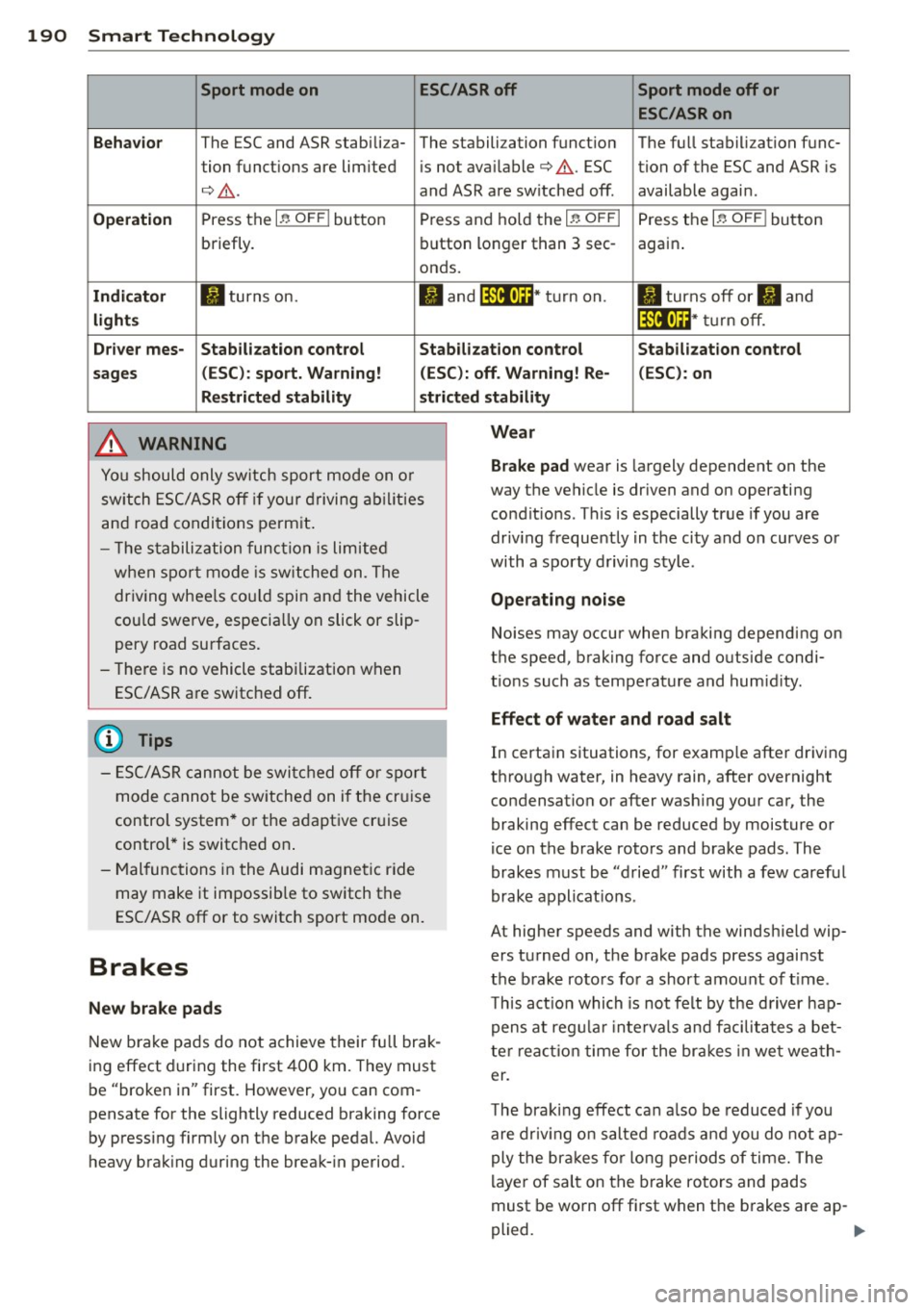
Sport mode on ESC/ASR off Sport mode off or
ESC/ASR on
Beha vior
The ESC and ASR stabiliza- The stabilization funct ion The full stab ilization f unc-
tion funct ions are lim ited is not ava ilable
c> .&. . ESC tion of the ESC and ASR is
¢ _&. . and ASR are sw itched off. available agai n.
Operation Press the l.i; OFF ! button P ress and hold the 1.i; OFFI Press the l.i; OFF ! button
briefly. button lo
nger than 3 sec-
again.
onds.
Indicator II turns on. II and jf'ill•lH * tu rn on. II turns off or fl and
light s jf 'ill•li~* t ur n off.
Dr iver mes- Stabilization control Stab ilizat ion control Stabilization control
sages (ESC ): sport. Warning! (ESC ): off . Warning! Re- (ESC ): on
R estricted stability stricted stability
_& WARNING
You should only switch spor t mode on o r
switch ESC/ASR o ff if your driving abiliti es
an d road condi tions perm it.
- T he s tabilization func tio n i s limite d
whe n spor t mode is sw itche d on. T he
dr iv ing whee ls co ul d spin an d the vehicle
cou ld swe rve , especia lly on slick or slip
pery road surfaces.
- The re is no vehicle stabilization w hen
ESC/ASR a re switched off .
@ Tips
- ESC/ASR c ann ot b e swi tc h ed off o r spor t
mode canno t be sw itche d on i f the cr uise
control system * or the a dapt ive cr uise
control * is switc hed on .
- Mal func tions in the Audi magne tic ride
may make it impossib le to sw itch t he
ESC/ASR off or to switch sport mo de on.
Brakes
New brake pads
-
N ew brake pads do not achieve their fu ll brak
ing effect d urin g the first
400 km. They must
be "broken i n" first. However, yo u can com
pensate for the slightly reduced braking force
by pressing fi rmly on t he brake pedal. Avo id
heavy brak ing dur ing the break- in period.
Wear
Brake pad
wear is largely dependent on the
way the vehicle is dr iven and on operati ng
condit io ns. This is especially true if you are
driv ing frequent ly in t he ci ty and o n curves or
with a spor ty d rivi ng s tyle.
Operating noise
Noises may occur when bra king depending on
the speed , braking force and outside condi
t ions such as tempe rature and hum id ity.
Effect of water and road salt
In certa in situations, for examp le after dr iv ing
t hr ough water, in heavy rain, after overnight
condensation or after was hing your car, the
braking effect can be reduced by moisture or
ice on the brake rotors and brake pads. The
brakes must be "d rie d" first with a few carefu l
brake applicat ions .
At highe r speeds and with the winds hield wip
ers tu rned on, the brake pads press against
the b rake ro to rs fo r a short a mount of t ime .
T h is act ion which is not felt by the d river hap
pen s at reg ular i nte rvals an d facilit ates a bet
te r rea ction t ime for the br akes in we t we ath
er.
T he bra king effect can a lso be redu ced if you
are dr iv ing o n sal ted roads a nd you do not a p
ply the br akes fo r long periods of time. The
l aye r of sa lt on the b rake roto rs and pads
must be wo rn off first when t he b rakes are ap -
plied. ..,..
Page 193 of 302
M N ,....
> co ,...., \!) 1.1'1 ,...., 1.1'1 ,....,
Corrosion
Leaving the vehicle parked for long periods of
time, low mi leage and avoiding heavy braking
can contribute to corrosion on the brake ro
tors and dirty brake pads.
If you usually avoid heavy braking or if there is
corrosion present, occasiona l heavy braking at
high speeds is recommended to clean the
brake rotors and pads~,& .
Brake system malfunction
if you notice that the brake pedal t ravel has
suddenly gotten larger, then a brake circuit
may have failed . Drive to you r authorized Audi
dealer or qualified repair facility immediately
to have the problem corrected. On the way
there, drive with reduced speed and keep in
mind that a long braking distance and in
creased pressure on the brake pedal will be
necessary .
Low brake fluid level
When the brake fluid level is low, ma lfunc
tions in the brake system may occur . The
brake fluid level is electronically monitored.
Brake booster
The brake booster amplifies the pressure you
apply to the brake pedal. It only works when
the eng ine is running.
A WARNING
-You should on ly perform braking maneu
vers to clean the brakes when the road condit ions perm it . Never put others on
the road at risk -never forget the risk of
acc idents!
- On steep slopes, reduce the speed and
select a lower gear or lower selector lev
er posi tion. Drive as little as possible
wh ile pressing the bra ke peda l and avoid
putt ing your left foot on the brake pedal
whi le driving. This could ca use the brakes
to overheat and impair the efficiency of
the brakes.
- Do not let the brakes "grind" by always
keeping yo ur foot on the brake peda l.
Smart Technolog y 191
This can cause the brakes to overheat in-,
crease wear and increase braking dis
tance unnecessar ily.
- Certain weather and operating condi
tions such as driving through water, driv
ing in heavy rain or driving after washing
your veh icle can impa ir the effectiveness
of the brakes. In the winter, ice may
bui ld up on the brake pads, rotors and
drums . Check these components by brak
ing caref ully. App lying the brakes care
fu lly several times dries the brakes and
removes ice build-up .
- The effic iency of the brakes can also be
impaired by driving for long stretches on
roads covered with salt without using the
brakes. You can remove salt deposits
from the brake rotors and pads by care
fully applying the brakes several times.
- If the front spoiler is damaged or you in
stall another spoiler, make sure the front
wheel brakes are ventilated properly.
Otherwise, the brake system could over heat, wh ich reduces their effectiveness .
- Failure of a brake circuit impa irs braking
performance, wh ich increases braking
d istance . Avoid driving the vehicle and
have it towed it to the nearest author
i z ed Audi dealer or authorized Audi Serv
ice Facility.
- Do not let your veh icle roll w ith the en
gine switched off under any circumstan
ces .
- If the brak e booster is not working, you
wi ll have to press much harder on the
brake peda l to compensate for the lack
of the booster.
(D Note
-Never let the brakes "rub" by pressing
the pedal lightly when braking is not
really necessary. This causes the brakes
to overheat and increases braking dis
tance and causes wear.
- Before driving on a long stretch with
steep s lopes, reduce your speed and shift
to the next lower gear This makes use of
the engine brak ing effect and relieves ..,.
•
•
•
Page 194 of 302
192 Smart Technology
the brakes. If you need to brake addition
ally, brake in intervals and not continu
ously.
(D Tips
- If the brake booster is not working, you
must press the brake pedal with much
more force then norma l.
- If you retrofit your vehicle with a front
spoiler, wheel covers or similar items,
make sure that the air flow to the front
wheels is not interrupted. Otherwise the
brake system can become too hot.
Electromechanical
steering
The electromechanical steering supports the
driver's steering movements .
Power steering adapts electronically based on
the vehicle speed.
The vehicle still has full steering functionality if the power steering fai ls or when the engine
is stopped (towing). To steer, you must apply
much more force than usual.
Indicator lights and messages
• Do not drive vehicle: steering defective
If this indicator light turns on and stays on
and this message appears, the power steering may have failed.
Do
not continue driving. See an authorized
Audi dea ler or authorized Audi Service Facility
for assistance.
• Do not drive vehicle: steering defective
There is a malfunct ion in the electron ic steer
ing lock. You cannot turn the ign ition on.
Do
not tow your vehicle because it cannot be
steered. See an authorized Aud i dealer or au
thor ized Audi Serv ice Facility for ass istance.
'I j Steering malfunction: you can continue
driving
If the indicator light turns on, the steering
wheel may be more difficult to move or more sensitive than usual.
The stee ring wheel may
also be at an angle when driving straight.
Drive slowly to your authorized Audi dealer or
qualified wo rkshop to have the malf u nct ion
corrected.
II Steering lock : system fault! Please con
tact Service
There is a malfunction in the electronic steer
ing lock .
Drive to an authorized Audi dealer or author
ized Audi Service Facility immediately to have
the malfunction corrected.
A WARNING ,___
Have the system malfunction corrected as
soon as possible by an authorized Aud i
dealer or authorized Audi Service Facility,
as this increases the risk o f an accident.
@ Tips
If the . or ,~ n ind icator light only stays
on for a short tim e, you may continue dr iv
in g.
All wheel drive
(quattro)
Applies to vehicles: with all wheel drive
In all wheel drive, all four wheels are pow
ered.
General information
In all whee l drive, the driving power is divided
between a ll four wheels . This happens auto
matically depending on your driving behavior
as well as the current road conditions. Refer
to
¢ page 188, Electronic stabilization con
trol (£SC) .
The all wheel drive concept is designed for
high engine power. Your vehicle is exception
ally powerful and has excellent driving charac
teristics both under normal driving cond itions
and on snow and ice . Always read and follow
safety p recaut ions
Q ,& . .,.
Page 196 of 302
194 Smart T echnol ogy
not used then is being generated in o rder to
maintain an optimal battery charge level.
(D Tips
- Energy management cannot overcome
the laws o f physics. Note that the charge
l evel and length of the battery life are
li mited .
- When the starting ability is endangered,
the (•) indicator light turns on
c> page20.
What you should know
Maintaining the starting ability is the highest
priority .
A lot of stress is p laced on the battery when
driving short distances, in traffic, and at co ld
times of the year. A lot of energy is used but
little is generated.
It is also critical when the
engine is not running but electrical equip ment is switched on . In this case, energy is
used but none is generated .
In situations like this, energy management
will actively regulated the distribut ion of en
ergy.
L ong periods wi thout u se
If you do not drive your vehicle for several
days or weeks, e lectrica l equipment is gradu
ally sca led back or switched off. This reduces
energy use and ensures the vehicle will be
able to start after long periods of time. Some
conven ience functions such as opening with
the remote control key may not be ava ilable.
These convenience functions w ill be availab le
again o nce you swi tch the ign ition on and
start the engine.
With the engine switched off
For example, if you listen to the radio when
the eng ine is sw itched off, the battery w ill
d rain .
A warning text w ill appear if energy consump
tion could impair starting ab ility .
The message shows that you need to start the
engine in order to charge the battery.
With the en gine running
Although e lectrical energy is gene rated while
driving, the battery can dra in. This can happen
when litt le energy is generated, and much is
u sed and the charge leve l of the battery is not
optimal.
T o restore the balance of ene rgy, components
that require large amounts of energy are tem
porari ly scaled back or switched off. Heating
systems in particular require a great deal of
energy. If you notice, for example, that the
seat heating* or rear window defroster is not
worki ng, then it has been temporar ily reduced
or switched off . These systems are available
again as soon as the energy balance has been
resto red.
In add ition, you may notice that the idle
speed has slightly increased. That is normal
and no cause for concern. Due to the in
c reased idling speed, the additional required
energy w ill be gene rated and the battery will
be charged.
Notice about data
recorded by the Event
Data Recorder and
vehicle control
modules
E v ent D ata Reco rder
This vehicle is equ ipped with an Event Data
Recorder (EDR). The main purpose of an EDR
is to record, in certain crash or near crash-like
situations, such as an a irbag deployment or
hitting a road obstacle, data that will assist in
understanding how a vehicle's systems per
formed . T he EDR is des igned to record data
related to vehicle dynam ics and safety sys
tems fo r a short period of time, typically
30 seconds or less . The EDR in this vehicle is
designed to record such data as:
- How various systems in your vehicle were
operating;
- Whether or not the driver and passenge r
safety belts were b uckled/fastened;
Page 200 of 302
198 Driving and the environment
can reach the cata lytic converter. This
could result in overheating of the con
verter, requ iring its replacement.
- To assure efficient operation of the Emis
sion Control System:
- Have your veh icle ma intained properly
and in accordance with the service rec
ommendations in your Warranty
&
Ma intenance booklet.
- Lack of proper maintenance as well as
improper use of the vehicle will impa ir
the function of the emission control
system and could lead to damage.
@ For the sake of the environment
Even when the Emission Contro l System is
operating properly, the exhaus t gas can
have a sulfur-like exhaust gas smell under
some operating states. This depends on
the sulfur content of the fue l being used .
Using a different brand of fuel may help,
or filling the tank w ith lead-free super
grade gasoline.
Placing your vehicle
out of service
If you wou ld like to take your vehicle out of
service for a longer t ime, contact your author
ized Audi dealer or qualified repair facility.
They will advise you of important measures,
such as corrosion protection, maintenance
and storage procedures. Also follow the infor
mat ion about the battery
¢ page 223.
Operate your vehicle
economically and
minimize pollution
General
Your personal style of driving will determine
the economy of your vehicle, as well as ex
haust and noise levels .
Fuel economy, environmental impact, and
wear on your engine, brakes and t ires largely
depend on three factors: -your
personal driving style
- operating conditions
- technical limitations
If you ant ic ipate what you need to do next and
drive econom ically, you can easily cut your
fuel consumpt ion by 1O-lS percent . This sec
t ion w ill give you some tips on how you can
help the env ironment and your pocketbook.
(D Tips
The consumption estimates as published
by ENVIRONMENTAL PROTECTION AGENCY
(EPA) and Transport Canada may not corre
spond to your actual consumption on the
road, which will vary depending upon vehi
cle load and speed, road and weather con
ditions, trip length, etc.
Drive smoothly and keep a lookout
ahead
Vehicles use the most fuel when they are ac
celerating.
.,. Avoid unnecessary accelerating and braking.
Vehicles use the most fuel when they are ac
ce lerating. If you anticipate what is going to
happen next, you will need to brake less and,
thus, acce lerate less. Let the vehicle coast
whenever possible -for example when you see
that the next traffic light is red.
Avoid full throttle '
Driving at moderate speeds saves fuel and
improves your mileage.
.,. Try and keep well below your car's maximum
speed.
Acce lerating gently reduces fue l consump
tion, engine wear, and does not disturb the
environment.
Fuel consumpt ion, exhaust emissions and en
gine noise increase disproportionate ly at high
speeds. If you drive at approximately three
quarters of top speed, fuel consumption wi ll
be reduced by one half. Never drive faster
1111>
Page 201 of 302
M N
" > co ...... \!) 1.1'1
...... 1.1'1 ......
than the posted speed limit and weather con
ditions permit. Reducing unnecessary idling
Even wh en your car is just idling it burns up
fuel.
.,. Shu t the engine off when you a re not dr iv ing
the vehi cle.
... Do not warm up the vehicle by letting the
engine run at idle.
It is effic ient to switch off the eng ine when
stopped at railroad crossings and long red
lights. Turning the engine
off for just 30-40
seconds saves more fu el than is burned by
starting the engine again.
It takes a long time fo r the engine to wa rm up
fu lly when it is running at idle. However , wear
and noxious emissions are especially high
when the engine is wa rming up. So you should
drive away as soon as you start the eng ine and
avoid running at h igh RPM while the engine is
still warm ing up.
Do not leave engine idling unattended af
ter starting. If warning lights should come on to indicate improper operation, they
wou ld go unheeded. Extended idling also
p roduces heat, which cou ld result in over
heating or other damage to the vehicle or
other prope rty .
Regular maintenance
A badly tuned engine unnecessarily wastes a lot of fuel.
.,. Have your vehicle serv iced at regular inter-
vals.
H aving your vehicle regularly serviced by an
author ized Audi dealer helps to ensure that it
runs properly and economically . T he condition
of your vehicle not only affects its safety and
ab ility to hold its value, it also affects fuel
c onsum ption.
Dri ving and the en vironm ent 199
Chec k your oil e ach t ime you fill your tank.
T he amou nt of oi l used is re lated to engine
load a nd speed.
It is normal for the oil consumption of a new
engine to reach its lowest value after a certa in
mileage has bee n driven.
You must drive your veh icle about 3,000 m iles
(5,000 kilometers) before you can properly
assess oil consumpt ion.
This also app lies to fue l consumption and en
gine output .
(D Note
- Have your veh icle ma inta ined properly
and in accordance with the service rec
ommendations in your Warranty
& Ma in
tenance booklet . Lack of proper mainte
nance as well as improper use of the ve
hicle will impair the function of the
em iss ion cont ro l system and cou ld lead
t o damage.
- Do not alter or remove any component of
the Emission Control System unless ap
proved by the manufacture r.
- Do not alter or remove any device, such
as hea t shie lds, switches, ign ition w ires,
valves, which are designed to protect
your vehicle's Emission Control System
and other important vehicle compo
nents.
Fewer short trips
Fuel consumption will always be relatively
high on short trips.
... Try to avoid dr iving sho rt distances with a
cold engine .
T he eng ine and catalytic conve rter have to
reach their optimal operati ng t emperature to
reduce fuel consumption and noxious emis
sions effectively.
Just after starting, a co ld eng ine in a mid-s ize
ca r only achieves a fuel economy of 6 -8 mi les
per gallon (30-40 l/100 km). After about a
half a mile, fuel economy climbs to 12 mpg ..,.
•
•
•
Page 203 of 302
M N
" > co ,...., \!) ..,.,
,...., ..,., ,....,
Trailer towing Driving with a trailer
General information
Your Audi was designed primarily for passen
ger transportation .
If you plan to tow a tra iler, p lease remember
that the addit ional load will affect durab ility,
economy and performance .
Trailer towing not on ly places more stress on
the vehicle, it also calls for more concentra
tion from the driver.
F or this reason, a lways fo llow the operating
a n d driving instr uctions provided and use
common sense.
Technical requirements
Traile r hitch
Use a weight-carrying hitch conforming to the
gross trailer we ight. The hitch must be suita
b le for your veh icle and trailer and must be
mounted secure ly on t he veh icle's chassis at a
technically sound location . Use only a t railer
h itch w ith a removab le ball moun t. A lways
check with the tr ailer hitch man ufac tur er to
make sure that you are using the correct
hitch.
Do not use a bumper hitch.
T he hitc h must be installed in such a way that
it does not inte rfe re with the impac t-absorb
i ng b umper syst em. No modifica tions should
be made to the vehicle exhaus t and b rake sys
tems . From t ime to time, check that a ll hitch
mo unt ing bolt s remain securely fas tened.
W hen you are not tow ing a trailer, remove the
trai le r hi tch ball moun t. T h is prevents the
hi tch from causing damage sho uld your ve hi
cle be str uck from be hind
¢ &. .
Trailer brakes
If yo ur tra iler is equ ipped w it h a braking sys
tem, check to be su re that it conforms to a ll
r eg ulat io ns .
Trailer towin g 201
The trailer hyd ra ulic bra ke system must not be
direct ly connected to the vehicle's hydraulic
brake system .
Safety chains
Alw ays use saf ety chains between your ve hicle
and t he tra ile r.
Trailer lights
Tra iler lights must meet all reg ulations . Be
su re to check with your Audi dea ler fo r cor re ct
wir ing, swi tches and relays.
Mirrors
If you a re unable to see the traffic behind you
u sing the regula r outside m irrors, then you
must i nsta ll ext ended mir rors . It is important
t h at you
always have clea r vis ion to the rear .
.8, WARNING
-
Afte r removing the trailer hit ch, do no t
s tore i t in yo ur vehicle . In case of sudden
b raking, the h itch cou ld fly forwar d an d in
ju re you or yo ur passengers .
Operating instructions
Maximum trailer weight
A tra ile r fo r you r vehicle is limited to a ty pical
cl ass 1 or class 2 tra ile r.
Trailer load distribution
B e sure the loa d in the tr aile r is held secure ly
i n place to p reven t it from shift ing forw ard,
ba ckward or sideways.
Never allow a passenger to ride in a trailer
¢ &. in Driving instru ctions on page 20 2.
Engine cooling system
Towing a trailer makes the engine work hard
er . It is impo rtant that the cooling system's
perfo rmance is up to the additional load .
Make sure that the coo ling syst em has enough
f lui d.
Tire pressure
When towing a trailer , inflate the tires of your
vehicle to t he cold tire pressure listed under .,..
•
•
•
Page 204 of 302
202 Trailer towing
"Full load" on the label located on the driver's
side B-pillar (visible when the door is open).
Inflate trailer tires to trai ler and t ire manufac
turers' specif ications.
Lights
Check to make sure both vehicle and trailer
lights are working properly.
Safety chains
Be sure trailer safety chains are properly con
nected from the trailer to the hitch on the ve
hicle. Leave enough slack in the chains to per
mit turning corners. When you install safety
chains, make sure they wi ll not drag on the
road when you are driving.
The chains should cross under the trailer
tongue to prevent it from dropping in case of
separation from the hitch.
Driving instructions
Driving with a trailer always requires extra
care and consideration.
To obtain the best possible handling of vehicle
and trailer, please note the following:
.. Do not tow a loaded tra iler when your car it
self is not loaded.
.,. Be espec ially car efu l when passing other
vehicles.
.. Observe speed limits.
.. Do not drive at the maximum permissible
speed.
.. Always apply brakes early .
.. Monitor the temperature gauge.
Weight distribution
Towing a loa ded trai ler with an empty ca r re
sults in a high ly unstable distribution of
weight . If this cannot be avoided, drive at very
low speeds only to avoid the risk of losing
steering control.
A "balanced" rig is easier to operate and con
trol. This means that the tow vehicle should be loaded to the extent poss ible and permissi
ble, while keeping the trailer as light as possi
ble under the circumstances . Whenever possi- ble,
transfer some cargo to the luggage com
partment of the tow vehicle while observing
tong ue load requirements and vehicle loading
considerations.
Speed
T he higher the speed, the more difficult it be
comes for the driver to control the rig. Do not
drive at the maximum permissible speed . Re
duce your speed even more if load, weather or
wind conditions are unfavorable -particularly
when going downhill.
Reduce vehicle speed
immediately if the trail
er shows the slightest sign of sway ing.
Do not
try to stop the swaying by accelerating.
Observe speed limits . In some areas, speeds
for vehicles towing trai lers are lower than for
regular vehicles .
Always apply brakes early. When driving
downhi ll, shift into a lower gear to use the en
gine braking effect to s low the vehicle. Use of
the brakes alone can cause them to overheat
and fail.
Coolant temperature
The coolant temperature gauge~ page 12
must be observed carefu lly. The coolant tem
perature can increase if you drive on long in
clines in a low gear at high engine speeds. Re
duce your speed immediately if the LEDs in
the top part of the d isplay turn on .
For more information about indicator lights,
refer to. ~
page 19 .
A WARNING
Anyone not properly restrained in a mov
ing vehicle is at a much greater risk in an
accident. Never let anyone ride in your car
who is not properly wearing the restraints
provided by Audi.
Trailer towing tips
Important to know
Your vehicle handles differently when towing
a trai ler because of the additional weight and ..,.
Page 206 of 302
204 Care and cleaning
Care and cleaning
General information
Regular, prope r care helps to maintain your
vehicle's val ue . It can also be a requirement
when submitting warranty claims for corro sion damage and paint defects on the body.
The necessary care products can be obtained
from your authorized Audi dea ler . Read and
follow the instructions for use on the packag
ing.
A WARNING
- Us ing clean ing and care products incor
rect ly can be dangerous to your hea lth.
- Always store cleaning and care products
out of reach of children to reduce the r isk
of po ison ing.
-
@ For the sake of the environment
- Preferably use environmentally-friendly
products when buying cleaning agents.
- Do not d ispose o f leftover cleaning and
care p rod ucts with household trash.
Car washes
The longer that deposits such as insects, bird
droppings, tree sap or road salt rema in on the
ve hicle, the more the surface can be dam
aged . High temperatures such as those
caused by sunlight inc rease the damag ing ef
fect .
Before washing, rinse
off heavy depos its with
p lenty of water .
Stubborn deposits s uch as bird droppings or
tree sap are best removed with plenty of wa
ter and a m icrofiber cloth.
A lso, was h the underside of your vehicle once
road salt stops be ing used for the season.
Pressure washers
When w ash ing your ve hicl es w ith a pressure
washer, always follow the oper ating instr uc
tions provided with the pressure washer. This is especially important in rega rd to the p res- sure and sp
raying distance. Do not di rect the
stream of water directly onto seals for the
s ide windows, doors, luggage compartment
li d or hood or onto the tires, rubber hoses, in
su lating materia l, the power top, sensors* or
camera lenses*. Keep a d istance of at least 16
i nches (40 cm) .
Do not remove snow and ice with a pressure
washer.
Never use rotary nozzles or high pressure noz
zles .
T he wate r temperature m ust not be above
140
° F (60 °().
Automat ic car washes
Sp ray off the veh icle befo re washing.
Make sure that the w indows and power top
are closed and the winds hield wipers are
off.
Follow instructions from the ca r wash opera
tor, especially if the re a re accessories attach
ed to yo ur vehicle.
If possible, use car washes that do not have
brushes .
Washing by hand
Clean the veh icle starting from the top and
working down using a soft sponge or cleaning
brush. Use solvent-free clean ing products .
Washing vehicle s with matte fini sh paint
by hand
To avoid damaging the paint when washing,
first remove dust and large particles from
your vehicle. Insects, grease spots and fi nger
pri nts are best removed with a special cleane r
fo r matte finish paint .
Apply the prod uct us ing a microfiber cloth. To
avo id damag ing the pa int surface, do not use
too much pressure .
Rinse the vehicle thoroughly with water. Then
clean using a neutral shampoo and a soft mi
c rofiber cloth.
Rinse the vehicle thoroughly again and let it
air dry. Remove any water residue using a
shammy.
Page 207 of 302
M N
" > co ,...., \!) ..,.,
,...., ..,., ,....,
Care and cleanin g 205
& WARNING
- Only wash the vehicle when the ignition
is off and follow the instructions from
the car wash operato r to reduce the risk
of accidents.
- To reduce the risk of cuts, protect your
self from sharp metal components when
wash ing the underbody or the inside of
the whee l housings.
- After washing the vehicle, the braking ef
fect may be delayed due to mo isture on
the brake rotors or ice in the winter . The
brakes must be dried first with a few
careful brake applicat io ns.
{[) Note
- If you wash th e vehicle in an automatic
ca r wash, yo u m ust fold the exterior m ir
ro rs in to reduce the r isk of damage to
the mirrors . Power foldi ng exterior m ir
r o rs* must o nly be folded in and out us
i ng the power folding function.
- To prevent pa int damage, do not wash
th e veh icle in direc t sun ligh t. -
To reduce the r is k of damage, do no t
wash the powe r top with a pressure
washer.
- To reduce the r is k of damage to the sur
face, do not use i nsect removing spong
es, kitchen sponges or similar items.
- Matte finish painted vehicle compo
nents:
- To reduce the risk of damage to the
surfac e, do not use polishi ng agents or
ha rd wax.
- Neve r use prot ective wax. It can de
stroy the matte fin is h effect.
- Do not place any stickers o r magnet ic
signs on vehicle parts painted w it h
ma tte fi nish pa in t. The pa int cou ld be
da maged whe n the stickers o r m ag nets
ar e removed.
@ For the sake of the environment
Only wash t he ve hicl e in facili ties spe cially
d es igned for th at p urpose . Th is will re duce
the r is k of d irty wate r contam ina ted with
oil from entering t he sewer system.
Cleaning and care information
When clea ning and caring for individua l vehi
cle components, refe r to the fo llow ing tab les .
The informa tion contained there is s imp ly rec
ommendations. Fo r quest ions or for compo -n
ents that are not listed , refer to an author
i z ed Audi dea ler. Also follow the info rma tion
fo und in ~ &, .
Exterior cleaning
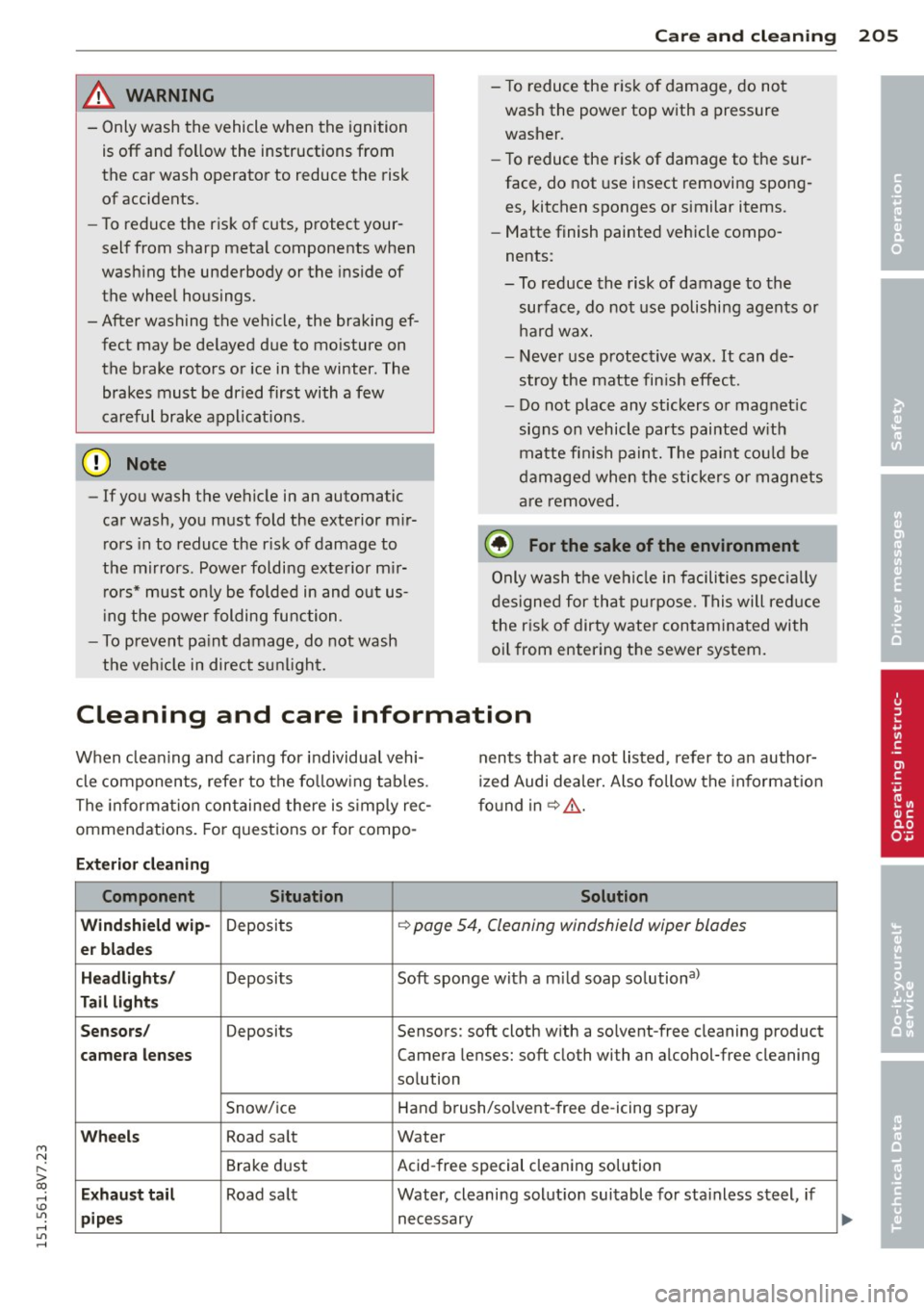
Component Situation Solution
Wind shield wip-
Deposits ¢ page 54, Cleaning windshield wiper blades
er bl ade s
Headlights /
Deposits Soft sponge with a m ild soap solution3>
Tail lights
Sensors /
Deposits Sensors: soft cloth w ith a so lvent-free cleaning product
camera lenses Camera lenses: soft cloth with an alcohol-free cleaning
so lution
Snow/ ice Hand brush/so
lve nt-free de -icing spray
Wheels Road sa lt Water
Brake dust Acid
-free special cleaning so lu tion
E x haust tail Road sa lt Water, cleaning solut ion suitable for stainless steel, if
pipes necessary •
•
•