light AUDI A3 CABRIOLET 2015 Owners Manual
[x] Cancel search | Manufacturer: AUDI, Model Year: 2015, Model line: A3 CABRIOLET, Model: AUDI A3 CABRIOLET 2015Pages: 302, PDF Size: 73.83 MB
Page 176 of 302
174 Child Safety
-The child and the passenger can also
injure each other in an accident.
- Never install rear-facing child safety
seats or infant carriers on the front pas
senger seat. A child will be seriously in
jured and can be killed when the passen ger airbag inflates -even with an Ad
vanced Airbag System.
- The inflating airbag will hit the child
safety seat or infant carrier with great
force and will smash the child safety seat and child against the backrest, center
armrest, door or roof.
- Always install rear-facing child safety
seats or infant carriers on the rear seat.
- Forward-facing child safety seats instal
led on the front passenger's seat can in
terfere with the airbag when it inflates
and cause serious injury to the child. Al
ways install forward-facing child safety
seats on the rear seat.
- If exceptional circumstances require the
use of a forward-facing child restraint on
the front passenger's seat, the child's safety and well-being require that the
following special precautions be taken:
- Make sure the forward-facing seat has
been designed and certified by its man
ufacturer for use on a front seat with a
passenger front and side airbag.
- Always carefully follow the manufac
turer's instructions provided with the
child safety seat or carrier.
- Always move the front passenger seat
into the rearmost position of the pas
senger seat's fore and aft adjustment
range, and as far away from the airbag
as possible before installing the child
restraint.
- Always make sure that nothing pre
vents the front passenger's seat from
being moved to the rearmost position
in its fore and aft adjustment range.
- Always make sure that the backrest is
in the upright position .
- Never place or use any electrical device (such as a laptop, CD player, electronic
games device, power inverter or seat heater for child seats) on the front pas
senger seat if the device is connected
to the 12-volt socket or the cigarette lighter socket.
- If a seat heater has been retrofitted or
otherwise added to the front passen
ger seat, never install any child re
straint system on this seat.
- Make sure that there are no wet objects
(such as a wet towel) and no water or
other liquids on the front passenger seat cushion .
- Never place objects on the seat (such
as a laptop, CD player, electronic
games device, power inverter or seat
heater for child seats) . These may in
fluence the electrical capacitance
measured by the capacitive passenger
detection system and can also fly
around in an accident and cause serious
personal injury.
- Always buckle the child safety seat firmly
in place even if a child is not sitting in it.
A loose child safety seat can fly around during a sudden stop or in a collision .
- Always read and heed all WARNINGS
whenever using a child restrained in ave
hicle is being used
¢ page 138, Safety
belts,
¢ page 146, Airbag system and
¢ page 169, Child Safety .
A WARNING
-To reduce the risk of serious injury, make
sure that the
PASSENGER AIR BAG OFF
light comes on and stays on whenever a
child restraint is installed on the front pas
senger seat and the ignition is switched
on.
- Take the child restraint off the front pas
senger seat and install it properly at one
of the rear seat positions if the
PASS EN·
GER AIR BAG OFF
light does not stay on.
- Have the airbag system inspected by
your authorized Audi dealer immediate
ly.
Page 178 of 302
1 76 Child Safety
& WARNING
Not using a child safety seat, using the
wrong child safety seat or improperly in
stalling a child restraint increases the risk of serious personal injury and death in a
crash .
- Never install rear-facing child safety
seats or infant carriers on the front pas
senger seat - even with an Advanced Air
bag System. A child will be seriously in
jured and can be killed when the inflat
ing airbag hits the child safety seat or in
fant carrier with great force and smashes
the child safety seat and child against
the backrest, door or roof¢
page 148,
Child restraints on the front seat -some
important things to know.
- Always install rear-facing child safety
seats or infant carriers on the rear seat.
- Never install a rear-facing child restraint
in the forward-facing direction . Such re
straints are designed for the special
needs of infants and very small children
and cannot protect them properly if the
seat is forward-facing.
- If you must install a rearward facing
child safety seat on the front passenger
seat because of exceptional circumstan
ces and the
PASSENGER AIR BAG OFF
light does not come on and stay on, im
mediately install the rear-facing child
safety seat in a rear seating position and
have the airbag system inspected by your
Audi dealer.
- Never place or use any electrical device
(such as a laptop, CO player, electronic
games device, power inverter or seat
heater for child seats) on the front pas
senger seat if the device is connected to
the 12-volt socket or the cigarette light
er socket.
- If a seat heater has been retrofitted or
otherwise added to the front passenger
seat, never install any child restraint sys
tem on this seat.
- Make sure that there are no wet objects
(such as a wet towel) and no water or other liquids on the front passenger seat
cushion.
- Never place objects on the seat (such as
a laptop, CO player, electronic games de
vice, power inverter or seat heater for
child seats). These may influence the
electrical capacitance measured by the
capacitive passenger detection system
and can also fly around in an accident
and cause serious personal injury.
- Always read and heed all WARNINGS
whenever using a child restrained in ave
hicle is being used
~page 138, Safety
belts,
~ page 146, Airbag system and
¢ page 169, Important things to know.
Convertible child safety seats
Properly used convertible child safety seats
can help protect toddlers and children over
age one who weigh between 20 and 40 lbs. (9
and 18 kg) in a crash.
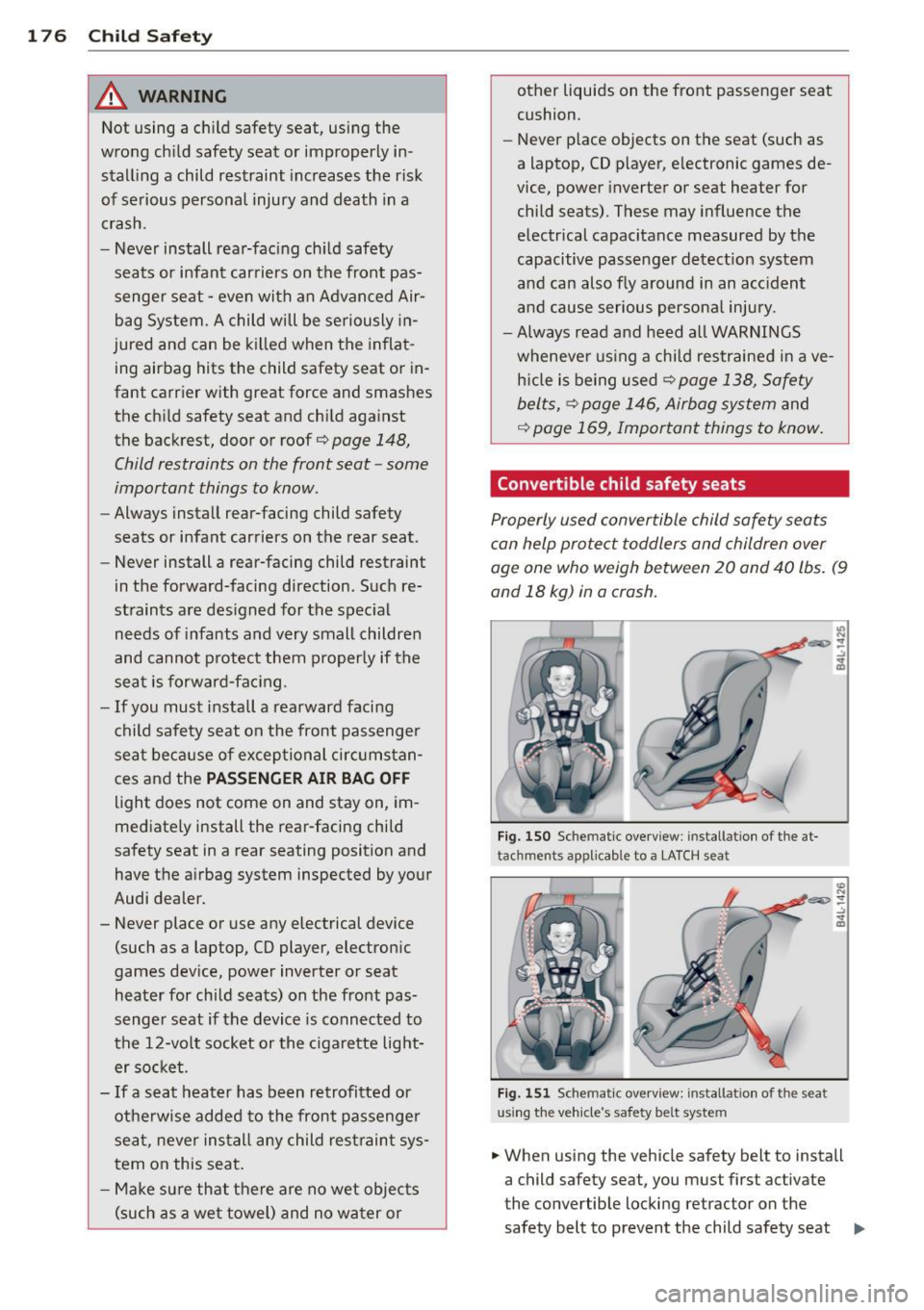
Fig . 150 Sc hema tic overview: installat ion of the at
tachments applicab le to a LATCH seat
Fig. 151 Schemat ic overv iew: inst allation of the seat
u sing the vehicl e's safety belt system
.. When using the vehicle safety belt to install
a child safety seat, you must first activate
the convertib le locking retractor on the
safety belt to prevent the child safety seat ..,_
Page 179 of 302
M N ,....
> co ,...., \!) 1.1'1 ,...., 1.1'1 ,....,
from moving r::!;> page 180 or install the seat
using the LATCH attachments.
~ Push the child safety seat down with your
full weight to get the safety belt really tight
so that the seat cannot move forward or
s ideways more than one inch (2 .5 cm)
¢ page 180.
~ If the child safety seat is equ ipped with a
tethe r strap, attach it to the tether anchors
¢page 185.
~ Secure unused safety bel ts on the rear sea t
¢page 175.
A toddler or child is usually too large for an in
fant restraint if it is more than one year o ld
and weighs more than 20 lbs . (9 kg) .
Toddle rs and ch ildren who are older than one
yea r up to abo ut 4 years o ld and weigh more
than 20 lbs (9 kg) up to 40 lbs. (18 kg) mus t
a lways be prope rly restrained in a ch ild safety
seat certified for their size and weight
¢ fig .150and ¢fig.151 .
The airbag on the passenge r side makes the
front seat a poten tially dangerous place for a
chi ld to ride. The front seat is not the safest
p lace for a child in a forward-facing child safe
ty seat.
It is a very dangero us place for an in
fant or a larger child in a rearward-fac ing seat.
A WARNING
Not using a ch ild safety seat, using the
wrong chi ld safety sea t or improper ly in
stalling a child restraint increases the risk
of serious personal injury and death in a
co llision or othe r eme rgency s ituation.
- Children on the front seat of any car,
even with Advan ced A irbags, can be seri
o usly injured or eve n killed when an a ir
bag inf lates . A child in a rearward -facing
child safety seat installed on the front
passenger seat wi ll be seriously injured
and can be ki lled if the front airbag in
flates -even with an Advanced Airbag
System.
- The inflating a irbag w ill hit the child
safety seat or infant carrier w ith great
force and w ill smash the ch ild safety seat
Child Sa fet y 177
and child against the backrest, center
arm rest, door or roof.
- Always install rear-facing chi ld safety
seats on the rear seat.
- If you must install a rearward facing
child safety seat on the front passenger
seat because of exceptional c ircumstan
ces and the
PASSENGER AIR BAG OFF
light does not come on and stay on, im
mediately install the rear-fac ing ch ild
safety seat in a rear seating position and have the airbag system inspe cted by your
Aud i dea le r.
- The rear side of the child safety seat
should be pos itioned as close as possib le
to the backres t on the vehicle seat.
- For ad justab le head restra ints: adjust or
remove the rea r seat he ad restr aint if i t
is diffi cult to ins tall the child seat w ith
the head restraint in place
¢ page 63. In
stall the head restraint again immed iate
ly once the child seat is removed . Dr iv ing
without head restraints or with head re
straints that are not properly adjusted
increases the risk of serious or fatal neck
i nj ury dramatically .
- Always read and heed all WARNINGS
wheneve r us ing a child restrained in ave
hicle is being used¢
page 138, Safety
b elts,
c::!;> page 146, Airbag system and
c::!;> page 169, Impor tan t things to know.
A WARNING
If ex cep tional cir cumstances require the
use o f a forward-facing child res traint on
the front passenge r's sea t, the child's safe
ty and well-being req uire that the follow
ing spec ial precautions be ta ken:
- Make sure the forward -facing seat has
been designed and certified by its man u
facturer for use on a front seat with a passenger front and side airbag.
- Always follow the manufacturer's in
structions provided with the ch ild safety
seat or infant carr ier.
•
•
•
Page 180 of 302
1 78 Child Safety
- Always move the front passenger seat in
to the rearmost position of the passen
ger seat's fore and aft adjustment range,
and as far away from the airbag as possi
ble before installing the child restraint .
- Always make sure that nothing prevents
the front passenger's seat from being
moved to the rearmost position in its
fore and aft adjustment range.
- Always make sure the backrest is in an
upright position .
- Never place or use any electrical device
(such as a laptop, CD player, electronic
games device, power inverter or seat
heater for child seats) on the front pas
senger seat if the device is connected to
the 12-volt socket or the cigarette light
er socket.
- If a seat heater has been retrofitted or
otherwise added to the front passenger
seat, never install any child restraint sys
tem on this seat.
- Make sure that there are no wet objects
(such as a wet towel) and no water or
other liquids on the front passenger seat
cushion.
- Never place objects on the seat (such as
a laptop, CD player, electronic games de
vice, power inverter or seat heater for
child seats). These may influence the
electrical capacitance measured by the
capacitive passenger detection system
and can also fly around in an accident
and cause serious personal injury .
- Make sure that the
PASSENGER AIR BAG
OFF
light comes on and stays on all the
time whenever the ignition is switched
on.
- If the PASSENGER AIR BAG OFF light
does not come on and stay on, immedi
ately install the forward-facing child seat
at a seating position on the rear seat and
have the airbag system inspected by your
authorized Audi dealer.
- Take the child restraint off the front pas
senger seat and install it properly at one
of the rear seat positions if the
PASSEN- GER AIR BAG OFF
light
does not stay on
whenever the ignition is switched on.
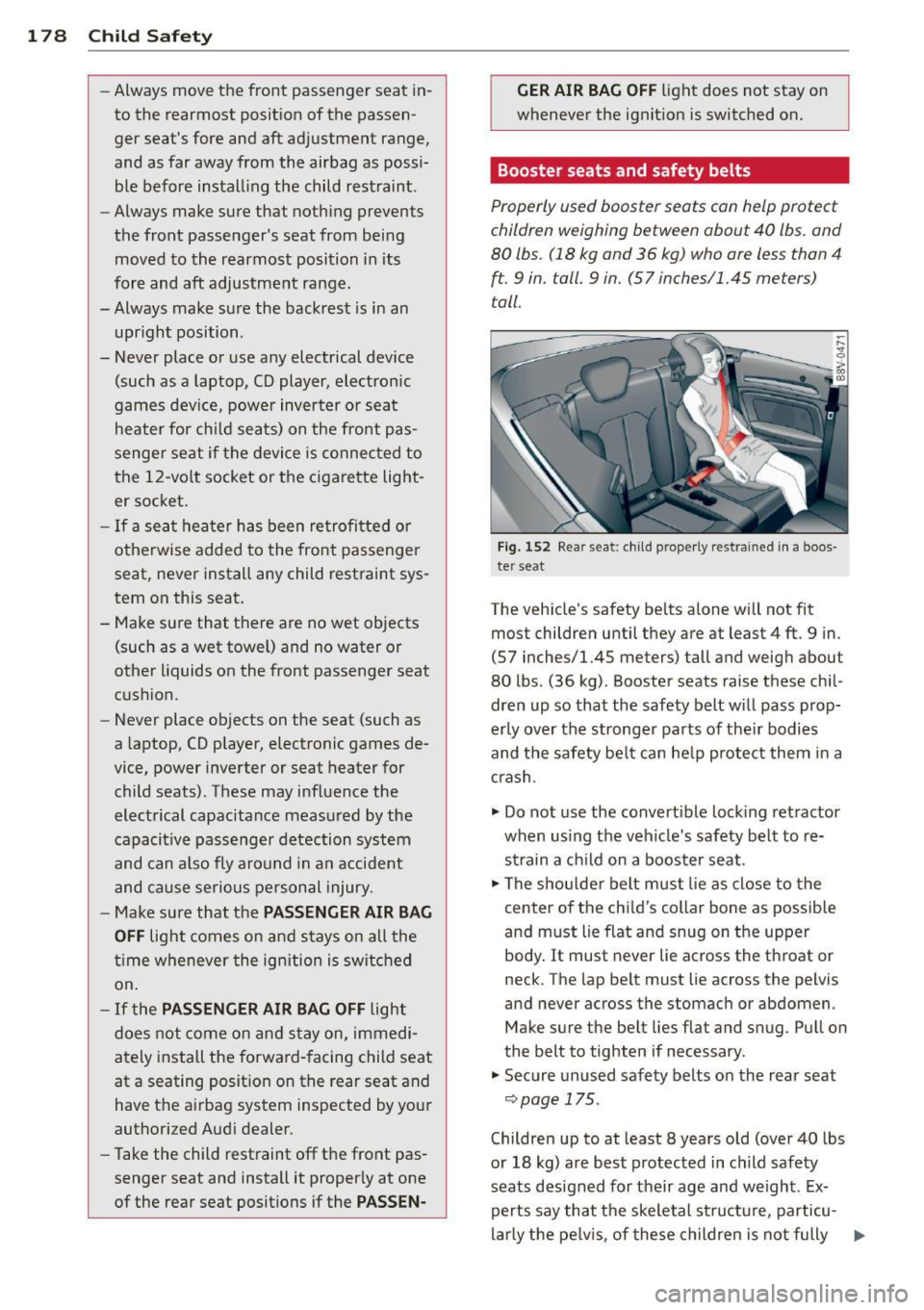
Booster seats and safety belts
Properly used booster seats can help protect
children weighing between about 40 lbs. and
80 lbs. (18 kg and 36 kg) who are less than 4
ft. 9 in. tall. 9 in. (57 inches/1.45 meters)
tall.
Fig. 1S2 Rear seat : child properly restrained in a boos·
te r seat
The vehicle 's safety belts alone will not fit
most children until they are at least 4 ft. 9 in.
(57 inches/1.45 meters) tall and weigh about
80 lbs .
(36 kg). Booster seats raise these chil
dren up so that the safety belt will pass prop
erly over the stronger parts of their bodies
and the safety belt can help protect them in a
crash.
" Do not use the convertible locking retractor
when using the vehicle's safety belt to re
strain a child on a booster seat.
"The shoulder belt must lie as close to the
center of the child's collar bone as possible
and must lie flat and snug on the upper
body. It must never lie across the throat or
neck . The lap belt must lie across the pelvis
and never across the stomach or abdomen.
Make sure the belt lies flat and snug . Pull on
the belt to tighten if necessary .
"Secure unused safety belts on the rear seat
~page 175.
Children up to at least 8 years old (over 40 lbs
or 18 kg) are best protected in child safety
seats designed for their age and weight . Ex
perts say that the skeletal structure, particu
larly the pelvis, of these children is not fully ...
Page 182 of 302
180 Child Safety
-Always remember that a child leaning
forward, sitting sideways or out of posi
tion in any way during an accident can be
struck by a deploying airbag . This will re
sult in serious personal injury or death .
- If you must install a booster seat on the
front passenger seat because of excep
tional circumstances the
PASSENGER
AIR BAG OFF
light must come on and
stay on, whenever the ignition is switch
ed on.
- If the
PASSENGER AIR BAG OFF light
does not come on and stay on, perform
the checks described¢
page 158, Moni
toring the Advanced Airbag System.
- Take the child restraint off the front pas
senger seat and install it properly at one
of the rear seat positions if the
PASSEN
GER AIR BAG OFF
light does not stay on
whenever the ignition is switched on.
- Always read and heed all WARNINGS
whenever using a child restrained in
ave
hicle is being used¢ page 138, Safety
belts,¢ page 146, Airbag system
and
¢page 169, Important things to know .
Installing a child safety
seat
Securing a child safety seat using a
safety belt
Safety belts for the rear seats and the front
passenger can be locked with the convertible
locking retractor to properly secure child
safety seats.
The safety belts emergency locking retractors
for the rear seats safe ty belts and for the
front passenger's seat safety belt have a con
vertible locking retractor for child restraints.
The safety belt must be locked so that belt
webbing cannot unreel. The retractor can be
activated to lock the safety belt and prevent
the safety belt webbing from loosening up
during normal driving. A child safety seat can
only be properly installed when the safety belt
is locked so that the child and child safety
seat will stay in place. Always
remember: Even though your vehicle is
equipped with an Advanced Airbag system, all
children, especially those 12 years and young
er , should always ride in the back seat proper
ly restrained for their age and si ze.
A WARNING
=
Improperly installed child safety seats in -
crease the risk of serious personal injury
and death in a collision .
- Always make sure that the safety belt re
tractor is locked when installing a child
safety seat. An unlocked safety belt re
tractor cannot hold the child safety seat
in place during normal driving or in a
crash.
- Always buckle the child safety seat firmly
in place even if a child is not sitting in it.
A loose child safety seat can fly around
during a sudden stop or in a collision.
- If the backrest is not securely latched,
the child and the child restraint will be
thrown forward together with the back
rest and will strike parts of the vehicle
interior. The child can be seriously in
jured or killed .
- Never install rear-facing child safety
seats or infant carriers on the front pas
senger seat. A child will be seriously in
jured and can be killed when the passen
ger airbag inflates.
- The inflating airbag will hit the child
safety seat or infant carrier with great
force and will smash the child safety seat and child against the backrest, center
armrest, door or roof.
- Always install rear-facing child safety
seats or infant carriers on the rear seat.
- Forward-facing child safety seats or in
fant carriers installed on the front pas senger's seat may interfere with the de
ployment of the airbag and cause serious
injury to the child.
- It is safer to install a forward-facing
child safety seat on the rear seat.
- Always read and heed all WARNINGS
whenever using a child restrained in ave-
hicle is being used
¢ page 169. Special ..,.
Page 183 of 302
Child Safet y 181
precautions apply when installing a chi ld -Always make sure the forward-facing
safety seat on t he front passenger seat seat has been designed and certified by
Q page 148, Child restraints on the front its manufacturer for use on a front seat
seat- some important things to know . with a passenger front and side a irbag .
- Never put the forward-facing child re-
_&. WARNING straint up, against or very near the in-
-strument panel.
Always take special precautions if you •
•
must install a forward or rearwa rd-facing -
Always move the passenger seat into its
child rest raint on the front passenger's rearmost position in t
he seat's fore and
sea t in except iona l situat ions: aft adjustment range, as fa
r away from
- Whenever a fo rward or rearward-facing the airbag as possible before installing
child restraint is installed on the front the forward-fa
cing ch ild restra int. The
passenge r seat, the
PASSENGER AIR b ackrest mu st be ad ju sted to an upright
BAG OFF light must come on and s tay on position
.
whenever the ignition is switched on . -
Ma ke sure that the
PASSENGER AIR BAG
- If the PASSENGER AIR BAG OFF light OFF light comes on and stays on all the
does no t come on and s tay on, per form time wheneve
r the ignit ion is switched
the checks described
Q page 158, Moni -on.
toring the Advanced Airbag System.
_&. WARNING - T ake the child restrain t off the front pas-~
senger seat and install it properly at one Rearward-facing child rest raints:
of the rea r seat positions if the
PASS EN-- A child in a re arward-facing chi ld safety
GER AIR BAG OFF light does not stay on
seat installed on the front passenger
whenever the ignition is switched on. seat will be seriously in jured and can be
- Improper installation of child restraints killed i
f the front airbag inflates -even
can reduce the ir effectiveness or even with an Advanced Airbag System.
prevent them from prov iding any protec-
-The inflating air bag will hit the ch ild
t ion .
safety seat or infant carrier with great
- An improperly installed child restraint force and will smash the child safety seat
can interfe re with the airbag as it de- and child against the backrest , center
ploys and serio usly injure or even kill the armrest, door or roof.
child .
-Always be especially careful if you must
- Always carefully follow the manufactur- install a rearward facing child safety seat
er's instructions provided with the child on the front passenger seat i n exception-
safety seat or carrier . al circumstances .
- After checking to make sure that the - Make sure that the
PASSENGER AIR BAG
child restrain t is properly installed, make OFF light comes on and stays on all the
certain that the child restraint is correct- time whenever the ig nit ion is switch ed
Ly recog nized by the capacitive pa ssenge r on.
de te ct ion sys tem in t he front p assenger
-If the
PASSENGER AIR BAG OFF light
sea t and that the
PASSENGER AIR BAG does not come on and stay on, immed i-
OFF light signals the correct front pas-
ately insta ll the rear-fa cing child s afety
senger fronta l airbag status.
seat in a rear seat ing pos ition and h ave
the airbag system inspected by your Audi
M
_&. WARNING • N dea le r. ,....
> co Forward-facing child restra ints: ,...., \!) 1.1'1 ,...., 1.1'1 ,....,
Page 188 of 302
186 Child Safet y
The purpose of the tether is to reduce the for
ward movement of the child restraint in a
crash, in order to help reduce the r isk of head
injury that could be caused by striking the ve
h icle interior.
F orward facing child restraints manufactured
after September 1, 1999, are required by U.S.
federal regulations to comply with new child
head movement performance requirements.
These new performance requ irements make a
tether necessary on most new ch ild safety
seats .
A WARNING
Imprope r insta llation of chi ld restrai nts
w ill increase the risk of inju ry and death in
a crash.
- Always follow the instructions p rov ided
by the manufacturer of the ch ild re
st raint you in tend to install in your Audi.
- Improper use of c hild restr aint anchors
(including tether anchors) can lead to in
jury in a co llision. The anchors are de
signed to withstand on ly those loads im
posed by correctly fitted ch ild restraints.
- Never mount two ch ild restraint systems
on one LATCH lower anchor po int.
- Never a ttach two child rest ra int sys tems
to one tether strap or tether anchorage.
- Never attac h a tether st rap to a tie -down
hook in the luggage compartment.
- Never use c hild restra int te ther ancho
rages to secure sa fety belts o r othe r
k inds of occupant restraints.
- Never secure or attach any luggage or
other items to the LATCH lowe r ancho
rages or to the tether anchors .
- If you must install a rearward facing
child safety seat on the front passenger
seat because of exceptional circ umstan
ces and the
PAS SENGER AIR BAG OFF
light does not come on and stay on, im
med iately install the rear-facing child
safety seat in a rear seating position and
have the a irbag system inspected by you r
Audi dea ler.
Installing the upper tether strap on the
anchorage
Fig. 158 Tet her strap: proper ro u ting and mountin g
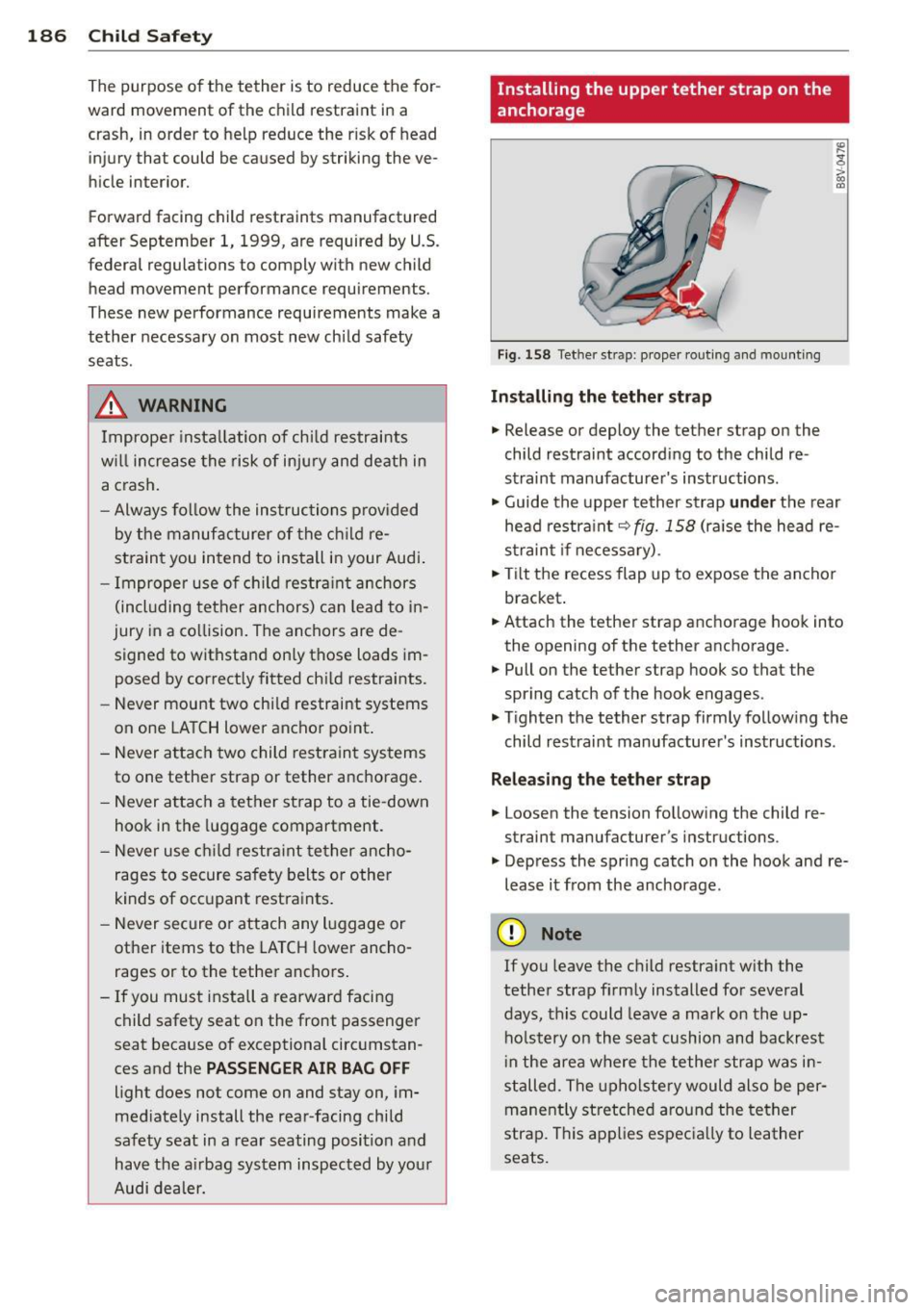
Installing the tether st rap
" Release or deploy the tether strap on the
child restraint according to the child re
s tr aint manufacturer's instructions.
" Guide the upper t ether strap
und er the rear
head restra int~
fig. 158 (ra ise the head re
s traint if ne cess ary) .
" Ti lt the recess flap up to expose the anchor
bracket .
" Attach the tether strap anchorage hoo k into
the opening of the tether anchorage.
" Pull on the tether strap hook so that the
spring catch of the hook engages.
" Tighten the tether strap firmly follow ing the
child r estraint manufacturer 's ins tructions.
Relea sing the tether strap
" Loosen the tension fo llow ing the child re
straint manufacturer's instructions.
" Depress the spri ng catch on the hook and re
lease it from the anchorage .
(D Note
If you leave the c hild restra int wit h the
tethe r strap firm ly installed for seve ral
days, this could leave a ma rk on the up
ho lstery on the seat cushion and backrest
i n the area w here the tethe r strap was in
s talled. The upholstery would also be per
manent ly st retche d around the tether
strap. T his applies espec ia lly to leather
seats.
Page 189 of 302
Using tether straps on rearward-facing
child restraints
Currently, few rear- facing child rest raint sys
tems come with a tether . P lease read and
heed the child res traint system manufactur
er 's instructions carefully to determine how to
prope rly install the tether.
A WARNING
A child in a rearward-facing child safety
seat installed on the front passenger seat
w ill be seriously injured and can b e kill ed if
the front a irbag inflates -even with an Ad
v a nced Airbag System.
- T he inflating a irbag w ill hit the child
safety sea t or infan t carrier w ith g reat
f orce and w ill smash the ch ild safety se at
and child against the backrest, center
armrest, or door.
- If you mus t inst all a rearward facing
child safety seat on the front passenger
seat beca use of exceptional circ umstan
ces and the
PASSENGER AIR BAG OFF
light does not come on and stay on, im
med iately install the rear-facing child
safety seat in a rear seating position a nd
have t he a irbag system inspected by you r
Audi dealer.
Additional Information
Sources of information about child
restraints and their use
There are a number of sources of additional in formation about ch ild restrai nt select ion, in
stallat ion a nd use:
NHTSA advises that the best child safety seat
i s the one that fits your child and fits in your
ve hicle, and that you wi ll use correctly and
consistently .
Try before you buy!
U.S National Highway Traffic Safety Admin· M N i s tration ,....
> co ,...., \!) 1.1'1 ,...., 1.1'1 ,....,
Te l.: 1-888-327-4236 (TTY: 1-800-424-9153)
www.nhtsa.gov
Child Sa fet y 187
National SAFE KIDS Campaign
Tel.: (202) 662-0600
www.safe kids.o rg
Safet y BeltSafe U.S .A
T el.: (800) 7 45-SAFE (English)
Tel.: (800) 747 -SANO (Spanish)
www.carseat.org
Transport Canada Information Centre
T el.: 1 -800 -333-0371 o r ca ll
1-613-998-86 16 if yo u are in the Ottawa area
http://www.tc.gc.ca/eng/roadsafety/
menu.htm
Audi Cu stomer Relation s
Tel.: (800) 822-2834
•
•
•
Page 190 of 302
188 Smart Technology
Smart Technology
Information about
data recorded by
vehicle control
modules
Your vehicle is not equipped with a crash data
recorder. This device is insta lled by some vehi
cle manufacturers to record data about crash
es so tha t it can be analy zed later. Crash data
recorders are also called "Event Data Record
ers (EDR)" .
In some legal jurisdictions, it is not permitted
to access or download data recorded by pre
installed crash data recorders in order to eval
uate a crash without clear consent of the vehi
cle owner .
Your veh icle is not equipped with a crash data
recorder. However it does contain a var iety of
e lectronic control modules for various vehicle
systems such as eng ine funct ion, exhaust
treatment or airbags and safety belts .
These electron ic control modules record vehi
cle data during normal driv ing for diagnosis
and repair purposes. The recording capab ility
of the electron ic control modules is lim ited to
data only- no sound is reco rded.
If t he control
mo dule detects a sys tem m alfu nction or other
change in sta tus, a very lim ited amount of da
ta is recorded for an extreme ly sma ll period of
time . Data t hat is recorded in s uch a case may
include veh icle speed, driving direction, the
load on the brakes and head restraints and
performance in the event of an acc iden t or
other change in status . The stored data can
only be read o r down loaded w ith specia l dev i
ces.
Electronic stabilization
control (ESC)
Description
The E lectronic Stabilization Cont rol (ESC) con
tr ibutes to d river safety. It reduces the risk of
slipp ing and improves driving stability. ESC detects critical situations such as the veh
icle
oversteering and understeering or the whee ls
are spinning . The vehicle is stabilized by ap
plying the brakes or reducing engine torq ue.
Once the ESC is activated, the ind icator light
Bl blinks in the instrument cluster .
The following systems are integrated in the ESC:
Anti -lock braking s ystem (ABS)
ABS prevents the whee ls from locking when
braking . The vehicle can still be steered even
during hard braking . App ly steady pressure to
the brake peda l. Do not pump the peda l. A
puls ing in the brake peda l ind icates that the
system is act ing to stabilize the ve hicle.
Brake assi st sy st e m
The brake assist system can decrease braking
distance .
It increases braking power when the
driver presses the brake peda l quickly in emer
gency s ituations. You m ust press and hold the
brake pedal until the dangerous situation is
over . In vehicles with adaptive cruise control*,
the brake assist system is more sens it ive if the
distance detected to the vehicle ahead is too
small.
Anti-slip regu lation (ASR )
ASR reduces engine power when the drive
wheels begin sp inning and adapts the force to
the road conditions. This makes it easier to
sta rt , accelerate and dr ive up inclines .
Electronic differenti al lock (EDL )
The EDL brakes whee ls that are spinning and
transfers the drive power to the other drive
wheel or wheels if the vehicle is equ ipped with
all wheel drive *). This function is not ava ilable
at h igher speeds .
In extreme cases, EDL automatically sw itches
off to keep t he b rake on the braked wheel
from overheat ing. The ve hicle is still working
co rrect ly. EDL w ill switch o n aga in automat i
ca lly when cond itions have ret urned to no r-
mal. .,._
Page 191 of 302
....,
N
r--. > co
rl I.O
"' rl
"' rl
Stee ring re comm endat ion
The ESC helps to stabilize the vehicle by
changing the steering torque.
Selective wheel torqu e control
Select ive wheel torque control is used when
driving on curves . The front wheel on the in
side of the curve or both wheels on the inside
of the curve are braked selective ly as needed.
This a llows more precise driving in curves.
Automatic post -collisi on brakin g system
The "Automatic post-collision braking system "
can help to reduce the risk of slidi ng and of
other coll is ions afte r an accident. I f the airbag
con tro l modu le detects a collision above ace r
tain vehicle speed, the vehicle is braked by the
ESC.
The vehicle does not brake automatically if:
- the driver presses the accelerator pedal, or
- the braking force generated by the pressed
brake pedal is greater than the braking force
that would be initiated by the system, or
- the ESC, the brake system or the vehicle
electrical system are not functioning.
A WARNING
-The ESC and its integrated systems can
not overcome the limits posed by natura l
physical laws. This is especially impor
tant on s lippery or wet roads. If the sys-
Switching on/off
Sm art Te chnol og y 189
terns beg in acting to stabilize your vehi
cle, you should immediately alter your
speed to match the road and traffic con
ditions . Do not let the increased safety
provided tempt you into taking r isks .
This could increase your risk of a co lli
SIOn.
- Please note the r isk of a coll is ion increas
es when driving fast, especially through
curves and on slippery or wet roads, and
when dr iv ing too close to objects ahead.
The ESC and its integrated systems can
not a lways prevent collisions -there is
still a risk of accidents!
- Press the accelerator pedal caref ully
when acce lerating on even, slippery sur
faces such as ice and snow. The drive
wheels can spin even when these control systems are installed and this can affect
driving stability and increase the r isk of a
coll is ion.
@ Tips
-ABS and ASR only function correctly
when all four wheels are equipped w ith
identical tires. Different t ire sizes can
lead to a reduct ion in engine power.
- You may hear noises when the systems
descr ibed are working.
- If the
Bl or [I] indicator light appears,
there may be a malfunction
¢ page 21.
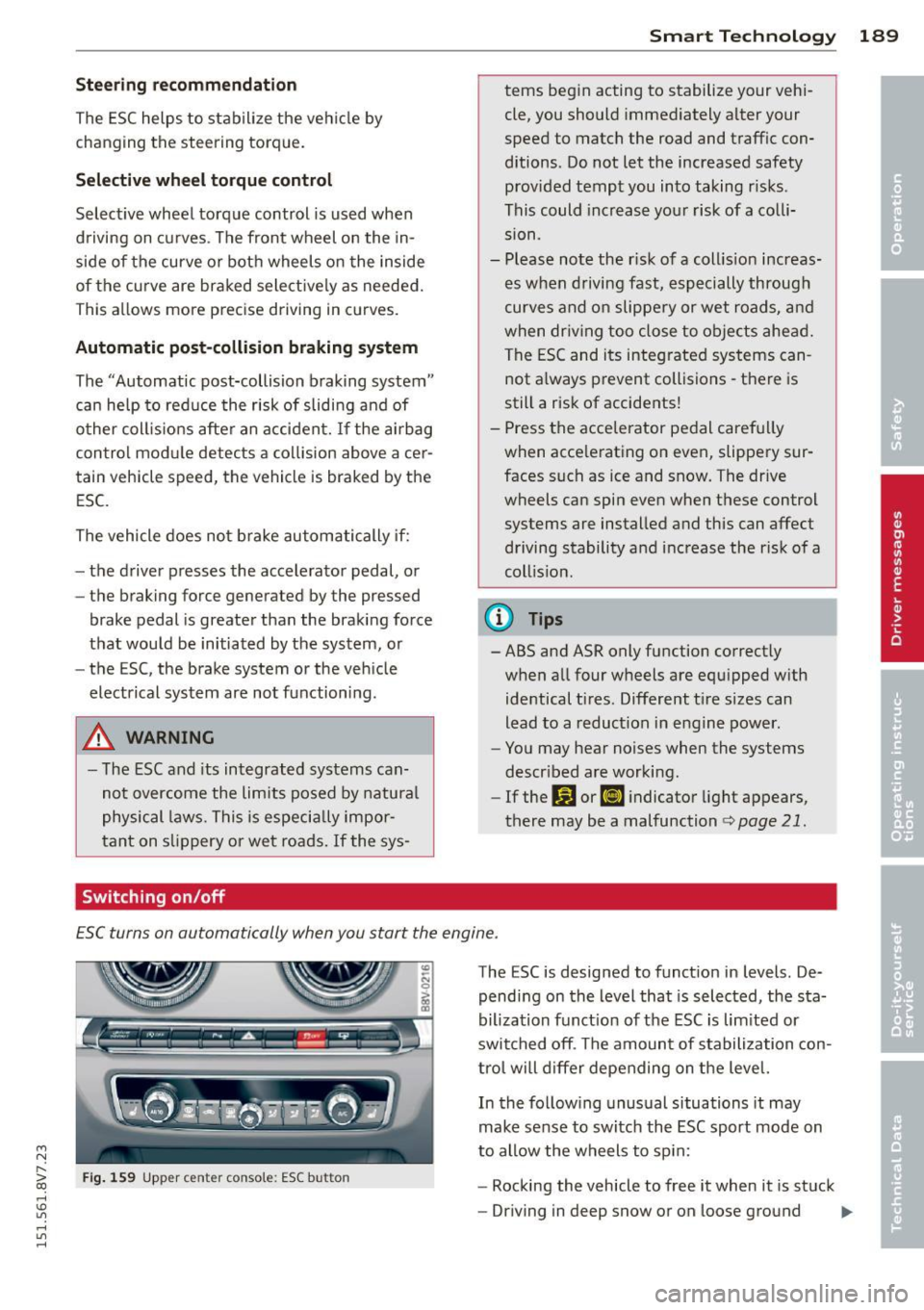
ESC turns on automatically when you start the engine .
Fig. 159 Upper c ente r conso le: ESC button
The ESC is designed to funct ion in levels . De
pend ing on the level that is selected, the sta
bilization funct ion of the ESC is lim ited or
swi tched off . The amoun t of stabilization con
trol wi ll differ depending on the level.
In the follow ing unusual situations it may
make sense to switch the ESC sport mode on
to allow the wheels to sp in:
- Rocking the vehicle to free it when it is stuck
- Driving in deep snow or on loose ground
IJJ-