fuel AUDI A3 CABRIOLET 2015 User Guide
[x] Cancel search | Manufacturer: AUDI, Model Year: 2015, Model line: A3 CABRIOLET, Model: AUDI A3 CABRIOLET 2015Pages: 302, PDF Size: 73.83 MB
Page 32 of 302
30 Driver in formation sy ste m
On-Board Diagnostics
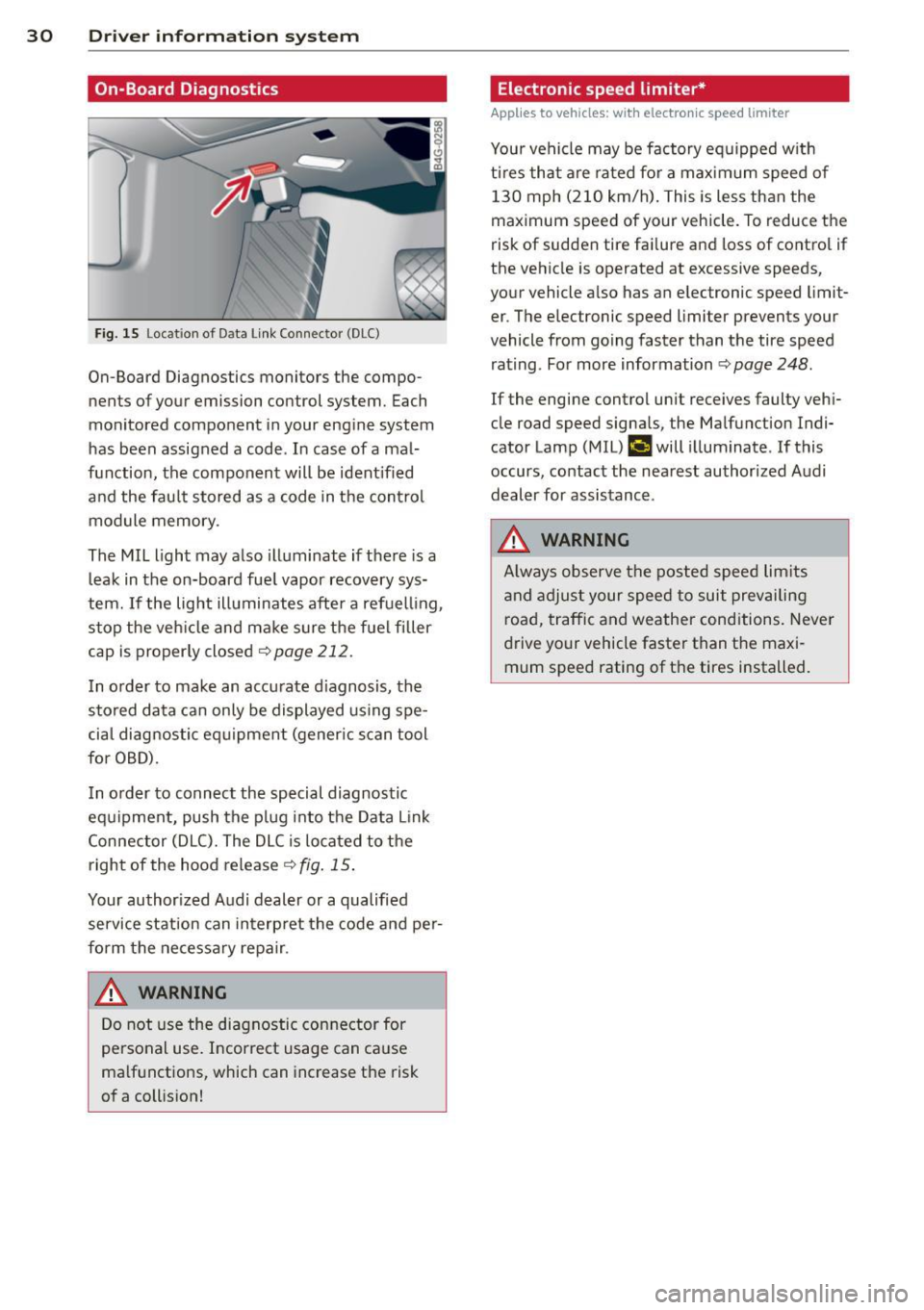
Fig. 15 Lo cat ion of D ata Link Connec tor (D LC)
On-Board Diagnostics monitors the compo
nents of your emission con trol system. Each
monitored component in your engine system
has been assigned a code . In case of a mal
function, the component will be ident ified
and the fau lt stored as a code in the control
module memory .
The MIL light may also illuminate if there is a
leak in the on-board fue l vapor recovery sys
tem.
If the lig ht illuminates after a refuelling ,
stop the veh icle and ma ke sure the fuel filler
cap is proper ly closed
<> page 212.
I n o rder to make an accurate d iagnosis, the
stored data can only be displayed using spe
cia l diagnostic eq uipment (gener ic s can tool
for OBD).
I n o rder to connect the special diagnostic
equipment, push the p lug i nto the Data Link
Connector (DLC). The DLC is located to the
right of the hood release¢
fig. 15 .
Your author ized A udi dealer or a qualified
service station can interp ret the code and pe r
form the necessary repa ir .
A WARNING
Do not use the diagnostic con nector for
personal use. Incorrect usage can ca use
ma lf u nctions, which can increase the risk
of a coll ision!
-
Electronic speed limiter*
Applies to vehicles: with electronic speed limiter
Your vehicle may be factory eq uipped w ith
t ir es that are rated fo r a max imum speed of
130 mph (210 km/h) . This is less than the
maximum speed of your vehicle. To reduce the
risk of sudden tire fa ilure and loss of contro l if
the vehicle is operated at excessive speeds,
your vehicle a lso has an electronic speed limit
er . The elec tronic speed limi ter prevents your
vehicle from going faster than the tire speed rating . For more information ¢
page 248.
If the engine control unit receives faulty veh i
cle road speed signa ls, the Malfunction Ind i
cator Lamp (M IL)
¢..fi will illuminate . If this
occurs, contact the nea rest authorized A udi
dealer for assistance .
A WARNING
Always observe the posted speed lim its
a nd adjust your speed to suit prevai ling
road, traffic and weather cond itions. Never
d rive your vehicle faster than the maxi
mum speed rating of the tires installed. -
Page 39 of 302
....,
N
" > co
rl I.O
"' ,....,
"' rl
this could make it possible for unauthor
ized persons to start the engine and oper
ate vehicle systems such as the power win
dows or sunroof . This can increase the risk
of serious injury .
(D Tips
-The vehicle cannot be started if an unau
thorized key is used. It may not be poss i
ble to start the vehicle under certain cir
cumstances, for example if there is an
other radio module like the key from an
other vehicle or a transponde r on the
same keychain.
- For an explanation on conformity with
the FCC regu lations in the United States
and the Industry Canada regulations, re
fer to
c::; page 285.
Safety central locking
Applies to vehicles: with safety central locking
Safety central locking provides the possibility,
to only unlock the driver's door and the fuel
filler door. The rest of the vehicle remains
locked.
Unlocking the driver's door and the fuel
filler door
.. Press the remote contro l key or convenience
key @! but ton
once or turn the key once in
the opening direction .
Unlocking all doors, the luggage
compartment lid and the fuel filler door
.. Press the remote control key or convenience
key @! button
twice within five seconds or
turn the key
twice within five seconds in the
opening direction .
When unlocking just the driver's door, the an
ti -theft alarm system* is also immediately de
activated .
In vehicles with an MMI, you can d irectly ad
just the safety central locking
o page 36 .
Opening and closing 3 7
Front passenger's door emergency
locking
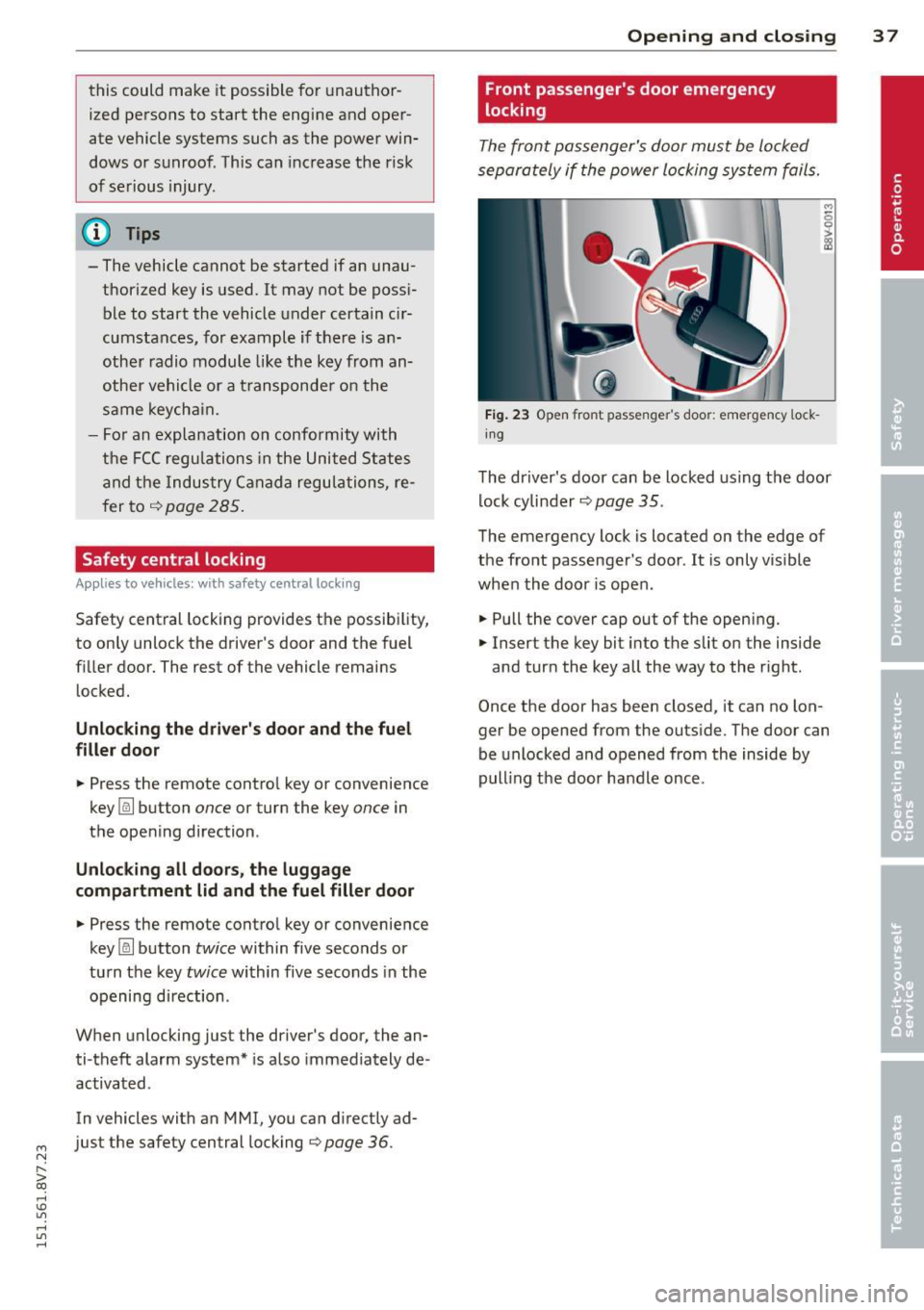
The front passenger's door must be locked
separately if the power locking system fails.
Fig. 23 Open fro nt passen ger' s doo r: emergency lock
in g
The driver's door can be locked using the door
lock cylinder
o page 35.
The emergency lock is located on the edge of
the front passenger 's door . It is only visible
when the door is open .
.. Pull the cover cap out of the opening.
.. Insert the key bit into the slit on the inside
and turn the key all the way to the right .
Once the door has been closed, it can no lon ger be opened from the outside. The door can
be unlocked and opened from the inside by
pulling the door handle once .
Page 72 of 302
70 Warm and cold
Warm and cold Climate control system
Description
Different systems could be installed.
- manual climate control system* or
- automatic climate control system*
The
climate control system* cools and re
moves humidity from the air in the vehicle in
terior. It is the most effective when the win
dows and power top are closed. If there is a
build-up of heat inside the vehicle, ventila tion
can help to speed up the cooling process. Be
cause of this, the windows can be opened
from outside .
~ page 39, Convenience open
ing/closing
Pollutant filter
The pollutant filter removes pollutants such
as dust and pollen from the air .
Key recognition
You can store various settings for the manual
and automatic
climate control system* and
assign them to the key being used .
A WARNING
Poor visibility can lead to accidents.
- For safer driving, keep a ll windows free
of ice, snow and fog.
- Become familiar as quickly as possible
with the correct use and function of the
climate control system, especially with
the defrosting and defogging function .
- When the temperature is below freezing,
only use the windsh ield washer system
after the w indshield has been warmed by the cl
imate control system . The washer
fluid could freeze on the windshield and
impair visibility.
(D Note
- If you suspect that the climate control
system is damaged, switch the system
off to prevent further damage and have
it checked by an authorized Audi dealer
or authorized Audi Service Facility.
- Repairs to the Audi climate control sys
tem require special technical knowledge
and special tools. See an authorized Audi
dealer or authorized Audi Serv ice Facility .
® For the sake of the environment
Reducing the amount of fuel used also re
duces the amount of pollutants that enter
the air.
(D Tips
- To prevent interference with the heating
and cooling output and to prevent the
w indows from fogging over, the air in
take in front of the windshield must be
free of ice, snow or leaves.
- Condensation from the cooling system*
can drip and form a puddle of water un
der the vehicle. This is normal and does
not mean there is a leak.
- T he energy management system may
switch the seat heating* or rear window
defroster off temporari Ly. These systems
are available again as soon as the energy
balance has been restored.
- The flows through the vents under the
rear window. Make sure the openings are
not covered when placing clothing on the
luggage compartment cover.
Page 75 of 302
M N
" > co ,...., \!) ..,.,
activates the "eco" mode*1>. I n "eco" mode*,
a ll settings are lowered slightly to save fuel.
When in "eco" mode* ,
eco is shown in the dis
play. To ex it "eco" mode*, press the
!AU TO !
button again .
I• I • I S etting the temperatu re
The temperature can be adjusted individually
for the driver and front passenger using the
dials . Temperatu res between 60 °F (+16 °C)
and 84 °F (+28 °C) can be set . Outs ide of this
range,
Lo or Hi will appear in the climate con
trol system display. In both settings, the cli mate control runs with constantly at the max
i mum cooling or heating level. The tempera
ture is not regu lated.
Syn chroni zation: By pressing the !AU TO I but
ton for two seconds , the temperat ure setting
for the driver is transferred to the front pas
senger's side. This applies a temperature
change to the front passenger's side.
~ Adjusting the blower
To prevent the windows from fogging over,
the blower shou ld always run at a low speed.
You ca n adj ust the volume of air generated by
the blower to you r preference. To have the
b lower regu la ted automatically, press the
!AU TO! button.
Adjusting th e air d istribution
The a ir distribution is adjusted with the~, [Ml
and ~ buttons. To have the air d istr ibut io n
r eg ulated automatically, press the
!AUTO ! but
ton .
The ro und air vents in the cockpit are adjusta
b le
~ page 74.
To keep the w indows from fogging in damp
weather, we recommend opening the side air
vents and t ilting them to the side
~ page 7 4, Adjusting the air vents.
Foot vents are located under the front seats
and adjustable vents on the end of the center
console to heat the rear of the vehicle.
,....,
"' l) This func tio n is not ava ilable in a ll coun tri es . ,....,
Warm and c old 73
~ Switching th e defro ster on and off
T he w indshield and side windows are defrost
ed or cleared of condensation as quickly as
poss ible . The maximum amount of air flows
main ly from the vents below the windshield.
Recircu lation mode switches off. The tempera
ture is controlled automatically. In the
[i] set
ting, the
! AIC ! cooling mode sw itches on auto
matically, depending on the outside air tem
perature .
The
! AU TO ! button sw itches the defroster off.
l""'I Sw itching recirculation mode on and
off
The recircu lation mode can be turned on man
ually or automatically* .
- Switching manual recirculation mode on and
off: Press the~ button. The LED light up
when switched on.
- Automatic* recircu lation mode: The recircu
lation mode must be activated in the MMI.
Select: the
I MENU I button >C ar> Sys tems *
contro l bu tton> A C> Auto recirculat ion .
The a ir quality sensor that is des igned for
diesel and gasoline exhaust automatically
sw itches the rec irculat ion mode on or off
depending on the leve l of po llutants in the
outs ide air .
In recirculation mode, the air inside the vehi
cle is circulated and filtered . This prevents the
unfiltered air outs ide the veh icle from e nter
ing the vehi cle interior. We recommend
switching recircu lation mode on when driving
th rough a tunne l or when sitting in traffic
~ .&. .
The 1- 1 button, IAU TO ! or the [i] bu tton
switches rec irculation mode off.
The system switches to recirculation mode
whe n driving in reve rse when the engine is
cold.
•
Page 112 of 302
110 Automatic transmission
Automatic
transmission S tronic-transmission
Introduction
Appl ies to vehicles: with S tro nic tr ansmiss ion
Your vehicle is equipped with an electronical
ly-controlled DSG transmission called S tronic.
Two independent clutches transfer the power
between the engine and transmission. It al
lows the vehicle to accelerate without a no
ticeable interruption in traction .
The transmission upshifts or downshifts auto
matically. The driving style continuously influ
ences the selection of the driving program.
When a
moderate driving style is used, the
transmission selects the most economica l
driving mode. The transmission upshifts at a
lower RPM and downshifts at a higher RPM to
improve fuel efficiency.
The transmission switches to a sporty mode
after a kick-down or when the driver uses a
sporty driving style characterized by quick ac
celerator pedal movements, heavy accelera
tion, frequent changes in speed and traveling
at the maximum speed.
If desired, the driver can also select the gears
manually (tiptronic mode) o page 115,
Shifting manually (tiptronic mode).
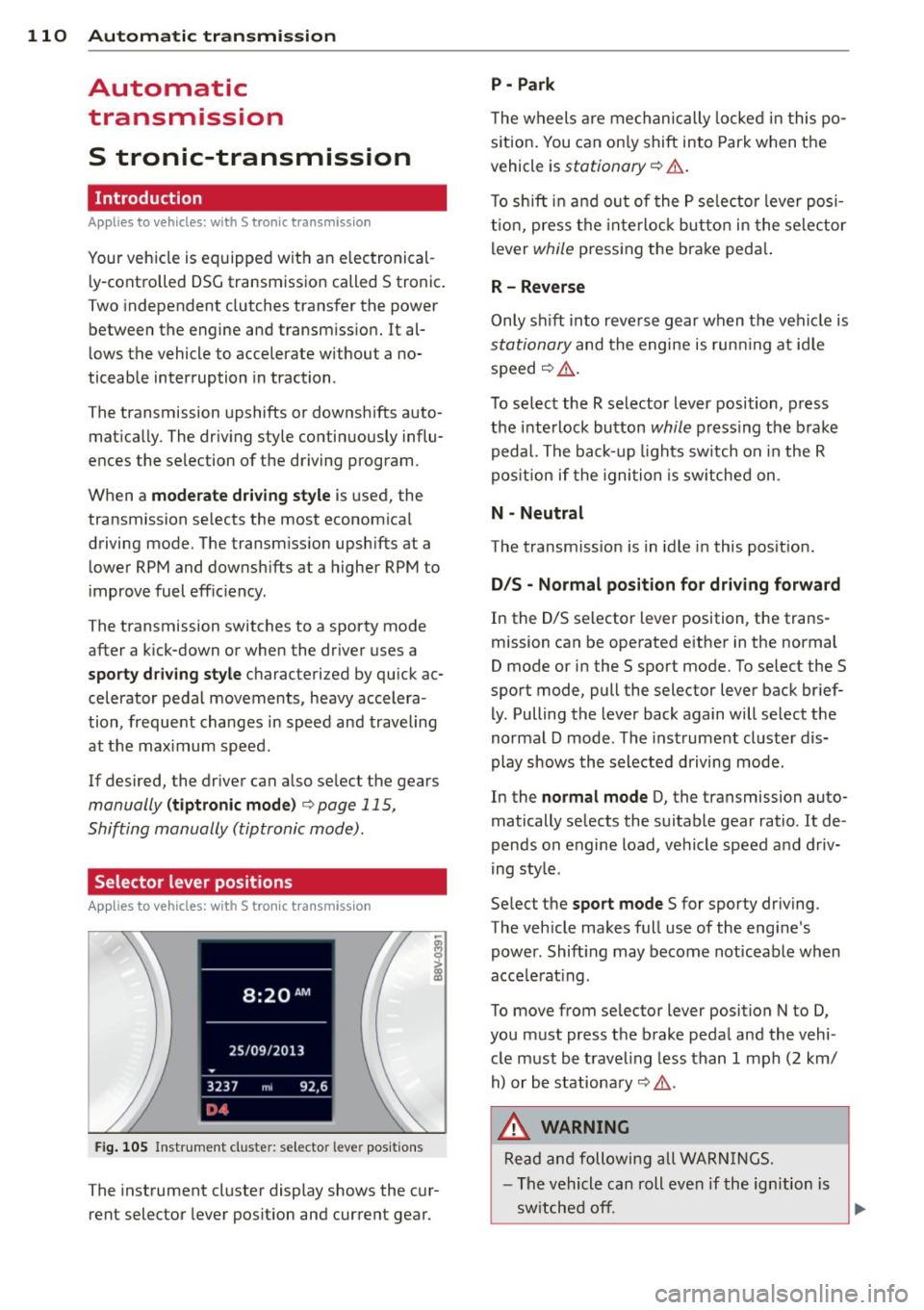
Selector lever positions
A pp lies to vehicles: with S tro nic tr ansmiss ion
Fig. 105 Instrument cluste r: selector leve r positions
The instrument cluster display shows the cur
rent selector lever position and current gear .
P -Park
The wheels are mechanically locked in this po
s iti on. You can only shift into Park when the
vehicle is
stationary o &..
To shift in and out of the P selector lever posi
tion, press the interlock button in the selector
lever
while pressing the brake peda l.
R- Reverse
Only shift into reverse gear when the vehicle is
stationary and the engine is running at idle
speed
o &. .
To select the R selector lever position, press
the interlock button
while pressing the brake
pedal. The back-up lights switch on in the R
pos ition if the ignition is switched on .
N -Neutral
The transmission is in idle in this position.
D/S - Normal position for driving forward
In the D/S selector lever position, the trans
mission can be operated either in the normal
D mode or in the S sport mode. To select the S
sport mode, pull the selector lever back brief
ly. Pulling the lever back again will select the
normal D mode . The instrument cluster dis
play shows the selected driving mode.
In the
normal mode D, the transmission auto
matically selects the suitable gear ratio.
It de
pends on engine load, vehicle speed and driv
ing style .
Se lect the
sport mode S for sporty driving.
The vehicle makes full use of the engine's
power. Shift ing may become noticeable when
acce lerat ing .
To move from selector lever position N to D,
you must press the brake pedal and the vehi
cle must be traveling less than 1 mph (2 km/
h) or be stationary
o &. .
,&. WARNING
Read and following all WARNINGS.
- The vehicle can roll even if the ignition is
switched
off. .__ _____________ __J~
Page 198 of 302
196 Driving and the environment
Driving and the
environment
The first 1,000 miles
(1,500 km) and
afterwards
New engine
The engine needs to be run-in during the first
1,000 miles (1,500 km).
For the fir st 600 miles
( 1,000 kilometers):
.,. Do not use full throttle.
... Do not d rive at engine speeds that are more
than 2/3 of the max imum permitted RPM.
... Avoid high engine speeds.
From 600 to 1,000 mile s (1 ,000 to
1,500 kilometers):
... Speeds can gradually be increased to the
max imum pe rm iss ible road or eng ine speed .
During and after break-in period
.,. Do not rev the eng ine up to high speeds
when it is cold. Th is app lies whether the
transm ission is i n N (Neutra l) or in gear.
After the break-in period
... Do not exceed maximum engine speed un
der any circumstances.
.,. Upshift into the next higher gear
before
reaching the red area at the end of the tach
ome ter scale
c:> page 10.
During the first few hours of driving, the en
g ine's interna l friction is higher tha n later
when all the movi ng pa rts have been broke n
in . How w ell this break- in process is do ne de
pends to a conside rable extent on the way the
ve hicl e is driven during the first 1,0 00 miles
(1, 500 k ilome ters).
0 Note
E xtremely high engi ne speeds are auto
mat ic all y reduced. However, these RPM
lim its are progr amme d for an eng ine t hat
is broken in, no t a new engine .
{® For the sake of the environment
Do not drive with unnecessarily hi gh en
g ine speeds - upshifting ear ly saves fuel,
r educes no ise and protects the environ
ment.
, New tires
If your vehicle is runni ng on new tires, drive
part icu larly caref ul for the first 350 miles
(500 kilomete rs) afte r fitt ing.
A WARNING
N ew tires tend to be slipp ery and mus t al
so be "b roken -in" . Be s ure to remember
this dur ing the fi rst 350 mi les ( 500 kilo
meters) . Brake gently . Avoid fo llow ing
closely behind other vehicles or other sit
uations that m ight require sudden, hard
braking .
New brake pads
Remember that new brake pads do not have a
full bra king effect dur ing the fi rst 250 m iles
(400 kilomete rs) afte r they a re insta lle d.
New brake pads have to be "burnished in" be
f o re t hey have optima l grab
c:> A .
During the break- in period, you should avoid
putting severe loads on the brakes. Severe
l oads include , for example, sudden hard b rak
i ng, in particular at very high speeds or, for
example, on mounta in passes .
A WARNING
New b ra ke pa ds don't have t he bes t stop
pi ng power and m us t be "broke n-in " dur
i ng the in itial 1 00 to 150 mi les (15 0 to
2 00 k ilometers) of no rma l city driving . You
can compensate for this by pressing t he
br ake pe da l mo re f irm ly . This also applies
l ater when new pads are installed.
Page 199 of 302
M N ,....
> co ,...., \!) 1.1"1 ,...., 1.1"1 ,....,
Driving through water
on roads
Note the following to avoid vehicle damage
when driving through water, for example on
flooded roads:
- The water must not be any higher than the bottom of the vehicle body.
- Do not drive faster than wa lking speed.
A WARNING
After driving through water or mud, the
braking effect can be reduced due to mois
ture on the brake discs and brake pads. A
few careful brake applications should dry off the brakes.
([) Note
Vehicle components such as the engine,
transmission, suspension or electrical sys
tem can be severely damaged by driving
through water.
- Determ ine the depth before driving
through water.
- Do not stop the vehicle, drive in reverse
or switch the engine off when driving
through water .
- Keep in mind that oncoming vehicles may create waves that raise the water
level and make it too deep for your vehi
cle to drive through safely.
- Avoid dr iving through salt water (corro
s ion).
Catalytic converter
App lies to vehicles: with gasoline engine
It is very important that your emission con
trol system (catalytic converter) is function
ing properly to ensure that your vehicle is run
ning in an environmentally sound manner.
.,. Always use lead-free gaso line¢ page 210,
Fuel supply .
.,. Never run the tank down all the way to emp-
ty .
Dri ving and the en vironm ent 197
.,. Never put too much motor oi l in your engine
¢ page 218, Adding engine oil 't:::r..
.,. Never try to push- or tow -start your vehicle.
T he catalytic converter is an efficient "clean
up" device bui lt into the exhaust system of
the vehicle . The cata lytic converter burns
many of the pollutants in the exhaust gas be
fore they are released into the atmosphere .
The exclusive use of unleaded fuel is critically important for the life of the catalytic convert
er and proper functioning of the engine.
A WARNING
The temperature of the exhaust system is h igh, both when driv ing and after stopping
the eng ine.
- Never touch the exhaust tail pipes once
they have become hot. This could result
in burns.
- Do not park or operate the vehicle in
areas where the hot exhaust system may
come in contact with dry grass, brush,
fue l spill or other material wh ich can
cause a fire.
- Do not apply additional undercoating or
rustp roofing o n or nea r the exhaust
manifold, exhaust pipes, catalyti c con
verter or heat shields . Dur ing driving, the
substance used for undercoating could
overheat and cause a fire.
([) Note
-Be aware that just one tank filling with
leaded fuel w ill already ser iously de
grade the performance of the catalytic
converter .
- Do not exceed the cor rect engine oil level
~page 218.
-Do not drive until the fue l tank becomes
completely empty . The engine cou ld mis
fire . Unburned fuel could also get into
the exhaust system and th is cou ld cause
the catalytic converter to overheat.
- Do not switch off the ignition while the
vehicle is moving.
- Do not continue to operate your vehicle
under these conditions, as otherwise fuel ..,_ •
•
•
Page 200 of 302
198 Driving and the environment
can reach the cata lytic converter. This
could result in overheating of the con
verter, requ iring its replacement.
- To assure efficient operation of the Emis
sion Control System:
- Have your veh icle ma intained properly
and in accordance with the service rec
ommendations in your Warranty
&
Ma intenance booklet.
- Lack of proper maintenance as well as
improper use of the vehicle will impa ir
the function of the emission control
system and could lead to damage.
@ For the sake of the environment
Even when the Emission Contro l System is
operating properly, the exhaus t gas can
have a sulfur-like exhaust gas smell under
some operating states. This depends on
the sulfur content of the fue l being used .
Using a different brand of fuel may help,
or filling the tank w ith lead-free super
grade gasoline.
Placing your vehicle
out of service
If you wou ld like to take your vehicle out of
service for a longer t ime, contact your author
ized Audi dealer or qualified repair facility.
They will advise you of important measures,
such as corrosion protection, maintenance
and storage procedures. Also follow the infor
mat ion about the battery
¢ page 223.
Operate your vehicle
economically and
minimize pollution
General
Your personal style of driving will determine
the economy of your vehicle, as well as ex
haust and noise levels .
Fuel economy, environmental impact, and
wear on your engine, brakes and t ires largely
depend on three factors: -your
personal driving style
- operating conditions
- technical limitations
If you ant ic ipate what you need to do next and
drive econom ically, you can easily cut your
fuel consumpt ion by 1O-lS percent . This sec
t ion w ill give you some tips on how you can
help the env ironment and your pocketbook.
(D Tips
The consumption estimates as published
by ENVIRONMENTAL PROTECTION AGENCY
(EPA) and Transport Canada may not corre
spond to your actual consumption on the
road, which will vary depending upon vehi
cle load and speed, road and weather con
ditions, trip length, etc.
Drive smoothly and keep a lookout
ahead
Vehicles use the most fuel when they are ac
celerating.
.,. Avoid unnecessary accelerating and braking.
Vehicles use the most fuel when they are ac
ce lerating. If you anticipate what is going to
happen next, you will need to brake less and,
thus, acce lerate less. Let the vehicle coast
whenever possible -for example when you see
that the next traffic light is red.
Avoid full throttle '
Driving at moderate speeds saves fuel and
improves your mileage.
.,. Try and keep well below your car's maximum
speed.
Acce lerating gently reduces fue l consump
tion, engine wear, and does not disturb the
environment.
Fuel consumpt ion, exhaust emissions and en
gine noise increase disproportionate ly at high
speeds. If you drive at approximately three
quarters of top speed, fuel consumption wi ll
be reduced by one half. Never drive faster
1111>
Page 201 of 302
M N
" > co ...... \!) 1.1'1
...... 1.1'1 ......
than the posted speed limit and weather con
ditions permit. Reducing unnecessary idling
Even wh en your car is just idling it burns up
fuel.
.,. Shu t the engine off when you a re not dr iv ing
the vehi cle.
... Do not warm up the vehicle by letting the
engine run at idle.
It is effic ient to switch off the eng ine when
stopped at railroad crossings and long red
lights. Turning the engine
off for just 30-40
seconds saves more fu el than is burned by
starting the engine again.
It takes a long time fo r the engine to wa rm up
fu lly when it is running at idle. However , wear
and noxious emissions are especially high
when the engine is wa rming up. So you should
drive away as soon as you start the eng ine and
avoid running at h igh RPM while the engine is
still warm ing up.
Do not leave engine idling unattended af
ter starting. If warning lights should come on to indicate improper operation, they
wou ld go unheeded. Extended idling also
p roduces heat, which cou ld result in over
heating or other damage to the vehicle or
other prope rty .
Regular maintenance
A badly tuned engine unnecessarily wastes a lot of fuel.
.,. Have your vehicle serv iced at regular inter-
vals.
H aving your vehicle regularly serviced by an
author ized Audi dealer helps to ensure that it
runs properly and economically . T he condition
of your vehicle not only affects its safety and
ab ility to hold its value, it also affects fuel
c onsum ption.
Dri ving and the en vironm ent 199
Chec k your oil e ach t ime you fill your tank.
T he amou nt of oi l used is re lated to engine
load a nd speed.
It is normal for the oil consumption of a new
engine to reach its lowest value after a certa in
mileage has bee n driven.
You must drive your veh icle about 3,000 m iles
(5,000 kilometers) before you can properly
assess oil consumpt ion.
This also app lies to fue l consumption and en
gine output .
(D Note
- Have your veh icle ma inta ined properly
and in accordance with the service rec
ommendations in your Warranty
& Ma in
tenance booklet . Lack of proper mainte
nance as well as improper use of the ve
hicle will impair the function of the
em iss ion cont ro l system and cou ld lead
t o damage.
- Do not alter or remove any component of
the Emission Control System unless ap
proved by the manufacture r.
- Do not alter or remove any device, such
as hea t shie lds, switches, ign ition w ires,
valves, which are designed to protect
your vehicle's Emission Control System
and other important vehicle compo
nents.
Fewer short trips
Fuel consumption will always be relatively
high on short trips.
... Try to avoid dr iving sho rt distances with a
cold engine .
T he eng ine and catalytic conve rter have to
reach their optimal operati ng t emperature to
reduce fuel consumption and noxious emis
sions effectively.
Just after starting, a co ld eng ine in a mid-s ize
ca r only achieves a fuel economy of 6 -8 mi les
per gallon (30-40 l/100 km). After about a
half a mile, fuel economy climbs to 12 mpg ..,.
•
•
•
Page 202 of 302
200 Driving and the environment
(20 l/100 km). After about 2.5 m iles (4 km),
the engine is at its proper operating tempera
ture and fuel economy has reached a normal
level. So you can see that you should avoid
short trips whenever possible.
The
outside temperature is also critical in this
regard. Your car cons umes more fuel in the
winter than in the summer.