fuel AUDI A3 CABRIOLET 2015 Owner's Manual
[x] Cancel search | Manufacturer: AUDI, Model Year: 2015, Model line: A3 CABRIOLET, Model: AUDI A3 CABRIOLET 2015Pages: 302, PDF Size: 73.83 MB
Page 208 of 302
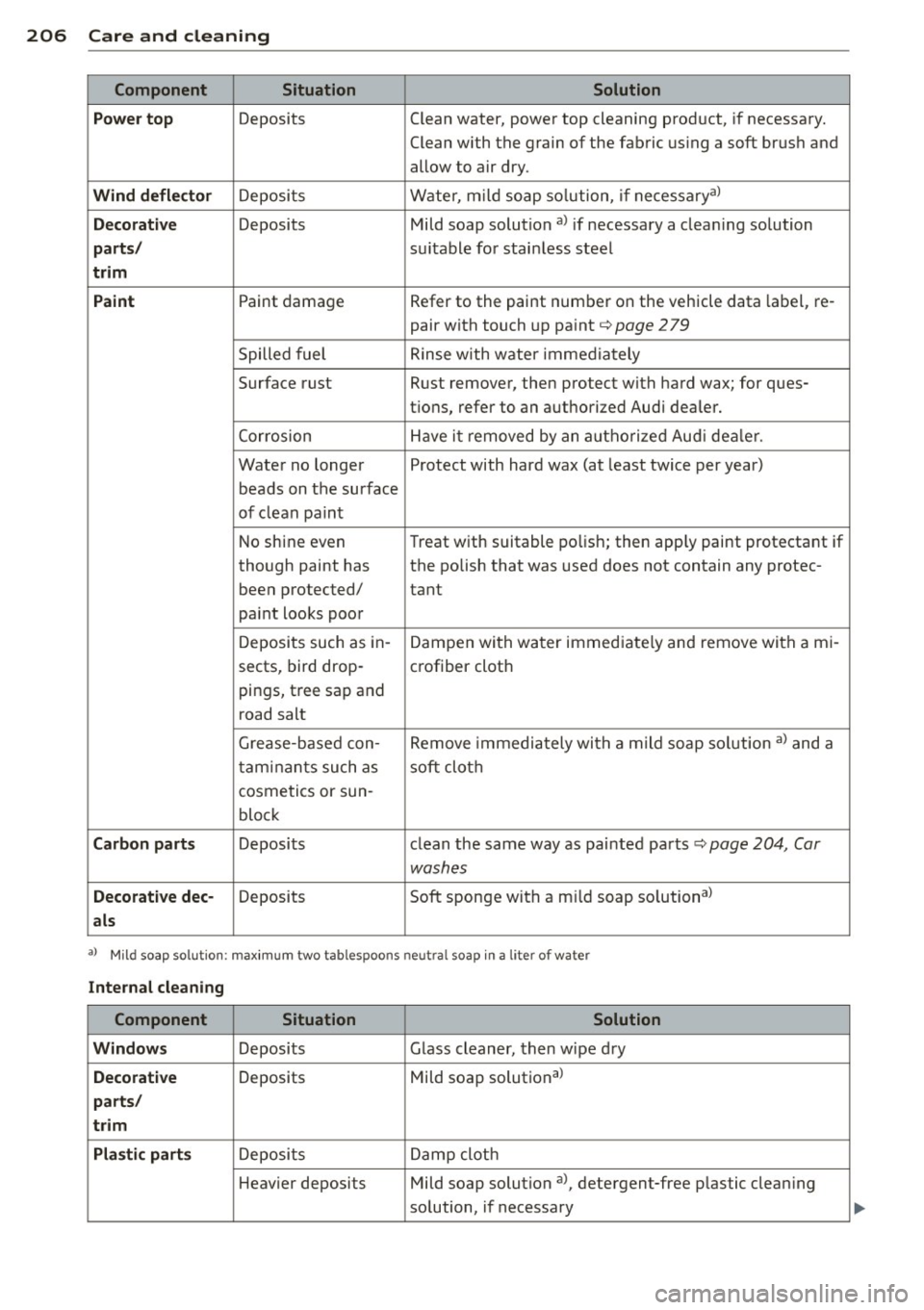
206 Care and cleaning Component Situation Solution
Powe r top
Deposits Clean water, power top cleaning product,
if necessary.
Clean with the g rain of the fab ric using a soft br ush and
allow to air dry .
Wind deflector Deposits W
ater, m ild soap so lution, if ne cessa rya>
Decorative Deposits Mild soap solution a) if necessary a clea ning so lution
parts/ s u itable fo r stai nless stee l
trim
Paint
Paint damage Refer t
o the paint number on the vehicle data la bel, re-
pair
wi th touch up pa int c:> page 279
Spilled fuel Rinse with water immed ia tely
Surface rust R ust remove r, then protect wit h hard wax; for ques-
t ions, refer t o an a uthorized Audi dealer.
Cor rosion Have i t removed by an autho riz e d Aud i deal er.
Wate r no longer Protect with hard wax (at least twice per year)
beads on the surface
of clean pa int
N o shi ne even
Treat w ith suitable po lish; then app ly paint protectant if
tho ugh paint has the polish that was used does not contain any protec-
been p rotected/ tant
pa int looks poo r
Deposi ts such as in- D
ampen wi th w ater immed iate ly and remove with a m i-
sects, bird drop -
crofiber clot h
pi ngs , tree sap a nd
road salt
G re ase-base d con- Re
move immedia tely wi th a mild soap so lu tion a) and a
ta minant s su ch as so ft clo th
cosme tics or sun -
bloc k
Carbon parts Deposits clean the same way as pai nted pa rts c:> pag e 204, Car
washes
Decorative dee· Deposits Soft sponge w
ith a m ild so ap solution a>
als
a) Mild soap so lu tio n: max imum tw o tab les poon s neut ral s oap in a lite r of wa te r
Internal cleaning
Component Situation Solution
Windows
Deposits Glass cleaner, then w ipe dry
Decorative Deposits Mild soa
p solutional
parts/
trim
Plastic parts
Deposi ts Damp clo th
Heavier deposits Mild soap solution a>, detergent-free p lastic clea ning
so lution, if necessary
Page 212 of 302
210 Checking and Filling
Checking and Filling
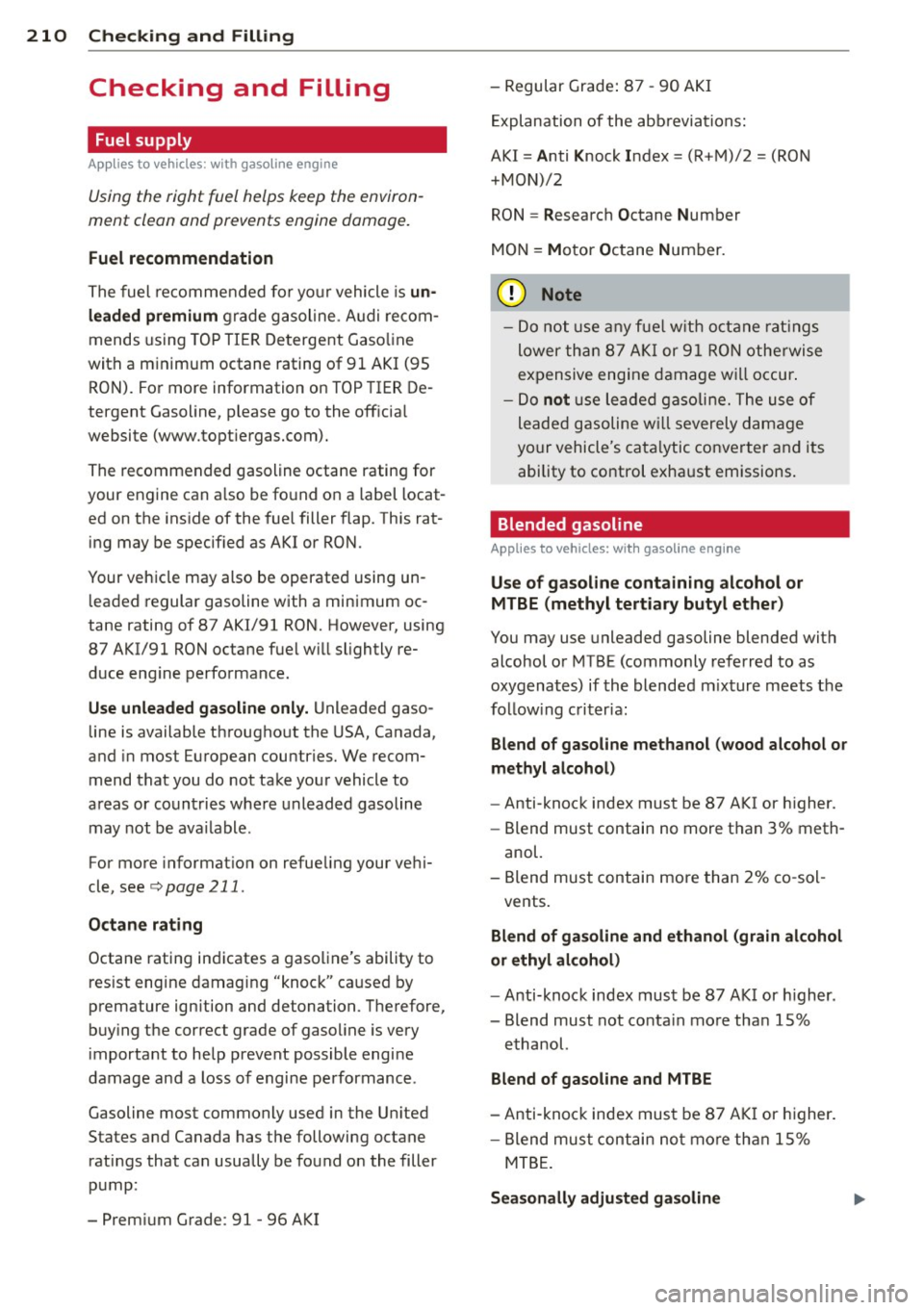
Fuel supply
Applies to vehicles: with gasoline engine
Using the right fuel helps keep the environ
ment clean and prevents engine damage.
Fuel recommendation
The fuel recommended for your vehicle is un
leaded premium
grade gasoline . Audi recom
mends using TOP TIER Detergent Gasoline
with a minimum octane rating of 91 AKI (95
RON). For more information on TOP TIER De
tergent Gasoline, please go to the off icia l
website (www.toptiergas.com).
The recommended gasoline octane rating for
your engine can a lso be found on a label locat
ed on the inside of the fuel filler flap. This rat
ing may be specified as AKI or RON.
Your vehicle may also be operated using un leaded regular gasoline with a minimum oc
tane rating of
87 AKI/91 RON. However, using
87 AKI/91 RON octane fuel w ill slightly re
duce eng ine performance.
Use unleaded gasoline only. Unleaded gaso
line is available throughout the USA, Canada,
and in most European countries. We recom
mend that you do not take your vehicle to
areas or countries where unleaded gasoline
may not be ava ilable .
For more informat ion on refueling your vehi
cle, see
c:> page 211 .
Octane rating
Octane rating indicates a gasoline's ability to
res ist engine damaging "knock" caused by
premature ign ition and detonation. Therefore,
buying the correct grade of gasoline is very
important to help prevent possible engine
damage and a loss of engine performance .
Gasoline most commonly used in the United
States and Canada has the following octane
ratings that can usually be found on the filler
pump:
- Prem ium Grade : 91- 96 AKI -
Regular Grade:
87 -90 AKI
E xplanation of the abbreviations:
AK I=
Anti Knock Index = (R +M)/2 = (RON
+MON)/2
RON= Research Octane Number
MON = Motor Octane Number.
(D Note
- Do not use any fuel w ith octane rat ings
lower than
87 AK I or 91 RON otherwise
expensive engine damage will occur .
- Do
not us e leaded gasoline. The use of
leaded gasoline w ill severely damage
your vehicle's catalytic converter and its
ability to control exhaust emissions.
Blended gasoline
Applies to vehicles: with gasoline engine
Use of gasoline containing alcohol or
MTBE (methyl tertiary butyl ether)
You may use unleaded gasoline blended with
alcohol or MTBE (commonly referred to as
oxygenates) if the blended mixture meets the
follow ing criteria:
Blend of gasoline methanol (wood alcohol or
methyl alcohol)
-Anti -knock index must be 87 AKI or higher.
- Blend must contain no more than 3% meth-
anol.
- Blend must contain more than 2% co-sol -
vents .
Blend of gasoline and ethanol (grain alcohol
or ethyl alcohol)
-Anti-knock index must be 87 AKI or higher.
- Blend must not co nta in more than 15%
ethanol.
Blend of gasoline and MTBE
-Anti-knock index must be 87 AKI or higher.
- Blend must contain not more than 15%
MTBE.
Seasonally adjusted gasoline
Page 213 of 302
M N
" > co ,...., \!) ..,.,
,...., ..,., ,....,
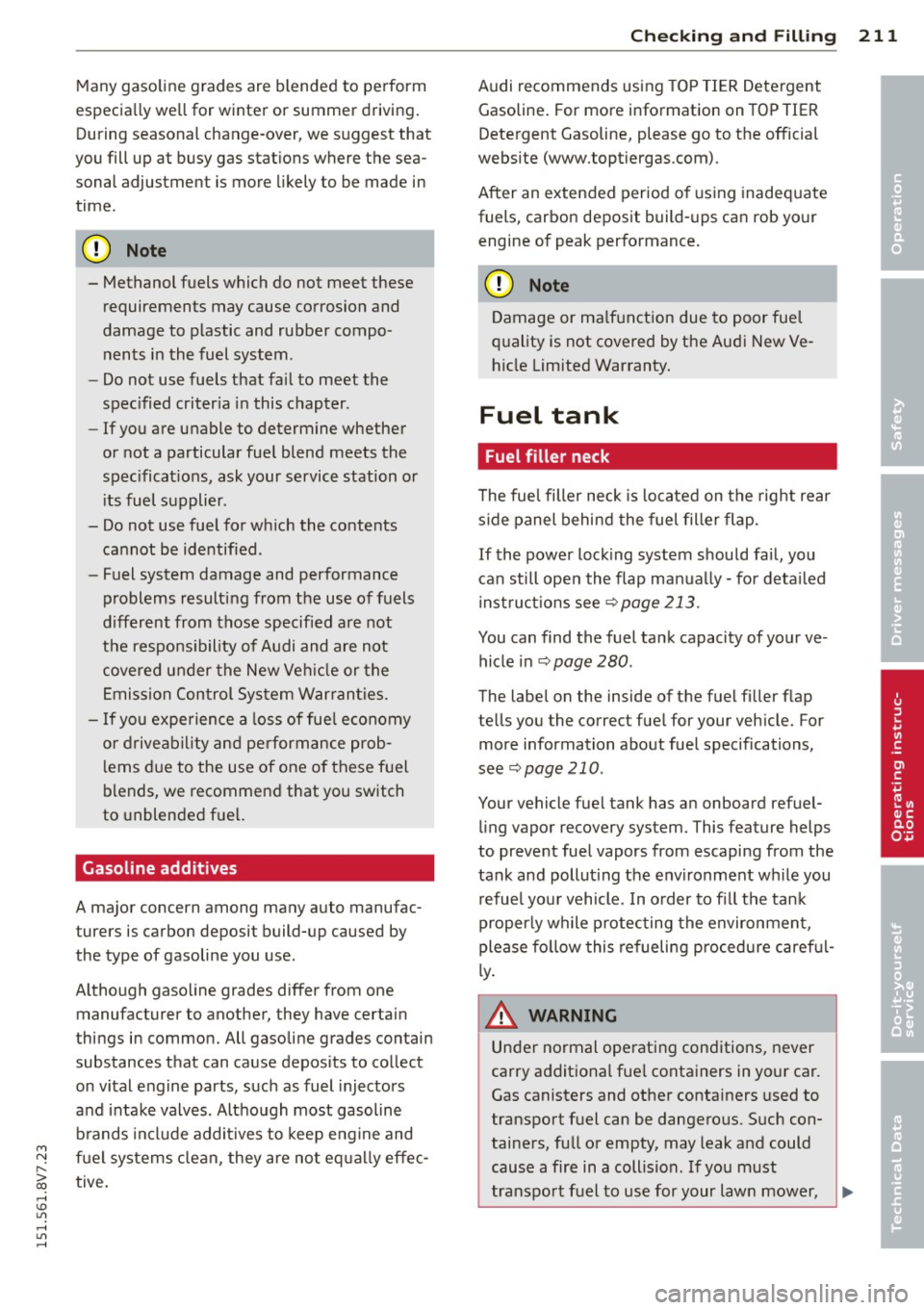
Many gasoline grades are blended to perform
especially well for winter or summer driving. During seasonal change-over , we suggest that
you fill up at busy gas stations where the sea sonal adjustment is more likely to be made in
time.
Q;) Note
- Methanol fuels which do not meet these requirements may cause corrosion and
damage to plastic and rubber compo
nents in the fuel system .
- Do not use fuels that fail to meet the
specified criteria in this chapter .
- If you are unable to determine whether
or not a particular fuel blend meets the
specificat ions, ask your service station or
i ts fuel supp lier .
- Do not use fuel for which the contents cannot be identified .
- Fuel system damage and performance
problems resulting from the use of fuels
different from those specified are not
the responsibility of Audi and are not
covered under the New Vehicle or the
Emission Control System Warranties.
- If you experience a loss of fuel economy
or driveability and performance prob
lems due to the use of one of these fuel
blends, we recommend that you switch
to unblended fuel.
Gasoline additives
A major concern among many auto manufac
turers is carbon deposit build-up caused by
the type of gasoline you use .
Although gasoline grades differ from one manufacturer to another, they have cer tain
things in common. All gasoline grades contain substances that can cause deposits to collect
on vital engine parts, such as fuel injectors
and intake valves. Although most gasoline
brands include additives to keep engine and
fuel systems clean, they are not equally effec
tive.
Checking and Filling 211
Audi recommends using TOP TIER Detergent
Gasoline . For more information on TOP TIER
Detergent Gasoline, please go to the official
website (www .toptiergas .com) .
After an extended period of using inadequate
fuels, carbon deposit build-ups can rob your engine of peak performance.
CJ) Note
Damage or malfunction due to poor fuel
quality is not covered by the Audi New Ve
hicle Limited Warranty.
Fuel tank
Fuel filler neck
The fuel filler neck is located on the right rear
side panel behind the fuel filler flap.
If the power locking system should fail, you
can still open the flap manually -for detailed
instructions see~
page 213.
You can find the fuel tank capacity of your ve
hicle in
~ page 280.
The label on the inside of the fuel filler flap
tells you the correct fuel for your vehicle. For
more information about fuel specifications,
see
~ page 210 .
Your vehicle fuel tank has an on board refuel
ling vapor recovery system. This feature helps
to prevent fuel vapors from escaping from the
tank and polluting the environment while you refuel your vehicle. In order to fill the tank
properly while protecting the environment,
please follow this refueling procedure careful
ly .
A WARNING ~
Under normal operating conditions, never
carry additional fuel containers in your car.
Gas canisters and other containers used to
transport fuel can be dangerous. Such con
tainers, full or empty, may leak and could
cause a fire in a collision . If you must
transport fuel to use for your lawn mower, ..,.
•
•
•
Page 214 of 302
212 Checking and Fill in g
snow blower, etc., be very careful and al
ways observe local and state laws regard ing the use, transportation and storage of
such fuel containers . Make certain the con
tainer meets industry standards (ANSI/
ASTM F852 -86) .
(D Note
Never drive your vehicle until the fuel tank
is completely empty . The irregular supply
of fuel can cause misfiring. Gasoline could
enter the exhaust system and damage the
catalyt ic converter.
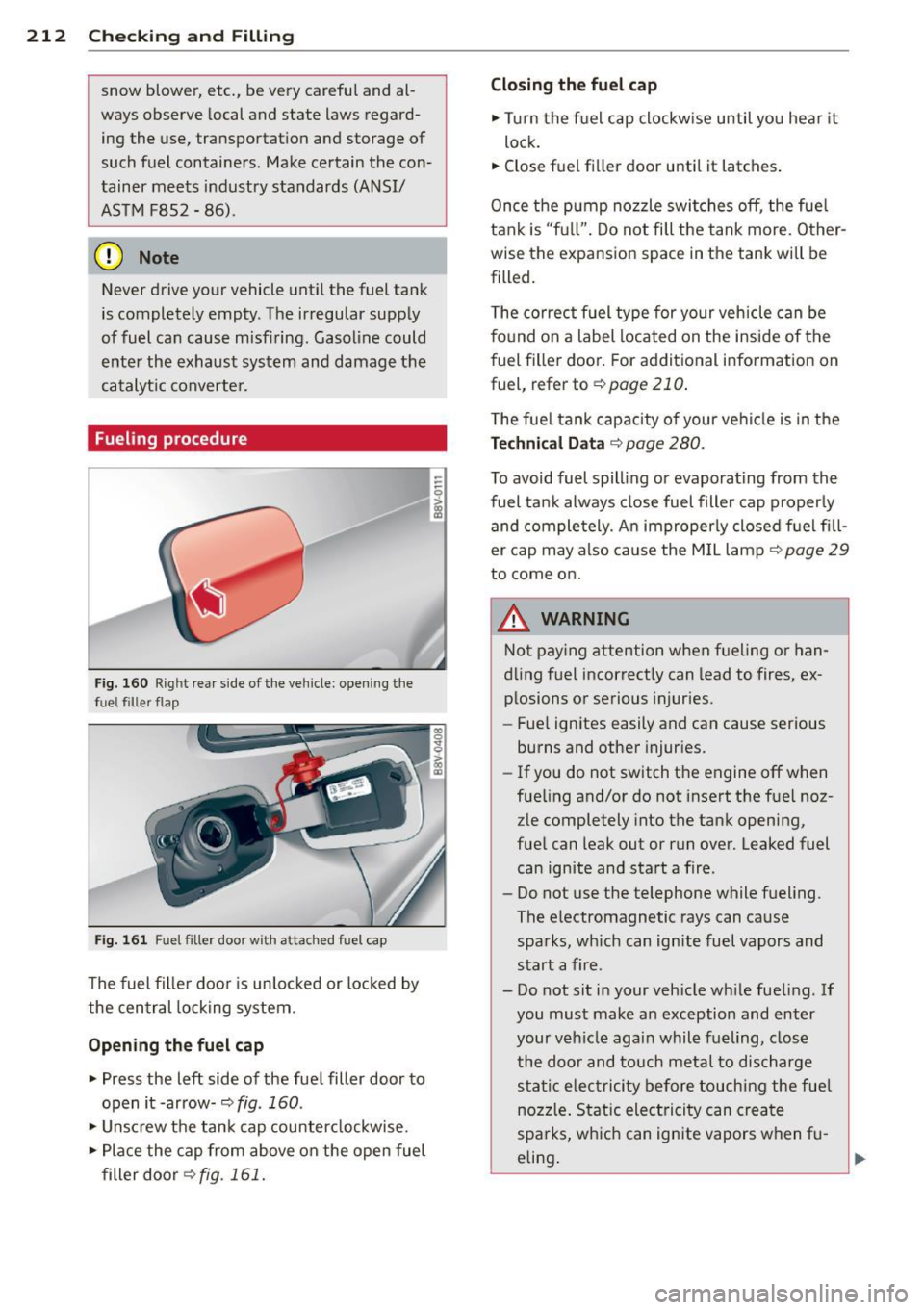
Fueling procedure
Fig. 160 R ig ht rea r side of the veh icle: open ing the
fue l filler f lap
Fig. 161 F u el filler door w ith attached fuel cap
The fuel filler door is unlocked or locked by
the central locking system.
Opening th e fu el cap
.,. Press the left side of the fuel filler door to
open it -arrow-
c::> fig. 160 .
• Unsc rew the tank cap counterclockwise.
• Place the cap from
above on the open fuel
filler door
c::> fig . 161.
Clo sin g th e fu el ca p
.,. Turn the f uel cap clockw ise until you hea r it
lock.
.,. Close f uel fil ler door until it latches .
Once the pump nozzle switches off, the fue l
tank is "fu ll". Do not fill the tank more. Other
wise the expansion space in the tank will be
filled.
The correct fuel type for your vehicle can be
f ound on a label located on the inside of the
fuel filler door. For additional information on
fuel, refer to
c::> page 210 .
The fue l tank capacity of your vehicle is in the
Techni cal D ata c::> page 280.
To avoid fuel spill ing or evaporating from the
fuel tank always close fuel filler cap properly and completely. An improperly closed fuel fi ll
er cap may also cause the M IL lamp
c::> page 29
to come on .
A WARNING
Not paying attention when fueling or han
d ling fuel incorrect ly can lead to fires, ex
plosions or serious injuries.
- Fue l ignites easily and can cause serious
burns and other injuries.
- If you do not switch the engine off when
fue ling and/or do not insert the fuel noz
zle completely into the tank opening ,
fuel can leak out or run over. Leaked fuel can ignite and start a fire .
- Do not use the telephone while fueling.
The electromagnetic rays can cause
sparks, wh ich can ignite fuel vapors and
start a fire.
- Do not sit in your vehicle while fueling . If
you must make an exception and enter
your veh icle again while fueling, close
the door and touch metal to discharge
s tatic electricity before touching the fue l
nozz le . Static electricity can create
sparks, wh ich can ignite vapors when fu-
eling . .,._
Page 215 of 302
....,
N
r--. > co
rl I.O
"' rl
"' rl
-Do not smoke or have an open flame in
the area when fueling your vehicle or fill
ing a fuel container because this
increases the risk of an explosion .
- For your safety, carrying fuel containers
in your vehicle is recommended. Wheth
er full or empty, the container can leak
and cause a fire in the event of an acci
dent .
- If you must make an exception and
transport a fuel container, note the fol
lowing:
- Never f ill the fuel container with fuel
while it is in or on the vehicle. Static
electricity is discharged when filling
which can cause the fuel vapors to ig
nite and increases the risk of an explo
s10n .
- Always place a fuel container on the
ground before filling .
- Always hold the fuel nozzle completely
in the fuel container when filling.
- If the fuel container is made of metal,
the fuel nozzle must always be in con
tact with the container when filling it
with fuel. This prevents static electrici
ty from discharg ing.
- Never sp ill fuel in the vehicle or the
luggage compartment. Evaporated fuel
is exp losive and increases the risk of
serious injury or death .
- Follow legal requirements when using,
storing and transporting fuel contain
ers.
- Make sure the fuel container conforms
to indust ry standards (ANSI/ASTM
F852-86).
(D Note
-Remove spilled fuel from vehicle paint
immediately, because it can damage
paint.
- Never drive until the fuel tank is com
pletely empty. The irregular supply of
fuel that results from that can cause the
engine to misfire. Uncombusted fuel will
enter the exhaust system and increase
Checking and Filling 213
the risk of damage to the catalytic con
verter.
@ For the sake of the environment
- If the fuel nozzle is used correctly , it will
indicate that the tank is full the first
time it switches off automatically. Do
not try to add more fuel, because it can
spill over. Also, the expansion space in
the tank will fill , which can result in fuel
spilling out when it becomes warm and
polluting the environment.
(D Tips
- If the engine is running while fueling, va
pors can escape or the fuel can spill over .
Because of this, the fuel nozzle switches
off before the tank is full.
- Do not fuel the vehicle when the ign ition
is switched on . Otherwise, the fuel
gauge may not show the correct level af
ter fueling the vehicle .
- The fuel filler door on your vehicle does
not lock when you lock the vehicle from
the inside .
Fuel filler door emergency release
If the central locking system is faulty, the
fuel filler door can be unlocked manually .
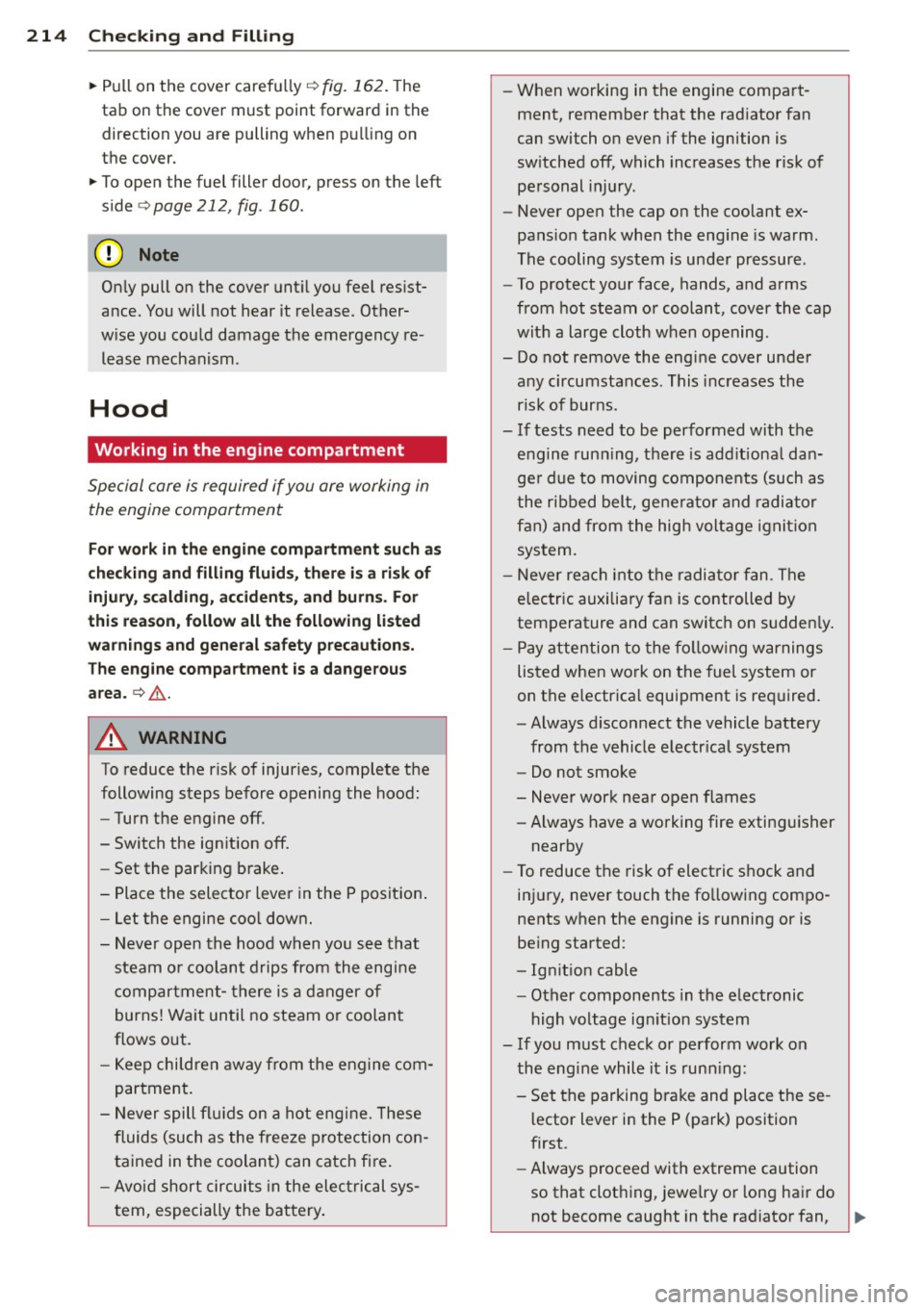
Fig. 162 Rear of the vehi cle: ri ght rea r seat folded for
wa rd
The emergency release is located behind the
right rear seat .
The pull cable for the emergency release is lo
cated on the cover .
.,. Remove the cover from the trim.
Page 216 of 302
214 Check ing and F illin g
•Pullon the cover carefu lly ¢ fig. 162. The
tab on the cover must point forward in the direction you are pulling when pu lling on
the cover.
• To open the fuel filler door, press on the left
side
¢ page 212, fig . 160 .
{Q) Note
Only pull on the cover unt il you feel resist
ance. You will not hear it release . Other
w ise you could damage the emergency re
lease mechanism.
Hood
Working in the engine compartment
Special care is required if you are working in the engine compartment
F o r w ork in th e eng in e c omp artm ent su ch as
c h ecking and fi llin g fluid s, t he re i s a risk of
inj ury, sca lding, accid ents, a nd b urn s. Fo r
thi s re aso n, follow all the follow in g listed
war ning s and ge neral safety p recaution s.
T he engine compartment is a d ang ero us
area. ¢,& .
A WARNING
To reduce the risk of injur ies, complete the
following steps before opening the hood:
- Turn the engine off.
- Switch the ignition off.
- Set the parking brake.
- Place the selector lever in the P position .
- Let the engine coo l down.
- Never open the hood when you see that
steam o r coolant drips from the engine
c ompartment- there is a danger of
burns! Wait until no steam or coolant
flows out.
- Keep chi ldren away from the engine com
partment.
- Never spill flu ids on a hot eng ine. These
fluids (such as the freeze protection con
tained in the coolant) can catch fire .
- Avo id short circuits in the electrical sys
tem, especially the battery . -
When working in the engine compart
ment, remember that the radiator fan
can switch on even if the ignition is
sw itched off, which increases the risk of
personal injury.
- Never open the cap on the coolant ex
pans ion tank when the eng ine is warm.
The cooling system is unde r pressure.
- To protect your face, hands, and arms
from hot steam or coolant, cover the cap
with a large cloth when opening .
- Do not remove the engine cover under any circumstances. This increases the
risk of burns .
- If tests need to be performed with the engine runn ing, there is add itiona l dan
ge r due to moving components (such as
the ribbed belt, generator and radiator
fan) and from the high voltage ignit ion
system.
- Never reach into the radiator fan. The
electric auxilia ry fan is controlled by
temperature and can switch on sudden ly .
- Pay attention to the fo llow ing warnings
listed when work on the fuel system or
on the e lectrica l equipment is required.
- Always disconnect the vehicle battery
from the vehicle e lectr ical system
- Do not smoke
- Never work near open flames
- Always have a working fire exting uisher
nearby
- To reduce the risk of electric s hock and
inj ury, never touch the fo llowing compo
nents when the engine is running or is
be ing started :
- Ig nition cable
- Other compone nts in the electronic
high voltage ign it ion system
- If you must check or perform work on the eng ine while it is runn ing:
- Set the parking brake and place these
lector lever in the P (park) position
first.
- Always proceed with extreme caution
so that clot hing, jewe lry or long hai r do
not become caught in the radiator fan, ..,.
Page 219 of 302
M N ,....
> co ,...., \!) 1.1'1 ,...., 1.1'1 ,....,
Engine oil
Engine oil specifications
The engine oil used must conform to exact
specifications .
The service interval display in the instrument
cluster of your vehicle w ill inform you when it
is t ime for an oil change. We recommend that
you have your o il changed by an author ized
Aud i Service Advisor .
If you have to top off the oil between oil
changes, use the Aud i oil quality standard
specified in the table .
Audi oil quality standard
G asoline
VW 502 00 or
e ngin e vw 504 00
Using the proper engine o il is important for
the functionality and service life of the en
g ine . Your engine was factory-filled with a
hi gh-quality oil which can usua lly be used
throughout the enti re yea r.
(D Note
Your Limited New Vehicle Warranty does
not cover damage or ma lfun ctions due to
fa ilure to fo llow recommended ma in te
nance and use requ irements as set forth in
the Audi Owner's Manua l and Warranty
&
Maintenance book let.
- U se only a high q uality eng ine oi l that ex
pressly comp lies with the Audi oil quality
standard specified for your vehicle's en
gine. Using any other oil can cause seri
ous engine damage.
- Do not mix any l ubricants or other addi
tives into the eng ine oi l. Doing so can
cause eng ine damage.
(D Tips
I f you need to add oi l and there is none
availab le that meets the Audi oil quality
standard your engine requires, you may
add a total of no more than 0.5 quart/liter
of a high-quality "synthetic"oil that meets
t he follow ing specifica tions.
Checking and Fillin g 217
-Veh icles with gasoline engine : ACEA A3
or AP! SM with a viscosity grade of
SAE O W-30, SAE 5W -30 or SAE SW-40 .
- For more information about engine o il
that has been approved for yo ur vehicle,
please contact either your authorized
Audi dealer or Aud i Customer Relations
at 1 (800) 822-2834 or visit our web site
at www .audiusa.com or
www.a udicanada.ca.
Engine oil consumption
The engine in your vehicle depends on an ade
quate amount of oil to lubricate and cool all
of its moving parts .
In order to provide effective lubrication and
cooling of interna l eng ine components, all in
te rnal combust io n engines consume a certa in
amount of oil. Oil consumpt ion va rie s from
engine to engine and may change sign ifi can tly
ove r th e life of the engine. Typically, engines
wi th a spec ified break -in pe riod (see
¢ page 196) consume more oil during the
break-in pe riod than they cons ume after oi l
consumption has stabilized.
U nder normal cond itions, the rate o f oi l con
s u mption depen ds on the q ual ity and viscos ity
of the oil, the RPM (revolutions per minute) at
which the engine is operated, the ambient
temperature and road conditions. Further fac
tors are the amount of oil dilut ion from water
condensa tion or fuel residue a nd the oxida
tion level of the oil. As any engine is subject to
wea r as m ileage builds up, the oil consump
t ion may incre ase over time until replacement
of wo rn components may be come necessary.
With a ll these va riab les coming into p lay, no
standard rate of oil consumpt io n can be es
tabl is h ed or spec ified. There is no alte rn ative
to regul ar and frequent che cking of the o il lev
el , see
Note.
If the yellow engine o il leve l warning sy mbo l
Ill in the ins trument cl uste r lights up, you
sho uld check the oil leve l as soon as possib le
¢ page 2 18 . Top off the oil at your earliest
convenience
¢ page 218 . ll-
•
•
•
Page 220 of 302
218 Checking and Filling
A WARNING
Bef ore you check anything in the engine
compartme nt, always read and heed all
WARNI NGS ¢
page 214.
(D Note
Dr iving with an insufficient oil level is like
ly to ca use severe damage to the eng ine.
(D Tips
- The oil pressu re warning display. is
not an indicator of the oil level. Do not
rely on it. Instead, chec k the oil level in
your engine at regular intervals, pref
erably each time you refuel, and always
before going on a long trip.
- If you have the imp ress ion your engine
consumes excessive amounts of o il, we
r ecommend that yo u consult an aut hor
iz ed Audi dealer to have the ca use of
you r concern p ro perl y diagnose d. Keep in
mind tha t the ac cura te measurement of
oi l co nsu mption requires great care and
may ta ke some time. An authorized Audi
dealer has instructions about how to
measure oil c onsumpt ion accurately.
Checking the engine oil level
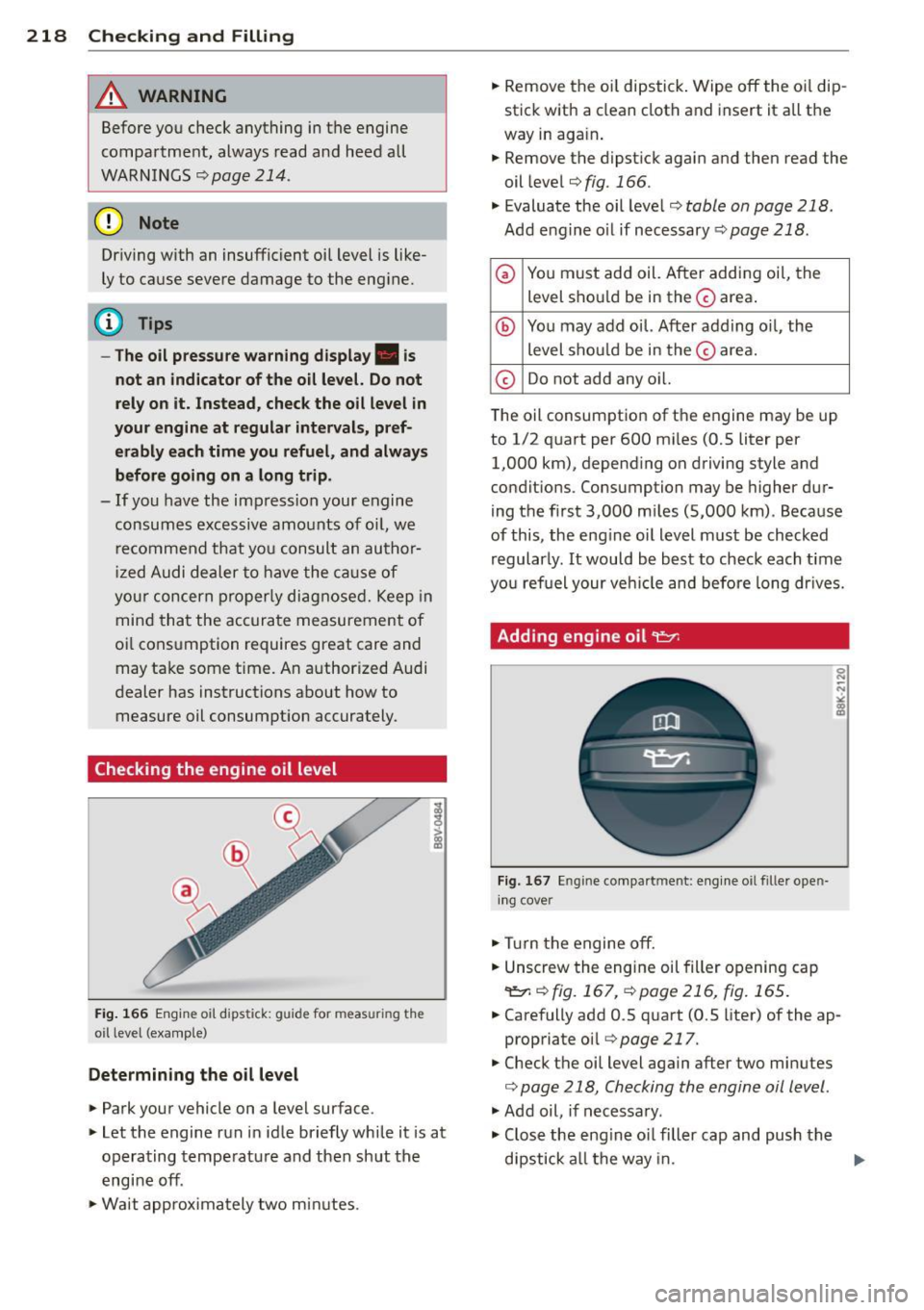
F ig. 166 Eng ine o il d ip st ick: g uide for meas urin g the
o il level (exa mple)
Determining the oil level
.. Park your vehicle on a level surface .
.. Let the engine run i n idle briefly whi le it is at
operating tempe rature and then shut the
engi ne off .
.,. Wait a pproxima tely two mi nutes . ..
Remove the oil dipstick . Wipe off the o il dip
stick w ith a clean cloth and insert it all the
way in aga in .
.. Remove the dipst ick aga in a nd then read the
oil leve l¢
fig. 166 .
.,. Evaluate the oil leve l r::;, table on page 218.
Add eng ine o il if necessary r::;, page 218.
0 You must add oil. After adding oi l, the
level sho uld be in the
0 area .
@ You may add oil. After add ing o il, the
level shou ld be in the
0 area.
0 Do not add any o il.
The oil consumptio n of the e ngine may be up
to 1/2 q uart per 600 m iles (0.5 liter per
1,000 km), depend ing on driving style and
condit ions . Consumption may be higher du r
ing the fi rst 3 ,000 m iles (5,000 km) . Because
of this, the eng ine oi l level must be checked
r e gularly. It would be b est to che ck each time
yo u ref uel your veh icle and befo re long dr ives.
Adding engine oil~
Fig. 1 67 Eng ine co mpa rtm ent: e ng in e o il fill er ope n
in g cover
.,. Turn t he engine off .
.. Unscrew the engine oil fille r opening cap
'l::71 9 fig. 167, r::;,page 216, fig. 165 .
.. Carefully add 0 .5 q uart (0.5 liter) of the ap
propriate oi l¢
page 217 .
.. Check the oil level aga in after two min utes
r::;, page 218, Checking the engine oil level.
.. Add oil, if necessary .
.,. Close the eng in e oil fill er cap and push the
dipstick a ll the way in. ..,.
Page 233 of 302
M N
" > co ,...., \!) 1.1'1 ,...., 1.1'1 ,....,
Bead
means the part of the tire that
is made of steel wires, wrapped
or reinforced by ply cords and
that is shaped to fit the rim.
Bead separation
means a breakdown of the bond
between components in the
bead.
Cord
means the strands forming the
plies in the tire .
Cold tire inflation pressure
means the tire pressure recom
mended by the vehicle manu
facturer for a tire of a designat
ed size that has not been driven
for more than a couple of miles (kilometers) at low speeds in
the three hour period before
the tire pressure is measured or
adjusted.
Curb weight
means the weight of a motor
vehicle with standard equip
ment including the maximum
capacity of fuel, oil, and cool
ant, air conditioning and addi
tional weight of optional equip
ment.
Tires and wheels 231
Extra load tire
means a tire design to operate
at higher loads and at higher inflation pressures than the
corresponding standard tire. Extra load tires may be identi
fied as "XL", "xl", "EXTRA
LOAD", or "RF" on the sidewall.
Gross Axle Weight Rating ("GAWR")
means the load-carrying capaci
ty of a single axle system,
measured at the tire-ground in
terfaces.
Gross Vehicle Weight Rating ("GVWR")
means the maximum total
loaded weight of the vehicle.
Groove
means the space between two
adjacent tread ribs.
Load rating (code)
means the maximum load that
a tire is rated to carry for a giv
en inflation pressure. You may
not find this information on all
tires because it is not required by law.
' •
•
' •
Page 245 of 302
M N
" > co ,...., \!) 1.1'1 ,...., 1.1'1 ,....,
tire failure and loss of
control.
-Excessive speed and/over loading can cause heat
build -up, sudden tire failure
and loss of control.
-If the tire pressure is too low or too high, the tires
will wear prematurely and
the vehicle will not handle
well.
-If the tire is not flat and you do not have to change a
wheel immediately, drive at
reduced speed to the near
est service station to check
the tire pressure and add air as required.
(D Note
Driving without valve stem
caps can cause damage to
the tire valves. To prevent
this, always make sure that
factory installed valve stem caps on all wheels are secure
ly mounted on the valve.
@ For the sake of the environment
Underinflated tires will also
increase the fuel consump
tion.
Tires and wheels 243
Tires and vehicle load limits
'
There are limits to the amount of load or weight that any vehi
cle and any tire can carry. Ave
hicle that is overloaded will not
handle well and is more diffi
cult to stop. Overloading can
not only lead to loss of vehicle
control, but can also damage important parts of the vehicle
and can lead to sudden tire fail
ure, including a blowout and
sudden deflation that can cause
the vehicle to crash.
Your safety and that of your passengers also depends on
making sure that load limits are
not exceeded. Vehicle load in
cludes everybody and every
thing in and on the vehicle .
These load limits are technical ly referred to as the vehicle's
Gross Vehicle Weight Rating
("GVWR").
The "GVWR" includes the
weight of the basic vehicle, all
factory installed accessories, a
full tank of fuel, oil, coolant and other fluids plus maximum ""
' •
•
' •