heating AUDI A3 CABRIOLET 2015 User Guide
[x] Cancel search | Manufacturer: AUDI, Model Year: 2015, Model line: A3 CABRIOLET, Model: AUDI A3 CABRIOLET 2015Pages: 302, PDF Size: 73.83 MB
Page 196 of 302
194 Smart T echnol ogy
not used then is being generated in o rder to
maintain an optimal battery charge level.
(D Tips
- Energy management cannot overcome
the laws o f physics. Note that the charge
l evel and length of the battery life are
li mited .
- When the starting ability is endangered,
the (•) indicator light turns on
c> page20.
What you should know
Maintaining the starting ability is the highest
priority .
A lot of stress is p laced on the battery when
driving short distances, in traffic, and at co ld
times of the year. A lot of energy is used but
little is generated.
It is also critical when the
engine is not running but electrical equip ment is switched on . In this case, energy is
used but none is generated .
In situations like this, energy management
will actively regulated the distribut ion of en
ergy.
L ong periods wi thout u se
If you do not drive your vehicle for several
days or weeks, e lectrica l equipment is gradu
ally sca led back or switched off. This reduces
energy use and ensures the vehicle will be
able to start after long periods of time. Some
conven ience functions such as opening with
the remote control key may not be ava ilable.
These convenience functions w ill be availab le
again o nce you swi tch the ign ition on and
start the engine.
With the engine switched off
For example, if you listen to the radio when
the eng ine is sw itched off, the battery w ill
d rain .
A warning text w ill appear if energy consump
tion could impair starting ab ility .
The message shows that you need to start the
engine in order to charge the battery.
With the en gine running
Although e lectrical energy is gene rated while
driving, the battery can dra in. This can happen
when litt le energy is generated, and much is
u sed and the charge leve l of the battery is not
optimal.
T o restore the balance of ene rgy, components
that require large amounts of energy are tem
porari ly scaled back or switched off. Heating
systems in particular require a great deal of
energy. If you notice, for example, that the
seat heating* or rear window defroster is not
worki ng, then it has been temporar ily reduced
or switched off . These systems are available
again as soon as the energy balance has been
resto red.
In add ition, you may notice that the idle
speed has slightly increased. That is normal
and no cause for concern. Due to the in
c reased idling speed, the additional required
energy w ill be gene rated and the battery will
be charged.
Notice about data
recorded by the Event
Data Recorder and
vehicle control
modules
E v ent D ata Reco rder
This vehicle is equ ipped with an Event Data
Recorder (EDR). The main purpose of an EDR
is to record, in certain crash or near crash-like
situations, such as an a irbag deployment or
hitting a road obstacle, data that will assist in
understanding how a vehicle's systems per
formed . T he EDR is des igned to record data
related to vehicle dynam ics and safety sys
tems fo r a short period of time, typically
30 seconds or less . The EDR in this vehicle is
designed to record such data as:
- How various systems in your vehicle were
operating;
- Whether or not the driver and passenge r
safety belts were b uckled/fastened;
Page 200 of 302
198 Driving and the environment
can reach the cata lytic converter. This
could result in overheating of the con
verter, requ iring its replacement.
- To assure efficient operation of the Emis
sion Control System:
- Have your veh icle ma intained properly
and in accordance with the service rec
ommendations in your Warranty
&
Ma intenance booklet.
- Lack of proper maintenance as well as
improper use of the vehicle will impa ir
the function of the emission control
system and could lead to damage.
@ For the sake of the environment
Even when the Emission Contro l System is
operating properly, the exhaus t gas can
have a sulfur-like exhaust gas smell under
some operating states. This depends on
the sulfur content of the fue l being used .
Using a different brand of fuel may help,
or filling the tank w ith lead-free super
grade gasoline.
Placing your vehicle
out of service
If you wou ld like to take your vehicle out of
service for a longer t ime, contact your author
ized Audi dealer or qualified repair facility.
They will advise you of important measures,
such as corrosion protection, maintenance
and storage procedures. Also follow the infor
mat ion about the battery
¢ page 223.
Operate your vehicle
economically and
minimize pollution
General
Your personal style of driving will determine
the economy of your vehicle, as well as ex
haust and noise levels .
Fuel economy, environmental impact, and
wear on your engine, brakes and t ires largely
depend on three factors: -your
personal driving style
- operating conditions
- technical limitations
If you ant ic ipate what you need to do next and
drive econom ically, you can easily cut your
fuel consumpt ion by 1O-lS percent . This sec
t ion w ill give you some tips on how you can
help the env ironment and your pocketbook.
(D Tips
The consumption estimates as published
by ENVIRONMENTAL PROTECTION AGENCY
(EPA) and Transport Canada may not corre
spond to your actual consumption on the
road, which will vary depending upon vehi
cle load and speed, road and weather con
ditions, trip length, etc.
Drive smoothly and keep a lookout
ahead
Vehicles use the most fuel when they are ac
celerating.
.,. Avoid unnecessary accelerating and braking.
Vehicles use the most fuel when they are ac
ce lerating. If you anticipate what is going to
happen next, you will need to brake less and,
thus, acce lerate less. Let the vehicle coast
whenever possible -for example when you see
that the next traffic light is red.
Avoid full throttle '
Driving at moderate speeds saves fuel and
improves your mileage.
.,. Try and keep well below your car's maximum
speed.
Acce lerating gently reduces fue l consump
tion, engine wear, and does not disturb the
environment.
Fuel consumpt ion, exhaust emissions and en
gine noise increase disproportionate ly at high
speeds. If you drive at approximately three
quarters of top speed, fuel consumption wi ll
be reduced by one half. Never drive faster
1111>
Page 201 of 302
M N
" > co ...... \!) 1.1'1
...... 1.1'1 ......
than the posted speed limit and weather con
ditions permit. Reducing unnecessary idling
Even wh en your car is just idling it burns up
fuel.
.,. Shu t the engine off when you a re not dr iv ing
the vehi cle.
... Do not warm up the vehicle by letting the
engine run at idle.
It is effic ient to switch off the eng ine when
stopped at railroad crossings and long red
lights. Turning the engine
off for just 30-40
seconds saves more fu el than is burned by
starting the engine again.
It takes a long time fo r the engine to wa rm up
fu lly when it is running at idle. However , wear
and noxious emissions are especially high
when the engine is wa rming up. So you should
drive away as soon as you start the eng ine and
avoid running at h igh RPM while the engine is
still warm ing up.
Do not leave engine idling unattended af
ter starting. If warning lights should come on to indicate improper operation, they
wou ld go unheeded. Extended idling also
p roduces heat, which cou ld result in over
heating or other damage to the vehicle or
other prope rty .
Regular maintenance
A badly tuned engine unnecessarily wastes a lot of fuel.
.,. Have your vehicle serv iced at regular inter-
vals.
H aving your vehicle regularly serviced by an
author ized Audi dealer helps to ensure that it
runs properly and economically . T he condition
of your vehicle not only affects its safety and
ab ility to hold its value, it also affects fuel
c onsum ption.
Dri ving and the en vironm ent 199
Chec k your oil e ach t ime you fill your tank.
T he amou nt of oi l used is re lated to engine
load a nd speed.
It is normal for the oil consumption of a new
engine to reach its lowest value after a certa in
mileage has bee n driven.
You must drive your veh icle about 3,000 m iles
(5,000 kilometers) before you can properly
assess oil consumpt ion.
This also app lies to fue l consumption and en
gine output .
(D Note
- Have your veh icle ma inta ined properly
and in accordance with the service rec
ommendations in your Warranty
& Ma in
tenance booklet . Lack of proper mainte
nance as well as improper use of the ve
hicle will impair the function of the
em iss ion cont ro l system and cou ld lead
t o damage.
- Do not alter or remove any component of
the Emission Control System unless ap
proved by the manufacture r.
- Do not alter or remove any device, such
as hea t shie lds, switches, ign ition w ires,
valves, which are designed to protect
your vehicle's Emission Control System
and other important vehicle compo
nents.
Fewer short trips
Fuel consumption will always be relatively
high on short trips.
... Try to avoid dr iving sho rt distances with a
cold engine .
T he eng ine and catalytic conve rter have to
reach their optimal operati ng t emperature to
reduce fuel consumption and noxious emis
sions effectively.
Just after starting, a co ld eng ine in a mid-s ize
ca r only achieves a fuel economy of 6 -8 mi les
per gallon (30-40 l/100 km). After about a
half a mile, fuel economy climbs to 12 mpg ..,.
•
•
•
Page 210 of 302
208 Care and cleaning
-Never use warm or hot water to re
move snow or ice from the camera
lens. This could cause the lens to crack.
- Never use abrasive cleaning materials
or alcohol to clean the camera lens.
Th is could cause scratches and cracks.
-Power top
- Remove bird droppings immediately.
- Never use gasoline, spot remover, ben-
zene, paint thinner or other solvents to
remove.
- Door windows
- Remove snow and ice on windows and
exterior mirrors with a plastic scraper.
To avoid scratches, move the scraper
only in one direction and not back and
forth.
- Never remove snow or ice from door
windows and mirrors using warm or
hot water because this could cause
cracks to form.
- To avoid damage to the rear window
defogger, do not apply any stickers on
the heating wires on the inside of the
window.
- Decorative parts/trim
- Never use chrome care or cleaning
products.
- Paint
- To reduce the risk of scratches, the ve-
hicle must be free of dirt and dust be
fore polishing or waxing.
- To prevent paint damage, do not polish or wax the vehicle in direct sunlight.
- To reduce the risk of paint damage, do
not polish away rust spots.
- Remove cosmetics and sunscreen im
mediately -these could damage the
paint.
- Displays
-To avoid scratches, do not use dry
cleaning methods on displays.
- Controls
- Make sure that no fluids enter the con-
trols, because this could cause dam
age.
- Safety belts
- Do not remove the safety belts to clean
them.
- Never clean safety belts or their com
ponents chemically or with corrosive
fluids or solvents and never allow sharp objects to come into contact
with the safety belts. This could cause
damage to the belt webbing.
- If there is damage to the webbing, the
connections, the retractors or the buck
les, have them replaced by an author
ized dealer.
- Textiles/artificial leather/Alcantara
- Never treat artificial leather/Alcantara
with leather care products, solvents,
floor polish, shoe polish, spot remove
or similar products.
- Have a specialist remove stubborn
stains to prevent damage.
- Never use steam cleaners, brushes,
hard sponges, etc. when cleaning.
- Do not turn on the seat heating* to dry
the seat.
- Objects with sharp edges such as zip
pers, rivets on clothing or belts can
cause damage to the surface.
- Open hook and loop fasteners, for ex
ample on clothing, can damage seat
covers. Make sure hook and loop fas
teners are closed.
- Natural leather
- Never treat leather with solvents, floor
polish, shoe polish, spot remover or
similar products.
- Objects with sharp edges such as zip
pers, rivets on clothing or belts can
cause damage to the surface.
- Never use steam cleaners, brushes,
hard sponges, etc. when cleaning.
- Do not turn on the seat heating* to dry
the seat.
- To help prevent the leather from fad
ing, do not leave the vehicle in direct
sunlight for long periods of time . If
leaving the vehicle parked for long pe
riods of time, you should cover the
leather to protect it from direct sun-
light. ...
Page 222 of 302
220 Check ing and F illin g
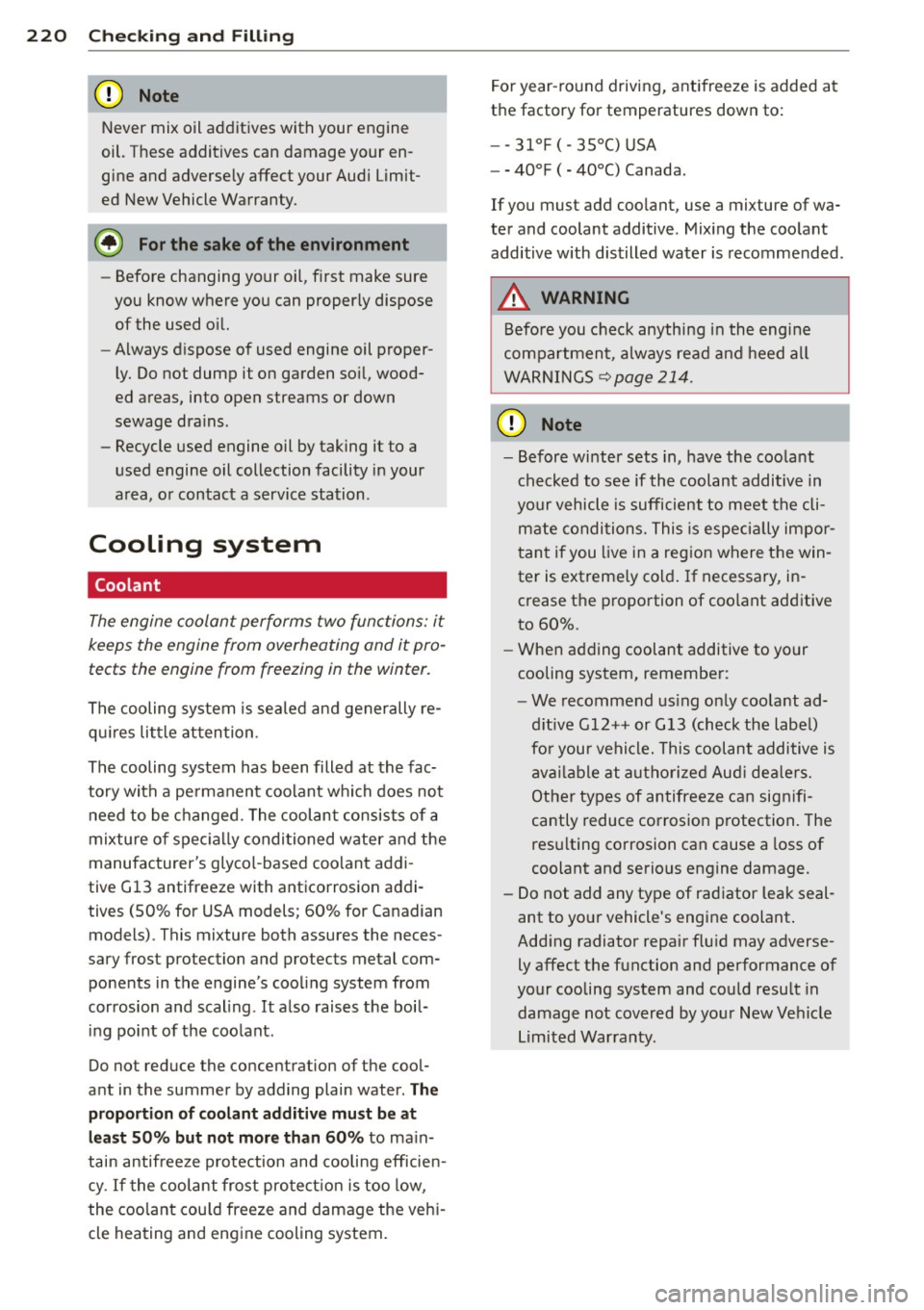
Never mix oil additives with your engine
oil. These additives can damage your en
gine and adversely affect your Audi Limit
ed New Vehicle Warranty.
@) For the sake of the environment
- Before changing your oi l, f irst make sure
you know where you can properly dispose of the used o il.
- Always dispose of used engine oil proper
l y. Do not dump it on garden so il, wood
ed areas, into open streams or down
sewage dra ins.
- Recycle used engine oil by taking it to a
used engine oil collection facility in your
area, or contact a service station .
Cooling system
Coolant
The engine coolant performs two functions: it
keeps the engine from overheating and it pro tects the engine from freezing in the winter.
The cooling system is sea led and generally re
q ui res little attention .
The cooling system has been filled at the fac
tory with a pe rmanent coolant which does not
need to be changed. The coolant consists of a
mixture o f spec ia lly condi tioned water and the
manufacturer's glycol -based coolant addi -
tive G l3 antifreeze with anticorrosion addi
tives (50% for USA models ; 60% for Canadian
models). This mixture both assures the neces
sary frost pro tection and protec ts metal com
ponents in the engine's cooling system from
corrosion and scaling . It also raises the boil
i ng po int of the coo lant .
Do not red uce the concentr ation of the coo l
ant in the summer by adding plain water.
The
proportion of coolant add iti ve mu st be at
least 50 % but not more than 60 %
to main
tain antifreeze protection and cooling efficie n
cy.
If t he coolant frost protect io n is too low,
the coo lant cou ld freeze and damage the veh i
cle heating and engine cooling system. F
or year -ro und driving, antifreeze is added a t
the factory for temperatures down to :
- -31°F(-35°C)USA
- -40°F ( -40°C) Canada.
If you must add coolant, use a mixture of wa
ter and coolant additive . Mix ing the coo lant
additive with distilled water is recommended .
.&, WARNING "---
Before you c hec k anyth ing in the engine
compartment, a lways read and heed a ll
WAR NIN GS ~
page 214.
0 Note
- Before wi nter sets in, have the coo lant
checked to see if the coolant additive in
your vehicle is sufficient to meet the cli
ma te conditions. This is especi ally impo r
tan t if you live in a reg ion where the win
ter is extreme ly cold . If necessary, in
crease the p roportion of coo lant add itive
to 60% .
- Whe n adding coolant additive to yo ur
cooling system, remembe r:
- We recommend us ing on ly coola nt ad
d itive Gl2++ or Gl3 (check the labe l)
fo r your vehicle. This coolant additive is
a va ila ble at au thorize d Au di dea le rs.
Other types of antifreeze can sign ifi
ca ntly reduce corrosion p rotection. The
resu lting corrosion can cause a loss of
coolant and serious engine damage.
- Do not add any type of radiator leak seal
ant to yo ur vehicle's engine coolant .
Add ing radiator repair f luid may adverse
ly affect the function and performance of
your cooling system and cou ld resu lt in
damage not covered by you r New Ve hicle
Limited Warranty.
Page 272 of 302
2 70 Fuses and bulbs
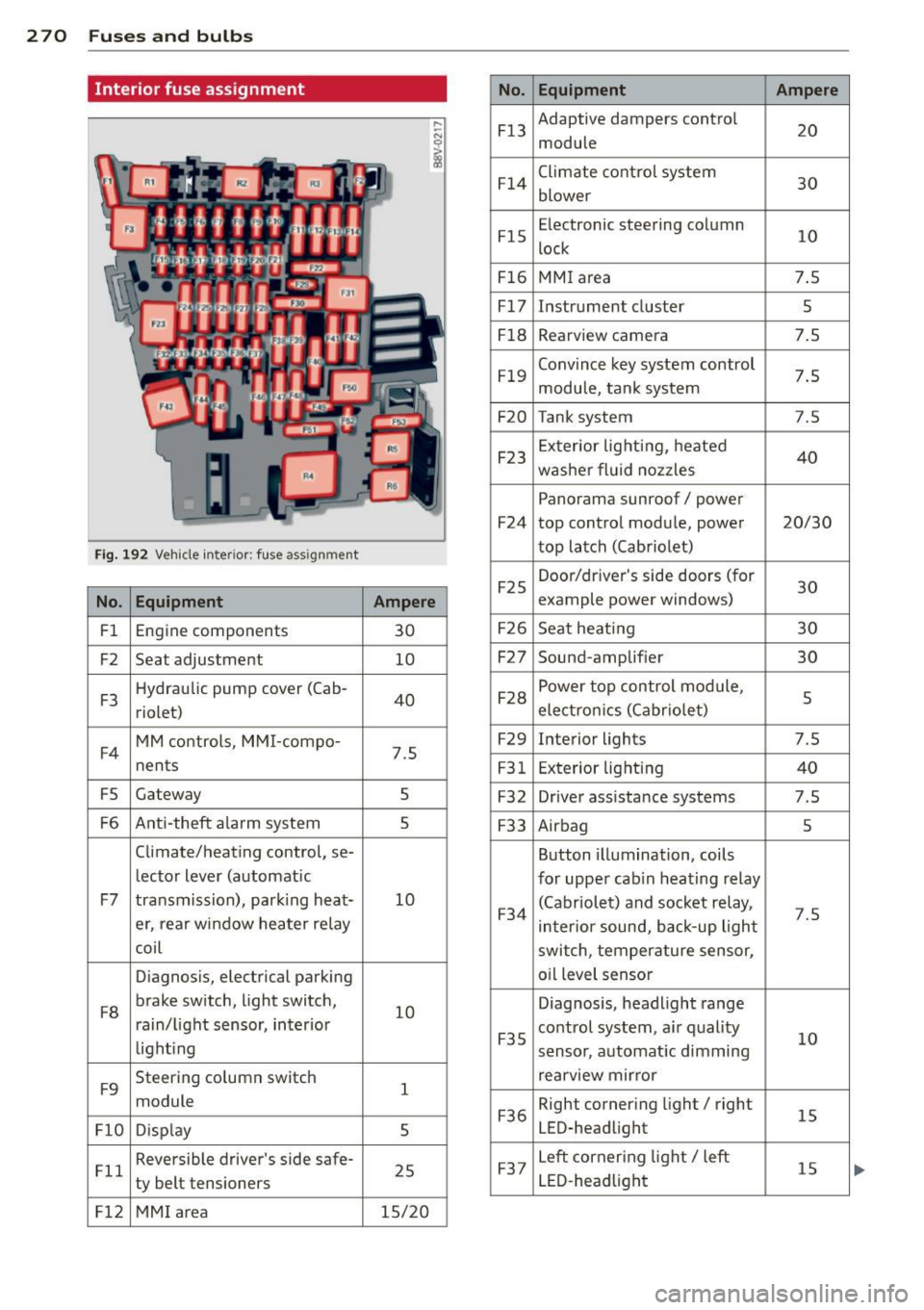
Interior fuse assignment
No. Equipment Ampere
Fl 3 Adaptive dampers contro
l
20
module
Fl4 Climate
control system
30
blower
Fl S E
lectronic steering column
10
lock
Fl6 MM I area 7.5
Fl7 Instrument cluster 5
Fl8 Rearview camera
7.5
F l9 Convince key
system control
7.5
module, tank system
F20 Tank system
7.5
F23 E
xterior lighti ng, heated
40
washe r fl ui d nozzles
Panorama sunroof/ power
F24 top control module, power 20/30
Fig. 192 Vehicle inter ior : fuse assignment top latch (Cabriolet)
No. Equipment Ampere
F25 Door/dr
iver's side doors (for
30
example power windows)
Fl Engine components 30 F26 Seat heat
ing 30
F2 Seat adjustment 10 F27
Sound-amplif
ier
30
F3 Hydraulic pump
cover (Cab-
40
riolet) F28
Power top control module,
5
elect ro ni cs (Cabr io let)
F4 M
M co ntrols, M MI-compo-
7.5
nents F29
Inte
rior lights
7.5
F3 1 E xterior lighting
40
F5 Gateway
5
F32 Driver ass istance systems 7.5
F 6 Anti-theft a
larm system
s F33 Airbag 5
Climate/heating control, se-
Button illumination, coils
lector lever (automatic
for upper cab in heating relay
F7 transmission), park ing heat- 10
er, rear window heater re lay F34 (Cabriolet) and socket relay,
7.5
in ter ior sound, back-up light
coil switch, temperature sensor,
Diagnosis, electrical parking oil level sensor
F 8 brake
switch, light switch,
10
rain/ light sensor, interior
light ing Diagnosis, headlight range
F35 co
ntrol system, a ir quality
10
sensor, a utomat ic dimming
F9 Steering column
switch
1
module
Fl0 D isp lay 5 rearview mir
ror
F36 Right
corner ing light/ right
15
LED-headlight
Fll Reversible driver's
side safe-
25
ty belt tensioners F37
Left corner
ing light/ left
15
L E D- headlight
Fl 2 M MI area 15/20
Page 273 of 302
....,
N
" > co
rl I.O
"' rl
"' rl
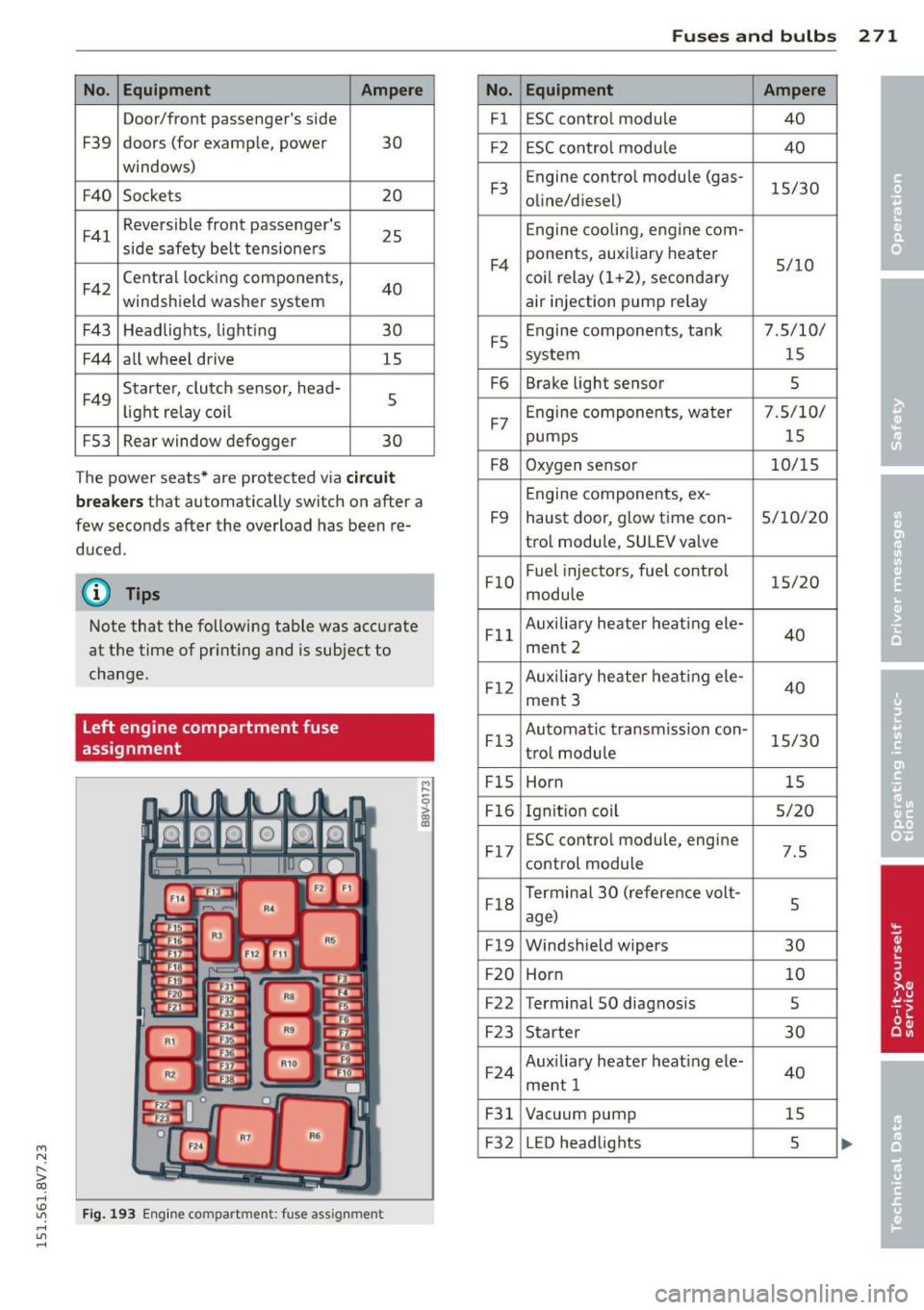
No. Equipment Ampere
Door/front passenger's side
F39 doors (for examp le, power
30
windows)
F40 Sockets 20
F41 Reversible front
passenger's
25
side safety belt tensioners
F42 Central locking components,
40
windshield washer system
F43 Headlights, light ing 30
F44 all wheel drive
15
F49 Starte
r, clutch sensor, head-
5
light re lay coil
FS3 Rear window defogger 30
The power seats* are protected v ia
ci rc uit
b reaker s
that automatically sw itch on after a
few seconds after the overload has been re
duced.
(D Tips
Note that the following table was accurate
at the time of print ing and is subject to
change.
Left engine compartment fuse
assignment
F ig. 193 Engine compartme nt: fuse assignment
No.
Fl
F2
F3
F4
F5
F6
F7
F8
F9
FlO
F ll
F12
Fl3
FlS
F l 6
F l 7
Fl8
F19
F20
F22
F23
F24
F3 1
F32
Fu se s and bulb s 2 71
Equipment Ampere
E5C contro l modu le 40
ESC contro l modu le 40
Engine control module (gas-
15/30
oli ne/d iesel)
Engine cooling, eng ine com-
ponents, auxiliary heater 5/10
coi l relay (1+2), secondary
air injection pump relay
Engine components, tank 7.5/10/
system 15
Brake light sensor 5
Engine components, wa ter 7.5/10/
pumps 15
Oxygen sensor
10/15
Engine compone nts, ex-
haust door, glow time con- 5/10/20
tro l module, SU LEV valve
Fuel injectors, fuel control
15/20
module
Auxiliary heater heating ele- 40
ment 2
Auxilia ry heater heat ing ele-
40
ment 3
Automat ic transmiss ion con-
15/30
t ro l module
Horn 15
Ignit ion coil 5/20
ESC contro l module, engine
7.5
control module
T ermina l 30 (reference volt-
5
age)
Windsh ie ld wipers
30
Horn 10
Termina l 50 diagnosis
5
Starter 30
Auxilia ry heater heat ing ele-
40
ment 1
Vacuum pump 15
L E D head lights 5
Page 292 of 302
290 Index
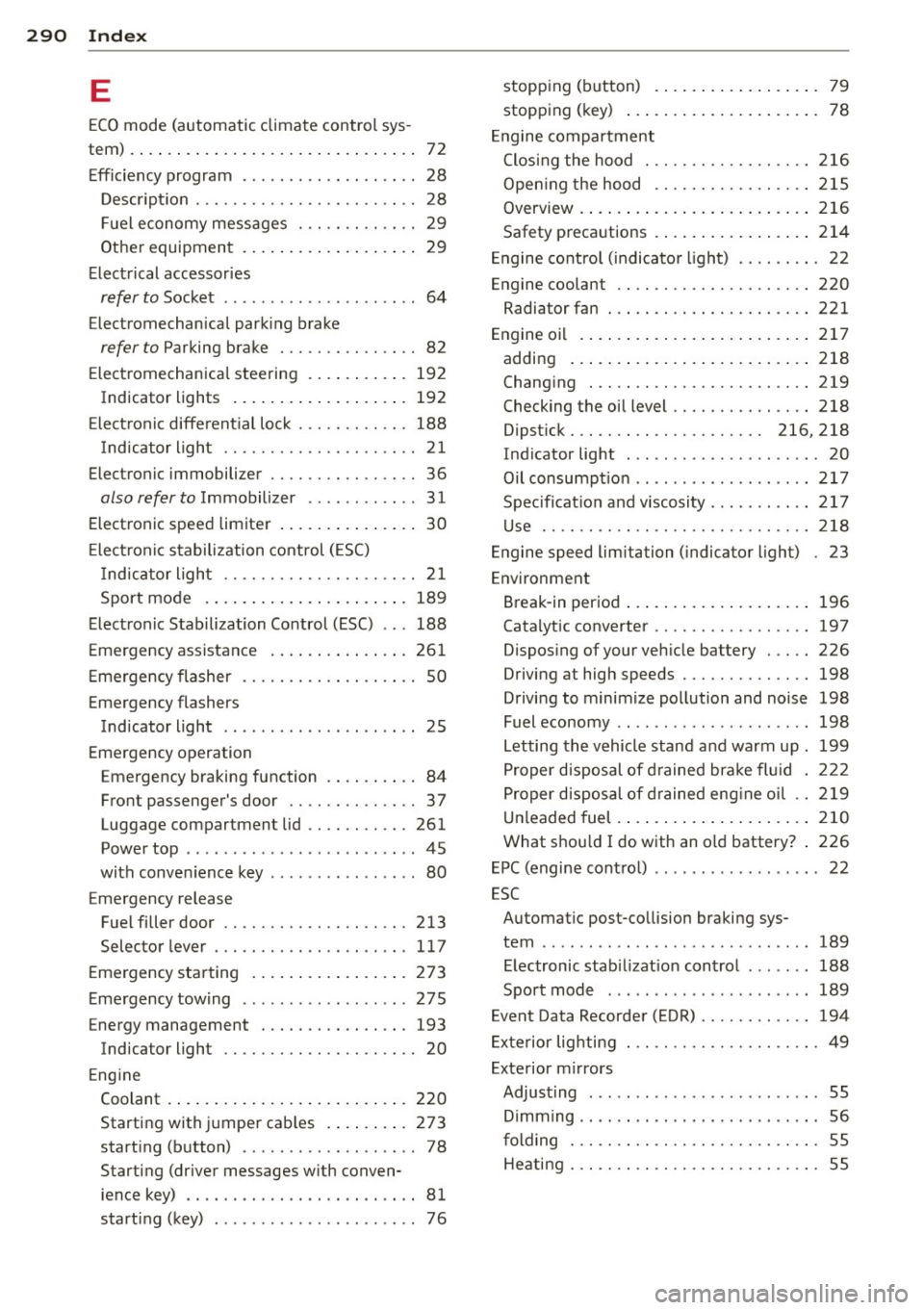
E
ECO mode (automatic climate control sys -
tem) . ..... .. ................ ..... ..
72
Efficiency program . . . . . . . . . . . . . . . . . . . 28
Description .............. .... .. .. .. 28
Fu el economy messages . . . . . . . . . . . . . 29
Other equipment . . . . . . . . . . . . . . . . . . . 29
Electrical accessor ies
refer to Socket . . . . . . . . . . . . . . . . . . . . . 64
Electromechanical parking brake
refer to Parking brake ......... .... .. 82
Electromechanical steering ....... ... . 192
Indicator lights ................... 192
Electronic diffe rent ial loc k ... .. .. .. .. . 188
Indicator light . . . . . . . . . . . . . . . . . . . . . 21
Electronic immobilizer ...... .... .... .. 36
also refer to Immobilizer . . . . . . . . . . . . 31
Electronic speed limiter . . . . . . . . . . . . . . . 30
Electronic stabilization control (ESC)
I ndicator light . . . . . . . . . . . . . . . . . . . . .
21
Sport mode ................ ..... . 189
Electronic Stabilization Control (ESC) . . . 188
Emergency assistance ....... ... .... . 261
Emergency flasher . . . . . . . . . . . . . . . . . . . 50
Emergency flashers
Indicator light . . . . . . . . . . . . . . . . . . . . .
25
Emergency operation
Emergency braking function .... .... ..
84
Front passenger's door ...... .. .. .. . . 37
Luggage compartment lid .. .... .... . 261
Power top . . . . . . . . . . . . . . . . . . . . . . . . . 45
·th ' k
w1 convenience ey . . . . . . . . . . . . . . . . 80
Emergency release
Fuel filler door ........... .........
213
Selector lever . . . . . . . . . . . . . . . . . . . . . 117
Emergency starting ......... ... .... . 273
Emergency towing ... .. .... .. .. .. .. . 275
Energy management ....... .. .. .. .. . 193
Indicator light . . . . . . . . . . . . . . . . . . . . . 20
Engine
Coolant
.. .. ................ ..... . 220
Starting with jumper cables . ..... .. . 273
starting (button) ............. .... .. 78
Starting (driver messages with conven-
ience key) .. ........ ..... .. ........
81
start ing (key) . .. ...... .... ... .. .. .. 76
stopping (button) ............. ..... 79
stopping (key) ... ................ .. 78
Engine compartment
Closing the hood .............. .. ..
216
Open ing the hood ................. 215
Overview . ..... .. ................ . 216
Safety precautions ............. .... 214
Engine control (indicator light) ...... .. . 22
Engine coolant .. .. ............. .... 220
Radiator fan ... .. ... .......... .... 221
Engine oil . ..... .. ................ . 217
adding ....... .. ................ . 218
Changing ........................ 219
Checking the oil level ............... 218
Dipstick. .. .. .. .. ............ 216, 218
Indicator light . .. ... ......... ... .. . 20
Oil consumption .. ..... ..... ... .. .. 217
Specification and viscosity ... .. .. .. .. 217
Use ...... .... ................... 218
Engine speed limitation (indicator light) . 23
Environment
Break-in period . . . . . . . . . . . . . . . . . . . .
196
Catalytic converter ............. .. .. 197
Disposing of your vehicle battery . .. .. 226
Driving at high speeds ............ .. 198
Driving to minimize pollution and noise 198
Fuel economy . ... ....... ...... .. .. 198
Letting the vehicle stand and warm up. 199
Proper disposal of drained brake fluid . 222
Proper disposal of drained eng ine oil .. 219
Unleaded fuel .... ................ . 210
What should I do with an o ld battery? . 226
EPC (engine contro l) . . . . . . . . . . . . . . . . . . 22
ESC
Automatic post-collision braking sys-
tem .. ... ... .. .. .. ...... ....... ..
189
Electronic stabilizat ion control . .. .. .. 188
Sport mode . .. .. ... ....... ... .. .. 189
Event Data Recorder (EDR) . . . . . . . . . . . . 194
Exterior lighting . .. ... .......... ..... 49
Exterior m irrors
Adjusting . . . . . . . . . . . . . . . . . . . . . . . . .
55
D. . 1mming .. .. ...... .. ... ... ... ..... 56
folding ... ................... ..... 55
Heating . .. ................... .... . 55
Page 297 of 302
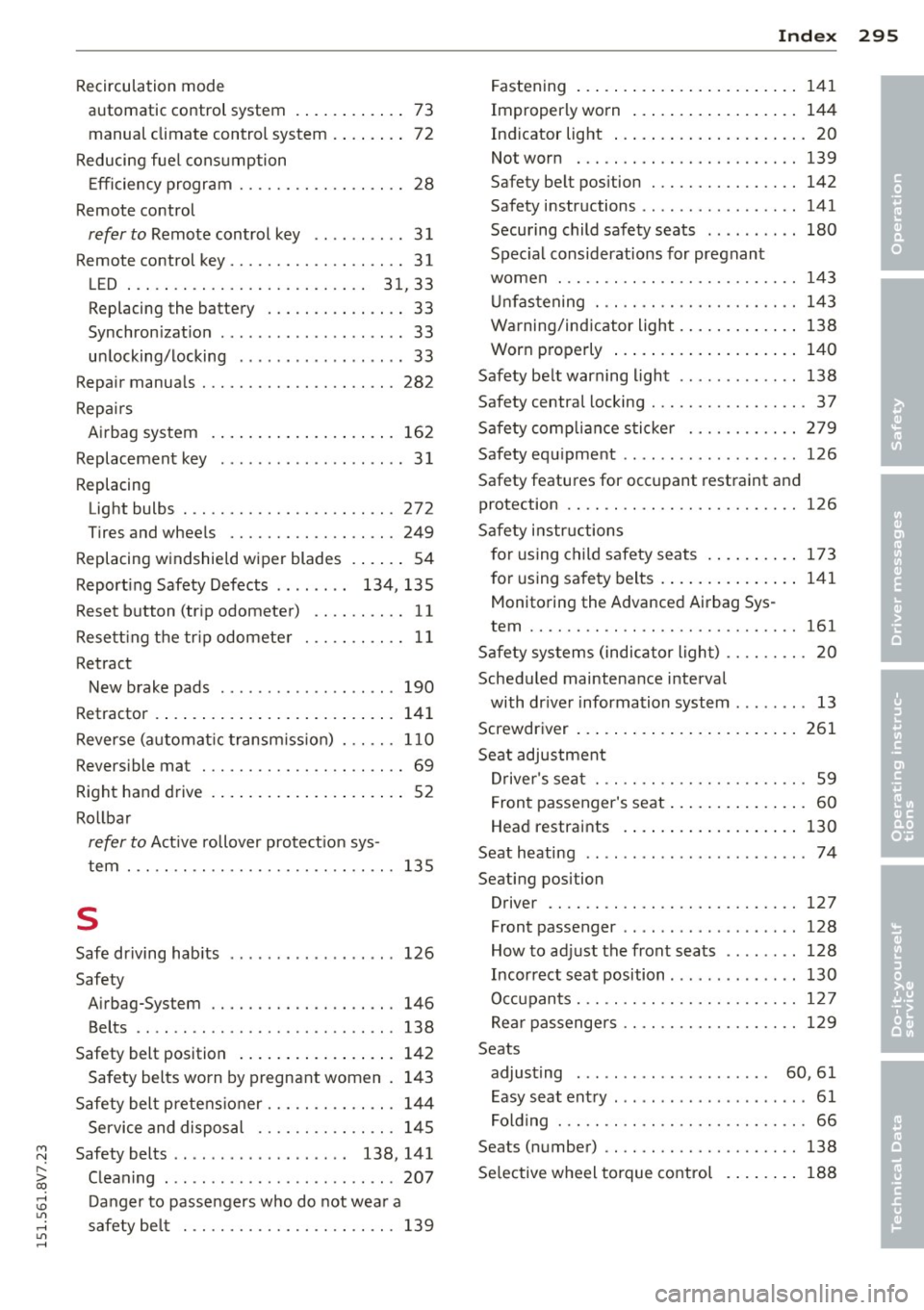
M N ,....
> co ,...., \!) 1.1'1 ,...., 1.1'1 ,....,
_______________________________ I~ n~ d:::: e~x 295
Recirculation mode
automatic control system . . . . . . . . . . . . 73
manual climate control system . . . . . . . . 72
Reducing fuel consumption
Efficiency program . . . . . . . . . . . . . . . . . . 28
Remote control
refer to Remote control key . . . . . . . . . . 31
Remote control key . . . . . . . . . . . . . . . . . . . 31
LED . . . . . . . . . . . . . . . . . . . . . . . . . . 31 33
,
Replacing the battery ..... .. .. .. .. .. 33
Synchron izat ion ....... ...... .... ... 33
un locking/locking ........... .... ... 33
Repair manuals ............ .... .. .. . 282
Repairs Airb ag system ........ ......... .. . 162
Replacement key . . . . . . . . . . . . . . . . . . . . 31
Replacing Light bulbs . ............. .... .. .. . 272
Tires and wheels ......... .. .. .. .. . 249
Replacing windshield wiper blades .. .. .. 54
Report ing Safety Defects . . . . . . . . 134, 135
Reset button (tr ip odometer) . . . . . . . . . . 11
Resetting the trip odometer ... .. .. .. .. 11
Retract New brake pads 190
Retractor
' . .. .. .............. ... .. . 141
Reverse (automat ic transmission) . .. .. . 110
Reversible mat ............ .... .. .. .. 69
Right hand drive .............. ... .. .. 52
Rollba r
refer to Active rollover protection sys -
tem ... .. .. .. .. ........... .. .. ... 135
s
Safe driving hab its
Safety 126
Airbag-System ........... .... .. .. . 146
Belts .. .. .. .. ........ ... .. ... ... . 138
Safety belt position ................. 142
Safety belts worn by pregnant women . 143
Safety belt pretens ioner ..... .. .. .. .. . 144
Service and disposal ...... .. .. .. .. . 145
Safety belts . . . . . . . . . . . . . . . . . . . 138, 141
Cleaning ... .. ........ ... .. ... ... . 207
Danger to passengers who do not wear a
safety belt .............. .. .. .. .. . 139 Fastening .
. . . . . . . . . . . . . . . . . . . . . . . 141
Improperly worn ... ............... 144
Ind icator light ... .. ................ 20
Not worn . .. .. .. ................. 139
Safety belt position . . . . . . . . . . . . . . . . 142
Safety instructions ................. 141
Securing child safety seats ...... .. .. 180
Spec ial considerations for pregnant
women . .. .. .. .. .. . .............. 143
Unfastening . .. .. .... ........... .. 143
Warning/indicator light ............. 138
Worn properly . . . . . . . . . . . . . . . . . . . . 140
Safety belt warning light ............. 138
Safety central locking ............ .. .. . 37
Safety compliance sticker ............ 279
Safety equ ipment ................... 126
Safety features for occupant restraint and
protection .. .. .. .. ................. 126
Safety instructions for using child safety seats .......... 173
for using safety belts .............. . 141
Monitoring the Advanced Airbag Sys -
tem .... .. .. .. .. .. ............... 161
Safety systems (indicator light) . . . . . . . . . 20
Scheduled maintenance interval
with dr iver information system . . . . . . . . 13
Screwdriver ....... .. ............... 261
Seat adjustment
Driver's seat . . . . . . . . . . . . . . . . . . . . . . . 59
Front passenger's seat . . . . . . . . . . . . . . . 60
Head restraints .................. . 130
Seat heating ....... ................. 74
Seating position Driver .... .. .. .. ................. 127
Front passenger .. .. ... ....... ..... 128
How to adjust the front seats ....... . 128
Incorrect seat position ............. . 130
Occupants . .. .. .. ............... .. 127
Rear passengers ...... ........... .. 129
Seats adjusting . . . . . . . . . . . . . . . . . . . . . 60, 61
Easy seat entry . . . . . . . . . . . . . . . . . . . . . 61
Folding ..... .. .. .. .. ........... .. . 66
Seats (number) .. ...... ............. 138
Selective wheel torque control ........ 188
•
•
•
Page 300 of 302
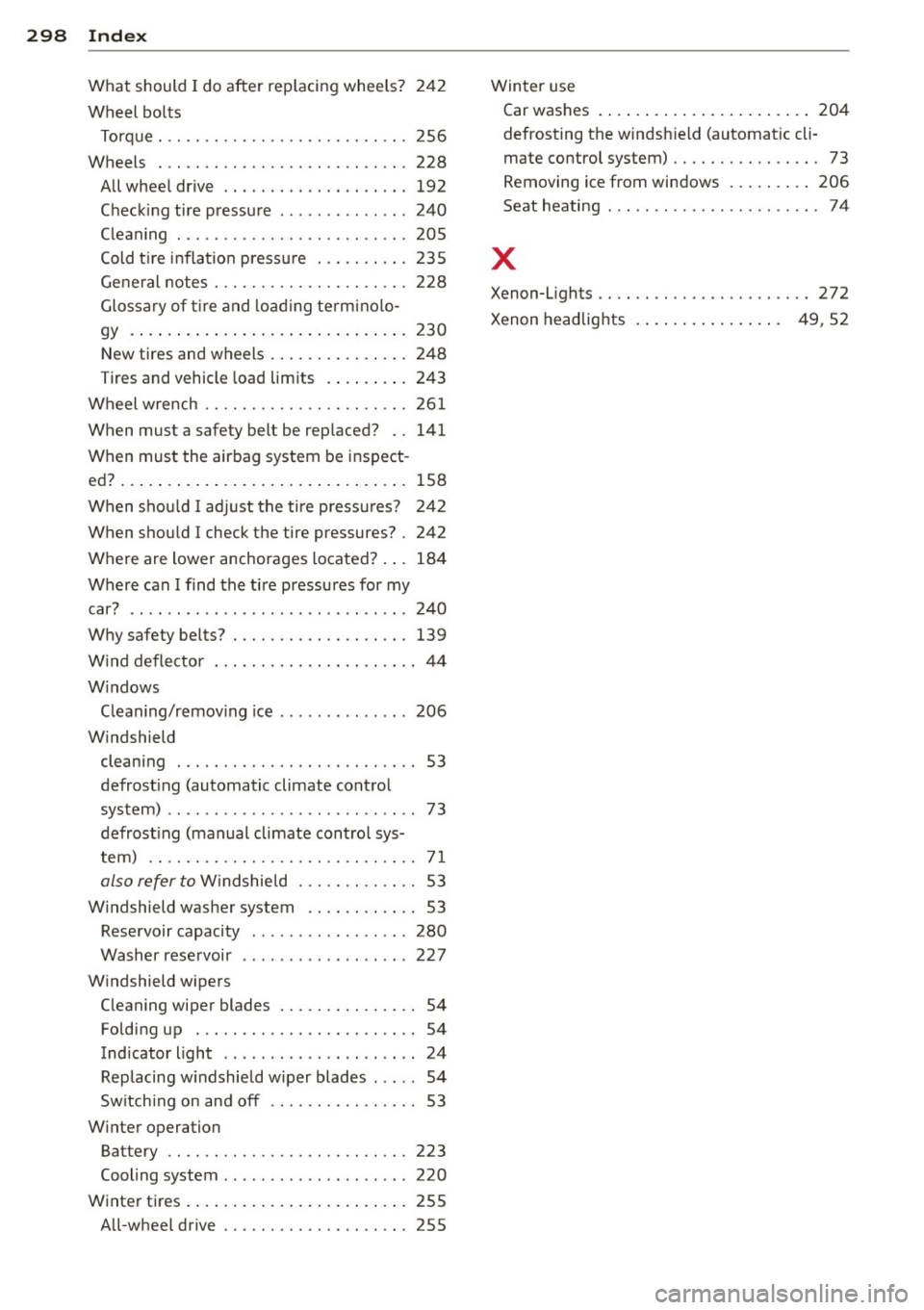
298 Index
What should I do after replacing wheels? 242
Wheel bo lts
Torque . .. .... ........... ........ . 256
Wheels . .. ................. .. .... . 228
All wheel drive .............. ... .. .
192
Check ing tire pressure .......... .... 240
C leaning . .. ................ ... ... 205
Cold t ire in flat ion pressu re ... .. .. .. . 235
General notes . ............... .... . 228
Glossary of t ire and load ing te rm ino lo-
gy .. .... .. ............ ... .. .... . 230
New tires and wheels .... .. .. .... .. . 248
Tires and vehicle load limits . ....... . 243
Wheel wrench ........... .. .. .. .. .. .
261
When must a safety belt be replaced? .. 141
When must the airbag system be inspect-
ed? ... .. .... .. .. ...... ... ... ..... . 158
When should I ad just the tire p ressu res? 242
When should I check the tire pressures? . 242
Where are lower anchorages located? . ..
184
Where can I find the tire pressures for my
car? ...... ....... ........... ... .. . 240
Why safety belts? ...................
139
Wind deflector .. ... .... ... .. .. .... .. 44
W indows
C leaning/remov ing ice ...... ... .. ... 206
W indshield
cleaning ... ............. .. .. .. ... . 53
defrost ing (automatic climate control
system) .. ................. ...... .. 73
defrost ing (manual climate cont ro l sys-
tem) .. .. .. .. ... ........ .. .. .. .. .. 7 1
also refer to Windshie ld ... .. .. .. .. . . 53
W indshield washer system ............ 53
Reservoir capacity ............ .. ...
280
Washer rese rvoir .......... .... .... 227
Windshield wipers Cleaning wiper blades ..... .... ...... 54
Folding up ............... ..... .. .. 54
Ind icator light . . . . . . . . . . . . . . . . . . . . .
24
Replacing w indshield w iper blades ... . . 54
Sw itching on and off ................ 53
W inter operation
Battery .... ...................... 223
Cooling system ................ .... 220
Winter tires .. ... .. ..... ... .. .. .... . 255
A ll-wheel drive .................... 255 Winter use
Car washes . ..... .. ... ..... ... .. .. 204
defrosting the windsh ie ld (automatic cli
mate control system) . . . . . . . . . . . . . . . . 73
Removing ice from windows ..... .... 206
Seat heating ..... ................ .. 74
X
Xenon-Lights .... ............... .... 272
Xenon headlig hts . . . . . . . . . . . . . . . .
49 , 52