sport mode AUDI A3 CABRIOLET 2015 User Guide
[x] Cancel search | Manufacturer: AUDI, Model Year: 2015, Model line: A3 CABRIOLET, Model: AUDI A3 CABRIOLET 2015Pages: 302, PDF Size: 73.83 MB
Page 174 of 302
172 Child Saf ety
WARNINGS. Make certain that the ch ild and
child restraint are correct ly recognized by the
capacitive passenger detect ion system in the
front passenger seat, that the front passenger
a irbag is turned off, and that the airbag status
is always correct ly signa led by the
PAS SEN
GER AIR BA G OFF
light .
Many types and models of child restra ints
have been ava ilable over the years, new mod
els are introduced regular ly incorporating new
and improved designs a nd older models are
taken out of production . Child rest raints are
not standardi zed. Ch ild restra ints of the same
type typi cally have differen t weights and s izes
and d ifferent "footprints", the size and shape
of the bottom of the child restraint that sits
on the seat, when they are installed on a vehi
cle seat. These differences make it virtually imposs ible to certify compliance w ith the re
qu irements for advanced a irbags w ith each
and every child restraint that has ever been
sold in the past or will be sold over the course
of the useful life of you r vehicle .
For this reason, the United States National
Highway Traffic Safety Admin istration has
published a list of specific type, makes a nd
models of child rest raints that must be used
to certify compliance of the Advanced Airbag
System in yo ur vehicle with the suppress ion
requirements of Federal Motor Vehicle Safety
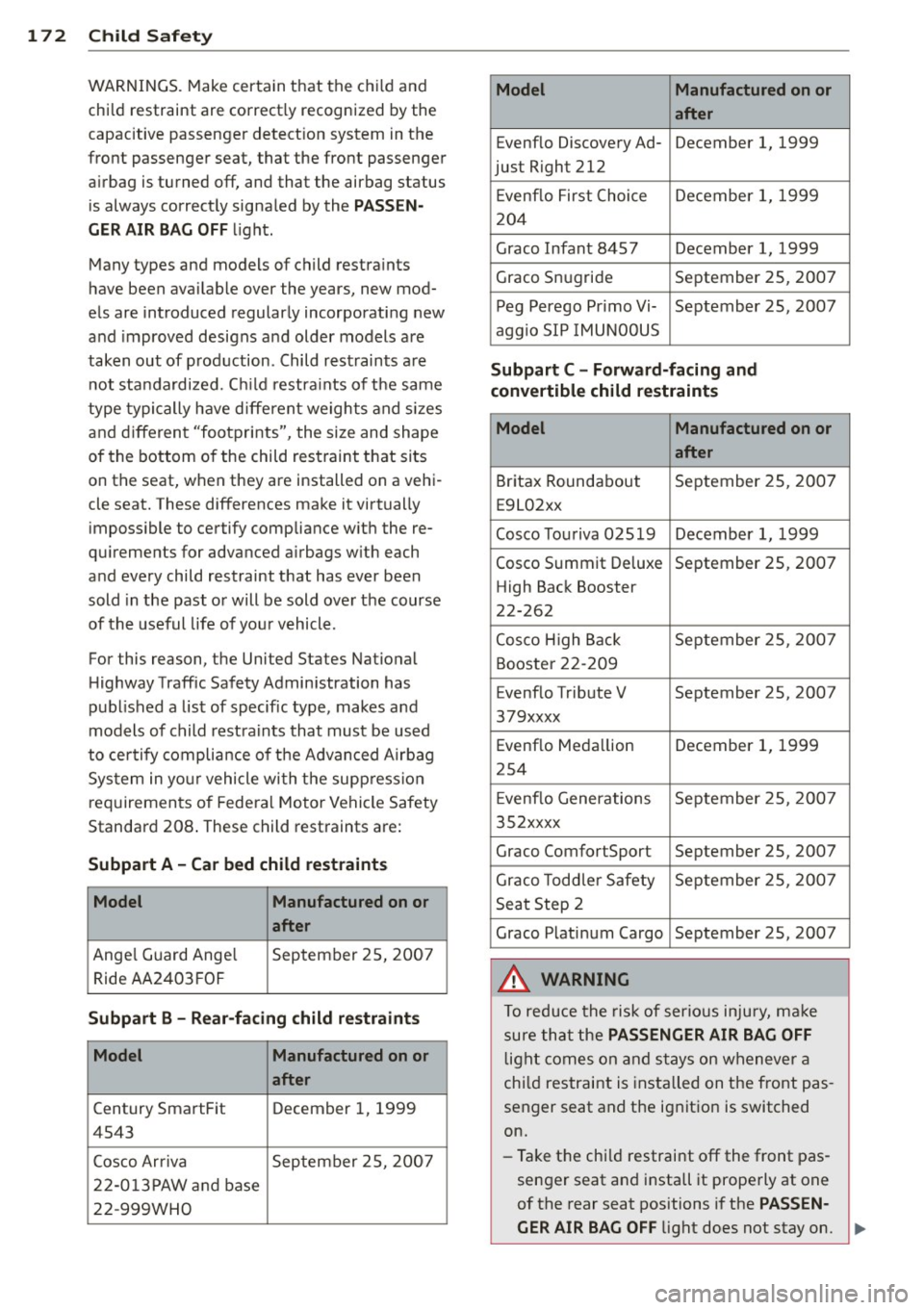
Standard 208 . These child restraints are:
Subpart A -Car bed child restraints
Model Manufactured on or
after
Ange l Guard Ange l September 2S, 200 7
Ride AA2403 FOF
Subpart B -Rear -facing child re straint s
Model Manufactured on or
after
Century SmartFit December 1, 1999
4543
Cosco Arriva September 2S, 2007
22-0 13PAW and base
22-999WHO
Model Manufactured on or
after
Evenflo Discovery Ad- December 1, 1999
just Right 212
E venflo First Choice December 1, 1999
204
Graco Infant 8457 December 1, 1999
Graco Snugride September 25 , 2007
Peg Perego Pr imo Vi- September 25, 2007
aggio SIP IMUNOOUS
Subpart C - Forw ard-facing and
convertible child restraint s
Model Manufactured on or
after
Britax Roundabout September 25, 2007
E9L02xx
Cosco Touriva 02S19 December 1, 1999
Cosco Summit De luxe September 2S, 2007
High Back Booster
22-262
Cosco H igh Back September 2S , 2007
Booste r 22-209
Evenflo Tribute V September 25, 2007
379xxxx
Evenflo Meda llion December 1, 1999
254
E venflo Generations September 25 , 2007
352xxxx
Graco ComfortSport September 25, 2007
Graco Todd ler Safety September 25, 2007
Seat Step 2
Graco Platinum Cargo September 25, 2007
A WARNING
To reduce the risk of serious inju ry, ma ke
sure that the
PASSENGER AIR BAG OFF
l ight comes on and stays on whenever a
chi ld restraint is installed on the front pas
senger seat and the ignition is switched
on.
- Take the chi ld restraint off the front pas
senger seat and install it properly at one
of the rear seat positions if the
PA SSEN -
GER AIR BAG OFF
light does not stay on. ...
Page 191 of 302
....,
N
r--. > co
rl I.O
"' rl
"' rl
Stee ring re comm endat ion
The ESC helps to stabilize the vehicle by
changing the steering torque.
Selective wheel torqu e control
Select ive wheel torque control is used when
driving on curves . The front wheel on the in
side of the curve or both wheels on the inside
of the curve are braked selective ly as needed.
This a llows more precise driving in curves.
Automatic post -collisi on brakin g system
The "Automatic post-collision braking system "
can help to reduce the risk of slidi ng and of
other coll is ions afte r an accident. I f the airbag
con tro l modu le detects a collision above ace r
tain vehicle speed, the vehicle is braked by the
ESC.
The vehicle does not brake automatically if:
- the driver presses the accelerator pedal, or
- the braking force generated by the pressed
brake pedal is greater than the braking force
that would be initiated by the system, or
- the ESC, the brake system or the vehicle
electrical system are not functioning.
A WARNING
-The ESC and its integrated systems can
not overcome the limits posed by natura l
physical laws. This is especially impor
tant on s lippery or wet roads. If the sys-
Switching on/off
Sm art Te chnol og y 189
terns beg in acting to stabilize your vehi
cle, you should immediately alter your
speed to match the road and traffic con
ditions . Do not let the increased safety
provided tempt you into taking r isks .
This could increase your risk of a co lli
SIOn.
- Please note the r isk of a coll is ion increas
es when driving fast, especially through
curves and on slippery or wet roads, and
when dr iv ing too close to objects ahead.
The ESC and its integrated systems can
not a lways prevent collisions -there is
still a risk of accidents!
- Press the accelerator pedal caref ully
when acce lerating on even, slippery sur
faces such as ice and snow. The drive
wheels can spin even when these control systems are installed and this can affect
driving stability and increase the r isk of a
coll is ion.
@ Tips
-ABS and ASR only function correctly
when all four wheels are equipped w ith
identical tires. Different t ire sizes can
lead to a reduct ion in engine power.
- You may hear noises when the systems
descr ibed are working.
- If the
Bl or [I] indicator light appears,
there may be a malfunction
¢ page 21.
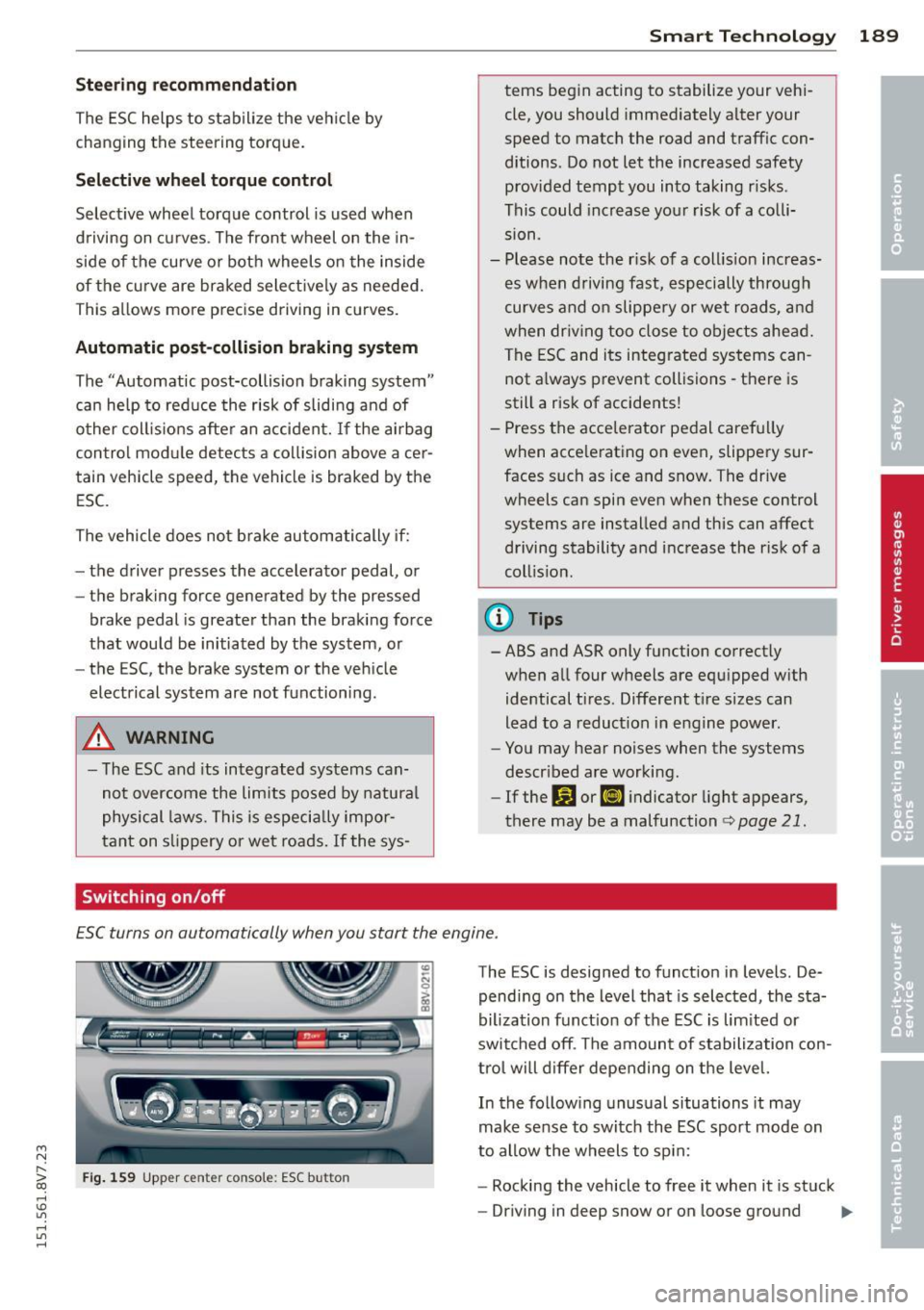
ESC turns on automatically when you start the engine .
Fig. 159 Upper c ente r conso le: ESC button
The ESC is designed to funct ion in levels . De
pend ing on the level that is selected, the sta
bilization funct ion of the ESC is lim ited or
swi tched off . The amoun t of stabilization con
trol wi ll differ depending on the level.
In the follow ing unusual situations it may
make sense to switch the ESC sport mode on
to allow the wheels to sp in:
- Rocking the vehicle to free it when it is stuck
- Driving in deep snow or on loose ground
IJJ-
Page 192 of 302
190 Smart Technology
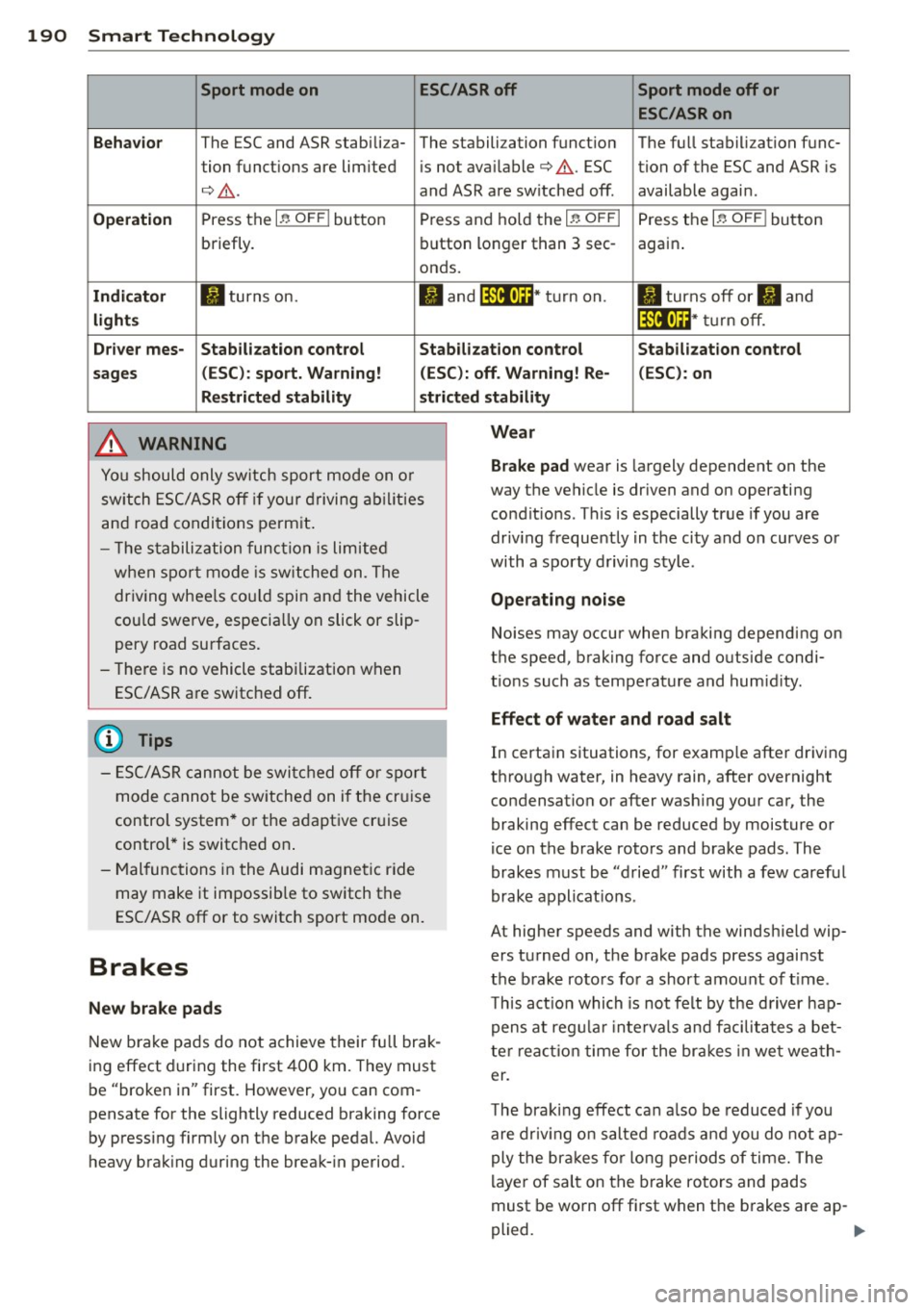
Sport mode on ESC/ASR off Sport mode off or
ESC/ASR on
Beha vior
The ESC and ASR stabiliza- The stabilization funct ion The full stab ilization f unc-
tion funct ions are lim ited is not ava ilable
c> .&. . ESC tion of the ESC and ASR is
¢ _&. . and ASR are sw itched off. available agai n.
Operation Press the l.i; OFF ! button P ress and hold the 1.i; OFFI Press the l.i; OFF ! button
briefly. button lo
nger than 3 sec-
again.
onds.
Indicator II turns on. II and jf'ill•lH * tu rn on. II turns off or fl and
light s jf 'ill•li~* t ur n off.
Dr iver mes- Stabilization control Stab ilizat ion control Stabilization control
sages (ESC ): sport. Warning! (ESC ): off . Warning! Re- (ESC ): on
R estricted stability stricted stability
_& WARNING
You should only switch spor t mode on o r
switch ESC/ASR o ff if your driving abiliti es
an d road condi tions perm it.
- T he s tabilization func tio n i s limite d
whe n spor t mode is sw itche d on. T he
dr iv ing whee ls co ul d spin an d the vehicle
cou ld swe rve , especia lly on slick or slip
pery road surfaces.
- The re is no vehicle stabilization w hen
ESC/ASR a re switched off .
@ Tips
- ESC/ASR c ann ot b e swi tc h ed off o r spor t
mode canno t be sw itche d on i f the cr uise
control system * or the a dapt ive cr uise
control * is switc hed on .
- Mal func tions in the Audi magne tic ride
may make it impossib le to sw itch t he
ESC/ASR off or to switch sport mo de on.
Brakes
New brake pads
-
N ew brake pads do not achieve their fu ll brak
ing effect d urin g the first
400 km. They must
be "broken i n" first. However, yo u can com
pensate for the slightly reduced braking force
by pressing fi rmly on t he brake pedal. Avo id
heavy brak ing dur ing the break- in period.
Wear
Brake pad
wear is largely dependent on the
way the vehicle is dr iven and on operati ng
condit io ns. This is especially true if you are
driv ing frequent ly in t he ci ty and o n curves or
with a spor ty d rivi ng s tyle.
Operating noise
Noises may occur when bra king depending on
the speed , braking force and outside condi
t ions such as tempe rature and hum id ity.
Effect of water and road salt
In certa in situations, for examp le after dr iv ing
t hr ough water, in heavy rain, after overnight
condensation or after was hing your car, the
braking effect can be reduced by moisture or
ice on the brake rotors and brake pads. The
brakes must be "d rie d" first with a few carefu l
brake applicat ions .
At highe r speeds and with the winds hield wip
ers tu rned on, the brake pads press against
the b rake ro to rs fo r a short a mount of t ime .
T h is act ion which is not felt by the d river hap
pen s at reg ular i nte rvals an d facilit ates a bet
te r rea ction t ime for the br akes in we t we ath
er.
T he bra king effect can a lso be redu ced if you
are dr iv ing o n sal ted roads a nd you do not a p
ply the br akes fo r long periods of time. The
l aye r of sa lt on the b rake roto rs and pads
must be wo rn off first when t he b rakes are ap -
plied. ..,..
Page 200 of 302
198 Driving and the environment
can reach the cata lytic converter. This
could result in overheating of the con
verter, requ iring its replacement.
- To assure efficient operation of the Emis
sion Control System:
- Have your veh icle ma intained properly
and in accordance with the service rec
ommendations in your Warranty
&
Ma intenance booklet.
- Lack of proper maintenance as well as
improper use of the vehicle will impa ir
the function of the emission control
system and could lead to damage.
@ For the sake of the environment
Even when the Emission Contro l System is
operating properly, the exhaus t gas can
have a sulfur-like exhaust gas smell under
some operating states. This depends on
the sulfur content of the fue l being used .
Using a different brand of fuel may help,
or filling the tank w ith lead-free super
grade gasoline.
Placing your vehicle
out of service
If you wou ld like to take your vehicle out of
service for a longer t ime, contact your author
ized Audi dealer or qualified repair facility.
They will advise you of important measures,
such as corrosion protection, maintenance
and storage procedures. Also follow the infor
mat ion about the battery
¢ page 223.
Operate your vehicle
economically and
minimize pollution
General
Your personal style of driving will determine
the economy of your vehicle, as well as ex
haust and noise levels .
Fuel economy, environmental impact, and
wear on your engine, brakes and t ires largely
depend on three factors: -your
personal driving style
- operating conditions
- technical limitations
If you ant ic ipate what you need to do next and
drive econom ically, you can easily cut your
fuel consumpt ion by 1O-lS percent . This sec
t ion w ill give you some tips on how you can
help the env ironment and your pocketbook.
(D Tips
The consumption estimates as published
by ENVIRONMENTAL PROTECTION AGENCY
(EPA) and Transport Canada may not corre
spond to your actual consumption on the
road, which will vary depending upon vehi
cle load and speed, road and weather con
ditions, trip length, etc.
Drive smoothly and keep a lookout
ahead
Vehicles use the most fuel when they are ac
celerating.
.,. Avoid unnecessary accelerating and braking.
Vehicles use the most fuel when they are ac
ce lerating. If you anticipate what is going to
happen next, you will need to brake less and,
thus, acce lerate less. Let the vehicle coast
whenever possible -for example when you see
that the next traffic light is red.
Avoid full throttle '
Driving at moderate speeds saves fuel and
improves your mileage.
.,. Try and keep well below your car's maximum
speed.
Acce lerating gently reduces fue l consump
tion, engine wear, and does not disturb the
environment.
Fuel consumpt ion, exhaust emissions and en
gine noise increase disproportionate ly at high
speeds. If you drive at approximately three
quarters of top speed, fuel consumption wi ll
be reduced by one half. Never drive faster
1111>
Page 282 of 302
28 0 Techni cal data
designated s eating position) and luggage
w eight ¢.&, .
Gross Axle W eight Rating
The Gross Axle Weight Rating is the maximum l oad that can be applied at each axle of the
vehicle ¢Lr!, .
Vehicle cap acit y weight
The vehicle capac ity we ight (max . load) is list
ed either on the dr iver's side B-pilla r or inside
the fuel filler flap.
_& WARNING
- T he actual Gross Axle Weight Rat ing at
the front and rear axles shou ld not ex
ceed the permissible weights, and their
combination must not exceed the Gross
Vehicle Weight Rating .
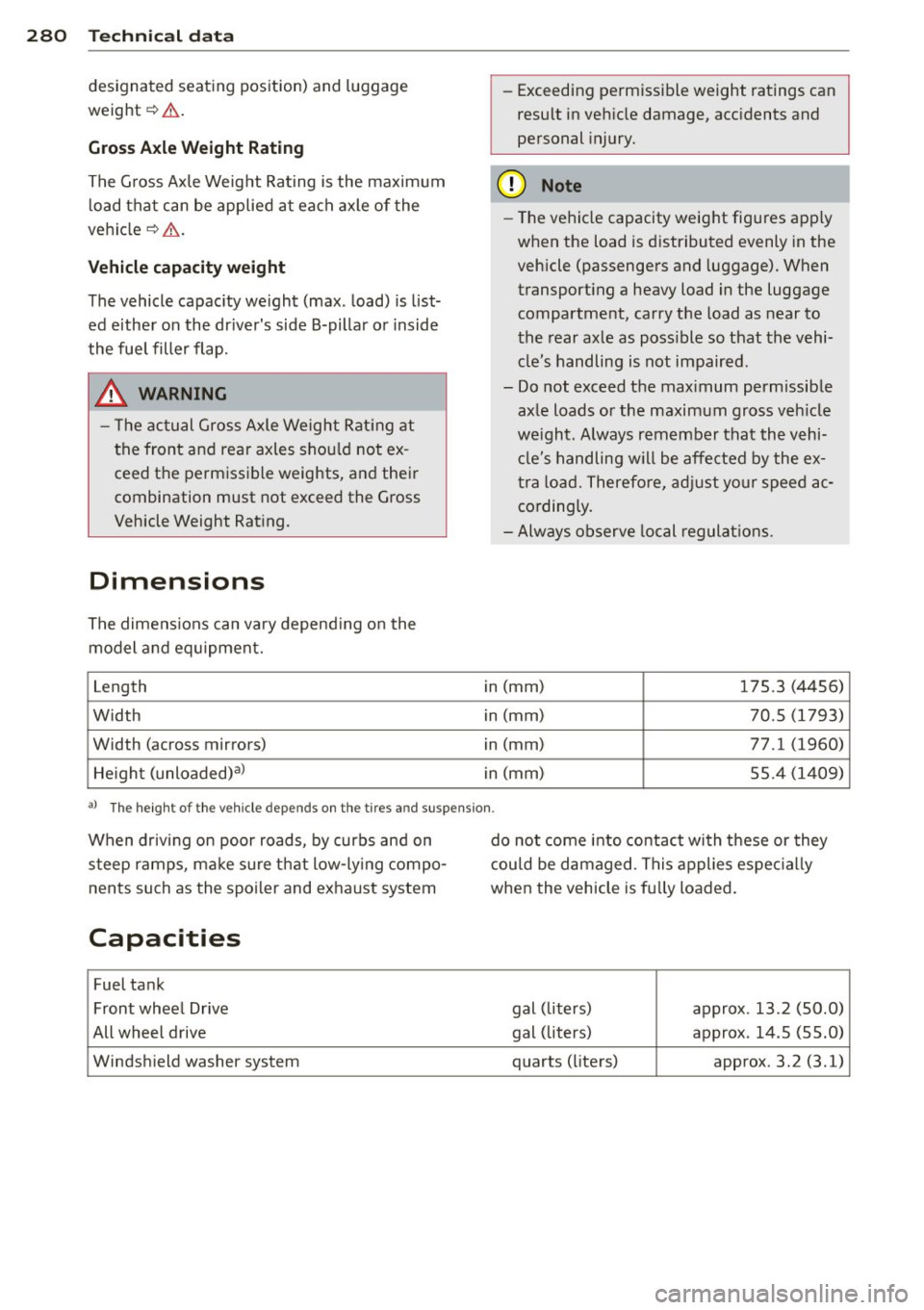
Dimensions
The dimensions can vary depend ing on the
model and eq uipment.
Length
Width
W idth (ac ross m irrors)
He ight (unloaded) a)
-
-Exceeding permissible weight ratings can
result in veh icle damage, acc idents and
personal injury.
(D Note
- The vehicle capacity weight figures apply
when the load is distributed evenly in the
vehicle (passengers and luggage). When
transport ing a heavy load in the luggage
compartment, carry the load as near to
the rear axle as poss ible so that the vehi
cle's handling is not impaired .
- Do not exceed the maximum permissible axle loads or the maximum gross veh icle
we ight. Always remember that the vehi
cle's handling w il l be affected by the ex
tra load. Therefo re, adj ust your speed ac
cordingly.
- Always observe local regulat ions .
in (mm)
175 .3 (4456)
in (mm) 70 .5 (1793)
in (mm) 77 .l (1960)
in (mm) 55 .4 (1409)
a) The h eigh t of the vehicle depen ds on the ti re s and suspension .
When driv ing on poor roads, by curbs and on
steep ramps, make s ure that low-lying compo
nents such as the spoiler and exhaust system
Capacities
F uel ta nk
F ront wheel Drive
All wheel drive
W indsh ield washe r system do not come
into contact with these or they
cou ld be damaged . This applies espec ia lly
when the vehicle is fu lly loaded.
gal (liters) approx.
13.2 (50 .0)
gal (liters) approx. 14.5 (55.0)
quarts (liters) approx. 3.2 (3.1)
Page 292 of 302
290 Index
E
ECO mode (automatic climate control sys -
tem) . ..... .. ................ ..... ..
72
Efficiency program . . . . . . . . . . . . . . . . . . . 28
Description .............. .... .. .. .. 28
Fu el economy messages . . . . . . . . . . . . . 29
Other equipment . . . . . . . . . . . . . . . . . . . 29
Electrical accessor ies
refer to Socket . . . . . . . . . . . . . . . . . . . . . 64
Electromechanical parking brake
refer to Parking brake ......... .... .. 82
Electromechanical steering ....... ... . 192
Indicator lights ................... 192
Electronic diffe rent ial loc k ... .. .. .. .. . 188
Indicator light . . . . . . . . . . . . . . . . . . . . . 21
Electronic immobilizer ...... .... .... .. 36
also refer to Immobilizer . . . . . . . . . . . . 31
Electronic speed limiter . . . . . . . . . . . . . . . 30
Electronic stabilization control (ESC)
I ndicator light . . . . . . . . . . . . . . . . . . . . .
21
Sport mode ................ ..... . 189
Electronic Stabilization Control (ESC) . . . 188
Emergency assistance ....... ... .... . 261
Emergency flasher . . . . . . . . . . . . . . . . . . . 50
Emergency flashers
Indicator light . . . . . . . . . . . . . . . . . . . . .
25
Emergency operation
Emergency braking function .... .... ..
84
Front passenger's door ...... .. .. .. . . 37
Luggage compartment lid .. .... .... . 261
Power top . . . . . . . . . . . . . . . . . . . . . . . . . 45
·th ' k
w1 convenience ey . . . . . . . . . . . . . . . . 80
Emergency release
Fuel filler door ........... .........
213
Selector lever . . . . . . . . . . . . . . . . . . . . . 117
Emergency starting ......... ... .... . 273
Emergency towing ... .. .... .. .. .. .. . 275
Energy management ....... .. .. .. .. . 193
Indicator light . . . . . . . . . . . . . . . . . . . . . 20
Engine
Coolant
.. .. ................ ..... . 220
Starting with jumper cables . ..... .. . 273
starting (button) ............. .... .. 78
Starting (driver messages with conven-
ience key) .. ........ ..... .. ........
81
start ing (key) . .. ...... .... ... .. .. .. 76
stopping (button) ............. ..... 79
stopping (key) ... ................ .. 78
Engine compartment
Closing the hood .............. .. ..
216
Open ing the hood ................. 215
Overview . ..... .. ................ . 216
Safety precautions ............. .... 214
Engine control (indicator light) ...... .. . 22
Engine coolant .. .. ............. .... 220
Radiator fan ... .. ... .......... .... 221
Engine oil . ..... .. ................ . 217
adding ....... .. ................ . 218
Changing ........................ 219
Checking the oil level ............... 218
Dipstick. .. .. .. .. ............ 216, 218
Indicator light . .. ... ......... ... .. . 20
Oil consumption .. ..... ..... ... .. .. 217
Specification and viscosity ... .. .. .. .. 217
Use ...... .... ................... 218
Engine speed limitation (indicator light) . 23
Environment
Break-in period . . . . . . . . . . . . . . . . . . . .
196
Catalytic converter ............. .. .. 197
Disposing of your vehicle battery . .. .. 226
Driving at high speeds ............ .. 198
Driving to minimize pollution and noise 198
Fuel economy . ... ....... ...... .. .. 198
Letting the vehicle stand and warm up. 199
Proper disposal of drained brake fluid . 222
Proper disposal of drained eng ine oil .. 219
Unleaded fuel .... ................ . 210
What should I do with an o ld battery? . 226
EPC (engine contro l) . . . . . . . . . . . . . . . . . . 22
ESC
Automatic post-collision braking sys-
tem .. ... ... .. .. .. ...... ....... ..
189
Electronic stabilizat ion control . .. .. .. 188
Sport mode . .. .. ... ....... ... .. .. 189
Event Data Recorder (EDR) . . . . . . . . . . . . 194
Exterior lighting . .. ... .......... ..... 49
Exterior m irrors
Adjusting . . . . . . . . . . . . . . . . . . . . . . . . .
55
D. . 1mming .. .. ...... .. ... ... ... ..... 56
folding ... ................... ..... 55
Heating . .. ................... .... . 55
Page 298 of 302
296 Index
Selector lever (automatic transmission)
Emergency operation . . . . . . . . . . . . . . . 117
Position ... ................ ..... . 110
Service and disposal
Safety belt p retens ioner ... .. .. .... . 145
Service interval display
with driver informat ion system .. .. .... 13
Setting clock ................ .. .... .. 10
Sett ing date ............ .. .. .. .. .. .. 10
Setting the temperature automatic climate control system ... . . 73
Setting time ............... ... .... .. 10
SETUP (basic setting) ......... .. .... .. 10
Shift paddles (automatic transmission) . 115
Short-term memory ................ .. 27
Side airbags
Description ............ .. .. .. .. .. . 165
H ow they work ........... .. .. .... . 167
Side assist . .. ..... ........... ... .. . 103
Adjust ing the brightness ..... .. .. .. . 105
Cleaning the sensors .......... .. ... 205
Sensor range . ........... .... .... . 104
switch ing on and off .... .. .. .. .. .. . 105
Snow chains ........... .... ... .. .. . 256
All wheel drive ............ ... .. .. . 192
Socket . ..... ................ ..... .. 64
Sources of information about child re-
straints and their use ....... .. .. .. .. . 187
Speed limiter . . . . . . . . . . . . . . . . . . . . . . . 30
Speedometer . . . . . . . . . . . . . . . . . . . . . . . 26
Speed rating letter code ..... .. .. .. .. . 251
Speed warning system ...... .. .. .. .. . . 84
Sport mode . ............... ... .... . 189
Star button .. ... .... ...... .. .. .. .. .. 27
STAR T ENGIN E STOP button (convenience
key) .. .. .. .. .. . .......... .. .. .... .. 78
START ENGINE STOP (convenience key) ... 79
Starting Hill hold . .. ................ ... .. .. 84
Starting from a stop Hill start assist ........... .. .. .... .. 83
Starting (engine)
Automatic start (button) ....... .... . . 78
Automatic start (key) ....... .... ... .. 76
Malfunction (button) . . . . . . . . . . . . . . . . 79
Malfunction (key) . . . . . . . . . . . . . . . . . . . 77 with button
. . . . . . . . . . . . . . . . . . . . . . . 78
with key . ..... .. .. .............. .. 76
Steering Electromechanical steering . . . . . . . 192, 0
Indicator light ... ............. .... . 21
Locking steering (ignition key) ........ 78
Locking the steering (button) . . . . . . . . . 79
locking (mechanica l ignition key) ...... 76
also refer to Electromechanical steer-
ing ... .... .... ................... 192
Steering wheel
adjusting . . . . . . . . . . . . . . . . . . . . . . . . . 76
Buttons ....... .. ............. ..... 27
Multifunction steering wheel .... .. .. . 26
Shift paddles (automatic transmission) 115
Steps for determining correct load limit . 24S
Stopping (engine) with button . . . . . . . . . . . . . . . . . . . . . . . 79
with key .. .... .. ............. .... . 78
Storage compar tments . . . . . . . . . . . 64, 6S
Storage hooks . . . . . . . . . . . . . . . . . . . . . . . 68
S tronic transmission
refer to Automatic transmission .. .. .. 110
Subwoofer .. .. .. .. ............. .. .. 263
Sun visors . ..... .. ................ .. 53
Switch ing daytime running lights on and
off .. .. .. .. .. .. .. .... ...... ... .. .. . 52
Switching the ignition on and off (with
key) ... .... .... ................... . 76
Symbols
refer to Indicator lights . . . . . . . . . . . . . . 13
System indicator light (M IL) . . . . . . . 23, 29
T
Tachometer . . . . . . . . . . . . . . . . . . . . . 10, 11
Technical Data ..... ................ . 279
T echnical modifications ............ .. 284
Temperature display Coolant ....... .. .. ........ ...... .. 10
Outs ide temperature . . . . . . . . . . . . . . . . 11
Tether anchors .. .. ............. .... 185
T ether strap .. .. .. ............. .. .. 185
The first 1 ,000 miles (1,SOO km) and after-
wards ......... ... .. .............. . 196
Tie-downs . . . . . . . . . . . . . . . . . . . . . 67, 133
t ip tron ic (automatic transmission) ..... 115
Page 299 of 302
M N ,....
> co ,...., \!) er, ,...., er, ,....,
Tire pressure .... ..... ..... .. .. .. .. .
Tire pressure monitoring system .. . ... .
T ires .. .. .. .. ............. ···· ·· ·· ·
Service l ife . .. ........... .. .. .. .. .
Speed rating letter code . ... . .. .. .. .
Tire manufacturing date ....... ... . .
T ire pressure monitoring system .... .
T ire spec ifications ........ .... .. .. .
Tread depth .. ........... .. .. .. .. .
Uniform tire quali ty g rading .. .. .. .. . 2
4 0
258
228 246
251
250
259
250
246
254
W inte r tires . ... ...... ... .. .. .. .. . 255
Tires and vehicle load lim its ..... .... .. 243
T ires and whee ls
Checking tire pressure ..... .. .. .. .. . 240
Cold tire i nflation pressure . .. .. .. .. . 235
Dimensions . ................ .. ... .
Gene ral notes ............. ... ... . .
Glossary of t ire and load ing te rmino lo-
gy .. .. ' . .. .. ............. .. .. .. .
L ow aspec t ratio tir es ...... .. .. .. .. .
N ew tires and wheels ... ... .. .. .. .. .
Replacing . ... ... .. ..... ... .. .. .. .
Snow chains 248
228
230 25 7
2 48
249
256
Tires and vehicle load limits .. .. .. .. . 243
Wheel bolts .. ........... .. .. .. .. . 256
W inte r tires
Tire service life
Tool kit 255
246
26 1
Torn or frayed safety be lts ... .. .. .. .. . 141
Tow ing
Tow truck procedures ... ... .. .. .. .. . 275
Towing loop ................ ... ... .. 276
T PMS (tire pressure monitor ing system) . 259
T railer towing 201
Opera ting ins truc tions .. ... .. .. .. .. . 201
Tec hnical req uirements . . . . . . . . 20 1, 202
Trailer towing tips ..... ... .. .. .. .. . 202
T ransm ission ma lf u nct io n (ind icator
l ight) . .. .. .. .. .. ........... .. .. ... 1 16
Transport Canada .... ...... .. .. .. .. . 135
T ravel mode ... ... ..... ... .. .. .. .. .. 52
T read Wear Indicato r (TWI) .. .. .. .. .. . 246
Trunk
refer to Luggage compartment . . . . . . . . 65
T u rn signa ls . ... .. ... . .... ... .. .. .... 51
Indicator light . . . . . . . . . . . . . . . . . . . . . 25
Inde x 297
u
Unfastening safety bel ts . ..... ... .. .. 143
Uni directional tires ... . .. .... .... .. .. 229
Un iform tire quality grading ...... .... 254
Un l ocking/locking
by remo te control . . . . . . . . . . . . . . . . . . 33
with the centra l locki ng sw itch ... .. .. . 35
with t he conven ience key ..... ... .. .. . 34
with the door lock . . . . . . . . . . . . . . . . . . 35
V
Vanity mirro r . . . . . . . . . . . . . . . . . . . . . . . . 53
Vehicle Care/ cleaning .. .. .... ......... .. .. 204
Di mens ions .. .. .. .. .. ........... .. 280
Ou t of service ...... . .. ... .... ... .. 198
Vehicle control modules .............. 194
Vehicle identification label ..... ... .. .. 279
Vehicle Ident ifi cat io n N umbe r (V IN) .. .. 279
Vehicle jack . . . . . . . . . . . . . . . . . . . 261, 266
Vehicle key . . . . . . . . . . . . . . . . . . . . . . . . . 31
Vehicle lite ratu re .. .. ... ....... .... ... 5
Vehicle tool kit .. .. ............. .... 261
w
Warning/indicator lights
System indicator light (MIL) .. ... .. .. . 23
Warning/ Indicato r lights
Airbag system . . . . . . . . . . . . . . . 158, 159
PASS ENGER A IR BAG OF F .... ... .. .. 159
Warning lights
r e fer to Indicato r lights ......... .... . 13
Warranty coverages ................. 282
Washe r fl uid level (ind icator light) ... .. . 24
Washer reservo ir ... ................ 227
Washing matte finish paint .... ... .. .. 204
Wea r indica to r .. .. ............... .. 246
Weights .. .. .. .. .. .. ............... 279
What happens if yo u wear your safety belt
too loose? . ... .... .. . .. .. ..... ... .. 142
What happe ns to unbe lted o ccupants? .. 139
What impairs driving safety? ...... .. .. 127
Wha t shou ld I do after changing a
whee l? ... .. .. .... .. . .. .. ..... ... .. 242
•
•