steering wheel AUDI A3 CABRIOLET 2015 User Guide
[x] Cancel search | Manufacturer: AUDI, Model Year: 2015, Model line: A3 CABRIOLET, Model: AUDI A3 CABRIOLET 2015Pages: 302, PDF Size: 73.83 MB
Page 85 of 302
M N
" > co ,...., \!) ..,.,
,...., ..,., ,....,
-Occasiona l noises when the parking
brake is set and re leased are norma l and
are not a ca use for concern .
- When the vehicle is parked, the parking
brake goes through a se lf-test cycle at
regular intervals. Any noises associated
with th is are normal.
- If there is a power failure, the parking
brake will not set if it is released, and it
will not release if it is set c::>
,&. See an
authorized Audi dea ler or authorized
Audi Service Facility for assistance .
Parking
"'Press the bra ke peda l to stop the vehicle.
"' Pull the switch@c::>
page 82, fig. 82 to set
t h e parking bra ke.
"' Place the selector lever in the P position .
"'T urn the eng ine
off c::> _& .
"'Turn the steering whee l when parking on in
clines so that the whee ls will ro ll into the
curb if the vehicle starts moving.
A WARNING
-Always take the vehicle key with you when leaving the veh icle, even for a
short per iod of t ime. This applies partic
u larly when ch ild ren remain in the vehi
cl e. Otherwise chi ld ren could sta rt the
engine, re lease the par king brake or op
erate electrical eq uipment such as powe r
w indows, which increases the risk of an
acc ident.
- No one sho uld remain in the vehicle
when it is locked, especia lly children.
Locked doors make it more diffic ult for
emergency workers to get into the vehi
cle, which puts lives at risk.
Dri vin g 83
Starting from a stop
The start assist function ensures that the
parking brake is released automatically upon starting .
Stopping and setting the parking brake
"' Pull the sw itch @c::> page 82 , fig. 82 to set
the parking brake.
Sta rting and automatically rel easi ng the
parking brake
Req uirement: The dr iver's door must be
locked and the driver's safety belt must be
fastened.
"' When you press the accelerator peda l, the
parking brake is automatically re leased and
your vehicle begins to move.
When stopping at a traffic signal or stopping in city traff ic, the parking brake can be ap
plied . The vehicle does not have to be held
with the brake pedal. The parking brake elimi nates the tendency to creep when a selector
lever pos it io n is engaged. As soon as you
press the accelerato r peda l, the par king b rake
r eleases a utomat ica lly and the vehicle starts
to move.
Starting on slopes
When sta rting on incl ines, the hill start assist
prevents the vehicle from un intent ionally roll
i ng ba ck. The bra kin g fo rce of the par kin g
brake is not re leased unt il su ff ic ient d riving
f o rce has been built up a t the wheels.
(D Tips
Fo r safety reaso ns, t he pa rking bra ke is re
l eased automatic ally o nly when the d riv
er's safety bel t is fa stened an d the driver's
d oor is locked.
•
Page 92 of 302
90 Audi adaptive cruise control
Switching adaptive cruise control off
.,. Push the lever away from you into position
@ until it clicks into p lace. The message
ACC: off appears.
The stored speed in the LED line is erased.
@ Indicator lights
II -adaptive cru ise contro l is switched on . No
objects are detected ahead. The stored speed
is maintained .
•- An object ahead was detected . The adap
tive cruise control system regulates the speed
and distance to the object ahead and brakes/
accelerates automatically.
r •j-adaptive cruise contro l is switched on . An
object ahead was detected. Your vehicle re
mains stopped and will not start driving auto
matica lly.
•- The automatic braking is not enough to
maintain a sufficient distance to an object
ahead. You must intervener:!>
page 93, Re
quest for driver intervention.
© Instrument cluster display
If adaptive cruise control is not shown in the
instrument cluster disp lay, you can call it up
using the mu ltifunction steering wheel but
tons
r:!> page 2 7.
Based on the graphics in the disp lay, yo u can
determine if the system is maintaining a dis
tance to a vehicle ahead and what that dis
tance to this vehicle is:
No vehicle -No object ahead was detected .
White vehicle -An object ahead was detected.
Red vehicle -Request for the driver to take ac
tion
c> page 93 .
Both arrows on the scale© indicate the dis
tance to the object ahead. No arrow appears
when the vehicle is on an open road and there
is no object ahead.
If an object is detected
ahead, the arrow moves on the scale .
The green zone on the scale indicates the
store distance. For information on changing the d
istance, refer to
i=;, page 92. If the dis
tance selected is exceeded or not reached, the
arrow moves into the red zone on the scale.
A WARNING
- Using adaptive cru ise control incorrectly
can cause collisions, other accidents and
serious injuries.
- If you press the
~IS-ET~I button when driv
ing at speeds below 20 mph (30 km/h),
the vehicle accele rates automatically up
to 20 mph (30 km/h), which is the mini
mum speed that can be set.
(D Tips
-If you switch the ignit ion or the adaptive
cruise control system off, the set speed
is erased for safety reason.
- The Electronic Stabilization Control (ESC)
and Anti-Slip Regulat ion (ASR) both
switch on when the adaptive cruise con
trol is switched on. ESC and ASR cannot
be switched
off when adaptive cruise
contro l is switched on.
- With the adaptive cruise control activat
ed the ESC sport mode canno t be activat
ed.
Changing the speed
App lies to vehicles: wi th Aud i ada ptive c ruise con tro l
0
f
• 0
Fig . 90 Ope rating lever: Changing the speed
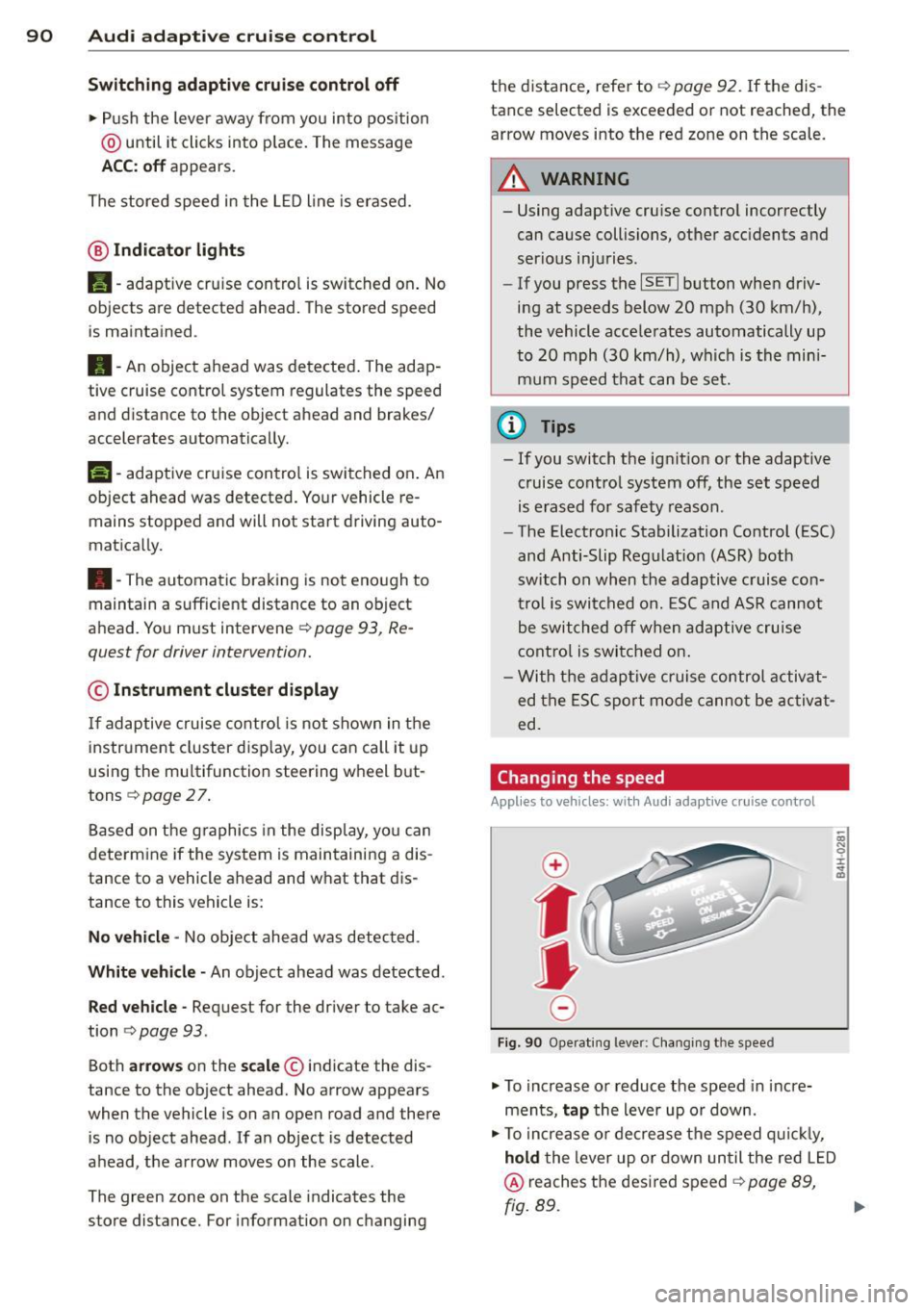
.,. To increase or reduce the speed in incre
ments,
tap the lever up or down.
.,. To increase or decrease the speed quickly,
hold the lever up or down un til the red LED
@ reaches the desired speed i=;, page 89,
fig. 89.
Page 101 of 302
M N
" > co ,...., \!) ..,.,
Audi active Lane assist Lane assist
Description
Applies to vehicles: with Audi active lane assist
Active lane assist detects lane marker lines
within the limits of the system using a camera
in the windshield.
If you are approaching a de
tected lane marker line and it appears likely
that you will leave the lane, the system will
warn you with corrective steering. You can
override this steering at any time. If you pass
over a line, the steering wheel will vibrate
lightly. In order for this warning vibration to
occur, it must first be switched on in the
MMI.
Active lane assist is operable when the lane
marker line is detected on at least one side of
the vehicle.
The system will not warn you before crossing
a lane marker line if you have activated the
turn signal. In this case, it assumes that you
are changing lanes intent ionally.
The system is designed for driving on express
ways and highways and therefore only acti
vates at speeds above approximately 40 mph (65 km/h).
_& WARNING
- The system warns the driver that the ve
hicle is leaving the lane using corrective
steering. The driver is always responsible
for keeping the vehicle within the lane.
- The system can help you keep the vehicle
in the lane, but it does not drive by itself.
Always keep your hands on the steering
wheel.
- Corrective steering may not occur in cer
tain situations, such as during heavy
braking.
- There may be cases where the camera
does not recognize all lane marker lines.
Corrective steering can only take place
on the side of the vehicle where lane
marker lines are detected.
,....,
..,., 1) This function is not available in all countries. ,....,
Audi active lane assist 99
-Other road structures or objects could
possibly be identified unintentionally as
lane marker lines. As a result, corrective
steering may be unexpected or may not
occur.
- The camera view can be restricted, for
example by vehicles driving ahead or by
rain, snow, heavy spray light shining into
the camera or by dirt on the window. This
can result in active lane assist not detect
ing the lane marker lines or detecting
them incorrectly.
- In certain situations where visibility is
low, the vehicle may switch from "early"
to "late" corrective steering
l).
-Under certain conditions such as ruts in
the road, an inclined roadway or cross
winds, the corrective steering alone may
not be enough to keep the vehicle in the
middle of the lane.
- For safety reasons, active lane assist
must not be used when there are poor
road and/or weather conditions such as
slippery roads, fog, gravel, heavy rain,
snow and the potential for hydroplaning. Using active lane assist under these con
ditions may increase the risk of a crash.
Page 102 of 302
100 Audi active lane assist
Switching on and off
App lies to vehicles: with Audi active lane assist
Fig. 95 Tu rn s igna l leve r: butto n fo r act ive lan e ass is t
F ig. 9 6 Windsh ie ld: ca mera window for act ive lane as
sist
-
I
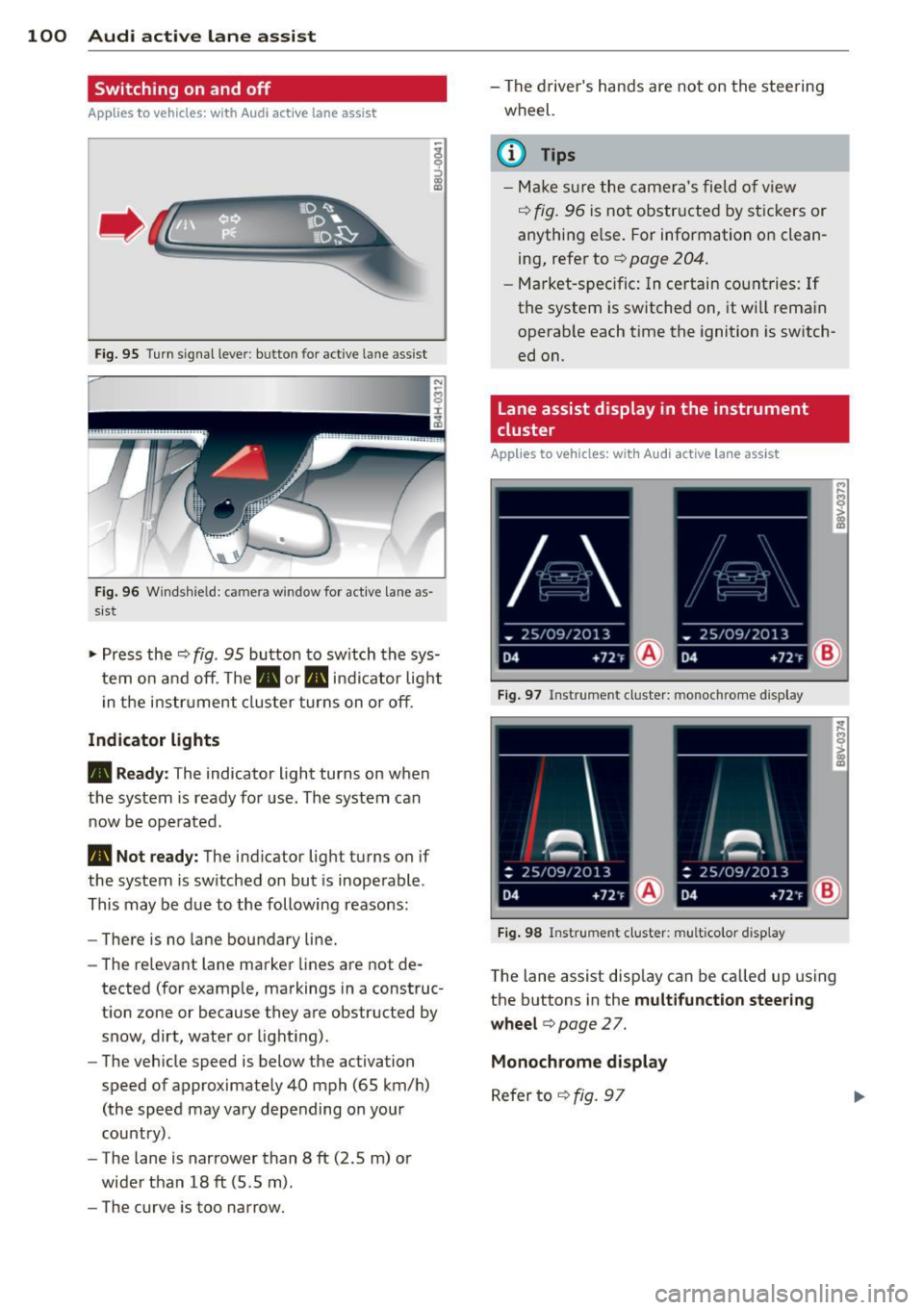
~ Pr ess the ¢ fig. 95 button to sw itch the sys
tem o n and off. The . or. indica tor lig ht
in the i nstru ment clus ter turns on o r off .
Indicator lights
• Ready: The indicator light turns on when
the system is rea dy for use . The system can
now be ope rated .
• Not ready: The ind icator ligh t turns on if
the system is sw itched on but is inoperable .
This may be d ue to the following reasons:
- There is no la ne boundary line.
- The re levant lane marke r lines a re not de-
tected (for examp le, markings in a construc
t ion zone or because they a re obstruc ted by
snow, dirt, water or light ing) .
- The veh icle speed is below the ac tivation
speed of appr oximate ly 40 mph (65 km/ h)
(the speed may vary depending on your
country) .
- The lane is nar rower than 8
ft (2 .5 m) o r
wide r than 18
ft (5 .5 m).
- The curve is too narrow. - T
he driver 's hands are not on the stee ring
wheel.
(D Tips
- Mak e sure th e ca me ra 's fie ld of view
¢
fig. 9 6 is n ot obstr ucte d by st ic kers or
anythi ng e lse. For information on clean
ing , refe r to ¢
page 204.
-Mark et-s pe ci fic: In certain co unt ries: If
the system is switched on, it wi ll rema in
o perab le each time the ignition is sw itch
ed on.
Lane assist display in the instrument
cluster
Applies to vehicles: with Audi active lane assist
Fig. 97 Instrume nt cl uster: monoc hrom e di spl ay
I
Fig. 98 Ins trume nt clust er: mult ic olor d is p lay
T he lane assist disp lay can be called up using
the buttons in the
multifunction steering
wheel
c> page 2 7.
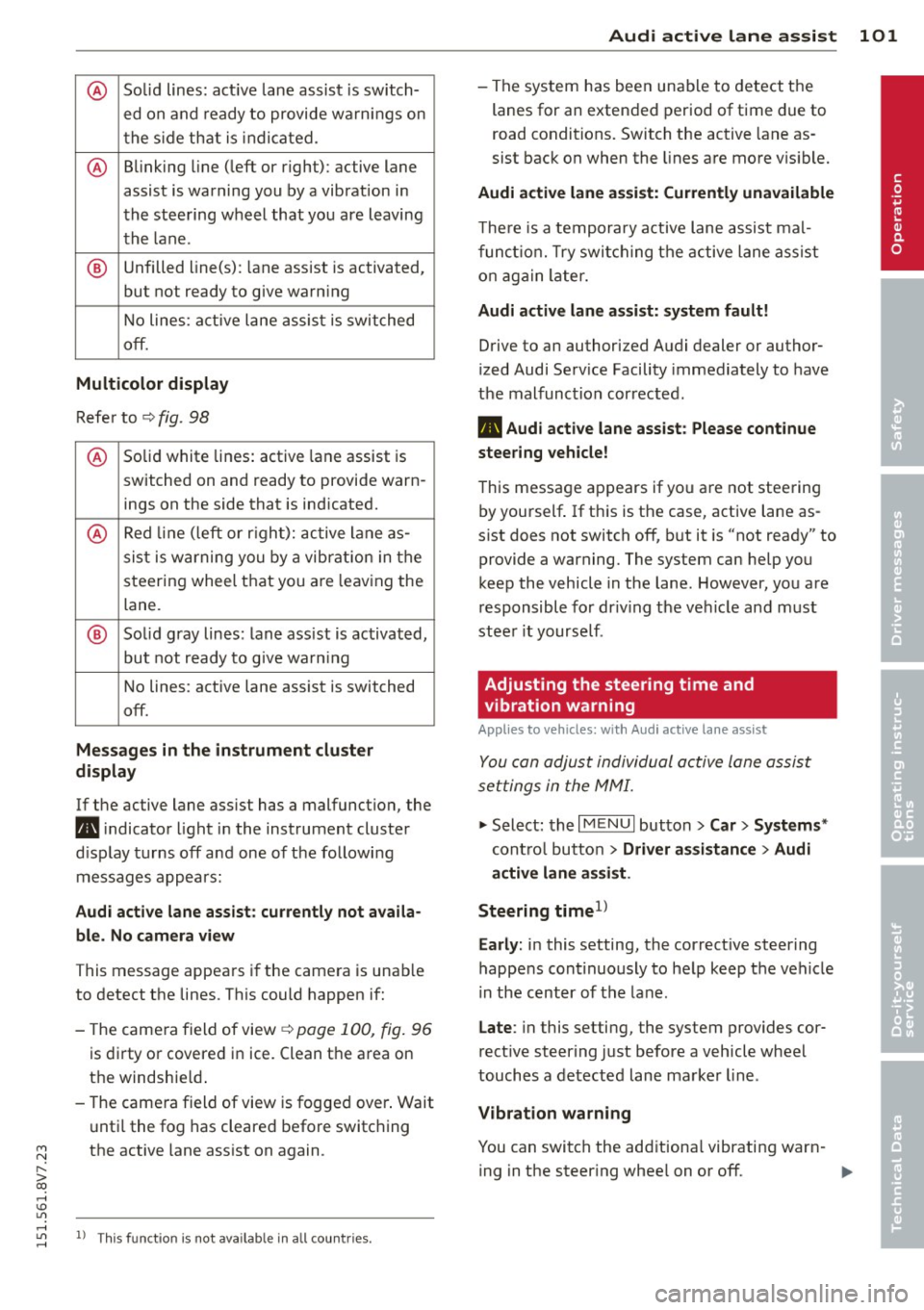
Monochrome display
R efer to ¢ fig. 97
Page 103 of 302
M N
" > co ,...., \!) 1.1"1
@ Solid lines: active lane assist is switch-
ed on and ready to provide warnings on
the side that is indicated.
@ Blinking line (left or right): active lane
assist is warning you by a vibration in
the steering wheel that you are leaving
the lane .
® Unfilled line(s): lane assist is activated,
but not ready to give warn ing
No lines: a ctive lane assist is switched
off.
Multicolor display
Refer to ¢ fig. 98
@ Solid white lines: active lane assist is
switched on and ready to provide warn-
ings on the side that is ind icated.
@ Red line (left or rig ht): active lane as-
sist is wa rning you by a vibrat ion in the
steering wheel that you a re leav ing the
lane.
® Solid gray lines: lane ass ist is activated,
but not ready to give warn ing
No lines: active lane assist is switched
off.
Messages in the instrument cluster
display
If the active lane ass ist has a malfunction, the
m, i ndicato r light in the instrument cluster
d isplay turns off and one of the following
messages appears:
Audi active lane assist: currently not availa
ble. No camera view
This message appears if the camera is unab le
to detect the lines . This could happen if:
- The camera field of view
¢ page 100, fig. 96
is dirty or covered in ice. Clean the area on
the windshie ld.
- The camera field of view is fogged over. Wait
until the fog has cleared before switching
the active lane assist on again.
,....,
1.1"1 l) This funct ion is not availab le in all coun tries. ,....,
Audi active lane assist 101
- The system has been unable to detect the
lanes for an extended period of time due to
road conditions. Switch the active lane as
sist back on when the lines are more v is ibl e.
Audi active lane assist: Currently unavailable
The re is a temporary active lane assist mal
function. Try switching the active lane assist
on again later.
Audi active lane assist: system fault!
Drive to an authorized Audi dealer or author
ized Audi Serv ice Facility immediately to have
the malfunction corrected.
m, Audi active lane assist: Please continue
steering vehicle!
This message appears if you are not steering
by yourself . If th is is the case, active lane as
s ist does not switch off, but it is "not ready" to
provide a warning. The system can help you
keep the vehicle in the lane . However, you are
responsible for driv ing the vehicle and must
steer it yourself .
Adjusting the steering time and
vibration warning
App lies to veh icles : w ith Audi ac tive la ne ass ist
You con adjust individual active lone assist
settings in the MMI.
""Select: the I MENU I button >Car > Systems *
control button > Driver assistance > Audi
active lane assist .
Steering time
1>
Early: in this setting, the correct ive steering
happens cont inuously to help keep the veh icle
i n the center of the lane.
Late : in this setting, the system provides cor
rect ive steer ing just before a vehicle wheel
touches a detected lane marker line .
Vibration warning
You can switch the additiona l vibrating warn-
ing in the steer ing whee l on or off. ..,_ •
Page 117 of 302
....,
N
r--. > co
Shifting manually (tiptronic mode)
Applies to vehicles: with S tronic transmission I shift pad
dles
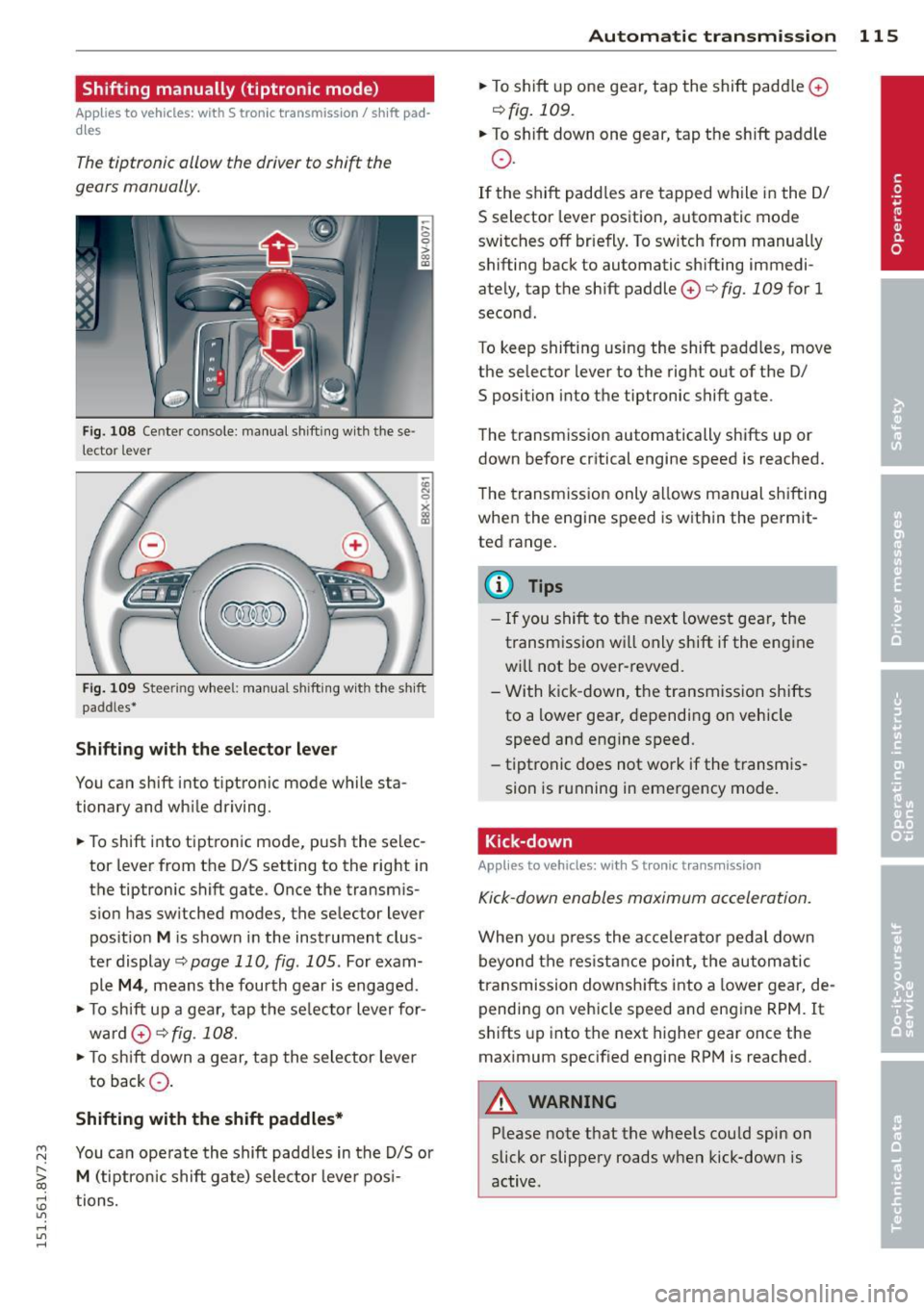
The tiptronic allow the driver to shift the
gears manually.
Fig. 108 Center console: manual shifting with these
lector lever
Fig . 109 Steering whee l: manua l sh ift ing with t he s hift
padd les*
Shifting with the selector lever
You can shift into tip tron ic mode while sta
tionary and while driving.
~ To shift into tip tronic mode, push the selec
tor lever from the D/S setting to the right in
t he tiptronic shift gate. Once the transmis
s ion h as switched modes, the selector lever
position
M is shown in the instrument clus
ter display
¢page 110, fig. 105 . For exam
ple
M4 , means the fourth gear is engaged.
~ To shift up a gear, tap the se lector lever for
ward
0 ¢fig. 108.
~ To shift down a gear, tap the selector lever
to back Q.
Shifting with the shift paddles*
You can operate the shift paddles in the D/S or
M (tiptron ic shift gate) selector leve r pos i-
:;, tions.
"' ,....,
"' ,....,
Autom atic transm ission 115
~ To shift up one gear, tap the shift paddle 0
¢fig. 109.
~ To shift down one gear, tap the shift paddle
0-
If the shift padd les are tapped while in the 0/
S selector lever position, automatic mode
switches off briefly. To switch from manually
shifting back to automatic sh ifting immedi
ate ly, tap the shift paddle
0 ¢ fig. 109 for 1
second .
To keep shifting using the shift paddles, move
the selector lever to the rig ht out of the D/
S position into the tiptronic shift gate.
The transmission automatically shifts up or down before critical engine speed is reached.
T he transmission only allows manual sh ifting
when the engine speed is within the permit
ted range .
(D Tips
-If you shift to the next lowest gear, the
transmission will only shift if the engine
wil l not be over-revved.
- With kick-down, the transmission shifts
to a lower gear, depending on vehicle
speed and engine speed.
- tiptronic does not work if the transmis
sion is running in emergency mode.
Kick-down
App lies to vehicles: wit h S tronic tran smi ssio n
Kick-down enables maximum accelera tion.
When you press the accelerator pedal down
beyond the resistance point, the automatic
transmission downshifts into a lower gear, de
pending on vehicle speed and engine RPM. It
shifts up into the next higher gear once the
maximum specified engine RPM is reached.
A WARNING
Please note that the wheels could spin on
slick or slippery roads when kick-down is
active.
Page 118 of 302
116 Automatic tran smi ssio n
Launch Control-Program
Ap plies to vehicles: with launch co ntrol
The Launch Control Program enables maxi
mum acceleration .
Requirement: The engine must be at operat
ing temperature and the steering wheel must
not be turned .
• With the engine running, press the
l~ OFFI
button briefly one time ll .
• Pull the selector lever back out of the D/S
position briefly to select the S position, or
press it toward the rig ht into the tipt ronic
pos it ion or select the
dynami c driving mode
in drive select*
~ page 107.
• Press the brake peda l firmly with your left
f oot and hold it all the way down for at least
1 second .
.. At the same time, press the gas peda l all the
way down with your right foot unti l the en
gine reaches and stays at a high RPM level.
• Remove your left foot from the brake.
A WARNING
- Always adapt your driving to the traffic
flow.
- Only use Launch Contro l when road and
t raff ic conditions a llow it and othe r driv
ers w ill not be endangered or impacted
by you r driv ing and the veh icle's acceler
ation.
- Please note that the drive whee ls can
spin and the vehicle can brea k away
when sport mode is sw itched on, espe
cially when the road is slippery.
- Once the vehicle has s tarted moving,
press the
I ~ OFF ! button br iefly to turn
the sport mode off.
@ Tips
- The transm ission tempera ture may in
crease significantly after using the
l ) In vehicles with a drive r inform ation system, an ESC
l ig ht in t he in strume nt cl us te r stays on cont inuously
and the m essage
Stabili zatio n co ntrol (ESC): spo rt.
W arn ing! Restricted st ability
appears te mpo rarily.
Launch Control Program . If that hap
pens, the program may not be availab le
for a few minutes . It will be ava ilable
again after a cool-down period.
- When accelerating using the Launch
Contro l Program, all vehicle parts are
subject to heavy loads. Th is can lead to
increased wear.
Emergency mode
Applies to vehicles: wit h S tronic transm issio n
In the event of a system malfunction, there is
an emergency program.
If all of the selector lever positions are high
li ghted with a light background in the instru
ment cluster d isp lay, there is a system mal
funct ion and the S tronic transmission is run
ning in the emergency program . The vehicle
can still be driven in emergency mode, but on
ly w it h reduced speed and not in all gears. In
some cases, the ve hicl e
cann ot driv e in re
v e rs e .
d) Note
If the transmission runs in emergency
mode, drive to your author ized Audi dealer
or q ualified repa ir fa cility immed iate ly to
have the ma lf u nct ion corrected.
Transmission malfunction
• Tran smi ssion m alfu ncti on! Please st op
the vehicle and select P
T he re is a malfunction in the transmiss ion .
Park the ve hicle securely and do not continue
driv ing. See an authorized A udi dealer or au
thorized Audi Service Facility for assistance.
• Tran smi ssion o verheating! Plea se stop
the vehicle!
The transm iss ion is too hot and can become
damaged . Stop and let the t ransmission cool .,.
Page 124 of 302
122 Parking systems
General information
Applies to vehicles: with par king system p lus w it h rear
view ca mera
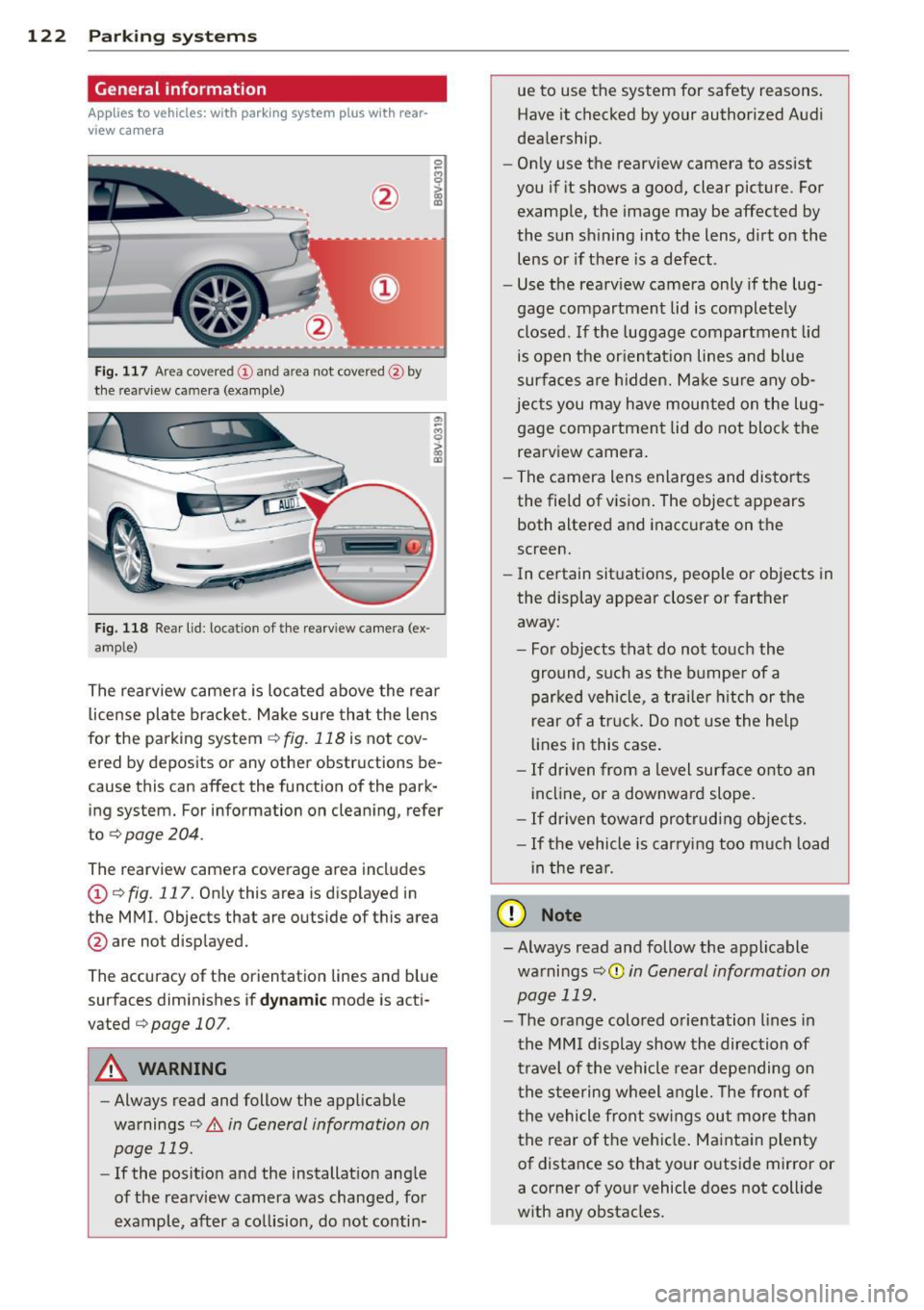
Fig. 117 Area covered
(D and area not covered @by
the rea rview camera (example)
Fig. 118 Rear lid : locat ion of the rearview camera (ex
ample)
0
-8 > "' m
"' §
> «> m
The rearview camera is located above the rear
license plate bracket . Make sure that the lens
for the parking system ¢
fig. 118 is not cov
ered by deposits or any other obstructions be
cause this can affect the function of the park
ing system. For information on clean ing, refer
to
¢ page 204.
The rearview camera coverage area includes
(D ¢ fig. 117. Only this area is displayed in
the MMI. Objects that are outside of this area
@ are not displayed.
The accuracy of the orientation lines and blue
surfaces diminishes if
dynamic mode is acti
vated
¢ page 107 .
_&. WARNING
-Always read and follow the applicable
warnings¢
& in General information on
page
119.
- If the position and the installation ang le
of the rearview camera was changed, for
example, after a collision, do not contin-
-
ue to use the system for safety reasons.
Have it checked by your authorized Audi
dealership.
- Only use the rearview camera to assist
you if it shows a good, clear picture . For
example, the image may be affected by
the sun shining into the lens, dirt on the lens or if there is a defect .
- Use the rearview camera only if the lug
gage compartment lid is completely
closed.
If the luggage compartment lid
is open the orientation lines and blue
surfaces are hidden. Make sure any ob
jects you may have mounted on the lug
gage compartment lid do not block the
rearview camera.
- The camera lens enlarges and distorts
the field of vision. The object appears
both altered and inaccurate on the
screen.
- In certain situations, people or objects in
the display appear closer or farther
away:
- For objects that do not touch the
ground, such as the bumper of a
parked vehicle, a trailer hitch or the
rear of a truck. Do not use the help
lines in this case.
-If driven from a level surface onto an
incline, or a downward slope.
- If driven toward protruding objects.
- If the vehicle is carrying too much load
in the rear.
Q) Note
- Always read and follow the applicable
warnings
¢ (D in General information on
page
119.
- The orange colored orientation lines in
the MMI display show the direction of
travel of the vehicle rear depending on
the steering wheel angle. The front of
the vehicle front swings out more than
the rear of the vehicle. Maintain plenty
of distance so that your outside mirror or
a corner of your vehicle does not collide
with any obstacles.
Page 126 of 302
124 Parking systems
Parallel parking
Applies to vehicles: wit h park ing system p lus with rea r
v iew camera
This view may be used when parallel parking
along the side of a street.
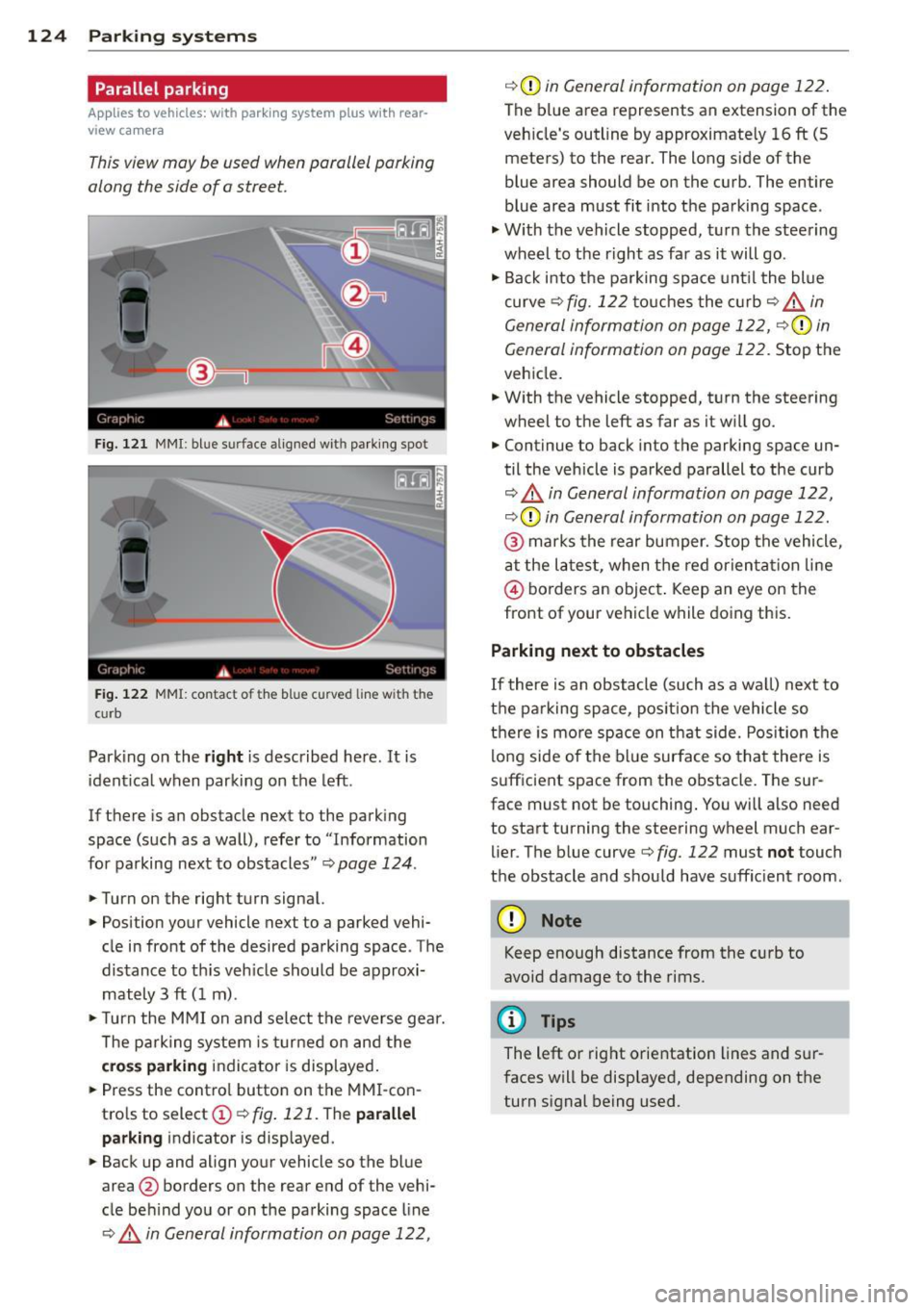
F ig. 121 MMI : bl ue surface aligned wit h parking spot
( )!'Ji 1~ ,11 ,.. ( ,1 11 f ;·.
Fig. 122 MMI: contact o f the b lu e curved line w it h th e
cu rb
Parking on the right is described here. It is
identical when parking on the left.
If there is an obstacle next to the parking
space (such as a wall), refer to "Information
for parking next to obstacles "
¢ page 124.
.. Turn on the right turn signal.
.. Position your vehicle next to a parked vehi
cle in front of the desired parking space . The
distance to th is veh icle should be approxi
mately 3 ft (1 m) .
.. Turn the MMI on and select the reverse gear.
T he parking system is turned on and the
cross parking indicator is displayed.
.. Press the contro l button on the MMI-con
tro ls to select
(D 9 fig . 121. The parallel
parking
indicator is displayed .
.. Back up and align your vehicle so the blue
area @ borders on the rear end of the vehi
cle beh ind you or on the parking space line
¢,&. in General information on page 122, ¢
(Din General information on page 122.
The blue area represents an extension of the
veh icle's outline by approximate ly 16 ft (5
meters) to the rear. The long side of the
blue area should be on the curb. The entire
blue area must fit into the parking space .
.. With the vehicle stopped, turn the steering
wheel to the right as far as it will go .
.. Back into the parking space unt il the blue
curve ¢
fig. 122 touches the curb¢,&. in
General information on page 122,
¢Ci) in
General information on page 122.
Stop the
vehicle .
.. With the vehicle stopped, turn the steering
wheel to the left as far as it w ill go.
.. Continue to back into the parking space un
til the vehicle is parked parallel to the curb
¢ .&. in General information on page 122,
¢ (Din General information on page 122.
@ marks the rear bumper. Stop the vehicle,
at the latest, when the red orientation line
© borders an object . Keep an eye on the
front of your vehicle while doing this.
Parking next to obstacles
If there is an obstacle (such as a wall) next to
the parking space, position the vehicle so
there is more space on that side. Position the
long side of the blue surface so that there is
sufficient space from the obstacle. The sur
face must not be touching . You will also need
to start turning the steering wheel much ear
lier . The blue curve
¢ fig. 122 must not touch
the obstacle and should have suffic ient room .
(D Note
Keep enough distance from the curb to
avoid damage to the rims.
(D Tips
The left or right orientation lines and sur
faces will be displayed, depending on the
turn signal being used.
Page 129 of 302
....,
N
r--. > co
rl I.O
"' rl
"' rl
.. Secure all luggage and other items carefully
r=> page 65, r::!;>page 65.
.. Make sure that nothing can interfere w ith
the pedals .
.. Adjust front seat, head restraint and mirrors
correct ly for your height .
.. Instruct passengers to adjust the head re
stra ints according to their height .
.,. Make sure to use the right child restraint
correctly to protect children
r=> page 169 ,
Child Safety .
.. Sit properly in your seat and make sure that
your passengers do the same
r=:>page 60,
Front seats .
.. Fasten your safety belt and wear it proper ly.
Also instruct your passengers to fasten their
safety belts properly
r=> page 138 .
What impairs driving safety?
Safe driving is directly related to the condi
tion of the vehicle , the driver as well as the
driver's ability to concentrate on the road
without being distracted.
The driver is responsible for the safety of the
vehicle and all of its occupants. If your ability
to drive is impaired, safety r isks for everybody
in the vehicle increase and you a lso become a
hazard to everyone else on the road
r=> ,&..
Therefore:
.,. Do not let you rself be dist racted by passen
gers or by us ing a cellular telephone .
.. NEVE R dr ive when yo ur dr iv ing ability is im
paired (by medicat ions, alcohol, drugs, etc.).
.. Observe all traffic laws, ru les of the road
and speed limits and plain common sense.
.. ALWAYS adjust your speed to road, traffic
and weather conditions .
.. Take frequent breaks on long trips. Do not
drive for more than two hours at a stretch.
.. Do NOT drive when you are t ired, under
pressure or when you are stressed .
A WARNING
Impaired driving safety increases the risk
of serious personal injury and death when
ever a veh icle is being used.
Driving safety 127
Proper occupant
seating positions
Proper seating position for the driver
The proper driver seating position is impor
tant for safe, relaxed driving .
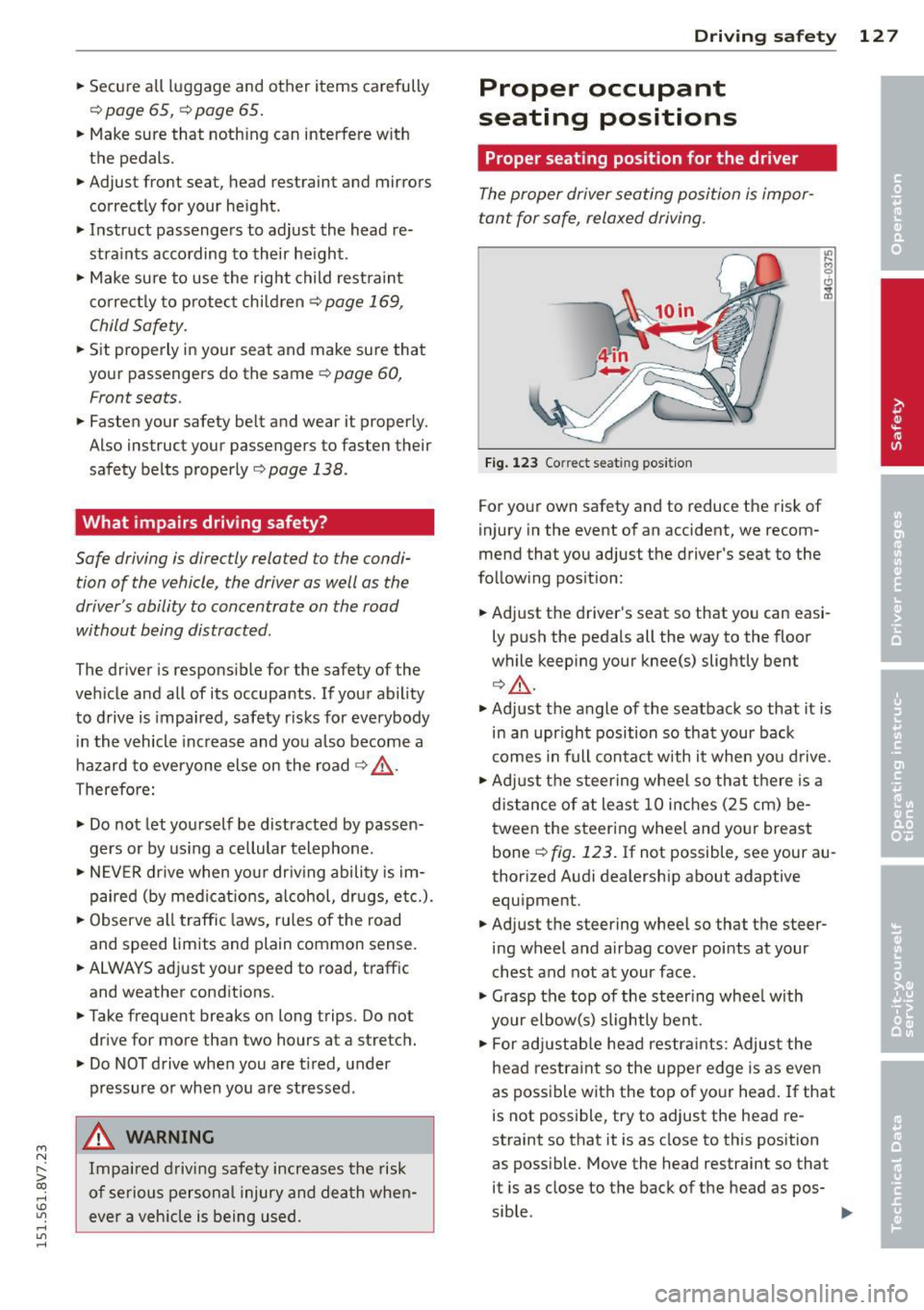
Fig. 123 Correct seat ing pos it ion
For your own safety and to reduce the risk of
injury in the event of an accident, we recom
mend that you adjust the driver's seat to the
follow ing position:
.. Adjust the driver's seat so that you can easi
ly push the pedals all the way to the floor
wh ile keeping your knee(s) slightly bent
r::!;> &,.
.. Adjust the angle of the seatback so that it is
in an upr ight position so that your back
comes in full contact w ith it when you drive.
.. Adjust the steering wheel so that th ere is a
distance of at least 10 inches (25 cm) be
tween the steering wheel and yo ur breast
bone r=:>
fig. 123. If not possible, see your au
thorized Audi dealership about adaptive
equipment .
.. Adjust the steering wheel so that the steer
ing wheel and airbag cover points at your
chest and not at your face .
.,. Grasp the top of the steer ing whee l with
your elbow(s) slightly bent.
.. For adjustable head restra ints: Adjust the
head restraint so the upper edge is as even
as possible with the top of your head. If that
is not possible, try to adjust the head re
straint so that it is as close to this position
as poss ible. Move the head restraint so that
it is as close to the back of the head as pos-
sible . .,.