air condition AUDI A3 CABRIOLET 2015 Owner's Manual
[x] Cancel search | Manufacturer: AUDI, Model Year: 2015, Model line: A3 CABRIOLET, Model: AUDI A3 CABRIOLET 2015Pages: 302, PDF Size: 73.83 MB
Page 233 of 302
M N
" > co ,...., \!) 1.1'1 ,...., 1.1'1 ,....,
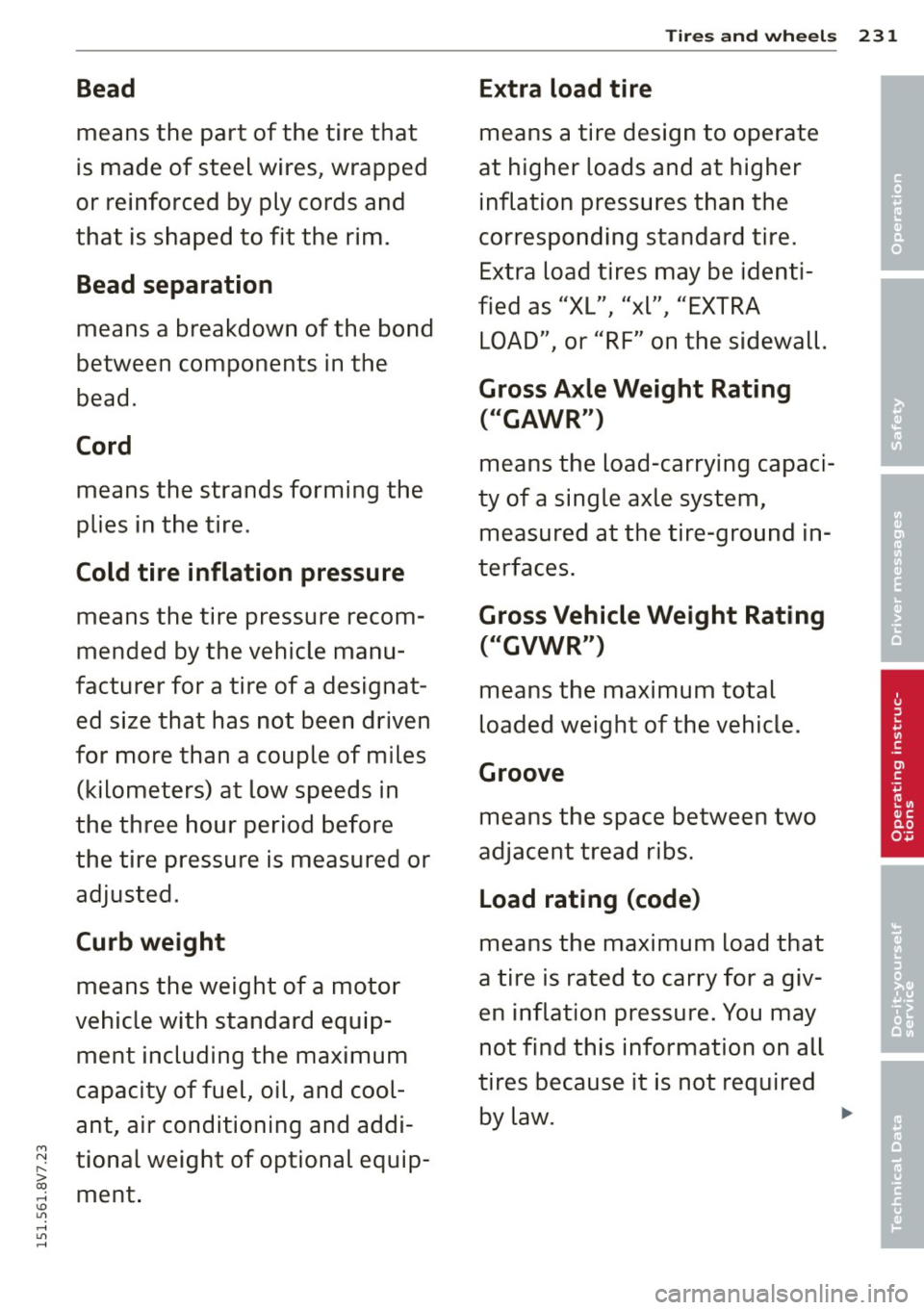
Bead
means the part of the tire that
is made of steel wires, wrapped
or reinforced by ply cords and
that is shaped to fit the rim.
Bead separation
means a breakdown of the bond
between components in the
bead.
Cord
means the strands forming the
plies in the tire .
Cold tire inflation pressure
means the tire pressure recom
mended by the vehicle manu
facturer for a tire of a designat
ed size that has not been driven
for more than a couple of miles (kilometers) at low speeds in
the three hour period before
the tire pressure is measured or
adjusted.
Curb weight
means the weight of a motor
vehicle with standard equip
ment including the maximum
capacity of fuel, oil, and cool
ant, air conditioning and addi
tional weight of optional equip
ment.
Tires and wheels 231
Extra load tire
means a tire design to operate
at higher loads and at higher inflation pressures than the
corresponding standard tire. Extra load tires may be identi
fied as "XL", "xl", "EXTRA
LOAD", or "RF" on the sidewall.
Gross Axle Weight Rating ("GAWR")
means the load-carrying capaci
ty of a single axle system,
measured at the tire-ground in
terfaces.
Gross Vehicle Weight Rating ("GVWR")
means the maximum total
loaded weight of the vehicle.
Groove
means the space between two
adjacent tread ribs.
Load rating (code)
means the maximum load that
a tire is rated to carry for a giv
en inflation pressure. You may
not find this information on all
tires because it is not required by law.
' •
•
' •
Page 239 of 302
M N
" > co ...... \!) 1.1'1
...... 1.1'1 ......
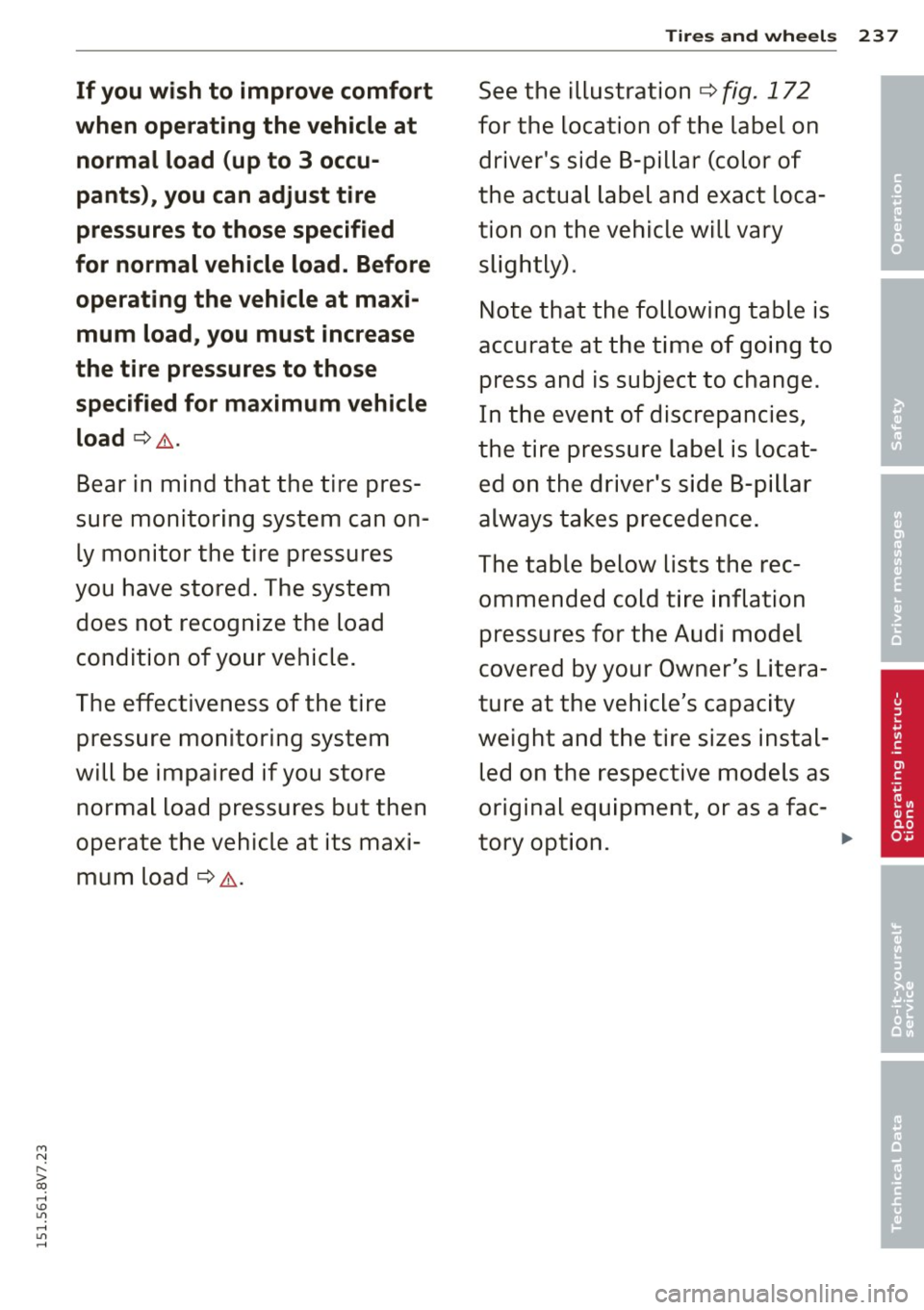
If you wish to improve comfort
when operating the vehicle at
normal load (up to 3 occu
pants), you can adjust tire
pressures to those specified
for normal vehicle load. Before
operating the vehicle at maxi mum load, you must increase
the tire pressures to those
specified for maximum vehicle
load
c> .&. .
Bear in mind that the tire pres
sure monitoring system can on
ly monitor the tire pressures
you have stored. The system does not recognize the load
condition of your vehicle.
The effectiveness of the tire pressure monitoring system
will be impaired if you store normal load pressures but then
operate the vehicle at its maxi
mum load
c> .&. .
Tires and wheels 237
See the illustration c> fig. 172
for the location of the label on
driver's side B-pillar (color of
the actual label and exact loca
tion on the vehicle will vary slightly).
Note that the following table is
accurate at the time of going to
press and is subject to change.
In the event of discrepancies,
the tire pressure label is locat ed on the driver's side B-pillar
always takes precedence.
The table below lists the rec ommended cold tire inflation pressures for the Audi model
covered by your Owner's Litera
ture at the vehicle's capacity
weight and the tire sizes instal
led on the respective models as
original equipment, or as a fac-
tory option. ..,.
' •
•
' •
Page 251 of 302
M N
" > co ,...., \!) 1.1'1 ,...., 1.1'1 ,....,
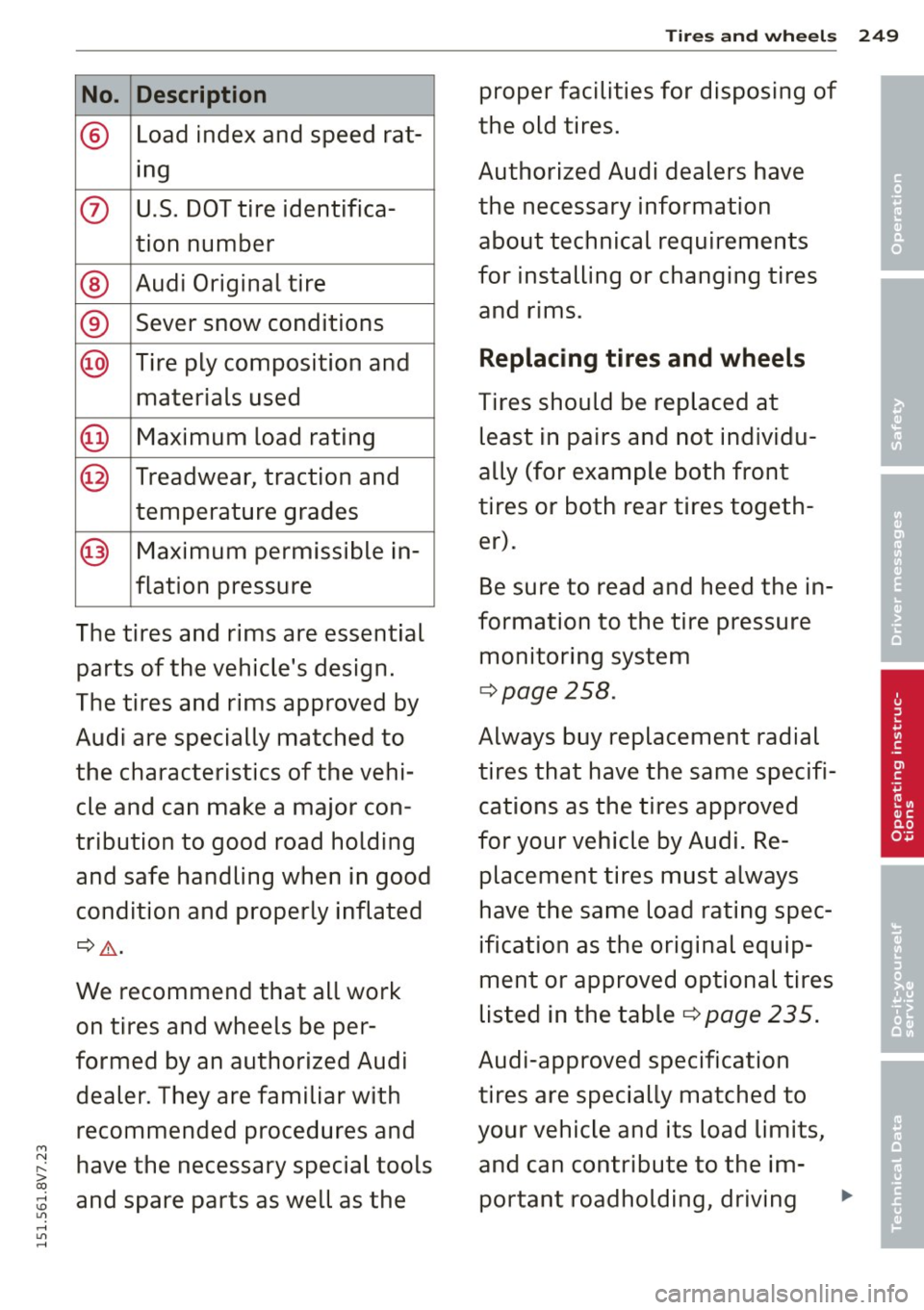
No. Description
® Load index and speed rat-
1ng
0 U.S. DOT tire identifica-
tion number
® Audi Original tire
® Sever snow conditions
@ Tire ply composition and materials used
@ Maximum load rating
@ Treadwear, traction and
temperature grades
@ Maximum permissible in-
flation pressure
The tires and rims are essential parts of the vehicle's design.
The tires and rims approved by
Audi are specially matched to
the characteristics of the vehi cle and can make a major con
tribution to good road holding and safe handling when in good
condition and properly inflated
¢ &.
We recommend that all work
on tires and wheels be per
formed by an authorized Audi dealer. They are familiar with
recommended procedures and
have the necessary special tools
and spare parts as well as the
Tires and wheels 249
proper facilities for disposing of
the old tires.
Authorized Audi dealers have
the necessary information about technical requirements
for installing or changing tires and rims.
Replacing tires and wheels
Tires should be replaced at least in pairs and not individu-
ally (for example both front
tires or both rear tires togeth- er).
Be sure to read and heed the in-
formation to the tire pressure
monitoring system
¢ page 258.
Always buy replacement radial
tires that have the same specifi-
cations as the tires approved
for your vehicle by Audi. Re- placement tires must always
have the same load rating spec-
ification as the original equip-
mentor approved optional tires
listed in the table¢
page 235.
Audi-approved specification
tires are specially matched to
your vehicle and its load limits, and can contribute to the im-portant roadholding , driving
' •
•
' •
Page 260 of 302

258 Tires and wheels
It is important that the inflation pressu re is
regularly checked and maintained at recom
mended levels .
Fo r more informat ion please ask your A udi
dealer for more details .
What you can do to avoid tire and rim
damage
L ow aspect ratio tires can be damaged more
easi ly by impact with potho les, curbs, gu llies
or ridges on the road, particularly if the tire is
underinflated.
I n o rder to minim ize the occurrence of impact
damage to the tires of your vehicle, we recom
mend that you observe the following precau
tions:
- Always maintain recommended inflation
pressures. Check your tire pressure every
2,000 miles (3,000 km) and add air if neces
sary.
- Drive carefu lly on roads with potholes, deep
gullies or ridges. The impact from driving
through or over such obstacles can damage
your tires. Impact with a curb may also cause damage to your tires.
- After any impact, immediately inspect your
tires or have them inspected by the nearest
authorized Audi dealer . Replace a damaged
t ir e as soon as possible.
- Inspect your tires every 2,000 miles (3,000
km) for damage and wear . Damage is not al
ways easy to see. Damage can lead to loss of
air and underinflation, wh ich could eventu
ally cause t ire failure.
If you believe that a
t ir e may have been damaged, replace the
tire as soon as possible.
- T hese tires may wea r more quickly than oth
ers.
- Please a lso remember that, while these tires
deliver respons ive handling, they may ride
less comfortably and make more noise than
other choices.
Reduced performance in winter/cold
season conditions
All tires are designed for certain purposes.
The low aspect ratio, ultra high performance ti
res or iginally installed on your vehicle are in
tended for maximum dry and wet road per
formance and handling. They are not suitable
for cold, snowy or icy weather conditions. If
you drive under those circumstances, you
should equ ip your vehicle with all-season or
winter tires, which offer better traction unde r
those conditions. We suggest you use the rec
ommended snow o r all-season tires specified
for your vehicle, or thei r equivalent.
Refer to~ page
255 for more detailed infor
mation regarding winter tires.
Tire pressure
monitoring system
ill General notes
Each tire, including the spare (if provided),
shou ld be checked monthly when co ld and in
flated to the inflat ion pressure recommended
by the vehicle man ufactur er on the veh icle
placard or tire inflation pressure labe l. (If your
vehicle has tires of a different size than the
size indicated on the vehicle placard or tire in
flation pressure label, you should determine
the proper t ire inflation pressure for those
t i res).
As an added safety feature, your vehicle has been equipped with a tire pressure monitoring
system (TPMS) that illuminates a low tire
pressure telltale when one or more of your
t ir es is signif icantly under-inflated. According
ly, when the low tire pressure telltale illumi
nates, you shou ld stop and check you r tires as
soon as possible, and inflate them to the
proper p ressure. Driving on a sign ificantly un
der -inflated tire causes the tire to overheat
and can lead to tire fa ilure . Under-inflation al
so reduces fuel eff iciency and tire tread life,
and may affect the vehicle's handling and
stopp ing ability.
Please note that the TPMS is not a substitute
for proper tire maintenance, and it is the driv
er's responsibility to maintain correct tire
pressure, even if under-inflation has not
Page 284 of 302
282 Consumer Information
Consumer Information
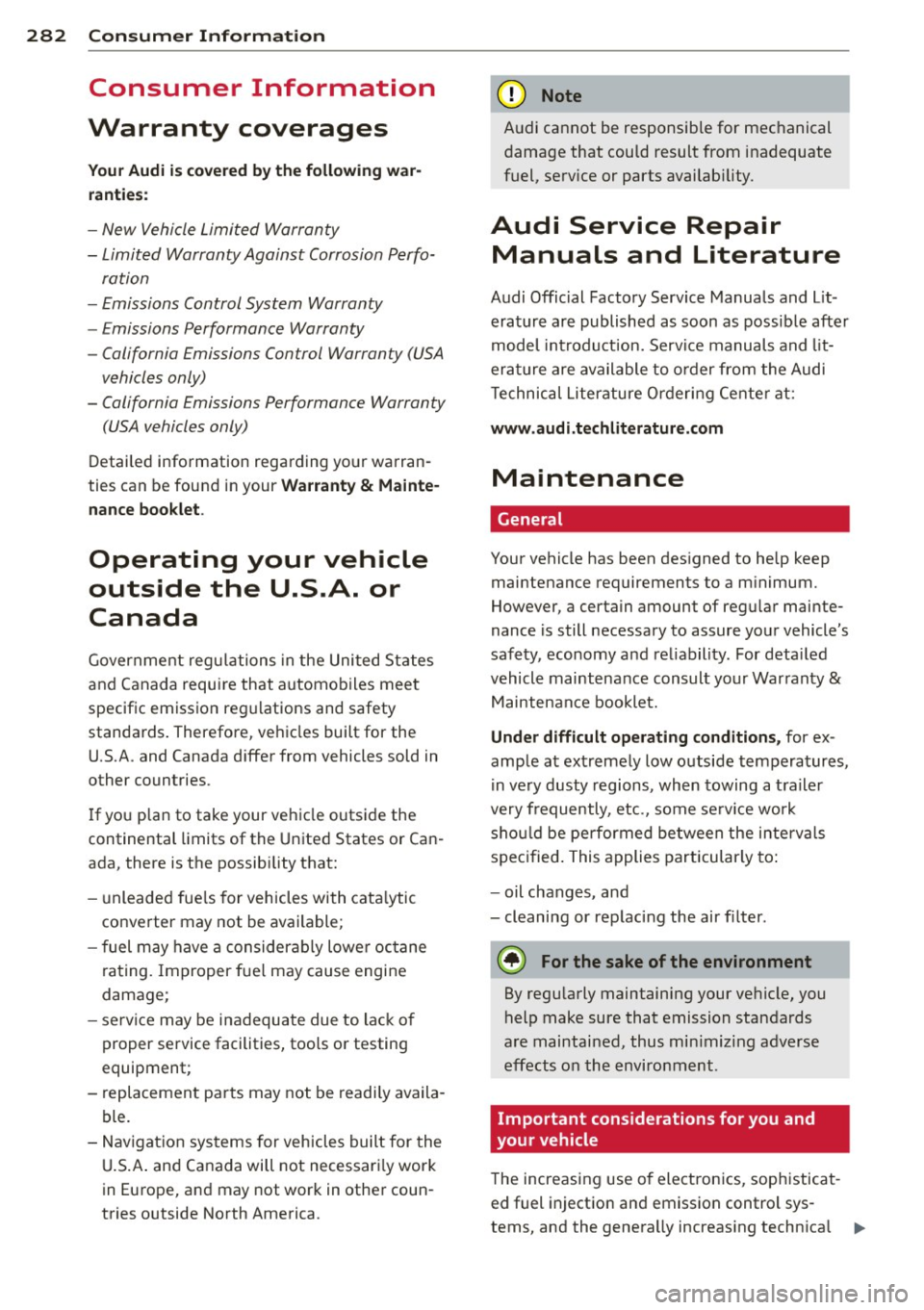
Warranty coverages
You r Audi is covered by the following war
ranties:
- New Vehicle Limited Warranty
- Limited Warranty Against Corrosion Perfo-
ration
- Emissions Control System Warranty
- Emissions Performance Warranty
- California Emissions Control Warranty (USA
vehicles only)
- California Emissions Performance Warranty
(USA vehicles only)
Detailed information regarding your warran
ties can be found in your
Warranty & Mainte
nance booklet .
Operating your vehicle
outside the U.S.A. or
Canada
Government regu lations in the United States
and Canada require that automobiles meet
specific emission regulations and safety
standards. Therefore, veh icles built for the
U.S.A . and Canada differ from vehicles sold in
other countries .
If you p lan to take your vehicle outside the
continental limits of the United States or Can
ada, there is the possibility that:
- unleaded fuels for vehicles with cata lytic
converter may not be available;
- fuel may have a considerably lowe r octane
rating. Improper fuel may cause engine
damage ;
- service may be inadequate due to lack of
proper service facilities, tools or testing
equipment ;
- replacement pa rts may not be readily availa
ble.
- Navigation systems for vehicles built for the
U.S.A. and Canada will not necessar ily work
in Europe, and may not work in other coun
tries outside North America .
(D Note
Audi cannot be responsible for mechanical
damage that could result from inadequate
fuel, service or parts availability.
Audi Service Repair Manuals and Literature
Audi Official Factory Service Manuals and Lit
erature are published as soon as possible after
model introduction. Service manuals and lit
erature are available to order from the Audi
T echnical Literature Ordering Center at:
www.audi.techliterature.com
Maintenance
General
Your vehicle has been designed to help keep
maintenance requirements to a minimum.
However, a certain amount of regular mainte
nance is still necessary to assure your vehicle's
s afety, economy and rel iability. For detailed
vehicle maintenance consult your Warranty &
Maintenance booklet.
Under difficult operating conditions, for ex
ample at extremely low outside temperatures,
i n very dusty regions , when towing a trailer
very frequently, etc., some service work
should be performed between the intervals
specified. This applies particularly to:
- oil changes, and
- cleaning or replacing the air filter .
(® For the sake of the environment
By regularly maintaining your vehicle, you
help make sure that emission standards
are maintained, thus minimizing adverse
effects on the environment.
Important considerations for you and
your vehicle
The increasing use of electronics, sophisticat
ed fuel injection and emission contro l sys-
tems, and the genera lly increasing technical
liJJ,
Page 285 of 302
M N
" > co ,...., \!) 1.1'1 ,...., 1.1'1 ,....,
complexity of today's automobi les, have
steadi ly reduced the scope of maintenance
and repairs which can be carried out by vehicle
owners.
Also, s afe ty and en vironm ental con
cerns p lace very strict limits on the nature of
repairs and adjustments to engine and trans
miss io n pa rts which an owner can perform .
Maintenance, adjustments and repairs usua lly
require special tools, testing devices and oth
er equipment avai lab le to specially trained
workshop personnel in order to assure prope r
performance, reliab ility and safety of the vehi
cle and its many systems .
Improper ma intenance, adjustments and re
pa irs can impair the operation and reliability
of your vehicle and even vo id your vehicle war
ranty. The refo re, p roof of servic ing in accord
ance w ith the ma intenance sched ule may be a
condition for upholding a poss ible war ranty
claim made within the warranty period .
Above all, operational safety can be adversely
affected, c rea ting unnecessary risks for you
and your passengers.
I f in doubt about any servicing, have it done
by your authori zed Audi dealer or any othe r
p roperly equipped and q ualified workshop .
We strong ly urge you to give your aut horized
Audi dealer the opportunity to perfo rm all
schedu led maintenance and necessary repairs .
Your dea ler has the facilities, or iginal parts
and trained spec ialists to keep your vehicle
running properly .
Performing limit ed m aintenance you rself
The fo llowing pages describe a limited num
ber of procedu res which can be performed on
your veh icle w ith ordinary too ls, should the
need arise and trained personnel be unavaila
b le. Before performing any of these proce
dures, always thoroughly read all of the app li
cable text and carefully follow the instruc
tions given. Always rigorously obse rve the
WARNINGS provided .
Before you check anything in th e engine
compartment, alway s re ad and heed all
WARNINGS ~&. and
~ page 214 .
Con sumer In formation 283
_& WARNING
- Ser ious personal injury may occur as a re
sult of improperly performed mainte
nance, ad justments or repa irs .
- Always be extremely careful when work
ing on the vehicle . Always follow com
monly accepted safety pract ices and gen
era l common sense. Never r is k personal
inju ry.
- Do not attempt any of the maintenance,
checks or repairs descr ibed o n the fol
lowing pages if you are not fully fam ilia r
with these or othe r procedures with re
spect to the vehicle, or are uncertain how
to p roceed .
- Do not do any work without the proper
too ls and equipment. Have the necessary
wo rk done by your authorized A udi deal
er or another proper ly equipped and
qualified workshop.
- The engine compartment of any motor
veh icle is a potentially hazardous area.
Never reach into th e area around or
touch the rad iator fan. It is temperature
contro lled and can switch on suddenly -
even when the engine is off. The radiato r
fan switches on automat ically when the
coo lant reaches a certain tempera ture
and will cont inue to run until the coo lant
temperature drops .
- Always sw itch o ff the ignition before any
one gets under the vehicle.
- Always support your veh icle with safety
s tands if it is necessary to work under
neath the vehicle. The jack s upplied with
the vehicle is not adequate for this pu r
pose and cou ld collapse causing serio us
personal injury.
- If you m ust wor k underneath the vehicle
with the wheels on the g round, a lways
make sure the vehicle is on leve l ground,
that the wheels are a lways securely
blocked and that the engine cannot be
started.
- Always make sure the transmission se lecto r lever (automatic transmission) is •
•
Page 287 of 302
M N ,....
> co ,...., \!) 1.1'1 ,...., 1.1'1 ,....,
This will help ensure that vehicle function,
performance and safety are not impaired
c::> _& .
Attempting to wo rk on electronic components
and the softwa re used with them can cause
malfunctions. Because of the way electronic
components are interconnected with each
other, such malfunctions can also have an ad
verse affect on other systems that are not di
rectly involved . Th is means that you risk both
a substantial reduction in the operat ional
safety of you r vehicle and an increased wear of
ve hicle parts
c::> ,& .
Author ized Audi dealers w ill perform this
work in a profess ional and competent manner
or, in special cases, refer you to a professional
company that specializes in such mod ifica
tions.
A WARNING
Imprope r repairs and modifications can
change the way vehicle systems work and
cause damage to the veh icle and serious
personal injury.
(D Note
-
If emergency repairs must be performed
elsewhere, have the ve hicle examined by
an authorized A udi dealer as soon as possi
ble.
Declaration of
Compliance, Telecom
municat ion and
Electronic Systems
Radio Frequency Devices and Radiocommuni
cation Equipment User Manual Notice.
The manufacturer is not responsible for any
radio or TV interference caused by unauthor
ized modifications to this equipment.
D ev ice s
The following devices each comp ly with FCC
Part 15.19, FCC 15.21 and RSS-Gen Issue 1:
- Adaptive cruise control*
Con sumer In formation 285
- Audi side assist*
- Cell phone package*
- Convenience key*
- Electron ic immobilizer
- Homelink un iversal remote control*
- Remote control key
FCC Part 15.1 9
This device complies with part 15 of the FCC
Ru les. Operation is subject to the fo llowing
two conditions:
(1) This device may not cause harmful inte r
ference, and
(2) this device must accept any interference
received, including interference that may
cause undes ired operation .
FCC Pa rt 15.21
CAUTION:
Changes or modifications not expressly ap
proved by the party responsible for compli
ance could void the user's authority to operate
the equ ipment.
RSS-G en Issue 1
Operation is subject to the following two con
ditions:
(1) this device may not cause interference,
and
(2) this device must accept any interfe rence ,
i ncluding interference that may cause unde
sired operation of the device.
•
•