seats AUDI A3 CABRIOLET 2015 Owner's Manual
[x] Cancel search | Manufacturer: AUDI, Model Year: 2015, Model line: A3 CABRIOLET, Model: AUDI A3 CABRIOLET 2015Pages: 302, PDF Size: 73.83 MB
Page 137 of 302
....,
N
r--. > co
rl I.O
"' rl
"' rl
Applicable to Canada
If you live in Canada and you
believe that your vehicle has a
defect that could cause a crash,
injury or death, you should im
mediately inform Transport
Canada, Defect Investigations
and Recalls. You should also no
tify Audi Canada.
Canadian customers who wish
to report a safety-related de
fect to Transport Canada , De
fect Investigations and Recalls,
may either call Transport Cana
da toll-free at:
Tel.: 1-800-333-0510 or
Tel.: 1-819-994-3328 (Ottawa region and from other coun
tries)
TTY for hearing impaired : Tel.:
1-888-675-6863
or contact Transport Canada by
mail at:
Transport Canada Motor Vehicle Safety Investiga
tions Laboratory
80 Noel Street
Gatineau, QC
J8Z 0Al
For additional road safety infor
mation, please visit the Road
Safety website at :
Driving safety 135
http://www.tc.gc.ca/eng/
roadsafety/menu. htm
Active rollover
protection system
. Function
Th e rollov er p rotection syst em prot ects v ehi
cl e o ccupants in th e ev ent of a ro llove r.
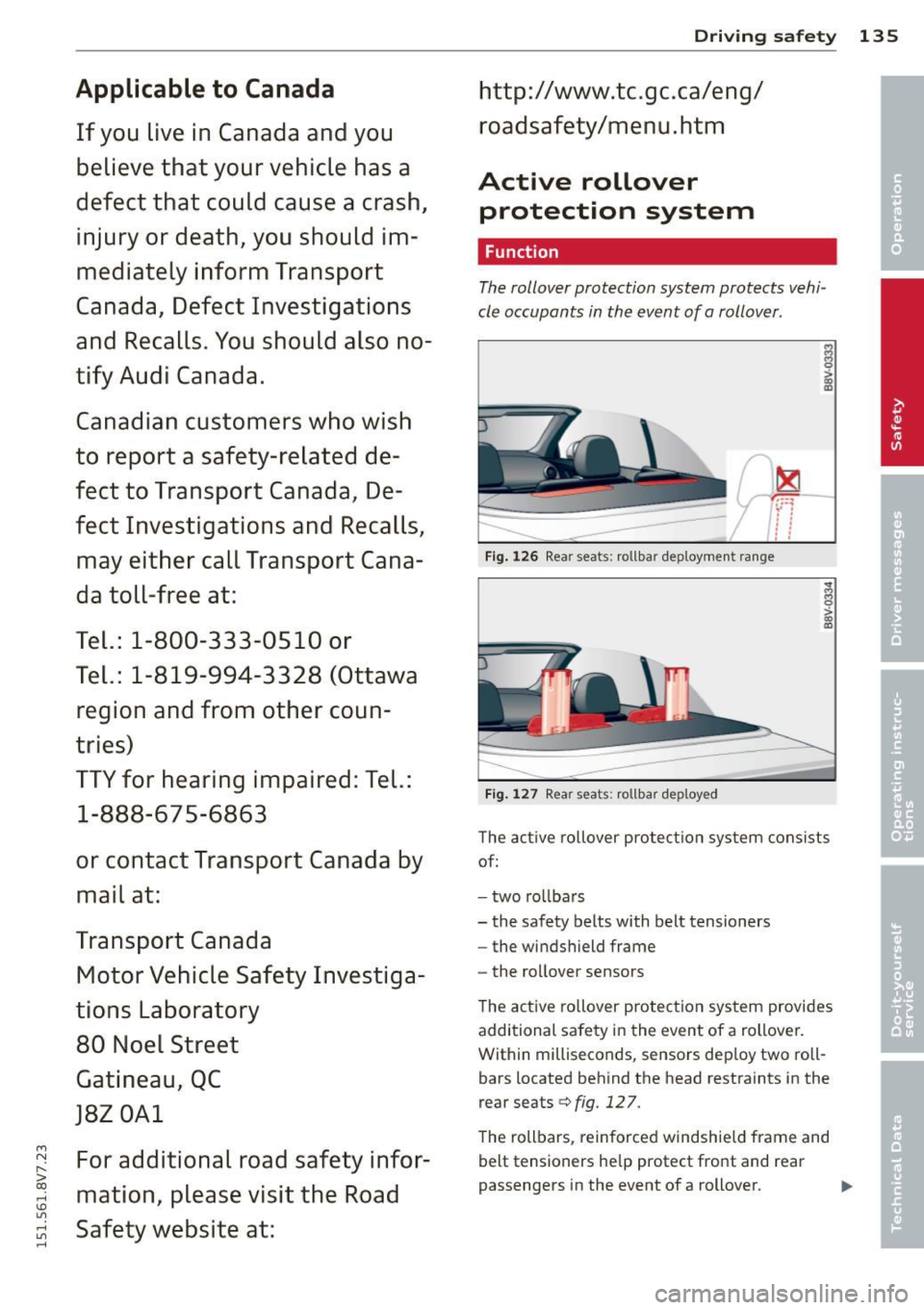
Fig. 126 Rear seats: roll ba r dep loy ment range
Fig. 127 Rea r seats : rollba r deploye d
The acti ve rollo ver p rotection s yst em consist s
o f:
- t wo r oll bar s
- t he safe ty b elts with b elt tensioners
- the wi ndshield frame
- the ro llover sensors
T he acti ve ro llover p rotec tion sys tem provi des
addi tion al sa fe ty in t he event of a rollover .
Within milli seco nds, sensors dep loy two roll
bars located be hind t he head restraints in the
rear seats ¢
fig. 127.
The roll bars, reinforce d w indsh ie ld frame and
b elt tensioners he lp protect fro nt and rear
passengers in th e event of a r ollove r.
Page 140 of 302
138 Safety belts
Safety belts
General notes
Always wear safety belts!
Wearing safety belts correctly saves lives!
This chapter explains why safety be lts are nec
essary, how they work and how to adjust and
wear them correctly .
.. Read a ll the information that fo llows and
heed all of the instructions and WARNINGS.
A WARNING
Not wearing safety belts or wearing them
improperly increases the risk of ser ious
personal in jury and death .
- Safety belts are the sing le most effective
means avai lab le to reduce the risk of se
r ious injury and dea th in a utomob ile acci
dents. For your protection and that of
yo ur passenge rs, always co rrectly wear
safety belts when the vehicle is moving.
- Pregnant women, injured, or physically
im paired perso ns m ust also use safety
belts. Lik e all veh icle occup ants, they are
more like ly to be ser iously injured if they
do not wea r safety be lts . The best way to
protect a fetus is to protect the mother -
throughout the entire pregnancy.
Number of seats
Your Audi has a total of four seating positions: two in the front and two in the rear. Each seat
ing position has a safety belt .
A WARNING
Not wearing safety belts or weari ng them
improp erly increases th e risk of ser ious
pe rsonal i njury and deat h.
- Never st rap more than one pe rson, in
cl uding small ch ild ren, into any belt.
It is
e speci ally dange rous to pla ce a safety
belt over a child s itting on yo ur lap.
- N ever le t mo re people ride in the ve hicl e
than there are s afe ty be lts avail able. -
Be s ure everyone riding in the vehicle is
properly restrained w ith a separate safe
ty belt or child restra int.
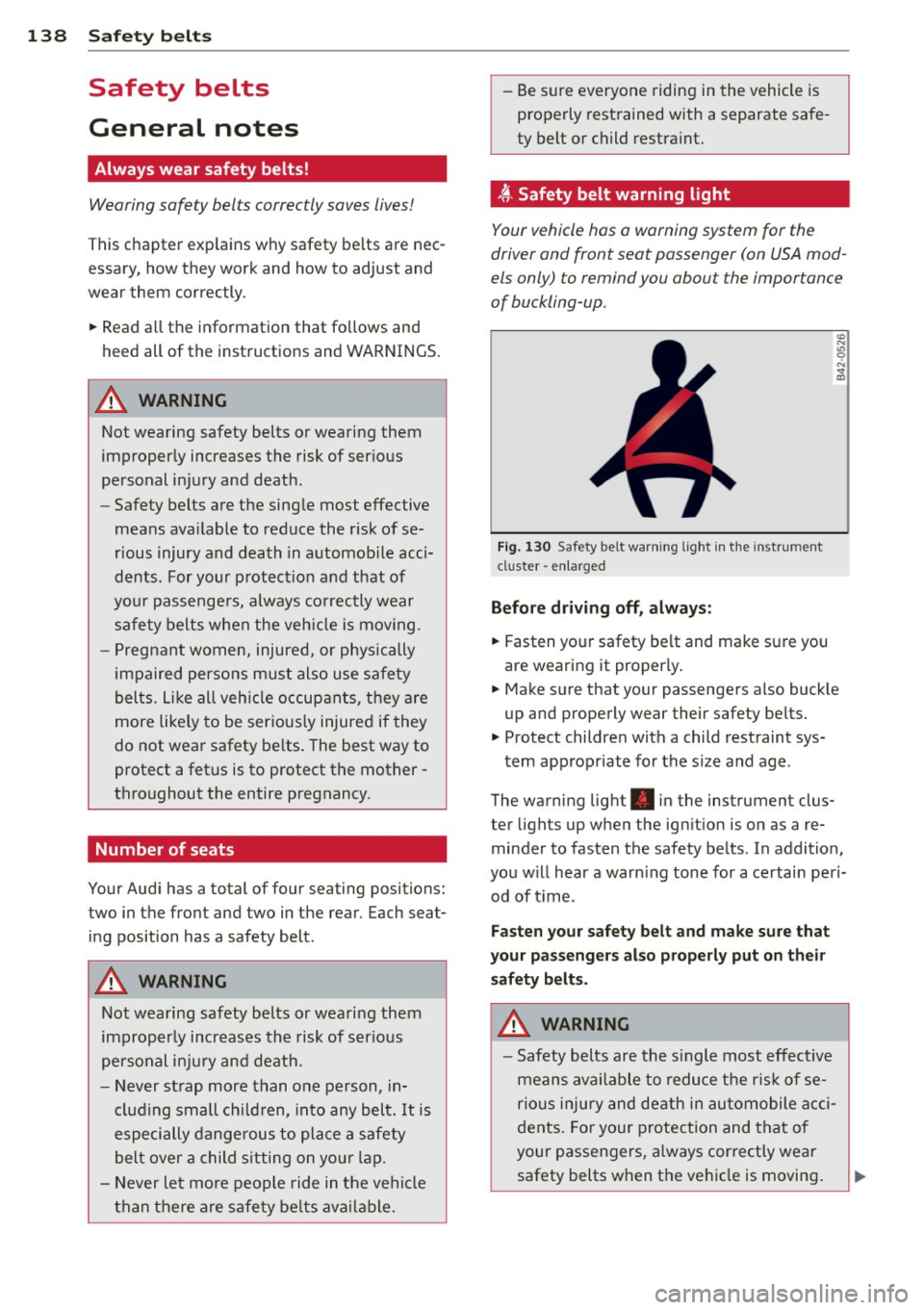
t Safety belt warning light
Your vehicle hos o warning system for the
driver and front seat passenger (on USA mod
els only) to remind you about the importance
of buckling-up .
Fi g. 130 Safety belt warni ng light in the instrument
cluster -en larged
Before driv ing off, alway s:
.. Fasten yo ur safety belt and make su re you
are wearing it properly .
.. Make s ure that your passengers also buck le
up and properly wear their safety be lts.
.. Protect childre n w ith a child restraint sys-
tem app ropriate for the s ize and age.
The warn ing light . in the instrument clus
ter lights up when the ign ition is on as a re
minder to fasten the safety be lts. In addition,
you w ill hear a warn ing tone for a ce rtai n pe ri
od of t ime.
Fasten you r safety belt and make sure that
your pass eng ers also properly put on the ir
s afety belt s.
A WARNING .....=-
-Safety b elts are the s ingle most eff ect ive
means avai lable to reduce t he ri sk of se
rio us inju ry and de ath in au tomobile a cci
dents. Fo r you r protection and that of
your passengers, a lways cor rectly wear
safety belts when t he vehicle is moving .
Page 142 of 302
140 Safety belts
occupant will slam violently into the steering
wheel, instrument panel, windshield, or what
ever else is in the way
c::> fig. 133. This imp act
with the vehicle interior has all the energy
t hey had just before the crash.
Never rely on a irbags alone for protection.
Even when they deploy, airbags provide only
additional protection. Airbags are not sup
posed to deploy in all kinds of accidents. Al
though your Audi is equipped with airbags, all
vehicle occupants, including the driver , must
wear safety belts correctly in order to mini
mize the risk of severe injury or death in a
crash.
Remember too, that airbags will deploy only
once and that your safety belts are always
there to offer protection in those accidents in
which airbags are not supposed to deploy or
when they have already deployed . Unbelted
occupants can also be thrown out of the vehi
cle where even more severe or fatal injuries
can occur.
It is also important for the rear passengers to
wear safety belts correctly. Unbelted passen
gers in the rear seats endanger not only them
selves but also the driver and othe r passen
gers ~
fig. 134. In a frontal collision they will
be thrown forward violently, where they can
hit and injure the driver and/or front seat pas
senger .
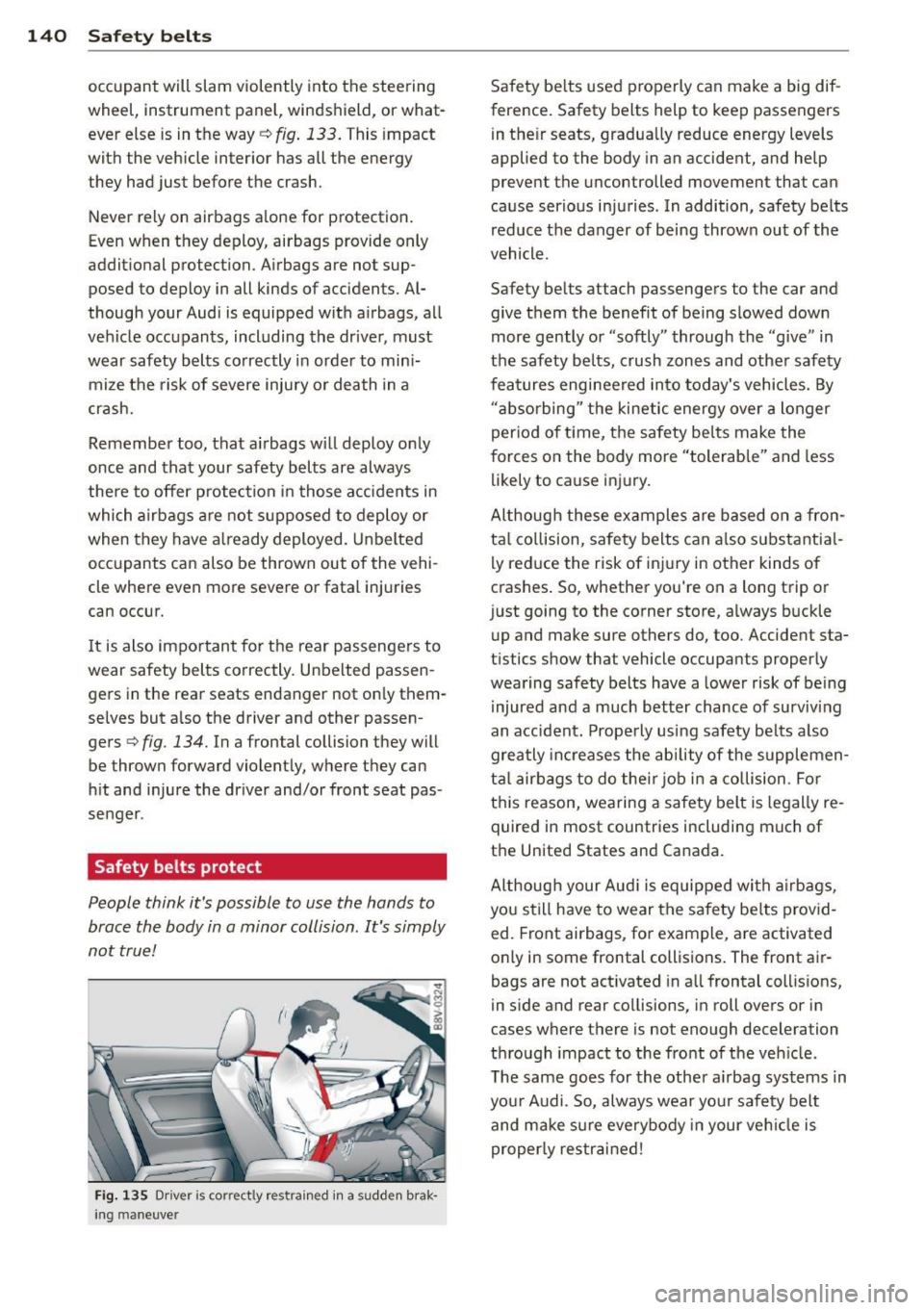
Safety belts protect
People think it's possible to use the hands to
brace the body in a minor collision . It's simply
not true !
Fig. 135 Driver is co rr ect ly re strain ed in a sudd en brak
ing maneuve r
Safety belts used properly can make a big dif
ference. Safety belts help to keep passengers
in their seats, gradually reduce energy levels
applied to the body in an accident, and help
prevent the uncontrolled movement tha t can
cause serious injuries . In addition, safety belts
reduce the danger of being thrown out of the
vehicle .
Safety belts attach passengers to the car and
give them the benefit of being slowed down
more gently or "softly" through the "give" in
the safety belts, crush zones and other safety
features engineered into today's vehicles. By
"absorbing " the kinetic energy over a longer
period of ti me, the safety belts make the
forces on the body more "tolerable" and less
likely to cause injury.
Although these examples are based on a fron
tal collision, safety belts can also substantial
ly reduce the r isk of injury in other kinds of
crashes. So, whether you're on a long trip or
just going to the corner store, always buckle up and make sure others do, too. Accident sta
tistics show that vehicle occupants properly
wearing safety belts have a lower risk of being
injured and a much better chance of surviving
an accident. Properly using safety belts also
greatly increases the ability of the supplemen
tal airbags to do their job in a collision . For
this reason, wearing a safety belt is legally re
quired in most countries including much of
the United States and Canada.
Although your Audi is equipped with airbags,
you still have to wear the safety belts provid
ed. Front airbags , for example, are activated
only in some frontal collisions. The front air
bags are not activated in all frontal collisions,
in side and rear collisions, in roll overs or in
cases where there is no t enough decelera tion
through impact to the front of the vehicle .
The same goes for the other airbag systems in
your Audi . So, always wear your safety belt
and make sure everybody in your vehicle is
properly restrained!
Page 144 of 302
142 Safet y belt s
To provide maximum protection, sa fety belts
must always be positioned correctly on the
wearer 's body .
.,. Adjust the front seat and head restr aint
properly ¢
page 60, Front seats .
.,. Make sure the seatback of the rear seat
bench is in an upright pos ition and securely
latched in place befo re using the belt¢.&, .
.,. Hold the belt by the tongue and pull it even
l y across the chest and pelvis¢.&, .
.,. Inse rt the tongue into the correct buckle of
you r seat until you hea r it latch securely
¢ fig . 136.
.,. Pull on the be lt to m ake s ure th at it is se-
curely latched in the b uckle .
Automatic safety belt retractors
Every safety belt is eq uipped w ith an automat
ic belt retractor on the shoulder be lt . T his fea
ture locks the be lt when the belt is pulled out
fast, dur ing hard bra king and in an acci dent.
The belt may also lock when yo u drive up or
down a steep hill or through a sharp curve. During normal driving the belt lets you move
freely .
Safety belt pret ensioners
The sa fe ty belts are equippe d wi th a be lt pre
tensioner that helps to tigh ten the safety bel t
and remove s lack when the pretensioner is ac
tivated ¢
page 144. The function of the pre
tensioner is monitored by a warning light
¢page 20.
Convert ible locking ret ractor
E very sa fe ty belt except the one on the dr iver
seat is eq uipped with a convertib le locking re
tractor that
must be used when the safety
be lt is used to attach a child seat. Be s ure to
read the important information about this
feature ¢
page 180 .
A WARNING
Improperly positioned safety belts can
cause se rious injury in an accident
¢ page 142, Safety bel t p osition.
- Saf ety belts offe r optim um pro te ction
only wh en the seatba ck is upr ight and be
lts are properly posit ioned on the
body.
- Never attach the safety be lt to the buck
le for another seat. Attaching the belt to
the wrong buckle will reduce safety be lt
effectiveness and can cause serious per
sonal injury .
- A passenger who is not proper ly restrain
ed can be seriously injured by t he safety
be lt itse lf w hen it moves from the stro n
ge r parts of the body into cr itica l areas
like the abdomen .
- Always lock the conve rtible locking re
tracto r when you are secu ring a child
seat in t he ve hicl e¢
page 182.
© Tips
Fo r information on safety belt pretens ion
ers, refer to¢
page 144.
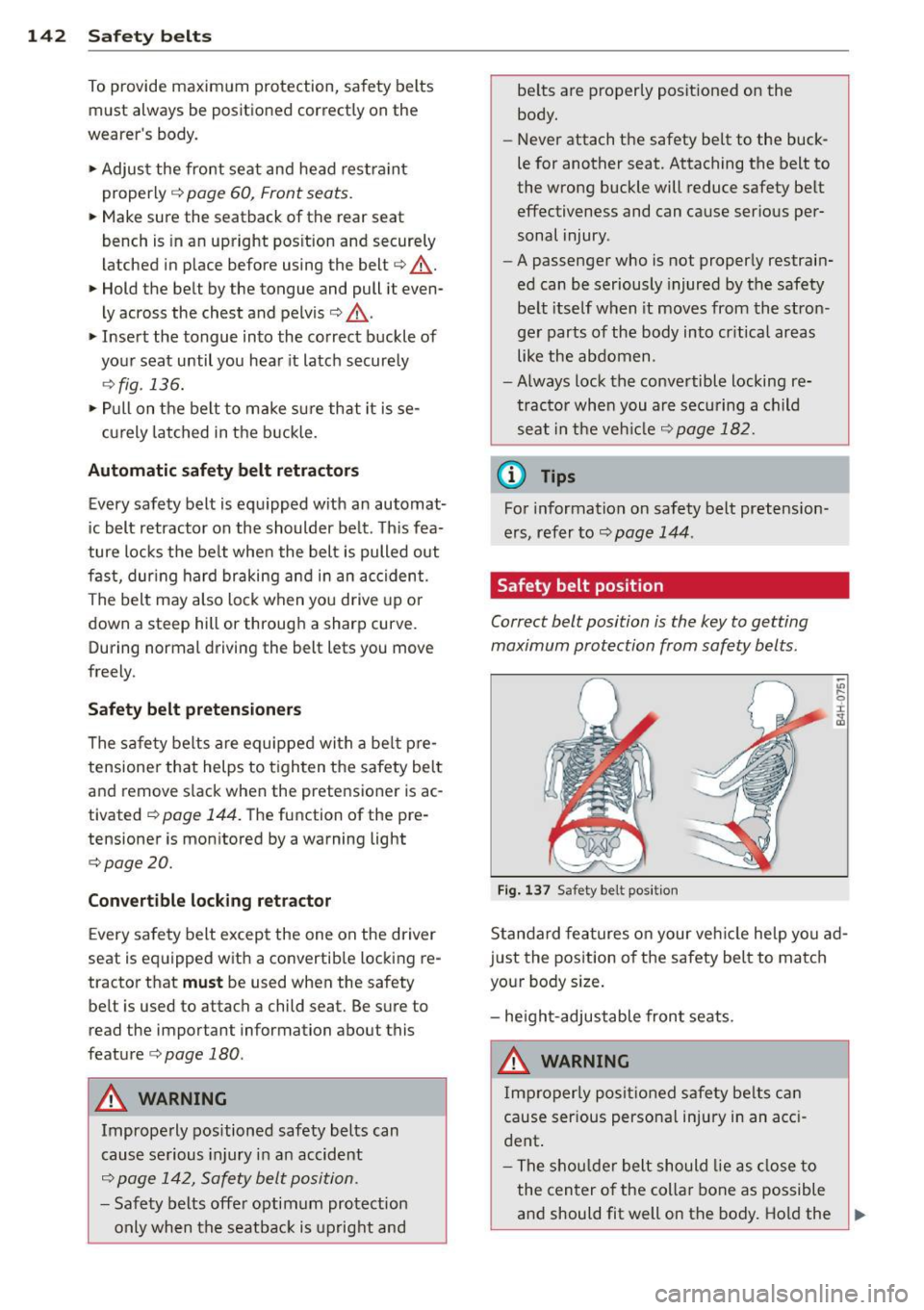
Safety belt position
Correct belt position is the key to getting
maximum protection from safety belts .
Fig. 137 Safet y bel t pos it ion
Stan dard fea tures o n your veh icle he lp yo u ad
ju st the pos ition o f th e safety be lt to ma tch
your body s ize .
- he ight-adjus table fron t seats.
A WARNING
Imp ro pe rl y pos it io ned safety be lts ca n
cause ser ious perso nal injury in an a cci
dent.
-
- T he s hou lder be lt should lie as close to
the center o f the collar bone as possible
an d should fit well on the body. Hol d the
~
Page 145 of 302
....,
N
r--. > co
rl I.O
"' rl
"' rl
belt above the latch tongue and pull it
evenly across the chest so that it sits as
low as possible on the pelvis and there is
no pressure on the abdomen. The belt
should always fit snugly
r=:> fig. 137 . Pull
on the belt to tighten if necessary.
- The lap belt port ion of the safety belt
must be positioned as low as possible
across pelvis and never over the abdo
men. Make sure the belt lies flat and
snug
c:> fig . 137. Pull on the belt to tight
en if necessary.
- A loo se-fitting safety belt can cause seri
ous injuries by sh ifting its position on
your body from the strong bones to more
vulnerable, soft tissue and cause serious
injury.
- Always read and heed all WARNINGS and
other important information
r::;, page 141.
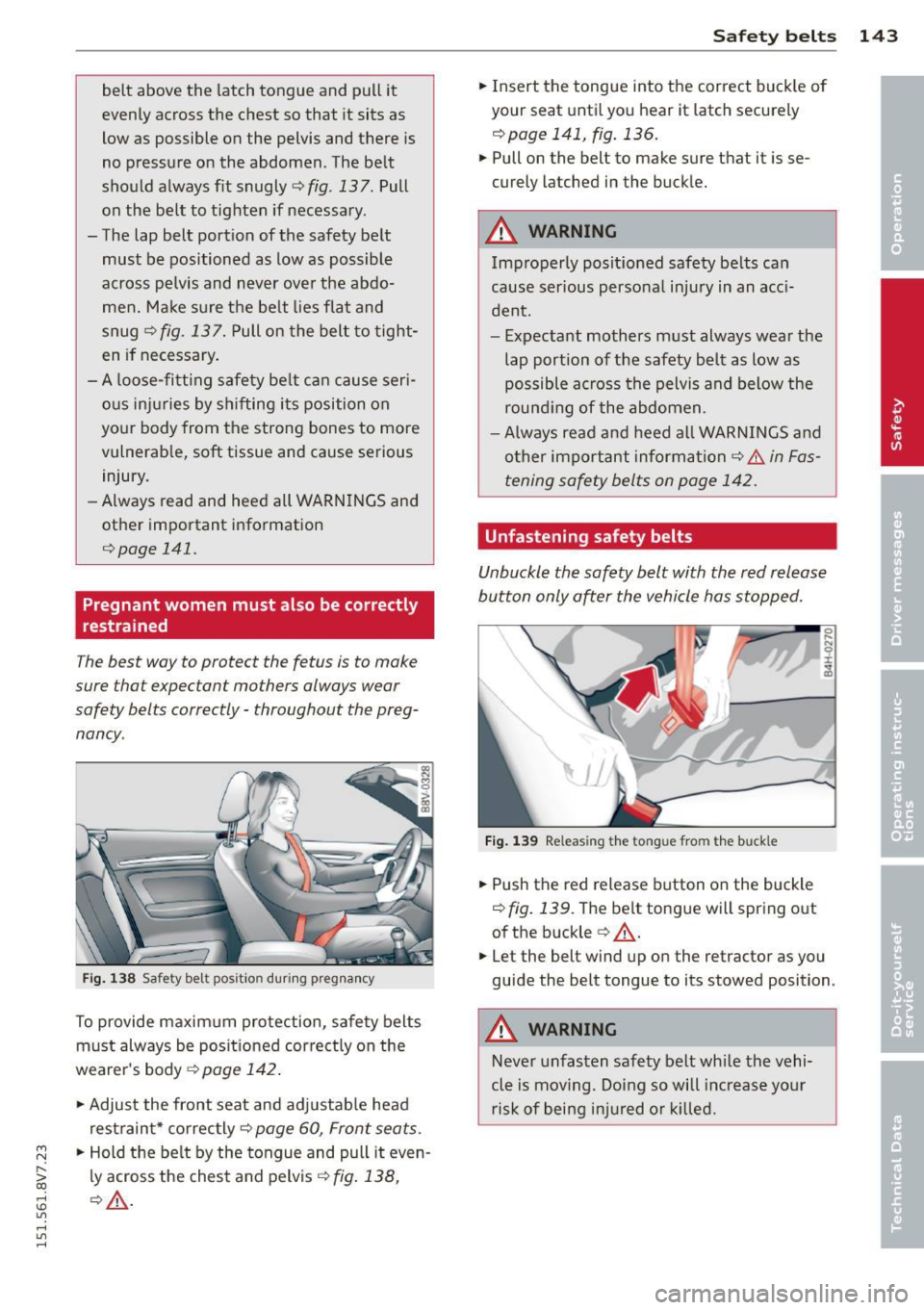
Pregnant women must also be correctly
restrained
The best way to protect the fetus is to make
sure that expectant mothers always wear
safety belts correctly -throughout the preg
nancy.
Fig. 138 Safety belt pos itio n during pregnancy
To provide maximum protection, safety belts
must always be positioned correctly on the
wearer's body
c:> page 142 .
.. Adjust the front seat and adjustable head
restraint* correctly
c:> page 60, Front seats .
.. Hold the belt by the tongue and pull it even
ly across the chest and pelvis
r:!> fig. 138,
QA .
Safety belts 143
.. Insert the tongue into the correct buckle of
your seat until you hear it latch securely
<=:>page 141, fig. 136.
.. Pull on the belt to make sure that it is se
curely latched in the buckle.
A WARNING
Improperly positioned safety belts can
cause ser ious personal injury in an acc i
dent.
- Expectant mothers must always wear the
lap portion of the safety belt as low as
possible across the pelvis and below the
round ing of the abdomen.
- Always read and heed all WARNINGS and
other important information
c:> & in Fas
tening safety belts on page 142.
Unfastening safety belts
Unbuckle the safety belt with the red release
button only a~er the vehicle has stopped.
.. J_
Fig. 139 Releas ing the tongue fro m the buck le
.. Push the red release button on the buckle
r=:> fig. 139. The belt tongue will spring out
of the buckle
r::;, ,&. .
.. Let the belt wind up on the retractor as you
guide the belt tongue to its stowed position .
A WARNING
--Never unfasten safety belt while the vehi
cle is moving . Doing so will increase your
risk of being injured or kill ed.
Page 146 of 302
144 Safety belts
Improperly worn safety belts
Incorrectly positioned safety belts can cause
severe injuries .
Wearing safety belts improperly can cause se
rious injury or death. Safety belts can only
work when they are correctly positioned on
the body . Improper seating positions reduce
the effect iveness of safety belts and will even
i ncrease the r isk of injury and death by mov
ing the safety belt to cr itical areas of the
body . Improper seating positions also in
crease the risk of serio us inj ury and death
when an airbag deploys and strikes an occu pant who is not in the correct seating posi
tion . A driver is responsible for the safety of
all vehicle occupants and especially for ch il
dren . Therefore:
.. Never permit anyone to assume an incorrect
sitting position in the vehicle wh ile traveling
¢ _& .
A WARNING
Improperly worn safety belts increase the
risk of se rious personal injury and death
whenever a veh icle is being used .
- Always make sure that al l vehicle occu-
pants are cor re ct ly restrained a nd stay in
a corre ct seating posit ion wheneve r the
vehicle is be ing used.
- Always read and heed all WARNI NGS and
other important informat ion
¢page 141.
Safety belt preten
sioners
How safety belt pretensioners work
In front, side and rear -end collisions above a
particular severity and in a rollover , safety
belts are tensioned automatically.
R ev er sible s afety belt ten sioners
The safety belts on the front seats are equip
ped with power reve rsible tensioners . The fol
low ing funct ions are available when the driv -er's/front passenger's safety belts are fas
tened:
- Automatic tens ioners : at the start of a dr ive,
t he sa fe ty belts automat ica lly adjust to the
passenger after a certain time period or ve
hicle speed.
- In certain driving situations, the safety belts
may tighten w ith a reversible tensioning
function
¢ page 95.
-The safety be lts may a lso tighten with this
reversible tensioning function in minor co lli
sions .
Pyrotechnic s afety belt pretens ioners
T he safety belts are equipped with sa fety belt
pretensioners. The system is ac tivated by sen
sors in front, side and rear-end co llisions of
great severity and in a rollover. This tightens
the belt and takes up belt slack ¢.&.
in Service
and disposal of safety belt pretensioner on
page 145.
Taking up the slack helps to reduce
forward occupant movement dur ing a colli
s ion .
A WARNING
-- It is poss ible for the pretens ioners to de-
p loy inco rrectly.
- The pyrotechnic system can only provide
p rotection fo r one coll is ion. If the pyro
technic pretensioners deploy, the preten sioning sys tem must be replaced .
{!) Tips
The pyrotechnic safety be lt pretensioners
can only deploy once.
- The safety belt pretensioners do not de
ploy in minor frontal and s ide collisions,
in rear-end co llisions, in rollovers and in
co llisions involving very little impact
force.
- A fine dust is released when the py ro
t echnic safety be lt pretensioners dep loy.
T his is normal and is not caused by a fire
in the vehicle .
- T he re levant safety requ irements must
be observed when the vehicle or compo
nents of the system are scrapped. A
Page 151 of 302
M N ,....
> co ,...., \!) 1.1'1 ,...., 1.1'1 ,....,
Fo r exa mple, the airbag may depl oy if:
-a small child that is heavier than a typical 1
year-o ld child is on the front passenger seat
(regardless of whether the child is in one of
the chi ld seats listed
page 171), or
- a ch ild who has outgrown child rest raints is
on the front passenger seat.
If the front passenger airbag is turned off, the
P ASS ENGER AIR B AG OFF light comes on in
the instrument cluster and stays on.
If the front passenger airbag deploys, the
Federal Standard requires the airbag to meet
the "low risk" deployment criter ia to reduce
the r isk of injury through interaction with the
airbag. "Low risk" deployment occurs in those
crashes that take place at lower decelerations
as defined in the electronic control unit
r::> page 159, PASSENGER AIR BAG OFF light.
Always remember, a chi ld seat or infant carri
er insta lled on the front seat may be struck
and knocked out of position by the rapidly in
flating passenger's airbag in a frontal colli
sion. The airbag could greatly reduce the ef
fectiveness of the child restraint and even se
riously injure the child during inflat ion.
For this reason, and because the back seat is
the safest place for children - when properly
restrained according to their age and size - we
strongly recommend that children always sit
in the back seat
r::> page 169, Child Safety .
A WARNING
A child in a rearward-facing child seat in
stalled on the front passenger seat will be
ser iously injured and can be killed if the
front airbag inflates -even with an Ad
vanced Airbag System .
- T he inflating airbag will hit the child seat
or infant carrier with great force and wi ll
smash the child seat and child against
the backrest, center armrest, door or roof.
- Always install rear-facing child seats on
the rear seat.
- If you must install a rearward facing
child seat on the front passenger seat
-
A irbag system 149
because of exceptional circumstances
and the
PA SSENGER AIR BAG OFF light
does not come on and stay on, immed i
ately install the rear-fac ing child seat in a
rear seat ing pos ition and have the airbag
system inspected by your A udi dealer.
- Forward-facing child seats installed on the front passenger's seat may interfere
with the dep loyment of the a irbag and
cause serious persona l injury to the
child.
A WARNING
If, in except iona l circumstances, you must
install a forward -facing child restraint on
the front passenger's seat:
- Always ma ke s ure the forward-facing
seat has been designed and certified by its manufacturer for use on a front seat
with a passenger front and s ide a irbag.
- Never put the forward-facing child re
straint up against or very near the instru
ment panel.
- Always move the passenge r seat into its
rearmost pos ition in the seat's fore and
aft ad justment range, as far away from
the airbag as possible before installing
the forward-fac ing ch ild restra int. The
backrest must be adjusted to an upright
position.
- Make sure that the
PASSENGER AIR BAG
OFF
l ight comes on and stays on all the
time wheneve r the ig nit ion is switched
on.
A WARNING
To reduce the ri sk of ser ious injury, ma ke
sure that the
PASSENGER AIR BAG OFF
light wi ll be displayed whenever a child re
straint is insta lled on the front passenger
seat and the ignition is switched on.
- If the PASSENGER AIR BAG OF F light
does not stay on, perform the checks de
scribed
¢ page 158, Monitoring the Ad-
vanced Airbag System.
~
•
•
•
Page 152 of 302
150 Airbag system
-Take the child restraint off the front pas
senger seat and install it properly at one
of the rear seat positions if the
PA SS EN
GE R AI R BAG OFF
light does not stay on .
- Have the airbag system inspected by
your Audi dealer immed iately.
- Always carefully follow instructions from
child restraint manufacturers when in
sta lling child restraints .
A WARNING ,.
If, in exceptional c ircumstances, you must
install a forward or rearward-fac ing child
restraint on the front passenge r's seat:
- Improper installation of child restraints
can reduce their effectiveness or even
prevent them from providing any protec
t ion.
- An improperly installed child restraint
can interfere with the airbag as it de
ploys and serio usly injure or even kill the
child -even wi th an Advanced Airbag
System.
- Always carefully follow the manufactur
er's instructions provided with the child
seat or car rier .
- Always m ake su re that there is nothing
on the front passenger seat that will
cause the capacitive passenger detection
system in the seat to s ignal to the Airbag
System that the seat is occupied by a person when it is not, or to signal that it
is occupied by someone who is heavier
than the pe rson actually s itting on the
seat. The presence of additiona l objects
cou ld cause the passenger front airbag
to be t urned on w hen it sho uld be off, or
cou ld cause the ai rbag to work in a way
that is different from the way it wou ld
have worked without the object on the
seat.
Front airbags
Description of front airbags
The airbag system can provide supplemental
protection to properly restrained front seat occupants .
Fig . 14 0 Loc atio n of drive r air b a g : i n stee ring wheel
Fig. 141 Loc ation of fro nt passe nge r's a irbag: in the in
str umen t pa nel
Your vehicle is equipped with an "Advanced
Airbag System " in compliance with Un ited
States Federa l Motor Veh icle Safety Standard
(FMVSS) 208 as applicable at the time you r
vehicle was manufactured . The safety belts
for the seats have "pretensioners" that help to take slack out of the belt system. The pre
ten sioners are also act ivated by the electronic
control unit for the airbag system.
T he front safety belts also have load lim iters
to help reduce the forces applied to the body
in a crash.
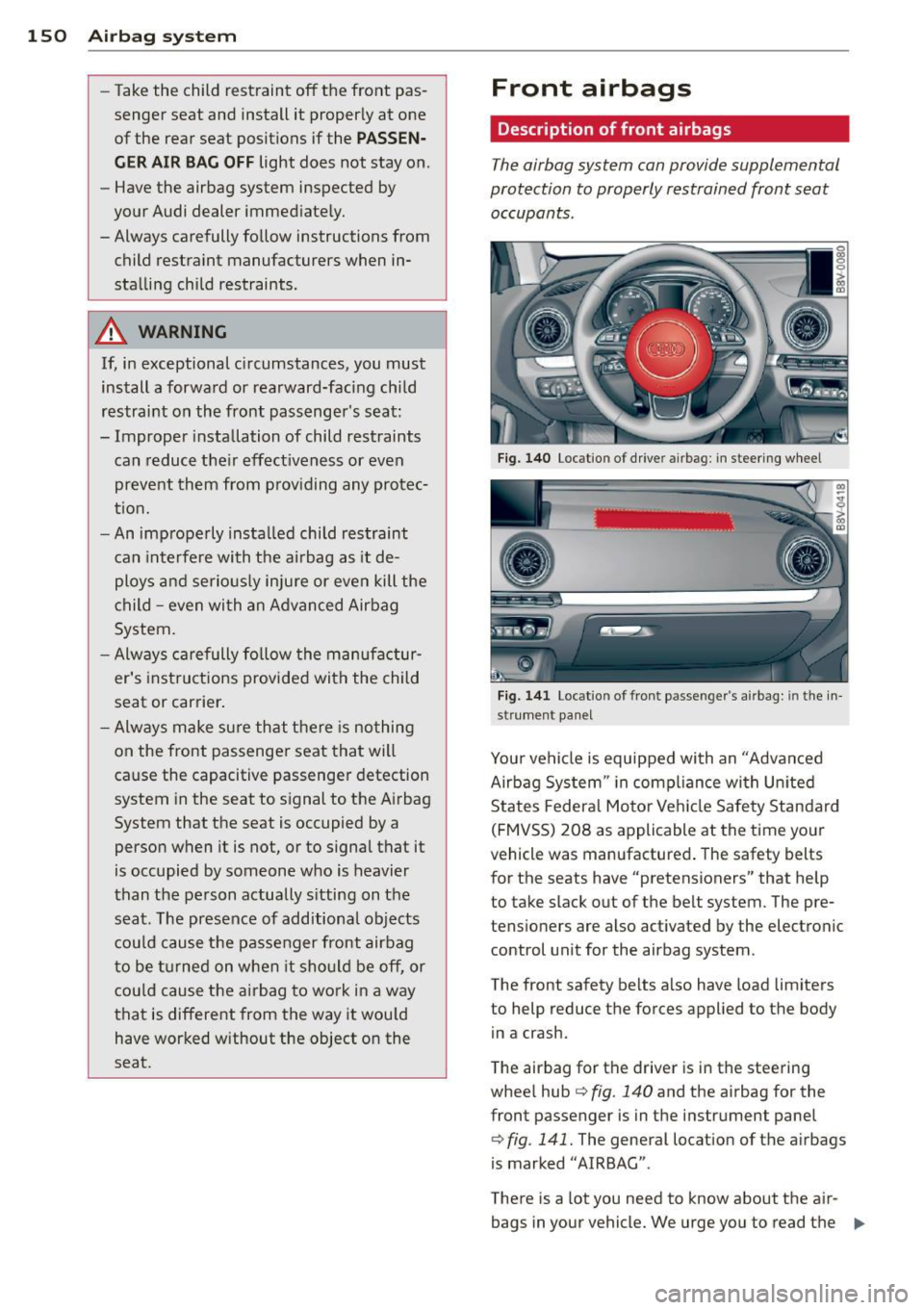
The airbag for the driver is in the steering
whee l hub
c:> fig. 140 and the airbag fo r the
front pas senger is in the instr ument panel
¢ fig . 141. The gener al location of the a irbags
is marked "AIRBAG".
T here is a lot you need to know about the a ir
bags in your vehicle. We urge you to read the
II>
Page 154 of 302
152 Airbag sys te m
U.S. Federal Standard if a chi ld with elec
trical capac itance greater than the com
bined capacitance of a typical one-year
old infant restra ined in one of the for
ward fac ing or rearward-fac ing ch ild
seats with which your vehicle was certi
fied is on the front passenger seat and
the other conditions for airbag deploy ment are met.
- Acc ident statist ics have shown that chil
dren are generally safer in the rear seat
area than in the front seating posit ion .
- For their own safety, all chi ldren, espe
ci ally 12 years and younger, sho uld a l
ways ride in the back properly rest rained
for their age and size .
Advanced front airbag system
Your vehicle is equipped with a front Advanced
Airbag System in compliance with United
States Federal Motor Vehicle Safety Standard
208 as applicable at the time your vehicle was manufactured.
The front Advanced Airbag System supple ments the safety belts to provide addit ional
protection for the driver's and front passeng
er's heads and upper bodies in frontal crashes .
The airbags inflate only in frontal impacts
when the vehicle dece le rat io n is high enoug h.
The front Advanced Airbag System for the
fro nt seat occupants is not a substitute for
your safety belts . Rather, it is part of the over
a ll occupa nt restraint system in your veh icle.
A lways remember that the airbag system ca n
on ly help to pro tect you, if you are s itting up
right, wearing yo ur safety belt and wearing it
properly. This is why you and yo ur passengers
must always be properly restrained, not just
beca use the law requires you to be.
The Advanced Airbag System in your veh icle
has been certified to meet the " low risk" re
qu irements for 3 and 6 year-o ld children on
the passenger side and very small adu lts on
the dr iver side. The low risk deployment crite
ria are intended to he lp reduce the risk of in
jury through interaction with the front airbag that can occur, for example, by being too
close to the steering wheel and instr ument
panel when the airbag inflates .
In add ition, the system has been cer tified to
comply with the "s uppression" requirements
of the Safety Standard, to turn off the front
airbag for infants 12 months o ld and younger
who are restrained on the front passenger
seat in child restraints that are listed in the
Standard
c> page 171, Child restraints and
Advanced front airbag system .
"Suppression" requires the front a irbag on the
passenger side to be turned off if:
- a child up to abo ut one year of age is re
strained on the front passenger seat in one
of the rear-fac ing or forward-facing infant
restraints listed in Federal Motor Vehicle
Safety Standard 208 with which the Ad
vanced A irbag System in your veh icle was
cert ified . Fo r a listing of the chi ld restraints
t hat were used to certify your vehi cle's com
p lia nce w it h t he US Sa fety S tandard
c>page 171,
-When a pe rson is detec ted o n the front pas
senger seat tha t has an elec trica l capa ci
tance that is more than the tota l electrical
capacitance of a child that is about 1 year
old restrained in one of the rear-facing or
forward-facing infant restraints (listed in
Federal Motor Vehicle Safety Standard 208
w ith which the Advanced A irbag System in
your veh icle was certified), the front airbag
on the passenger side may or may not de p loy .
The
PASS ENG ER AIR BAG OFF light comes on
when the elect ronic cont ro l unit detects a to
ta l elect rical capac itance on the front passen
ger seat that requ ires the front a irbag to be
tu rned off. If the
PASSENGER AIR BAG OFF
ligh t does not come on, the front airbag on
t h e passenger side has not been turned off by
the control unit and can deploy if the contro l
u nit senses an impact that meets the condi
t ions stored in its memory.
If the total e lectr ica l capacitance regis tered
on the front passenger seat is more than that
ll-
Page 155 of 302
M N
" > co ,...., \!) 1.1"1 ,...., 1.1"1 ,....,
of a typical 1 year-old, but less than the
weight of a small adult, the front airbag on
the passenger s ide may deploy (the
PASSEN·
GER AIR BA G OFF
light does not come on).
For example, the a irbag may depl oy if:
- a small child that is heavier than a typical 1
year-o ld child is on the front passenger seat
(regardless of whether the child is in one of
the chi ld seats listed
page 171),
-a ch ild who has outgrown child rest raints is
on the front passenger seat.
I f the front passenger airbag is turned off, the
PA SSENGER AIR BAG OFF light in the center
of the inst rument panel w ill come on and stay
on.
If the front passenger airbag deploys, the
F ederal Standard requires the a irbag to meet
the " low ris k" deployment criteria to help re
d uce the risk of injury through interaction
with the airbag . "Low risk" deployment occurs
in those crashes that take place at lower de
celerations as defined in the electronic control
un it
r:::> page 158.
Alway s remember : Even though your vehicle
is equipped with Advanced Airbags, the safest
p lace for children is properly restrained on the
back seat. Please be sure to read the impor
tant information in the sect ions that follow
and be sure to heed all of the WARNINGS .
A WARNING
To reduce the risk of injury when an airbag
inflates, a lways wear safety belts prope rly.
- If you are unrestrained, lean ing forward,
sitting sideways or out of position in any
way, your risk of injury is much higher.
- You w ill also receive serious injuries and
cou ld even be killed if you are up against
the a irbag or too close to it when it in
fla tes - even with an Advanced Airbag
page 146 .
A WARNING ,~
A child in a rearward -facing child seat in -
stalled on the front passenger seat will be
-
A irbag system 153
seriously injured and can be killed if the
front airbag inflates - even w ith an Ad
vanced A irbag System.
- Altho ugh the Advanced Airbag System in
your veh icle is designed to turn off the
front airbag when a rearward-facing child restraint has been installed on the
front passenge r seat, nobody can abso
lutely guarantee that dep loyment is im
possible in all conceivable s ituations that
may happen dur ing the usef ul life of your
veh icle.
- The infla ting airbag will h it the ch ild seat
or infant carrier with g reat force and will
smash the child seat and child against
the backrest, center armrest, door, or
roof.
- Always install rearward-facing chi ld re
straints on the rear seat.
- If you must insta ll a rearwa rd fac ing
child seat on the front passenger seat because of exceptional circumstances
and the
PASSENGER AIR BAG OFF light
does not come on and stay on, immed i·
ately insta ll the rear-fac ing child seat in a
rea r seat ing pos ition and have the airbag
system inspected by you r Audi dealer .
A WARNING
If, in except iona l circumstances, you must
install a forward-facing child restraint on
the front passenge r's seat:
- Always ma ke sure the forward-facing
seat has been designed and cer tified by
its manufacture r for use on a front se at
with a passenger fron t and s ide a irbag .
- Never put the fo rward-facing child re
straint up against or ve ry near the instru
ment panel.
- Always move the passenge r seat into its
rea rmost pos ition in the seat's fore and
aft ad justment range, as fa r away from
the airbag as possible, before installing
the forward-fac ing chi ld restraint. The
backrest must be ad justed to an upright
position .
...
•
•
•