weight AUDI A3 CABRIOLET 2015 Owner's Manual
[x] Cancel search | Manufacturer: AUDI, Model Year: 2015, Model line: A3 CABRIOLET, Model: AUDI A3 CABRIOLET 2015Pages: 302, PDF Size: 73.83 MB
Page 232 of 302
230 Tires and wheels
-If you notice unusual vibra
tion or if the vehicle pulls to
one side when driving, al
ways stop as soon as it is
safe to do so and check the
wheels and tires for dam
age.
0 Note
-Please note that summer and winter tires are de
signed for the conditions
that are typical in those sea
sons. Audi recommends us
ing winter tires during the
winter months. Low tem peratures significantly de
crease the elasticity of
summer tires, which affects
traction and braking ability. If summer tires are used
in
very cold temperatures, cracks can form on the tread
bars, resulting in perma
nent tire damage that can
cause loud driving noise and
unbalanced tires. Audi is not
responsible for this type of
damage.
-Burnished, polished or chromed rims must not be used in winter road condi
tions. The surface of the
rims does not have suffi
cient corrosion protection
for this and could be perma
nently damaged by road salt
or similar substances.
Glossary of tire and loading terminology
Accessory weight
means the combined weight (in
excess of those standard items
which may be replaced) of auto matic transmission, power
steering, power brakes, power
windows, power seats, radio, and heater, to the extent that
these items are available as fac
tory-installed equipment (whether installed or not).
Aspect ratio
means the ratio of the height to
the width of the tire in percent.
Numbers of 55 or lower indi
cate a low sidewall for im
proved steering response and
better overall handling on dry
pavement.
...
Page 233 of 302
M N
" > co ,...., \!) 1.1'1 ,...., 1.1'1 ,....,
Bead
means the part of the tire that
is made of steel wires, wrapped
or reinforced by ply cords and
that is shaped to fit the rim.
Bead separation
means a breakdown of the bond
between components in the
bead.
Cord
means the strands forming the
plies in the tire .
Cold tire inflation pressure
means the tire pressure recom
mended by the vehicle manu
facturer for a tire of a designat
ed size that has not been driven
for more than a couple of miles (kilometers) at low speeds in
the three hour period before
the tire pressure is measured or
adjusted.
Curb weight
means the weight of a motor
vehicle with standard equip
ment including the maximum
capacity of fuel, oil, and cool
ant, air conditioning and addi
tional weight of optional equip
ment.
Tires and wheels 231
Extra load tire
means a tire design to operate
at higher loads and at higher inflation pressures than the
corresponding standard tire. Extra load tires may be identi
fied as "XL", "xl", "EXTRA
LOAD", or "RF" on the sidewall.
Gross Axle Weight Rating ("GAWR")
means the load-carrying capaci
ty of a single axle system,
measured at the tire-ground in
terfaces.
Gross Vehicle Weight Rating ("GVWR")
means the maximum total
loaded weight of the vehicle.
Groove
means the space between two
adjacent tread ribs.
Load rating (code)
means the maximum load that
a tire is rated to carry for a giv
en inflation pressure. You may
not find this information on all
tires because it is not required by law.
' •
•
' •
Page 234 of 302
232 Tires a nd whee ls
Ma ximum load rating
means the load rating for a tire
at the maximum permissible in
flation pressure for that tire.
Maximum loaded vehicle
weight
means the sum of:
(a) Curb weight
(b) Accessory weight
(c) Vehicle capacity weight, and
(d) Production options weight
Maximum (permissible)
inflation pressure
means the maximum cold infla
tion pressure to which a tire
may be inflated. Also called
"maximum inflation pressure."
Normal occupant weight
means 150 lbs. (68 k ilograms)
times the number of occupants seated in the vehicle up to the
total seat ing capac ity of your
vehicle.
Occupant distribution
means distribution of occu
pants in a vehicle .
Outer diameter
means the overall diameter of
an inflated new tire.
Overall width
means the linear distance be
tween the ex teriors of the side
walls of an inflated tire, includ
ing elevations due to labeling,
decorations, or protect ive
bands or ribs .
Ply
means a layer of rubber -coated
parallel cords .
Production options weight
means the comb ined we ight of
those installed regular produc
tion op tions weighing over 5
lbs . (2. 3 kg) in excess of those
standard items which they re
place, no t prev iously consid
ered in curb weight or accessory
weight , incl uding heavy duty
brakes, ride leve lers, roof rac k,
heavy duty bat tery, and spec ial
trim.
Radial ply tire
means a pneumatic tire in
wh ich the p ly c ords that extend
t o the beads are laid at sub
stantially 90 degrees to the
centerline of the t read .
Page 236 of 302
234 Tir es and whee ls
Tread separation
means pulling away of the
tread from the tire carcass .
Treadwear indicators (TWI )
means the projections with in
the principal grooves designed
to give a visual indication of the degrees of wear of the tread.
See
¢ page 246, Tread Wear
Indicator (TWI)
for more infor
mation on measuring tire wear .
Uniform Tire Quality Grading
is a tire information system de
veloped by the United States
National Highway Traffic Safety
Administration (NHTSA) that is
designed to help buyers make
relative comparisons among
tires. The UTQG is not a safety
rat ing and not a guarantee that
a tire will last for a prescribed
number of miles (kilometers) or
perform in a certain way. It
simply gives tire buyers addi
tional information to comb ine
with other considerations, such as price, brand loyalty and deal
er recommendations. Under
UTQG, tires are graded by the
tire manufacturers in three areas: treadwear, traction, and
temperature resistance . The UTQG information on the t
ires
molded into the sidewalls.
U.S. DOT Tire Identification
Numbe r (TIN )
,
This is the tire's "serial num
ber" . It begins with the letters
"DOT" and indicates that the
tire meets all federal stand
ards . The next two numbers or
letters indicate the plant where
it was manufactured, and the
last four numbers represent the
week and year of manufacture. F or example,
DO T ... 2214 ...
means that the tire was pro
duced in the 22nd week of
2014. The other numbers are
marketing codes that may or
may not be used by the tire
manufacturer. This information
is used to contact consumers if
a tire defect requires a recall.
Vehicle capacity weight
means the rated cargo and lug
gage load plus 150 lbs. (68 kilograms) times the vehi
cle's total seating capacity as
listed on the label located on
the driver's side B-pillar . .,..
Page 237 of 302
....,
N
r--. > co
rl I.O
"' rl
"' rl
Vehicle maximum load on the tire
means that load on an individu
al tire that is determined by
distributing to each axle its
share of the maximum loaded
vehicle weight and dividing by two.
Vehicle normal load on the tire
means that load on an individu
al tire that is determined by
Tires and wheels 235
distributing to each axle its
share of the curb weight, acces
sory weight, and normal occu pant weight (distributed in ac
cordance with table below
¢ page 235) and dividing by
two.
Occupant loading and distribution for vehicle normal load for
various designated seating capacities
Designated seating Vehicle normal load, Occupant distribu-
capacity, number of number of occupants tion in a normally
occupants loaded vehicle
4 3 2 in front, 1 in back
seat
Cold tire inflation pressure
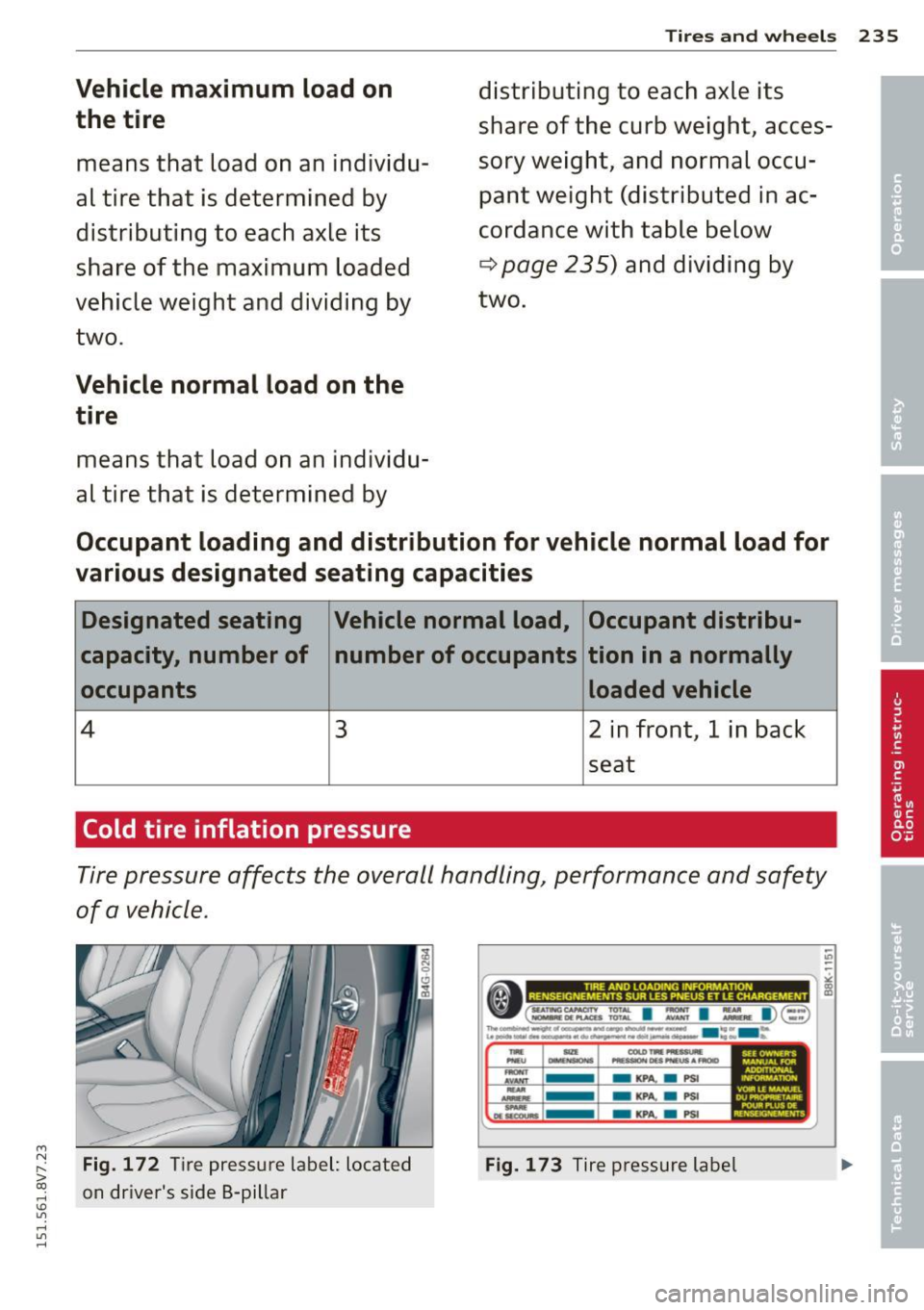
Tire pressure affects the overall handling, performance and safety
of a vehicle.
Fig. 172 Ti re pressure label: located
on driver's s ide B -pillar
""" -,.._ u net:MHW>NS
-.....
--.,._
- KPA. a PSI
- KPA.
a PSI
-KPA. a PSI
Fig. 173 Tire pressure label
"'
Page 238 of 302
236 Tires and wheels
Tire pressure generally refers to tant things you can do to help
the amount of air in a tire that avoid sudden tire failure. Un-
it needs it to do its job and derinflated tires are a major
safely carry the combined load cause of sudden tire failure.
of the entire vehicle and its con- Keeping tires at the right pres-
tents. Tire pressure is measured sure is also important for safe in kilopascals (kPa), the inter-and responsive vehicle han-
national measuring unit and in dling, traction, braking and
pounds per square inch (PSI). load carrying.
Tire pressures
Tire pressure is based in part on are particularly important
the vehicles design and load when the vehicle is being driv-
limit -the greatest amount of en at higher speeds, and then
weight that the vehicle can car-especially when heavily loaded
ry safely and the tire size. The even within the permissible
proper tire pressure is frequent-load-carrying capacities ap-
ly referred to as the "recom-proved for your vehicle.
mended cold tire inflation pres-
The recommended tire pres-
sure." Air in the tires expands
sures for your Audi depend on
when the tire heats up because the kind of tires on your vehicle
of internal friction when it flex-
and the number of passengers
es in use. The tire pressure is
and/or amount of luggage you
higher when the tire has will be transporting.
warmed up than when it is The tire pressure label is locat-
"cold." It is the inflation pres-
ed on the driver's side 8-pillar.
sure in a "cold " tire that counts .
Therefore, you should never let The tire pressure label lists the
recommended cold t ire infla-
air out of a warm tire to match
"cold tire inflation pressure" tion pressures for the vehicle at
its maximum capacity weight
recommendations. The tires
would then be underinflated and tires that were on your ve-
and could fail suddenly. hicle at the time it was manu-
factured .
...
Maintaining proper tire pres-
sure is one of the most impor-
Page 239 of 302
M N
" > co ...... \!) 1.1'1
...... 1.1'1 ......
If you wish to improve comfort
when operating the vehicle at
normal load (up to 3 occu
pants), you can adjust tire
pressures to those specified
for normal vehicle load. Before
operating the vehicle at maxi mum load, you must increase
the tire pressures to those
specified for maximum vehicle
load
c> .&. .
Bear in mind that the tire pres
sure monitoring system can on
ly monitor the tire pressures
you have stored. The system does not recognize the load
condition of your vehicle.
The effectiveness of the tire pressure monitoring system
will be impaired if you store normal load pressures but then
operate the vehicle at its maxi
mum load
c> .&. .
Tires and wheels 237
See the illustration c> fig. 172
for the location of the label on
driver's side B-pillar (color of
the actual label and exact loca
tion on the vehicle will vary slightly).
Note that the following table is
accurate at the time of going to
press and is subject to change.
In the event of discrepancies,
the tire pressure label is locat ed on the driver's side B-pillar
always takes precedence.
The table below lists the rec ommended cold tire inflation pressures for the Audi model
covered by your Owner's Litera
ture at the vehicle's capacity
weight and the tire sizes instal
led on the respective models as
original equipment, or as a fac-
tory option. ..,.
' •
•
' •
Page 241 of 302
Tires and wheels 239
technically referred to as the not be able to stop the vehi-
vehicle's Gross Vehicle Weight cle within a safe distance.
Rating ("GVWR"). The Gross -Tires on a vehicle that has
Axle Weight Rating ("GAWR") is been overloaded can fail
the maximum load that can be suddenly causing loss of
' •
•
applied at each of the vehicle's control and a crash.
two axles. The Gross Vehicle -Always make sure that the
Weight Rating and the Gross total load being transported
Axle Weight Rating are listed -including the weight of a
on the safety compliance stick- trailer hitch and the tongue
er label located on the driver's weight of a loaded trailer -
side B-pillar. The tire pressure does not make the vehicle
label on your Audi lists the heavier than the vehicles
maximum combined weight of Gross Vehicle Weight Rat-
all of the occupants and lug- 1ng.
gage or other cargo that the ve-
A WARNING hicle can carry. For the location
of the tire pressure label -Incorrect tire pressures
¢ fig
. 172. and/or underinflation can
lead to a serious or fatal ac-
A WARNING
-cident.
Overloading a vehicle can -Incorrect tire pressures
cause loss of vehicle control, and/or underinflation cause
a crash or other accident, se- increased tire wear and can
rious personal injury, and affect the handling of the
even death. vehicle.
-Carrying more weight than -Incorrect tire pressures
your vehicle was designed and/or underinflation can
to carry will prevent the ve- also lead to sudden tire fail-
hicle from handling properly ure, including a blowout
and increase the risk of a and sudden deflation, caus-
' • M loss of vehicle control.
ing loss of vehicle control. N
" >
-The brakes on a vehicle that co ...... \!)
has been overloaded may
1.1'1
...... 1.1'1 ......
Page 245 of 302
M N
" > co ,...., \!) 1.1'1 ,...., 1.1'1 ,....,
tire failure and loss of
control.
-Excessive speed and/over loading can cause heat
build -up, sudden tire failure
and loss of control.
-If the tire pressure is too low or too high, the tires
will wear prematurely and
the vehicle will not handle
well.
-If the tire is not flat and you do not have to change a
wheel immediately, drive at
reduced speed to the near
est service station to check
the tire pressure and add air as required.
(D Note
Driving without valve stem
caps can cause damage to
the tire valves. To prevent
this, always make sure that
factory installed valve stem caps on all wheels are secure
ly mounted on the valve.
@ For the sake of the environment
Underinflated tires will also
increase the fuel consump
tion.
Tires and wheels 243
Tires and vehicle load limits
'
There are limits to the amount of load or weight that any vehi
cle and any tire can carry. Ave
hicle that is overloaded will not
handle well and is more diffi
cult to stop. Overloading can
not only lead to loss of vehicle
control, but can also damage important parts of the vehicle
and can lead to sudden tire fail
ure, including a blowout and
sudden deflation that can cause
the vehicle to crash.
Your safety and that of your passengers also depends on
making sure that load limits are
not exceeded. Vehicle load in
cludes everybody and every
thing in and on the vehicle .
These load limits are technical ly referred to as the vehicle's
Gross Vehicle Weight Rating
("GVWR").
The "GVWR" includes the
weight of the basic vehicle, all
factory installed accessories, a
full tank of fuel, oil, coolant and other fluids plus maximum ""
' •
•
' •
Page 246 of 302
244 Tires and wheels
load. The maximum load in
cludes the number of passen
gers that the vehicle is intend
ed to carry ("seating capacity")
with an assumed weight of
150 lbs (68 kg) for each pas
senger at a designated seating
position and the total weight of
any luggage in the vehicle. If
you tow a trailer, the weight of
the trailer hitch and the tongue
weight of the loaded trailer
must be included as part of the
vehicle load .
The
Gross Axle Weight Rating
("GAWR") is the maximum load
that can be applied at each of
the vehicle's two axles.
The Gross Vehicle Weight Rat ing and the Gross Axle Weight Rating are listed on the safety
compliance sticker label locat
ed on the driver's side 8-pillar.
Your Audi has 5 seating posi
tions, 2 in the front and 3 in the rear for total seating capacity
of 5. Each seating position has
a safety belt
¢ page 138, Safe
ty belts.
The fact that there is an upper
limit to your vehicle's Gross Ve
hicle Weight Rating means that the total weight of whatever is
being carried in the vehicle (in
cluding the weight of a trailer hitch and the tongue weight of
the loaded trailer) is limited.
The more passengers in the ve
hicle or passengers who are
heavier than the standard
weights assumed mean that less weight can be carried as
luggage.
The tire pressure label on your
Audi also lists the maximum
combined weight of all of the
occupants and luggage or other
cargo that the vehicle can carry.
For the location of the label
¢page 235, fig. 172.
A WARNING -
Overloading a vehicle can
cause loss of vehicle control,
a crash or other accident, se
rious personal injury, and
even death.
-Carrying more weight than your vehicle was designed to carry will prevent the ve
hicle from handling properly
and increase the risk of the
loss of vehicle control.