weight AUDI A3 CABRIOLET 2015 User Guide
[x] Cancel search | Manufacturer: AUDI, Model Year: 2015, Model line: A3 CABRIOLET, Model: AUDI A3 CABRIOLET 2015Pages: 302, PDF Size: 73.83 MB
Page 171 of 302
M N
" > co ,...., \!) 1.1"1 ,...., 1.1"1 ,....,
Child Safety
Important things to know
Introduction
The rear seat is generally the safest place in a
collision.
The physical principles of what happens when
your veh icle is in a crash app ly also to chi ldren
~ page 139, What happens to occupants not
wearing safety belts?.
But unlike adults and
teenagers, their muscles and bones are not
fu lly developed. In many respects children are
at greater risk of serious injury in crashes than
adu lts.
Because children's bodies are not fully deve l
oped, they require restraint systems especial ly designed for their size, weight, and body
structure. Many countries and all states of the
United States and provinces of Canada have
laws requiring the use of approved child re
straint systems for infants and small children .
In a fronta l crash at a speed of 20 -35 mph
(30-56 km/h) the forces acting on a 13-pound
(6 kg) infant w ill be more than 20 t imes the
weight of the child . This means the weight of
the child would suddenly be more than
260 pounds ( 120 kg). Under these conditions,
on ly an appropriate chi ld restraint properly
used can reduce the risk of ser ious injury.
Child restra ints, like adult safety belts, must
be used properly to be effective. Used improp
erly, they can increase the risk of serious in
jury in an accident.
Consult the child safety seat manufacturer's
instructions in order to be sure the seat is
right for your chi ld's size ~
page 173, Impor
tant safety instructions for using child safety
seats.
Please be sure to read and heed all of
the important information and WARNINGS
about ch ild safety, Advanced A irbags, and the
installation of child restraints in this chapter.
There is a lot you need to know about the Ad
vanced Airbags in your vehicle and how they
wo rk when infants and children in child re-
Child Sa fet y 169
straints are on the front passenger seat . Be
cause of the large amount of important infor
mation, we cannot repeat it a ll here . We urge
you to read the detailed information in this owner's manual about airbags and the Ad
vanced Airbag System in your vehicle and the
very important information about transport
ing children on the front passenger seat .
Please be sure to heed the WARNINGS -they
are extremely important for yo ur safety and
the safety of your passengers, especially in
fants and small children .
.A, WARNING
-Accident statistics have shown that chil
dren are generally safer in the rear seat
area than in the front seating position.
Always restrain any child age 12 and un der in the rear.
- All vehicle occupants and especially chil
dren must be restrained properly when
ever riding in a vehicle . An unrestrained
or improperly restrained chi ld could be
injured by str iking the interior or by be
ing ejected from the vehicle during a
sudden maneuve r or impact. An un re
strained or improperly restrained chi ld is
also at greater risk of injury or death
through contact with an inflating airbag.
- A suitable chi ld restraint properly instal
led and used at one of the rear seating
positions provides the highest degree of
protection for infants and small children
in most accident situations.
A WARNING
Children on the front seat of any car even
with Advanced Airbags can be ser iously in
jured or even killed when an a irbag in
flates. A child in a rearward-facing child
safety seat installed on the front passen
ger seat will be ser iously injured and can
be killed if the front airbag inflates .
- The inflating airbag will h it the child
safety seat or infant carrier with great
force and will smash the child safety seat
and child against the backrest, center
armrest, or door.
•
•
•
Page 174 of 302
172 Child Saf ety
WARNINGS. Make certain that the ch ild and
child restraint are correct ly recognized by the
capacitive passenger detect ion system in the
front passenger seat, that the front passenger
a irbag is turned off, and that the airbag status
is always correct ly signa led by the
PAS SEN
GER AIR BA G OFF
light .
Many types and models of child restra ints
have been ava ilable over the years, new mod
els are introduced regular ly incorporating new
and improved designs a nd older models are
taken out of production . Child rest raints are
not standardi zed. Ch ild restra ints of the same
type typi cally have differen t weights and s izes
and d ifferent "footprints", the size and shape
of the bottom of the child restraint that sits
on the seat, when they are installed on a vehi
cle seat. These differences make it virtually imposs ible to certify compliance w ith the re
qu irements for advanced a irbags w ith each
and every child restraint that has ever been
sold in the past or will be sold over the course
of the useful life of you r vehicle .
For this reason, the United States National
Highway Traffic Safety Admin istration has
published a list of specific type, makes a nd
models of child rest raints that must be used
to certify compliance of the Advanced Airbag
System in yo ur vehicle with the suppress ion
requirements of Federal Motor Vehicle Safety
Standard 208 . These child restraints are:
Subpart A -Car bed child restraints
Model Manufactured on or
after
Ange l Guard Ange l September 2S, 200 7
Ride AA2403 FOF
Subpart B -Rear -facing child re straint s
Model Manufactured on or
after
Century SmartFit December 1, 1999
4543
Cosco Arriva September 2S, 2007
22-0 13PAW and base
22-999WHO
Model Manufactured on or
after
Evenflo Discovery Ad- December 1, 1999
just Right 212
E venflo First Choice December 1, 1999
204
Graco Infant 8457 December 1, 1999
Graco Snugride September 25 , 2007
Peg Perego Pr imo Vi- September 25, 2007
aggio SIP IMUNOOUS
Subpart C - Forw ard-facing and
convertible child restraint s
Model Manufactured on or
after
Britax Roundabout September 25, 2007
E9L02xx
Cosco Touriva 02S19 December 1, 1999
Cosco Summit De luxe September 2S, 2007
High Back Booster
22-262
Cosco H igh Back September 2S , 2007
Booste r 22-209
Evenflo Tribute V September 25, 2007
379xxxx
Evenflo Meda llion December 1, 1999
254
E venflo Generations September 25 , 2007
352xxxx
Graco ComfortSport September 25, 2007
Graco Todd ler Safety September 25, 2007
Seat Step 2
Graco Platinum Cargo September 25, 2007
A WARNING
To reduce the risk of serious inju ry, ma ke
sure that the
PASSENGER AIR BAG OFF
l ight comes on and stays on whenever a
chi ld restraint is installed on the front pas
senger seat and the ignition is switched
on.
- Take the chi ld restraint off the front pas
senger seat and install it properly at one
of the rear seat positions if the
PA SSEN -
GER AIR BAG OFF
light does not stay on. ...
Page 175 of 302
M N
" > co ,...., \!) 1.1"1 ,...., 1.1"1 ,....,
-Have the airbag system inspected by
your authorized Audi dealer immediate
ly.
(D Tips
The child seats listed in categories A to C have been statically tested by Audi only for
the Advanced Airbag function.
Important safety instructions for using
child safety seats
Correc t use of child safety sea ts substantially
reduces the risk of injury in an accident!
As the driver, you are responsible for the safe
ty of everybody in the vehicle, especially chil
dren:
.. Always use the right child safety seat for
each child and always use it properly
¢ page 175.
.,. Always carefully follow the child safety seat
manufacturer's instructions on how to route
the safety belt properly through the child
safety seat.
.. When using the vehicle safety belt to install
a child safety seat, you must first activate
the convertible locking retractor on the
safety belt to prevent the child safety seat
from moving
¢ page 180.
.,. Push the child safety seat down with your
full weight to get the safety belt really tight so that the seat cannot move forward or
sideways more than one inch (2.5 cm) .
.. Secure unused safety belts on the rear seat
¢page 175.
Always remember: Even though your vehicle is
equipped with an Advanced Airbag system, all
children, especially those 12 years and young
er, should always ride in the back seat proper
ly restrained for their age and size.
_& WARNING
Not using a child safety seat, using the
wrong child safety seat or improperly in stalling a child restraint increases the risk
of serious personal injury and death.
-
Child Safety 173
- All vehicle occupants and especially chil
dren must be restrained properly when
ever riding in a vehicle . An unrestrained
or improperly restrained child could be
injured by striking the interior or by be
ing ejected from the vehicle during a
sudden maneuver or impact. An unre
strained or improperly restrained child is
also at greater risk of injury or death
through contact with an inflating airbag.
- Commercially available child safety seats
are required to comply with U.S. Federal
Motor Vehicle Safety Standard (FMVSS)
213 (in Canada CMVSS 213).
- When buying a child restraint, select
one that fits your child and the vehicle.
- Only use child restraint systems that fully contact the flat portion of the
seat cushion . The child restraint must
not tip or lean to either side. Audi does
not recommend using child safety
seats that rest on legs or tube-like
frames. They do not provide adequate
contact with the seat.
- Always heed all legal requirements per
taining to the installation and use of
child safety seats and carefully follow
the instructions provided by the manu
facturer of the seat you are using.
- Never allow children under 57 inches
(1.45 meters) to wear a normal safety
belt. They must always be restrained by a
proper child restraint system. Otherwise,
they could sustain injuries to the abdo
men and neck areas during sudden brak
ing maneuvers or accidents.
- Never let more than one child occupy a
child safety seat.
- Never let babies or older children ride in
a vehicle while sitting on the lap of an
other passenger .
- Holding a child in your arms is never a
substitute for a child restraint system .
- The strongest person could not hold
the child with the forces that exist in
an accident. The child will strike the in
terior of the vehicle and can also be
struck by the passenger .
•
•
•
Page 177 of 302
....,
N
" > co
rl I.O
"' rl
"' rl
Secure unused safety belts on the rear
seat
F ig. 148 Schematic overview: keep un used safety belts
away from chi ld re n in c hild saf ety seats .@ - outer rear
safety belt
If a child safety seat is used o n the rear bench,
espec ially with LATCH universal lower ancho
rages, the unused safety belts
mu st be se
cured so that the ch ild in the ch ild restra int
cannot reach them
¢ ,&. .
- Gu ide the safety belt webbing @behind the
head restraint of the seat where the child re
stra int is ins ta ll ed
¢ fig. 148. When do ing
so , do not engage the switchable locking re
tractor! You should not hear a "clicking"
sound when wind ing up the safety be lt.
- Let the belt re tractor wind up the safety be lt
webbing .
_& WARNING
A child in a child safety seat installed with
the LATCH lower anchorages or with the
standard safety belt or a child in a booster
seat on the rear seat could play with u n used rear seat safety belts and become en
tangled . This could cause the child serious
pe rsonal in jury and even deat h.
-Always secure u nused rear seat safety
belts out of reach of ch ildren in ch ild
sea ts such as by properly routing them
around the head res traint of the sea t
whe re the child restraint is installed.
- Never act ivate the convertib le loc king re
tra ctor when rout ing the safety belts
around the head res traints .
Child S afety 175
Child safety seats
Infant seats
Babies and infants up to about one year old
and 20 lbs. or 9 kg need special rearward-fac
ing child restraints that support the back,
neck and head in a crash .
Fig. 14 9 Schem atic ove rv ie w : re arward-fac ing in fant
se at, p rope rly insta lled on t he re ar seat
.. When using the vehicle safety belt to install
a child safety seat, you must first activate
the convertib le locking retractor on the
safety belt to prevent the child safety seat
from mov ing
¢ page 180 or install the seat
using the LATCH attachments .
.. Push the chi ld safety seat down w ith your
full weight to get the safety be lt really tight
so that the seat cannot move forward or
sideways more than one inch (2.5 cm).
.. Secure unused safety bel ts on the rear seat
¢ page 175.
Infants up to about one year (20 lbs. or 9 kg)
a re best pro tected in spec ial infant carriers
and child safety seats designed for their age
group . Many experts believe that infants and
small ch ildren shou ld ride on ly in special re
stra in ts in which the child faces the back of
the vehicle. These infa nt sea ts support the ba
by 's back, neck and head i n a crash
¢ fig. 149 .
The airbag on the passenger side makes the
front seat a potentia lly dange rous place for a
ch ild to ride . The front seat is not the safest
place for a child in a fo rward-facing child seat.
It is a very dangerous place for an infant or a
larger child in a rearward-facing seat.
ll>
Page 179 of 302
M N ,....
> co ,...., \!) 1.1'1 ,...., 1.1'1 ,....,
from moving r::!;> page 180 or install the seat
using the LATCH attachments.
~ Push the child safety seat down with your
full weight to get the safety belt really tight
so that the seat cannot move forward or
s ideways more than one inch (2 .5 cm)
¢ page 180.
~ If the child safety seat is equ ipped with a
tethe r strap, attach it to the tether anchors
¢page 185.
~ Secure unused safety bel ts on the rear sea t
¢page 175.
A toddler or child is usually too large for an in
fant restraint if it is more than one year o ld
and weighs more than 20 lbs . (9 kg) .
Toddle rs and ch ildren who are older than one
yea r up to abo ut 4 years o ld and weigh more
than 20 lbs (9 kg) up to 40 lbs. (18 kg) mus t
a lways be prope rly restrained in a ch ild safety
seat certified for their size and weight
¢ fig .150and ¢fig.151 .
The airbag on the passenge r side makes the
front seat a poten tially dangerous place for a
chi ld to ride. The front seat is not the safest
p lace for a child in a forward-facing child safe
ty seat.
It is a very dangero us place for an in
fant or a larger child in a rearward-fac ing seat.
A WARNING
Not using a ch ild safety seat, using the
wrong chi ld safety sea t or improper ly in
stalling a child restraint increases the risk
of serious personal injury and death in a
co llision or othe r eme rgency s ituation.
- Children on the front seat of any car,
even with Advan ced A irbags, can be seri
o usly injured or eve n killed when an a ir
bag inf lates . A child in a rearward -facing
child safety seat installed on the front
passenger seat wi ll be seriously injured
and can be ki lled if the front airbag in
flates -even with an Advanced Airbag
System.
- The inflating a irbag w ill hit the child
safety seat or infant carrier w ith great
force and w ill smash the ch ild safety seat
Child Sa fet y 177
and child against the backrest, center
arm rest, door or roof.
- Always install rear-facing chi ld safety
seats on the rear seat.
- If you must install a rearward facing
child safety seat on the front passenger
seat because of exceptional c ircumstan
ces and the
PASSENGER AIR BAG OFF
light does not come on and stay on, im
mediately install the rear-fac ing ch ild
safety seat in a rear seating position and have the airbag system inspe cted by your
Aud i dea le r.
- The rear side of the child safety seat
should be pos itioned as close as possib le
to the backres t on the vehicle seat.
- For ad justab le head restra ints: adjust or
remove the rea r seat he ad restr aint if i t
is diffi cult to ins tall the child seat w ith
the head restraint in place
¢ page 63. In
stall the head restraint again immed iate
ly once the child seat is removed . Dr iv ing
without head restraints or with head re
straints that are not properly adjusted
increases the risk of serious or fatal neck
i nj ury dramatically .
- Always read and heed all WARNINGS
wheneve r us ing a child restrained in ave
hicle is being used¢
page 138, Safety
b elts,
c::!;> page 146, Airbag system and
c::!;> page 169, Impor tan t things to know.
A WARNING
If ex cep tional cir cumstances require the
use o f a forward-facing child res traint on
the front passenge r's sea t, the child's safe
ty and well-being req uire that the follow
ing spec ial precautions be ta ken:
- Make sure the forward -facing seat has
been designed and certified by its man u
facturer for use on a front seat with a passenger front and side airbag.
- Always follow the manufacturer's in
structions provided with the ch ild safety
seat or infant carr ier.
•
•
•
Page 180 of 302
1 78 Child Safety
- Always move the front passenger seat in
to the rearmost position of the passen
ger seat's fore and aft adjustment range,
and as far away from the airbag as possi
ble before installing the child restraint .
- Always make sure that nothing prevents
the front passenger's seat from being
moved to the rearmost position in its
fore and aft adjustment range.
- Always make sure the backrest is in an
upright position .
- Never place or use any electrical device
(such as a laptop, CD player, electronic
games device, power inverter or seat
heater for child seats) on the front pas
senger seat if the device is connected to
the 12-volt socket or the cigarette light
er socket.
- If a seat heater has been retrofitted or
otherwise added to the front passenger
seat, never install any child restraint sys
tem on this seat.
- Make sure that there are no wet objects
(such as a wet towel) and no water or
other liquids on the front passenger seat
cushion.
- Never place objects on the seat (such as
a laptop, CD player, electronic games de
vice, power inverter or seat heater for
child seats). These may influence the
electrical capacitance measured by the
capacitive passenger detection system
and can also fly around in an accident
and cause serious personal injury .
- Make sure that the
PASSENGER AIR BAG
OFF
light comes on and stays on all the
time whenever the ignition is switched
on.
- If the PASSENGER AIR BAG OFF light
does not come on and stay on, immedi
ately install the forward-facing child seat
at a seating position on the rear seat and
have the airbag system inspected by your
authorized Audi dealer.
- Take the child restraint off the front pas
senger seat and install it properly at one
of the rear seat positions if the
PASSEN- GER AIR BAG OFF
light
does not stay on
whenever the ignition is switched on.
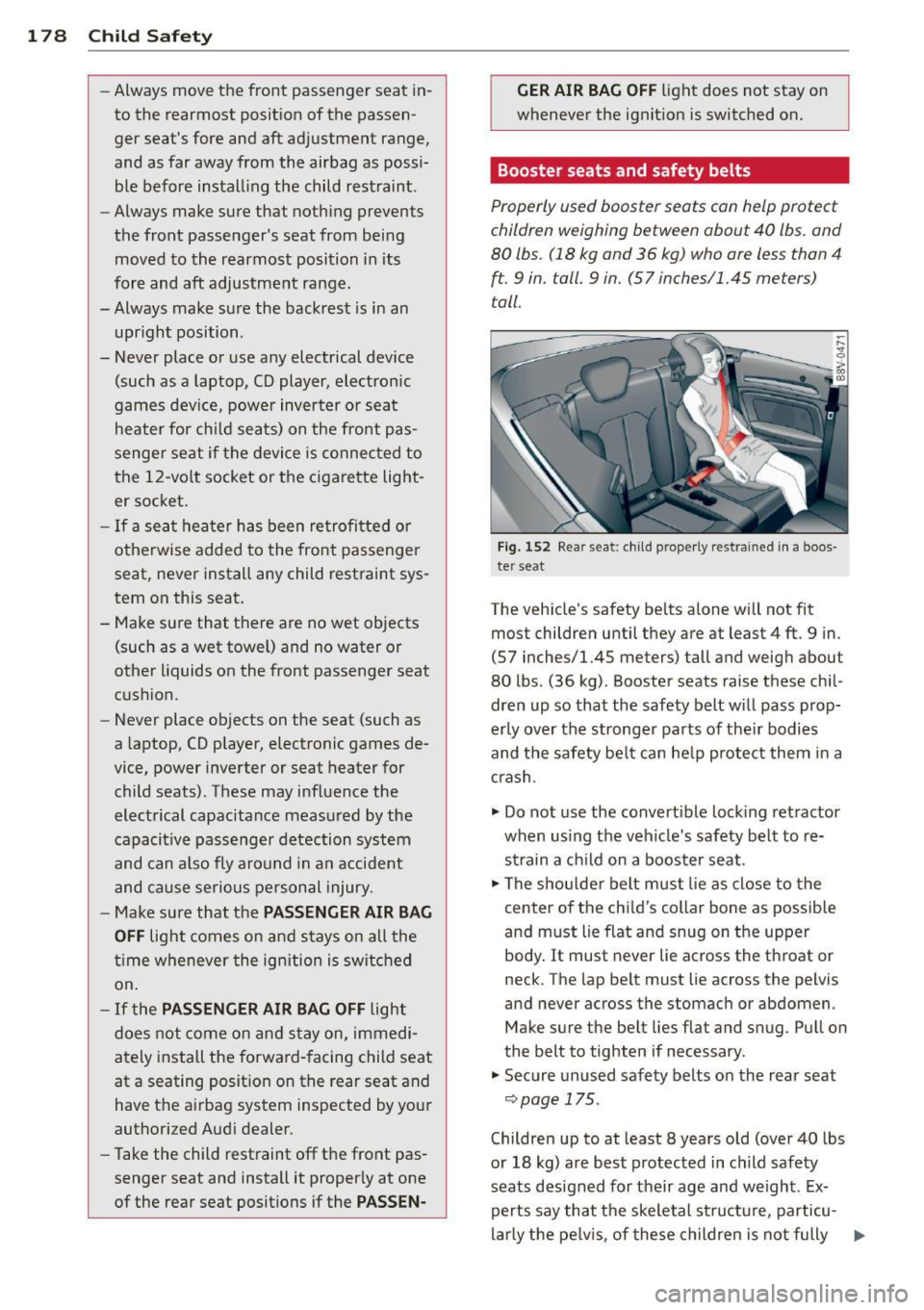
Booster seats and safety belts
Properly used booster seats can help protect
children weighing between about 40 lbs. and
80 lbs. (18 kg and 36 kg) who are less than 4
ft. 9 in. tall. 9 in. (57 inches/1.45 meters)
tall.
Fig. 1S2 Rear seat : child properly restrained in a boos·
te r seat
The vehicle 's safety belts alone will not fit
most children until they are at least 4 ft. 9 in.
(57 inches/1.45 meters) tall and weigh about
80 lbs .
(36 kg). Booster seats raise these chil
dren up so that the safety belt will pass prop
erly over the stronger parts of their bodies
and the safety belt can help protect them in a
crash.
" Do not use the convertible locking retractor
when using the vehicle's safety belt to re
strain a child on a booster seat.
"The shoulder belt must lie as close to the
center of the child's collar bone as possible
and must lie flat and snug on the upper
body. It must never lie across the throat or
neck . The lap belt must lie across the pelvis
and never across the stomach or abdomen.
Make sure the belt lies flat and snug . Pull on
the belt to tighten if necessary .
"Secure unused safety belts on the rear seat
~page 175.
Children up to at least 8 years old (over 40 lbs
or 18 kg) are best protected in child safety
seats designed for their age and weight . Ex
perts say that the skeletal structure, particu
larly the pelvis, of these children is not fully ...
Page 184 of 302
182 Child Safety
Activating the convertible locking retractor
Use the convertible locking retractor to se
cure a child restraint.
Always heed the child safety seat manufactur
er's instructions when installing a child re
straint in your vehicle. To activate the conver
tible locking retractor:
• Place the child restraint on a seat, prefera
bly on the rear seat.
• Slowly pull the belt
all the way out.
• Route it around or through the child re
straint belt path¢.&_ .
• Push the child safety seat down w ith your
full weight to get the safety belt really tight.
• Insert the belt tongue into the buckle for
that seating position.
• Guide the safety belt back into the retractor
until the belt lies flat and snug on the child
safety seat .
• You should hear a "clicking " noise as the
belt winds back into the inertia reel. Test the
convertible locking retractor by pulling on
the belt. You should no longer be able to
pull the belt out of the retractor. The con
vertible locking retractor is now activated.
• Make sure that the red release button is fac
ing away from the child restraint so that it
can be unbuckled quickly .
•Pullon the belt to make sure the safety belt
is properly tight and fastened so that the
seat cannot move forward or sideways more
than one inch (2.5 cm).
.&_ WARNING
Using the wrong child restraint or an im
properly installed child restraint can cause
serious personal injury or death in a crash.
- Always make sure that the safety belt re-
tractor is locked when installing a child
safety seat. An unlocked safety belt re
tractor cannot hold the child safety seat in place during normal driving or in a
crash .
- Always buckle the child safety seat firmly
in place even if a child is not sitting in it.
-
A loose child safety seat can fly around
during a sudden stop or in a crash.
- Always make sure the seat backrest to
which the child restraint is installed is in
an upright position and securely latched
into place and cannot fold forward. Oth
erwise, the seatback with the child safety
seat attached to it could fly forward in
the event of an accident or other emer
gency situation.
- Always read and heed all WARNINGS
whenever using a child restrained in ave
hicle is being used
¢page 169. Special
precautions apply when installing a child
safety seat on the front passenger seat
¢ page 148, Child restraints on the front
seat -some important things to know.
'
Deactivating the convertible locking
retractor
T he convertible locking retractor for child re
strain ts will be deactiva ted automatically
when the bel t is wound all the way back in to
the retractor .
• Press the red button on the safety belt buck
le . The belt tongue will pop out of the buck
le .
• Guide the safety belt all the way back into
its stowed position .
Always let the safety bel t retract completely
into its stowed position . The safety belt can
now be used as an ordinary safety belt with
out the convertible locking retractor for child
restraints.
If the convertible locking retractor should be
activated inadvertently, the safety belt must be unfastened and guided completely back in
to its stowed position to deactivate this fea
ture. If the convertible locking retractor is not
deactivated , the safety belt will gradually be-
come tighter and uncomfortable to wear.
11>-
Page 203 of 302
M N
" > co ,...., \!) ..,.,
,...., ..,., ,....,
Trailer towing Driving with a trailer
General information
Your Audi was designed primarily for passen
ger transportation .
If you plan to tow a tra iler, p lease remember
that the addit ional load will affect durab ility,
economy and performance .
Trailer towing not on ly places more stress on
the vehicle, it also calls for more concentra
tion from the driver.
F or this reason, a lways fo llow the operating
a n d driving instr uctions provided and use
common sense.
Technical requirements
Traile r hitch
Use a weight-carrying hitch conforming to the
gross trailer we ight. The hitch must be suita
b le for your veh icle and trailer and must be
mounted secure ly on t he veh icle's chassis at a
technically sound location . Use only a t railer
h itch w ith a removab le ball moun t. A lways
check with the tr ailer hitch man ufac tur er to
make sure that you are using the correct
hitch.
Do not use a bumper hitch.
T he hitc h must be installed in such a way that
it does not inte rfe re with the impac t-absorb
i ng b umper syst em. No modifica tions should
be made to the vehicle exhaus t and b rake sys
tems . From t ime to time, check that a ll hitch
mo unt ing bolt s remain securely fas tened.
W hen you are not tow ing a trailer, remove the
trai le r hi tch ball moun t. T h is prevents the
hi tch from causing damage sho uld your ve hi
cle be str uck from be hind
¢ &. .
Trailer brakes
If yo ur tra iler is equ ipped w it h a braking sys
tem, check to be su re that it conforms to a ll
r eg ulat io ns .
Trailer towin g 201
The trailer hyd ra ulic bra ke system must not be
direct ly connected to the vehicle's hydraulic
brake system .
Safety chains
Alw ays use saf ety chains between your ve hicle
and t he tra ile r.
Trailer lights
Tra iler lights must meet all reg ulations . Be
su re to check with your Audi dea ler fo r cor re ct
wir ing, swi tches and relays.
Mirrors
If you a re unable to see the traffic behind you
u sing the regula r outside m irrors, then you
must i nsta ll ext ended mir rors . It is important
t h at you
always have clea r vis ion to the rear .
.8, WARNING
-
Afte r removing the trailer hit ch, do no t
s tore i t in yo ur vehicle . In case of sudden
b raking, the h itch cou ld fly forwar d an d in
ju re you or yo ur passengers .
Operating instructions
Maximum trailer weight
A tra ile r fo r you r vehicle is limited to a ty pical
cl ass 1 or class 2 tra ile r.
Trailer load distribution
B e sure the loa d in the tr aile r is held secure ly
i n place to p reven t it from shift ing forw ard,
ba ckward or sideways.
Never allow a passenger to ride in a trailer
¢ &. in Driving instru ctions on page 20 2.
Engine cooling system
Towing a trailer makes the engine work hard
er . It is impo rtant that the cooling system's
perfo rmance is up to the additional load .
Make sure that the coo ling syst em has enough
f lui d.
Tire pressure
When towing a trailer , inflate the tires of your
vehicle to t he cold tire pressure listed under .,..
•
•
•
Page 204 of 302
202 Trailer towing
"Full load" on the label located on the driver's
side B-pillar (visible when the door is open).
Inflate trailer tires to trai ler and t ire manufac
turers' specif ications.
Lights
Check to make sure both vehicle and trailer
lights are working properly.
Safety chains
Be sure trailer safety chains are properly con
nected from the trailer to the hitch on the ve
hicle. Leave enough slack in the chains to per
mit turning corners. When you install safety
chains, make sure they wi ll not drag on the
road when you are driving.
The chains should cross under the trailer
tongue to prevent it from dropping in case of
separation from the hitch.
Driving instructions
Driving with a trailer always requires extra
care and consideration.
To obtain the best possible handling of vehicle
and trailer, please note the following:
.. Do not tow a loaded tra iler when your car it
self is not loaded.
.,. Be espec ially car efu l when passing other
vehicles.
.. Observe speed limits.
.. Do not drive at the maximum permissible
speed.
.. Always apply brakes early .
.. Monitor the temperature gauge.
Weight distribution
Towing a loa ded trai ler with an empty ca r re
sults in a high ly unstable distribution of
weight . If this cannot be avoided, drive at very
low speeds only to avoid the risk of losing
steering control.
A "balanced" rig is easier to operate and con
trol. This means that the tow vehicle should be loaded to the extent poss ible and permissi
ble, while keeping the trailer as light as possi
ble under the circumstances . Whenever possi- ble,
transfer some cargo to the luggage com
partment of the tow vehicle while observing
tong ue load requirements and vehicle loading
considerations.
Speed
T he higher the speed, the more difficult it be
comes for the driver to control the rig. Do not
drive at the maximum permissible speed . Re
duce your speed even more if load, weather or
wind conditions are unfavorable -particularly
when going downhill.
Reduce vehicle speed
immediately if the trail
er shows the slightest sign of sway ing.
Do not
try to stop the swaying by accelerating.
Observe speed limits . In some areas, speeds
for vehicles towing trai lers are lower than for
regular vehicles .
Always apply brakes early. When driving
downhi ll, shift into a lower gear to use the en
gine braking effect to s low the vehicle. Use of
the brakes alone can cause them to overheat
and fail.
Coolant temperature
The coolant temperature gauge~ page 12
must be observed carefu lly. The coolant tem
perature can increase if you drive on long in
clines in a low gear at high engine speeds. Re
duce your speed immediately if the LEDs in
the top part of the d isplay turn on .
For more information about indicator lights,
refer to. ~
page 19 .
A WARNING
Anyone not properly restrained in a mov
ing vehicle is at a much greater risk in an
accident. Never let anyone ride in your car
who is not properly wearing the restraints
provided by Audi.
Trailer towing tips
Important to know
Your vehicle handles differently when towing
a trai ler because of the additional weight and ..,.
Page 205 of 302
M N
" > co ,...., \!) 1.1"1 ,...., 1.1"1 ,....,
different weight distribution. Safety, perform
ance and economy wi ll greatly depend on how
carefu lly you load your trailer and operate
your rig.
Before you actually tow your trailer, practice
turning, stopping and backing up in an area
away from traffic. Keep practicing until you
have become comp letely familiar with the way
your vehicle- trailer combination behaves and
responds .
Backing up is d ifficult and requires practice.
Backing up with a trai ler generally requires
stee ring action opposite to that when backing
up your vehicle without a trailer .
Maintain a greater distance between your ve
hicle and the one in front of you. You will need
more room to stop. To compensate for the
trailer, you will need a larger than normal
turn ing radius.
When passing, remember that you cannot ac
celerate as fast as you normally would be
cause of the added load. Make sure you have
enough room to pass . After passing, allow
p lenty of room for your tra iler before chang
ing lanes again.
Avoid jerky starts, sharp turns or rapid lane
changes.
(D Tips
- Do not tow a tra iler during the break-in
period of your vehicle.
- If you tow a trailer, your Audi may re
quire more frequent maintenance due to
the extra load
¢ page 282 .
Parking on a slope
Do not park on a slope with a trailer. If i t can
not be avoided, do so only after doing the fol
lowing:
When parking:
.. Apply the foot brake.
.. Have someone place chocks under both the
vehicle and the trailer wheels.
Trailer towing 203
.. With chocks in place, slowly release the
brakes until the wheel chocks absorb the
load .
.. Turn the wheels towards the curb.
.. Apply the parking brake.
.. Select the P selector lever posit ion.
When re starting after parking:
.. App ly the foot brake.
.. Start the engine.
.. Select the
0/5 selector lever position.
.. Release the parking brake and slowly pull
out and away from the wheel chocks .
.. Stop and have someone retr ieve the wheel
chocks.
(D Tips
If you move the selector lever of the auto
matic transmission to
P before applying
the parking brake and before blocking the
whee ls, you may have to use more force
lat er to move the lever out of the
P posi
tion.
•
•
•