warning light AUDI A3 CABRIOLET 2015 Repair Manual
[x] Cancel search | Manufacturer: AUDI, Model Year: 2015, Model line: A3 CABRIOLET, Model: AUDI A3 CABRIOLET 2015Pages: 302, PDF Size: 73.83 MB
Page 163 of 302
M N
" > co ,...., \!) ..,.,
,...., ..,., ,....,
on the front passenger seat that might cause the capa citive passenger detecti on
system to miscalcu late electrical capac i
tance.
Important safety instructions on
monitoring the Advanced Airbag System
A WARNING
- If the status of the Adv a need Airb ag Sys
tem has changed while the vehicle is
moving, the
PASSENGER AIR BAG OFF
light b links for about S seconds to catch
the driver's attent ion. If this happens, al
ways stop as soon as it is safe to do so
and check the steps described above .
- If the
PASSENGER AIR BAG OFF light
does not go off when an adult who is not
very small is sitting on the front passen ger seat after taking the steps descr ibed
above, make sure the adult is properly
seated and restrained at one of the rear seating pos it ions. Have the a irbag sys
tem inspected by your authorized Audi
dealer before transporting anyone on the
front passenger seat .
A WARNING
An airbag system that is not funct ioning
properly cannot provide supplemental pro
tection in a frontal crash.
- If the airbag indicator light
c> page 20
turns on when the vehicle is being used,
have the system inspected immediately
by you r autho rized Aud i dea le r. It is pos
sible that the a irbag will inf late when it
is not s upposed to, or w ill not inflate
when it sho uld.
A WARNING
If the front airbag infla tes, a ch ild witho ut
a c hild restraint , or in a rearwar d-fac ing
child safety seat , or in a forward-facing
child rest raint that has not been properly
installed will be serio usly injured and can
be killed.
-
A irbag system 16 1
-Even tho ugh you r vehicle is equipped
with an Advanced A irbag System, make
certa in that all children, espec ia lly 12
yea rs and younger, always ride on the
back seat prope rly rest rained for their
age and size .
- Always install forward o r rear-facing
child seats on the rear seat -even with
an Advan ced A irbag System.
- I f you must install a rearwa rd-facing
child seat on the front passenger seat because of ex ceptio nal circumstances
an d the
PASSENGER AIR BAG OFF light
does not appear and s tay on, immedi ate
ly install the rear -facing child seat in a
rea r seating pos ition and have the airbag
system inspected by you r Audi dealer.
- If, in exceptiona l circumstances, you
m ust install a forwar d-fac ing ch ild re
straint on the front passenger seat, al
ways move the seat into its rearmost po
sition in the seat's fore and aft adjust
ment range, as fa r away from the a irbag
as poss ible. The backrest must be ad just
ed to an upright pos ition. Make su re that
the
PASSENGER AIR BAG OFF light
comes on a nd stays on all the time when
eve r the ignit ion is switched on .
A WARNING
=
- If the PASSENGER AIR BAG OFF light
does not go o ut when an a dult is sitting
on the front passenger seat after taking
the steps described above, make sure the
adu lt is properly seated and restra ined at
one of the rea r seat ing pos itions .
- Have the airbag system inspected by
your Aud i dea ler before transporting
anyone on the front passenger seat .
(D Tips
If the capacitive passenger detection sys
tem dete rm ines that the front passenger
seat is empty, t he fronta l airbag on the
passenger side will be turned off, and the
PASSENGER AIR BAG OFF light will stay
on.
•
•
•
Page 166 of 302
164 Airbag system
Remember too, airbags will deploy only once
and on ly in certain k inds of accidents -your
safety belts are always there to offer protec
tion in those accidents in which airbags are
not supposed to deploy or when they have al
ready deployed, for example when your veh i
cle strikes or is struck by another after the
first coll is ion .
This is just one of the reasons why an airbag is
not a substitute for the safety belt . The airbag
system works most effectively when used with
the safety belts . Therefore, always wear your
safety be lts correctly .
It is important to remember that while the
supplemental knee airbag system is designed
to reduce the likelihood of serious injuries,
other injuries , for example , swell ing, bruising
and minor abrasions and friction burns can al
so occur when an airbag inflates.
The knee airbag system basically consists
of:
- The elec tronic con trol module
- T wo inflatab le airbags (airbag and gas gen-
erator), one fo r the driver and one for the
front passenger
- T he airbag indicator light in the instrument
panel
The knee airbag system will not deploy:
-when the ign ition is switched off
- in frontal collisions when the deceleration
measured by the control unit is too low
- in side collisions
- in rear-end collisions
- in rollovers
- i n the event of a system malfunction (warn-
i ng/indicator light is on)
Q page 20.
.8, WARNING
-Safety belts and the airbag system can
only provide protection when occupants
are in the proper seating posit ion
Q page 156.
-If the airbag indicator light¢ page 20
tur ns on when the vehicle is being used,
have the system inspected immediately
-
by your authorized Audi dealer. It is pos
sible that the airbag will inflate when it
is not supposed to, or will not inflate
when it should .
How knee airbags work
Applies to vehicles: wi th knee airbags
The risk of injury to the leg area can be re
duced by fully inflated knee airbags.
Fig . 145 Inflated a irbags protecting in a fronta l co lli
sion
The knee airbag system has been designed so
that the airbags for the driver and front pas
senger deploy in certa in but not all frontal
collisions.
If the front airbags dep loy, the knee airbags
also dep loy in frontal collisions when the de
ployment threshold stored in the control unit
is met.
When the system deploys, the airbags fill
with a compressed propellant gas, and inf late
between the lower part of the instrument
panel and the driver and the lower part of the
instrument panel and the front passenger
Qpage 156, fig. 142.
Although they are not a soft pillow, they can
"cushion" the impact and in th is way they can
help to reduce the risk of injury to the lower
extremit ies .
All of th is takes place in the blink of an eye, so
fast that many people don't even realize that
the a irbags have deployed . The airbags also
i nflate with a great deal of force and it is im
portant for occupant safety that nothing
shou ld be in their way when they deploy. ..,.
Page 168 of 302
166 Airbag sys te m
not seated p roperly. The side airbag for the
front passenger seat can be used with proper l y installed ch ild restraints. Please be sure to
read the important information and warnings
whenever us ing a child restraint in a vehicle:
Safety belts¢
page 138, Airbag system
c:;, page 146, Child safety c:;, page 169.
The side airb ag system basically con sists of:
- the e lectronic control module and external
side impact sensors
- the two airbags located in the sides of the
front backrests
- the a irbag warn ing light in the inst rument
cluster .
The airbag system is monitored elect ron ica lly
to make certain that it is functioning prope rly
at all times. Each time you switch on the igni
tion, the ai rbag system indicato r light will
come on for a few seconds (self diagnostics).
The s ide airbag system supp lements the safe
ty belts and can help to reduce the risk of in
jury to the driver's and front passenger's up
per torso on the side of the vehicle that is
struck in a side co llision . The airbag deploys
only in s ide impacts and on ly when the veh icle
acceleration registered by the control unit is
h igh enough . If this rate is below the refer
ence value programmed into the control un it,
the side airbags will not be tr iggered, even
though the ca r may be badly damaged as a re
sult of the collision.
It is not possible to de
f ine an a irbag tr igger ing range that will cover
every possible angle o f impact, since the cir
cumstances wi ll vary conside rably between
one co llision and another. Important factors
include, for example, the nature (hard or soft)
of the impacting object, the angle of impact ,
ve hicle speed, etc. ¢
page 167, Important
safety instructions on the side airbag system .
Aside from their normal safety function, safe
ty belts work to he lp keep the driver or front
passenger in position i n the event of a side
coll is io n so that the side a irbags can provide
protection .
The airbag system is
not a substitute for your
safety belt . Rather, it is part of the overall oc -cu pant restraint system in you
r vehicle . A l
ways remember that the side airbag system can only help to protect you if you are wearing
your safety belt and wearing it properly. This is another reason why you should always wear
your safety belts, not just because the law re
quires you to do so c:;,
page 138, General
notes.
It i s important to remember that w hile the
supplementa l side airbag system is designed
to reduce the likelihood of ser ious inju ries,
other injur ies, for example, swelling, bru is ing,
friction burns and m ino r abrasions can a lso be
associated w it h dep loyed side airbags. Re
member too, side a irbags w ill dep loy on ly
once and on ly in certain kinds of accidents -
your safety belts are always the re to offer pro
tection .
Vehicle damage, repair costs or even the lack
of ve hicle damage are not necessarily an indi
cation of over-sensitive or failed airbag activa
t ion. In some col lisions, both front and side
airbags may inflate. Remember too, that air
bags will deploy only once and only in certain
k inds of col lisions -your safety belts are al
ways the re to offer p rotection in those acc i
dents in which airbags are not supposed to
deploy or when they have a lready deployed .
The side airbag system will not deploy:
-when the ignit ion is switched off
- in side co llisions when the acceleration
measured by t he sensor is too low
- in front-end collisions
- in rear-end co llisions
- in rollove rs .
In some types of accidents the front airbags,
s ide cu rtain airbags and s ide a irbags may be
t rigge red togethe r.
_&. WARNING ~ ~
- Safety belts and the airbag system will
only provide protection when occupa nts
are in the proper seating position
c;, page 167 .
Page 169 of 302
....,
N
r--. > co
rl I.O
"' rl
"' rl
-If the airbag indicator light c::> page 20
turns on when the vehicle is being used,
have the system inspected immediately
by your authorized Aud i dea le r. It is pos
sible that the a irbag will inflate when it
is not s upposed to, or w ill not inflate
when it sho uld.
How supplemental side airbags work
Side airbags deploy instantly and can help re duce the risk of upper torso injuries for occu
pants who are properly restrained.
Fig . 14 7 Side impac t pro tectio n: inflated s ide a irbag
When the system is triggered, the airbag is
fi lled with propel lant gas and brea ks thro ugh
a seam in the seat surface area marked "AIR
BAG".
It expands between the side trim panel
and the passenger. In order to help provide
this additional protection, the side a irbag
must inf late within a fraction of a second at
ve ry high speed a nd with great force . The sup
p lemental side a irbag could i njure you if your
seating position is no t proper or upr igh t or if
items are located in the area where the sup
p lemental side a irbag expands. This app lies
espec ia lly to children
c::> page 169, Child Safe
ty.
Supplementa l side airbags inflate between
the occupant and the door panel on the side
of the vehicle that is struck in certain side col lision
c::> fig . 147 .
Although they are not a soft pillow, they can
"cushion" the impact and in th is way they can
he lp to reduce the risk of injury to the upper
part of the body .
A fine dust may develop when the airbag de p loys. Th is is norma l and does not mean there
is a fire in the ve hicle.
A irba g sy stem 16 7
Important safety instructions on the
side airbag system
Airbags are only supplemental restraints . Al
ways properly wear safety belts and ride in a
proper seating position.
T he re is a lot that yo u and your passengers
must know a nd act accord ingly to help the
safe ty belts and airbags do their job to pro
v ide s upplemental pro tect ion .
A WARNING
An inflating side ai rbag can cause serio us
or fata l injury. Improperly wearing safety
belts and improper seat ing positions in
crease the risk of serious personal injury
and death whenever a vehicle is bei ng
used .
- In order to reduce the risk of injury when
the supplemental side airbag inflates:
- Always sit in an upright position and
never lean aga inst the area where the
supplementa l side airbag is located .
- Never let a child or anyo ne e lse res t
their head aga inst the s ide trim pane l
in the area where the supplementa l
s ide airbag inflates.
- A lways make sure that safety be lts are
worn correctly,
- Do no t let anyone s itting in the front
seat put the ir hand or any ot her parts
of their body out of the window.
-Always ma ke s ure that the side a irbag
can inflate without interfe rence.
- Neve r install seat covers or rep lace
ment upholste ry over the front seat
bac ks that have not be en specifically
approved by Audi.
- Neve r use addi tional seat c ush ions that
cover the areas where t he s ide a irbags
deploy.
- Damage to the orig inal seat cove rs or
t o the seam in the area of the side a ir
bag module mus t always be repaired
i mmedi ately by an author ized Audi
dealer.
Page 172 of 302
1 70 Child Safety
-Always install rear-facing child safety
seats on the rear seat.
- If you must install a rearward facing
child safety seat on the front passenger
seat in exceptional circumstances and
the
PASSENGER AIR BAG OFF light does
not come on and stay on, immediately
install the rear-facing child safety seat in
a rear seating position and have the air
bag system inspected immediately by
your Audi dealer.
_&, WARNING
- Forward-facing child seats installed on
the front passenger seat may interfere
with the deployment of the airbag and
cause serious personal injury to the
child.
- If exceptional circumstances require the
use of a forward-facing child restraint on
the front passenger 's seat, the child's
safety and well-being require the follow ing special precautions to be taken:
- Always make sure that the forward-fac
ing seat has been designed and certi
fied by its manufacturer for use on a
front passenger seat with a front and
side airbag.
- Always carefully follow the manufac
turer's instructions provided with the
child seat or infant carrier.
- Never install a child restraint without a
properly attached top tether strap if
the child restraint manufacturer's in
structions require the top tether strap
to be used.
- Never put the forward-facing child re
straint up against or very near the in
strument panel.
- Always set the safety belt upper an
chorage to the adjustment position
that permits proper installation in ac
cordance with the child restraint manu
facturer's instructions.
-Always move the passenger seat into
its rearmost position in the seat's fore
and aft adjustment range, as far away
.
from the airbag as possible before in
stalling the child restraint. The back
rest must be adjusted to an upright po
sition .
- Always make sure that nothing pre
vents the front passenger's seat from
being moved to the rearmost position
in its fore and aft adjustment range.
- Never place objects on the seat (such
as a laptop, CD player, electronic
games device, power inverter or seat
heater for child seats) . These may in
fluence the electrical capacitance
measured by the capacitive passenger
detection system and can also fly
around in an accident and cause serious
personal injury.
- Never place or use any electrical device
(such as a laptop, CD player, electronic
games device, power inverter or seat
heater for child seats) on the front pas
senger seat if the device is connected
to the 12 -volt socket or the cigarette
lighter socket.
- If a seat heater has been retrofitted or
otherwise added to the front passen
ger seat, never install any child re
straint system on this seat.
- Make sure that there are no wet objects
(such as a wet towel) and no water or
other liquids on the front passenger
seat cushion .
- Always make sure that the
PASSENGER
AIR BAG OFF
light comes on and stays
on all the time whenever the ignition is
switched on.
- If the PASSENGER AIR BAG OFF light
does not come on and stay on, immedi
ately install the forward-facing child seat in a rear seating position and have
the airbag system inspected by your
authori zed Audi dealer.
- Always buckle the child seat firmly in
place even if a child is not sitting in it.
A loose child seat can fly around during
a sudden stop or in a collision.
~
Page 174 of 302
172 Child Saf ety
WARNINGS. Make certain that the ch ild and
child restraint are correct ly recognized by the
capacitive passenger detect ion system in the
front passenger seat, that the front passenger
a irbag is turned off, and that the airbag status
is always correct ly signa led by the
PAS SEN
GER AIR BA G OFF
light .
Many types and models of child restra ints
have been ava ilable over the years, new mod
els are introduced regular ly incorporating new
and improved designs a nd older models are
taken out of production . Child rest raints are
not standardi zed. Ch ild restra ints of the same
type typi cally have differen t weights and s izes
and d ifferent "footprints", the size and shape
of the bottom of the child restraint that sits
on the seat, when they are installed on a vehi
cle seat. These differences make it virtually imposs ible to certify compliance w ith the re
qu irements for advanced a irbags w ith each
and every child restraint that has ever been
sold in the past or will be sold over the course
of the useful life of you r vehicle .
For this reason, the United States National
Highway Traffic Safety Admin istration has
published a list of specific type, makes a nd
models of child rest raints that must be used
to certify compliance of the Advanced Airbag
System in yo ur vehicle with the suppress ion
requirements of Federal Motor Vehicle Safety
Standard 208 . These child restraints are:
Subpart A -Car bed child restraints
Model Manufactured on or
after
Ange l Guard Ange l September 2S, 200 7
Ride AA2403 FOF
Subpart B -Rear -facing child re straint s
Model Manufactured on or
after
Century SmartFit December 1, 1999
4543
Cosco Arriva September 2S, 2007
22-0 13PAW and base
22-999WHO
Model Manufactured on or
after
Evenflo Discovery Ad- December 1, 1999
just Right 212
E venflo First Choice December 1, 1999
204
Graco Infant 8457 December 1, 1999
Graco Snugride September 25 , 2007
Peg Perego Pr imo Vi- September 25, 2007
aggio SIP IMUNOOUS
Subpart C - Forw ard-facing and
convertible child restraint s
Model Manufactured on or
after
Britax Roundabout September 25, 2007
E9L02xx
Cosco Touriva 02S19 December 1, 1999
Cosco Summit De luxe September 2S, 2007
High Back Booster
22-262
Cosco H igh Back September 2S , 2007
Booste r 22-209
Evenflo Tribute V September 25, 2007
379xxxx
Evenflo Meda llion December 1, 1999
254
E venflo Generations September 25 , 2007
352xxxx
Graco ComfortSport September 25, 2007
Graco Todd ler Safety September 25, 2007
Seat Step 2
Graco Platinum Cargo September 25, 2007
A WARNING
To reduce the risk of serious inju ry, ma ke
sure that the
PASSENGER AIR BAG OFF
l ight comes on and stays on whenever a
chi ld restraint is installed on the front pas
senger seat and the ignition is switched
on.
- Take the chi ld restraint off the front pas
senger seat and install it properly at one
of the rear seat positions if the
PA SSEN -
GER AIR BAG OFF
light does not stay on. ...
Page 176 of 302
174 Child Safety
-The child and the passenger can also
injure each other in an accident.
- Never install rear-facing child safety
seats or infant carriers on the front pas
senger seat. A child will be seriously in
jured and can be killed when the passen ger airbag inflates -even with an Ad
vanced Airbag System.
- The inflating airbag will hit the child
safety seat or infant carrier with great
force and will smash the child safety seat and child against the backrest, center
armrest, door or roof.
- Always install rear-facing child safety
seats or infant carriers on the rear seat.
- Forward-facing child safety seats instal
led on the front passenger's seat can in
terfere with the airbag when it inflates
and cause serious injury to the child. Al
ways install forward-facing child safety
seats on the rear seat.
- If exceptional circumstances require the
use of a forward-facing child restraint on
the front passenger's seat, the child's safety and well-being require that the
following special precautions be taken:
- Make sure the forward-facing seat has
been designed and certified by its man
ufacturer for use on a front seat with a
passenger front and side airbag.
- Always carefully follow the manufac
turer's instructions provided with the
child safety seat or carrier.
- Always move the front passenger seat
into the rearmost position of the pas
senger seat's fore and aft adjustment
range, and as far away from the airbag
as possible before installing the child
restraint.
- Always make sure that nothing pre
vents the front passenger's seat from
being moved to the rearmost position
in its fore and aft adjustment range.
- Always make sure that the backrest is
in the upright position .
- Never place or use any electrical device (such as a laptop, CD player, electronic
games device, power inverter or seat heater for child seats) on the front pas
senger seat if the device is connected
to the 12-volt socket or the cigarette lighter socket.
- If a seat heater has been retrofitted or
otherwise added to the front passen
ger seat, never install any child re
straint system on this seat.
- Make sure that there are no wet objects
(such as a wet towel) and no water or
other liquids on the front passenger seat cushion .
- Never place objects on the seat (such
as a laptop, CD player, electronic
games device, power inverter or seat
heater for child seats) . These may in
fluence the electrical capacitance
measured by the capacitive passenger
detection system and can also fly
around in an accident and cause serious
personal injury.
- Always buckle the child safety seat firmly
in place even if a child is not sitting in it.
A loose child safety seat can fly around during a sudden stop or in a collision .
- Always read and heed all WARNINGS
whenever using a child restrained in ave
hicle is being used
¢ page 138, Safety
belts,
¢ page 146, Airbag system and
¢ page 169, Child Safety .
A WARNING
-To reduce the risk of serious injury, make
sure that the
PASSENGER AIR BAG OFF
light comes on and stays on whenever a
child restraint is installed on the front pas
senger seat and the ignition is switched
on.
- Take the child restraint off the front pas
senger seat and install it properly at one
of the rear seat positions if the
PASS EN·
GER AIR BAG OFF
light does not stay on.
- Have the airbag system inspected by
your authorized Audi dealer immediate
ly.
Page 178 of 302
1 76 Child Safety
& WARNING
Not using a child safety seat, using the
wrong child safety seat or improperly in
stalling a child restraint increases the risk of serious personal injury and death in a
crash .
- Never install rear-facing child safety
seats or infant carriers on the front pas
senger seat - even with an Advanced Air
bag System. A child will be seriously in
jured and can be killed when the inflat
ing airbag hits the child safety seat or in
fant carrier with great force and smashes
the child safety seat and child against
the backrest, door or roof¢
page 148,
Child restraints on the front seat -some
important things to know.
- Always install rear-facing child safety
seats or infant carriers on the rear seat.
- Never install a rear-facing child restraint
in the forward-facing direction . Such re
straints are designed for the special
needs of infants and very small children
and cannot protect them properly if the
seat is forward-facing.
- If you must install a rearward facing
child safety seat on the front passenger
seat because of exceptional circumstan
ces and the
PASSENGER AIR BAG OFF
light does not come on and stay on, im
mediately install the rear-facing child
safety seat in a rear seating position and
have the airbag system inspected by your
Audi dealer.
- Never place or use any electrical device
(such as a laptop, CO player, electronic
games device, power inverter or seat
heater for child seats) on the front pas
senger seat if the device is connected to
the 12-volt socket or the cigarette light
er socket.
- If a seat heater has been retrofitted or
otherwise added to the front passenger
seat, never install any child restraint sys
tem on this seat.
- Make sure that there are no wet objects
(such as a wet towel) and no water or other liquids on the front passenger seat
cushion.
- Never place objects on the seat (such as
a laptop, CO player, electronic games de
vice, power inverter or seat heater for
child seats). These may influence the
electrical capacitance measured by the
capacitive passenger detection system
and can also fly around in an accident
and cause serious personal injury.
- Always read and heed all WARNINGS
whenever using a child restrained in ave
hicle is being used
~page 138, Safety
belts,
~ page 146, Airbag system and
¢ page 169, Important things to know.
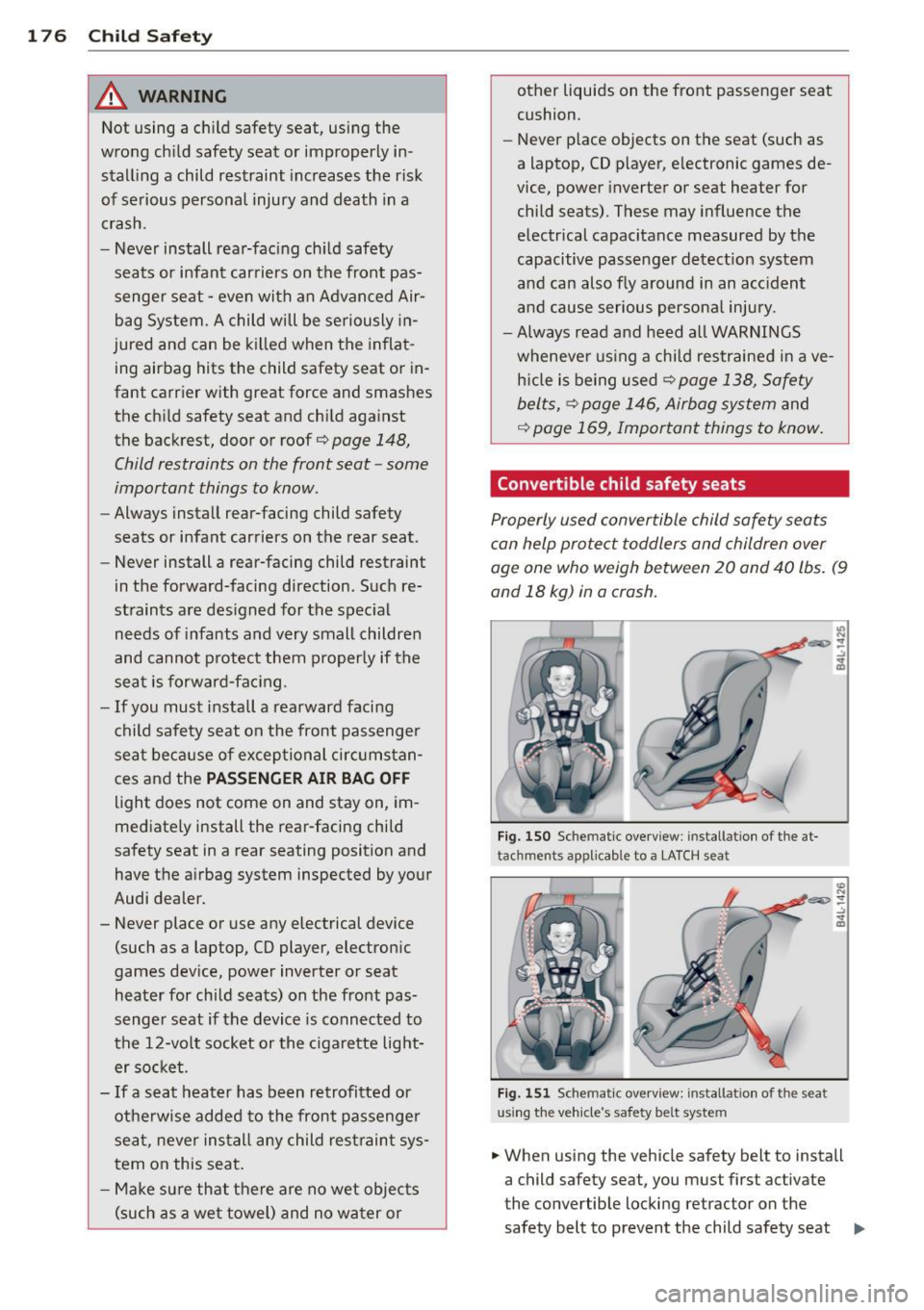
Convertible child safety seats
Properly used convertible child safety seats
can help protect toddlers and children over
age one who weigh between 20 and 40 lbs. (9
and 18 kg) in a crash.
Fig . 150 Sc hema tic overview: installat ion of the at
tachments applicab le to a LATCH seat
Fig. 151 Schemat ic overv iew: inst allation of the seat
u sing the vehicl e's safety belt system
.. When using the vehicle safety belt to install
a child safety seat, you must first activate
the convertib le locking retractor on the
safety belt to prevent the child safety seat ..,_
Page 179 of 302
M N ,....
> co ,...., \!) 1.1'1 ,...., 1.1'1 ,....,
from moving r::!;> page 180 or install the seat
using the LATCH attachments.
~ Push the child safety seat down with your
full weight to get the safety belt really tight
so that the seat cannot move forward or
s ideways more than one inch (2 .5 cm)
¢ page 180.
~ If the child safety seat is equ ipped with a
tethe r strap, attach it to the tether anchors
¢page 185.
~ Secure unused safety bel ts on the rear sea t
¢page 175.
A toddler or child is usually too large for an in
fant restraint if it is more than one year o ld
and weighs more than 20 lbs . (9 kg) .
Toddle rs and ch ildren who are older than one
yea r up to abo ut 4 years o ld and weigh more
than 20 lbs (9 kg) up to 40 lbs. (18 kg) mus t
a lways be prope rly restrained in a ch ild safety
seat certified for their size and weight
¢ fig .150and ¢fig.151 .
The airbag on the passenge r side makes the
front seat a poten tially dangerous place for a
chi ld to ride. The front seat is not the safest
p lace for a child in a forward-facing child safe
ty seat.
It is a very dangero us place for an in
fant or a larger child in a rearward-fac ing seat.
A WARNING
Not using a ch ild safety seat, using the
wrong chi ld safety sea t or improper ly in
stalling a child restraint increases the risk
of serious personal injury and death in a
co llision or othe r eme rgency s ituation.
- Children on the front seat of any car,
even with Advan ced A irbags, can be seri
o usly injured or eve n killed when an a ir
bag inf lates . A child in a rearward -facing
child safety seat installed on the front
passenger seat wi ll be seriously injured
and can be ki lled if the front airbag in
flates -even with an Advanced Airbag
System.
- The inflating a irbag w ill hit the child
safety seat or infant carrier w ith great
force and w ill smash the ch ild safety seat
Child Sa fet y 177
and child against the backrest, center
arm rest, door or roof.
- Always install rear-facing chi ld safety
seats on the rear seat.
- If you must install a rearward facing
child safety seat on the front passenger
seat because of exceptional c ircumstan
ces and the
PASSENGER AIR BAG OFF
light does not come on and stay on, im
mediately install the rear-fac ing ch ild
safety seat in a rear seating position and have the airbag system inspe cted by your
Aud i dea le r.
- The rear side of the child safety seat
should be pos itioned as close as possib le
to the backres t on the vehicle seat.
- For ad justab le head restra ints: adjust or
remove the rea r seat he ad restr aint if i t
is diffi cult to ins tall the child seat w ith
the head restraint in place
¢ page 63. In
stall the head restraint again immed iate
ly once the child seat is removed . Dr iv ing
without head restraints or with head re
straints that are not properly adjusted
increases the risk of serious or fatal neck
i nj ury dramatically .
- Always read and heed all WARNINGS
wheneve r us ing a child restrained in ave
hicle is being used¢
page 138, Safety
b elts,
c::!;> page 146, Airbag system and
c::!;> page 169, Impor tan t things to know.
A WARNING
If ex cep tional cir cumstances require the
use o f a forward-facing child res traint on
the front passenge r's sea t, the child's safe
ty and well-being req uire that the follow
ing spec ial precautions be ta ken:
- Make sure the forward -facing seat has
been designed and certified by its man u
facturer for use on a front seat with a passenger front and side airbag.
- Always follow the manufacturer's in
structions provided with the ch ild safety
seat or infant carr ier.
•
•
•
Page 182 of 302
180 Child Safety
-Always remember that a child leaning
forward, sitting sideways or out of posi
tion in any way during an accident can be
struck by a deploying airbag . This will re
sult in serious personal injury or death .
- If you must install a booster seat on the
front passenger seat because of excep
tional circumstances the
PASSENGER
AIR BAG OFF
light must come on and
stay on, whenever the ignition is switch
ed on.
- If the
PASSENGER AIR BAG OFF light
does not come on and stay on, perform
the checks described¢
page 158, Moni
toring the Advanced Airbag System.
- Take the child restraint off the front pas
senger seat and install it properly at one
of the rear seat positions if the
PASSEN
GER AIR BAG OFF
light does not stay on
whenever the ignition is switched on.
- Always read and heed all WARNINGS
whenever using a child restrained in
ave
hicle is being used¢ page 138, Safety
belts,¢ page 146, Airbag system
and
¢page 169, Important things to know .
Installing a child safety
seat
Securing a child safety seat using a
safety belt
Safety belts for the rear seats and the front
passenger can be locked with the convertible
locking retractor to properly secure child
safety seats.
The safety belts emergency locking retractors
for the rear seats safe ty belts and for the
front passenger's seat safety belt have a con
vertible locking retractor for child restraints.
The safety belt must be locked so that belt
webbing cannot unreel. The retractor can be
activated to lock the safety belt and prevent
the safety belt webbing from loosening up
during normal driving. A child safety seat can
only be properly installed when the safety belt
is locked so that the child and child safety
seat will stay in place. Always
remember: Even though your vehicle is
equipped with an Advanced Airbag system, all
children, especially those 12 years and young
er , should always ride in the back seat proper
ly restrained for their age and si ze.
A WARNING
=
Improperly installed child safety seats in -
crease the risk of serious personal injury
and death in a collision .
- Always make sure that the safety belt re
tractor is locked when installing a child
safety seat. An unlocked safety belt re
tractor cannot hold the child safety seat
in place during normal driving or in a
crash.
- Always buckle the child safety seat firmly
in place even if a child is not sitting in it.
A loose child safety seat can fly around
during a sudden stop or in a collision.
- If the backrest is not securely latched,
the child and the child restraint will be
thrown forward together with the back
rest and will strike parts of the vehicle
interior. The child can be seriously in
jured or killed .
- Never install rear-facing child safety
seats or infant carriers on the front pas
senger seat. A child will be seriously in
jured and can be killed when the passen
ger airbag inflates.
- The inflating airbag will hit the child
safety seat or infant carrier with great
force and will smash the child safety seat and child against the backrest, center
armrest, door or roof.
- Always install rear-facing child safety
seats or infant carriers on the rear seat.
- Forward-facing child safety seats or in
fant carriers installed on the front pas senger's seat may interfere with the de
ployment of the airbag and cause serious
injury to the child.
- It is safer to install a forward-facing
child safety seat on the rear seat.
- Always read and heed all WARNINGS
whenever using a child restrained in ave-
hicle is being used
¢ page 169. Special ..,.