fold seats AUDI A3 CABRIOLET 2015 Owners Manual
[x] Cancel search | Manufacturer: AUDI, Model Year: 2015, Model line: A3 CABRIOLET, Model: AUDI A3 CABRIOLET 2015Pages: 302, PDF Size: 73.83 MB
Page 48 of 302
46 Power top
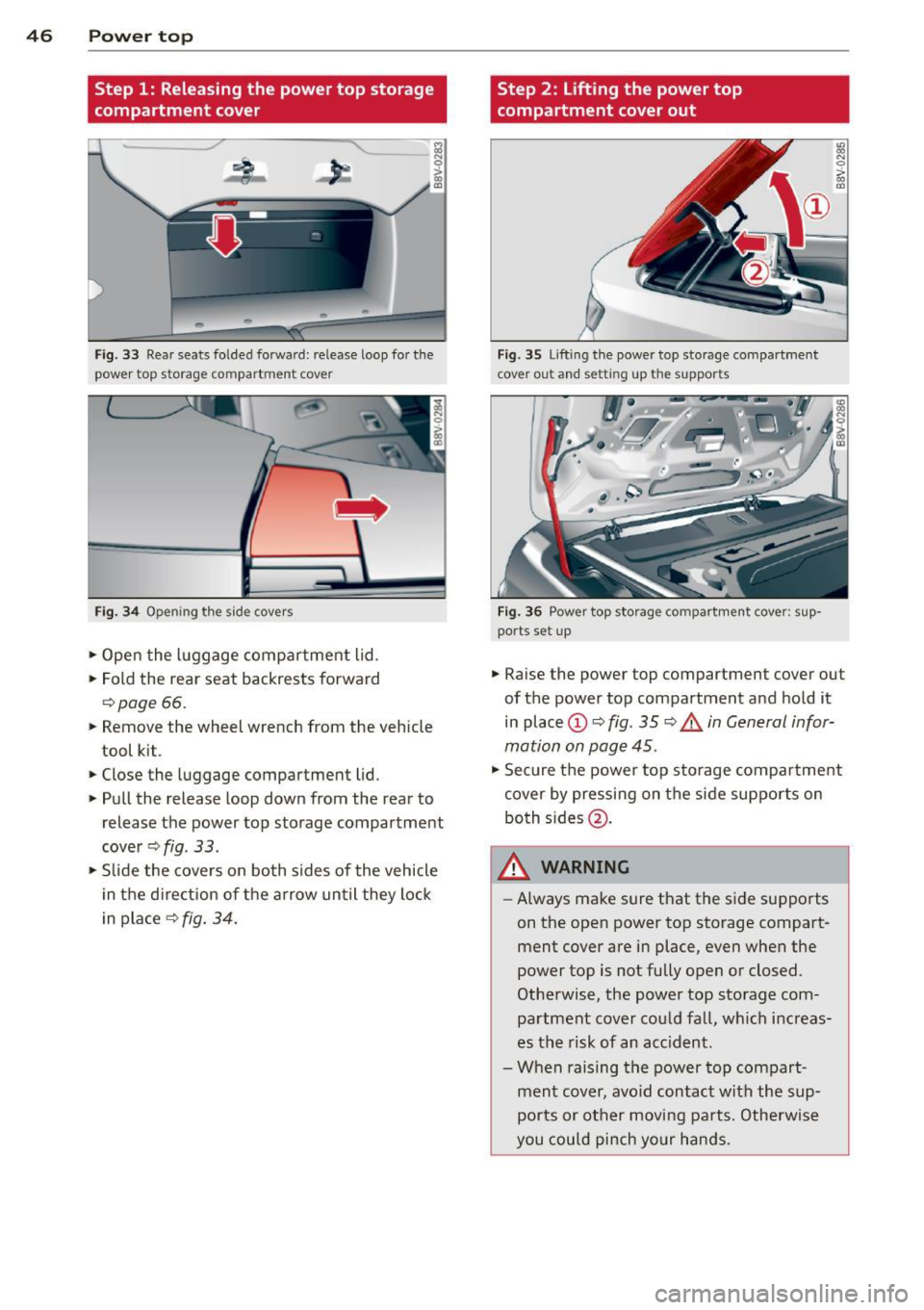
Step 1: Releasing the power top storage
compartment cover
Fig. 33 Rear seats folded forward: release loop for the
power top storage compartment cover
Fig . 34 Opening the side covers
.,. Open the luggage compartment lid.
.,. Fold the rear seat backrests forward
r=;, page 66.
> Remove the wheel wrench from the vehicle
tool kit.
> Close the luggage compartment lid.
.,. Pull the release loop down from the rear to
release the power top storage compartment
cover
r=;, fig . 33.
.,. Slide the covers on both sides of the vehicle
in the direction of the arrow until they lock
in place
r=;, fig. 34.
Step 2 : Lifting the power top
compartment cover out
Fig. 35 Lifting the power top storage compartment
cover out and setting up the supports
Fig. 36 Power top storage compartment cover: s up·
ports set up
.,. Raise the power top compartment cover out
of the power top compartment and hold it
in place
(D r=;, fig. 35 r=;, .& in General infor
mation on page 45.
.,. Secure the power top storage compartment
cover by pressing on the side supports on
both sides @.
A WARNING ~
-Always make sure that the side supports
on the open power top storage compartment cover are in place, even when the
power top is not fully open or closed.
Otherwise, the power top storage com
partment cover could fall, which increas
es the risk of an acc ident.
- When raising the power top compart ment cover, avoid contact with the sup
ports or other moving parts. Otherwise
you could pinch your hands.
Page 64 of 302
62 Seats and storage
Folding the front seat backrests forward
.,. Pull the handle@ ¢fig. 57forward.
.,. Fold the backrest forward until it locks into
place and then slide the seat all the way for
ward using the backrest @.
Folding the front seat backrests back
.,. Slide the seat all the way back using the
backrest @
c;> fig. 58.
.,. Fold the backrest back until it locks into
place @.
The seat will return to its original position af
ter using easy seat entry .
A WARNING -
The front seat backrests must always be
locked in lace while driving for safety rea
sons.
- When using easy seat entry, the seat
must always slide all the way back when
returning it to its original position. Oth
erwise, the set will not be able to lock in
place. Only drive once the seat is locked
into place.
@ Tips
If the seat will not lock in place after using
easy seat entry, slide the seat all the way
back until it stops. Then ad just the seat to
the desired position.
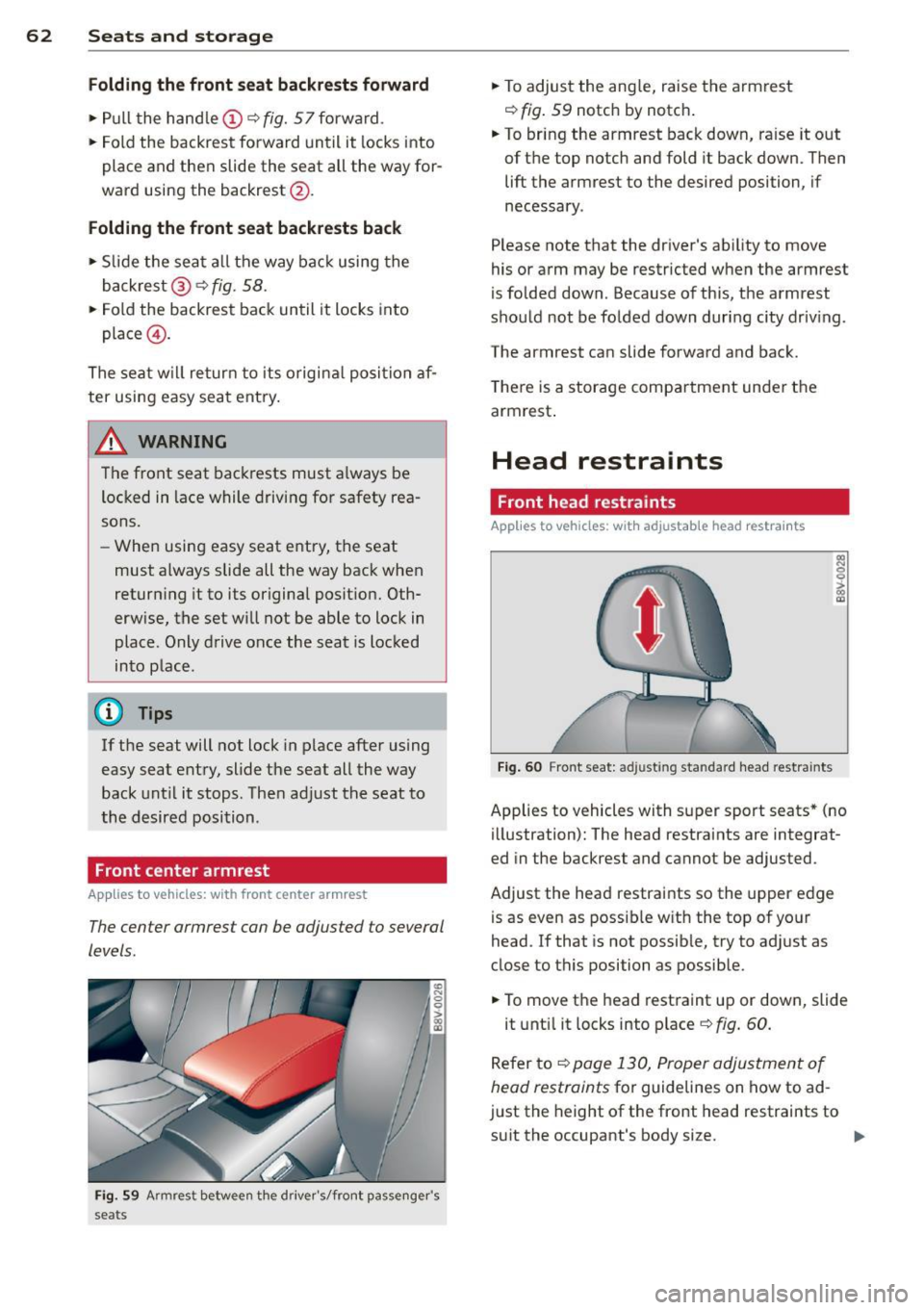
Front center armrest
Applies to vehicles: with front center armrest
The center armrest can be adjusted to several
levels.
Fi g. 59 Armrest between th e driver 's/fro nt passe nge r's
seats
.,. To adjust the angle, raise the armrest
c;> fig. 59 notch by notch .
.,. To bring the armrest back down, raise it out
of the top notch and fold it back down. Then
lift the armrest to the desired position, if
necessary .
P lease note that the driver's ability to move
his or arm may be restricted when the armrest
is folded down. Because of th is, the armrest
should not be folde d down during city driv ing.
The armrest can slide forward and back.
T here is a storage compartment under the
armrest .
Head restraints
Front head restraints
Applies to vehicles: wit h adjusta ble head restra ints
Fig. 60 Front seat: ad justing standard head restraints
Applies to vehicles with super sport seats* (no
illustration): The head restraints are integrat
ed in the backrest and cannot be adjusted.
Adjust the head restraints so the upper edge
is as even as possible with the top of your
head. If that is not possible, try to adjust as
close to this position as possible .
.,. To move the head restraint up or down, slide
it until it locks into place
c;>fig . 60.
Refer to
c;> page 130, Proper adjustment of
head restraints
for guidelines on how to ad
ju st the height of the front head restraints to
s ui t the occupant's body size.
Page 65 of 302
....,
N
" > co
rl I.O
"' rl
"' rl
_& WARNING
-Driving without head restraints or head
restraints that are not adjusted correctly
dramatically increases the risk of serious
or fatal neck injuries.
- Read and follow ing the WARNINGS in
¢ page 130, Proper adjustment of head
restraints.
@ Tips
Head restraints that are adjusted correctly
and safety belts are an extremely effective
combinat ion of safety equipment.
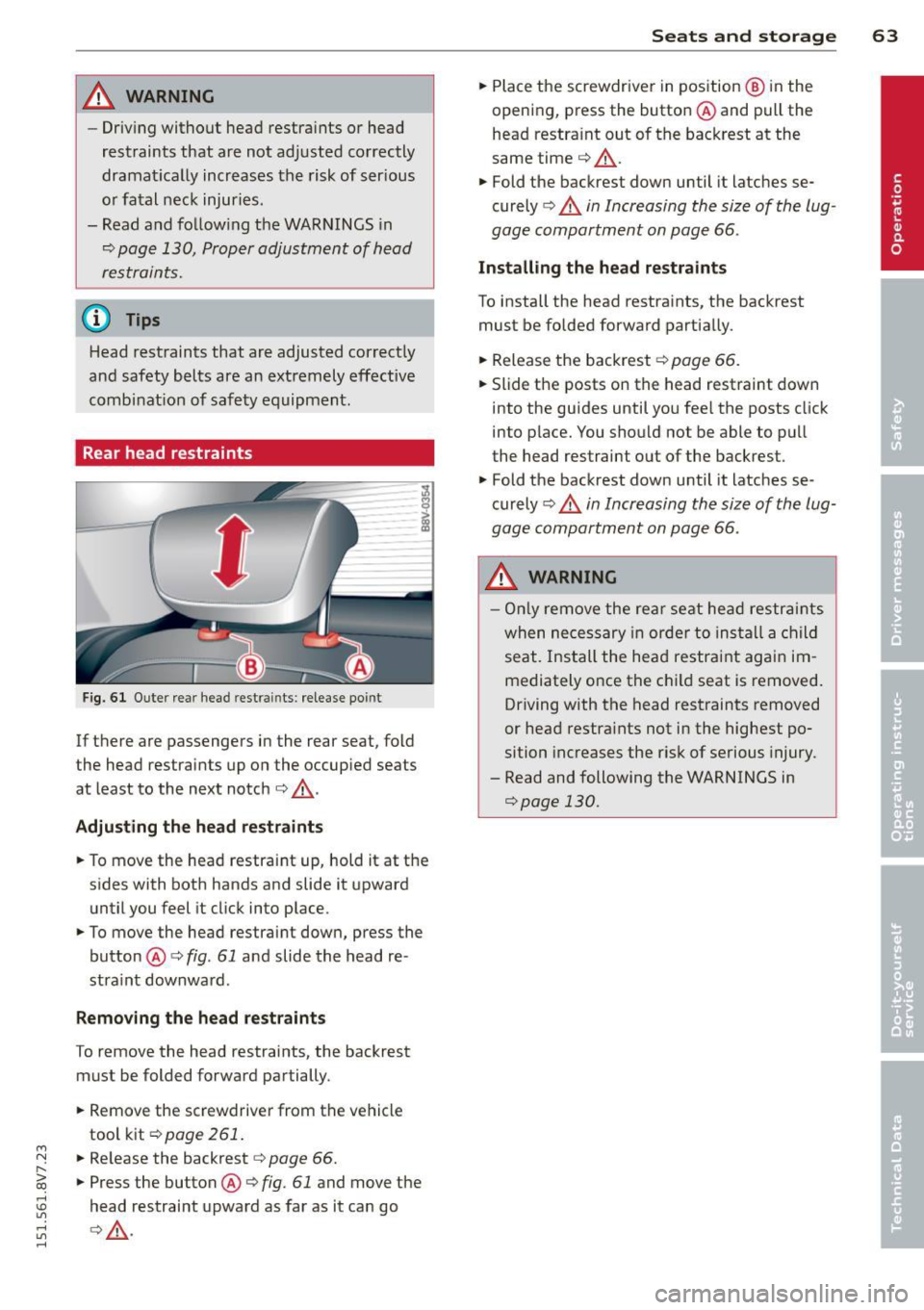
Rear head restraints
Fig. 61 Outer rear head restra ints: release poi nt
If there are passengers in the rear seat, fold
the head restraints up on the occupied seats
at least to the next notch
c:> .&_ .
Adjusting the head restraints
• To move the head restraint up, hold it at the
sides with both hands and slide it upward
until you feel it click into place.
• To move the head restraint down, press the
button @<=>
fig. 61 and slide the head re
straint downward.
Removing the head restraints
To remove the head restraints, the backrest
must be folded forward partially .
• Remove the screwdriver from the vehicle
tool kit
c:> page 261 .
• Re lease the backrest c:> page 66.
• Press the button@<=> fig. 61 and move the
head restraint upward as far as it can go
<=> .&_ .
Seats and storage 63
• Place the screwdriver in position ® in the
opening, press the button @and pull the
head restra int out of the backrest at the
same time
c:> .&, .
• Fold the backrest down until it latches se
curely
c:> .&. in Increasing the size of the lug
gage compartment on page 66.
Installing the head restraints
To install the head restraints, the backrest
must be folded forward partially.
• Release the backrest
c:> page 66.
• Slide the posts on the head restraint down
into the guides until you feel the posts click
into place. You should not be able to pull
the head restraint out of the backrest.
• Fold the backrest down until it latches se
curely
c:> & in Increasing the size of the lug
gage compartment on page 66 .
_& WARNING
- Only remove the rear seat head restraints
when necessary in orde r to install a child
seat. Install the head restraint again im
mediately once the child seat is removed.
Driving with the head restraints removed
or head restra ints not in the highest po
sition increases the risk of serious injury.
- Read and following the WARNINGS in <=>
page 130 .
Page 68 of 302
66 Seats and st o rage
• Place heavy objects as far forward as possi
ble ~
fig. 67.
• Secure luggage items with the cargo net* or
with non-elastic retaining straps to the tie
down rings*
c::;;page 67.
A WARNING
- Loose objects in the luggag e compar t
ment can slide about suddenly and alter
the vehicle's handling characterist ics.
- Loose objects in the passenger compart
ment can fly forward dur ing abrupt ma
neuvers or accidents and injure occu
pants.
- Always store objects in the luggage com
partment and use suitab le straps, pa rtic
ularly with heavy objects.
- Whe n you transport heavy objects, a l
ways remembe r that a change in the cen
te r of gravity may result in a change in
the vehicle 's handling characterist ics.
- Follow a ll warnings
c::;; page 126, Driving
safe ty.
(D Tips
The tire pressu re must be adjusted to the
load -see the tire p ressure s tic ker located
on the driver 's side B-p illar .
General information
A WARNING
Refer to the chapter Driving Safely
c::;;page 126, Driving safetyfor important
information, t ips, suggestions and warn
ings that you sho uld read and fo llow for
your own safety and the safety of yo ur pas
s enge rs.
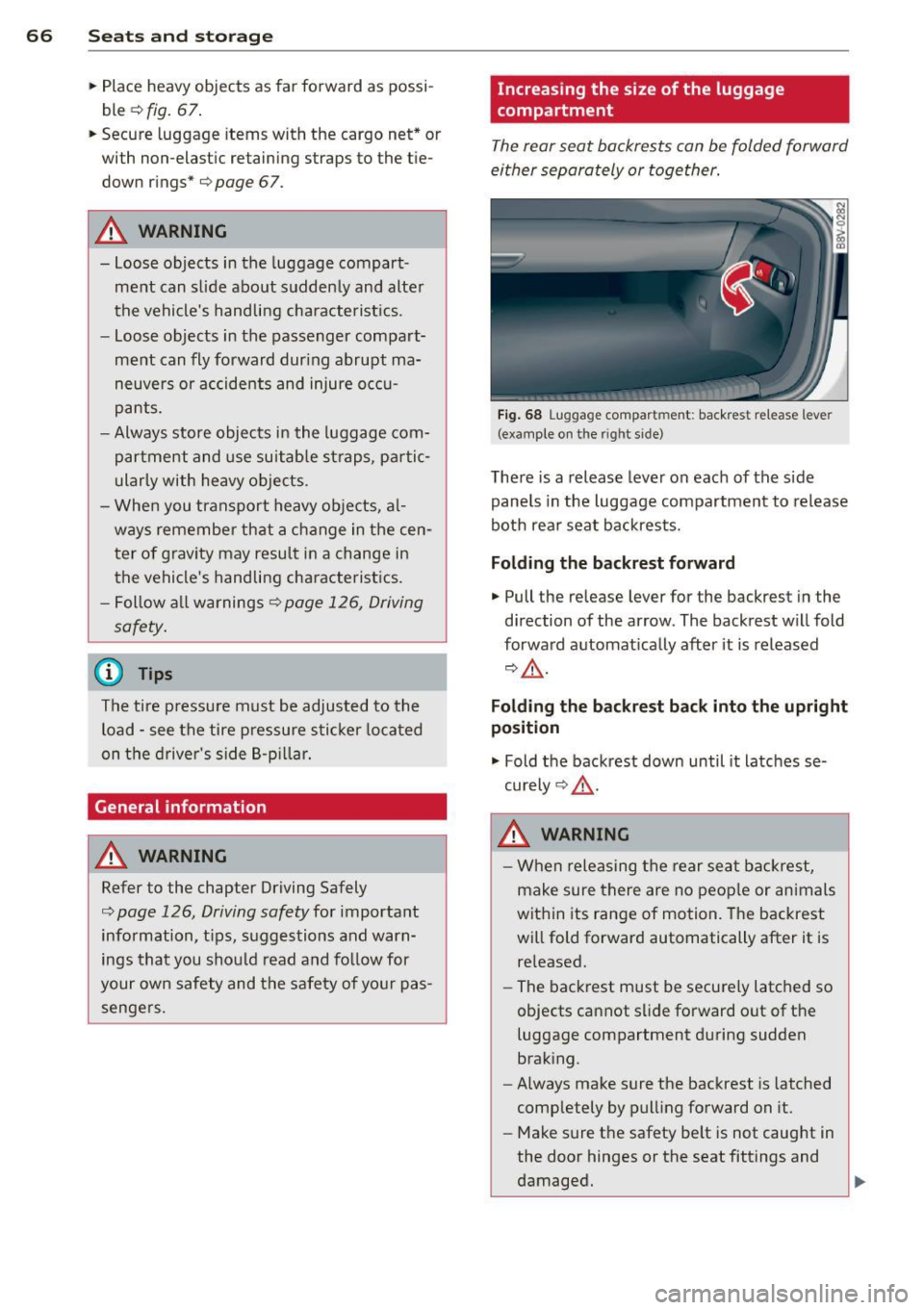
Increasing the size of the luggage
compartment
The rear seat backrests can be folded forward
either separately or together.
Fig . 68 Luggage compartment: backres t release lever
(example o n the right side)
T here is a release lever on each of the side
panels in the luggage compartment to release
both rea r seat backres ts.
Folding the b ackre st forward
• Pull the release lever for the backrest in the
direction of the arrow. The backrest w ill fold
forward automat ically after it is released
c::;;.&_ .
Folding the b ackrest b ack into the upright
position
• Fold th e backrest down until it latches se
curely ~.,&. .
A WARNING
-W hen releasing the rear se at backrest,
make sure t here are no peop le or animals
wit hin its range of motion. The backrest
will fold forward automatically after it is
re leased.
- The backrest m ust be securely latched so
objects cannot s lide forward out of the
luggage compartment during sudden
brak ing.
- Always make sure the backrest is latched
completely by pul ling forward on it.
- Make sure the safety be lt is not caught in
the door hinges or the seat fittings and
-
damaged. ..,.
Page 71 of 302
....,
N
r--. > co
rl I.O
"' rl
"' rl
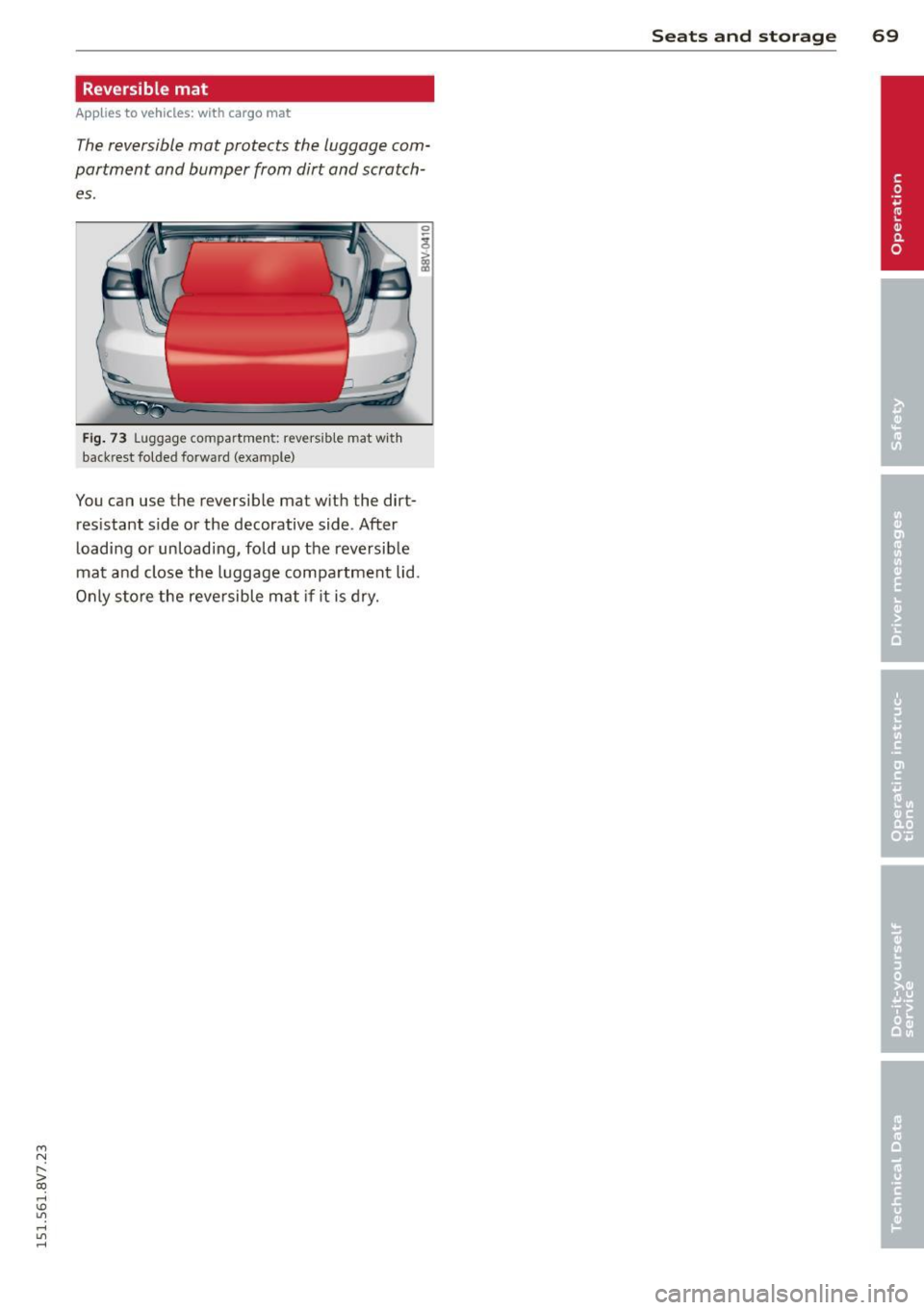
Reversible mat
Applies to vehicles: with cargo mat
The reversible mat protects the luggage com
partment and bumper from dirt and scratch es.
Fig. 73 L uggage compartment: revers ible mat w it h
backres t folded forward (example}
You can use the reversible mat with the dirt
resistant side or the decorative side. After
loading or unloading, fold up the reversible
mat and close the luggage compartment lid.
Only store the reversible mat if it is dry .
Seats and storage 69
Page 130 of 302
128 Driving safety
• Fasten and wear safety belts correctly
9page 141.
• Always keep both feet in the footwell so
that you are in control of the vehicle at all
t ime s.
Fo r detailed information on how to adjust the
driver's seat, see
<=>page 61 .
A WARNING
Drivers who are unbelted, out of position
or too close to the airbag can be seriously
injured by an airbag as it unfolds. To help
reduce the risk of serious personal injury:
- Always adjust the driver's seat and the steering wheel so that there are at least
10 inches (25 cm) between your breast
bone and the steering wheel.
- Always adjust the driver's seat and the
steering wheel so that there are at least
4 inches (10 cm) between the knees and
the lower part of the instrument panel.
- Always hold the steering wheel on the
outside of the steering wheel rim with
your hands at the 9 o'clock and 3 o'clock
positions to help reduce the risk of per
sonal injury if the driver's airbag inflates.
- Never hold the steering wheel at the
12 o'clock position or with your hands at
other positions inside the steering wheel
rim or on the steering wheel hub. Hold
ing the steering wheel the wrong way
can cause serious injuries to the hands,
arms and head if the driver's airbag in
flates.
- Pointing the steering wheel toward your face decreases the ability of the supple
mental driver's airbag to protect you in a
collision .
- Always sit in an upright position and nev
er lean against or place any part of your
body too close to the area where the air
bags are located.
- Before driving, always adjust the front
seats properly and make sure that all
passengers are properly restrained. -
For adjustable head restraints: before
driving, always also adjust the head re
straints properly.
- Never adjust the seats while the vehicle
is moving. Your seat may move unexpect
edly and you could lose control of the ve hicle .
- Never drive with the backrest reclined or
tilted far back! The farther the backrests
are tilted back, the greater the risk of in
jury due to incorrect positioning of the safety belt and improper seating posi
tion .
- Children must always ride in child seats
<=> page 169. Special precautions apply
when installing a child seat on the front
passenger seat <=>
page 146.
Proper seating position for the front
passenger
The proper front passenger seating position
is important for safe, relaxed driving.
For your own safety and to reduce the risk of
injury in the event of an accident, we recom
mend that you adjust the seat for the front
passenger to the following position:
• Adjust the angle of the seatback so that it is
in an upright position and your back comes
in full contact with it whenever the vehicle is
moving.
• For ad justab le head restra ints: adjust the
head restraint so the upper edge is as even
as possible with the top of your head. If that
is not possible, try to adjust the head re
straint so that it is as close to this position
as possible <=>
page 130 . Move the head re
straint so that it is as close to the back of
the head as possible.
• Keep both feet flat on the floor in front of
the front passenger seat.
• Fasten and wear safety belts correctly
<=> page 141.
For detailed information on how to adjust the
front passenger's seat, see
<=> page 60. ...
Page 131 of 302
M N
" > co ,...., \!) 1.1'1 ,...., 1.1'1 ,....,
A WARNING ,~ ~
Front seat passengers who are unbelted,
out of posit ion or too close to the airbag
can be seriously injured or k illed by the air
bag as it unfolds. To help reduce the r isk of
ser ious personal inju ry:
- Passengers must always s it in an upr ight
posit ion and never lean against o r place
any part of their body too close to the
area where the airbags are located.
- Passengers who are unbelted, out of po
sit ion or too close to the airbag can be
seriously injured by an airbag as it un
f olds with great force in the blink of an
eye.
- Always make sure that there are at leas t
10 inches (25 cm) between the front
passenger's breastbone and the instru
ment pane l.
- Always make sure that there are at least
4 inches (10 cm) between the front pas
senger's knees and the lower part of the
instrument panel.
- Each passenger m ust always s it on a seat
of the ir own and properly fasten and
wea r the safety belt be long ing to that
seat .
- Before driv ing, a lways adjust the front
passenger seat properly .
- For adjustable head restraints : before
dr iv ing, always a lso adjust the head re
straints properly .
- Always keep your feet on the f loor in
front of the seat . Never rest them on the
seat, instrument panel, out of the win
dow, etc. The airbag system and safety
belt w ill not be ab le to protec t you prop
e rl y and can even incre ase the ris k of in
jury in a crash .
- Never drive wi th the backrest recl ined o r
t il ted far bac k! T he farther the backrests
are t ilted back , the greater the ris k of in
jury d ue to incorrect positioning of the
safety belt and improper seating posi
t ion.
- Children must always ride in child seats
¢
page 169. Special precautions apply
Dri ving s afe ty 129
when instal ling a child seat on the front
passenger seat¢
page 146.
Proper seating positions for passengers
in rear seats
Rear sea t passengers mus t sit uprigh t wi th
both fee t on the floor consistent wi th their
physical size and be properly restrained whenever the vehicle is in use .
To reduce the risk of injury caused by an incor
rect seating posit ion in the event of a sudde n
braking maneuver or an accident, your pas
sengers on the rear bench sea t must always
obse rve the following:
... For ad justab le head restra ints: adjust the
head restra int so the uppe r edge is as even
as poss ible with the top of your head . If that
is not poss ible, try to adjus t the head re
s tr aint so that it is as close to this position
as poss ible
¢ page 130 .
... Keep both feet flat in the footwell in front of
the rear seat .
... Fasten and wea r safety be lts proper ly
¢ page 141 .
... Make sure that children are always properly
restrained in a child restraint that is appro
pr iate for the ir size and age
¢ page 169.
A WARNING
Passengers w ho are imp roperly seated on
the rea r seat can be se rio usly in jured in a
cr ash.
- Each passenge r must always si t on a seat
of their own and properly fa sten and
wear the safe ty belt belonging to that
seat.
- Safety belts only o ffer maximum pro tec
tion when the sa fety belts are properly
positioned on the body and securely
latched. By not sitting upr ight, a rear
seat passenger increases the r is k of per
sonal injury from imp roperly pos itioned
safety belts!
- For ad justab le head restra ints: always
ad just the head restraint properly so that
it can g ive maximum protect ion .
•
•
•
Page 158 of 302
156 Airbag system
How the Advanced Airbag System
components work together
The front Advanced Airbag System and the
side airbags supplement the protection of
fered by the front three-point safety be lts
with pretensioners and load limiters and the
adjustable head restra ints* to help reduce the
risk of injury in a wide range of acc ident and
crash situat ions. Be sure to read the impor
tant information abo ut safety and heed the
WARNINGS in this c hapter .
Dep loyment of the Advanced Airbag System
and the activat ion of the safety be lt preten
sioners depend on the dece lerat ion meas ured
by the c rash senso rs and regis tered by the
e lectronic control u nit. Crash sever ity depends
on speed and deceleration as well as the mass
and stiffness of the vehicle or object involved
i n the c rash.
On the passenger side, regard less of safety
be lt use, the front passenger front al airbag
will be turned off i f the e lectrical capacitance
measured by the capac itive passenger detec
tion system on the front passenger seat is less
than the amount programmed in the electron ic control unit. The front passenger frontal air
bag will a lso be turned off if the capacitance
measured by the system for the front passen
ge r seat equa ls that of an infant of abo ut on e
yea r of age i n one of the child sea ts that was
used to cer tify the Advanced Airbag System
under Federal Motor Vehicle Safety Standard
208 . The
PASSENGER AIR BAG OF F light
comes on and stays on to tell you when the
front Advanced A irbag System on the passen
ger s ide has been turned off¢
page 159.
A WARNING
To reduce the risk of injury when a n airbag
inflates, a lways wear safety belts properly .
- If you are unrestrained, lean ing forward,
sitting sideways or out of position in any
way, your risk of inj ury is much higher.
- You w ill also receive serious injuries and
cou ld even be killed if you are up against
the a irbag or too close to it when it in- flates
-even w ith an Advanced A irbag
¢ page 146.
More important things to know about
front airbags
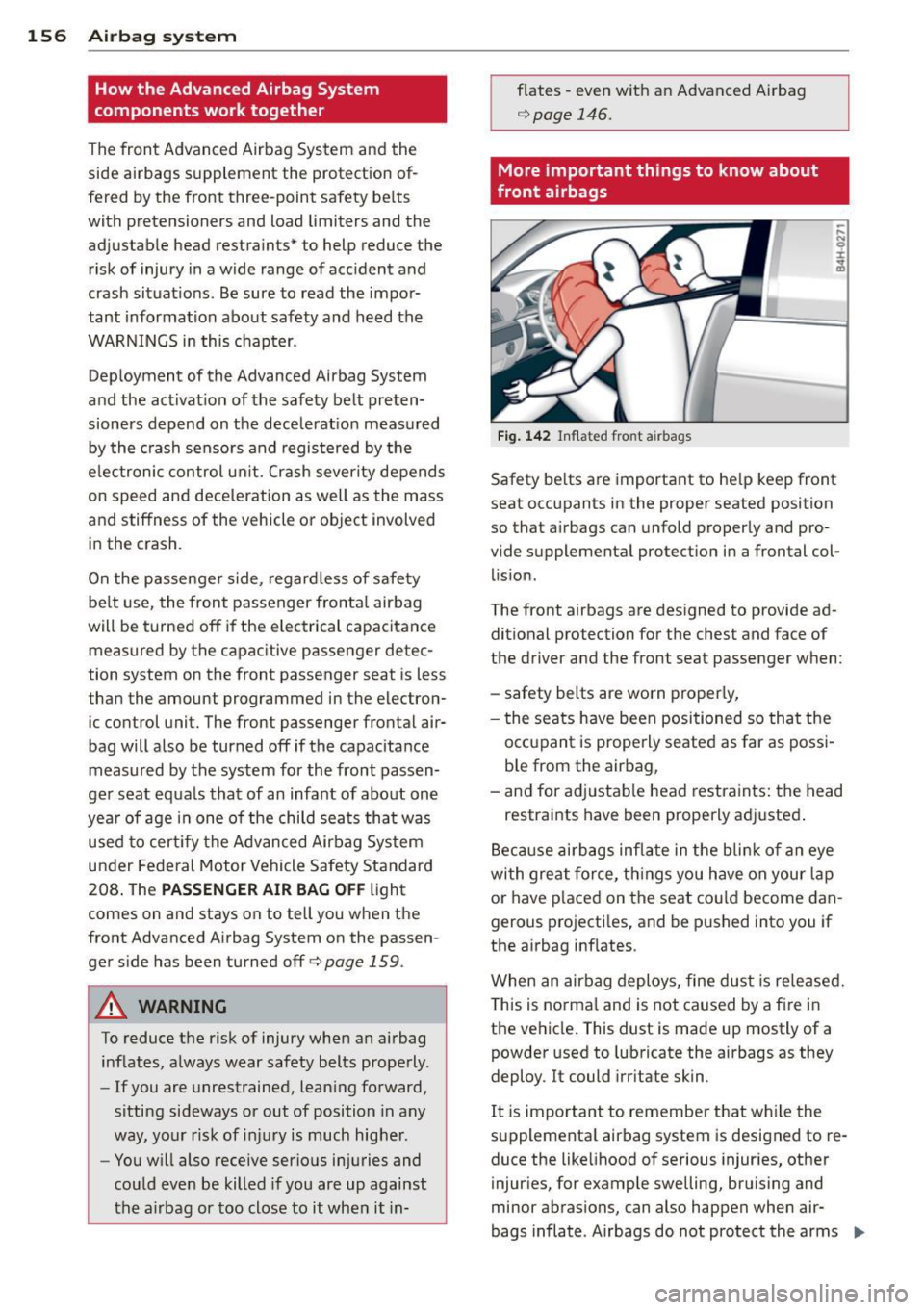
Fi g. 142 Inflated fro nt a irbags
-...
q :r:
iZ
Safety be lts are important to he lp keep front
seat occupants in the proper seated position
so that a irbags can unfold proper ly and pro
vide supplemental protect ion in a frontal col
lis ion .
The front airbags are des igned to provide ad
ditional protection for the chest and face of
the driver and the front seat passenger when:
- safety belts are worn proper ly,
- the seats have been posi tioned so that the
occupant is properly seated as far as poss i
b le from the airbag ,
- and for ad justab le head restraints: the head
restraints have been properly ad justed .
B ec au se airb ags inflate in the bli nk of an eye
with great force, th ings you h ave on your lap
or have p laced on the seat co uld become dan
gerous pro jecti les, and be p ushed into you if
the a irbag inf lates .
When an airbag deploys, fine dust is re leased.
T his is no rma l and is not caused by a fi re in
the ve hicle . This dust is made up mostly of a
powder used to lubricate the airbags as they
deploy. It could irr itate skin .
It is important to remembe r that while the
supplementa l airbag system is designed to re
duce the like lihood of serious injur ies, other
injur ies, for examp le swelling, bruising and
minor abrasions, can also happen when air-
bags inflate . A irbags do not protect the arms
IIJI,
Page 159 of 302
M N ,....
> co ,...., \!) 1.1'1 ,...., 1.1'1 ,....,
or the lower parts of the body. Front airbags
supp lement the three-point safety belts only
in some frontal collisions in which the vehicle
dece leration is high enough to deploy the air
bags.
F ront airbag s will no t deplo y:
- if the ignition is switched off when a crash
occurs,
- in side collisions,
- in rear-end collisions,
- in rollovers,
- when the crash deceleration measured by
the a irbag system is less than the m inimum
threshold needed for airbag deployment as
registered by the electronic control unit.
The f ront pas seng er airbag al so will n ot
deploy:
- when the front passenger seat is not occu
pied,
- when the electrical capac itance measured by
the capacitive passenger detect io n system
for the front passenger seat indicates that
the passenger side frontal airbag must be switched off by the electronic control unit
(the
P AS SENGER A IR BA G OFF light
c:> page 159 and how they work comes on
and stays on).
A WARNING
Sitting in the wrong position can increase
the risk of serious injury in crashes.
- To reduce the r isk of injury when the air
bags inflate, the driver and passengers
must always sit in an upright posit ion,
must not lean against or place any part
of the ir body too close to the area where
the a irbags are located.
- Occupants who a re unbelted, out of posi
t ion or too close to the airbag can be se
riously injured by an airbag as it unfolds
with great force in the blink of an eye
c:> page 148 .
A WARNING
A child in a rearward-facing child seat in
stalled on the front passenger seat will be
-
A irbag system 157
seriously injured and can be killed if the
front airbag inflates -even w ith an Ad
vanced A irbag System.
- The inflating airbag will hit the ch ild seat
or infant carrier with great force and will
smash the child seat and child against
the backrest, center armrest, door or
roof.
- Always install rear-fac ing ch ild seats on
the rear seat.
- If you must install a rearward fac ing
child seat on the front passenger seat because of exceptional circumstances
and the
P A SSENGER AIR BAG OFF light
does not come on and stay on, immed i
ately insta ll the rear-fac ing child seat in a
rear seat ing position and have the airbag
system inspected by your A udi dealer.
A WARNING
r---------
O b j e cts between you and the airbag will
increase the risk of injury in a crash by in
terfering with the way the airbag unfolds
or by be ing pushed into you as the airbag
inflates.
- Never hold things in your hands or on
your lap when the veh icle is in use.
- Never transport items on or in the area
of the front passenger seat. Objects
could move into the area of the front air bags during braking or other sudden ma
neuvers and become dangerous projec
tiles that can cause ser ious personal in
jury if the a irbags inflate.
- Never p lace or attach accesso ries o r oth
er objects (such as cup holders, te le
phone b rac kets, large, heavy or bulky ob
jects) on the doors, over o r near the area
marked "AIRBAG" on the steering wheel,
instrument panel, seat backrests or be
tween those areas and yourself . These
objects could cause injury in a crash, es pecially when the airbags inflate.
- Never recline the front passenger's seat
to transport objects. Items can also
move into the area of the s ide a irbag or
the front a irbag during braking or in a
•
•
Page 290 of 302
288 Index
Centra l indicator light .... .. .. .. .... . . 1 3
Central locking ............. ... .. .... 3 1
Ce ntr al loc king switch ..... .. .. .... .. 35
Conven ience key . . . . . . . . . . . . . . . . . . . . 34
Emergency locking ........ .. .. .. .. .. 37
Folding the exterior mirrors .. .... .. .. 36
Luggage compartment lid .. .. .. .... . . 38
p . d ower win ows ........... ... .... . . 39
Remote control key ....... .. .. .. .. .. 33
Safety central locking . . . . . . . . . . . . . . . 3 7
Setting .. ................. ...... ..
36
Certification ............. ... .. .... . 285
Changing a wheel ................... 263
Changing engine oil ........ .. .. .. .. . 219
Checking
Tire pressure ..... ......... ... .... .
240
Child restra ints
Danger of us ing c hild restra ints in the
front seat . . . . . . . . . . . . . . . . . . . . . . . .
148
Where can I get addit ional information
about child restraints and their use? ..
187
Ch ild restra int system anchors ... .. ... 183
Child safety .... ............. .. .... . 169
Convertible lo cking retractor .. .. .. ... 180
Important safety instructions for using
ch ild safety seats .............. ....
173
Important things to know when driving
with ch ildren .....................
169
Tether anchors .................... 185
Tether straps . ........... .... .... . 185
Child safety lock
Power wi ndows . . . . . . . . . . . . . . . . . . . .
38
Ch ild safety seats ............ .. .. .. . 175
Booster seats ............ .. .. .... . 178
Convertible child seats .......... .. . 176
Convertible locking retractor . . . . . . . . . 180
H ow do I properly install a child safety
seat in my vehicle? ........ .. .. .. .. .
173
Infant seats ...................... 175
Install ing .. .. ... ..... ..... .. .. .. . 180
Installing a child restraint using the
L ATCH system .... ..... ... .. .. .... .
185
LATCH system .. . ...... ... .. .. .... . 185
Lower anchorages ............ .... . 184
Mount ing and releasing the anchorage
hook .. ... ................... ... .
185
Safety instructions . . . . . . . . . . . . . . . . . 173
Unused safety belts on the rea r seat .. 17 5 Cleaning
Cleaning/removing ice from windows
.. .
Cleaning Alcantara . ... .......... .. . .
204
206
207
Cleaning artificial leather ......... .... 20 7
Cleaning carbon parts . . . . . . . . . . 206, 207
Cleaning contro ls .. ... .. ..... ... .. .. 207
Cleaning decorative parts/trim ........ 206
Cleaning displays .. ............. .... 207
Cleaning exhaust tail pipes .... ... .. .. 205
Cleaning plastic pa rts ............... . 206
Cleaning rims ... .. ... .. ..... ... .. .. 205
Cleaning seat covers ............. .. .. 20 7
Cleaning textiles . .. .......... ....... 207
Cleaning the tail lights . .. ..... ... .. .. 205
Cleaning th e wind deflector ........... 206
Climate control system
Key recogni tion . . . . . . . . . . . . . . . . . . . .
70
Climate control system (automatic)
Adjusting air vents . . . . . . . . . . . . . .
73 , 74
Air distrib ution, air vents ..... ... .. .. . 73
Audi drive select .. ... ...... .... .. .. 107
AUTO (climate control system) ....... . 72
B lower ....... .................... 73
Controls . . . . . . . . . . . . . . . . . . . . . . . . . . 72
Defrost ing the windsh ie ld .......... .. 73
Rea r window defogger .......... .... . 74
Recirc ulat ion mode ............ .... . 73
Setting the temperatu re . . . . . . . . . . . . . 73
synchronizing .... .. ... ..... ... .. .. . 73
Climate control system (manual)
Adjusting air vents ... .......... .
71, 7 4
Adjus ting the temperature ........... 71
Air distrib ution, air vents ...... .... .. . 71
B lowe r ... .... .. .. ... ..... ... .. .. . 71
Defrosting windows ..... .... ... .. .. . 71
Operation . . . . . . . . . . . . . . . . . . . . . . . . . 71
Rear window defogger .......... .. .. . 74
Recirculation mode ............ .... . 72
Clock . ... .. .... .. .. ... ..... ... .. .. . 10
Clos ing
Hood . .... .... .. ............. ....
216
Windows . .. .. .. .... ......... .... . 38
Closing/opening
by remote control . . . . . . . . . . . . . . . . . . 33
with the central locking switch ..... .. .
35
with the conven ience key . . . . . . . . . . . . . 34
with the door lock ........... .... .. . 35