remove seats AUDI A3 CABRIOLET 2015 Owners Manual
[x] Cancel search | Manufacturer: AUDI, Model Year: 2015, Model line: A3 CABRIOLET, Model: AUDI A3 CABRIOLET 2015Pages: 302, PDF Size: 73.83 MB
Page 48 of 302
46 Power top
Step 1: Releasing the power top storage
compartment cover
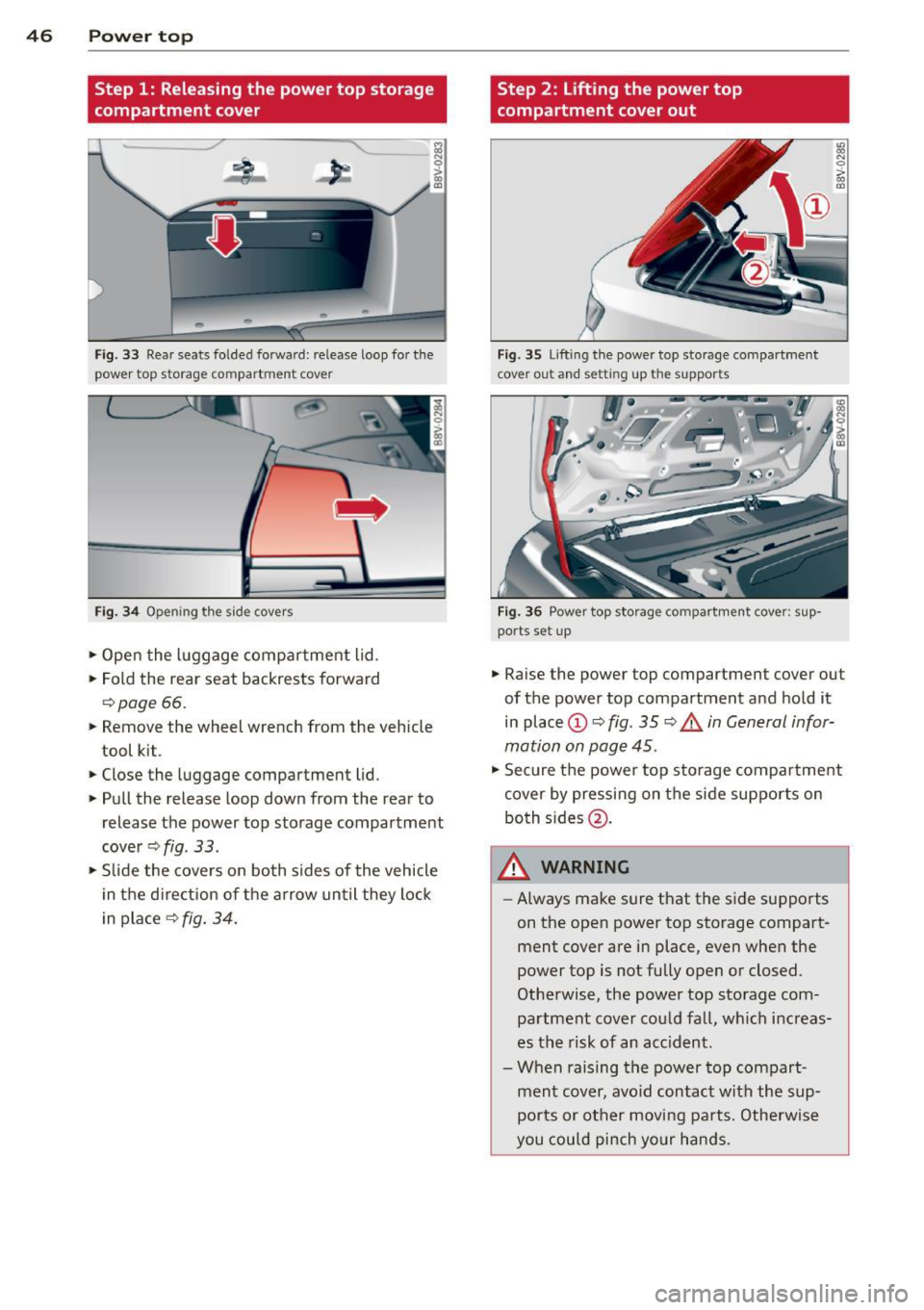
Fig. 33 Rear seats folded forward: release loop for the
power top storage compartment cover
Fig . 34 Opening the side covers
.,. Open the luggage compartment lid.
.,. Fold the rear seat backrests forward
r=;, page 66.
> Remove the wheel wrench from the vehicle
tool kit.
> Close the luggage compartment lid.
.,. Pull the release loop down from the rear to
release the power top storage compartment
cover
r=;, fig . 33.
.,. Slide the covers on both sides of the vehicle
in the direction of the arrow until they lock
in place
r=;, fig. 34.
Step 2 : Lifting the power top
compartment cover out
Fig. 35 Lifting the power top storage compartment
cover out and setting up the supports
Fig. 36 Power top storage compartment cover: s up·
ports set up
.,. Raise the power top compartment cover out
of the power top compartment and hold it
in place
(D r=;, fig. 35 r=;, .& in General infor
mation on page 45.
.,. Secure the power top storage compartment
cover by pressing on the side supports on
both sides @.
A WARNING ~
-Always make sure that the side supports
on the open power top storage compartment cover are in place, even when the
power top is not fully open or closed.
Otherwise, the power top storage com
partment cover could fall, which increas
es the risk of an acc ident.
- When raising the power top compart ment cover, avoid contact with the sup
ports or other moving parts. Otherwise
you could pinch your hands.
Page 63 of 302
....,
N
r--. > co
rl I.O
"' rl
"' rl
driving or riding. The safety belts and air
bag system can provide the greatest pro
tection possible when the backrests are
in the upright position and the safety
belts are worn correctly. The more a
backrest is reclined, the greater the risk
of inju ry due to an incorrect seating posi
tion and safety belt position .
Power seat adjustment
Applies to vehicles: with power adjustable seats
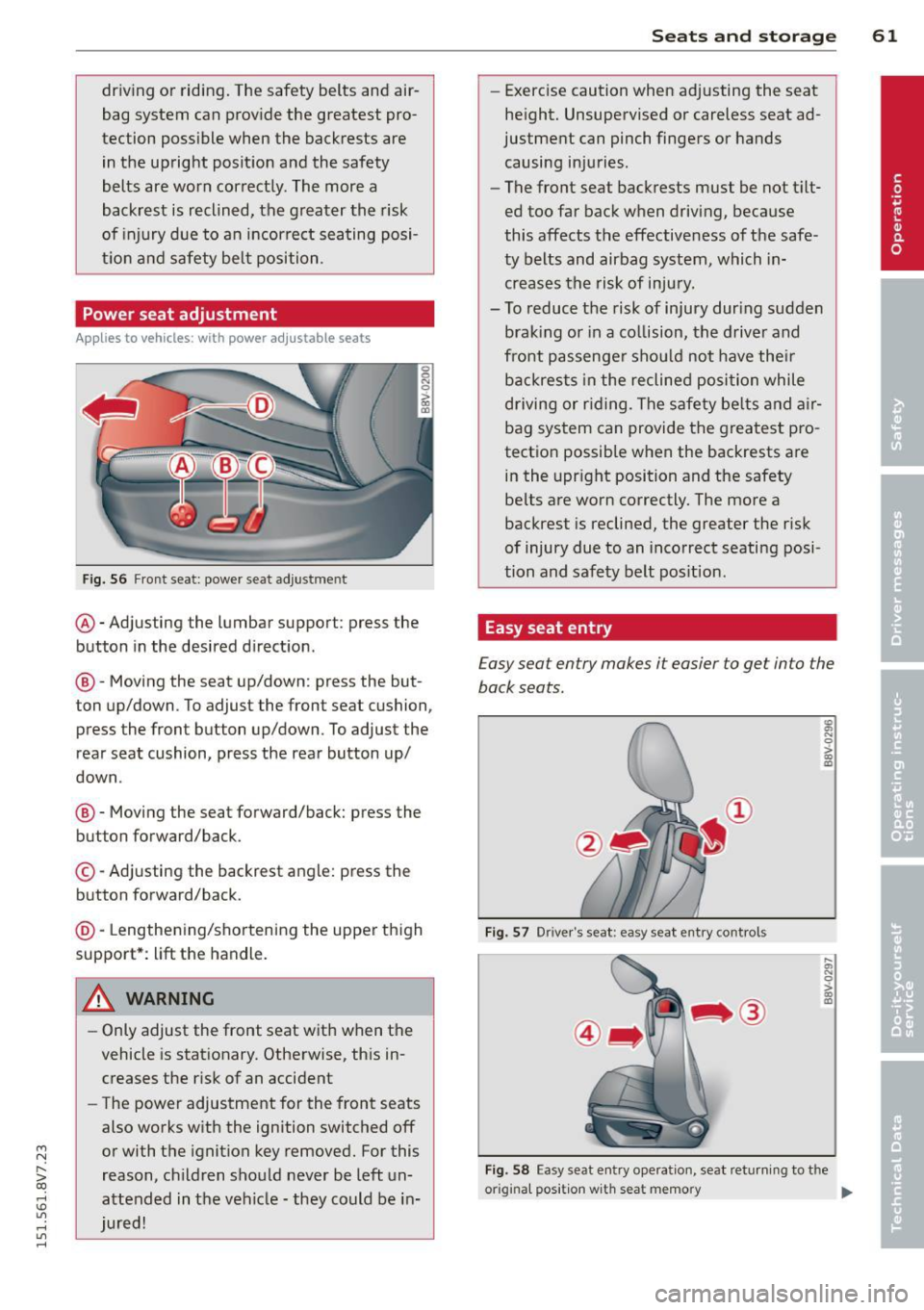
Fig. 56 Fr ont seat: power seat adjustment
@ -Adjusting the lumbar support: press the
button in the desired d irection.
@ -Moving the seat up/down : press the but
ton up/down. To adjust the front seat cushion,
press the front button up/down. To adjust the
rear seat cushion, press the rear button up/
down .
@-Moving the seat forward/back: press the
button forward/back.
© -Adj usting the backrest angle: press the
button forward/back.
@ -Lengthening/shortening the upper thigh
support*: lift the handle.
A WARNING ,-
- Only adjust the front seat w ith when the
vehicle is stationary. Otherwise, this in
creases the r isk of an accident
- The power adjustment for the front seats
also works with the ignition switched off
or with the ignition key removed. For this
reason, ch ildren should never be left un
attended in the vehicle -they co uld be in
jured!
Seats and storage 61
-Exercise caution when adjusting the seat
height. Unsupervised or careless seat ad
justment can pinch fingers or hands
causing injuries.
- The front seat backrests must be not t ilt
ed too far back when driving, because
this affects the effective ness of the safe
ty belts and airbag system, which in
creases the risk of injury.
- To reduce the risk of injury dur ing sudden
braking or in a co llision, the driver and
front passenger shou ld not have their
backrests in the reclined position while
driving or rid ing. The safety be lts and air
bag system can provide the greatest pro
tection possible when the backrests are in the upright position and the safety
be lts are worn correctly. The more a
backrest is reclined, the greater the risk
of injury due to an incorrect seating posi
tion and safety belt position.
Easy seat entry
Easy seat entry makes it easier to get into the
back seats.
Fig. 57 Driver's seat: easy seat entry controls
~ N 0 > m a,
....
l1l 0 > m a,
Fig . 58 Easy seat entry operation, seat returning to the
origina l pos it ion w ith seat memory
Ill>
Page 65 of 302
....,
N
" > co
rl I.O
"' rl
"' rl
_& WARNING
-Driving without head restraints or head
restraints that are not adjusted correctly
dramatically increases the risk of serious
or fatal neck injuries.
- Read and follow ing the WARNINGS in
¢ page 130, Proper adjustment of head
restraints.
@ Tips
Head restraints that are adjusted correctly
and safety belts are an extremely effective
combinat ion of safety equipment.
Rear head restraints
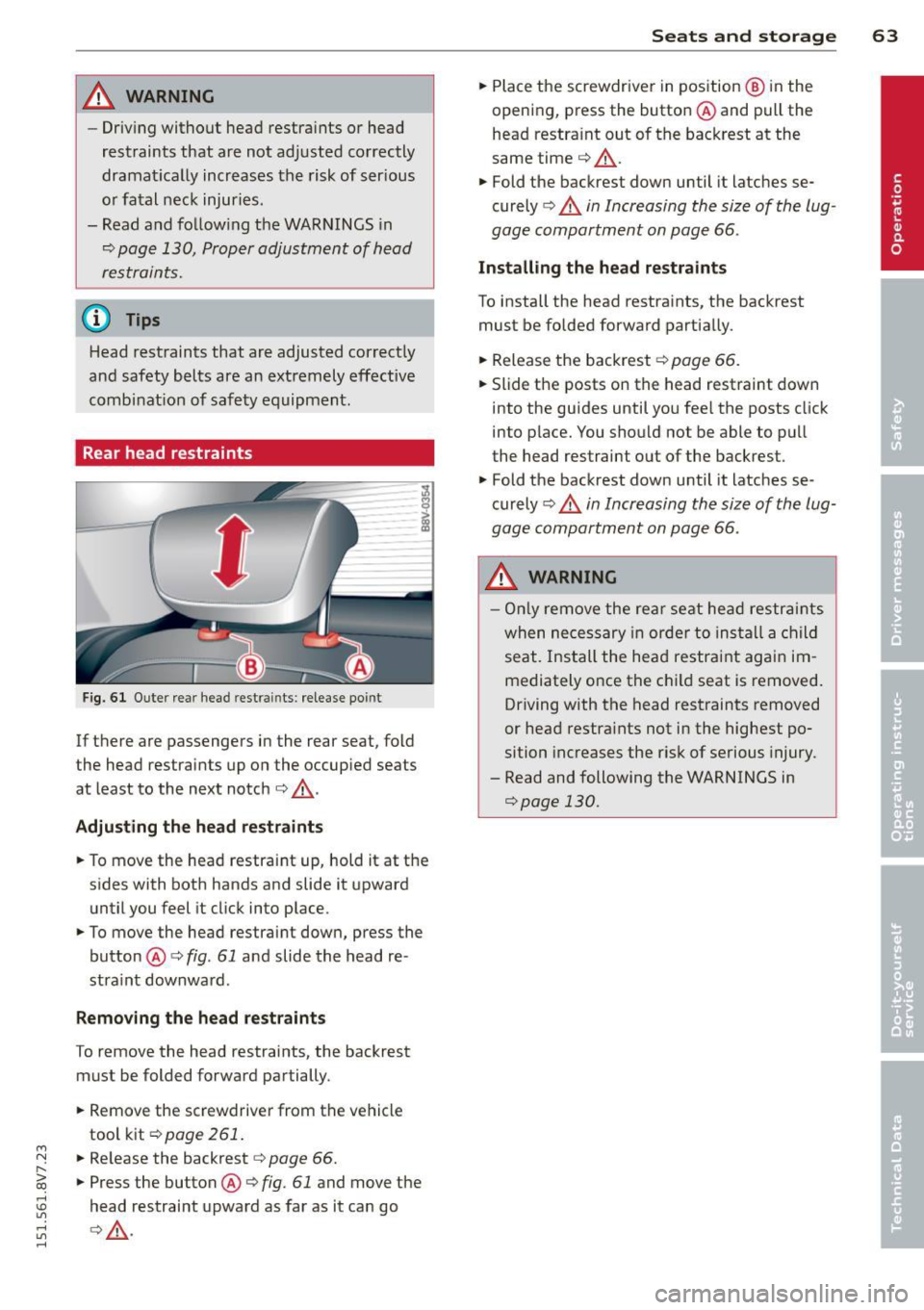
Fig. 61 Outer rear head restra ints: release poi nt
If there are passengers in the rear seat, fold
the head restraints up on the occupied seats
at least to the next notch
c:> .&_ .
Adjusting the head restraints
• To move the head restraint up, hold it at the
sides with both hands and slide it upward
until you feel it click into place.
• To move the head restraint down, press the
button @<=>
fig. 61 and slide the head re
straint downward.
Removing the head restraints
To remove the head restraints, the backrest
must be folded forward partially .
• Remove the screwdriver from the vehicle
tool kit
c:> page 261 .
• Re lease the backrest c:> page 66.
• Press the button@<=> fig. 61 and move the
head restraint upward as far as it can go
<=> .&_ .
Seats and storage 63
• Place the screwdriver in position ® in the
opening, press the button @and pull the
head restra int out of the backrest at the
same time
c:> .&, .
• Fold the backrest down until it latches se
curely
c:> .&. in Increasing the size of the lug
gage compartment on page 66.
Installing the head restraints
To install the head restraints, the backrest
must be folded forward partially.
• Release the backrest
c:> page 66.
• Slide the posts on the head restraint down
into the guides until you feel the posts click
into place. You should not be able to pull
the head restraint out of the backrest.
• Fold the backrest down until it latches se
curely
c:> & in Increasing the size of the lug
gage compartment on page 66 .
_& WARNING
- Only remove the rear seat head restraints
when necessary in orde r to install a child
seat. Install the head restraint again im
mediately once the child seat is removed.
Driving with the head restraints removed
or head restra ints not in the highest po
sition increases the risk of serious injury.
- Read and following the WARNINGS in <=>
page 130 .
Page 66 of 302
64 Seats and storage
Socket
Applies to vehicles: wit h socket
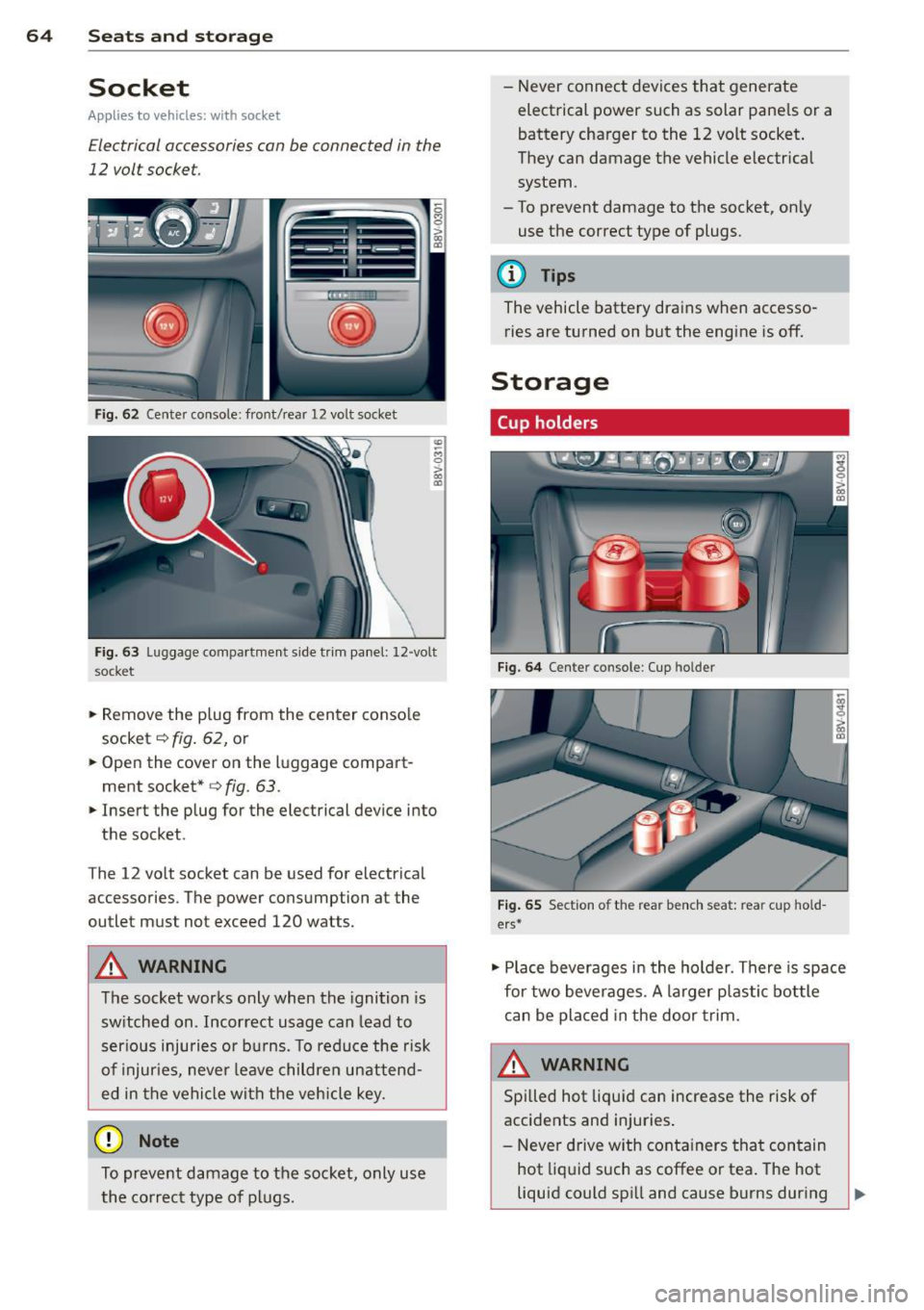
Electrical accessories can be connected in the
12 volt socket.
F ig . 6 2 Center console: front/rear 1 2 vol t so cket
"' -M
0
> a, (D
F ig. 63 Lu ggage compartme nt s ide tr im panel: 12 -volt
s ocke t
.,. Remove the p lug from the center conso le
socket
c::> fig . 62, or
~ Open the cover on the luggage compart
ment socket*
<=> fig. 63 .
.,. Insert the plug for the electrical device into
the socket .
T he 12 vo lt socket can be used for electrical
accessories. T he power cons umption a t the
outlet mus t not exceed 120 watts.
&_ WARNING
The socket works only when the ignition is
sw itched on . Incor rect usage can lead to
ser ious injuries or bu rns. To reduce the r isk
of injur ies, never leave childre n unattend
ed in the vehicle wi th the vehicle key.
(D Note
To preve nt damage to the socket, only use
the co rrect type o f plugs. - N
ever connec t devices tha t generate
electrical power such as solar pane ls or a
battery charger to the 12 volt socket .
They can damage the vehicle e lectrical
system .
- To prevent damage to the socket, on ly
use the correct type of plugs.
(D Tips
The vehicle battery dra ins when accesso
ries are turned on but the engine is off.
Storage
Cup holders
F ig. 6 4 Center co nso le : C up holde r
Fig. 65 Sect io n of th e re ar ben ch seat: re ar cu p hold
ers *
.,. Place beverages i n the holder . There is space
for two bever ages. A larger p lastic bottle
can be placed in the door trim.
&_ WARNING
Spi lled hot liquid can increase the risk of
accidents and injuries .
- Never d rive w ith conta iners that con tain
hot liq uid such as coffee or tea . The hot
liquid could spi ll and cause burns during
Page 73 of 302
....,
N
r--. > co
rl I.O
"' rl
"' rl
Climate control system controls
App lies to ve hicles: with manu al cl im ate c ontrol syst em
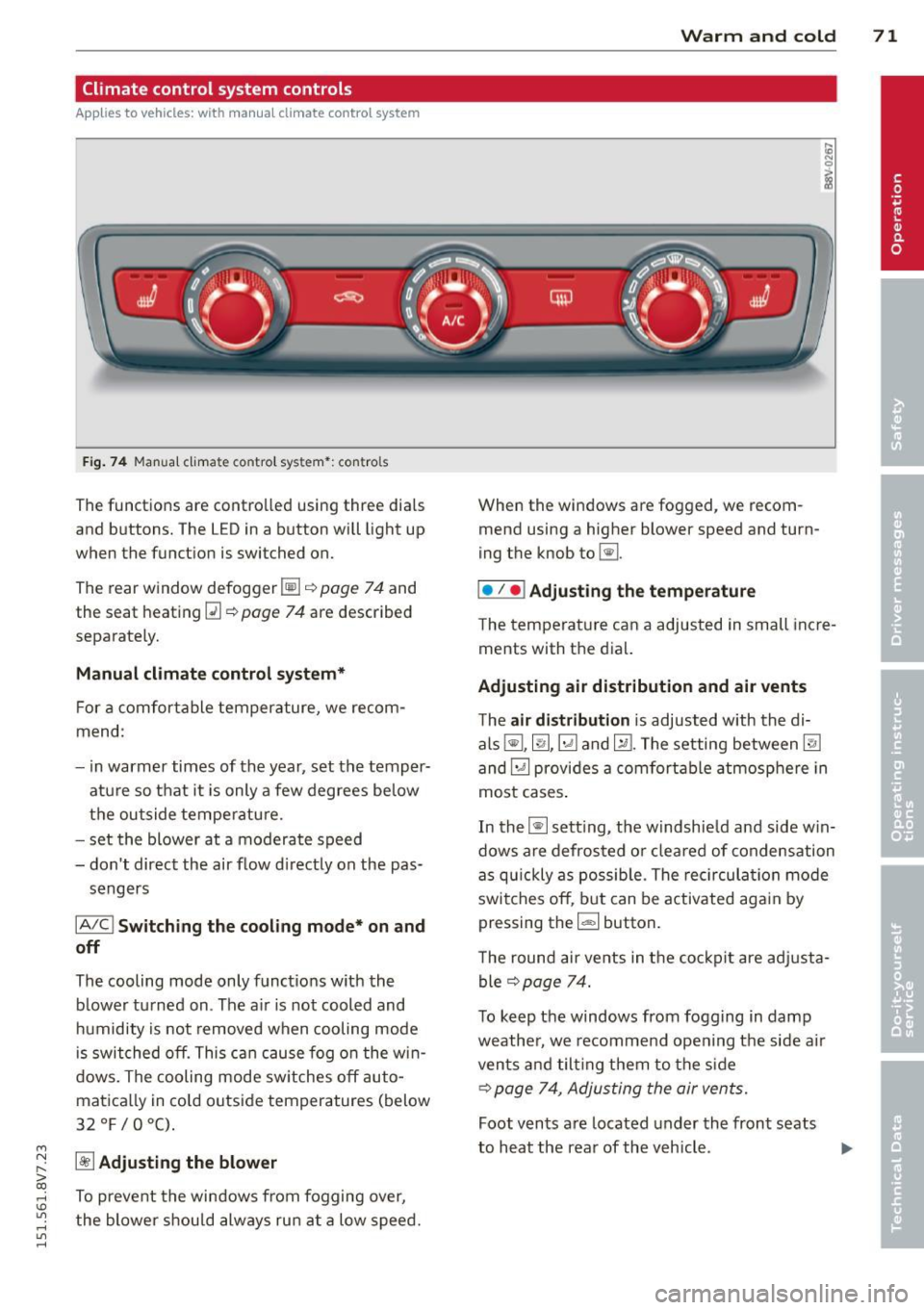
F ig . 7 4 Man ual cl ima te con tro l sy ste m•: con tro ls
The functions are contro lled using three dia ls
and buttons. The L ED in a button will light up
when the function is switched on.
The rear window defogger~¢
page 7 4 and
the seat heating~
c::> page 74 are described
separate ly.
Manual climat e control system*
For a comfortable temperature, we recom
mend :
- in warmer times of the yea r, set the temper
atu re so that it is only a few degrees be low
the outside tempe ratu re.
- set the blower at a moderate speed
- don't direct the air flow d irectly on the pas-
sengers
IA/C l Switching the cooling mode* on and
off
The cooling mode only f unct ions w ith the
b lower turned on . The a ir is not cooled and
h umidity is not removed when cooling mode
i s swit ched off. This c an cause fog o n the w in
dows. The cooling mode sw itches off auto
matica lly in co ld outside temperatures (below
32 °F/0°C) .
~ Adjusting the blower
To prevent the windows from fogging over,
the blower sh ou ld always ru n at a low speed.
W arm and cold 71
When the w indows are fogged , we recom
mend using a h igher blowe r speed and tu rn
ing t he knob to~-
I• I • I Adjusting the temperature
T he tempera ture can a adjusted in small inc re
ments with t he dial.
Adjusting air distribution and air vents
The air di stribution is adjusted with the di
als ~'~ .~ and ~-T he setting between
@J
and~ provides a comf ort abl e atmosphere in
most cases .
In the~ setting, the windshie ld and side w in
dows are defros ted o r cleared of condensation
as q uickly as possib le . The rec ircul ation mode
swi tche s off , bu t can be activated aga in by
pressing the
l d;) I button.
T he round air ve nts in t he coc kpit are adj usta
ble
¢ page 74.
To keep the windows from fogg ing in damp
weathe r, we recomme nd open ing the side a ir
vents and tilt ing them to the s ide
c::> page 7 4, Adjusting the air vents.
Foot vents a re located under the front seats
to h eat the rear of the v eh icle . ...,
Page 144 of 302
142 Safet y belt s
To provide maximum protection, sa fety belts
must always be positioned correctly on the
wearer 's body .
.,. Adjust the front seat and head restr aint
properly ¢
page 60, Front seats .
.,. Make sure the seatback of the rear seat
bench is in an upright pos ition and securely
latched in place befo re using the belt¢.&, .
.,. Hold the belt by the tongue and pull it even
l y across the chest and pelvis¢.&, .
.,. Inse rt the tongue into the correct buckle of
you r seat until you hea r it latch securely
¢ fig . 136.
.,. Pull on the be lt to m ake s ure th at it is se-
curely latched in the b uckle .
Automatic safety belt retractors
Every safety belt is eq uipped w ith an automat
ic belt retractor on the shoulder be lt . T his fea
ture locks the be lt when the belt is pulled out
fast, dur ing hard bra king and in an acci dent.
The belt may also lock when yo u drive up or
down a steep hill or through a sharp curve. During normal driving the belt lets you move
freely .
Safety belt pret ensioners
The sa fe ty belts are equippe d wi th a be lt pre
tensioner that helps to tigh ten the safety bel t
and remove s lack when the pretensioner is ac
tivated ¢
page 144. The function of the pre
tensioner is monitored by a warning light
¢page 20.
Convert ible locking ret ractor
E very sa fe ty belt except the one on the dr iver
seat is eq uipped with a convertib le locking re
tractor that
must be used when the safety
be lt is used to attach a child seat. Be s ure to
read the important information about this
feature ¢
page 180 .
A WARNING
Improperly positioned safety belts can
cause se rious injury in an accident
¢ page 142, Safety bel t p osition.
- Saf ety belts offe r optim um pro te ction
only wh en the seatba ck is upr ight and be
lts are properly posit ioned on the
body.
- Never attach the safety be lt to the buck
le for another seat. Attaching the belt to
the wrong buckle will reduce safety be lt
effectiveness and can cause serious per
sonal injury .
- A passenger who is not proper ly restrain
ed can be seriously injured by t he safety
be lt itse lf w hen it moves from the stro n
ge r parts of the body into cr itica l areas
like the abdomen .
- Always lock the conve rtible locking re
tracto r when you are secu ring a child
seat in t he ve hicl e¢
page 182.
© Tips
Fo r information on safety belt pretens ion
ers, refer to¢
page 144.
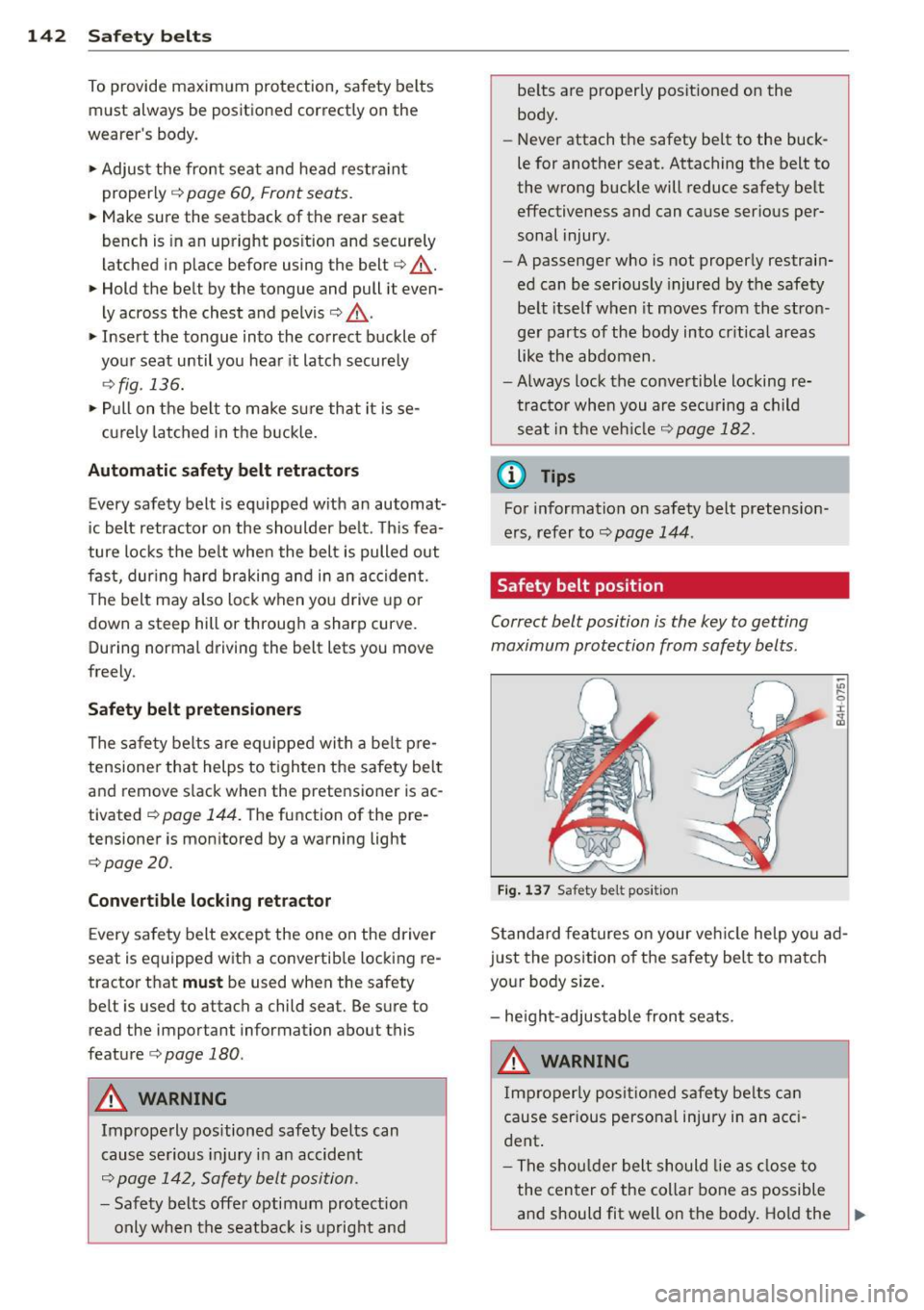
Safety belt position
Correct belt position is the key to getting
maximum protection from safety belts .
Fig. 137 Safet y bel t pos it ion
Stan dard fea tures o n your veh icle he lp yo u ad
ju st the pos ition o f th e safety be lt to ma tch
your body s ize .
- he ight-adjus table fron t seats.
A WARNING
Imp ro pe rl y pos it io ned safety be lts ca n
cause ser ious perso nal injury in an a cci
dent.
-
- T he s hou lder be lt should lie as close to
the center o f the collar bone as possible
an d should fit well on the body. Hol d the
~
Page 157 of 302
Airbag system 155
-Never remove the front passenger or games device, power inverter or seat
driver seat from the vehicle. heater for child seats) on the front pas-
- Never remove the upholstery from the senger seat if the device is connected to
front passenger seat. the 12-volt socket or the cigarette light-
- Never disassemble or remove parts from er socket. Such devices can influence the
the seat or disconnect wires from it. capacitance registered by the capacitive
- Never carry sharp objects in your pockets passenger detection system, so that in-
•
correct information is provided to the
air-• or put them on the seat. The capacitive
passenger detection mat in the front bag control unit.
passenger seat will not function properly -
If you must use a child restraint on the
if it is punctured . front passenger seat
and the child re-
- Never carry things on your lap or carry straint manufacturer's instructions
re-
objects on the front passenger seat. quire the use of a towel,
foam cushion or
Such objects can influence the capaci- something else to properly position the
tance registered by the capacitive pas- child restraint, make certain that the
senger detection system, so that incor-
PASSENGER AIR BAG OFF light comes
rect information is provided to the airbag on and stays on whenever the child re-
control unit. straint is installed on the front passen-
- Never store items under the front pas- ger seat.
senger seat. Parts of the Advanced Air--
If the
PASSENGER AIR BAG OFF light
bag System under the passenger seat does not come on and stay on, immedi-
could be damaged, preventing them and ately
install child restraint in a rear seat-
the airbag system from working proper- ing position and have
the airbag system
Ly. inspected by your Audi dealer.
- Never place seat covers or replacement
.&_ WARNING upholstery that have not been specifical-
ly approved by Audi on the front seats.
If the front passenger seat gets wet, dry it
- Seat covers can prevent the Advanced
immediately.
Airbag System from recognizing child re- - If liquid soaks into the front passenger
straints or occupants on the front pas-
seat, this can keep the airbag system
senger seat and prevent the side airbag from working properly and may, for in-
in the seat backrest from deploying prop- stance, deactivate the passenger frontal
erly .
airbag. If this happens, the
PASSENGER
-If a seat heater has been retrofitted or AIR BAG OFF light will come on and stay
otherwise added to the front passenger on together with the airbag indicator
seat, never install any child restraint sys- light
fl in the instrument cluster.
tern on this seat. -If liquid is pooled on the seat, but has
- Never use cushions, pillows, blankets, or
not soaked in, this may also keep the air-
similar items on the front passenger bag system from working properly and
seat. The additional layers prevent the cause the passenger frontal airbag to be
capacitive passenger detection system
enabled (turned on), even though there
from accurately measuring the capaci-
is a properly installed child restraint sys-
tance of the child safety seat and/or the
tern on the seat. Wet towels or other wet
person on the seat and thus keep the Ad- things on the seat cushion can have the
M vanced Airbag System from working
same effect. If the front passenger fron-• N
" > co properly. tal airbag is turned on, the PASSENGER
,...., -Never place or use any electrical device AIR BAG OFF light will go out . \!) ..,.,
,...., (such as a laptop, CD player, electronic ..,., ,....,
Page 162 of 302
160 Airbag sys te m
- and i f th e e lec trica l capacitance registered
on the front passenger seat is equal to or
l ess than t he combined capacitance of a ty p
ical 1 year-old infant and one of the rear
ward-facing o r forward-facing child re
stra ints listed in Federal Motor Ve hicle Safe
ty Standard 208 w ith whic h the Adva nce d
Airbag System in your vehicle was ce rtified .
If the front passenger seat is not occupied,
the front airbag will not deploy, and the
PAS
SENGER AIR BAG OFF
li ght w ill stay on . Nev
e r i nsta ll a rearwa rd-fac ing ch ild restra int on
the front passenger seat, the safest place fo r
a child in any kind of child restraint is at o ne
of the seat ing positions on the rear seat
¢ page 148, Child restraints on the front seat
- some important things to know
and
¢ page 169, Child Safety .
If the PASSENGER AIR BAG light comes
on ...
If the PASSENGER AIR BAG OFF light comes
on when one of the cond itions listed above is
met , be sure to check the light regularly to
make certa in that the
PASSENGER AIR BAG
OFF
light stays on cont inuous ly whenever the
ignit io n is on . If t he
PASSENGER AIR BAG
OFF
l ight does not appear on and does not
stay o n all the time, s top as soon as it is safe
to do so a nd
- react ivate the system by turning the ignition
off for more than 4 seconds and then tu rn
i ng it on agai n;
- remove and re install the chi ld restraint.
Make su re that the child res traint is properly
insta lled and that the safety be lt fo r the
fron t passenger seat has been correct ly
ro uted throug h the child restraint as descri
bed in t he chi ld restraint man ufact urer 's in
structions;
- make sure that the convertible locking re
t ractor on the safety belt for the front pas
senger seat has been act ivated and that the
safety belt has been pulled tight.
- ma ke sure that no e lectrica l device (such as
a laptop, CD playe r, electronic games device,
power inverter or seat heater for child seats)
is p laced or used on the front passenger seat
if the dev ice is connected to the 12-volt
socket or the cigarette lighter soc ket;
- ma ke s ure that no seat heater has been ret
rofitted or otherwise added to the front pas
senger seat;
- ma ke s ure that no thing can interfere with
the safety belt buck les an d that they are not
obstructed ;
- make sure that there are no wet objects (such as a wet towe l) and no water or other
liquids on the front passenger seat cushion.
If the PASSENGER AIR BAG light still
does not c ome on ...
If the PASSENGER AIR BAG OFF light still
does not come on and does not stay on con
t in uous ly (when the ignition is switched on),
- t ake the child restraint off the front passen -
ge r seat and install it proper ly at o ne of the
rear seat positions. Have the airbag system
inspected by yo ur Audi dealer immed iately.
- move the child to a rear seat position and
make sure t hat the c hil d is properly restra in
ed in a c hild restra int that is appropriate for
its size and age .
The PASSENGER AIR BAG light should
NOT come on . ..
The PASSENGER AIR BAG OFF light should
NOT come on when the ignit ion is on and an
adult is s itting in a proper seating position on
the front passenger seat. If t he
PASSENGER
AIR BAG OFF
light comes o n and s tays on o r
flashes fo r about S seconds w hile d riving, un
der these circumstances, make sure tha t:
- t he adult on the front passenge r sea t is
prope rly seated on the cente r of the seat
cushion wi th his o r her back up aga inst the
backrest and the backrest is no t re cli ned,
- t he adult is not tak ing we ight o ff the sea t by
holding on to the passenger assis t handle
above the front passenger door or s upport
ing their weight on the armrest ,
- t he sa fe ty belt is be ing properly wo rn and
t ha t the re is not a lot o f slack in the safety
be lt webbing,
- t here are no aftermar ket sea t covers or
cushions or other things (such as blankets) .,..
Page 179 of 302
M N ,....
> co ,...., \!) 1.1'1 ,...., 1.1'1 ,....,
from moving r::!;> page 180 or install the seat
using the LATCH attachments.
~ Push the child safety seat down with your
full weight to get the safety belt really tight
so that the seat cannot move forward or
s ideways more than one inch (2 .5 cm)
¢ page 180.
~ If the child safety seat is equ ipped with a
tethe r strap, attach it to the tether anchors
¢page 185.
~ Secure unused safety bel ts on the rear sea t
¢page 175.
A toddler or child is usually too large for an in
fant restraint if it is more than one year o ld
and weighs more than 20 lbs . (9 kg) .
Toddle rs and ch ildren who are older than one
yea r up to abo ut 4 years o ld and weigh more
than 20 lbs (9 kg) up to 40 lbs. (18 kg) mus t
a lways be prope rly restrained in a ch ild safety
seat certified for their size and weight
¢ fig .150and ¢fig.151 .
The airbag on the passenge r side makes the
front seat a poten tially dangerous place for a
chi ld to ride. The front seat is not the safest
p lace for a child in a forward-facing child safe
ty seat.
It is a very dangero us place for an in
fant or a larger child in a rearward-fac ing seat.
A WARNING
Not using a ch ild safety seat, using the
wrong chi ld safety sea t or improper ly in
stalling a child restraint increases the risk
of serious personal injury and death in a
co llision or othe r eme rgency s ituation.
- Children on the front seat of any car,
even with Advan ced A irbags, can be seri
o usly injured or eve n killed when an a ir
bag inf lates . A child in a rearward -facing
child safety seat installed on the front
passenger seat wi ll be seriously injured
and can be ki lled if the front airbag in
flates -even with an Advanced Airbag
System.
- The inflating a irbag w ill hit the child
safety seat or infant carrier w ith great
force and w ill smash the ch ild safety seat
Child Sa fet y 177
and child against the backrest, center
arm rest, door or roof.
- Always install rear-facing chi ld safety
seats on the rear seat.
- If you must install a rearward facing
child safety seat on the front passenger
seat because of exceptional c ircumstan
ces and the
PASSENGER AIR BAG OFF
light does not come on and stay on, im
mediately install the rear-fac ing ch ild
safety seat in a rear seating position and have the airbag system inspe cted by your
Aud i dea le r.
- The rear side of the child safety seat
should be pos itioned as close as possib le
to the backres t on the vehicle seat.
- For ad justab le head restra ints: adjust or
remove the rea r seat he ad restr aint if i t
is diffi cult to ins tall the child seat w ith
the head restraint in place
¢ page 63. In
stall the head restraint again immed iate
ly once the child seat is removed . Dr iv ing
without head restraints or with head re
straints that are not properly adjusted
increases the risk of serious or fatal neck
i nj ury dramatically .
- Always read and heed all WARNINGS
wheneve r us ing a child restrained in ave
hicle is being used¢
page 138, Safety
b elts,
c::!;> page 146, Airbag system and
c::!;> page 169, Impor tan t things to know.
A WARNING
If ex cep tional cir cumstances require the
use o f a forward-facing child res traint on
the front passenge r's sea t, the child's safe
ty and well-being req uire that the follow
ing spec ial precautions be ta ken:
- Make sure the forward -facing seat has
been designed and certified by its man u
facturer for use on a front seat with a passenger front and side airbag.
- Always follow the manufacturer's in
structions provided with the ch ild safety
seat or infant carr ier.
•
•
•
Page 181 of 302
M N
" > co ,...., \!) 1.1'1 ,...., 1.1'1 ,....,
developed, and they must not use the vehicle
safety belts without a suitable child restraint.
It is usually best to put these children in ap
propriate booster seats. Be sure the booster
seat meets all applicable safety standards.
Booster seats raise the seating position of the
child and reposition both the lap and shoulder parts of the safety belt so that they pass
across the child's body in the right places. The
routing of the belt over the child's body is very
important for the child's protection, whether
or not a booster seat is used. Children age 12
and under must always ride in the rear seat.
Children who are at least 4
ft. 9 in. (57 in
ches/1.45 meters) tall can generally use the
vehicle's three point lap and shoulder belts. Never use the lap belt portion of the vehicle's
safety belt alone to restrain any child, regard less of how big the child is . Always remember
that children do not have the pronounced pel
vic structure required for the proper function
of lap belt portion of the vehicle's three point
lap and shoulder belts. The child's safety ab
solutely requires that a lap belt portion of the
safety belt be fastened snugly and as low as
possible around the pelvis. Never let the lap
belt portion of the safety belt pass over the
child's stomach or abdomen.
In a crash, airbags must inflate within a blink
of an eye and with considerable force. In order
to do its job, the airbag needs room to inflate
so that it will be there to protect the occupant
as the occupant moves forward into the air
bag.
A vehicle occupant who is out of position and
too close to the airbag gets in the way of an inflating airbag. When an occupant is too
close, he or she will be struck violently and
will receive serious or possibly even fatal in
Jury.
In order for the airbag to offer protection, it is
important that all vehicle occupants, especial
ly any children, who must be in the front seat
because of exceptional circumstances, be
properly restrained and as far away from the
airbag as possible. By keeping room between
Child Safety 1 79
the child's body and the front of the passen
ger compartment, the airbag can inflate com
pletely and provide supplemental protection
in certain frontal collisions.
A WARNING
Not using a booster seat, using the boos
ter seat improperly, incorrectly installing a
booster seat or using the vehicle safety
belt improperly increases the risk of seri
ous personal injury and death in a collision
or other emergency situation. To help re
duce the risk of serious personal injury
and/or death:
- The shoulder belt must lie as close to the
center of the child's collar bone as possi
ble and must lie flat and snug on the up
per body. It must never lie across the
throat or neck. The lap belt must lie
across the pelvis and never across the
stomach or abdomen. Make sure that the
belt lies flat and snug. Pull on the belt to
tighten if necessary .
- Failure to properly route safety belts
over a child's body will cause severe inju ries in an accident or other emergency
situation
¢page 138.
- The rear side of the child safety seat
should be positioned as close as possible
to the backrest on the vehicle seat.
- For adjustable head restraints: adjust or
remove the rear seat head restraint if it
is difficult to install the child seat with
the head restraint in place¢
page 63. In
stall the head restraint again immediate
ly once the child seat is removed. Driving
without head restraints or with head re
straints that are not properly adjusted increases the risk of serious or fatal neck
injury dramatically.
- Children on the front seat of any car,
even with Advanced Airbags, can be seri
ously injured or even killed when an air
bag inflates .
- Never let a child stand or kneel on any seat, for example the front seat.
- Never let a child ride in the cargo area of
your vehicle.
II>-
•
•
•