rims AUDI A3 CABRIOLET 2015 Owners Manual
[x] Cancel search | Manufacturer: AUDI, Model Year: 2015, Model line: A3 CABRIOLET, Model: AUDI A3 CABRIOLET 2015Pages: 302, PDF Size: 73.83 MB
Page 126 of 302
124 Parking systems
Parallel parking
Applies to vehicles: wit h park ing system p lus with rea r
v iew camera
This view may be used when parallel parking
along the side of a street.
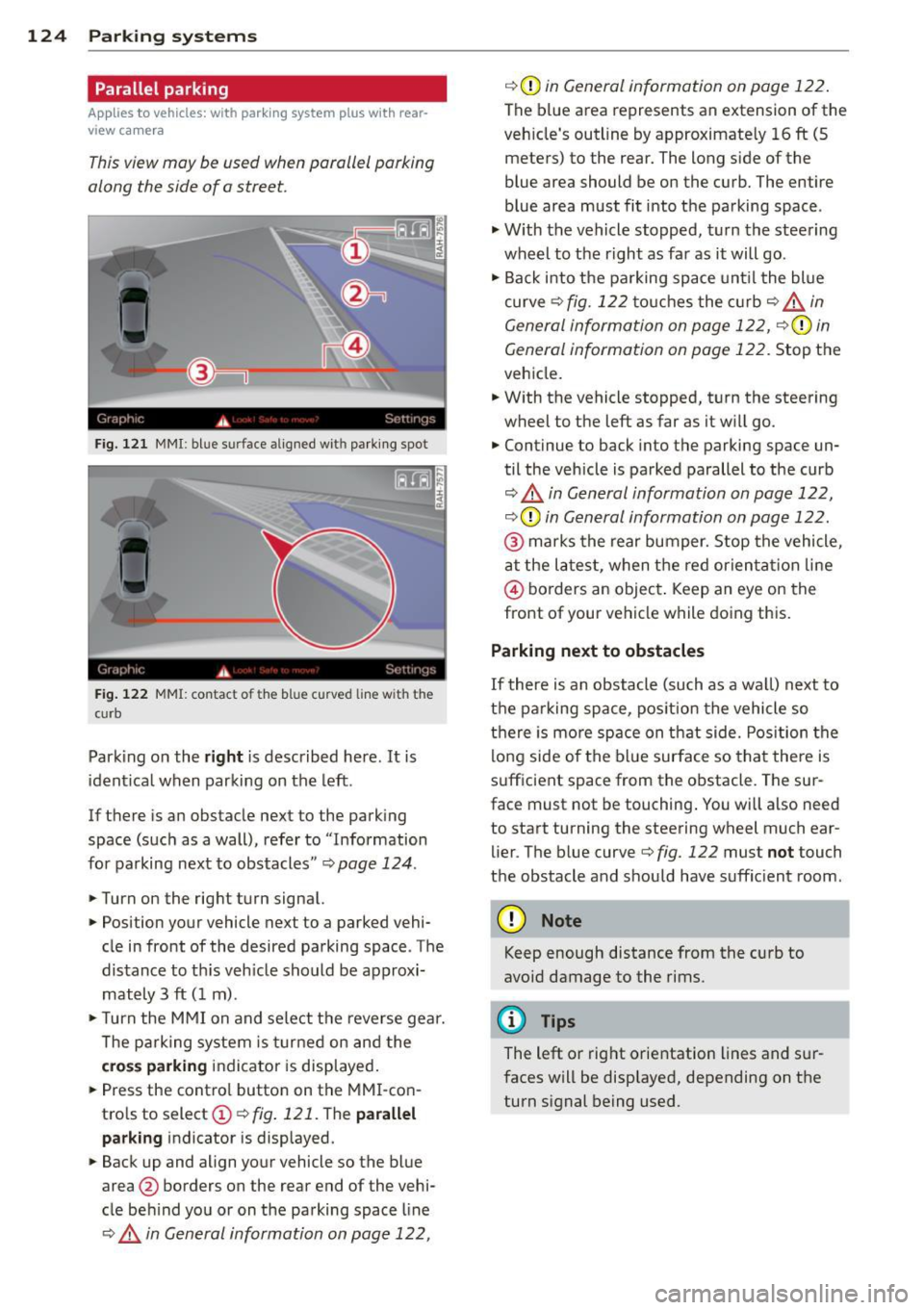
F ig. 121 MMI : bl ue surface aligned wit h parking spot
( )!'Ji 1~ ,11 ,.. ( ,1 11 f ;·.
Fig. 122 MMI: contact o f the b lu e curved line w it h th e
cu rb
Parking on the right is described here. It is
identical when parking on the left.
If there is an obstacle next to the parking
space (such as a wall), refer to "Information
for parking next to obstacles "
¢ page 124.
.. Turn on the right turn signal.
.. Position your vehicle next to a parked vehi
cle in front of the desired parking space . The
distance to th is veh icle should be approxi
mately 3 ft (1 m) .
.. Turn the MMI on and select the reverse gear.
T he parking system is turned on and the
cross parking indicator is displayed.
.. Press the contro l button on the MMI-con
tro ls to select
(D 9 fig . 121. The parallel
parking
indicator is displayed .
.. Back up and align your vehicle so the blue
area @ borders on the rear end of the vehi
cle beh ind you or on the parking space line
¢,&. in General information on page 122, ¢
(Din General information on page 122.
The blue area represents an extension of the
veh icle's outline by approximate ly 16 ft (5
meters) to the rear. The long side of the
blue area should be on the curb. The entire
blue area must fit into the parking space .
.. With the vehicle stopped, turn the steering
wheel to the right as far as it will go .
.. Back into the parking space unt il the blue
curve ¢
fig. 122 touches the curb¢,&. in
General information on page 122,
¢Ci) in
General information on page 122.
Stop the
vehicle .
.. With the vehicle stopped, turn the steering
wheel to the left as far as it w ill go.
.. Continue to back into the parking space un
til the vehicle is parked parallel to the curb
¢ .&. in General information on page 122,
¢ (Din General information on page 122.
@ marks the rear bumper. Stop the vehicle,
at the latest, when the red orientation line
© borders an object . Keep an eye on the
front of your vehicle while doing this.
Parking next to obstacles
If there is an obstacle (such as a wall) next to
the parking space, position the vehicle so
there is more space on that side. Position the
long side of the blue surface so that there is
sufficient space from the obstacle. The sur
face must not be touching . You will also need
to start turning the steering wheel much ear
lier . The blue curve
¢ fig. 122 must not touch
the obstacle and should have suffic ient room .
(D Note
Keep enough distance from the curb to
avoid damage to the rims.
(D Tips
The left or right orientation lines and sur
faces will be displayed, depending on the
turn signal being used.
Page 209 of 302
M N
" > co ,...., \!) 1.1"1 ,...., 1.1"1 ,....,
Care and cleanin g 207
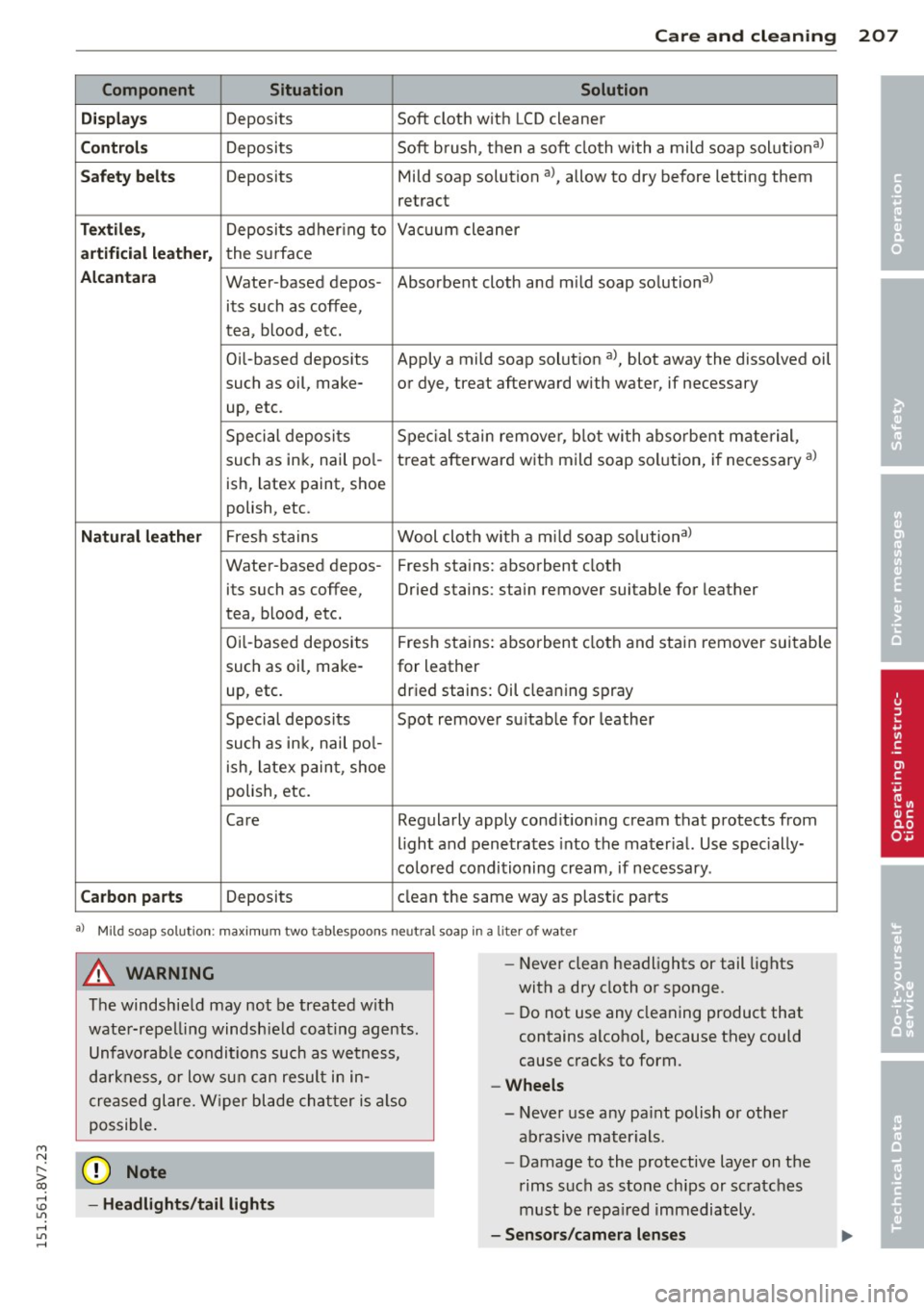
Component Situ ation Solution
D ispl ays
Deposits Soft clotlh with LCD cleaner
Controls Deposits Soft brush, then a soft cloth with a mild soap solutiona>
Sa fet y bel ts Deposits Mild soap solution a>, allow to dry before letting them
retract
Te xtil es, Deposits adher ing to Vacuum cleaner
a rtificial l eather, the surface
Alc ant ara Water-based depos- Absorbernt cloth and mild soap solutional
its such as coffee,
tea, blood, etc.
Oil-based deposits Apply a mild soap solution al, blot away the disso lved oil
such as oil, make- or dye, treat afterward with water, if necessary
up, etc.
Special depos its Spec
ial stain remover, b lot with absorbent material,
such as ink, nail po l- t reat afterward with mild soap solution, if necessary a)
ish, latex paint, shoe
polish, etc.
Natur al le ather Fresh stains Wool cloth with a m
ild soap solutional
Water-based depos- Fresh stains: absorbent cloth
its such as coffee, Dried stains: stain remover suitable for leather
tea, blood, etc.
Oi l-based deposits Fresh stains: absorbent cloth and stain remover suitable
such as oil, make- for leather
up, etc. dried stains: Oil cleaning spray
Special deposits Spot remover suitable for leather
such as ink, nail po l-
ish, latex paint, shoe
polish, etc.
Care Regularly apply condit ioning cream that protects from
l ight and penetrates into the mater ial. Use specially-
colored conditioning cream, if necessary .
Car bon part s Deposits clean the same way as plastic parts
al Mild soap solut ion : max imum two tablespoons neutral soap in a liter of water
A WARNING
The windshield may not be treated with
water-repelling windsh ie ld coating agents.
Unfavorab le conditions such as wetness,
da rkness, or low sun can result in in
creased glare. W iper blade chatter is a lso
possible.
- Headlight s/tail light s
-
-Never clean headlights or tail lights
with a dry cloth or sponge.
- Do not use any cleaning product that
contains alcohol, because they could
cause cracks to form.
-Wheels
- Neve r use any pa int polish or other
abrasive mater ials.
- Damage to the protective layer on the
rims such as stone chips or scratches
must be repa ired immediately .
-Se nsor s/camera l ense s
•
•
•
Page 230 of 302
228 Tires an d whee ls
Tires and wheels
Tires
General notes
Tires may be the least appreci
ated and most abused parts of
a motor vehicle.
Ti res may be the least appreci
ated and most abused parts of
a motor vehicle. Tires are, how
ever, one of the most important
parts of a vehicle, particularly
considering the comparatively
small patch of r ubber on each
tire that assures that all-impor
tant contact between you, your
vehicle and the road.
Maintaining the co rrect tire
p ressure, making sure that your
vehicle and its tires do not have
to carry more we ight than they
can safe ly handle, avoiding
damage from road hazards and
regularly inspecting tires for
damage including cuts, s lashes
irregular wear and overall con
d ition are the most important
things that you can do to help
avoid sudden tire failure inc lud
ing tread separation and blow
outs.
Avoiding damage
If you have to drive over a curb
or similar obstacle, drive very
slowly and as close as possible
at a right angle to the curb.
Always keep chemicals includ
ing grease, oil, gasoline and
brake fluid off the tires.
Inspect the tires regularly for
damage (cuts, cracks or blis
ters, etc.). Remove any foreign
bodies embedded in the treads.
Storing tires
Mark tires when you remove
them to indicate the direction
of rotation. This ensures you to be able to mount them correct
ly when you reinstall them.
When removed, the wheels or
tires should be stored in a cool,
dry and preferably dark p lace.
Store tires in a vertical position if they are not mounted on
rims, in a horizontal position if
they are mounted on rims.
New tires
New tires have to be broken in
¢ &.
The tread depth of new tires
may vary, according to the type .,.
Page 231 of 302
M N
" > co ,...., \!) 1.1'1 ,...., 1.1'1 ,....,
and make of tire and the tread
pattern.
Hidden damage
Damage to tires and rims is of
ten not readily visible. If you
notice unusual vibration or the
vehicle pulls to one side, this may indicate that one of the
tires has been damaged . The
tires must be checked immedi ately by an authorized Audi
dealer or qualified workshop.
Unidirectional tires
A unidirectional tire can be identified by arrows on the
sidewall, that point in the direc
tion the tire is designed to ro
tate. You must follow the speci
fied direction of rotation. This is necessary so that these tires
can develop their optimum
characteristics regarding grip,
road noise, wear and hydro
planing resistance. For more in
formation
¢ page 268.
A WARNING
-
New tires or tires that are
old, worn or damaged cannot
provide maximum control
and braking ability.
Tires and wheels 229
-New tires tend to be slip
pery and must also be bro
ken-in. To reduce the risk of
losing control, a collision
and serious personal inju
ries, drive with special care
for the first 350 miles (560 km).
-Driving with worn or dam aged tires can lead to loss of
control , sudden tire failure,
including a blowout and
sudden deflation, crashes and serious personal inju
ries. Have worn or damaged
tires replaced immediately.
-Tires age even if they are
not being used and can fail
suddenly, especially at high
speeds. Tires that are more
than 6 years old can only be
used in an emergency and
then with special care and at low speed.
-Never mount used tires on your vehicle if you are not
sure of their "previous histo
ry." Old used tires may have
been damaged even though
the damage cannot be seen
that can lead to sudden tire
failure and loss of vehicle
control.
' •
•
' •
Page 232 of 302
230 Tires and wheels
-If you notice unusual vibra
tion or if the vehicle pulls to
one side when driving, al
ways stop as soon as it is
safe to do so and check the
wheels and tires for dam
age.
0 Note
-Please note that summer and winter tires are de
signed for the conditions
that are typical in those sea
sons. Audi recommends us
ing winter tires during the
winter months. Low tem peratures significantly de
crease the elasticity of
summer tires, which affects
traction and braking ability. If summer tires are used
in
very cold temperatures, cracks can form on the tread
bars, resulting in perma
nent tire damage that can
cause loud driving noise and
unbalanced tires. Audi is not
responsible for this type of
damage.
-Burnished, polished or chromed rims must not be used in winter road condi
tions. The surface of the
rims does not have suffi
cient corrosion protection
for this and could be perma
nently damaged by road salt
or similar substances.
Glossary of tire and loading terminology
Accessory weight
means the combined weight (in
excess of those standard items
which may be replaced) of auto matic transmission, power
steering, power brakes, power
windows, power seats, radio, and heater, to the extent that
these items are available as fac
tory-installed equipment (whether installed or not).
Aspect ratio
means the ratio of the height to
the width of the tire in percent.
Numbers of 55 or lower indi
cate a low sidewall for im
proved steering response and
better overall handling on dry
pavement.
...
Page 240 of 302
238 Tires and wheels
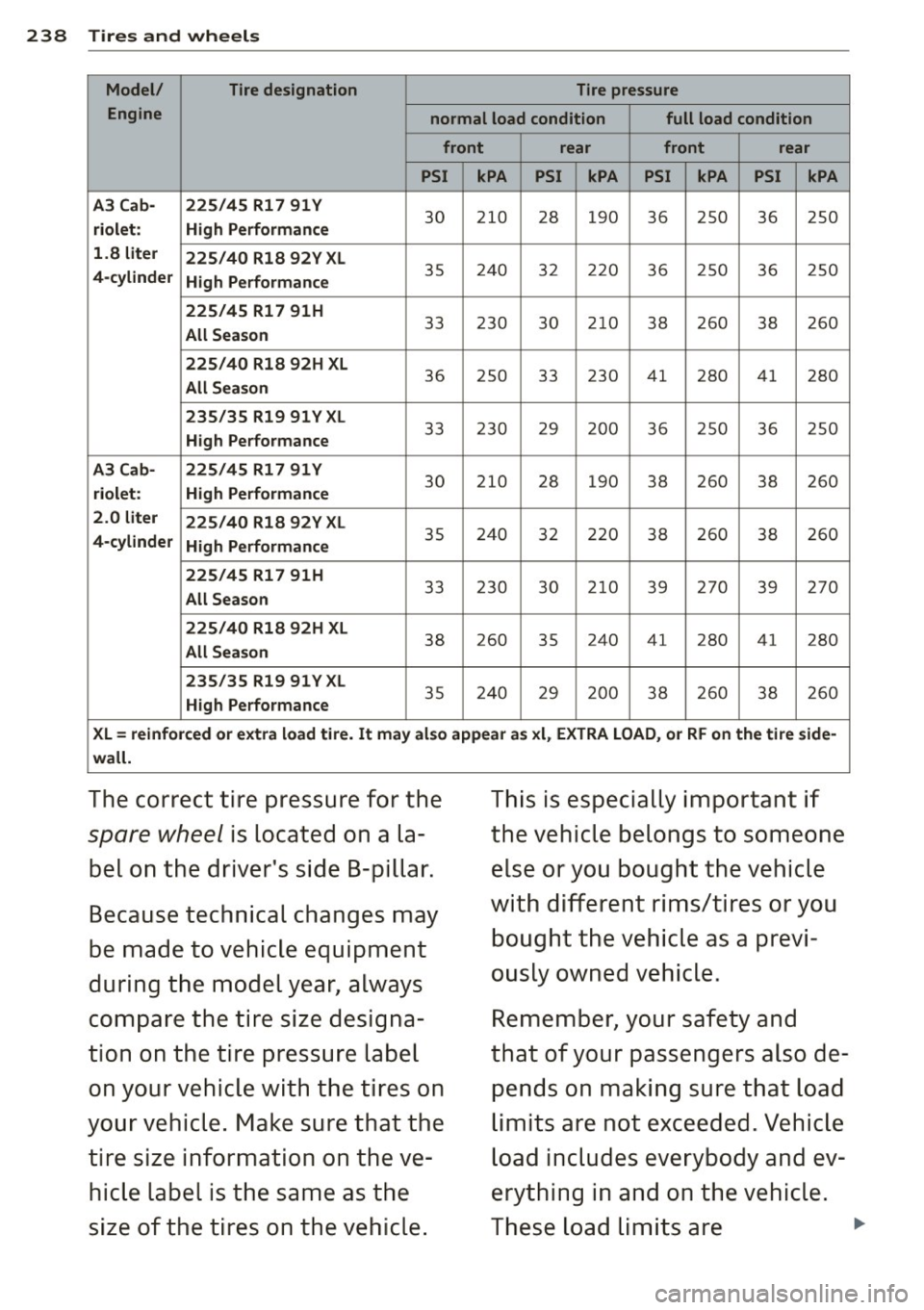
Model/ Tire designation Tire pressure
Engine normal load condition full load condition
front
rear front rear
PSI kPA PSI kPA PSI kPA PSI kPA
A3 Cab -225/45 Rl 7 91 Y
30 210 28 190 36 250 36 250 riolet : High Performance
1.8 liter 225/40 R18 92Y XL
4-cylinder High Performance
35 240 32 220 36 250 36 250
225/45 Rl7 91H
33 230
30 2
10
38 260
38 260 All Season
225/40 R18 92H XL
36 250 33 230 41 280 280 All Season 41
235/35 Rl9 91 Y XL
33 230 29 200 36 250 36 250 High Performance
A3 Cab- 225/45 Rl 7 91 Y
30 210 28 190 38 260 38 260 riolet: High Performance
2.0 liter
225/40 Rl8 92Y XL
4-cylinder High Performance
35 240 32 220 38 260 38 260
225/45 R17 91H
33 230 30 210 39
270
39 270 All Season
225/40 R18 92H XL
38 260 35 240 41 280 41
280
All Season
235/35 R19 91 Y XL
35 240 29 200 38 260 38 260 High Performance
XL= reinforced or extra load tire. It may also appear as xi, EXTRA LOAD, or RF on the tire side-
wall.
The correct tire pressure for the
spare wheel is located on a la
bel on the driver's side B-pillar.
Because technical changes may
be made to vehicle equipment
during the model year, always
compare the tire size designa
tion on the tire pressure label on your vehicle with the tires on
your vehicle. Make sure that the tire size information on the ve
hicle label is the same as the
size of the tires on the vehicle. This is
especially important if
the vehicle belongs to someone else or you bought the vehicle
with different rims/tires or you bought the vehicle as a previ
ously owned vehicle.
Remember, your safety and
that of your passengers also de pends on making sure that load
limits are not exceeded. Vehicle
load includes everybody and ev
erything in and on the vehicle.
These load limits are
Page 251 of 302
M N
" > co ,...., \!) 1.1'1 ,...., 1.1'1 ,....,
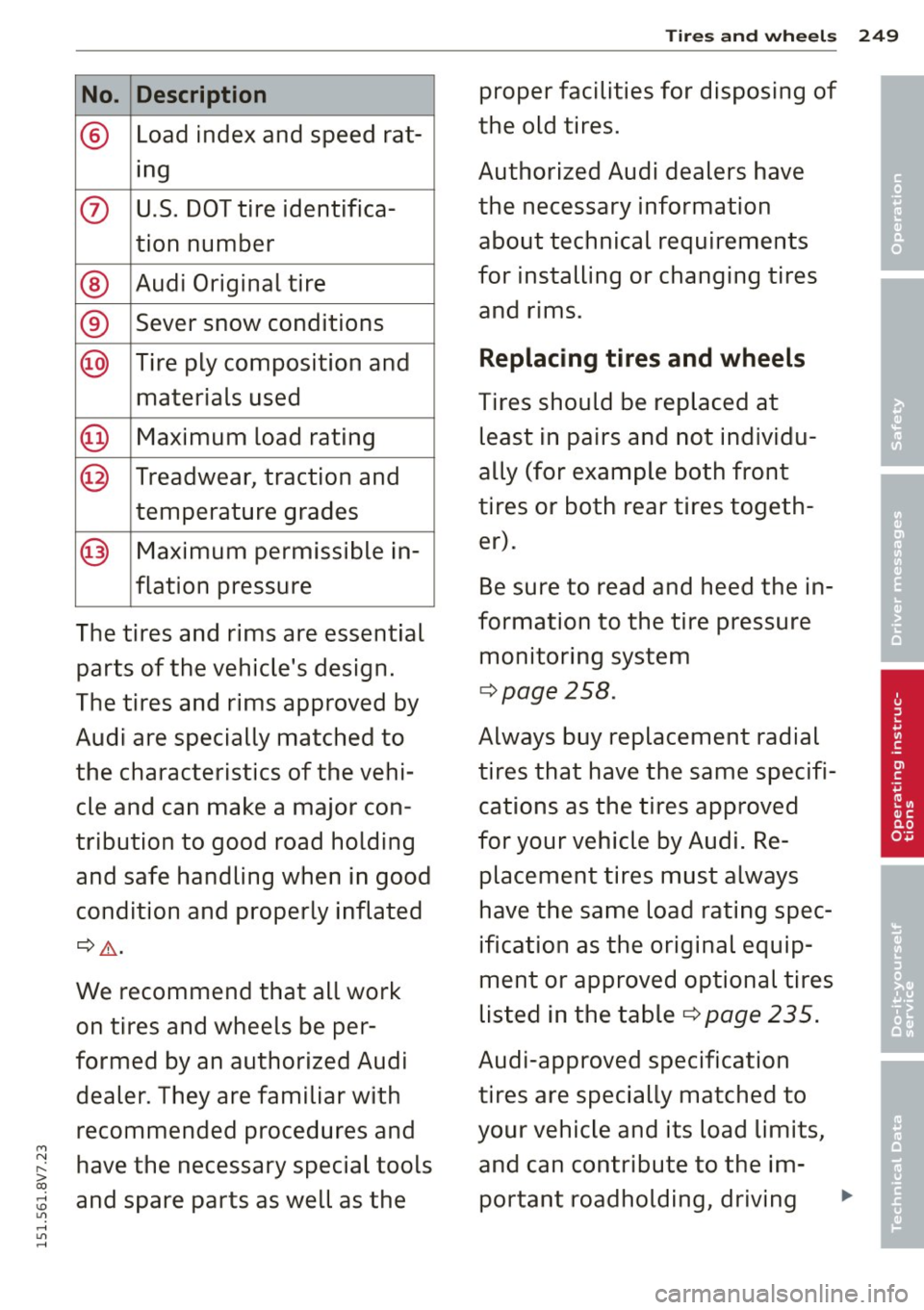
No. Description
® Load index and speed rat-
1ng
0 U.S. DOT tire identifica-
tion number
® Audi Original tire
® Sever snow conditions
@ Tire ply composition and materials used
@ Maximum load rating
@ Treadwear, traction and
temperature grades
@ Maximum permissible in-
flation pressure
The tires and rims are essential parts of the vehicle's design.
The tires and rims approved by
Audi are specially matched to
the characteristics of the vehi cle and can make a major con
tribution to good road holding and safe handling when in good
condition and properly inflated
¢ &.
We recommend that all work
on tires and wheels be per
formed by an authorized Audi dealer. They are familiar with
recommended procedures and
have the necessary special tools
and spare parts as well as the
Tires and wheels 249
proper facilities for disposing of
the old tires.
Authorized Audi dealers have
the necessary information about technical requirements
for installing or changing tires and rims.
Replacing tires and wheels
Tires should be replaced at least in pairs and not individu-
ally (for example both front
tires or both rear tires togeth- er).
Be sure to read and heed the in-
formation to the tire pressure
monitoring system
¢ page 258.
Always buy replacement radial
tires that have the same specifi-
cations as the tires approved
for your vehicle by Audi. Re- placement tires must always
have the same load rating spec-
ification as the original equip-
mentor approved optional tires
listed in the table¢
page 235.
Audi-approved specification
tires are specially matched to
your vehicle and its load limits, and can contribute to the im-portant roadholding , driving
' •
•
' •
Page 254 of 302
252 Tires a nd whee ls
tires beca use they meet the
h ighest standards regarding
safety and driving characteris
t ics when used correctly. Your
autho rized Audi dealer w ill
g lad ly provide you with more
information.
Tire ply composition and materials used
T he number of plies indicates
the number of layers of rubber
coated fabric in the tire. In gen
eral, the greater the number of
plies , the more weight a tire
can support . Tire manufactur
ers also must indicate the ma
ter ia ls in the tire, wh ich include
steel, nylon, polyester, and oth
ers .
Ma ximum Load Rating
This number indicates the max
imum load in kilograms and
pounds that can be carried by
the tire.
Tire quality grading for
treadwear, traction , and
temperature resistance
Tread wear, traction and tem
perature grades¢
page 254.
Maximum Permissible
Inflation Pressure
This number is the greatest
amount of air pressure that
should ever be put in the tire
under normal driving condi
tions.
A WARN ING
-Using incorrect or unmatch
ed tires and/or wheels or improper tire and wheel
combinations can lead to loss of control, collis ion and
serious personal injury.
-Always use tires, rims and
wheel bolts that meet the
specifications of original
factory-installed tires or
other combinations that
have been specifically ap
proved by the vehicle manu
facturer.
- Tires age even if they are
not being used and can fail
suddenly, especially at high
speeds. Tires that are more
than 6 years old can only be
used in an emergency and
then with special care and
at lower speeds.
-Never mount used tires on
your vehicle if you are not
Page 256 of 302
254 Tires and wheels
run flat tires. If run flat tires
are used, they must be in
stalled on all four wheels. Mixing tire types is not per
mitted.
@) Note
-For technical reasons, it is not generally possible to
use the wheel rims from
other vehicles. This can hold
true for wheels of the same
vehicle type.
- If the spare tire is different
from the tires that you have mounted on your vehicle
(for example winter tires or
wide prof ile tires), then use
the spare tire for a short pe
riod of time only and drive
with extra care. Replace the
flat tire with the tire match ing the others on your vehi
cle as soon as possible.
- Never drive without the
valve stem cap . The valves
could get damaged.
@) For the sake of the environment
Dispose of old tires in accord
ance w ith the local require
ments.
Uniform tire quality grading
- Tread wea r
- Traction AA A B C
- Temperature ABC
Quality g rades can be foun d where applicab le
on the t ire s ide wall between t read sho ulder
and maximum section width
¢ page 248,
fig . 176 .
For example: Tread wear 200 , Traction AA,
Tempera ture A .
All passenge r ca r tir es must con fo rm to Feder
al Safety Req uirements in ad dition to these
grades.
Tread wear
T he tread we ar g rade is a c omparative r ati ng
b as ed on the wea r ra te of the tire when tes ted
u nder con tro lled cond itions o n a specifie d
government test course .
F o r ex am ple, a tire gr aded 1 S0 would wear
o n e and one h alf ( 11/ 2) times as well on the
government course as a tire gr aded 10 0 .
T he re lative per forman ce of tires depen ds
up on the actu al cond itions of the ir use, h ow
ever, and m ay dep art s ignific antly from the
no rm due to va ria tions i n driving ha bits, se rv
ice p ractices and differe nces in road c haracter
ist ics and climate.
Traction
The tr actio n gr ad es, fro m hig hest to lowest,
are AA, A, Ban d
C. Those grades represent t he
ti re 's ability to stop on wet pavement as
measured unde r cont rolled conditions on
specified g overnment test surfaces of aspha lt
and co ncrete. A t ire mar ked C may have poor
traction performance
¢ A .
Temperature
The temperature g rades are A (the highest),
B, an d C, represe nting the tire's resistance to
the generation of heat and its ab ility to dissi
pate heat when tested unde r controlled condi
t ions on a specif ied ind oor l abo rato ry test
whee l.
Page 258 of 302
256 Tires and wheels
loss of control, crashes and serious per
sona l injuries . Have worn or damaged tires
replaced immediate ly.
- Winter tires have maximum speed rating
that may be lower than your vehicle's
maximum speed .
- Never drive faster than the speed for
which the winter or other tires installed
on your vehicle are rated.
A WARNING
Always adjust your driving to the road and
traffic conditions. Never let the good ac
celeration of the winter tires and all-wheel
drive tempt you into taking extra risks. Al
ways remember:
- When braking, an all-wheel drive vehicle
handles in the same way as a front drive
vehicle .
- Drive carefully and reduce your speed on
icy and slippery roads, even winter tires
cannot help under black ice conditions.
@) For the sake of the environment
Use summer tires when weather condi
tions permit. They are quieter, do not wear
as quickly and reduce fuel consumption.
Snow chains
Snow chains may be fitted only to the front
wheels, and only to certain tire sizes. Ask your
authorized Audi dealer on which tire sizes
snow chains can be used.
If you are going to use snow chains, then you
must install them on the front wheels at
l east.
The snow chains must have low-profile links
and must not be thicker than 0.53 inch
(13.5 mm), including the lock.
Remove wheel center covers and trim discs
before putting snow chains on your vehicle
q 0 . For safety reasons cover caps must then
be fitted over the wheel bolts. These are avail
able from authorized Audi dealers.
A WARNING
Using the wrong snow chains for your vehi
cle or installing them incorrectly can in
crease the risk of loss of control leading to
serious personal injury.
- Snow chains are available in different
sizes . Always make sure to follow the in
structions provided by the snow chain
manufacturer.
- When driving with snow chains never
drive faster than the speed permitted for
your specific snow chains.
- Always observe local regulations.
@ Note
-Remove snow chains before driving on
roads not covered with snow to avoid
damaging tires and wearing the snow
chains down unnecessarily .
- Snow chains, which come into direct con
tact with the wheel rim, can scratch or
damage it. Therefore, make sure that the
snow chains are suitably covered. Check
the position of the snow chains after
driving a few yards and correct if neces
sary. Follow the instructions from the
snow chain manufacturer when doing so.
@ Tips
Where snow chains are mandatory on cer
tain roads, this normally also applies to
vehicles with all-wheel drive .
Wheel bolts
Wheel bolts must always be tightened to the
correct torque.
The design of wheel bolts is matched to the
factory installed rims. If different rims are fit
ted, the correct wheel bolts with the right
length and correct ly shaped bolt heads must
be used. This ensures that wheels are fitted
securely and that the brake system functions
correctly . .,..