roof AUDI A3 CABRIOLET 2015 Owners Manual
[x] Cancel search | Manufacturer: AUDI, Model Year: 2015, Model line: A3 CABRIOLET, Model: AUDI A3 CABRIOLET 2015Pages: 302, PDF Size: 73.83 MB
Page 39 of 302
....,
N
" > co
rl I.O
"' ,....,
"' rl
this could make it possible for unauthor
ized persons to start the engine and oper
ate vehicle systems such as the power win
dows or sunroof . This can increase the risk
of serious injury .
(D Tips
-The vehicle cannot be started if an unau
thorized key is used. It may not be poss i
ble to start the vehicle under certain cir
cumstances, for example if there is an
other radio module like the key from an
other vehicle or a transponde r on the
same keychain.
- For an explanation on conformity with
the FCC regu lations in the United States
and the Industry Canada regulations, re
fer to
c::; page 285.
Safety central locking
Applies to vehicles: with safety central locking
Safety central locking provides the possibility,
to only unlock the driver's door and the fuel
filler door. The rest of the vehicle remains
locked.
Unlocking the driver's door and the fuel
filler door
.. Press the remote contro l key or convenience
key @! but ton
once or turn the key once in
the opening direction .
Unlocking all doors, the luggage
compartment lid and the fuel filler door
.. Press the remote control key or convenience
key @! button
twice within five seconds or
turn the key
twice within five seconds in the
opening direction .
When unlocking just the driver's door, the an
ti -theft alarm system* is also immediately de
activated .
In vehicles with an MMI, you can d irectly ad
just the safety central locking
o page 36 .
Opening and closing 3 7
Front passenger's door emergency
locking
The front passenger's door must be locked
separately if the power locking system fails.
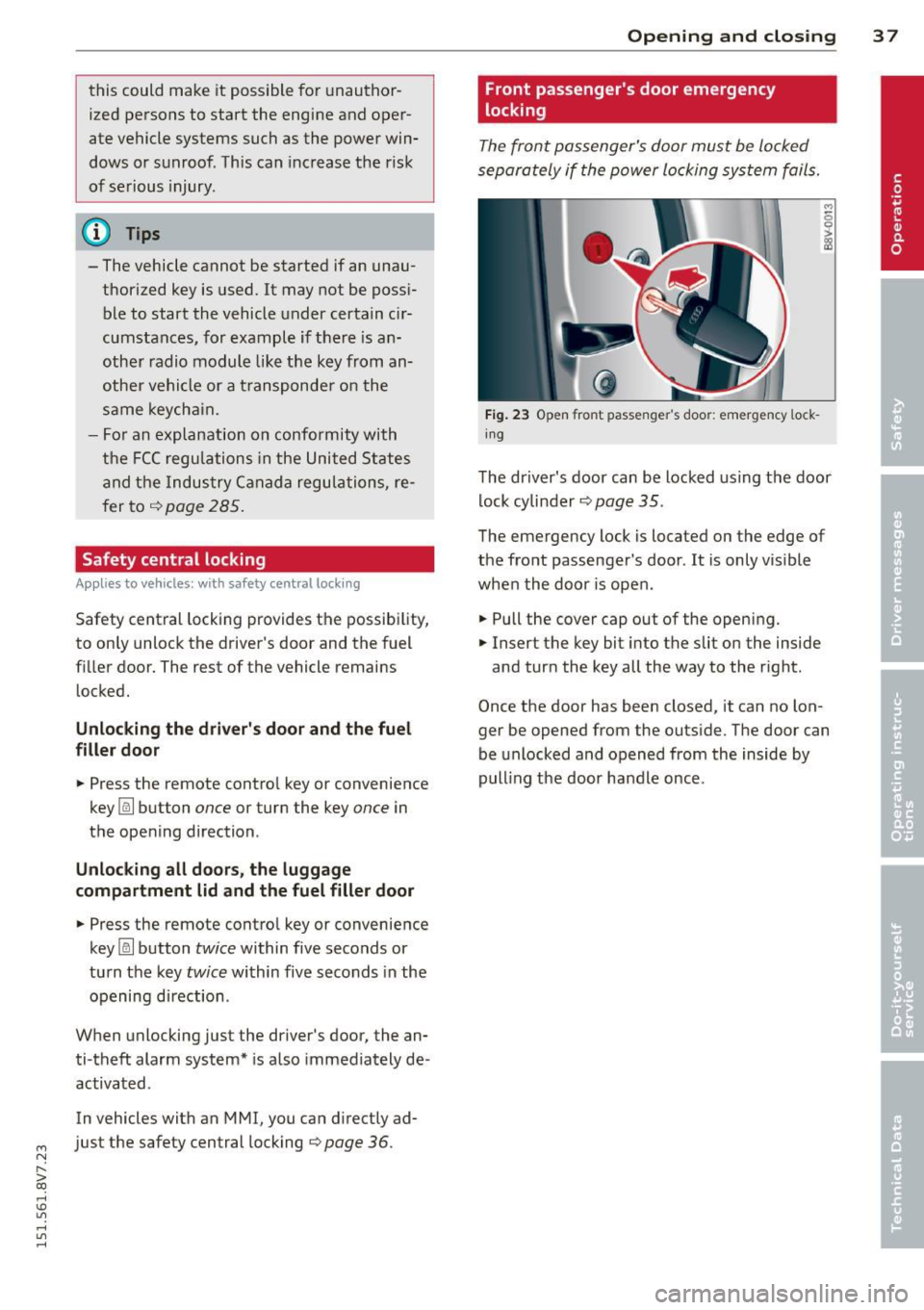
Fig. 23 Open fro nt passen ger' s doo r: emergency lock
in g
The driver's door can be locked using the door
lock cylinder
o page 35.
The emergency lock is located on the edge of
the front passenger 's door . It is only visible
when the door is open .
.. Pull the cover cap out of the opening.
.. Insert the key bit into the slit on the inside
and turn the key all the way to the right .
Once the door has been closed, it can no lon ger be opened from the outside. The door can
be unlocked and opened from the inside by
pulling the door handle once .
Page 43 of 302

....,
N
r--. > co
rl I.O
"' rl
"' rl
Power top
Automatic power top
General information
The power top opens and closes automatical ly . When open, the power top is stored com
pletely in the power top compartment. The
power top can be opened or closed at speeds
up to 30 mph (SO km/h).
Under normal conditions, the power top is
wind and waterproof. In rare cases, small
droplets of water may form under extreme
weather conditions such as torrential or pro longed rain. That is normal and no cause for
concern.
Follow the care instructions to keep the power
top free of leaks and to maintain its appear
ance
c::> page 204, Core and cleaning. Also ob
serve the following:
- Op en and stow the power top only when it is
clean and dry . Sharp-edged dirt particles can
cause damage to the rear window and the
power top. Stowing the power top when it is
damp can create imprints in it, and if it is
left that way for long periods of time, mil
dew and other damage can form.
- Do not leave the power top open for several
weeks or the creases in it may become dis
colored.
- Remove ice and snow before opening the
power top. Do not use any sharp edged ob
jects to remove ice and snow or the power
top could be scratched or damaged. The rear
window may be cleared with a standard ice
scraper.
- Do not open the power top when the tem
perature is below 32 °F (0 °C). The fabric in
the power top loses elasticity in sub-ze ro
temperatures.
_& WARNING
- When positioning the power top, avoid
contact with the supports or other mov
ing parts. Make sure all of the windows
.
Power top 41
are lowered. Otherwise you could pinch
your hands.
- Never drive when the power top is not
locked correctly. The wind from driving
could cause the power top to open. This
can result in injuries and damage to the
vehicle.
Opening and closing the power top
Fig. 27 Center console: power top switch
Requirement: The power top storage com
partment must be lowered
c::> page 43 and
the luggage compartment lid must be closed.
.. Switch the ignition on.
.. To open or close the power top, pull or press
the button @during the entire process.
T he status of the power top is shown in the in
strument cluster display when operating the
power top switch.
You can close the power top when the wind
deflector is installed
~ page 44.
A message will appear in the instrument clus
ter if the power top cannot be opened or
closed
c::> page 43.
A WARNING
- When operating the power top, make
sure the function is not affected by wind
or other factors and that it does not in
terfere with other drivers.
- Never drive when the power top is not
locked correctly. The wind from driving
could cause the power top to open. This
can result in injuries and damage to the
vehicle.
-
Page 151 of 302
M N ,....
> co ,...., \!) 1.1'1 ,...., 1.1'1 ,....,
Fo r exa mple, the airbag may depl oy if:
-a small child that is heavier than a typical 1
year-o ld child is on the front passenger seat
(regardless of whether the child is in one of
the chi ld seats listed
page 171), or
- a ch ild who has outgrown child rest raints is
on the front passenger seat.
If the front passenger airbag is turned off, the
P ASS ENGER AIR B AG OFF light comes on in
the instrument cluster and stays on.
If the front passenger airbag deploys, the
Federal Standard requires the airbag to meet
the "low risk" deployment criter ia to reduce
the r isk of injury through interaction with the
airbag. "Low risk" deployment occurs in those
crashes that take place at lower decelerations
as defined in the electronic control unit
r::> page 159, PASSENGER AIR BAG OFF light.
Always remember, a chi ld seat or infant carri
er insta lled on the front seat may be struck
and knocked out of position by the rapidly in
flating passenger's airbag in a frontal colli
sion. The airbag could greatly reduce the ef
fectiveness of the child restraint and even se
riously injure the child during inflat ion.
For this reason, and because the back seat is
the safest place for children - when properly
restrained according to their age and size - we
strongly recommend that children always sit
in the back seat
r::> page 169, Child Safety .
A WARNING
A child in a rearward-facing child seat in
stalled on the front passenger seat will be
ser iously injured and can be killed if the
front airbag inflates -even with an Ad
vanced Airbag System .
- T he inflating airbag will hit the child seat
or infant carrier with great force and wi ll
smash the child seat and child against
the backrest, center armrest, door or roof.
- Always install rear-facing child seats on
the rear seat.
- If you must install a rearward facing
child seat on the front passenger seat
-
A irbag system 149
because of exceptional circumstances
and the
PA SSENGER AIR BAG OFF light
does not come on and stay on, immed i
ately install the rear-fac ing child seat in a
rear seat ing pos ition and have the airbag
system inspected by your A udi dealer.
- Forward-facing child seats installed on the front passenger's seat may interfere
with the dep loyment of the a irbag and
cause serious persona l injury to the
child.
A WARNING
If, in except iona l circumstances, you must
install a forward -facing child restraint on
the front passenger's seat:
- Always ma ke s ure the forward-facing
seat has been designed and certified by its manufacturer for use on a front seat
with a passenger front and s ide a irbag.
- Never put the forward-facing child re
straint up against or very near the instru
ment panel.
- Always move the passenge r seat into its
rearmost pos ition in the seat's fore and
aft ad justment range, as far away from
the airbag as possible before installing
the forward-fac ing ch ild restra int. The
backrest must be adjusted to an upright
position.
- Make sure that the
PASSENGER AIR BAG
OFF
l ight comes on and stays on all the
time wheneve r the ig nit ion is switched
on.
A WARNING
To reduce the ri sk of ser ious injury, ma ke
sure that the
PASSENGER AIR BAG OFF
light wi ll be displayed whenever a child re
straint is insta lled on the front passenger
seat and the ignition is switched on.
- If the PASSENGER AIR BAG OF F light
does not stay on, perform the checks de
scribed
¢ page 158, Monitoring the Ad-
vanced Airbag System.
~
•
•
•
Page 155 of 302
M N
" > co ,...., \!) 1.1"1 ,...., 1.1"1 ,....,
of a typical 1 year-old, but less than the
weight of a small adult, the front airbag on
the passenger s ide may deploy (the
PASSEN·
GER AIR BA G OFF
light does not come on).
For example, the a irbag may depl oy if:
- a small child that is heavier than a typical 1
year-o ld child is on the front passenger seat
(regardless of whether the child is in one of
the chi ld seats listed
page 171),
-a ch ild who has outgrown child rest raints is
on the front passenger seat.
I f the front passenger airbag is turned off, the
PA SSENGER AIR BAG OFF light in the center
of the inst rument panel w ill come on and stay
on.
If the front passenger airbag deploys, the
F ederal Standard requires the a irbag to meet
the " low ris k" deployment criteria to help re
d uce the risk of injury through interaction
with the airbag . "Low risk" deployment occurs
in those crashes that take place at lower de
celerations as defined in the electronic control
un it
r:::> page 158.
Alway s remember : Even though your vehicle
is equipped with Advanced Airbags, the safest
p lace for children is properly restrained on the
back seat. Please be sure to read the impor
tant information in the sect ions that follow
and be sure to heed all of the WARNINGS .
A WARNING
To reduce the risk of injury when an airbag
inflates, a lways wear safety belts prope rly.
- If you are unrestrained, lean ing forward,
sitting sideways or out of position in any
way, your risk of injury is much higher.
- You w ill also receive serious injuries and
cou ld even be killed if you are up against
the a irbag or too close to it when it in
fla tes - even with an Advanced Airbag
page 146 .
A WARNING ,~
A child in a rearward -facing child seat in -
stalled on the front passenger seat will be
-
A irbag system 153
seriously injured and can be killed if the
front airbag inflates - even w ith an Ad
vanced A irbag System.
- Altho ugh the Advanced Airbag System in
your veh icle is designed to turn off the
front airbag when a rearward-facing child restraint has been installed on the
front passenge r seat, nobody can abso
lutely guarantee that dep loyment is im
possible in all conceivable s ituations that
may happen dur ing the usef ul life of your
veh icle.
- The infla ting airbag will h it the ch ild seat
or infant carrier with g reat force and will
smash the child seat and child against
the backrest, center armrest, door, or
roof.
- Always install rearward-facing chi ld re
straints on the rear seat.
- If you must insta ll a rearwa rd fac ing
child seat on the front passenger seat because of exceptional circumstances
and the
PASSENGER AIR BAG OFF light
does not come on and stay on, immed i·
ately insta ll the rear-fac ing child seat in a
rea r seat ing pos ition and have the airbag
system inspected by you r Audi dealer .
A WARNING
If, in except iona l circumstances, you must
install a forward-facing child restraint on
the front passenge r's seat:
- Always ma ke sure the forward-facing
seat has been designed and cer tified by
its manufacture r for use on a front se at
with a passenger fron t and s ide a irbag .
- Never put the fo rward-facing child re
straint up against or ve ry near the instru
ment panel.
- Always move the passenge r seat into its
rea rmost pos ition in the seat's fore and
aft ad justment range, as fa r away from
the airbag as possible, before installing
the forward-fac ing chi ld restraint. The
backrest must be ad justed to an upright
position .
...
•
•
•
Page 159 of 302
M N ,....
> co ,...., \!) 1.1'1 ,...., 1.1'1 ,....,
or the lower parts of the body. Front airbags
supp lement the three-point safety belts only
in some frontal collisions in which the vehicle
dece leration is high enough to deploy the air
bags.
F ront airbag s will no t deplo y:
- if the ignition is switched off when a crash
occurs,
- in side collisions,
- in rear-end collisions,
- in rollovers,
- when the crash deceleration measured by
the a irbag system is less than the m inimum
threshold needed for airbag deployment as
registered by the electronic control unit.
The f ront pas seng er airbag al so will n ot
deploy:
- when the front passenger seat is not occu
pied,
- when the electrical capac itance measured by
the capacitive passenger detect io n system
for the front passenger seat indicates that
the passenger side frontal airbag must be switched off by the electronic control unit
(the
P AS SENGER A IR BA G OFF light
c:> page 159 and how they work comes on
and stays on).
A WARNING
Sitting in the wrong position can increase
the risk of serious injury in crashes.
- To reduce the r isk of injury when the air
bags inflate, the driver and passengers
must always sit in an upright posit ion,
must not lean against or place any part
of the ir body too close to the area where
the a irbags are located.
- Occupants who a re unbelted, out of posi
t ion or too close to the airbag can be se
riously injured by an airbag as it unfolds
with great force in the blink of an eye
c:> page 148 .
A WARNING
A child in a rearward-facing child seat in
stalled on the front passenger seat will be
-
A irbag system 157
seriously injured and can be killed if the
front airbag inflates -even w ith an Ad
vanced A irbag System.
- The inflating airbag will hit the ch ild seat
or infant carrier with great force and will
smash the child seat and child against
the backrest, center armrest, door or
roof.
- Always install rear-fac ing ch ild seats on
the rear seat.
- If you must install a rearward fac ing
child seat on the front passenger seat because of exceptional circumstances
and the
P A SSENGER AIR BAG OFF light
does not come on and stay on, immed i
ately insta ll the rear-fac ing child seat in a
rear seat ing position and have the airbag
system inspected by your A udi dealer.
A WARNING
r---------
O b j e cts between you and the airbag will
increase the risk of injury in a crash by in
terfering with the way the airbag unfolds
or by be ing pushed into you as the airbag
inflates.
- Never hold things in your hands or on
your lap when the veh icle is in use.
- Never transport items on or in the area
of the front passenger seat. Objects
could move into the area of the front air bags during braking or other sudden ma
neuvers and become dangerous projec
tiles that can cause ser ious personal in
jury if the a irbags inflate.
- Never p lace or attach accesso ries o r oth
er objects (such as cup holders, te le
phone b rac kets, large, heavy or bulky ob
jects) on the doors, over o r near the area
marked "AIRBAG" on the steering wheel,
instrument panel, seat backrests or be
tween those areas and yourself . These
objects could cause injury in a crash, es pecially when the airbags inflate.
- Never recline the front passenger's seat
to transport objects. Items can also
move into the area of the s ide a irbag or
the front a irbag during braking or in a
•
•
Page 176 of 302
174 Child Safety
-The child and the passenger can also
injure each other in an accident.
- Never install rear-facing child safety
seats or infant carriers on the front pas
senger seat. A child will be seriously in
jured and can be killed when the passen ger airbag inflates -even with an Ad
vanced Airbag System.
- The inflating airbag will hit the child
safety seat or infant carrier with great
force and will smash the child safety seat and child against the backrest, center
armrest, door or roof.
- Always install rear-facing child safety
seats or infant carriers on the rear seat.
- Forward-facing child safety seats instal
led on the front passenger's seat can in
terfere with the airbag when it inflates
and cause serious injury to the child. Al
ways install forward-facing child safety
seats on the rear seat.
- If exceptional circumstances require the
use of a forward-facing child restraint on
the front passenger's seat, the child's safety and well-being require that the
following special precautions be taken:
- Make sure the forward-facing seat has
been designed and certified by its man
ufacturer for use on a front seat with a
passenger front and side airbag.
- Always carefully follow the manufac
turer's instructions provided with the
child safety seat or carrier.
- Always move the front passenger seat
into the rearmost position of the pas
senger seat's fore and aft adjustment
range, and as far away from the airbag
as possible before installing the child
restraint.
- Always make sure that nothing pre
vents the front passenger's seat from
being moved to the rearmost position
in its fore and aft adjustment range.
- Always make sure that the backrest is
in the upright position .
- Never place or use any electrical device (such as a laptop, CD player, electronic
games device, power inverter or seat heater for child seats) on the front pas
senger seat if the device is connected
to the 12-volt socket or the cigarette lighter socket.
- If a seat heater has been retrofitted or
otherwise added to the front passen
ger seat, never install any child re
straint system on this seat.
- Make sure that there are no wet objects
(such as a wet towel) and no water or
other liquids on the front passenger seat cushion .
- Never place objects on the seat (such
as a laptop, CD player, electronic
games device, power inverter or seat
heater for child seats) . These may in
fluence the electrical capacitance
measured by the capacitive passenger
detection system and can also fly
around in an accident and cause serious
personal injury.
- Always buckle the child safety seat firmly
in place even if a child is not sitting in it.
A loose child safety seat can fly around during a sudden stop or in a collision .
- Always read and heed all WARNINGS
whenever using a child restrained in ave
hicle is being used
¢ page 138, Safety
belts,
¢ page 146, Airbag system and
¢ page 169, Child Safety .
A WARNING
-To reduce the risk of serious injury, make
sure that the
PASSENGER AIR BAG OFF
light comes on and stays on whenever a
child restraint is installed on the front pas
senger seat and the ignition is switched
on.
- Take the child restraint off the front pas
senger seat and install it properly at one
of the rear seat positions if the
PASS EN·
GER AIR BAG OFF
light does not stay on.
- Have the airbag system inspected by
your authorized Audi dealer immediate
ly.
Page 178 of 302
1 76 Child Safety
& WARNING
Not using a child safety seat, using the
wrong child safety seat or improperly in
stalling a child restraint increases the risk of serious personal injury and death in a
crash .
- Never install rear-facing child safety
seats or infant carriers on the front pas
senger seat - even with an Advanced Air
bag System. A child will be seriously in
jured and can be killed when the inflat
ing airbag hits the child safety seat or in
fant carrier with great force and smashes
the child safety seat and child against
the backrest, door or roof¢
page 148,
Child restraints on the front seat -some
important things to know.
- Always install rear-facing child safety
seats or infant carriers on the rear seat.
- Never install a rear-facing child restraint
in the forward-facing direction . Such re
straints are designed for the special
needs of infants and very small children
and cannot protect them properly if the
seat is forward-facing.
- If you must install a rearward facing
child safety seat on the front passenger
seat because of exceptional circumstan
ces and the
PASSENGER AIR BAG OFF
light does not come on and stay on, im
mediately install the rear-facing child
safety seat in a rear seating position and
have the airbag system inspected by your
Audi dealer.
- Never place or use any electrical device
(such as a laptop, CO player, electronic
games device, power inverter or seat
heater for child seats) on the front pas
senger seat if the device is connected to
the 12-volt socket or the cigarette light
er socket.
- If a seat heater has been retrofitted or
otherwise added to the front passenger
seat, never install any child restraint sys
tem on this seat.
- Make sure that there are no wet objects
(such as a wet towel) and no water or other liquids on the front passenger seat
cushion.
- Never place objects on the seat (such as
a laptop, CO player, electronic games de
vice, power inverter or seat heater for
child seats). These may influence the
electrical capacitance measured by the
capacitive passenger detection system
and can also fly around in an accident
and cause serious personal injury.
- Always read and heed all WARNINGS
whenever using a child restrained in ave
hicle is being used
~page 138, Safety
belts,
~ page 146, Airbag system and
¢ page 169, Important things to know.
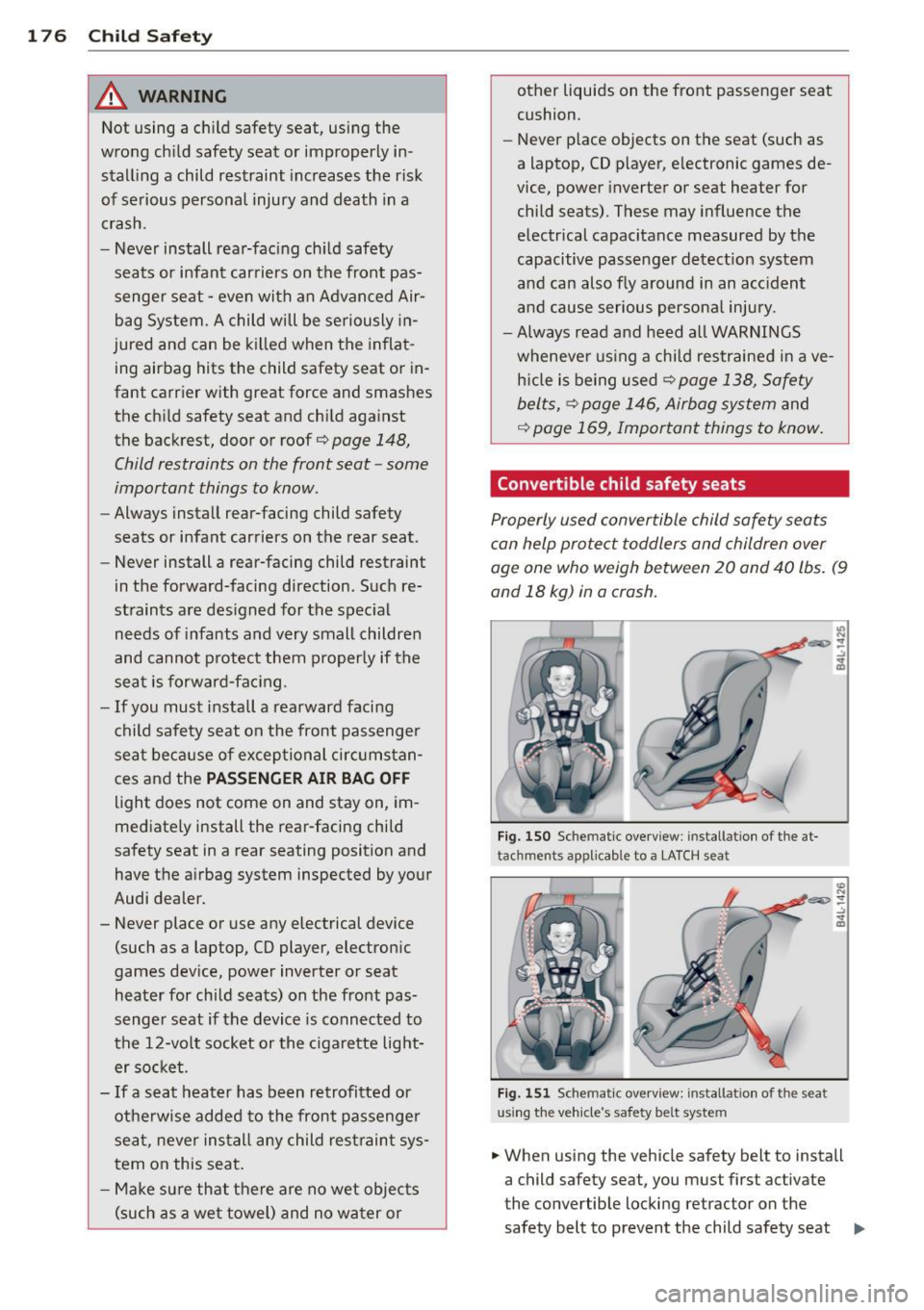
Convertible child safety seats
Properly used convertible child safety seats
can help protect toddlers and children over
age one who weigh between 20 and 40 lbs. (9
and 18 kg) in a crash.
Fig . 150 Sc hema tic overview: installat ion of the at
tachments applicab le to a LATCH seat
Fig. 151 Schemat ic overv iew: inst allation of the seat
u sing the vehicl e's safety belt system
.. When using the vehicle safety belt to install
a child safety seat, you must first activate
the convertib le locking retractor on the
safety belt to prevent the child safety seat ..,_
Page 179 of 302
M N ,....
> co ,...., \!) 1.1'1 ,...., 1.1'1 ,....,
from moving r::!;> page 180 or install the seat
using the LATCH attachments.
~ Push the child safety seat down with your
full weight to get the safety belt really tight
so that the seat cannot move forward or
s ideways more than one inch (2 .5 cm)
¢ page 180.
~ If the child safety seat is equ ipped with a
tethe r strap, attach it to the tether anchors
¢page 185.
~ Secure unused safety bel ts on the rear sea t
¢page 175.
A toddler or child is usually too large for an in
fant restraint if it is more than one year o ld
and weighs more than 20 lbs . (9 kg) .
Toddle rs and ch ildren who are older than one
yea r up to abo ut 4 years o ld and weigh more
than 20 lbs (9 kg) up to 40 lbs. (18 kg) mus t
a lways be prope rly restrained in a ch ild safety
seat certified for their size and weight
¢ fig .150and ¢fig.151 .
The airbag on the passenge r side makes the
front seat a poten tially dangerous place for a
chi ld to ride. The front seat is not the safest
p lace for a child in a forward-facing child safe
ty seat.
It is a very dangero us place for an in
fant or a larger child in a rearward-fac ing seat.
A WARNING
Not using a ch ild safety seat, using the
wrong chi ld safety sea t or improper ly in
stalling a child restraint increases the risk
of serious personal injury and death in a
co llision or othe r eme rgency s ituation.
- Children on the front seat of any car,
even with Advan ced A irbags, can be seri
o usly injured or eve n killed when an a ir
bag inf lates . A child in a rearward -facing
child safety seat installed on the front
passenger seat wi ll be seriously injured
and can be ki lled if the front airbag in
flates -even with an Advanced Airbag
System.
- The inflating a irbag w ill hit the child
safety seat or infant carrier w ith great
force and w ill smash the ch ild safety seat
Child Sa fet y 177
and child against the backrest, center
arm rest, door or roof.
- Always install rear-facing chi ld safety
seats on the rear seat.
- If you must install a rearward facing
child safety seat on the front passenger
seat because of exceptional c ircumstan
ces and the
PASSENGER AIR BAG OFF
light does not come on and stay on, im
mediately install the rear-fac ing ch ild
safety seat in a rear seating position and have the airbag system inspe cted by your
Aud i dea le r.
- The rear side of the child safety seat
should be pos itioned as close as possib le
to the backres t on the vehicle seat.
- For ad justab le head restra ints: adjust or
remove the rea r seat he ad restr aint if i t
is diffi cult to ins tall the child seat w ith
the head restraint in place
¢ page 63. In
stall the head restraint again immed iate
ly once the child seat is removed . Dr iv ing
without head restraints or with head re
straints that are not properly adjusted
increases the risk of serious or fatal neck
i nj ury dramatically .
- Always read and heed all WARNINGS
wheneve r us ing a child restrained in ave
hicle is being used¢
page 138, Safety
b elts,
c::!;> page 146, Airbag system and
c::!;> page 169, Impor tan t things to know.
A WARNING
If ex cep tional cir cumstances require the
use o f a forward-facing child res traint on
the front passenge r's sea t, the child's safe
ty and well-being req uire that the follow
ing spec ial precautions be ta ken:
- Make sure the forward -facing seat has
been designed and certified by its man u
facturer for use on a front seat with a passenger front and side airbag.
- Always follow the manufacturer's in
structions provided with the ch ild safety
seat or infant carr ier.
•
•
•
Page 182 of 302
180 Child Safety
-Always remember that a child leaning
forward, sitting sideways or out of posi
tion in any way during an accident can be
struck by a deploying airbag . This will re
sult in serious personal injury or death .
- If you must install a booster seat on the
front passenger seat because of excep
tional circumstances the
PASSENGER
AIR BAG OFF
light must come on and
stay on, whenever the ignition is switch
ed on.
- If the
PASSENGER AIR BAG OFF light
does not come on and stay on, perform
the checks described¢
page 158, Moni
toring the Advanced Airbag System.
- Take the child restraint off the front pas
senger seat and install it properly at one
of the rear seat positions if the
PASSEN
GER AIR BAG OFF
light does not stay on
whenever the ignition is switched on.
- Always read and heed all WARNINGS
whenever using a child restrained in
ave
hicle is being used¢ page 138, Safety
belts,¢ page 146, Airbag system
and
¢page 169, Important things to know .
Installing a child safety
seat
Securing a child safety seat using a
safety belt
Safety belts for the rear seats and the front
passenger can be locked with the convertible
locking retractor to properly secure child
safety seats.
The safety belts emergency locking retractors
for the rear seats safe ty belts and for the
front passenger's seat safety belt have a con
vertible locking retractor for child restraints.
The safety belt must be locked so that belt
webbing cannot unreel. The retractor can be
activated to lock the safety belt and prevent
the safety belt webbing from loosening up
during normal driving. A child safety seat can
only be properly installed when the safety belt
is locked so that the child and child safety
seat will stay in place. Always
remember: Even though your vehicle is
equipped with an Advanced Airbag system, all
children, especially those 12 years and young
er , should always ride in the back seat proper
ly restrained for their age and si ze.
A WARNING
=
Improperly installed child safety seats in -
crease the risk of serious personal injury
and death in a collision .
- Always make sure that the safety belt re
tractor is locked when installing a child
safety seat. An unlocked safety belt re
tractor cannot hold the child safety seat
in place during normal driving or in a
crash.
- Always buckle the child safety seat firmly
in place even if a child is not sitting in it.
A loose child safety seat can fly around
during a sudden stop or in a collision.
- If the backrest is not securely latched,
the child and the child restraint will be
thrown forward together with the back
rest and will strike parts of the vehicle
interior. The child can be seriously in
jured or killed .
- Never install rear-facing child safety
seats or infant carriers on the front pas
senger seat. A child will be seriously in
jured and can be killed when the passen
ger airbag inflates.
- The inflating airbag will hit the child
safety seat or infant carrier with great
force and will smash the child safety seat and child against the backrest, center
armrest, door or roof.
- Always install rear-facing child safety
seats or infant carriers on the rear seat.
- Forward-facing child safety seats or in
fant carriers installed on the front pas senger's seat may interfere with the de
ployment of the airbag and cause serious
injury to the child.
- It is safer to install a forward-facing
child safety seat on the rear seat.
- Always read and heed all WARNINGS
whenever using a child restrained in ave-
hicle is being used
¢ page 169. Special ..,.
Page 183 of 302
Child Safet y 181
precautions apply when installing a chi ld -Always make sure the forward-facing
safety seat on t he front passenger seat seat has been designed and certified by
Q page 148, Child restraints on the front its manufacturer for use on a front seat
seat- some important things to know . with a passenger front and side a irbag .
- Never put the forward-facing child re-
_&. WARNING straint up, against or very near the in-
-strument panel.
Always take special precautions if you •
•
must install a forward or rearwa rd-facing -
Always move the passenger seat into its
child rest raint on the front passenger's rearmost position in t
he seat's fore and
sea t in except iona l situat ions: aft adjustment range, as fa
r away from
- Whenever a fo rward or rearward-facing the airbag as possible before installing
child restraint is installed on the front the forward-fa
cing ch ild restra int. The
passenge r seat, the
PASSENGER AIR b ackrest mu st be ad ju sted to an upright
BAG OFF light must come on and s tay on position
.
whenever the ignition is switched on . -
Ma ke sure that the
PASSENGER AIR BAG
- If the PASSENGER AIR BAG OFF light OFF light comes on and stays on all the
does no t come on and s tay on, per form time wheneve
r the ignit ion is switched
the checks described
Q page 158, Moni -on.
toring the Advanced Airbag System.
_&. WARNING - T ake the child restrain t off the front pas-~
senger seat and install it properly at one Rearward-facing child rest raints:
of the rea r seat positions if the
PASS EN-- A child in a re arward-facing chi ld safety
GER AIR BAG OFF light does not stay on
seat installed on the front passenger
whenever the ignition is switched on. seat will be seriously in jured and can be
- Improper installation of child restraints killed i
f the front airbag inflates -even
can reduce the ir effectiveness or even with an Advanced Airbag System.
prevent them from prov iding any protec-
-The inflating air bag will hit the ch ild
t ion .
safety seat or infant carrier with great
- An improperly installed child restraint force and will smash the child safety seat
can interfe re with the airbag as it de- and child against the backrest , center
ploys and serio usly injure or even kill the armrest, door or roof.
child .
-Always be especially careful if you must
- Always carefully follow the manufactur- install a rearward facing child safety seat
er's instructions provided with the child on the front passenger seat i n exception-
safety seat or carrier . al circumstances .
- After checking to make sure that the - Make sure that the
PASSENGER AIR BAG
child restrain t is properly installed, make OFF light comes on and stays on all the
certain that the child restraint is correct- time whenever the ig nit ion is switch ed
Ly recog nized by the capacitive pa ssenge r on.
de te ct ion sys tem in t he front p assenger
-If the
PASSENGER AIR BAG OFF light
sea t and that the
PASSENGER AIR BAG does not come on and stay on, immed i-
OFF light signals the correct front pas-
ately insta ll the rear-fa cing child s afety
senger fronta l airbag status.
seat in a rear seat ing pos ition and h ave
the airbag system inspected by your Audi
M
_&. WARNING • N dea le r. ,....
> co Forward-facing child restra ints: ,...., \!) 1.1'1 ,...., 1.1'1 ,....,