spare wheel AUDI A3 CABRIOLET 2015 Owners Manual
[x] Cancel search | Manufacturer: AUDI, Model Year: 2015, Model line: A3 CABRIOLET, Model: AUDI A3 CABRIOLET 2015Pages: 302, PDF Size: 73.83 MB
Page 5 of 302
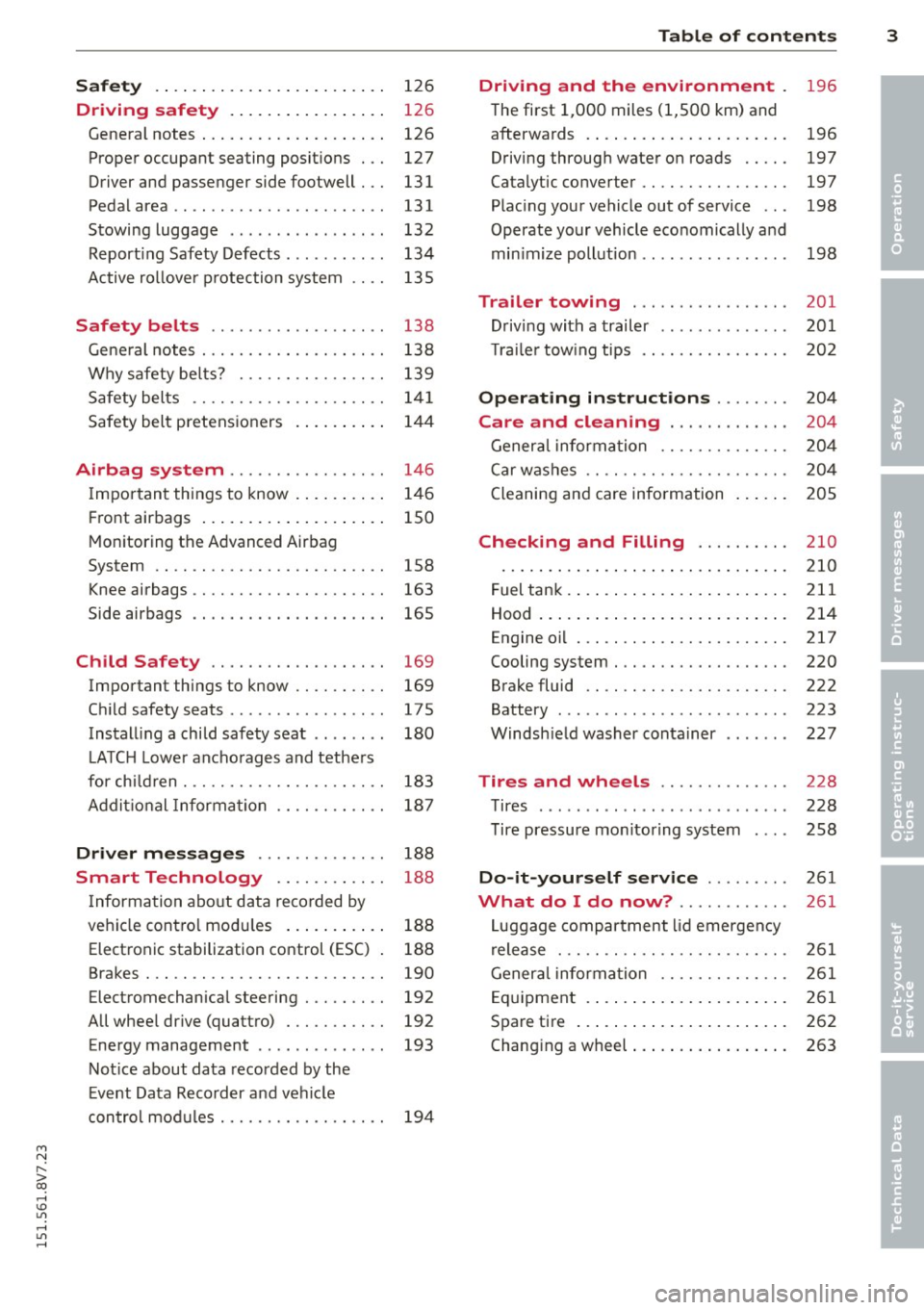
Safety . . . . . . . . . . . . . . . . . . . . . . . . . 126
Driving safety . . . . . . . . . . . . . . . . . 126
General notes . . . . . . . . . . . . . . . . . . . . 126
Proper occupant seating posit ions . . . 127
Driver and passenger side footwell . . . 131
Pedalarea .. .. .............. ... .. 131
Stowing luggage . . . . . . . . . . . . . . . . . 132
R eport ing Safety Defects . . . . . . . . . . . 134
Active ro llover p rotection system 135
Safety belt s . . . . . . . . . . . . . . . . . . . 138
Gene ral notes . . . . . . . . . . . . . . . . . . . . 138
Why safety be lts? . . . . . . . . . . . . . . . . 139
Safety belts . . . . . . . . . . . . . . . . . . . . . 1 41
Safety bel t pretens ioners . . . . . . . . . . 14 4
Airbag system ......... .. .. .. . .
Impor tant things to know . ... .. .. . .
Fr ont airbags .... ..... ... .. .. .. . .
Monitoring the Advanced Airbag
System .. .. ................. .. . .
Knee airbags .. ........... .. .. .. . .
Side airbags .. .. .. .... .... . .... . .
Ch ild Safety ............... .. . .
Important things to know .. .. .. .. . .
C hi ld safety seats ............ .... .
Install ing a chi ld safety seat .. .. ... .
L A TC H L ower ancho rag es and tethe rs
fo r ch ild ren . ............. .... .. . .
A ddit io nal Informa tion 146
1
46
150
158
163
165
169 169
175
180
183
187
Driver messages . . . . . . . . . . . . . . 188
Smart Technology . . . . . . . . . . . . 188
I nforma tion abo ut data reco rded by
ve hicl e cont ro l mod ules . . . . . . . . . . . 188
Elect ron ic stabilization control (ESC) 188
Brakes . . . . . . . . . . . . . . . . . . . . . . . . . . 190
Electromechanical steering . . . . . . . . . 192
All whee l drive (quatt ro) . . . . . . . . . . . 192
Energy management . . . . . . . . . . . . . . 193
Not ice about data recorded by the
E vent Data R eco rder and ve hicle
con tro l mod ules . . . . . . . . . . . . . . . . . . 194
Table of contents 3
Driving and the environment
196
T he first 1,000 miles (1 ,500 km) and
afterwa rds . . . . . . . . . . . . . . . . . . . . . . 196
Driving through wate r on roads . . . . . 197
Catalytic converter . . . . . . . . . . . . . . . . 197
Plac ing your vehicle out of service . . . 198
Operate your vehicle eco nomically and
min imize poll ution . . . . . . . . . . . . . . . . 198
Trailer towing . . . . . . . . . . . . . . . . . 201
D rivi ng with a trailer . . . . . . . . . . . . . . 201
T ra ile r tow ing t ips . . . . . . . . . . . . . . . . 202
Operating instructions . . . . . . . . 204
Care and cleaning . . . . . . . . . . . . . 204
Genera l infor mation . . . . . . . . . . . . . . 20 4
C ar w ashes .. .. .. .. . ............ .
Cleaning and care information
Checking and Filling ......... .
Fuel tank . ... .... .. . .. .. ..... ... .
Hood ... .. .. .. .... . ... ...... ... .
Engine oi l ... .. .. .... ........... .
Cooling system . .. .. ............. .
Brake fluid .. .. .. .... ........... .
Battery ......... .. ..... ........ .
Windsh ie ld washer container
Tires and wheels ............. .
Tires ... .. .. .. .... .. ........ ... . 2
0 4
20 5
210
210
2 11
214
217
220
222
223
22 7
228
228
T ire pressure mo nitoring system 258
Do-it-yourself service . . . . . . . . . 261
What do I do now? . . . . . . . . . . . . 261
L uggage compartment lid emergency
r elease . . . . . . . . . . . . . . . . . . . . . . . . . 261
Gener al infor mation . . . . . . . . . . . . . . 261
E q uipment . . . . . . . . . . . . . . . . . . . . . . 261
Spare tire . . . . . . . . . . . . . . . . . . . . . . . 262
Changi ng a wheel . . . . . . . . . . . . . . . . . 263
•
•
M a N ,....
> co ,...., \!) 1.1'1 ,...., 1.1'1 ,....,
Page 240 of 302
238 Tires and wheels
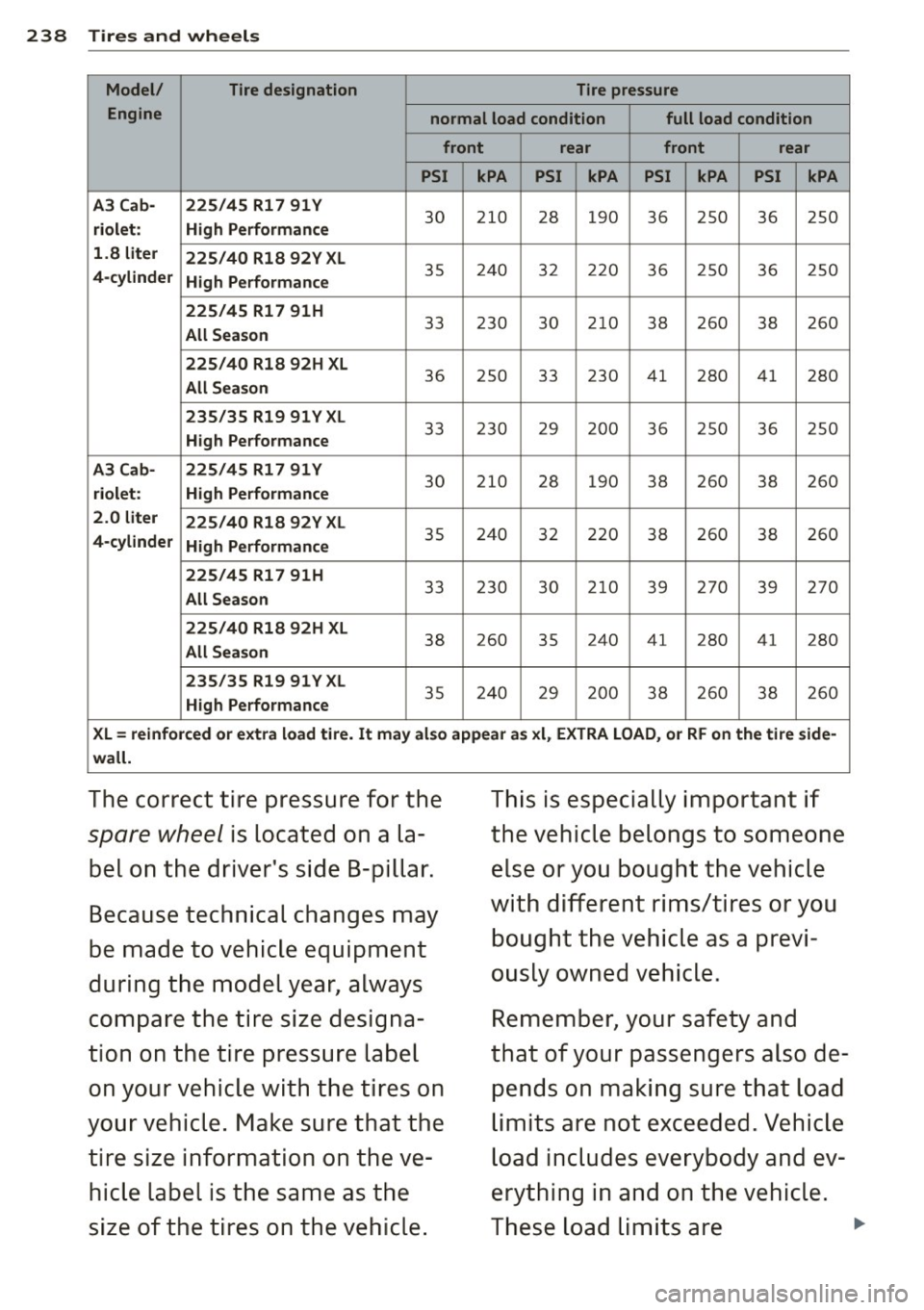
Model/ Tire designation Tire pressure
Engine normal load condition full load condition
front
rear front rear
PSI kPA PSI kPA PSI kPA PSI kPA
A3 Cab -225/45 Rl 7 91 Y
30 210 28 190 36 250 36 250 riolet : High Performance
1.8 liter 225/40 R18 92Y XL
4-cylinder High Performance
35 240 32 220 36 250 36 250
225/45 Rl7 91H
33 230
30 2
10
38 260
38 260 All Season
225/40 R18 92H XL
36 250 33 230 41 280 280 All Season 41
235/35 Rl9 91 Y XL
33 230 29 200 36 250 36 250 High Performance
A3 Cab- 225/45 Rl 7 91 Y
30 210 28 190 38 260 38 260 riolet: High Performance
2.0 liter
225/40 Rl8 92Y XL
4-cylinder High Performance
35 240 32 220 38 260 38 260
225/45 R17 91H
33 230 30 210 39
270
39 270 All Season
225/40 R18 92H XL
38 260 35 240 41 280 41
280
All Season
235/35 R19 91 Y XL
35 240 29 200 38 260 38 260 High Performance
XL= reinforced or extra load tire. It may also appear as xi, EXTRA LOAD, or RF on the tire side-
wall.
The correct tire pressure for the
spare wheel is located on a la
bel on the driver's side B-pillar.
Because technical changes may
be made to vehicle equipment
during the model year, always
compare the tire size designa
tion on the tire pressure label on your vehicle with the tires on
your vehicle. Make sure that the tire size information on the ve
hicle label is the same as the
size of the tires on the vehicle. This is
especially important if
the vehicle belongs to someone else or you bought the vehicle
with different rims/tires or you bought the vehicle as a previ
ously owned vehicle.
Remember, your safety and
that of your passengers also de pends on making sure that load
limits are not exceeded. Vehicle
load includes everybody and ev
erything in and on the vehicle.
These load limits are
Page 243 of 302
Tires and wheels 241
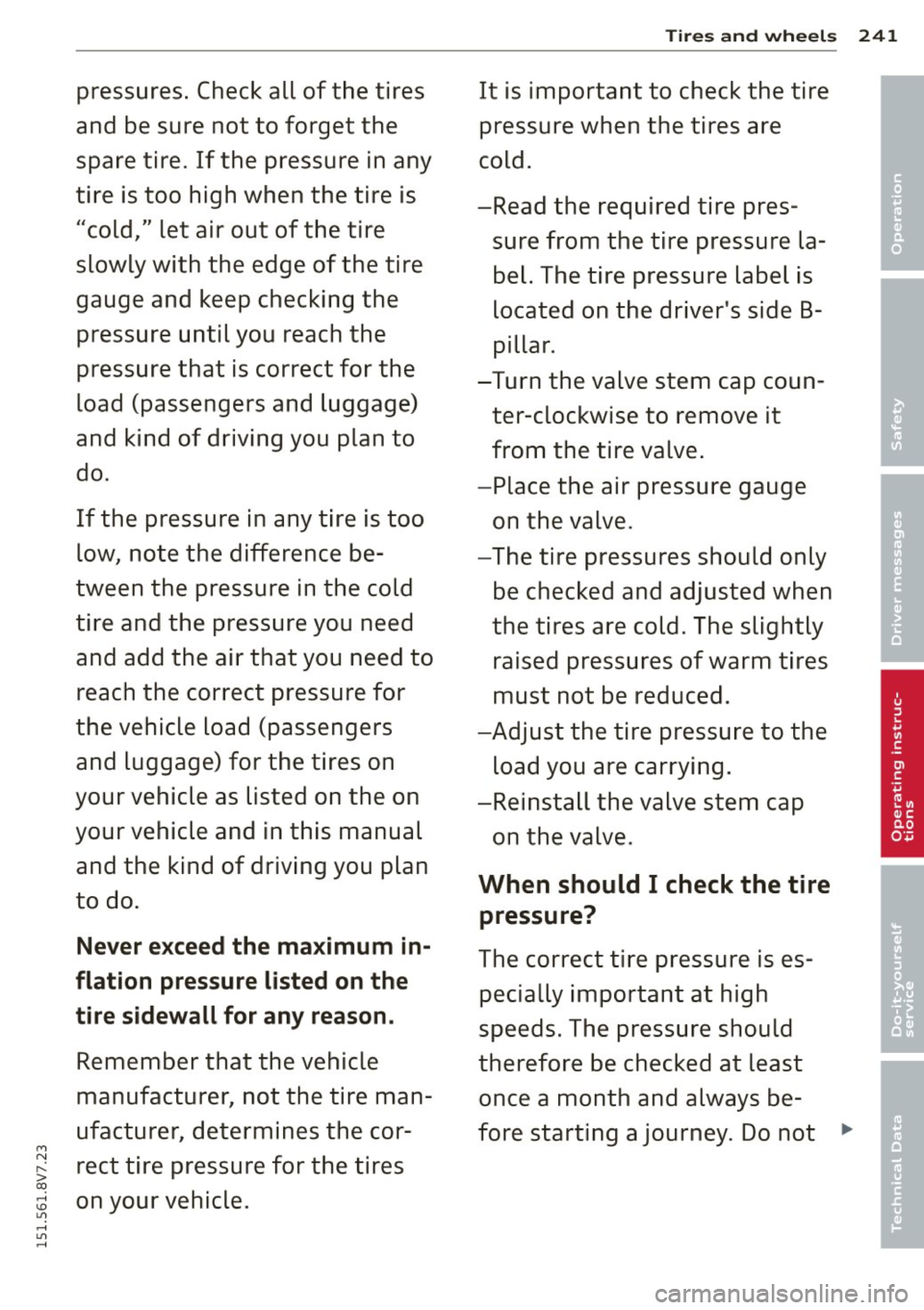
pressures. Check all of the tires It is important to check the tire
and be sure not to forget the pressure when the tires are
spare tire. If the pressure in any cold.
tire is too high when the tire is -Read the required tire pres-
"cold," let air out of the tire
'
sure from the tire pressure la-•
•
slowly with the edge of the tire bel. The tire pressure label is
gauge and keep checking the located on the driver's side B-
pressure until you reach the pillar.
pressure that is correct for the -Turn the valve stem cap coun-
load (passengers and luggage) ter-clockwise to remove it
and kind of driving you plan to from the tire valve.
do. -Place the air pressure gauge
If the pressure in any tire is too on the valve.
low, note the difference be- -The tire pressures should only
tween the pressure in the cold be checked and adjusted when
tire and the pressure you need the tires are cold. The slightly
and add the air that you need to
raised pressures of warm tires
reach the correct pressure for must not be reduced.
the vehicle load (passengers -Adjust the tire pressure to the
and luggage) for the tires on load you are carrying.
your vehicle as listed on the on -Reinstall the valve stem cap
your vehicle and in this manual on the valve.
and the kind of driving you plan
When should I check the tire
to do.
pressure?
Never exceed the maximum in-
The correct tire pressure is es-
flation pressure listed on the
pecially important at high
tire sidewall for any reason.
speeds. The pressure should
Remember that the vehicle therefore be checked at least
manufacturer, not the tire man- once a month and always be-
ufacturer, determines the cor- fore starting a journey. Do not
.... ' • M N
rect tire pressure for the tires " > co
on your vehicle . .... \!) 1.1'1
.... 1.1'1 ....
Page 244 of 302
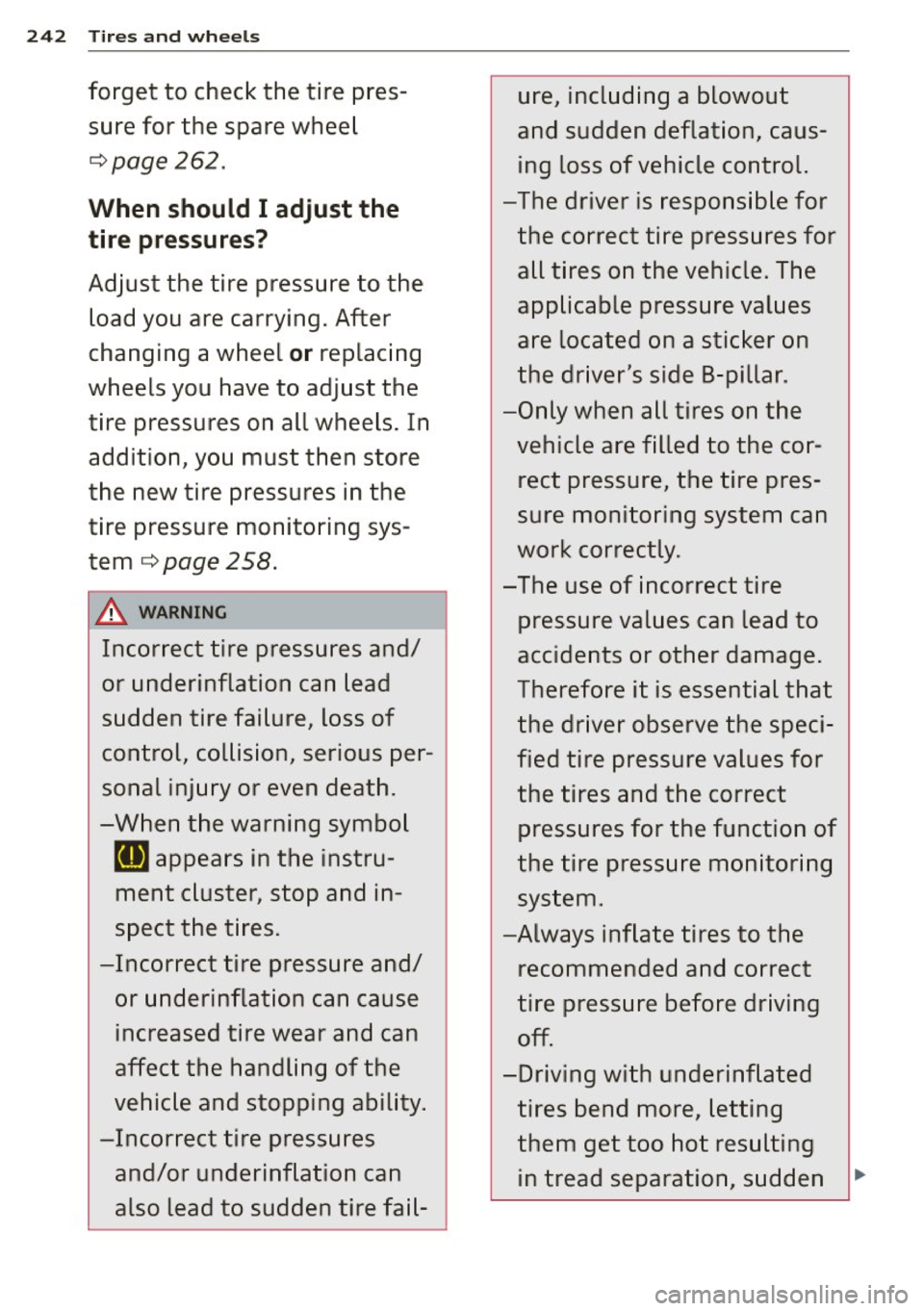
242 Tires and wheels
forget to check the tire pres-ure, including a blowout
sure for the spare wheel and sudden deflation, caus-
¢page 262 .
ing loss of vehicle control.
When should I adjust the -The driver is responsible for
tire pressures? the correct tire pressures for
Adjust the tire pressure to the all tires on the vehicle
. The
applicable pressure values
load you are carry ing. After
are located on a sticker on
changing a wheel
or replacing
the driver's side B-pillar .
wheels you have to adjust the
-Only when all tires on the
tire pressures on all wheels. In
vehicle are filled to the car-
addition , you must then store
rect pressure, the tire pres-
the new tire pressures in the
sure monitoring system can
tire pressure monitoring sys-
work correctly.
tern ¢
page 258.
-The use of incorrect tire
A WARNING
-pressure values can lead to
Incorrect tire pressures and/
accidents or other damage.
or underinflation can lead Therefore it is essential that
sudden tire failure, loss of the driver observe the speci-
control, collision, serious per -
fied tire pressure values for
sonal injury or even death. the tires and the correct
-When the warning symbol pressures for the function of
[IJ appears in the instru-
the tire pressure monitoring
ment cluster, stop and in-
system.
spect the tires. -Always inflate tires to the
-Incorrect tire pressure and/ recommended and correct
or underinflation can cause tire pressure before driving
increased tire wear and can off.
affect the handling of the -Driving with underinflated
vehicle and stopping ability. tires bend more, letting
-Incorrect tire pressures them get too hot resulting
and/or underinflation can in tread separation, sudden
..
also lead to sudden tire fail-
Page 251 of 302
M N
" > co ,...., \!) 1.1'1 ,...., 1.1'1 ,....,
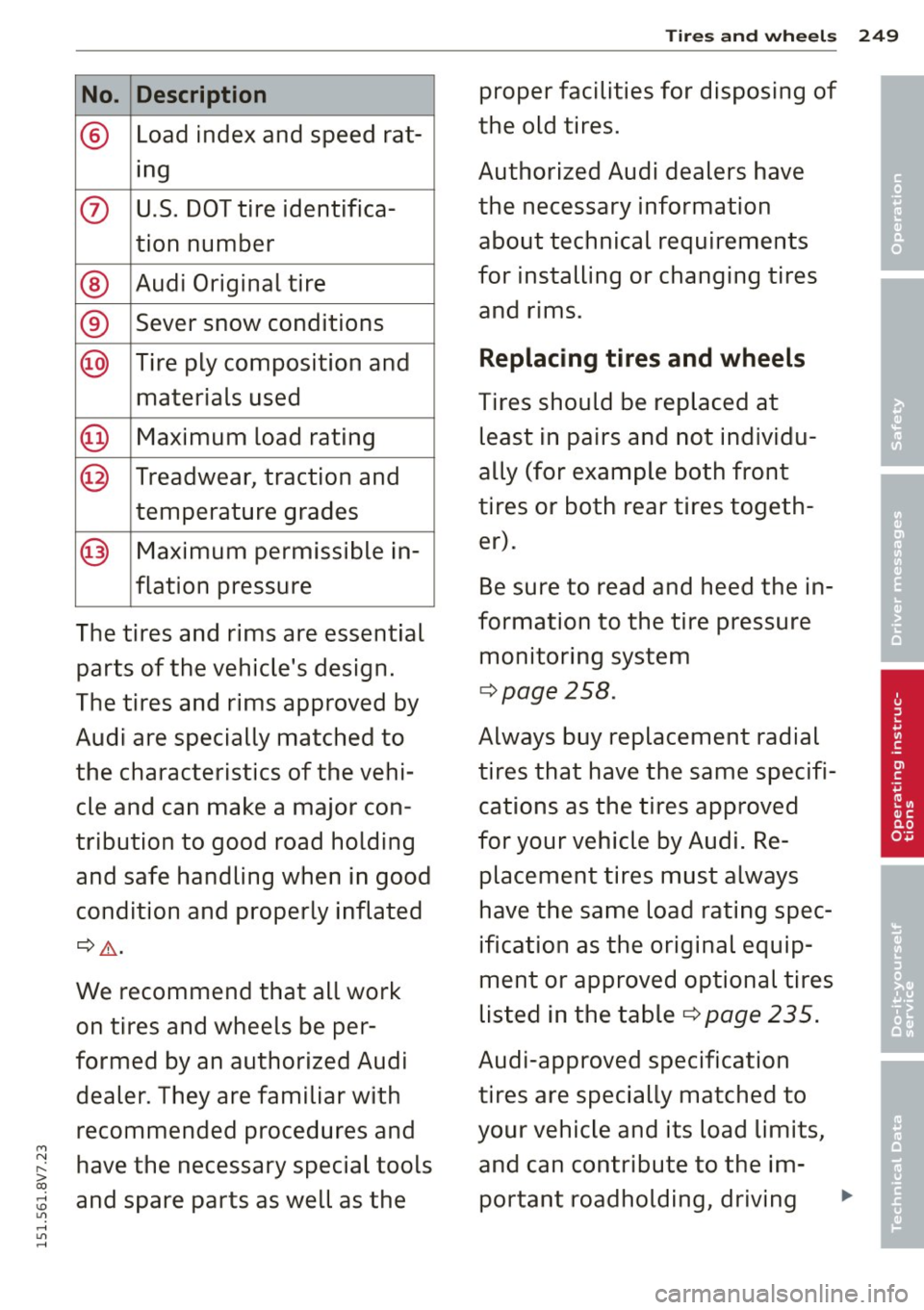
No. Description
® Load index and speed rat-
1ng
0 U.S. DOT tire identifica-
tion number
® Audi Original tire
® Sever snow conditions
@ Tire ply composition and materials used
@ Maximum load rating
@ Treadwear, traction and
temperature grades
@ Maximum permissible in-
flation pressure
The tires and rims are essential parts of the vehicle's design.
The tires and rims approved by
Audi are specially matched to
the characteristics of the vehi cle and can make a major con
tribution to good road holding and safe handling when in good
condition and properly inflated
¢ &.
We recommend that all work
on tires and wheels be per
formed by an authorized Audi dealer. They are familiar with
recommended procedures and
have the necessary special tools
and spare parts as well as the
Tires and wheels 249
proper facilities for disposing of
the old tires.
Authorized Audi dealers have
the necessary information about technical requirements
for installing or changing tires and rims.
Replacing tires and wheels
Tires should be replaced at least in pairs and not individu-
ally (for example both front
tires or both rear tires togeth- er).
Be sure to read and heed the in-
formation to the tire pressure
monitoring system
¢ page 258.
Always buy replacement radial
tires that have the same specifi-
cations as the tires approved
for your vehicle by Audi. Re- placement tires must always
have the same load rating spec-
ification as the original equip-
mentor approved optional tires
listed in the table¢
page 235.
Audi-approved specification
tires are specially matched to
your vehicle and its load limits, and can contribute to the im-portant roadholding , driving
' •
•
' •
Page 255 of 302
Tires and wheels 253
sure of their "previous histo-and sudden deflation and
ry." Old used tires may have loss of control.
been damaged even though -Temperature grades apply
the damage cannot be seen to tires that are properly in-
that can lead to sudden tire flated and not over or un-
' •
•
failure and loss of vehicle derinflated.
control. -For technical reasons it is
-All four wheels must be fit- not always possible to use
ted with radial tires of the wheels from other vehicles -
same type , size (rolling cir-
in some cases not even
cumference) and the same wheels from the same vehi-
tread pattern. Driving with cle model.
different tires reduces vehi- -If you install wheel trim
cle handling and can lead to discs on the vehicle wheels,
a loss of control. make sure that the air flow
-If the spare tire is not the to the brakes is not blocked.
same as the tires that are Reduced airflow to the
mounted on the vehicle - for brakes can them to over-
example with winter tires - heat, increasing stopping
only use the spare tire for a distances and causing a col-
short period of time and lision.
drive with extra ca re. Refit -Run flat tires may only be
the normal road wheel as used on vehicles that were
soon as safely possible. equipped with them at the
-Never drive faster than the factory. The vehicle must
maximum speed for which have a chassis designed for
the tires on your vehicle are run flat tires. Incorrect use
rated because tires that are of run flat tires can lead to
driven faster than their rat- vehicle damage or acci-
ed speed can fail suddenly. dents. Check with an au-
-Overloading tires cause heat thorized Audi dealer or tire
' M • N
" build-up, sudden tire fail- specialist to see if your vehi-> co ......
ure, including a blowout cle can be equipped with ... \!) 1.1'1
...... 1.1'1 ......
Page 256 of 302
254 Tires and wheels
run flat tires. If run flat tires
are used, they must be in
stalled on all four wheels. Mixing tire types is not per
mitted.
@) Note
-For technical reasons, it is not generally possible to
use the wheel rims from
other vehicles. This can hold
true for wheels of the same
vehicle type.
- If the spare tire is different
from the tires that you have mounted on your vehicle
(for example winter tires or
wide prof ile tires), then use
the spare tire for a short pe
riod of time only and drive
with extra care. Replace the
flat tire with the tire match ing the others on your vehi
cle as soon as possible.
- Never drive without the
valve stem cap . The valves
could get damaged.
@) For the sake of the environment
Dispose of old tires in accord
ance w ith the local require
ments.
Uniform tire quality grading
- Tread wea r
- Traction AA A B C
- Temperature ABC
Quality g rades can be foun d where applicab le
on the t ire s ide wall between t read sho ulder
and maximum section width
¢ page 248,
fig . 176 .
For example: Tread wear 200 , Traction AA,
Tempera ture A .
All passenge r ca r tir es must con fo rm to Feder
al Safety Req uirements in ad dition to these
grades.
Tread wear
T he tread we ar g rade is a c omparative r ati ng
b as ed on the wea r ra te of the tire when tes ted
u nder con tro lled cond itions o n a specifie d
government test course .
F o r ex am ple, a tire gr aded 1 S0 would wear
o n e and one h alf ( 11/ 2) times as well on the
government course as a tire gr aded 10 0 .
T he re lative per forman ce of tires depen ds
up on the actu al cond itions of the ir use, h ow
ever, and m ay dep art s ignific antly from the
no rm due to va ria tions i n driving ha bits, se rv
ice p ractices and differe nces in road c haracter
ist ics and climate.
Traction
The tr actio n gr ad es, fro m hig hest to lowest,
are AA, A, Ban d
C. Those grades represent t he
ti re 's ability to stop on wet pavement as
measured unde r cont rolled conditions on
specified g overnment test surfaces of aspha lt
and co ncrete. A t ire mar ked C may have poor
traction performance
¢ A .
Temperature
The temperature g rades are A (the highest),
B, an d C, represe nting the tire's resistance to
the generation of heat and its ab ility to dissi
pate heat when tested unde r controlled condi
t ions on a specif ied ind oor l abo rato ry test
whee l.
Page 257 of 302
M N
" > co ,...., \!) 1.1"1 ,...., 1.1"1 ,....,
Sustained high tem perature can cause the
materia l of the tire to degenerate and reduce
tire life, and excessive temperature can lead
to sudden tire failure <=>,& .
The grade C corresponds to a level of per form
ance which a ll passenger car tires must meet
under the Federa l Motor Veh icle Safety Stand
ard No. 109. Grades Band A represent higher levels of performance on the laboratory test
wheel than the m inimum required by law.
_&. WARNING
The traction grade assigned to this t ire is
based on stra ight-ahead b raking t raction
tests, and does not include acceleration,
c o rnering, hydrop lan ing o r peak tr actio n
character istics .
_&. WARNING
The temperature grade for this t ire is es
tablished for a ti re that is p roperly inflated
and not overloaded . Excessive speed, un
derinflation, or excessive loading, either
separately or in combination, can cause
heat buildup and possible tire fa ilure.
Winter tires
Winter tires can improve vehicle handling on
snow and ice. At temperatures below 45 °F
(7 °C) we recommend changing to winter
tires .
In some heavy snow areas, loca l governments
may require true winter or "snow" tires, those
with very deeply cut tread. These tires shou ld
only be used in pa irs and be installed on all
four wheels. Make sure you pu rchase snow
tires that are the same size and const ruct ion
type as t he other tires on your ve hicle.
If your vehicle is equipped with all-wheel
d rive*, this will improve tract ion during winte r
d riving, eve n w it h the standard t ires. Howev
e r, we strong ly recommend t hat you a lways
eq uip a ll four wheels on yo ur vehicle wi th cor
rectly fitted win ter t ires or a ll-season tires,
when winter road conditions are expected .
Tires an d wheel s 255
This also improves the veh icle's b rak ing per
formance and reduces stopping distances.
Summe r ti res prov ide les s gr ip on i ce and
snow.
Winter t ires (snow tires) must always be fitted
o n all fo ur whee ls.
Ask your authorized Audi dealer or qualified
workshop for permitted winter tire sizes. Use
o nl y rad ial winter t ires.
Winter tires lose their effectiveness whe n the
tread is worn down to a depth of0 .157 inch
(4 mm) .
Only drive w ith w inter t ires under w inter con
dit ions. Summer t ires handle better when
there is no snow or ice on the roads and the
temperature is above 45 °F (7 °() .
If you have a flat tire, see notes on spare
whee l¢
page 248.
Please a lways remember that winter tires may
have a lower speed rating t han the tires o rigi
nally installed on your vehicle at the time it
was manufactured. P lease see¢
page 251,
Speed rating (letter code)
for a listing of the
speed rating le tter codes and the max imum
speed at which the tires can be d rive n.
The speed rating letter code(¢
page 233) is
o n the side wall of the tire ¢
page 248.
_&. WARNING
Winter t ires have maximum speed limits
that may b e lower than yo ur vehicle's max
imum speed. Always know the max imum
speed before dr iv ing off. Never dr ive faster
than the speed permitted for yo ur spe cific
win ter tires . This wi ll ca use damage to the
tires leading to an accident and ser ious
personal injury to you and your passen
gers.
_&. WARNING
Driving faster than the maximum speed
for which the winter tires on your ve hicle
were designed can cause t ire fail ure in
cluding a blowout and sudden d eflation,
-
•
•
•
Page 260 of 302

258 Tires and wheels
It is important that the inflation pressu re is
regularly checked and maintained at recom
mended levels .
Fo r more informat ion please ask your A udi
dealer for more details .
What you can do to avoid tire and rim
damage
L ow aspect ratio tires can be damaged more
easi ly by impact with potho les, curbs, gu llies
or ridges on the road, particularly if the tire is
underinflated.
I n o rder to minim ize the occurrence of impact
damage to the tires of your vehicle, we recom
mend that you observe the following precau
tions:
- Always maintain recommended inflation
pressures. Check your tire pressure every
2,000 miles (3,000 km) and add air if neces
sary.
- Drive carefu lly on roads with potholes, deep
gullies or ridges. The impact from driving
through or over such obstacles can damage
your tires. Impact with a curb may also cause damage to your tires.
- After any impact, immediately inspect your
tires or have them inspected by the nearest
authorized Audi dealer . Replace a damaged
t ir e as soon as possible.
- Inspect your tires every 2,000 miles (3,000
km) for damage and wear . Damage is not al
ways easy to see. Damage can lead to loss of
air and underinflation, wh ich could eventu
ally cause t ire failure.
If you believe that a
t ir e may have been damaged, replace the
tire as soon as possible.
- T hese tires may wea r more quickly than oth
ers.
- Please a lso remember that, while these tires
deliver respons ive handling, they may ride
less comfortably and make more noise than
other choices.
Reduced performance in winter/cold
season conditions
All tires are designed for certain purposes.
The low aspect ratio, ultra high performance ti
res or iginally installed on your vehicle are in
tended for maximum dry and wet road per
formance and handling. They are not suitable
for cold, snowy or icy weather conditions. If
you drive under those circumstances, you
should equ ip your vehicle with all-season or
winter tires, which offer better traction unde r
those conditions. We suggest you use the rec
ommended snow o r all-season tires specified
for your vehicle, or thei r equivalent.
Refer to~ page
255 for more detailed infor
mation regarding winter tires.
Tire pressure
monitoring system
ill General notes
Each tire, including the spare (if provided),
shou ld be checked monthly when co ld and in
flated to the inflat ion pressure recommended
by the vehicle man ufactur er on the veh icle
placard or tire inflation pressure labe l. (If your
vehicle has tires of a different size than the
size indicated on the vehicle placard or tire in
flation pressure label, you should determine
the proper t ire inflation pressure for those
t i res).
As an added safety feature, your vehicle has been equipped with a tire pressure monitoring
system (TPMS) that illuminates a low tire
pressure telltale when one or more of your
t ir es is signif icantly under-inflated. According
ly, when the low tire pressure telltale illumi
nates, you shou ld stop and check you r tires as
soon as possible, and inflate them to the
proper p ressure. Driving on a sign ificantly un
der -inflated tire causes the tire to overheat
and can lead to tire fa ilure . Under-inflation al
so reduces fuel eff iciency and tire tread life,
and may affect the vehicle's handling and
stopp ing ability.
Please note that the TPMS is not a substitute
for proper tire maintenance, and it is the driv
er's responsibility to maintain correct tire
pressure, even if under-inflation has not
Page 261 of 302

M N
" > co ,...., \!) 1.1"1 ,...., 1.1"1 ,....,
reached the level to trigger illumination of the
TPMS low tire pressure telltale.
Your veh icle has also been equ ipped with a
TPMS malfunction indicato r to indica te when
the system is not operating properly . The
TPMS malfunction indicator is combined with
the low tire pressure tellta le . When the sys
tem detects a malfunct ion, the telltale will
flash for approximately one minute and then
remain cont inuous ly illuminated. This se
quence will continue upon subsequent vehicle
start-ups as long as the ma lfunction ex ists .
When the malfunct ion indicator is illuminat
ed, the system may not be able to detect or
sig nal low t ire pressure as intended . TPMS
malfunct ions may occur for a variety of rea
sons, including the installa tio n of replace
ment or a lternate tires or whee ls on the veh i
cle that prevent the TPMS from funct ion ing
properly. Always check the TPMS malfunction
tellta le after replacing one or more tires or
wheels on your veh icle to ensure that the re
placement or alternate tires and wheels allow
the TPMS to continue to function properly.
If the Tire Pressure Monitoring System
indicator appears
Applies to vehicles: with tire pressure monito ring system
The tire pressure indicator in the instrument
cluster informs you if the tire pressure is too
low or if there is a system malfunction .
Fig . 177 In strum ent clus te r: indica tor l igh t w ith mes
sage
Using the ABS sensors, the tire pressure moni
toring system compares the t ire tread circum
ference and vibration characteristics of the in
d iv idual tires . If the pressure changes in one
Tire s an d wheel s 259
or more tires, this is indicated in the instru
ment cluster disp lay with an indicator light
ti] and a message c:::> fig . 177. If only one tire
is affected, the locat ion of that tire will be in
dicated. The message turns off after a few mi
nutes . You can d isplay the message aga in
c:::> page 2 8 .
The tire pressures must be stored in the menu
display again each time the pressures change
(sw itching between partial and full load pres
sure) or after chang ing or replacing a t ire on
your vehicle
c:::> page 260 . The t ire press ure
monitori ng system only monito rs the tire
pressure yo u have stored . Yo u can find the rec
ommended t ire press ures for your vehicle on
the labe l on the driver 's doo r pillar
c:::> page235 .
Tire t read circumference and vib rat ion charac
teristics can change and cause a tire pressu re
warning if :
- I f the tire pressure in one or mo re tires is
t oo low,
- the t ire has structural damage,
-The tire was replaced or the t ire p ressure
changed and it was not stored again
c:::> page 260 .
-The spare tire is installed .
Indicator light s
ti]-Loss of pressure in at least one tire c:::> &.
Check the tires and replace or repair if neces
sary. Check/correct the pressures of all four
tires . Then store the t ire pressures in the MMI
c:::> page 2 60 .
DI (T ire Pressure Monitoring System) T ir e
press ure: S ystem malfunct ion!. If Ill ap
pears afte r switching the ignition on or while
driv ing and the
ti] indicator l ight in the in
str ume nt cluster b links for app rox imately one
minute and then stays on , the re is system
malfunction. Try to s to re the co rrec t ti re pres
s u res
c:::> page 260. If the indicator light does
turn off or tu rns on again after a short period
of time, drive to yo ur authorized Aud i dea ler
or qualified repa ir facility immed iate ly to have
the malfunction corrected. .,..
•
•
•