warning AUDI A3 CABRIOLET 2016 Owners Manual
[x] Cancel search | Manufacturer: AUDI, Model Year: 2016, Model line: A3 CABRIOLET, Model: AUDI A3 CABRIOLET 2016Pages: 272, PDF Size: 67.88 MB
Page 233 of 272
<( co ..... N
" N ..... 0 r--. > 00
A WARNING
If the tire pressure is less than 19 psi
(130 kPA) after 10 minutes of driving , then
the ti re is too severely damaged . Do not con
tinue dr iv ing . See an authorized Audi dealer
or authorized Aud i Servi ce Fac ility for assis
tance .
A WARNING
Pay attent ion to the following after repair ing
the tire:
- Do not drive faster than SO mph (80 km/h).
- Avoid hard acceleration, brak ing sharp ly,
and fast cornering.
- The veh icle may become more difficult to
control.
- If the t ire is too severely damaged, see an
authorized Audi dealer or authorized Aud i
Service Facility for assistance .
@ For the sake of the environment
You can give the used tire sealant bottle to an
author ized Audi dealer or authorized A udi
Serv ice Facility for disposal.
(I_) Tips
Remember to obtain a new bottle of sealant
from an authorized Aud i dea ler or authorized
Aud i Service Facility after repairing a tire.
Spare tire
General information
Applies to: vehicles with space-saving spare tire (compact
spare tire)
Fig. 177 L ugg age co mpa rtment : ca rgo floo r cover folded
up ward
Em ergen cy a ssis tanc e
Fig. 178 Spa re t ire (examp le )
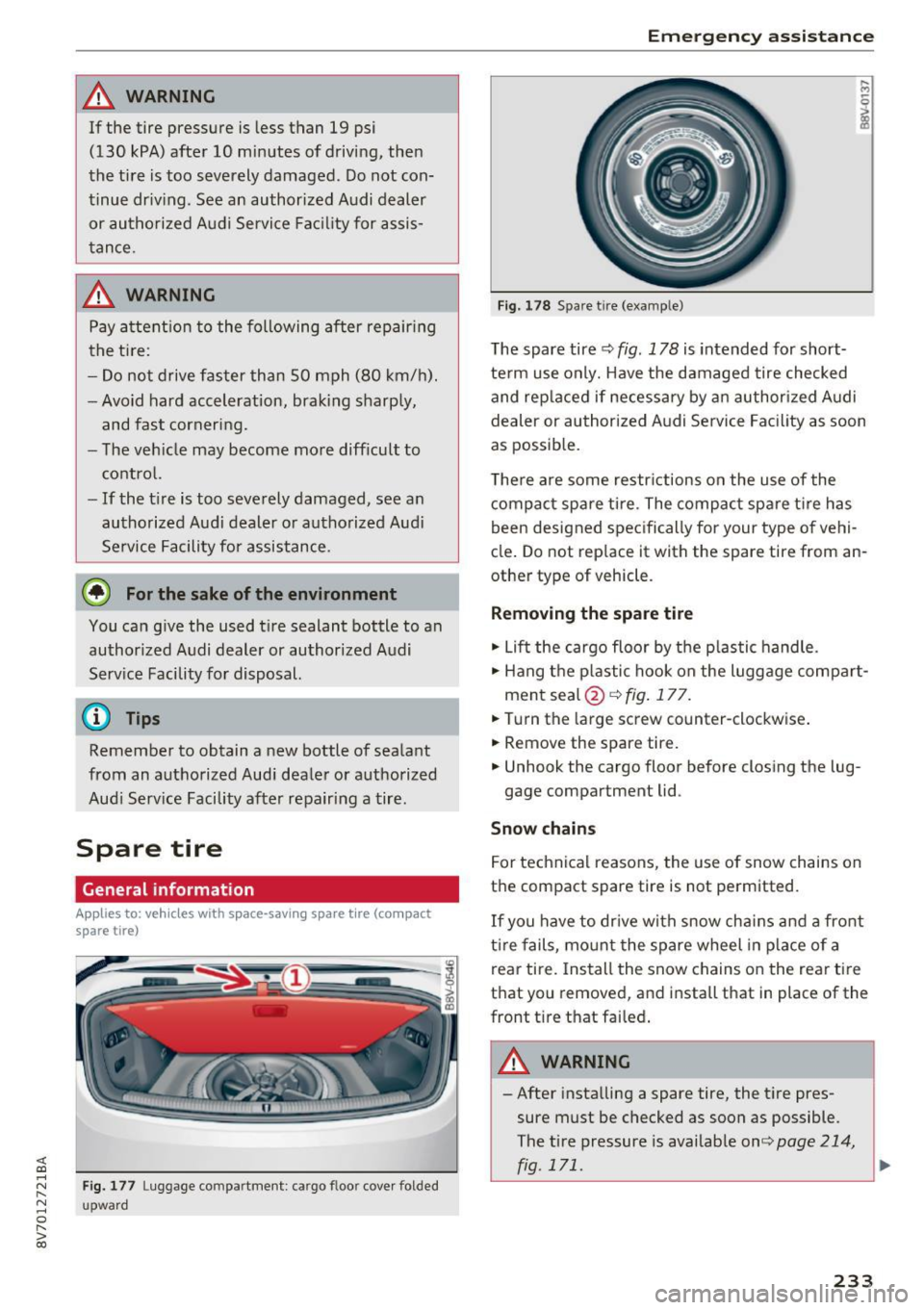
The spare tire ¢ fig. 178 is intended for short
te rm use only. Have the damaged tire checked
and replaced if necessary by an author ized Audi
dealer or authorized A udi Service Facility as soon
as possible.
T here are some restr ictions on the use of the
compact spare tire . The compact spare t ire has
been designed specifically for your type of vehi
cle. Do not rep lace it with the spare tire from an
other type of vehicle.
Removing the spare tire
.,. Lift the cargo floor by the p lastic handle .
.,. Hang the plastic hook on the luggage compart -
ment seal@¢
fig. 177.
.,. Turn the large screw counter-clockwise .
.,. Remove the spare tire.
.. Unhook the cargo floor befo re closing the lug -
gage compartment lid .
Snow chains
For technical reasons, the use of snow chains on
the compact spare tire is not permitted.
If you have to dr ive with snow chains and a front
t ire fails, mo unt the spare wheel in p lace of a
rear tire. Install the snow chains on the rear tire
that you removed, and install that in place of the
front t ire that fai led .
A WARNING
--After installing a spare tire, the t ire pres
sure must be checked as soon as possible.
The tire pressure is available one:>
page 214,
-
rg.111 . ~
233
Page 234 of 272
Emerg enc y assis ta nc e
-If the spare tire is more than 6 years old,
use it only in an emergency and with ex
treme caution and careful dr iving .
- The spare tire is intended on ly for tempora
ry and short-term use. It should be replaced
as soon as possible with the normal wheel and t ire .
- After mounting the compact spare t ire, the
t ire pressure must be checked as soon as
poss ible . The tire pressure of the compact
spare tire must be
61 psi (420 kPA); other
wise, you risk hav ing an accident.
- Do not drive faster than
50 mph (80 km/h).
You risk hav ing an accident.
- Avoid full -throttle accelerat ion, heavy brak
ing, and fast cornering. You risk having an
acc ident.
- Never dr ive using more than one spare
wheel and tire. You risk having an acc ident .
- Normal summer or winter tires must not be mounted on the compact spare wheel rim.
- For technical reasons, the use of tire chains
on the spare tire is not perm itted. If it is
necessary to drive with t ire chains, the spare
wheel must be mounted on the front axle in
the event of a flat in a rear tire. The new ly
available front wheel m ust then be insta lled
in place of the rear wheel with the flat tire.
Installing the tire chain before mounting
the wheel and tire is recommended.
- Loose items in the passenger compartment
can cause serious personal injury during
hard braking or in an accident. Never store
the inflatable spare t ire or jack and too ls in
the passenger compartment.
- Normal summer or winter tires must not be
mounted on the compact spare wheel rim.
Replacing wheels
Before changing a wheel
Observe the following precautions for your own
and your passenger's safety when changing a
wheel.
.,. After you experience a tire failure, pull the car
well away from moving traff ic and try to reach
le vel ground before you stop¢_& .
234
.. All passengers should lea ve th e car and move
to a safe location (for instance, behind the
guardrail) ¢ _& .
.. Engage the
par king br ake to prevent your vehi
cle from rolling unintentionally¢_& .
.. Move
selec tor le ve r to p osition P ¢ _& .
.. If you are towing a tra iler , u nhitch the trailer
from your vehicle.
.. Ta ke the
jac k¢ page 230 and the spar e tir e
¢ page 233 out of the luggage compa rtment.
A WARNING
-
You or your passengers could be injured while
changing a whee l if you do not follow these
safety precautions:
- If you have a flat tire, move a safe distance off the road. Turn off the engine, turn the
emergency f lashers on and use other warn
ing dev ices to alert other motorists.
- Make sure that passengers wait in a safe
place away from the vehicle and well away
from the road and traff ic.
- To help prevent the veh icle from moving
suddenly and possibly slipping off the jack,
always fully set the parking brake and block
the wheel diagonally opposite the wheel be
ing cha nged . When one front wheel is lifted
off the ground, placing the Automat ic
T ransmiss ion in P (Park) will
not prevent the
veh icle from moving.
- Before you change a whee l, be sure the
gro und is level and firm . If necessary, use a
sturdy board under the jack.
- Always sto re the vehicle too l kit, the jack
and the replaced tire in the luggage com
par tment
¢page 130.
Changing a wheel
When you change a wheel, follow the sequence
described below step-by-step and in exactly that
order.
1. Remove the decorati ve wh eel co ver* . For
more detai ls see also ¢
page 235, Decora
tive wheel covers
or ¢ page 235, Wheels
with wheel bolt caps .
2. Loosen the wh ee l bolt s ¢page 236.
Page 235 of 272
<( co ..... N
" N ..... 0 r--. > 00
3. Locate the proper mounting point for the
jack and align the jack below that poin t
¢page 236.
4. Raise the car with the jack¢ page 236.
5. Remove the wheel with the flat tire and then
install
the spare ¢ page 238.
6. Tighten all wheel bolts lightly.
7. Lower the veh icle with the jack.
8. Use the wheel bolt wrench and firmly tighten
all wheel bolts
¢page 236 .
9. Replace the decorative wheel cover* .
_& WARNING
Always read and follow all WARNINGS and in
formation
¢ .&. in Raising the vehicle on
page
237 and ¢ page 239.
After changing a wheel
A wheel change is not complete without the do
ing the following .
.,. Always store the vehicle tool kit, the jack* and
the replaced tire in the luggage compartment
¢ page 130.
.,. Check the tire pressure on the spar e wheel im
mediate ly after mount ing it .
.,. As soon as possible, have the
tightening tor
ques
on all wheel bolts checked with a torque
wrench . The correct tightening torque is
90 ft
lb
(120 Nm) .
.,. Have the flat tire
replaced as soon as possible .
(D Tips
-If you notice that the wheel bolts are cor
ro ded and difficult to turn while changing a
tire , they should be replaced before you
check the tightening torque .
- Drive at reduced speed until you have the
tightening torques checked.
-Af ter changing a wheel, the tire pressure in
all four tires must be checked/corrected and
the tire pressure monitoring indicator must
be stored in the MMI
9page 223.
Emergency assistance
Decorative wheel covers
Applies to: vehicles with decorative wheel covers
The decorative wheel covers must be removed
first to access the wheel bolts .
Fig. 179 Changing a whe el: Removin g the wh eel cov er
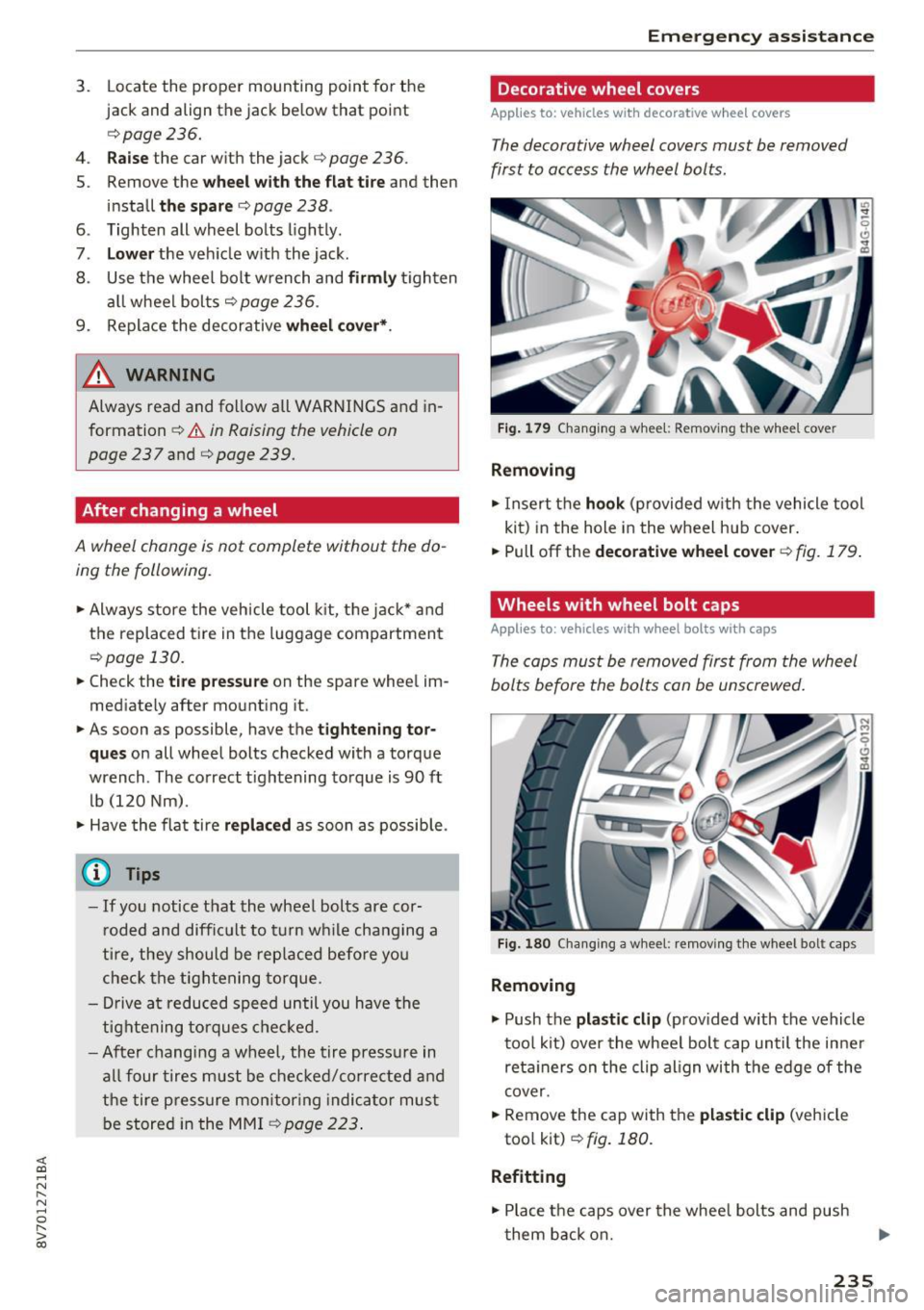
Removing
.,. Insert the hook (provided w ith the vehicle tool
kit) in the hole in the wheel hub cover.
.,. Pull off the
decorative wheel cover¢ fig. 179.
Wheels with wheel bolt caps
Applies to: vehicles with wheel bolts w,th caps
The caps must be removed first from the wheel
bolts before the bolts can be unscrewed.
Fig. 180 Chang ing a whee l: removing th e whee l bol t cap s
Removing
.,. Push the plastic clip (provided with the vehicle
tool kit) over the wheel bolt cap until the inne r
reta iners on the clip align with the edge of the
cover.
.,. Remove the cap with the
plastic clip (vehicle
tool kit)
¢ fig. 180.
Refitting
.,. Place t he caps over the wheel bolts and push
t hem back on.
235
Page 236 of 272
Emergency assistance
The caps are to protect and keep the whee l bolts
clean.
Loosening and tightening the wheel bolts
Th e wheel bolts must be loosened before raising
the vehicle.
Fig . 181 Cha ngin g a wheel: loosening t he w heel bolts
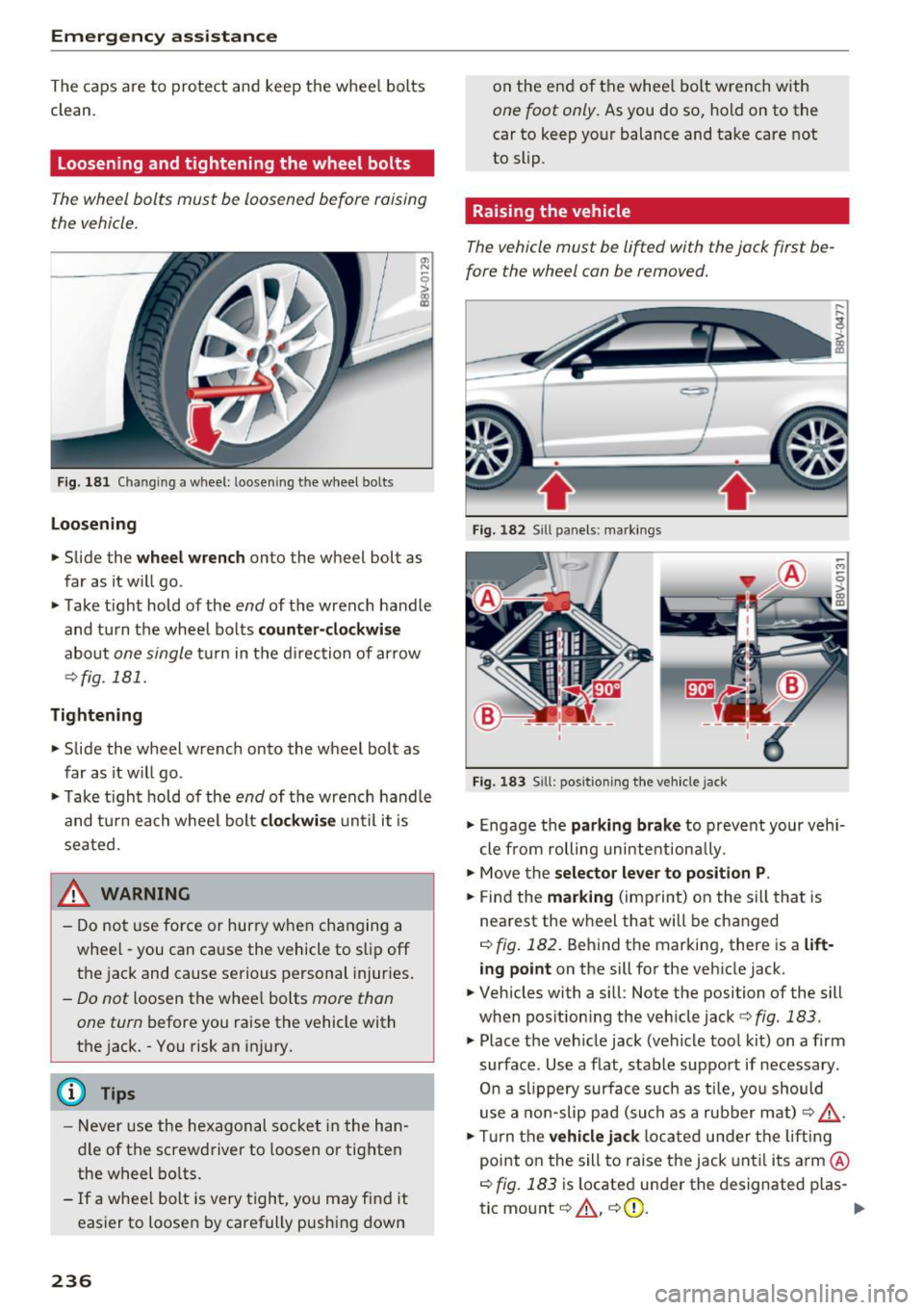
Loosening
• Slide the wheel wrench onto the wheel bolt as
far as it w ill go .
• Take tight hold of the
end of the wrench handle
and turn the wheel bolts
counter-clockwise
about one single tur n in the direction of arrow
c:::>fig . 181.
Tightening
• Slide the wheel wrench onto the wheel bolt as
far as it w ill go .
• Ta ke tight hold of the
end of the wrench handle
and turn each whee l bolt
clockwise until it is
seated.
_& WARNING
- Do not use force or hurry when changing a
wheel -you can cause the vehicle to slip off
the jack and cause serious personal injuries.
-Do not loosen the whee l bolts more than
one turn
before you raise the vehicle with
the jack . - You risk an injury .
(D Tips
-Never use the hexagonal socket in the han
dle of the screwdriver to loosen o r tighten
the wheel bolts.
- If a whee l bolt is very tight, you may find it
easier to loosen by carefully push ing down
236
on the end of the whee l bolt wrench with
one foot only. As you do so, hold on to the
car to keep your balance and take care not
to slip .
Raising the vehicle
The vehicle must be lifted with the jack first be
fore the wheel can be removed.
Fig. 182 Sill panels: marking s
Fig. 183 S ill: pos itio ning the vehicle jack
• Engage the parking brake to prevent your vehi
cle from rolling unintentiona lly .
• Move the
selector lever to position P .
• Find the marking (imprint) on the sill that is
nea rest the wheel that will be changed
c:::>fig. 182. Behind the marking, there is a lift
ing point on the sill for the vehicle jack.
• Vehicles with a sill : Note the position of the sill
when position ing the veh icle jack
c:::> fig. 183 .
• Place the veh icle jack (vehicle tool kit) on a firm
surface . Use a f lat, stable support if necessary .
On a slippery surface such as tile, you should
use a non-slip pad (such as a rubber mat)
c:::> & -
• Tur n the vehicle jack located under the lifting
point on the sill to raise the jack until its arm @
c:::> fig. 183 is located under the designated plas-
tic mount
c:::> ,&. , c:::>(D . "'
Page 237 of 272
<( co .... N ,.__
N .... 0 ,.__
> co
~ Align the jack so that its arm@¢ fig. 183 en
gages in the designated lifting point in the door
s ill and the movable base ® lies flat on the
ground. The base ® must be
vertical under the
lifting po int @ .
~ Wind the jack up further until the flat tire
comes off the ground ¢
,&.
Position the veh icle jack on ly under the designat
ed lifting points on the sill¢
fig. 182 . There is ex
actly
one locat ion for each wheel. The jack must
not be positioned at any other location ¢ _8. ¢(D .
An
u nstable surface under the jack can cause the
ve hicle to slip off the jack . Always provide a firm
base for the jack on the ground. If necessary
place a sturdy boa rd or sim ilar support under the
jack . On
hard, sli ppery surfac es (such as tiles)
use a rubbe r mat o r similar to prevent the j ack
from sli pping ¢.&. .
& WARNING
-
-Yo u or your passengers could be injured
whi le changing a wheel if you do not follow
these safety precautions :
- Position the veh icle jack only at the desig
nated lifting points and align the jack .
Othe rw ise, the vehicle jac k c ou ld slip and
cause an injury if it does no t have suffi
cient hold on the vehicle.
- A soft or unstable s urface unde r the jack
may cause the vehicle to slip off the jac k.
Always p rovide a firm base for the jack on
the ground . If necessary, use a sturdy
board under the jack .
- On hard, s lippery surface (such as tiles)
use a rubber mat or similar to prevent the
jack from slipp ing.
- On ly raise your vehicle with the vehicle
jack provided by the factory. If you use a veh icle jack for another vehicle, your vehi
cle can slide and cause injury.
- Changes in temperature or load can affect
the height of the veh icle.
- Never start the engine when the vehicle is
raised, which co uld cause an accident.
- Support the vehicle securely with appro
p riate stands if work is to be performed
Em ergenc y ass is tanc e
underneath the vehicle; otherwise, there
is a potential risk for injury.
- To help prevent injury to yourse lf and your
passengers:
- Do not raise t he vehicle until you are sure
the jack is securely engaged.
- Passengers m ust not remain in the vehicle
when it is jacked up .
- Make sure that passengers wa it in a safe
place away from the vehicle and well away
from the road and traffic.
- Make sure jack position is correct, adjust
as necessary and then continue to raise
t h e jack.
- Changes in temperatu re or load can affect
the height of the veh icle.
(D Note
Do not lift the vehicle by the s ill. Pos it ion the
vehicle jack only at the des ignated lift ing
po ints on the sill. Ot herw ise, your veh icle w ill
be damaged.
237
Page 239 of 272
<( co .... N r--N .... 0 r--> co
-If the spare tire has to be installed in the incor
rect direction, use the s pare tire only tempora
ri ly s ince the tire w ill not be ab le to achieve its
opt imum performance c haracter istics with re
gard to aquaplaning, noise and wear .
- We recommend that you pay particular atten
tion to this fact during wet weathe r and that
yo u ad just yo ur speed to match road condi
t io ns.
- Replace t he f lat t ire with a new one and have it
insta lled on yo ur vehicle as soon as possible to
r e store the handling adva ntages of a unid irec
t io na l t ire .
Notes on wheel changing
Please read the i nfo rma tion ¢ page 211 if y ou
ar e goi ng to use a sp are tir e which i s different
fr om t he tires on yo ur vehicle.
Af ter you ch an ge a tire:
-Check the tire pressure on the spare immedi
ately after installation.
- Have the wheel bolt tightening torque
checked with a torque wrench as soon as pos
sible by your authorized Audi dealer or a
qualified service station .
- With steel and alloy wheel rims, the wheel
bolts are correctly tightened at a torque of
90 ft lb (120 Nm) .
- If you notice that the wheel bolts are corroded
and difficult to turn while changing a tire,
they should be replaced before you check the
tightening torque.
- Replace the flat tire with a new one and have
it installed on your vehicle as soon as possi
ble . Remount the wheel cover.
Until then, drive with extra care and at reduced
speeds .
.8, WARNING
- If you are going to e quip yo ur ve hicl e w ith
tir es or r ims w hic h diff er from t hose whi ch
w ere fa cto ry i nst alled, t hen be s ure t o read
t h e informat ion ¢pa ge
211.
- Alw ays mak e sure the d amag ed whee l or
even a flat tire and t he jack and tool ki t are
-
Emergency assistance
proper ly sec ure d in the l ugga ge compart
ment a nd a re not loose in the passenger
compa rtm ent.
- In an accident or sudden maneuver they
could fly forward, injuring a nyone in the ve
h icle.
- A lways sto re damaged wheel, jack and tools
securely in the l uggage compartment. Ot h
erw ise , in an acc ident or sud den maneuve r
they cou ld fly forwar d, causing injury to pas
s en ger s in the vehicle .
239
Page 240 of 272
Fuses and bulbs
Fuses and bulbs
Electrical fuses
Replacing fuses
A fuse that has blown will have metal strips that
have burned through.
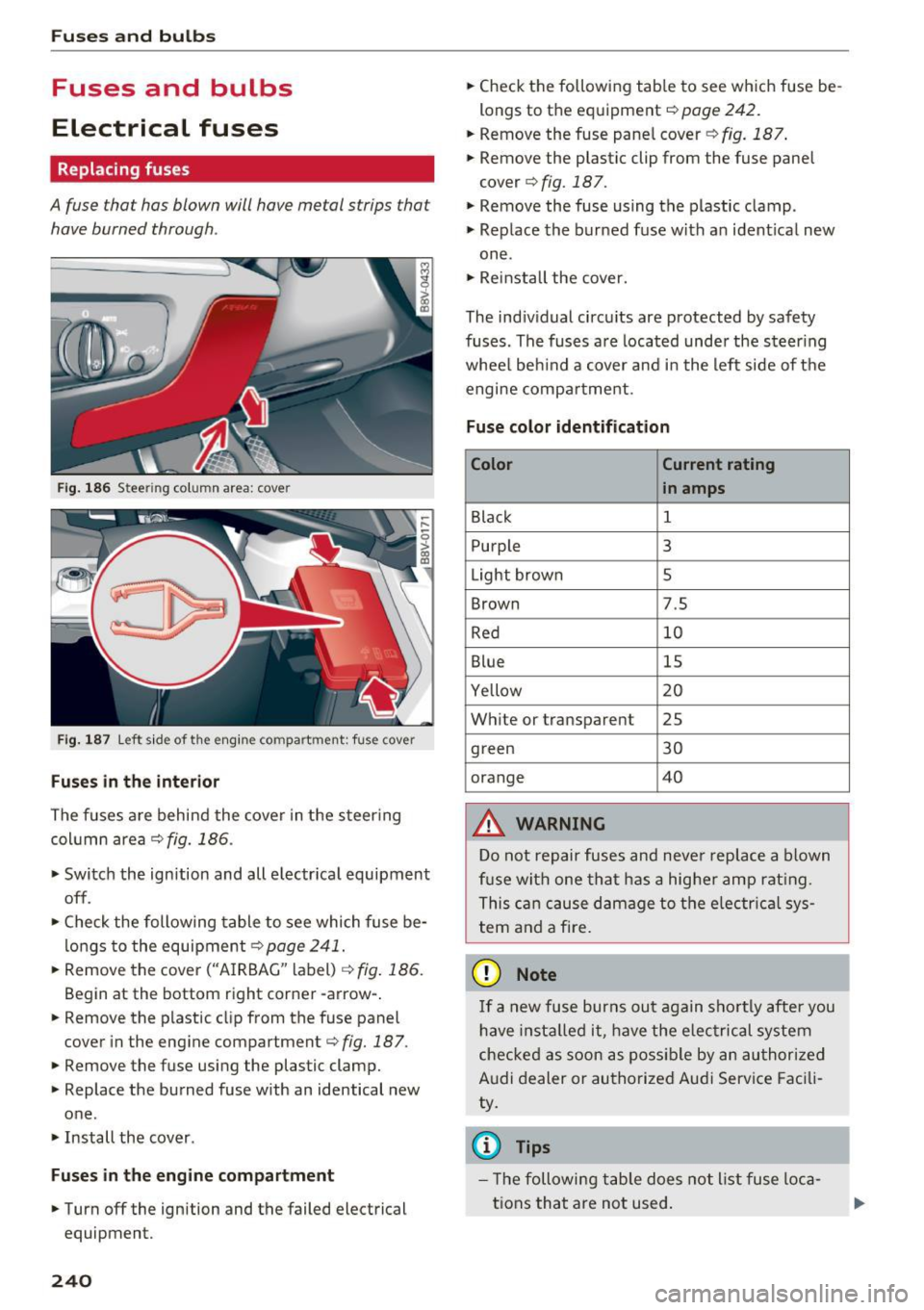
Fig. 18 6 Stee ring column area: cover
F ig. 1 87 Left s ide of the engine compartment: fuse cover
Fuses in the interior
The fuses are behind the cover in the s teer ing
col umn area
¢ fig. 186 .
"Switch the ignition and all e lectr ica l equipment
off.
" Check the following table to see which fuse be
lo ngs to the equipment ¢
page 241.
"Remove the cover ("AIRBAG" label)¢ fig. 186.
Begin at the bottom right corner -arrow-.
" Remove the plastic clip from the fuse panel
cover in the engine compartment¢
fig. 187 .
"Remove the fuse using the plastic clamp.
" Replace the burned fuse with an identical new
one .
" Install the cover .
Fuses in the engine compartment
" Turn off the ignition and the failed electrical
equipment.
240
" Check the following tab le to see wh ich fuse be
longs to the equipment
¢ page 242.
"Remove the fuse pane l cover ¢ fig. 187 .
" Remove the plastic clip from the fuse panel
cover ¢
fig. 187.
"Remove the fuse using the plastic clamp .
" Replace the b urn ed f use w ith a n ident ica l new
one .
" Reinstall the cover.
The ind iv idual circu its are protected by safety
fuses . The fuses a re located under the steer ing
whee l be hind a cover and in the left side of t he
engine compa rtme nt.
Fuse color identification
Color Current rating
in amps
Bla ck 1
Purple 3
Light brown 5
Brown 7.5
Red 10
Blue 15
Yellow 20
Wh ite or transparent 25
green 30
orange 40
&, WARNING
D o not repair fuses and neve r rep lace a blown
f u se w ith one that has a hig he r amp rat ing.
T his ca n ca use damage to the e lectr ic al sys
tem and a fi re.
(D Note
If a new fuse burns ou t again s ho rtly after you
h ave inst alled it , have the electrical system
checke d as soon as possible by an au thor ized
A udi dealer o r au thorized Au di Service Fac ili
ty.
(D Tips
- T he followi ng ta ble does not list fuse loc a
t io ns that are not used .
Page 243 of 272
<( co .... N ,.__
N .... 0 ,.__
> co
Sheet metal and bulb holders can have sharp
edges that can cause serious cuts, and parts must be correctly taken apart and then proper ly
put back together to help prevent breakage of
parts and long term damage from water that can
enter housings that have not been properly re
sealed.
For your safety, we recommend that you have
your authorized Audi dealer replace any bulbs for
you, since your dealer has the proper tools, the
correct bulbs and the expert ise.
Gas discharge lamps (Xenon lights):
Due to the high electrical voltage, have the bulbs
replaced by a qualified technician . Headlights
with Xenon light can be identif ied by the high
voltage sticker.
LE D headlights* require no maintenance. Please
contact your authorized Audi dealer if a bulb
needs to be replaced.
A WARNING
Contact w ith high-voltage components of the
electrical system and improper replacement
of gas discharge (Xenon) headlight bulbs can
cause serious personal injury and death.
- Xenon bulbs are pressurized and can ex
plode when be ing changed.
- Changing Xenon lamps requires the special
training, instructions and equipment .
- Only an authori zed Audi dea ler or other
qualified workshop should change the bulbs
in gas discharge lamps .
A WARNING
There are parts with sharp edges on the open
ings and on the bulb holders that can cause
ser ious cuts.
- If you are uncerta in about what to do, have
the work performed by an authorized Audi
dealer or other qualified workshop . Serious
personal injury may resul t from improperly
performed work .
(D Tips
-If you still prefer to rep lace the light bu lbs
you rself , be aware that the engine compart-
Fuses and bulbs
ment is a hazardous area to work in
¢ page 188¢ &.
-It is best to ask your authorized Audi dealer
whenever you need to change a bulb.
243
Page 244 of 272

Emergency situations
Emergency situations
General
This chapter is intended for trained emergency crews and working personnel who have the nec
essary tools and equipment to perform these
operations.
Starting by pushing or
towing
CD Note
Vehicles with an automatic transmission can
not be started by pushing or towing.
Starting with jumper
cables
If necessary, the engine con be started by con
necting it to the battery of another vehicle .
If the engine should fail to start because of a dis
charged or weak battery, the battery can be con
nected to the battery of
another vehicle, using a
pair of jumper cables to start the engine.
Jumper cables
Use only jumper cables of sufficiently large cross
section
to carry the starter current safely. Refer
to the manufacturer's specifications.
Use only jumper cables with
insulated terminal
clamps which are distinctly marked :
plus(+) cable in most cases colored red
minus(-) cable
in most cases colored black .
A WARNING
Batteries contain electricity, acid, and gas.
Any of these can cause very serious or fatal in
jury. Follow the instructions below for safe hand Ling of your vehicle's battery .
-Always shield your eyes and avoid leaning
over the battery whenever possible.
-A discharged battery can freeze at tempera
tures just below 32 °F (0 °C). Before con
necting a jumper cable, you must thaw the
244
frozen battery completely, otherwise it could explode .
- Do not allow battery acid to contact eyes or
skin. Flush any contacted area with water immediately.
- Improper use of a booster battery to start a
vehicle may cause an explosion.
- Vehicle batteries generate explosive gases.
Keep sparks, flame and lighted cigarettes
away from batteries.
- Do not try to jump start any vehicle with a
low acid level in the battery .
- The voltage of the booster battery must also
have a 12-volt rating. The capacity (Ah) of
the booster battery should not be lower
than that of the discharged battery. Use of
batteries of different voltage or substantial
ly different "Ah" rating may cause an explo
sion and personal injury .
- Never charge a frozen battery. Gas trapped in the ice may cause an explosion .
- Never charge or use a battery that has been
frozen . The battery case may have be weak
ened .
- Use of batteries of different voltage or sub stantially different capacity (Ah) rating may
cause an explosion and injury. The capacity
(Ah) of the booster battery should not be
lower than that of the discharged battery.
- Before you check anything in the engine
compartment, always read and heed all
WARNINGS
~page 188.
CD Note
-Applying a higher voltage booster battery
will cause expensive damage to sensitive
electronic components, such as control
units, relays, radio, etc.
- There must be no electrical contact between
the vehicles as otherwise current could al
ready start to flow as soon as the positive
(+) terminals are connected.
@ Tips
The discharged battery must be properly con-
nected to the vehicle's electrical system. .,..
Page 246 of 272

Emerg enc y s it uati ons
The battery is vented to the outside so that not
gases enter the passenger compartment. Make
sure that the connected posit ive termina l clamps
on the jump start cable have sufficient contact
with metal.
A WARNING
Follow the warnings and instructions from
the jump start cable manufacturer to reduce
the risk of ser ious injuries and vehicle dam
age. If you are unsure about anything, call
roads ide assistance .
- The jump start cables must be long enough
so that the vehicles do not touch .
-
-Route the jump start cables so they cannot
get caught in the moving parts in the engine
compartment.
- Always read and follow the warnings before
che ck ing anything in the engine compart
ment
¢page 188.
(D Note
Connecting jump start cables incorrectly can
destroy the alternator .
- Always connect the positive terminal(+) to
the positive term inal( +) and the negative
terminal(-) to the negat ive termina l(-) on
the body ground po int, but not the negative
terminal on the battery.
- Make su re the screw pl ugs on the batte ry
ce lls are installed securely.
If not, tighten
the plugs before connecting the clamps to
the negat ive termina l on the battery .
- Please no te that the connecting p ro cess de
scribed below for the jump start cab les is in
tended for when your vehicle is being jump
started . If you are j ump starting another ve
hicle, do not connect the negative cable to
the negat ive termina l(·) on the drained
battery, but rather connect it to a large
metal component that is bolted secu rely to
the engine block, o r to the engine block it
se lf. If the battery in the vehicle being jump
started is no t vented to the o uts ide , the re is
a risk of exp losion due to hydrogen gas .
-Make su re that the conne cted positive te r
minal clamps have s ufficient contact with
me tal.
246
- Do not use the battery negative terminal for
jump starting or a ma lfunction cou ld occur
in the vehicle electrical system.
Towing with a tow truck
General hints
Your Audi requires special handling for towing .
The following information is to be used by com
merc ial tow truck operators who know how to op
erate their equipment safely .
-Never to w yo ur Audi. To w ing will cause d am ·
a ge to the engine and t ran sm ission.
- Never wrap the safet y chains or winch cable s
a roun d the brake l ines .
- To pre vent un nece ssary damage , your Audi
must be t ran sported with a flat bed tru ck.
- To l oad the vehicle on to the flat bed , use the
towing loop found in the vehicle tools and at
t ac h to the fro nt or re ar ancho rage
¢ page 247 and ¢ page 247.
A WARNING
A vehicle being towed is not safe for passen
gers . Never allow anyone to ride in a vehicle
being towed, for any reason .