warning AUDI A3 CABRIOLET 2016 Owners Manual
[x] Cancel search | Manufacturer: AUDI, Model Year: 2016, Model line: A3 CABRIOLET, Model: AUDI A3 CABRIOLET 2016Pages: 272, PDF Size: 67.88 MB
Page 175 of 272
<( co .... N ,.__
N .... 0 ,.__
> co
It is usually best to put these children in appropriate booster seats. Be sure the booster seat
meets all applicable safety standards.
Booster seats ra ise the seat ing pos it ion of the
child and reposition both the lap and shoulder
parts of the safety be lt so that they pass across
the child's body in the right places . The rout ing of
the belt over the child's body is very important
for the child's protection, whether or not a boos
ter seat is used. Children age 12 and under must
always ride in the rear seat.
Children who are at least 4 ft. 9 in. (57 inches/ 1.45 meters) tall can generally use the vehicle's
three point lap and shoulder belts. Never use the lap belt portion of the vehicle 's safety belt alone
to restrain any child, regardless of how b ig the
child is. A lways remembe r that children do not
have the pronounced pelv ic struc ture requ ired for
the proper function of lap belt portion of the ve
hicle's three point lap and shoulder be lts. The
chi ld's safety absolutely requires that a lap belt
port ion of the safety be lt be fastened snugly and
as low as possible around the pelvis. Never let
the lap belt portion of the safety belt pass over
the child's stomach or abdomen.
In a crash, airbags must inflate within a blink of
an eye and with considerable force. In order to do its job, the airbag needs room to inflate so that it
will be there to protect the occupant as the occu
pant moves forward into the a irbag .
A vehicle occupant who is out of position and too
close to the airbag gets in the way of an inflating
airbag. When an occupant is too close, he or she
will be struck v iolently and will receive ser ious or
possibly even fatal injury.
In order for the airbag to offer protection, it is important that all vehicle occupants, especially
any children, who must be in the front seat be
cause of exceptional circumstances, be properly
rest rained and as far away from the airbag as
possib le. By keep ing room be tween the child's
body and the front of the passenger compa rt
ment, the airbag can inflate comp letely and pro
vide supplemental protection in certain fronta l
coll isions.
Ch ild safety
_& WARNING
Not using a booster seat, using the booster
seat improperly, incorrectly installing a boos
ter seat or us ing the vehicle safety belt im
p roperly increases the r isk of serious personal
i njury and death in a collision or other emer
gency situation. To help reduce the risk of se rious personal injury and/or death:
- The sho ulde r belt m ust lie as close to the
center of the ch ild's co llar bone as possible
and must lie flat and snug on the upper
body . It must never lie across the throat or
neck. The lap belt must lie across the pelvis
and never across the stomach or abdomen. Make sure that the belt lies f lat and snug.
Pull on the belt to tighten if necessary.
- Fa ilure to properly route safety belts over a
child's body w ill cause severe injuries in an
accident or other emergency situation
c:::>page 135.
- The rear side of the ch ild safety seat should
be positioned as close as possible to the
backrest on the veh icle seat.
- For adjustable head restraints: adjust or re move the rea r seat head rest raint if it is dif
f icult to insta ll the ch ild seat with the head
rest raint in place
c:::> page 55. Install the
head restraint again immed iate ly once the
child seat is removed. Driving witho ut head
restraints or with head restraints that a re
not properly adjusted increases the risk of
serio us or fatal neck injury dramatica lly.
- Never let a chi ld put the shoulder belt under
the arm or behind the back, because it could
cause severe injuries in a crash.
- Chi ldren on the front seat of a ny car, even
with Advanced Airbags, can be seriously in
jured or even k illed when an airbag inflates.
- Never let a chi ld stand or kneel on any seat,
for examp le the front seat.
- Never let a chi ld ride in the cargo area of
your veh icle.
- Always remember that a chi ld leaning fo r
ward, sitting sideways or out of position in
any way during an accident can be struck by
a dep loying airbag. Th is w ill result in serious
-
personal injury or death . ~
175
Page 176 of 272
Child safet y
-If you must install a booster seat on the
front passenger seat because of exceptional
circumstances the
P ASSENGER AIR BAG
OFF
light must come on and stay on, when
ever the ignition is switched on.
- If the PASSENGER AIR BAG OFF light does
not come on and stay on, perform the
checks descr ibed
~ page 155, Monitoring
the Advanced Airbag System.
- Take the ch ild restraint off the front passen
ger seat and install it p roperly at one of the
rea r seat positions if the
PA SSENGER AIR
BAG OFF
l ight does not stay on whenever
the ignition is switched on.
- Always read and heed all WARN INGS when
ever using a child restrained in a veh icle is
being used~
page 135, Safety belts,
~ page 143, Airbag system and
~page 165, Important information.
Securing child seats
Securing a child safety seat using a safety
belt
---
Safety belts for the rear seats and the front pas
senger can be locked with the convertible locking
retractor to properly secure child safety seats .
The safety belts emergency locking retractors for
the rear seats safety belts and for the front pas
senger's seat safety belt have a convertib le lock
i n g ret rac to r fo r child rest raints . The safety belt
m ust be locked so that belt webbing cannot un
reel. The retractor can be activated to lock the
safety belt and prevent the safety belt webbing
from loosening up during normal driving. A child
safety seat can only be properly installed when
the safety belt is locked so that the child and
chi ld safety seat w ill stay in place .
A lways remember: Even though your vehicle is
equ ipped w ith an Advanced Airbag system, all
children, especially those 12 years and younger,
should always ride in the back seat properly re
stra ined for their age and size .
176
A WARNING ,.
Improperly installed child safety seats in-
crease the r isk of serious personal injury and
death in a collision.
-
- Always make sure that the safety be lt re
tractor is locked when installing a ch ild
safety seat . An unlocked safety be lt retrac
tor cannot hold the ch ild safety seat in place
during normal d riving or in a c rash.
- Always buckle the child safety seat firmly in
place even if a ch ild is not si tting in it. A
loose child safety seat can fly a round dur ing
a sudden s top or in a collision.
- I f the backrest is not se curely latched, the
child and the ch ild restraint will be thrown
forward together with the backrest and w ill
strike parts of the veh icle interior. The child
can be seriously injured or killed.
- Never install rear -facing child safety seats
or infant carriers on the front passenger
seat. A child w ill be seriously injured and
can be k illed when the passenger a irbag in
flates.
- The inflating airbag will h it the ch ild safety
seat or infant carr ier with great force and
w ill smash the child safety seat and child
aga inst the backrest, center armrest, door
or roof.
- Always install rear-fac ing ch ild safety seats
or infant carriers on the rear seat .
- Forward-facing child safety seats or infant
carriers installed on the front passenger's
seat may interfere w ith the deployment of
the airbag and ca use serio us inju ry to the
child.
- It is safer to install a forward-facing child
safety seat on the rear seat.
- Always read and heed all WARNINGS when
eve r us ing a child restrained in a vehicle is
be ing used
c::!;> page 165. Special p recautions
apply when installing a child safety seat on
the front passenger seat~
page 144, Child
restraints on the front seat -some impor-
tant things to know .
~
Page 177 of 272
<( co .... N ,.__
N .... 0 ,.__
> co
A WARNING 1=
Always take special precautions if you must install a forward or rearward -facing ch ild re
straint on the front passenger's seat in excep
tional situations:
- Whenever a forward or rearward -facing
child restraint is installed on the front pas
senger seat, the
P ASSENGER AIR BAG OFF
light must come on and stay on whenever
the ignition is switched on .
- If the
PA SSENGER AIR BAG OFF light does
not come on and stay on , perform the
checks descr ibed
~ page 155, Monitoring
the Advanced Airbag System.
- T ake the ch ild restraint off the front passen
ger seat and install it p roperly at one of the
rear seat positions if the
PAS SEN GER AI R
BAG OF F
light does not stay on whenever
the ignition is switched on.
- Improper installation of ch ild restraints can
reduce their effectiveness or even prevent
them from providing any protection .
- An improper ly installed child restraint can
interfere with the airbag as it deploys and
seriously injure or even kill the child .
- Always carefu lly follow the manufacturer's
instructions provided with the child safety
seat or carrier.
- After checking to make sure that the child restra int is properly installed, make certa in
tha t the child restraint is correctly recog
nized by the capacit ive passenger detection
system in the front passenger seat and that
the
PASSENGER AIR BAG OFF light signals
the cor rect front passenger fronta l airbag
status .
A WARNING
Forward-fac ing child rest raints :
- Always ma ke sure the forward-fac ing seat
has been designed and ce rtified by its man
ufacturer for use on a fron t seat with a pas
senger front and s ide a irbag .
- Never put the forward-facing child restraint
up, against or very near the instrument pan
el.
-
Ch ild safety
-Always move the front passenger seat to
the highest posit ion in the up and down ad
justment range and move it back to the rearmost posit ion in the seat's fore and aft
ad justment range, as far away from the a ir
bag as possible , before installing the for
ward-facing ch ild restraint.
- Always make sure that the safety belt upper
anchorage is behind the ch ild rest raint and
not next to o r in front of the child restraint
so that the safety be lt will be p roperly posi
tioned.
- Ma ke sure that the
PASSENGER AIR BAG
OFF
li ght comes on and stays on a ll the time
whenever the ignit ion is switched on .
A WARNING
= Rearward-facing chi ld restraints:
- A child in a rearward-fac ing c hild safety sea t
installed on the front passenger seat will be
serio usly injured and can be ki lled if the
front airbag inflates -even with an Ad
vanced Airbag System .
- The inflating airbag will hit the c hild safety
seat or infant carr ier with great force and
will smash the child safety seat and child
aga inst the backrest, center armrest, door
or roof.
- Always be especially carefu l if you must in
stall a rearward facing child safety seat on
the front passenger seat in except ional cir
cumstances.
- Make sure that the
PASSENGER AIR BAG
OFF
light comes on and stays on all the time
whenever the ignit ion is switched on .
- If the
PA SSENGER AIR BAG OFF light does
not come on and stay on, immediately in
stall the rea r-facing child safety seat in a
rear seating posit ion and have the airbag
sys tem inspected by you r Audi dealer.
Activating the convertible locking retractor
Use the convertible locking retractor to secure a
child restraint.
Always heed the c hild safety seat manufacturer 's
instruct ions when installing a child restraint in
177
Page 178 of 272
Child safety
your vehicle. To activate the convertible locking
retractor:
.,. Place the child restraint on a seat, preferably
on the rear seat.
.,. Slowly pull the belt
all the way out.
.,. Route it around or through the child restraint
belt path
~ .&_ .
.,. Push the child safety seat down with your full
weight to get the safety belt really tight .
.,. Insert the belt tongue into the buckle for that
seating position .
.,. Guide the safety belt back into the retractor un
til the belt lies flat and snug on the child safety
seat.
.,. You should hear a "clicking" noise as the belt
winds back into the inertia reel. Test the con
vertible locking retractor by pulling on the belt.
You should no longer be able to pull the belt
out of the retractor. The convertible locking re
tractor is now activated.
.,. Make sure that the red release button is facing
away from the child restraint so that it can be
unbuckled quickly.
.,. Pull on the belt to make sure the safety belt is
properly tight and fastened so that the seat
cannot move forward or sideways more than
one inch (2.5 cm).
A WARNING
Using the wrong child restraint or an improp
erly installed child restraint can cause serious
personal injury or death in a crash.
- Always make sure that the safety belt re tractor is locked when installing a child
safety seat. An unlocked safety belt retrac
tor cannot hold the child safety seat in place during normal driving or in a crash.
- Always buckle the child safety seat firmly in
place even if a child is not sitting in it . A
loose child safety seat can fly around during
a sudden stop or in a crash.
- Always make sure the seat backrest to which
the child restraint is installed is in an up
right position and securely latched into
place and cannot fold forward. Otherwise,
the seatback with the child safety seat at-
178
tached to it could fly forward in the event of
an accident or other emergency situation .
- Always read and heed all WARNINGS when
ever using a child restrained in a vehicle is
being used
¢page 165. Special precautions
apply when installing a child safety seat on
the front passenger seat¢
page 144, Child
restraints on the front seat -some impor
tant things to know.
Deactivating the convertible locking
retractor
The convertible locking retractor for child re
straints will be deactivated automatically when the belt is wound all the way back into the re
tractor.
.,. Press the red button on the safety belt buckle.
The belt tongue will pop out of the buckle.
.,. Guide the safety belt all the way back into its
stowed position.
Always let the safety belt retract completely into
its stowed position. The safety belt can now be
used as an ordinary safety belt without the con
vertible locking retractor for child restraints.
If the convertible locking retractor should be ac
tivated inadvertently, the safety belt must be un
fastened and guided completely back into its
stowed position to deactivate this feature. If the
convertible locking retractor is not deactivated,
the safety belt will gradually become tighter and
uncomfortable to wear.
A WARNING
Improperly installed child safety seats in
crease the risk of serious personal injury and
death in a collision .
- Never unfasten the safety belt to deactivate the convertible locking retractor for child re
straints while the vehicle is moving. You
would not be restrained and could be seri
ously injured in an accident.
- Always read and heed all WARNINGS when
ever using a child restrained in a vehicle is
being used ¢
page 165. Special precautions
apply when installing a child safety seat on
Ill>
Page 179 of 272
<( co ..... N
" N ..... 0 r--. > 00
the front passenger seat Q page 144, Child
restraints on the front seat -some impor
tant things to know.
LATCH system (Lower
anchorages and tethers
for children)
Child Restraint System anchors and how
are they related to child safety
To provide a simpler and more practicable way to
attach the child restraint on the vehicle seat,
F ederal regulations require special lower ancho
rages in vehicles and devices on new child re
straints to attach to the vehicle anchorages.
In the United States, the combination of the
tether anchorages and the lower anchorages is
now generally called the LATCH system for
" L ower Anchorages and Tethers for Childr en". In
Canada, the terms "top tether" with "lower uni
versal anchorages" (or "lower universal anchor
age bars") are used to describe the system.
In other countries the term "ISO FIX" is used to
describe the lower anchorages.
F orward-facing child restraints manufactured af
ter September 1, 1999, are required by U.S. fed
eral regulations to comply with new child head
movement performance requirements. These
new performance requirements make a tether
necessary on most new child seats.
Installing a child restraint that requires a top
tether without one can seriously impair the per
formance of the child restraint and its ability to
protect the child in a collision. Installing a child
restraint that requires a top tether without the
top tether may be a violation of state law.
Child restraint manufacturers offer LATCH lower
anchorages on their child seats with hook-on or
push-on connectors attached to adjustable
straps.
In addition to the LATCH lower anchorages, these
child restraint systems usually require the use of
tether straps to help keep the child restraint
firmly in place .
Child sa fety
A WARNING
-Improper installation of child restraints will
increase the risk of injury and death in a
crash.
- Always follow the instructions provided by
the manufacturer of the child restraint you
intend to insta ll in your vehicle.
- Never install a child restraint without a
properly attached top tether strap if the
child restraint manufacturer's instructions
require the top tether strap to be used.
- Improper use of chi ld restraint LATCH lower
anchorage points can lead to injury in a colli
sion . The LATCH lower anchorage po ints are
des igned to w ithstand only those loads im
posed by correctly fitted child restraints.
- Never mount two child restraint systems on one LATCH lower anchorage point.
- Never secure or attach any luggage or other
item to the LATCH lower anchorages.
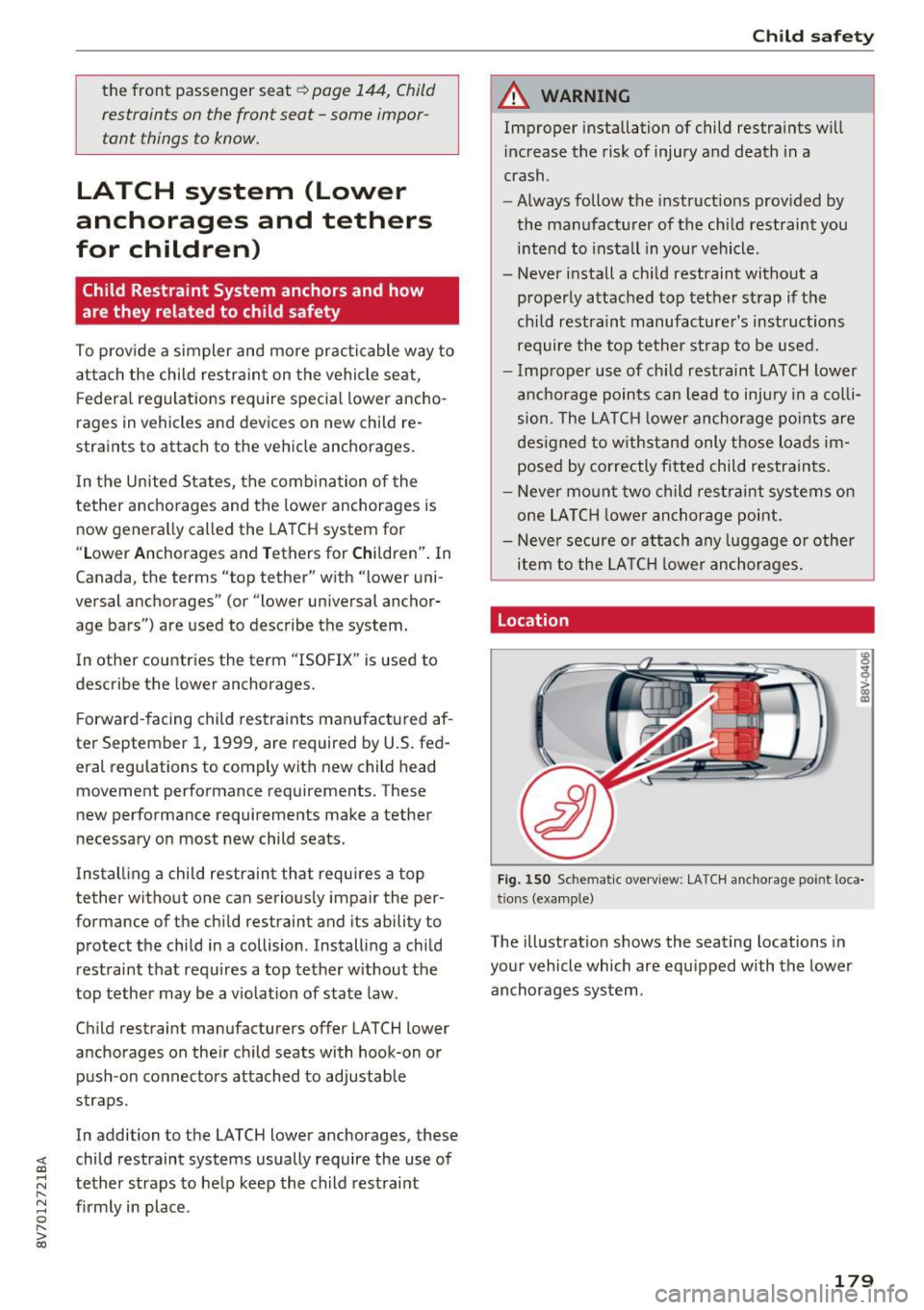
Location
Fig. 150 Schematic overview: LATCH anchorage point loca
tions (example)
The illustration shows the seating locations in
your vehicle which are equipped with the lower
anchorages system.
1 79
Page 180 of 272
Child safety
Description
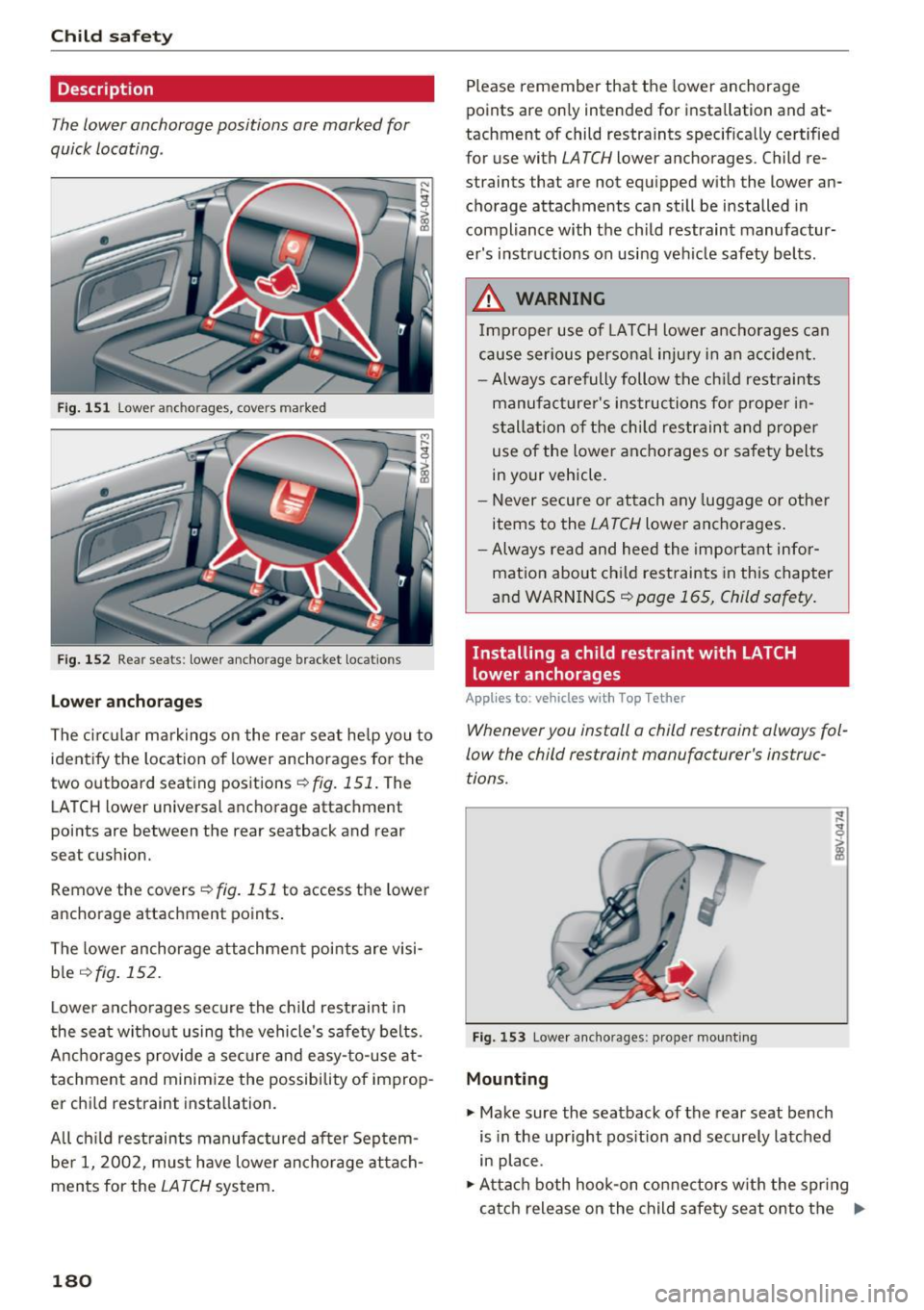
The lower anchorage positions are marked for
quick locating .
Fig. 151 Lower an ch orages, cove rs marked
Fig. 152 Rear seats: lower anchorage bracke t locations
Lowe r anchor ag es
The circular mark ings on the rea r seat he lp you to
ident ify the location of lower anchorages for the
two outboard seating positions
r=> fig. 151. The
LATCH lower universal anchorage attachment
points are between the rear seatback and rear
seat cushion.
Remove the covers
r=> fig. 151 to access the lower
anchorage attachment points.
The lower anchorage attachment poi nts are visi
b le
r=> fig. 152.
Lower ancho rages secure the ch ild rest raint in
the sea t witho ut using the vehicle 's safety belts.
Anchorages provide a secure and easy-to-use at
tachment and minimize the possibility of improp
er child restraint installation .
All ch ild rest raints manufactured after Septem
ber 1, 2002, must have lowe r anchorage at tach
ments for the
LATCH sys tem .
180
Please remember that the lower anchorage
points are on ly intended for installation and at
tachment of child restraints specif ically certified
for use with
LATCH lower anchorages . Child re
straints that are not equipped with the lower an
chorage attachments can still be installed in
compliance with t he ch ild restraint manufactur
er's instructions on using vehicle safety belts .
.&_ WARNING
Imp roper use of LATCH lower anchorages can
cause serious personal inju ry in an accident.
- Always carefully follow the ch ild restraints
manufact urer's instructions for proper in
stallat ion of the chi ld restraint and proper
use of the lower anchorages or sa fety belts
in your vehicle.
- Never secure or attach any luggage o r othe r
items to the
LATCH lower anchorages .
- Always read and heed the important infor
mation about child restraints in this chapter
and WARN INGS
~page 165, Child safety.
Installing a child restraint with LATCH
lower anchorages
Applies to : vehicles with Top Tether
Whenever you install a child restraint always fol
low the child restraint manufacturer's instruc
tions.
Fig. 153 Lowe r anchorages: p rope r mount ing
Mounting
.., Make sure the seatback of the rear seat bench
is in the upright pos ition and secure ly latched
in place .
.., Attach both hook-on connectors w ith the spr ing
catch release on the child safety seat o nto the .,.
Page 181 of 272
<( co ..... N
" N ..... 0 r--. > 00
LATCH lower anchorage so that the connectors
lock into place
¢fi g. 153 .
.. Pull on the connector attachments to make
sure they are properly attached to the LATCH
lower anchorage .
.. Pull straps tight following the child restraint
manufacturer's instructions.
R elea sing
.. Loosen the tension on the straps following the
child restraint manufacturer's instructions.
.. Depress the spring catches to release the an
chorage hooks from the lower anchorages.
Remember: Use tether straps to help keep the
child restraint firmly in place.
A WARNING
Improper use of the LATCH system can in
crease the risk of serious pe rsonal injury and
death in an acc ident.
- These anchors were developed only for child safety seats using the "LATCH" system.
- Never attach other child safety seats, belts
or othe r objects to these anchors .
- Always make sure that you hear a click when
latch ing the seat in place. If you do not hear
a click the seat is not secure and could fly
forward and h it the interior of t he vehicle,
o r be ejected from the vehicle.
A WARNING
Improper installatio n of c hild rest rai nts will
increase t he r is k of i njury in an a cc ident.
- Always follow the child restra int system
man ufacturer's inst ru ct ions for proper in
sta llation of the child res tra int system and
pro per use of tether straps as well as the
lower anchorages or safety be lts in your
ve
hicle.
- Always read and heed the important infor
mation and WARNINGS about child safety
and the insta llation of chi ld restraint sys
tems ¢
page 165, Child safety.
Child sa fety
Tether anchors and tether straps
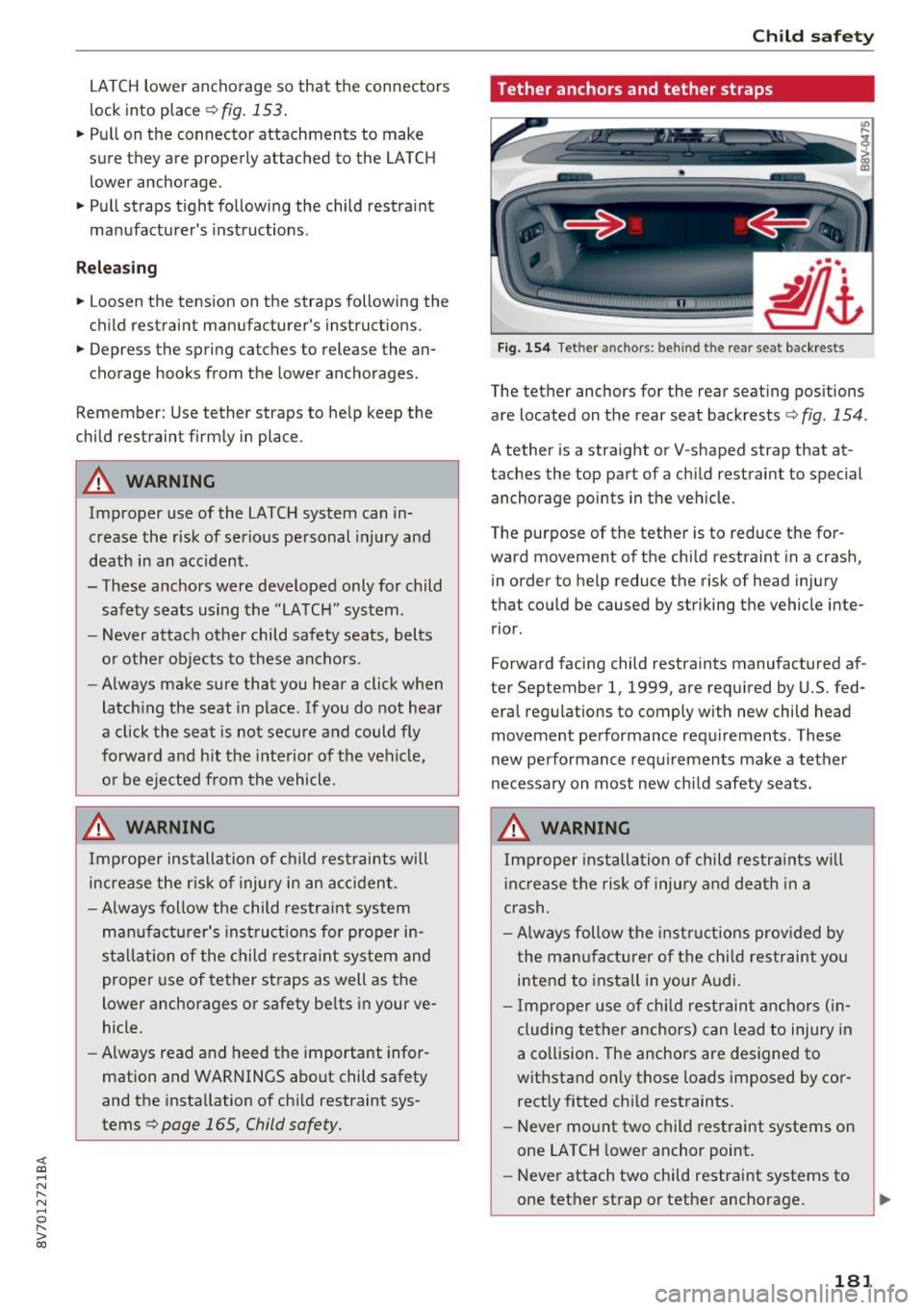
F ig. 154 Tether anchors: behind the rear seat backrests
The tether anchors for the rear seating positions
are located on the rear seat backrests¢
fig. 154.
A tether is a straight or V-shaped strap that at
taches the top part of a child restraint to special
anchorage points in the vehicle.
T he purpose of the tether is to reduce the for
ward movement of the child restraint in a crash,
in order to help reduce the risk of head injury
that could be caused by striking the vehicle inte
r ior.
Forward facing child restraints manufactured af
ter September 1, 1999, are required by U.S . fed
era l regulations to comply with new child head
movement pe rformance requ irements. These
new performance requ irements make a tether
necessary on most new chi ld safety sea ts.
A WARNING
I mp roper installa tion of child restra ints w ill
i nc rease the risk o f injury and dea th in a
crash.
- Always follow the instru ctions prov ided by
the man ufa ct u rer of the ch ild restrain t you
i n tend to insta ll in your A udi.
- I mp roper use of chi ld restrain t ancho rs ( in
cluding tether anchors) can lead to injury in
a co llision. The anchors are designed to
withstand only those loads imposed
by cor
rectly fitted ch ild restraints.
- Never mo unt two child rest rai nt systems on
one LATC H lower anchor point.
- Never attach two child restra int systems to
one tether strap or tether anchorage .
181
Page 182 of 272
Child safety
-Never attach a tether strap to a tie-down
hook in the luggage compartment.
- Never use child restraint tether anchorages
to secure safety belts or other kinds of occu
pant restraints.
- Never secure or attach any luggage or other
items to the LATCH lower anchorages or to
the tether anchors.
- If you must install a rearward facing child
safety seat on the front passenger seat be
cause of exceptional circumstances and the
PAS SEN G ER AIR BAG OFF light does not
come on and stay on, immed iate ly install
the rear-fac ing ch ild safety seat in a rea r
seat ing pos ition and have the airbag system
inspected by your Audi dealer.
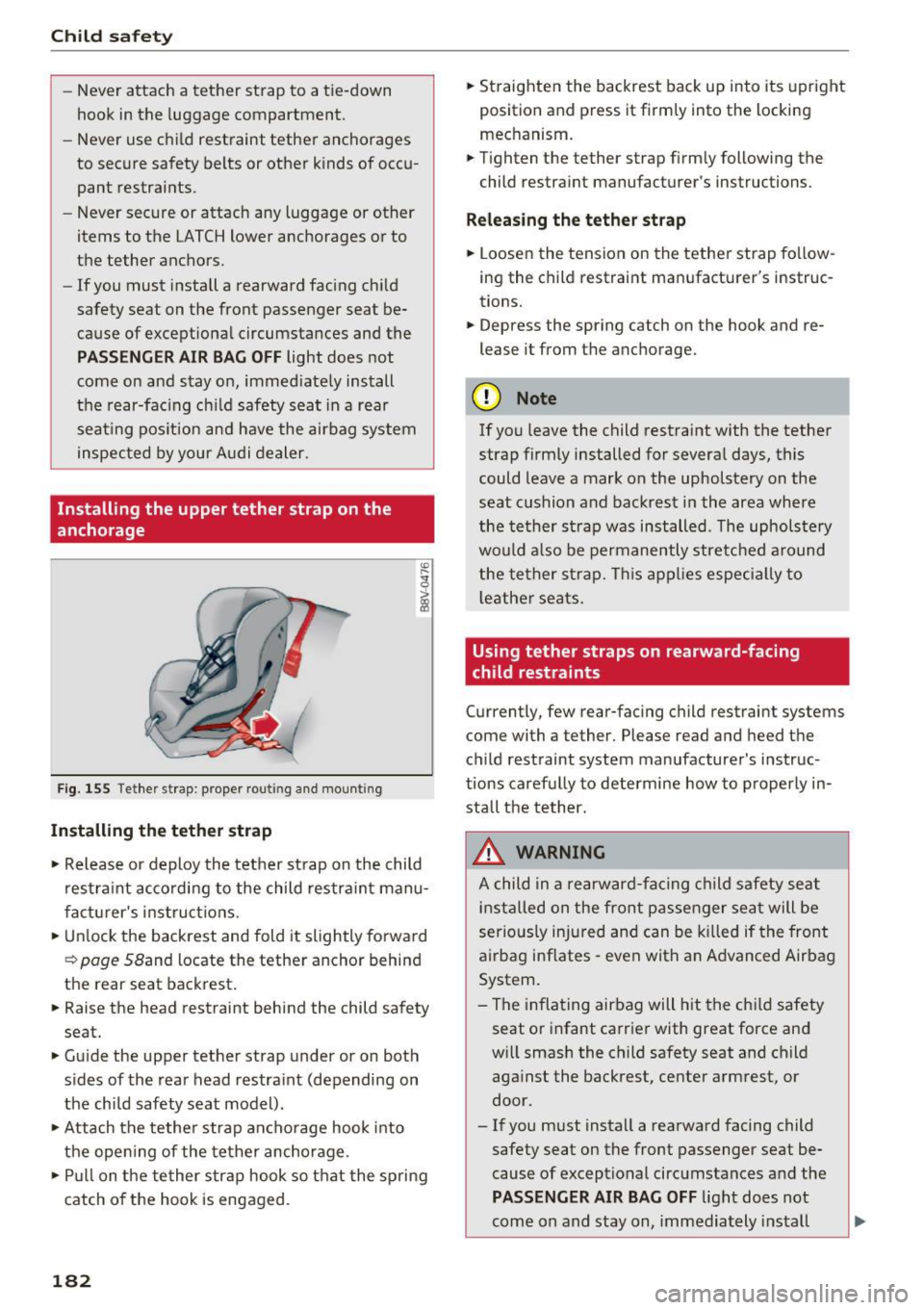
Installing the upper tether strap on the
anchorage
Fig. 155 Tet her strap: proper routing and mounting
Installing th e teth er strap
.,. Release or deploy the tether strap on the child
restra int acco rding to the child restra int manu
fac ture r's instruct ions.
.,. Un lock the backrest and fold it slightly forward
¢ page 58and locate the tether anchor behind
the rear seat backrest.
.,. Raise the head restraint behind the child safety
seat.
.,. Gu ide the upper tether strap under or on both
s ides of the rea r head restra int (depending on
the child safety seat model) .
.,. Attach the tether strap ancho rage hook into
the open ing of the tether anchorage.
.,. Pull on the tether strap hook so that the spring
catch of the hook is engaged.
182
.,. Straighten the backrest back up into its upright
position and press it firmly into the locking
mechanism.
.,. Tighten the tether strap firmly following the
child restraint manufacturer's instructions.
Releasi ng th e tet her strap
.,. Loosen the tension on the tethe r strap fo llow
ing the child restraint manufacturer's instruc
tions.
.,. Depress the spring catch on the hook and re
lease it from the anchorage.
(D Note
If you leave the child restraint with the tether
strap firmly installed for several days, this
could leave a mark on the upholstery on the
seat cushion and backrest in the area where
the tether strap was installed. The upholstery
would also be permanently stretched a round
the tether s trap. This applies especially to
l eather seats.
Using tether straps on rearward-facing
child restraints
Currently, few rear-facing child restraint systems
come with a tether. Please read and heed the
ch ild restraint system manufacturer's i nstruc
tions carefully to determine how to properly in
stall the tether.
&_ WARNING
A child in a rearward-facing child safety seat installed on the front passenger seat will be
seriously inju red and can be k illed if the front
airbag inf lates -even with an Advanced Airbag
System.
- The inflating airbag will h it the child safety
seat or infant carrier with great force and
will smash the child safety seat and child aga inst the backrest, center armrest, or
door.
- If you m ust install a rearward facing child
safety seat on the front passenger seat be
cause of exceptional circumstances and the
PA SSENGER A IR BA G OFF light does not
come on and stay on, immediately install
Page 185 of 272
<( co .... N r--N .... 0 r--> co
-If you are unable to determine whether or
not a particular fuel blend meets the speci
ficat ions, ask your service station or its fuel
supplier.
- Do not use fuel for which the contents can
not be identified.
- Fuel system damage and performance prob
lems resulting from the use of fue ls diffe r
ent from those specified are not the respon
s ibility of Audi and are not covered under
the New Veh icle or the Emiss ion Control
System Warrant ies .
- If you experience a loss of fue l economy or
driveability and pe rformance problems due
to the use of one of these fuel blends, we r ecommend that you switch to unblended
fuel.
Gasoline additives
A ma jor concern among many auto manufactur
ers is carbon deposit build-up ca used by the type
of gasoline yo u use.
A lt hough gasoline grades d iffer from one manu
facturer to another, they have cer tain things in
common . A ll gasoline grades contain substances
that can cause deposits to collect on vita l engine
parts, such as fue l injectors and intake valves. Al
though most gasoline brands include additives to
keep engine and fuel systems clean, they are not
equally effective .
Aud i recommends using TOP TIER Detergent Gas
oline. For more informat ion on TOP TIER Dete r
gent Gasoline, please go to the official website
(www.toptiergas .com) .
After an extended period of using inadequate
fuels, carbon deposit build-ups can rob your en
g ine of peak performance.
CD Note
Damage or malfunction due to poor fuel q ual
ity is not covered by the Aud i New Vehicle
Limited Warranty.
Ch eck ing and Filling
Refueling
Fuel filler neck
The fue l filler neck is located on the rig ht rea r
s ide panel behind the fuel fille r flap .
If the power lock ing system shou ld fail, yo u can
st ill open the flap manually -fo r detailed instruc
tio ns see
9 page 187.
You can find the fuel tank capacity of your vehicle
i n c:;,
page 251 .
The label on the inside of the f uel fi ller flap tells
you the correct fuel for your vehicle. For more in
f ormat ion about fuel spec ificat ions, see
9 page 184.
Your vehicle fuel tank has an onboard refue lling
vapor recovery system. This feature helps to pre
vent fuel vapors from escaping from the tank and
polluting the environme nt wh ile you refue l yo ur
vehicle . In order to fill the tank p roper ly w hile
pro tect ing t he e nvir onment, p lease follow t his
r efue ling p rocedure ca refully.
_& WARNING
Un der normal opera ting co nd it io ns, neve r car
r y additional f uel con tainers in your car. Gas
canisters and other containers used to trans
port fue l can be dange rous. Such containe rs,
f ull or empty, may leak and could cause a fire
i n a co llision. If you must transpo rt fuel to
use for your lawn mower, snow blower, etc .,
be ve ry careful and always observe local and
sta te laws rega rding the use, transportation
and storage of su ch f uel con tainers. Make cer
t ai n t he co ntain er meets industry standards
(ANSI/AS TM F8S2 -86).
CD Note
Neve r drive your veh icle until the fue l tank is
complete ly empty. The irreg ular s upply of
f u el can cause misfiring. Gasol in e c ould enter
the e xhaust sys tem an d damage the cat aly tic
conve rter.
185
Page 186 of 272
Checking and Filling
Fueling procedure
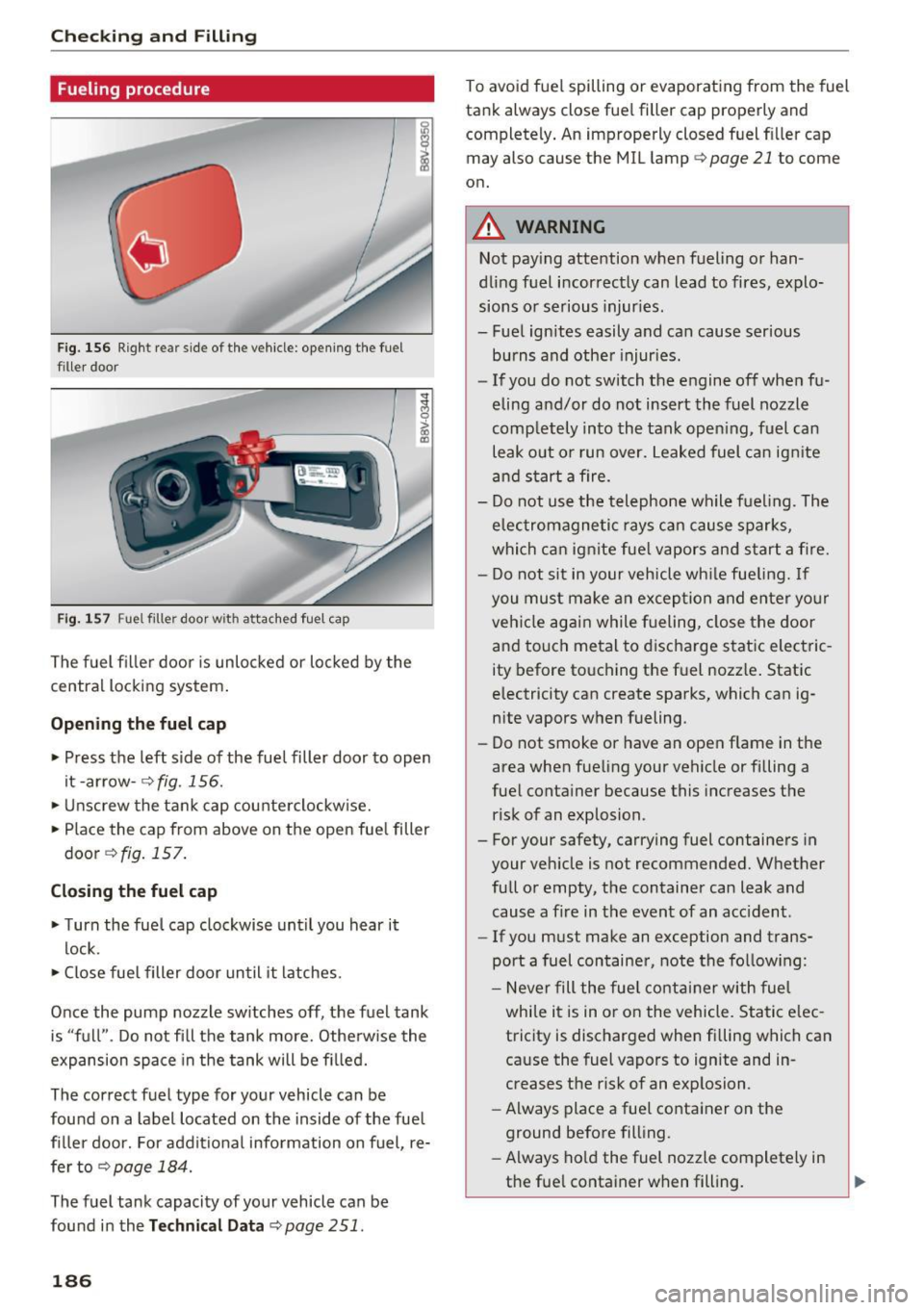
Fig. 156 Right rear side of the vehicle: opening the fue l
filler door
Fig . 157 Fue l filler door w it h atta ched fue l cap
The fuel fi ller door is unlocked or locked by the
central locking system .
Opening the fuel cap
I
• Press the left side of the fuel filler door to open
it -arrow -
9 fig. 156.
• Unscrew the tank cap counte rclockw ise.
• Place the cap from above on the open fue l filler
door
9 fig. 157.
Cl osi ng th e fu el cap
• Turn the fue l cap clockwise until you hear it
lock.
• Close fuel filler door until it latches.
Once the pump nozzle sw itches off, the fuel tank
is "fu ll". Do not fi ll the tank more. Otherw ise the
expansion space in the tank will be fi lled.
The correct fuel type for your vehicle can be
found on a label located on the inside of the fue l
fi ller door. For addit io nal info rmation on fuel, re
fe r to
Q page 184.
The fuel tank capacity of your vehicle can be
found in the
Technic al Data 9 page 251.
186
To avoid fuel spilling or evaporating from the fuel
tank always close fue l filler cap properly and
completely . An improperly closed f uel f iller cap
may also cause the MIL lamp
~ page 21 to come
on.
A WARNING
Not pay ing attention w hen fueling or han
dling f uel incorrectly can lead to fires , explo
sions o r serious injur ies .
- Fue l ignites easily and can cause serious
burns and other injur ies .
-
-If you do not switch the engine off when fu
eling a nd/or do not insert the fuel nozzle
comp letely into the tank open ing, fuel can
leak out o r run over. Leaked fuel can ign ite
and start a fire.
- Do not use the telephone wh ile f uel ing . The
elec tromagneti c rays can cause sparks,
which can ignite fue l vapors and s tart a fire.
- Do not sit in your vehicle wh ile fue ling. If
you must make an excep tion and enter yo ur
veh icle aga in while fueling, close the door
and touch me tal to discharge static electric
ity before touching the f uel nozz le . Static
electricity can create sparks, which can ig
nite vapors when fueling .
- Do not smoke or have an open flame in the
area when fueling your vehicle or filling a
fue l conta iner because this increases the
risk of an explosion.
- For your safety, carrying fuel containers in
your veh icle is not recommended. Whether
full or empty, the container can leak and
cause a fire in the even t of an acc ident.
- If you must make an exception and trans
port a fuel containe r, note the follow ing:
- Never fill the fuel co ntainer with fue l
while it is in or on the vehicle. Static e lec
tricity is discharged when fi lling which can
cause the fuel vapors to ignite and in
creases the risk of an exp losion.
- Always place a fuel conta iner on the
ground before fill ing.
- Always ho ld the fuel nozzle completely in
the fue l container when filling.