tires AUDI A3 CABRIOLET 2016 User Guide
[x] Cancel search | Manufacturer: AUDI, Model Year: 2016, Model line: A3 CABRIOLET, Model: AUDI A3 CABRIOLET 2016Pages: 272, PDF Size: 67.88 MB
Page 208 of 272

Tires and wheels
(a) Curb weight
(b) Accessory weight
(c) Vehicle capacity weight, and
(d) Production options weight
Ma ximum (permissible )
inflation pressur e
means the maximum cold infla
tion pressure to which a tire may be inflated. Also called "maxi
mum inflation pressure ."
Normal occupant weight
means 150 lbs . (68 kilograms)
times the number of occupants
seated in the vehicle up to the to
ta l seating capacity of your vehi
c le .
Occupant d istribution
means distribution of occupants
in a vehic le .
Outer diameter
means the overall diameter of an
inflated new tire.
Overall width
means the l inear distance be
tween the exteriors of the side
walls of an inflated tire , including
elevations due to labeling , deco
rations, or protective bands or
ribs .
208
Ply
means a layer of rubber -coated
parallel cords.
Production options weight
means the comb ined weight of
those installed regular production
options weighing over 5 lbs . (2 .3
kg) in excess of those standard
items which they replace, not pre
vio usly considered in c urb weight
or accessory weight, inc luding
heavy duty brakes, ride levelers,
roof rack, heavy duty ba ttery, and
special trim.
Radial ply tire
means a pneumatic tire in which
the ply cords that extend to the beads are laid at subs tantially 90
degrees to the centerline of the
tread .
Recommended inflation
pressure
see~ page 207, Cold tire infla
tion pressure.
Reinforced tire
means a tire designe d to operate
at higher loads and at higher in
flat ion pressures than the corre
spond ing standard tire . Rein
forced tires may be identified as .,.
Page 209 of 272

<( a:, ... N .... N ... 0
s: a:,
"XL" "xl" "EXTRA LOAD" or "RF" ' ' '
on the sidewall.
Rim
means a metal support for a tire
or a tire and tube assembly upon
which the tire beads are seated .
Rim diameter
means nominal diameter of the
bead seat. If you change your
wheel size, you will have to pur
chase new tires to match the new
rim diameter .
Rim size designat ion
means rim diameter and width.
Rim width
means nominal distance between
rim flanges.
Sidewall
means that portion of a tire be
tween the tread and bead.
Speed rating (letter code )
means the speed at wh ich a t ire is
designed to be driven for extend
ed periods of time . The ratings
range from 93 mph (150 km/h)
to 186 mph (298 km/h)
¢ table
on page 205.
You may not find
this information on all tires be
cause it is not required by law .
Tires and wheels
The speed rating letter code,
where applicable, is molded on
the tire sidewall and indicates the maximum permissible road
speeds
¢ & in Winter tires on
page 219 .
Tire pressure monitoring
system*
means a system that detects
when one or more of a vehicle's
tires are underinflated and illum i
nates a low tire pressure warning
telltale .
Tread
means that portion of a tire that
comes into contact with the road.
Tread separation
means pulling away of the tread
from the tire carcass .
Treadwear indicators (TWI)
means the projections within the
principal grooves designed to give
a visual indication of t he degrees
of wear of the tread . See
¢ page 213, Treadwear indicator
for more information on measur-
ing tire wear. .,.
209
Page 210 of 272
Tires and wheels
Uniform Tire Qu ality Gr ading
is a tire information system devel
oped by the United States Nation
al Highway Traffic Safety Admin
istration (NHTSA) that is designed
to help buyers make relative com parisons among tires. The UTQG
is not a safety rating and not a
guarantee that a tire will last for
a prescr ibed number of miles
(kilometers) or perform in acer
tain way. It simply gives tire buy
ers additional information to
combine with other considera
tions, such as price, brand loya lty
and dealer recommendations. Un
der UTQG, t ires are graded by the
tire manufacturers in three areas:
treadwear, traction, and tempera
ture resistance . The UTQG infor
mation on the tires, molded into
the sidewalls.
U.S. DOT Tire Identification
Number (TIN)
This is the tire's "serial number" .
It begins with the letters "DOT"
and indicates that the tire meets
all federal standards. The next
two numbers or letters indicate
the plant where it was manufac
tured, and the last four numbers represent the
week and year of
manufacture . For example,
210
DOT ... 2215 ...
means that the tire was produced
in the 22nd week of 2015. The
other numbers are marketing co
des that may or may not be used by the tire manufacturer . This in
formation is used to contact con sumers if a tire defect requires a
recall.
Veh icle capacity weight
means the rated cargo and lug
gage load plus 150 lbs . (68 k ilo
grams) times the vehicle's desig
nated seating capacity .
Vehicle maximum load on the
tire
means that load on an ind ividual
tire that is determined by distrib
uting to each axle its sha re of the
maximum loaded veh ic le weight
and dividing by two.
Vehicle normal load on the tire
means that load on an individual
tire that is determined by distrib
uting to each axle its sha re of the
curb weight, accessory weight,
and normal occupan t weight (dis
tributed in accordance with
c:::> ta
ble on page 216) and dividing by
two .
~
Page 211 of 272
<( a:, ... N .... N ... 0
s: a:,
Occupant loading and distri
bution for vehicle normal load
for various designated seating
capacities
Refer to the tire inflation pres
sure label
c::> page 214, fig. 171
for the number of seating posi
tions. Refer to the table
c::> table
on page 216
for the number of
people that correspond to the ve
hicle normal load.
New tires or wheels
Audi recommends having all work
on tires or whee ls perfo rmed by
an authorized Audi dealer or au
thorized Audi Service Facility .
These facilities have the proper
knowledge and are equ ipped with
the required tools and replace
ment parts .
.,,. New tires do not yet have the
opt imum adhesion properties.
Drive carefully and at moderate
speeds for the first 350 m iles
(500 km) with new tires .
.,,. On ly use tires w ith the same de
sign, size (rolling c ircumference)
and as close to the same tread pattern as possible on all four
wheels.
Tire s and wheel s
.,,.Do not replace tires individually.
At least replace both tires on the same axle at the same time .
.,,. Audi recommends that you use
A udi Original equipment tires. If
you would like to use different
tires, please note that the tires may perform differently even if
they are the same si ze
c::> ,&. .
.,,. If you would like to equip your
vehicle w ith a tire/r im comb ina
tion that is different from what
was installed at the factory, con
sult w ith an authorized Audi
dealer or authorized Audi Service
Facility before making a pur
chase ¢
..1,..
The spare t ire* is diffe rent from
the regular tires installed on the
vehicle - for example, if winter
tires or wide tires are installed -
then only use the spare tire* tem
porarily in case of emergency and
drive carefully while it is in use . It
should be replaced with a regular
tire as soon as possible.
On
all wheel d rive vehicles, all
four wheels must be equipped
with tires that are the same brand
and have the same construction
and tread pa ttern so that the
drive system is not damaged by
2 11
Page 212 of 272
Tires and wheels
different tire speeds. For this rea
son, in case of emergency, only
use a spare tire* that is the same
circumference as the regular
tires.
,&. WARNING -
-Only use tire/rim combina
tions and suitable wheel bolts
that have been approved by
Audi. Otherwise, damage to
the vehicle and an accident could result.
-For technical reasons, it is not possible to use tires from oth
er vehicles - in some cases,
you cannot even use tires from
the same vehicle model.
-Make sure that the tires you select have enough clearance
to the vehicle. Replacement
tires should not be chosen simply based on the nominal
size, because tires with a dif
ferent construction can differ
greatly
even if they are the
same size. If there is not
enough clearance, the tires or
the vehicle can be damaged and this can reduce driving
safety and increase the risk of an accident.
212
-Only use tires that are more
than six years old when abso lutely necessary and drive
carefully when doing so.
-Do not use run-flat tires on your vehicle. Using them when not permitted can Lead to ve
hicle damage or accidents.
-If you install wheel covers on
the vehicle, make sure they al
low enough air circulation to
cool the brake system. If they
do not, this could increase the
risk of an accident.
Tire wear/damage
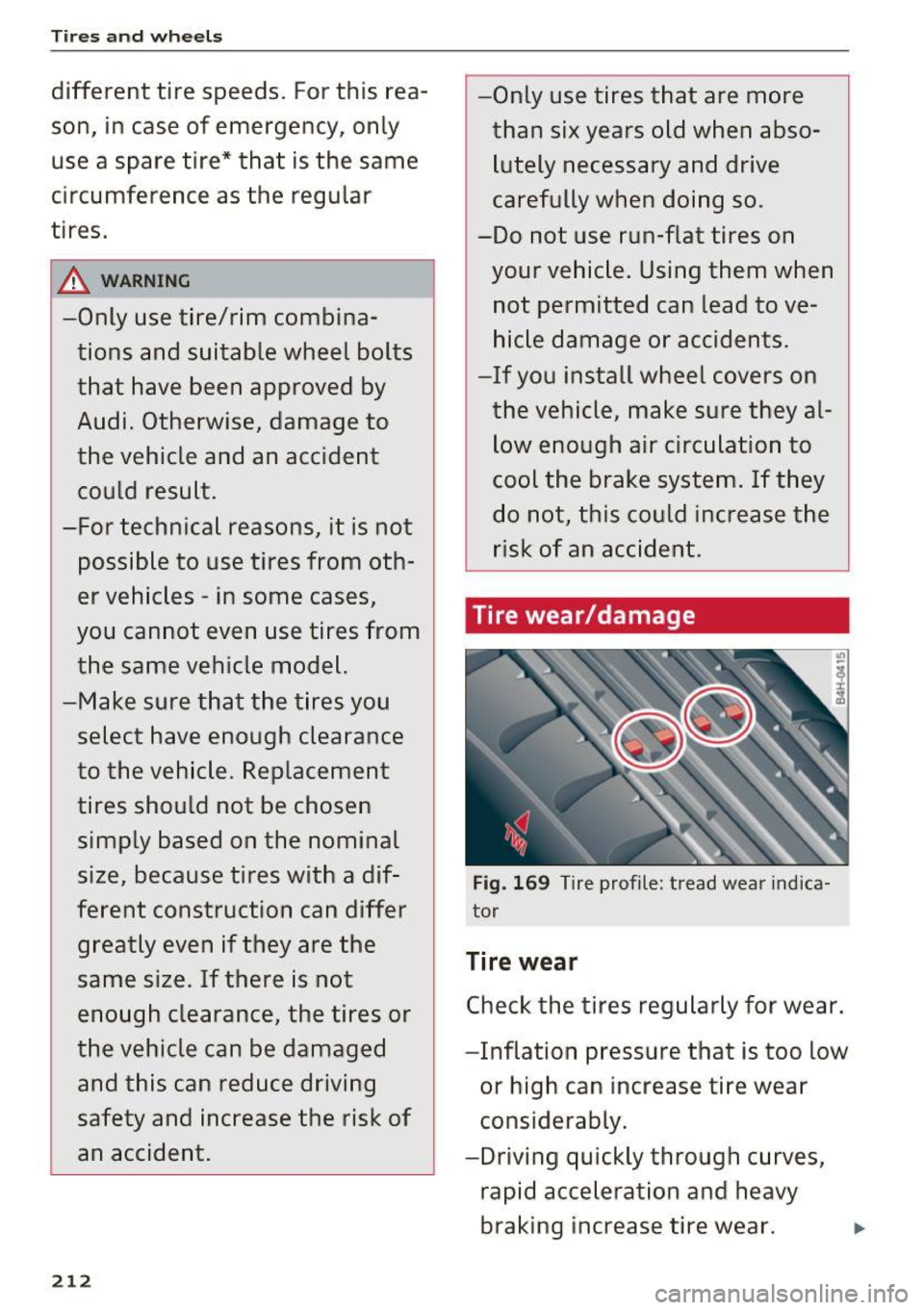
Fig. 169 Tire profile: tread wear indica
tor
Tire wear
Check the tires regularly for wear.
-Inflation pressure that is too low
or high can increase tire wear
considerably.
-Driving quickly through curves, rapid acceleration and heavy
braking increase tire wear. ..
Page 213 of 272
Tires and wheels
-Have an authorized Audi dealer wear evenly. To rotate wheels, in-
or authorized Audi Service Facili- stall the wheels from the rear
ty check the wheel alignment if axle on the front axle and vice
there is unusual wear. versa. This will allow the tires to
-Have the wheels rebalanced if an have approximately the
same
imbalance is causing noticeable length of service life.
vibration in the steering wheel.
For unidirectional tires, make
If you do not, the tires and other sure the tires are installed accord-
vehicle components could wear ing to the running direction indi-
more quickly. cated on the tire sidewall
Treadwear indicator ¢page 238.
Original equipment tires contain Hidden damage
treadwear indicators in the tread
Damage to tires and rims can of-
pattern, which are bars that are ten occur in locations that are
1/16 in. (1.6 mm) high and are
hidden. Unusual vibrations in the
spaced evenly around the tire per- vehicle or pulling to one side may
pendicular to the running di rec- indicate that there is tire damage.
tion
¢fig. 169. The letters "TWI"
Reduce your speed immediately.
or triangles on the tire sidewall Check the tires for damage. If no
indicate the location of the tread- damage is visible from the out-
wear indicators. side, drive slowly and carefully to
The tires have reached the mini- the nearest authorized Audi deal-
mum tread depth
l) when they er or authorized Audi Service Fa-
have worn down to the tread wear cility to have the vehicle inspect-
indicators . Replace the tires with ed.
new ones¢ &.
& WARNING
-
Wheel rotation Tread that has worn too low or
Rotating the wheels regularly is different tread depths on the
recommended to ensure the tires tires can reduce driving safety.
..
<( a:, ... N .... l) Obey
any applicable regulations in your N ... 0 .... country. > a:,
213
Page 214 of 272
Tires and wheels
This can especially have a nega
t ive effect on handling, on the
risk aquaplaning when driving
through water, when driving
through curves and when brak ing, which increases the risk of
an accident.
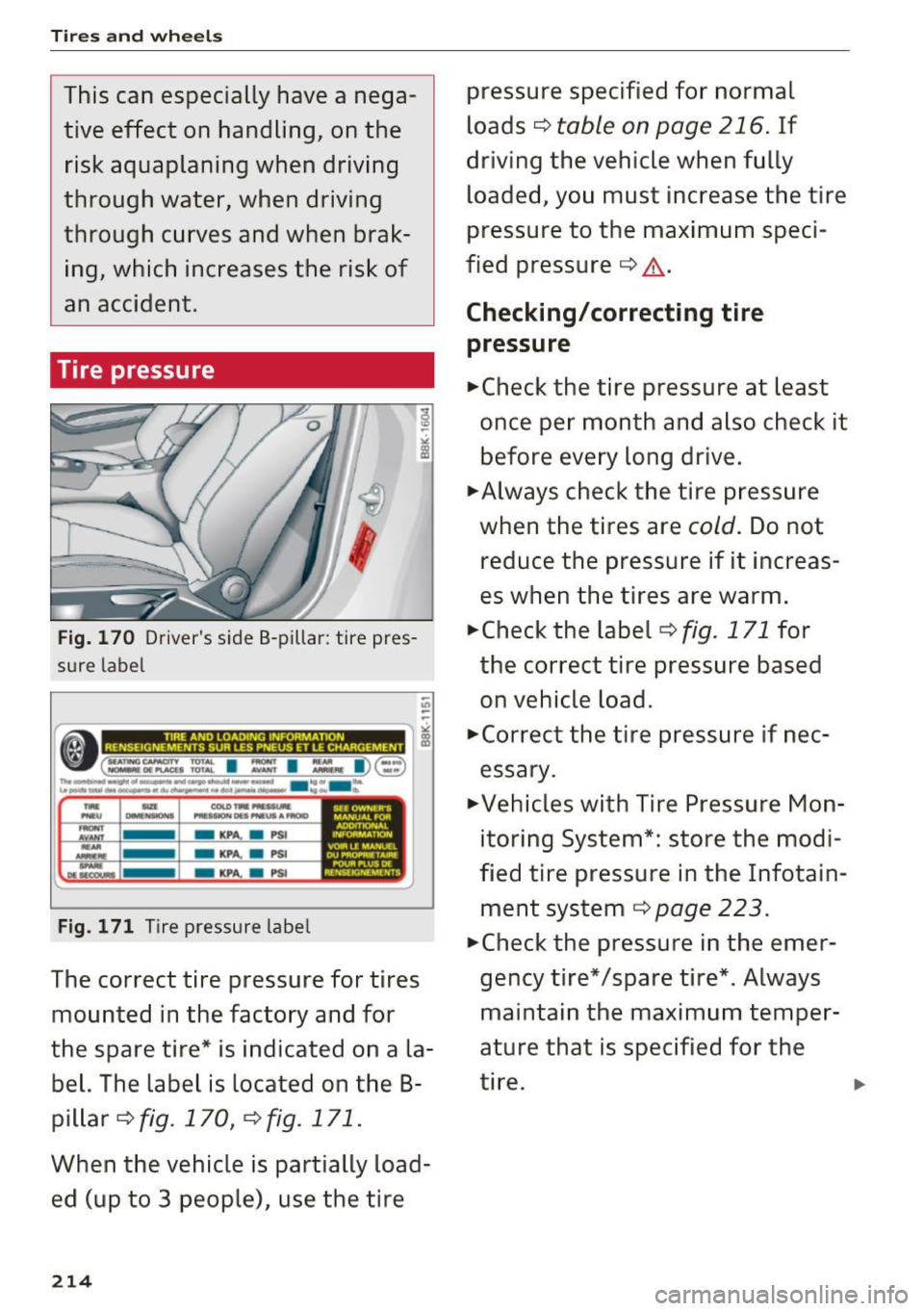
Tire pressure
Fig. 170 Dr iver's side 8-pillar: tire pres
sur e lab el
-"' -r,...-------------~
•c==. ~:t I :'.!: I :,. 1)§ l il! ................. .._.. ....................... .... . .. , '--................................ ,............ .... -.
TN 11D COt..O TN Nl&AUM. ,_U ~ ,,,...,..00,....AMOID
- KP aPSt
- KPA. a PSI
- KPA. a PSl
Fig. 171 Tire pressure label
SIE OWNl:llt'S MAN UAL FOR AD0010NAl 1NfOAMAT101-4 ~l[M.ANUCL DU PMCM"M T Al!IJ[ POW. ,tU$ Dl MNSC.JONlMtNTS
The correct tire pressure for tires
mounted in the factory and for
the spare tire* is indicated on a la
bel. The label is located on the B
pillar
¢fig. 170, ¢fig. 171.
When the vehicle is partially load
ed (up to 3 people), use the tire
214
pressure specified for normal
loads¢
table on page 216. If
driving the vehicle when fully loaded, you must increase the tire
pressure to the maximum speci
fied pressure ¢.&, .
Checking/correcting tire
pressure
.,.Check the tire pressure at least
once per month and also check it
before every long drive .
.,.Always check the tire pressure
when the tires are
cold . Do not
reduce the pressure if it increas
es when the tires are warm .
.,.Check the label ¢
fig. 171 for
the correct tire pressure based
on vehicle load.
.,.Correct the tire pressure if nec
essary .
.,.Vehicles with Tire Pressure Mon
itoring System*: store the modi
fied tire pressure in the Infotain
ment system ¢
page 223.
.,.Check the pressure in the emer
gency tire* /spare tire*. Always
maintain the maximum temper
ature that is specified for the
tire. .,.
Page 215 of 272
<( a:, ... N .... N ... 0
s: a:,
A WARNING
Always adapt the tire pressure
to your driving style and vehicle load.
-Overloading can lead to loss of
vehicle control and increase the risk of an accident. Read
and follow the important safe
ty precautions in¢
page 216,
Tires and vehicle load limits.
-The tire must flex more if the
tire pressure is too low or if
the vehicle speed or load are
too high. This heats the tire up
too much. This increases the risk of an accident because it
can cause the tire to burst and result in loss of vehicle con
trol.
-Incorrect tire pressure in creases tire wear and has a
Tire pressure table
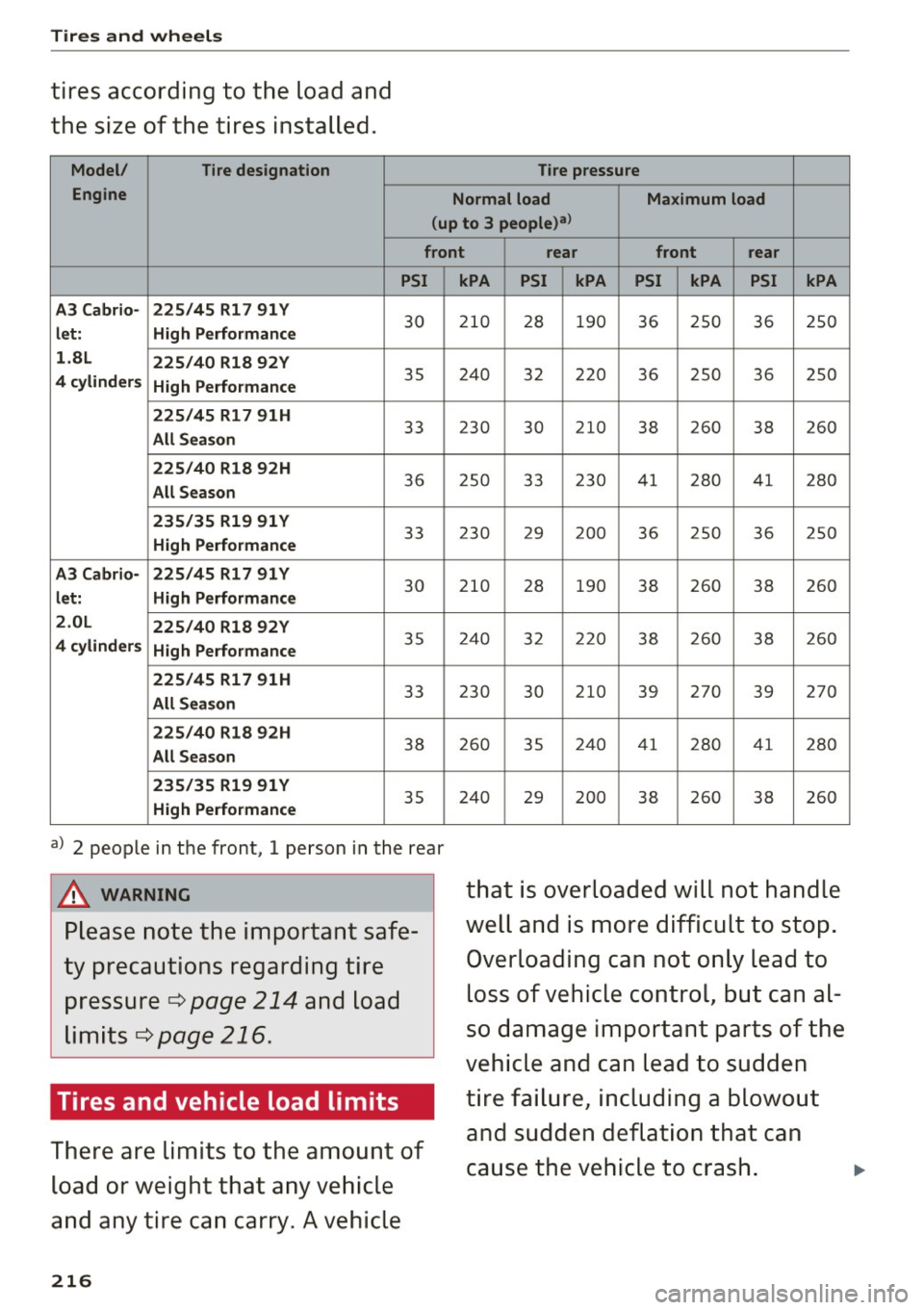
Please note that the information
contained in the following table
was correct at the time of print
ing, and the information is sub
ject to change. If there are differ
ences between this information
and the tire pressures specified
on the label on the driver's side B pillar, always follow the specifica-
Tires and wheels
negative effect on driving and
braking behavior, which in
creases the risk of an accident.
Replace lost valve caps to re
duce the risk of damage to the
tire valves.
@ For the sake of the environment
Tire pressure that is too low in
creases fuel consumption.
(1) Tips
Audi recommends using the
tire pressure specified for a normal load ¢
table on
page 216
or for a full load
when the vehicle is partially
loaded.
tion on the B-pillar label
¢ page 214, fig. 170.
Make sure that the tire designa
tion on your tire matches the des ignation on the tire pressure label
and the tire pressure table.
The following table lists recom mended tire pressures in cold
215
Page 216 of 272
Tires and wheels
tires according to the load and
the size of the tires installed.
Model/ Tire designation
Engine Tire pressure
Normal load Maximum load
(up to 3 people)
3>
front rear front rear
PSI
A3 Cabrio- 225/45 Rl7 91Y let: High Performance
30
l.8L
225/40 Rl8 92Y
4 cylinders High Performance
35
225/45 Rl 7 91H
All Season
33
225/40 Rl8 92H
All Season
36
235/35 Rl9 91 Y
High Performance
33
A3 Cabrio- 225/45 Rl 7 91 Y
let: High Performance
30
2.0L 225/40 Rl8 92Y
4 cylinders High Performance
35
225/45 Rl 7 91H
All Season
33
225/40 Rl8 92H
All Season
38
235/35 Rl9 91 Y
High Performance
35
a) 2 people in the front , 1 perso n in the rear
.&, WARNING
Please note the important safe
ty precautions regarding tire
pressure
¢ page 214 and load
limits
¢page 216.
Tires and vehicle load limits
There are limits to the amount of
load or weight that any vehicle
and any tire can carry. A vehicle
216
kPA PSI kPA PSI kPA PSI kPA
210 28 190 36 250 36 250
240 3 2 220 36 2 50 36 250
2 30 30 210 38 260 38 260
250 33 230 41 280 41 280
2 30 29 200
36 25
0
36 25
0
210 28 190 38 260 38 260
240 32 220 38 260 38 260
230 30 2 10 39 270
39 270
260 35 240 41 280 41 280
240 29 200 38 260
38 260
that is
overloaded will not handle
well and is more difficult to stop.
Overloading can not only lead to
loss of vehicle control, but can al
so damage important parts of the
vehicle and can lead to sudden
tire failure, including a blowout
and sudden deflation that can
cause the vehicle to crash.
Page 217 of 272
Your safety and that of your passengers also depends on making
sure that load limits are not ex
ceeded. Vehicle load includes ev
erybody and everything in and on
the vehicle. These load limits are
technically referred to as the vehi
cle's
Gross Vehicle Weight Rat
ing
("GVWR").
The "GVWR" includes the weight
of the basic vehicle, all factory in
stalled accessories, a full tank of
fuel, oil, coolant and other fluids
plus maximum load. The maxi
mum load includes the number of
passengers that the vehicle is in
tended to carry ("seating capaci
ty") with an assumed weight of
150 lbs. (68 kg) for each passen
ger at a designated seating posi
tion and the total weight of any luggage in the vehicle. If you tow
a trailer, the weight of the trailer
hitch and the tongue weight of
the loaded trailer must be includ
ed as part of the vehicle load.
The
Gross Axle Weight Rating
("GAWR") is the maximum load
that can be applied at each of the
vehicle's two axles .
; The fact that there is an upper
N
~ limit to your vehicle's Gross Vehi-
o
s: a:,
Tires and wheels
cle Weight Rating means that the
total weight of whatever is being
carried in the vehicle (including
the weight of a trailer hitch and
the tongue weight of the loaded
trailer) is limited. The more pas
sengers in the vehicle or passen
gers who are heavier than the
standard weights assumed mean
that less weight can be carried as
luggage.
The Gross Vehicle Weight Rating
and the Gross Axle Weight Rating
are listed on the safety compli
ance sticker label located on the driver's side B-pillar
9page 214,
fig. 170.
A WARNING
Overloading a vehicle can cause
loss of vehicle control, a crash
or other accident, serious per
sonal injury, and even death.
-Carrying more weight than your vehicle was designed to carry will prevent the vehicle
from handling properly and increase the risk of the loss of
vehicle control.
-The brakes on a vehicle that
has been overloaded may not
be able to stop the vehicle
within a safe distance.
217