service AUDI A3 CABRIOLET 2016 Workshop Manual
[x] Cancel search | Manufacturer: AUDI, Model Year: 2016, Model line: A3 CABRIOLET, Model: AUDI A3 CABRIOLET 2016Pages: 272, PDF Size: 67.88 MB
Page 194 of 272
Check ing and F illing
- After adding engine oil, the o il level must
not be above the marking@~
fig. 162, be
cause this increases the risk of cata lytic con
verter and/or eng ine damage. Do not start
the engine. Contact an authorized Audi
dealer or authorized Audi Service Fac ility to
have excess engine oil extracted if necessa
r y .
- Do not mix any additional lubricants into
the engine o il. Damage cause by such addi
tives is not cove red by the war ranty .
@ For the sake of the environment
-Engine o il should never enter the sewe r sys
tem or come into contact with the ground
under any circumsta nces.
- Pay attention to legal requirements when
d ispos ing of empty oil containe rs .
(D Tips
The engine oil consumption may be up to 0.5
quart/600 m iles (0.5 liter/1,000 km), de
pending on d rivi ng s tyle and operating condi
tions. Consumption may be higher du ring the
fi rst 3,00 0 miles (5, 000 km). Be cause of this,
t he engine oil leve l m ust be chec ke d r egular
ly. It wo uld be best to check each time you re
fue l your vehicle and before long drives .
Changing the engine oil
We recommend that hove your oil changed by an
authorized Audi dealer or a qualified service sta
tion .
Before you check a nyth ing in the eng ine compart
men t,
alway s read and heed all WARNINGS
~ page 188.
The engine oil must be changed accord ing to the
i n tervals specified in your Warran ty
& Mai nte
nance booklet . This is very importan t because the
lubricating p roperties of o il diminish gradually
during normal vehicle use.
Under some c irc ums tances the eng ine o il sho uld
be changed more frequently. Change oil more o f
ten if yo u drive most ly short distances, operate
the vehicle in dusty areas or under predominantly
stop-and-go traffic cond it ions, or have your vehi-
194
de where temperatures remain be low free zin g
for extended periods.
Dete rge nt additives in the oi l will make fres h oil
l ook dark a fter the engine has been r unning for a
short time . This is normal and is no t a reason to
change the oi l more often than recommende d.
Bec ause of t he pr oblem of prope r dispos al, along
with t he speci al tools and ne ce ssary expertise re
quired, we strongly recommend that yo u have
your oi l changed by an authorized
Audi dealer or
a q ua lified serv ice station .
If you choo se to change your oil your self , please
note the fo llowing important information:
_& WARNING
To reduce the risk of persona l injury if you
must change the eng ine oil in you r vehicle
yourself:
- Wear eye protect ion .
- To reduce the r isk o f bu rns from hot engine
oil, let t he engine cool down to the touch.
-
- When removin g the oil dr ain plug with yo ur
fingers, stay as far away as possible. Always
keep your forearm pa rallel to the gro und to
he lp prevent hot oil from running down your
arm.
- Drain the oil into a conta iner designed fo r
this purpose, one la rge enough to hold at
least the tota l amount of oil in your engine.
- Engine oil is poisonous. Keep it well out of
the reach of children .
- Continuous contact wit h used engine o il is
ha rmf ul to your skin . Always protect your
skin by washing oil off thoroughly with soap
and water .
{[) Note
Neve r mix oil additives with yo ur engine oil.
These additives can damage your engine and
adverse ly affect you r Audi Limited New Vehi
cle Warranty .
@) For the sake of the environment
-Be fore chang ing your oi l, first make sure
you know where you can p roperly dispose of
the used oil.
Ill-
Page 196 of 272
Check ing and F illing
Adding coolant
Req uirement: the re must be a res idual amo unt of
coo lant in the expansion tank¢(!) .
"' Let the engine coo l down.
"' Place a cloth over the coolant expans ion tank
cap and unscrew the cap counter cloc kwise
¢ &_ .
"'Add coolant mixed in the correct ratio
¢page 195 up to the upper marking .
"' Make sure that the fluid level remains stable.
Add more coo lant if necessary.
"' Close the cap securely.
A coolant loss suggests a leak. Immediately dr ive
your veh icle to an authori zed Audi dealer or au
thor ized Audi Service Facility and have the cool
ing system inspected . If the cooling system is not
leaking, a loss can come from the coolant boi ling
through overheating and be ing pushed o ut of the
coo ling system.
_& WARNING
T he coo ling sys tem is pres suriz ed a nd can be
come very ho t. To reduce the r is k of burns
from hot coolant :
- Do no t open the coo la nt expan sion tan k cap
with the engine ho t. There is a risk of burns .
- Stop the engine and allow it to cool.
- Prote ct your face, hands and arms from es -
c aping co o lant and steam by covering the
c oolant t ank cap with a large, th ick cloth.
- T urn the coo la nt tank cap co un terclo ckwise
slowly a nd kee p lig ht pressu re o n the cap .
- T o reduce the risk of burns, do not allow any
an tifreeze o r coolant to drip on to the ex
haus t sys tem or hot engine components.
T he ethylene glycol in eng ine coolan t can
catch fire under certain circumstances .
- T he coo lant add itive an d the cool ant can be
dange rous to you r healt h. For this reason,
keep the coolant in the o rigina l container
away from c hildren. There is a risk of poi
soning .
- When working in the engine compartment,
remember that the rad iator fan can switch
on even if the ign ition is switched off, which
increases the risk of personal injury .
196
(D Note
Do not add coo lant if the expansion tank is
empty. A ir cou ld enter the cooling system and
damage the eng ine. If this is the case, do not
continue driving. See an author ized Audi deal
e r o r a uthorized Audi Serv ice Facility fo r ass is
tance .
Radiator fan
The radia tor fan switches on au tomatically by it
self.
An a uxiliary e lectric radiator fan switches on and
off depend ing on coo lant temperature and other
vehicle ope rating conditions .
After yo u switch the engine off, the auxiliary fan
can continue running for up to 10 m inutes - even
with the ignit ion off.
It can even switch on aga in
l ate r by itself ¢.& , if
- the temperat ure o f the eng ine coolant rises due
to the heat build- up from the engine in the en
gine compartment, or
- the engine compartment heats up because the veh icle is parked in intense s unlight.
_& WARNING
- To reduce the r isk of personal injury never
to uch the radiator fan .
- The auxiliary e lectric fan is temperature
controlled and can switch on suddenly even
when the engine is not ru nning .
- The auxiliary radiator fan switches on auto
mat ica lly when the eng ine coolant reaches a
certain temperature and will continue to run
until t he coo lant tempe rature d rops.
-
Page 202 of 272
Check ing and F illing
with all environmental regulations. D isposing
of vehicle batteries improperly is very danger
ous to the env ironment .
Windshield washer
system
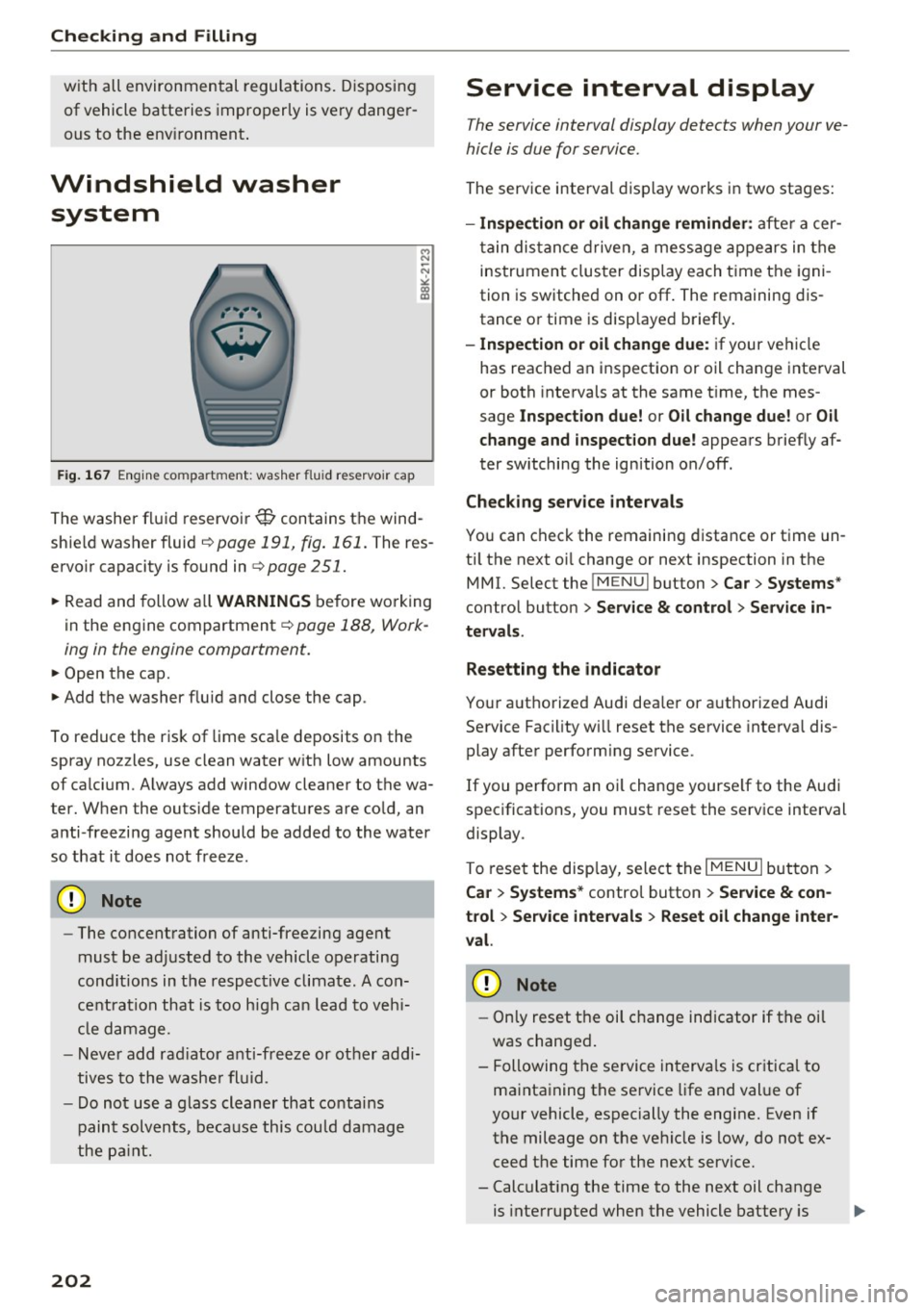
F ig. 16 7 Engin e co mpartment : washer fluid reservoir cap
"' N
-N
" 0:, lD
The washer flu id reservoir§ contains the wind
shie ld wash er fluid
¢ page 191, fig. 161. The res
ervoir capacity is found in
9 page 251.
.. Read and follow a ll WARNINGS before wo rking
in the engine compartment ¢
page 188, Work
ing in the engine compartment.
.. Open the cap .
.. Add the washer fluid and close the cap .
To reduce the risk of lime sca le deposits on the
spray nozzles, use clean water w ith low amounts
of calc ium . A lways add window cleaner to the wa
t er. When the outs ide temperatures are co ld, an
anti-freezing agent should be added to the water
so that it does not freeze .
(D Note
-The concentration of anti-freezing agent
must be ad justed to the vehicle operating
cond itions in the respect ive climate . A con
ce ntration that is too high can lead to veh i
cle damage.
- Neve r add rad iator ant i-freeze or ot her addi
tives to the washe r fl uid .
- Do not use a glass cleaner that conta ins
paint solvents, beca use this cou ld damage
the pa int.
202
Service interval display
T he service interval display detects when your ve
hicle is due for service.
The service interval display works in two stages :
-Inspe cti on or oil change reminder: afte r a cer-
tain dis tan ce dr ive n, a message appears in the
instrument cluster display each t ime the igni
tion is switched on or off . The remaining dis
tance or tim e is disp layed briefly.
- Inspection or oil change due : if your vehicl e
has reached an inspection or oil change inte rval
or both intervals at the same t ime, the mes
sage
Inspection due! or Oil change due! or Oil
change and inspection d ue!
appears briefly af
ter switching the ignition on/off.
Check ing ser vice inter vals
You can check the remaining d istance or t ime un
ti l the next oi l change or next inspection in the
MMI. Select the
i MENU I button> Car> Systems *
control button > Ser vice & control > Service in
tervals .
Resetting the indic ator
Your a uthorized Audi dea ler or authorized Audi
Service Facility w ill reset the service interva l dis
play after perform ing service .
If you perform an o il change yourse lf to the Audi
specifications, you must reset the service interval
display .
To rese t the disp lay, select the
I MENU I but ton>
Car > Systems * control button > Service & con
t rol > Service inter vals > Re set oil change inter ·
val.
(D Note
- Only reset the oil c hange indicator if the oi l
was changed .
- Following the service in terva ls is cr itica l to
mainta ining the se rvice life and val ue of
your vehicle, especially the engine. Even if
the mileage on the ve hicle is low, do not ex
ceed the time for the next service.
- Calculat ing the time to the next oil change
is inte rrupted when the vehicle battery is
Page 205 of 272

<( co .... N ,.__
N .... 0 ,.__
> co
(D Tires for passenger vehicles
(if applicable)
P indicates a tire for a passenger
vehicle. T indicates a tire desig
nated for temporary use.
@ Nominal width
Nominal width of the tire be
tween the sidewalls in millime
ters. In general: the larger the number, the wider the tire.
@ Aspect ratio
Height/width ratio expressed as a
percentage.
@ Tire construction
R indicates a radial tire.
® Rim diameter
Size of the rim diameter in inches.
@ Load index and speed rating
The load index indicates the tire's load-carrying capacity.
The speed rating indicates the maximum permitted speed¢.&
in
Winter tires on page 219.
"EXTRA LOAD", "xl" or "RF" indi
cates that the tire is reinforced or
is an Extra Load tire.
Speed rat- Maximum permitted speed
ing
p
up to 93 mph (150 km/h)
Q up to 99 mph (160 km/h)
Tires and wheels
Speed rat- Maximum permitted speed
ing
R up to 1 06 m ph (170 km/h)
s up to 110 mph (180 km/h)
T up to 118 mph (190 km/h)
u up to 124 mph (200 km/h)
H up to 130 mph (210 km /h)
V up to 149 mph (240 km/h)al
z above 149 mph (240 km/h)al
w up to 168 mph (270 km/h)al
y up to 186 mph (300 km/h)al
a ) Tire manufacturers sometimes use "ZR"
for tires with a maximum speed above
149 mph (240 km/h).
(j) US DOT number (TIN) and
manufacture date
The manufacture date is listed on
the tire sidewall (it may only ap
pear on the inner side of the tire):
DOT ... 2215 ...
means, for example, that the tire
was produced in the 22nd week of
the year 2015.
@ Audi Original equipment
tires
Audi Original equipment tires
with the designation "AO" or "RO"
have been specially matched to
your Audi. When used correctly,
these tires meet the highest standards of safety and handling.
An authorized Audi dealer or au
thorized Audi Service Facility will ""
205
Page 211 of 272
<( a:, ... N .... N ... 0
s: a:,
Occupant loading and distri
bution for vehicle normal load
for various designated seating
capacities
Refer to the tire inflation pres
sure label
c::> page 214, fig. 171
for the number of seating posi
tions. Refer to the table
c::> table
on page 216
for the number of
people that correspond to the ve
hicle normal load.
New tires or wheels
Audi recommends having all work
on tires or whee ls perfo rmed by
an authorized Audi dealer or au
thorized Audi Service Facility .
These facilities have the proper
knowledge and are equ ipped with
the required tools and replace
ment parts .
.,,. New tires do not yet have the
opt imum adhesion properties.
Drive carefully and at moderate
speeds for the first 350 m iles
(500 km) with new tires .
.,,. On ly use tires w ith the same de
sign, size (rolling c ircumference)
and as close to the same tread pattern as possible on all four
wheels.
Tire s and wheel s
.,,.Do not replace tires individually.
At least replace both tires on the same axle at the same time .
.,,. Audi recommends that you use
A udi Original equipment tires. If
you would like to use different
tires, please note that the tires may perform differently even if
they are the same si ze
c::> ,&. .
.,,. If you would like to equip your
vehicle w ith a tire/r im comb ina
tion that is different from what
was installed at the factory, con
sult w ith an authorized Audi
dealer or authorized Audi Service
Facility before making a pur
chase ¢
..1,..
The spare t ire* is diffe rent from
the regular tires installed on the
vehicle - for example, if winter
tires or wide tires are installed -
then only use the spare tire* tem
porarily in case of emergency and
drive carefully while it is in use . It
should be replaced with a regular
tire as soon as possible.
On
all wheel d rive vehicles, all
four wheels must be equipped
with tires that are the same brand
and have the same construction
and tread pa ttern so that the
drive system is not damaged by
2 11
Page 213 of 272
Tires and wheels
-Have an authorized Audi dealer wear evenly. To rotate wheels, in-
or authorized Audi Service Facili- stall the wheels from the rear
ty check the wheel alignment if axle on the front axle and vice
there is unusual wear. versa. This will allow the tires to
-Have the wheels rebalanced if an have approximately the
same
imbalance is causing noticeable length of service life.
vibration in the steering wheel.
For unidirectional tires, make
If you do not, the tires and other sure the tires are installed accord-
vehicle components could wear ing to the running direction indi-
more quickly. cated on the tire sidewall
Treadwear indicator ¢page 238.
Original equipment tires contain Hidden damage
treadwear indicators in the tread
Damage to tires and rims can of-
pattern, which are bars that are ten occur in locations that are
1/16 in. (1.6 mm) high and are
hidden. Unusual vibrations in the
spaced evenly around the tire per- vehicle or pulling to one side may
pendicular to the running di rec- indicate that there is tire damage.
tion
¢fig. 169. The letters "TWI"
Reduce your speed immediately.
or triangles on the tire sidewall Check the tires for damage. If no
indicate the location of the tread- damage is visible from the out-
wear indicators. side, drive slowly and carefully to
The tires have reached the mini- the nearest authorized Audi deal-
mum tread depth
l) when they er or authorized Audi Service Fa-
have worn down to the tread wear cility to have the vehicle inspect-
indicators . Replace the tires with ed.
new ones¢ &.
& WARNING
-
Wheel rotation Tread that has worn too low or
Rotating the wheels regularly is different tread depths on the
recommended to ensure the tires tires can reduce driving safety.
..
<( a:, ... N .... l) Obey
any applicable regulations in your N ... 0 .... country. > a:,
213
Page 219 of 272

<( co .... N r--N .... 0 r--> co
the availab le cargo an d lug
gage loa d capaci ty o f yo ur vehi
c le.
.,,. Chec k the tire s idewall
(¢ page 204 , fig. 16 8) to deter
min e th e des ig nate d lo ad ratin g
for a speci fic tir e.
Wheel bolts and rims
Wheel b olts
Wheel bolts must be clean and loosen/t ighten
eas ily.
Rims
R ims with a bolted rim ring* or w ith bolted wheel
covers* consist of mu ltip le pieces . These compo
n ents we re bolted toge ther using specia l bolts
and a specia l procedure . You must not repair or
disassemble them¢
A.
A WARNING
-
Wheel bolts that are tightened or repaired in
correctly can become loose and result in loss
of vehicle control, which increases the risk of
an acc ident. For the correct tightening specif i
cation, refer to¢
page 235, After changing a
wheel .
-Always keep the wheel bolts and the
threads in the wheel hub clean and free of
grease.
- Only use wheel bolts that fit the rim.
-Always have damaged r ims repaired by an
authorized Audi dealer or authorized Aud i
Service Facility. Never repair or d isassemble
rims yourself, because this increases the risk
of an accident.
Winter tires
W inter tires s ignificantly improve the vehicle's
h andling w hen d riving in w inter condit ions. Be
cause of the ir constr uction (width, compound,
tread pattern), summe r tires provide less trac
tion on ice and snow.
Tir es and wheel s
.. Use winter tires on all four wheels.
.. On ly use winter tires that are approved for your
veh icle.
.. Please note that the maximum permitted
speed may be lower with winter tires¢,&. An
author ized Audi dealer or authorized Audi Serv
ice Facility can inform you about the maximum
perm itted speed for your t ires .
.. Check the tire p ressure afte r insta lling wheels
¢ page 214.
The effectiveness of winter tires is reduced great
ly when the tread is wo rn down to a depth of
0.157 i nch (4 mm). The characte ris tics of winter
t ir es also decrease g reatly as the ti re ages, re
gard less of the rema ining t read.
A WARNING
-- Never drive faster than the max imum per
mitted speed for your tires . This could cause
the t ires to heat up too much. This increases
the risk of an accident because it can cause
the t ire to burst.
- Always adapt your driving to the road and
traffic cond itions. Drive carefully and reduce
your speed on icy or slippery roads . Even
winter t ires can lose tract ion on black ice .
(® For the sake of the environment
Reinstall summer tires at the appropr iate
time, because they prov ide better handling
when roads are free of snow and ice. Summer
tires cause less road no ise, tire wear and fue l
consumpt ion.
(D Tips
You can also use all season tires instead of
winter tires. Please note that in some coun
tries where winter tires are required, on ly
winter tires w ith the
& symbo l may be per
mitted.
Snow chains
Snow chains improve traction in the snow.
.. Only install snow chains on the front wheels .
This applies a lso to vehicles with a ll wheel
drive*.
219
Page 220 of 272

Tires and wheels
"' Check and cor rect the seating of the snow
c h ains if necessa ry after dr iving a few feet. Fo l
l ow the instructions from the manufacturer .
"' Note the maximum permitted speed when d riv
i ng with snow chains. Do not exceed 30 mp h
(SO km/h) .
Snow chains not only improve the
driving in win
ter road conditions, but also the
broking .
Use of snow cha ins is o nly pe rmitted with certain
rim/t ire combinations due to tec hnical reasons .
C hec k with an authorized A udi dealer o r autho r
i z ed Audi Service Fac ility to see if yo u may use
snow cha ins.
Use
fine-mesh snow chains . They must not add
mo re t han 0.53 inch (13.5 mm) in height, includ
i n g the chain loc k.
You must remove the c hains when d riving on
roads that are
free of snow . W hen roads a re free
of snow, snow c hains ca n impair handling and
damage the ti res, and the chai ns w ill quickly be
destroyed.
A WARNINC
Us ing inco rrect snow c hains or insta lling snow
c hai ns inco rre ctl y can resul t in loss o f vehicle
c o ntro l, w hich incr ease s th e ris k of an a cci
d ent .
(D Note
Snow chains can damage th e rims/wheel cov
ers* i f the cha ins come in to d irect contact
w it h t hem. R emove the w heel c overs* first .
U se coat ed sn ow cha ins.
Low aspect ratio tires
Your Au di is fac to ry-equipped wi th low aspec t ra
tio tires . These ti res have been tho roughly tested
a nd been se lected specifically fo r yo ur model fo r
their supe rb per fo rmance, road feel and handling
un der a variety of driving conditions . As k yo ur au
thor ized Audi dealer for mo re details.
The low aspect ratio of these t ires is i ndicated by
a numeral of
55 or less in t he tire's size designa
tion. The nume ra l rep resents the rat io of the
tire's sidewall he ight i n relat io n to its tread width
220
exp ressed in perce nta ge . Conventiona l tir es h ave
a height/width ratio of 60 or more.
The performance of low-aspect -ratio tires is par
ticularly sensitive to improper inflation pres
sure. It is therefore important that low aspect ratio tires are inflated to the specified pressure
and that the inflation pressure is regularly
checked and maintained. Tire pressures should
be checked at least once a month and always
before a long trip
r=> pog e 214.
What you can do to avoid tire and rim
damage
Low aspect ratio tires can be damaged more eas i
l y by impact with potho les, curbs, gullies or
r idges on the road, particularly if the tire is un
der inflated .
In orde r to min imize the occur rence of impact
damage to the tires of you r vehicle, we recom
mend that you observe the following preca u
tions:
- Always ma intain recommended inflation pres
sures. Check you r tir e pressure every
2,000 miles (3,000 km) and add a ir if necessa
ry.
- Dr ive ca refully on roads w it h potholes, deep
gu llies o r ridges . Th e impac t from dr iv ing
t hroug h or over such o bstacl es ca n da mage
your tire s. I mpac t w ith a curb may also cau se
d am age to yo ur ti re s.
- After any impac t, imme diate ly inspect you r
t ire s or h ave them inspe cted by t he nea rest a u
t hori ze d Audi d ealer. Repl ace a dama ged t ire as
soon as possible.
- Ins pect your tir es eve ry 2,00 0 m iles (3,0 00 k m)
for dama ge and wear. Dam age is no t always
easy to see . Damage can lead to loss of a ir and
unde rinflation, w hich coul d event ua lly cause
tire fa ilure. If yo u be lieve that a tire may have
been damaged, replace the tire as soon as pos
sible .
- These tires may wear mo re quick ly than others.
- Please also remember that, while t hese tires
delive r responsive hand ling, they may ride less
comfortably and make mo re noise than other
choices. ""
Page 221 of 272
<( co .... N r--N .... 0 ,.__
> co
Reduced performance in winter /cold season
conditions
All tires are designed for certain purposes. The
low aspect ratio, ultra high performance t ires
originally installed on your vehicle are intended
for maximum dry and wet road performance and handling . They are not suitable for cold, snowy or
i cy weather cond it ions. If you dr ive under those
circumstances, you shou ld equ ip your vehicle
with all-season or winter tires, whic h offe r better
traction under those conditions. We suggest you
use the recommended snow or all-season tires
specified for you r vehicle, or their equivalent.
Refer to¢
page 219 for more detailed informa
tion regarding winter tires.
Uniform tire quality grading
-Tread wear
- Traction AA A B C
- Temperature ABC
Quality grades can be found where applicable on
the tire side wall between tread shoulder and
maximum section w idth ¢
page 204, fig . 168 .
For example: Tread wear 200, Traction AA, Tem
perature
A .
All passenger car tires must conform to Federal
Safety Requirements in addition to these grades.
Tread wea r
The tread wear grade is a comparative rating
based on the wear rate of the tire when tested
under contro lled conditions on a specified gov
ernment test course.
F or example, a tire graded
150 would wear one
and one ha lf
( 1 1/2) times as well on the govern
ment course as a tire graded
100.
The relative performance of tires depends upon
the actual conditions of their use, howeve r, and
may depart significantly from the norm due to
variations in driving habits, service practices and
differences in road characteristics and climate.
Traction
The traction grades, from highest to lowest, are
AA, A, B and
C. Those grades represent the tire's
Tires and wheels
ability to stop on wet pavement as measured un
der controlled conditions on specified govern
ment test surfaces of asphalt and concrete. A tire
marked C may have poor traction performance
¢ &.
Temperature
The temperature grades are A (the highest), B,
and
C, representing the tire's resistance to the
generation of heat and its ability to dissipate
heat when tested under controlled conditions on
a specified indoor laboratory test wheel.
Sustained high temperature can cause the mate
rial of the tire to degenerate and reduce tire life,
and excessive temperature can lead to sudden
tire failure¢ &.
The grade
C corresponds to a level of perform
ance which all passenger car tires must meet un
der the Federal Motor Vehicle Safety Standard
No.
109 . Grades Band A represent higher levels
of performance on the laboratory test wheel than
the minimum required by law.
&, WARNING
The traction gra de assigned to this tire is
based on straight-ahead braking traction
tests, and does not include acceleration, cor
nering, hydroplaning or peak traction charac
teristics.
.&_ WARNING
= -
The temperature grade for this tire is estab lished for a tire that is properly inflated and
not overloaded. Excessive speed, underinfla
tion, or excessive loading, either separately or
in comb inat ion, can cause heat buildup and
possible tire failure .
.&_ WARNING
--
Temperature grades apply to tires that are
properly inflated and not over or underinflat
ed.
221
Page 223 of 272
<( co .... N r--N .... 0 r--> co
Indicat or lights
IE -Loss of pressure in at least one ti re c::> ,& .
Check the tires and replace or repair if necessary.
Check/correct the pressures of all four tires. Then
store the tire pressures in the MMI
<=:>page 223.
mm (T ire Pressure Monitoring System) Tire
press ure: System malfuncti on!.
Ifm appears
after switching the ignition on or whi le driving
and the
IE indicator light in the instrument clus
ter blinks for approximately one minute and then
stays on, there is system malfunction . Try to
store the correct tire pressures
c::> page 223 . If
the indicator light does not turn off or turns on
again after a short period of time, drive to an au
thor ized Audi dealer or authorized Audi Service
Faci lity immediately to have the malfunction cor
rected.
A WARNING
- If the tire pressure warning light IE in the
instrument cluster turns on, the pressure in
one or more tires is too low . Reduce the ve
hicle speed immediately and avo id any hard
steering or braking maneuvers. Stop as soon as possible, check the tire and inflate the
t ire to the correct pressure, which is speci
fied on the tire pressure label on the veh icle
<=:> page 214. Driving w ith a t ire with low
pressure c auses the t ire to overheat and can
result in failure of the tire . Low pressure can
also have a negative effect on the driving
and braking behavior of the vehicle .
- T he driver is responsib le for maintaining the
correct tire pressures . You must check the
tire pressures regularly .
- Under certain conditions (such as a sporty
driv ing style, winter conditions or unpaved
roads), the pressure monitor indicator may
be delayed.
- Do not use run-flat tires on your vehicle . Us
ing them when not permitted can lead to
vehicle damage or accidents .
(D Tips
-The tire pressure monitoring system can al
so stop working when there is an ESC mal
function.
Tir es and wheel s
- Us ing snow chains may result in a system
ma lfunction.
- The tires with the identification "AO" or
"RO"
c::> page 211 have been matched with
your Audi tire pressure monitoring system .
We recommend that you use these tires.
- The tire pressure monitoring system can on
ly monitor the tire pressure of the driving
tires. Check the tire pressure of the spare
wheel in the luggage compartment so that if necessary it is ready for use.
Storing tire pressures
App lies to : vehicles wi th Tir e Pressure Mo nito rin g Sys te m in
dic ator
A change in tire pressur e or a change in tires
must be stored in the syst em .
The tire press ure is stored in the MM I.
.,. Make sure before storing that the t ire pressures
of all four tires meet the specified values and
are adap ted to the load. O therwise the system
could malfunction
c::> page 214.
.. Switch on the ignition.
.,. Select: the I MENU I button> Ca r> Sys tem s*
con trol button > S er vice & control > Tire pre s
s u re m on itor > Stor e tire pressu re > Yes , sto re
no w.
(D Tips
Do not store the tire pressures if snow chains
are installed. Otherw ise the system could
malfunction.
223