tab area AUDI A3 SEDAN 2018 User Guide
[x] Cancel search | Manufacturer: AUDI, Model Year: 2018, Model line: A3 SEDAN, Model: AUDI A3 SEDAN 2018Pages: 404, PDF Size: 62.3 MB
Page 206 of 404
Navigat ion
-If a contact is grayed out in the directory,
this contact has neither a destination nor an
address assigned to them.
Point of interest search
Applies to: ve hicles w ith navigation system
.. Press the I NAV /MAPI bu tton repeatedly until
t he
E nte r d estination menu is displayed
¢page 201 , fig . 1 82 .
.. Select : left cont rol button > Point s of intere st.
-C hanging the search area : select and confirm
Sear ch ar ea > a search area from the list .
The following search categories are avai lab le:
Nearb y: points o f interes t can be sele cted from
different categories . The points o f interest are
list ed starting from the immediate vicinity of the
vehicle up to a radi us of approximate ly 124
miles (200 km).
Along the route: points of inte rest a long the
route can on ly be select ed during active rout e
gu idance. The points of interest are located d i
rect ly along or in the immediate vicinity of the
calcul ated route. The points of interest can like
wise be selected from various categor ies . For ex
ample, you can search for a hotel or park ing lot
at the destination .
Near destin ation /Near stopo ver : po ints of inter
est near a destination or a stopover can only be
selected dur ing active route guidance . T he poi nts
of interest can likewise be se lected from va rious
ca tegor ies. For examp le, you ca n search fo r a ho
tel or parking lot a t the destination.
In new city : select a country/state or searc h in a
new c ity . Ente r the name of the des ired c ity .
P oints of i nte rest can be selected from var ious
ca tegor ies. Th is f unction allows you to searc h for
points of interes t in any ci ty regardless of the ac
tive route guidance or the vehicle position.
-Sea rch for a p oint of inter est name in these
lec ted search are a:
en ter the name of the po int
of inte rest .
-Sear ching f or a poin t of inter est in a specifi c
ca tegory :
select Select cat egory . Select and
confirm a ca tegory such as
Restaurant s.
204
(D Tips
-Distances to points of interest are displayed
as a stra ight -line d istance from your current
location. The actual d istance from your cur
rent location to the point of interest is up
dated automatically. The list of found
points of interest is not resorted when this
happens.
-T here may be entr ies in the l ist that cannot
be displayed comp letely due to t heir length .
Select the cor respond ing ent ry from the
list. Select: r ight cont rol b utton> Show des
ti na tion det ails. De tailed informa tion fo r
the se lected entry in the list is then dis
played .
Online point of interest search (online
search)
App lies to: vehicles wit h a navigation system and Audi co n
nect (Infota inment)
You can search for points of interest on the In
t e rnet .
Requirement: the requirements for Aud i connect
(Infotai nment) must be met
¢ page 190 .
.. Press the I NAV/MAPI button repeatedly until
the
Enter des tination me nu is displayed
~ page 201, fig. 182 .
.. Select: left control button > Online sear ch . Th e
searc h area last set is displayed in the inpu t
fie ld .
-C hanging the search area : select: right cont rol
bu tton >
S elect sear ch are a.
-Searching for onlin e destinations in thes e
l ec ted search ar ea :
ente r a new c ity/state if
necessary. En ter the search term, such as hotel.
Press the contro l knob. Se lect and confirm an
online destination from the list.
-Sea rching for online de stinations in a specific
categor y:
se lect and confirm Sele ct category.
Select and confirm a category such as Re stau
rants .
Find w hich search areas are avai lab le under
¢ page 204 , Point of interest search .
You can search for online destinations using the
vo ice recog nitio n
sys tem ¢ table on page 173. .,..
Page 219 of 404
LL co ..... N
" N ..... 0 N > co
e-tron navigation
functions
Electric range
Applies to: vehicles with plug- in hybrid drive
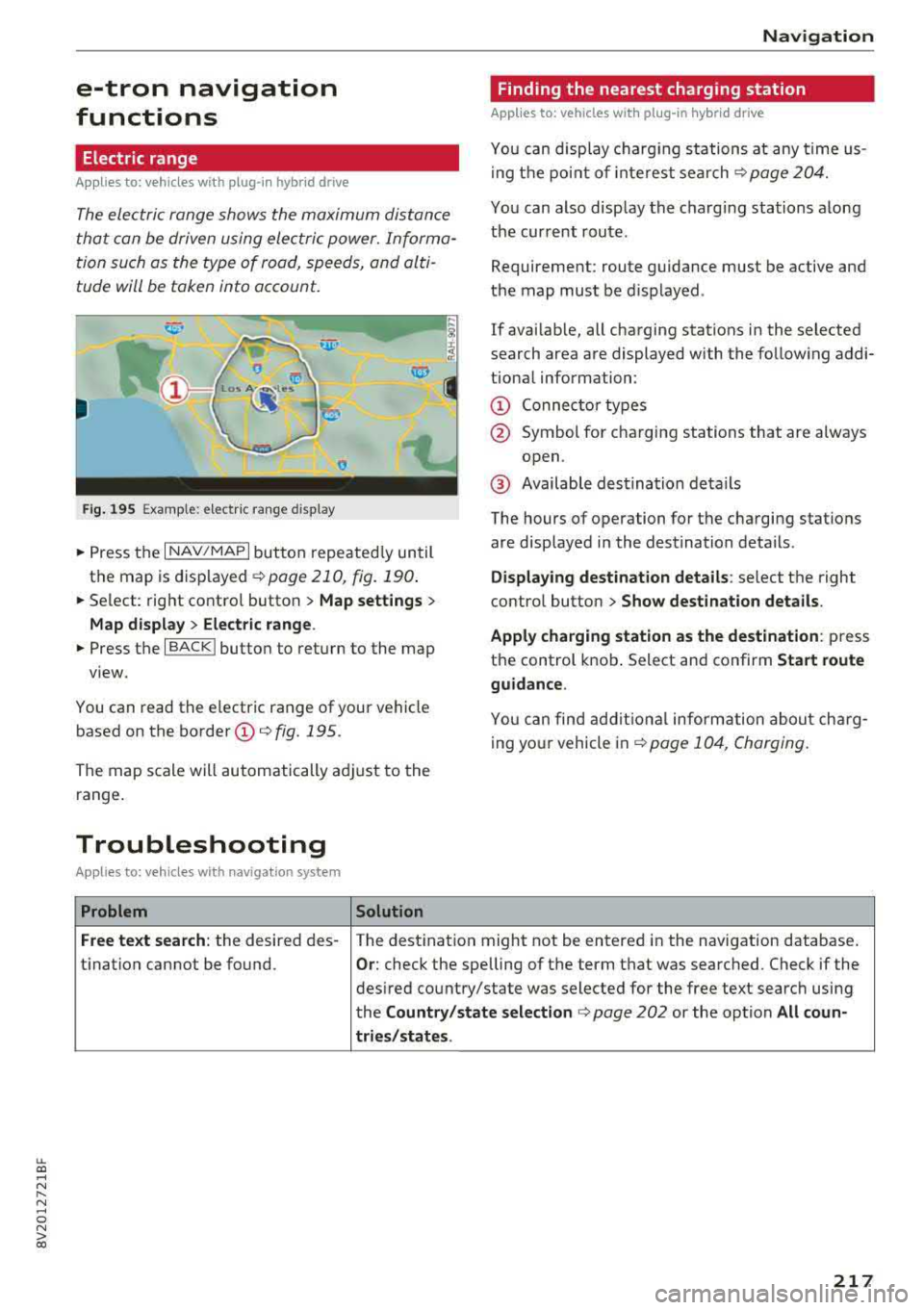
The electric range shows the maximum distance
that con be driven using electric power. Informa tion such as the type of rood, speeds, and alti
tude will be token into account.
Fig. 195 Example: e lectric range display
• Press the I NAV/MAPI button repeated ly un til
the map is displayed ¢
page 210, fig. 190 .
• Select: right contro l button > Map set tings >
Map display > Elect ric range .
• Press the I BACK I button to return to the map
view.
You can read the electric range of your vehicle
based on the border
(D ¢ fig. 195.
The map scale will automatically adjust to the
range .
Troubleshooting
Applies to: vehicles with navigation system
Problem Solution Na
viga tion
Finding the nearest charging station
Applies to: vehicles with plug -in hybrid drive
You can display charg ing stations at any time us
i ng t he po int of interest search
¢page 204.
You can also display the charging stations along
the cur rent route.
Requirement: route guidance must be active and
the map must be d isplayed .
If avai lab le, all charging stations in the selected
search area are displayed with the fo llow ing addi
tiona l information:
(D Connec to r types
@ Symbol for charging stations that are always
open.
@ Available destination deta ils
The hours of operation for the charging stations
are displayed in the destination details .
Displa ying destination detail s: se lect th e right
contro l button
> S how destination details .
Apply charging station a s the destinat ion:
p ress
the control knob. Select and confirm
Sta rt route
guidance .
You can find add it iona l information about charg
ing yo ur vehicle in
~ page 104, Charging.
Free te xt sear ch : the desired des- The destination might not be entered in the navigation database .
t i nation cannot be found .
Or: check the spelling of the term that was searched. Check if the
des ired country/state was selected for the free text search using
the
Count ry /s tate select ion ¢ page 202 or the option All coun-
tries /state s.
217
Page 253 of 404
u. 00 .-< N l' N .-< 0 N > 00
-Pointing the steering wheel toward your
face decreases the ability of the supplemen
tal driver's airbag to protect you in a colli sion.
- Always sit in an upright position and never
lean against or place any part of your body
too close to the area where the airbags are
located.
- Before driving, always adjust the front seats
properly and make sure that all passengers
are properly restrained.
- For adjustable head restraints : before driv
ing, always also adjust the head restraints
properly.
- Never adjust the seats while the vehicle is moving . Your seat may move unexpectedly
and you could lose control of the vehicle.
- Never drive with the backrest reclined or
tilted far back! The farther the backrests are
tilted back, the greater the risk of injury due
to incorrect positioning of the safety belt
and improper seating position.
- Children must always ride in child seats
~ page 294. Special precautions apply
when installing a child seat on the front
passenger seat
i::> page 269 .
Proper seating position for the front
passenger
The proper front passenger seating position is
important for safe, relaxed driving.
For your own safety and to reduce the risk of in
jury in the event of an accident, we recommend that you adjust the seat for the front passenger
to the following position:
.. Adjust the angle of the seatback so that it is in
an upright position and your back comes in full
contact with it whenever the vehicle is moving.
.. For adjustable head restraints: adjust the head
restraint so the upper edge is as even as possi
ble with the top of your head. If that is not pos
sible, try to adjust the head restraint so that it
is as close to this position as possible
~ page 61. Move the head restraint so that it is
as close to the back of the head as possible.
Driving safety
.. Keep both feet flat on the floor in front of the
front passenger seat.
.. Fasten and wear safety belts correctly
<=:>page 264.
For detailed information on how to adjust the
front passenger's seat, see
<=:>page 59.
A WARNING
= -
Front seat passengers who are unbelted, out
of position or too close to the airbag can be
seriously injured or killed by the airbag as it
unfolds . To help reduce the risk of serious
personal injury:
- Passengers must always sit in an upright po
sition and never lean against or place any part of their body too close to the area
where the airbags are located.
- Passengers who are unbelted, out of posi
tion or too close to the airbag can be seri
ously injured by an airbag as it unfolds with
g reat force in the blink of an eye.
- Always make sure that there are at least
10 inches (25 cm) between the front pas
senger's breastbone and the instrument panel.
- Always make sure that there are at least
4 inches (10 cm) between the front passen
ger's knees and the lower part of the instru
ment panel.
- Each passenger must always sit on a seat of
their own and properly fasten and wear the
safety belt belonging to that seat.
- Before driving, always adjust the front pas
senger seat properly.
- For adjustable head restraints: before driv
ing, always also adjust the head restraints
properly .
- Always keep your feet on the floor in front
of the seat. Never rest them on the seat, in
strument panel, out of the window, etc. The
airbag system and safety belt will not be
able to protect you properly and can even in
crease the risk of injury in a crash .
- Never drive with the backrest reclined or
tilted far back! The farther the backrests are
tilted back, the greater the risk of injury due
~
251
Page 255 of 404
u. 00 .-< N l' N .-< 0 N > 00
-Every person in the vehicle must have a
properly adjusted hea d restra int.
- Always make sure each person in the vehicle
properly adjusts their head res traint. Adjus t
t h e head restra int so the upper edge is as
even as possib le with the top of your head.
If that is not possib le, try to adjust the h ead
restra int so that it is as close to th is position
as possib le.
- Applies to: forward/back adjustable head
restra ints: Move the head restra int so that it
is as close to the back of the head as possi
ble.
- Never attempt to adjust head restra int
wh ile driving. If you have dr iven off and
must adjust the dr iver head rest for any rea
son, first s top the veh icle sa fely before at
tempting to ad just the head restraint .
- C hildren mus t always be p roperly res trained
in a ch ild restraint that is appropriate for
their age and size
i::> page 294.
Examples of improper seating positions
The occupant restraint system con only reduce
the risk of injury if vehicle occupants ore properly
seated.
I mp roper seating posi tions can cause se rious in
ju ry o r death. Safety bel ts can only work when
they are p roperly positioned on the body. Im
proper seating positions reduce the effectiveness
of safety belts and w ill even increase the r is k of
in ju ry and death by moving the safety belt to crit
ical areas of t he body. Improper seating posit ions
also increase the risk of ser ious injury and death
when an airbag deploys a nd strikes an occupant
who is not i n the prope r seat ing pos ition . A d rive r
i s respons ib le for the safety of all vehicle occu
pants and especia lly fo r children. Therefo re:
"" Never allow anyone to assume an incorrect
seat ing pos it ion when t he ve hicle is being used
i::, & -
The follow ing bulletins list only some sample po
sitions that will increase the risk of serious in jury
a nd death. O ur hope is that these examp les w ill
make you more aw are of sea ting pos it io ns tha t
ar e dange ro us.
Dri ving saf ety
Th erefore , whenever the vehicle is moving :
-neve r st an d up i n the vehicle
- neve r stand on the seats
- neve r kneel on the seats
- never ride wit h the seatback recl ined
- neve r lie down on the seats
- never lean up against the instrument panel
- never sit on t he edge of the seat
- neve r sit sideways
- neve r lean out t he window
- neve r put your feet out the wi ndow
- never put your feet on the instrument panel
- neve r rest your feet on the seat cushion or back
of the seat
- never ride in the footwell
- never ride in the cargo area
A WARNING
--
Improper seating positions inc rease the risk
of ser ious personal in ju ry and death whenever
a veh icle is being used.
- Always make sure that all veh icle occupants
stay in a proper seating posit ion and are
proper ly restrained whenever the vehicle is
be ing used.
Driver's and front
passenger's footwell
Important safety instructions
Applies to : vehicles wit h knee airbags
A WARNING
Always ma ke su re t hat the knee airbag can i n
fl ate w ithout interfe rence. Objects between
yourself and the airbag can in cre ase the risk
of inju ry in an accident by interfering with the
way the ai rbag dep loys o r by being pushed in
to you as the ai rbag dep loys.
- No persons (ch ildren) or animals should ride
in the footwell in front of the passenger
seat . If the airbag deploys, this can res ult in
serio us or fatal injur ies.
- No objects of any kind should be carried in
the footwell area in front of the dr iver's or
passenger's seat. Bu lky objects (shopping
bags, for examp le) can hamper or prevent
~
253
Page 256 of 404
Drivin g saf ety
proper deployment of the airbag. Small ob
jects can be thrown through the vehicle if the a irbag deploys and injure you or your
passengers .
Pedal area
Pedals
The pedals must always be free to move and
must never be interfered with by a floor mat or
any other object.
Make sure that all pedals move freely without in
terference and that not hing prevents them from
retu rni ng to the ir origi na l positions.
Only use floor mats that leave the pedal area free
and can be secured with floor mat fasteners .
If a brake c ircuit fa ils, increased brake peda l trav
el is required to br ing the veh icle to a full stop .
A WARNING
Pedals that cannot move freely can cause loss
of vehicle control and inc rease the risk of ser i
ous
in Jur y.
-Never place any objects in t he driver's foot
we ll. An object cou ld get into the peda l area
and interfere w it h pedal fu nction. In case of
s u dden brak ing o r an accident, yo u wo uld
not be ab le to brake or accelerate!
- Always make sure that noth ing ca n fa ll o r
move in to the dr iver's foo twell .
Floor mats on the driver side
Always use floor mats that can be securely at
tached to the floor mat fasteners and do not in
terfere with the free movement of the pedals .
.,. Make sure that the floor mats are properly se
cu red and cannot move and inte rfe re with the
peda ls ~ & -
Use o nly floo r mats that leave the pedal a rea un
obstructed and that are firmly secured so that
they cannot slip out of pos it ion. Yo u ca n ob tain
sui table floo r ma ts from yo ur autho riz ed Aud i
Dea le r.
254
Floor mat fasteners are installed in your Audi .
Floor mats used in you r vehicle must be attached
to these fasteners . Properly secur ing the floor
mats will p revent them from slid ing into pos i
tions that could interfere with the pedals or im
pair safe operation of your vehicle in other ways.
A WARNING
Pedals that cannot move freely can res ult in a
l oss of vehicle contro l and increase the r isk of
serious personal injury.
- Always make sure that floor mats are prop erly secured.
- Never p lace or install floor mats o r other
floor coverings in the vehicle that cannot be properly secured in place to prevent them
from s lipping and interfer ing with the ped
als or the ab ility to control the vehicle .
- Never p lace or install floor mats or other
floor coverings on top of already installed
floor mats . Additional floor mats and other
cover ings will reduce the si ze of t he pedal
a rea and interfe re w ith the pedals.
- Always properly re insta ll and sec ure floo r
mats that have been ta ke n out for clea ning.
- Always make sure that objects cannot fall
into t he d river footwe ll whi le the vehicle is
mov ing. Objects can become t rapped under
t he br ake pedal and accelerator pedal c aus
ing a loss o f vehicle con trol.
Page 257 of 404
LL co .... N
" N .... 0 N > co
Storing cargo correctly
Loading the luggage compartment
All luggage and other objects must be properly
stowed and secured in the luggage compart
ment.
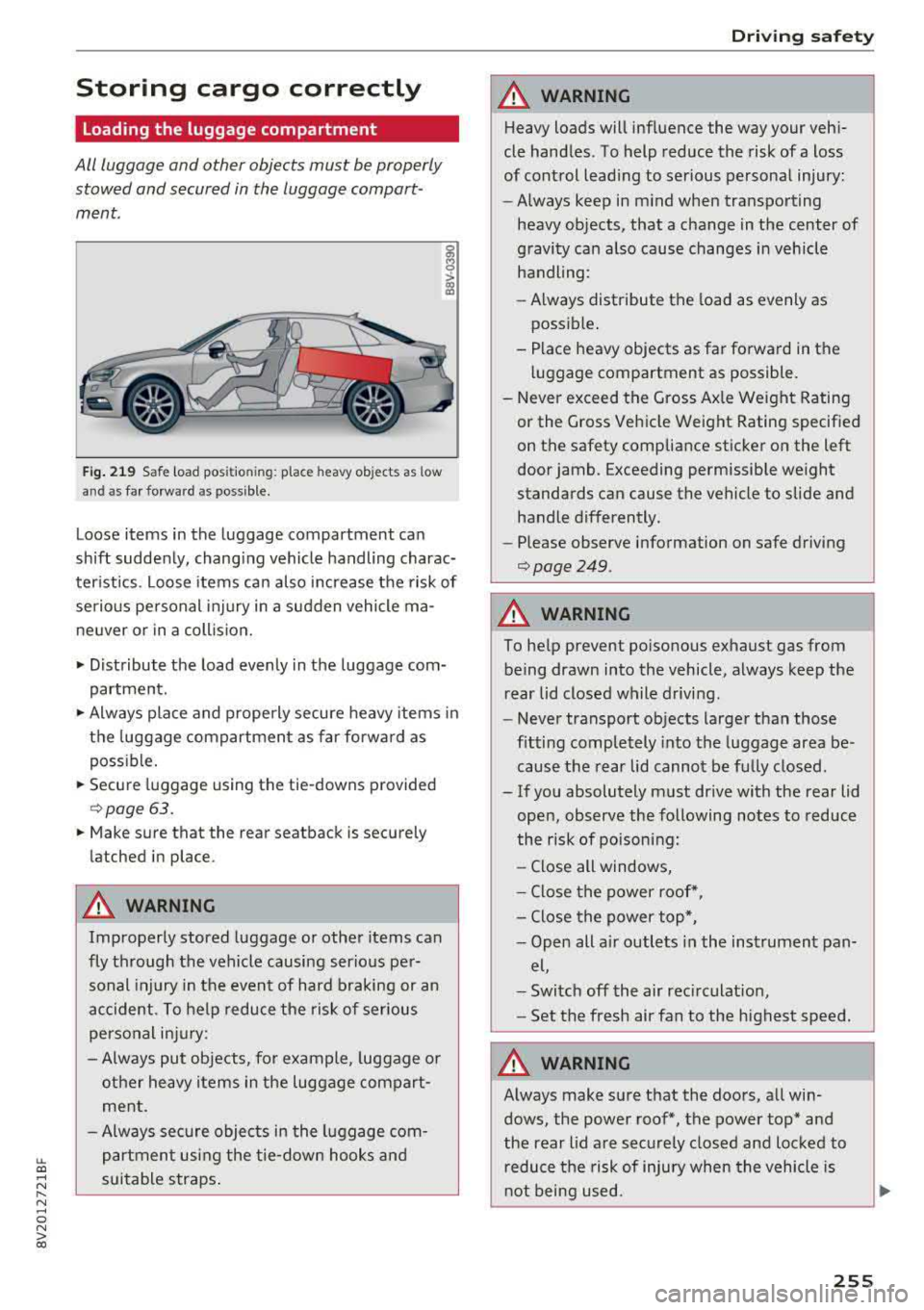
Fig . 219 Safe load pos itio ning : place heavy objects as low
an d as far forward as poss ible.
g M 0
> a, a,
Loose items in the luggage compartment can
shift suddenly, chang ing vehicle handling charac
ter istics . Loose items can also increase the risk of
serio us personal inj ury in a sudden vehicle ma
ne uver or in a coll ision.
• Distribute the load evenly in the luggage com
partment.
• Always place and properly secure heavy items in
the luggage compartment as far forward as
poss ible.
• Secure luggage using the tie-downs provided
¢ page 63.
• Make sure that the rear seatback is securely
latched in place .
A WARNING
Improperly stored luggage or other items can
fly through the vehicle causing serio us per
sonal injury in the event of hard braking or an
accident . To help reduce the risk of serious
personal injury:
- Always put objects, fo r example, luggage o r
other heavy items in the luggage compart ment.
- Always sec ure objects in the luggage com
partment using the tie-down hooks and
s u itable straps .
Driving safety
A WARNING
Heavy loads will influence the way your vehi
cle handles. To help reduce the risk of a loss
of control lead ing to serious personal injury:
- Always keep in m ind when transport ing
heavy objects, that a change in the center of
gravity can a lso cause changes in vehicle
handling :
- Always distribute the load as evenly as
possible .
- Place heavy objects as far forward in the luggage compartment as possible.
- Never exceed the Gross Ax le Weight Rating
or the G ross Vehicle Weight Rating specified
on the safety compliance sticker on the left
door jamb. Exceeding permissible we ight
standards can cause the vehicle to slide and handle differently.
- Please observe information on safe driving
¢page 249 .
A WARNING
-
To help prevent poisonous exhaust gas from
being drawn into the vehicle, always keep the
rear lid closed while driving.
- Never transport objects larger than those
fitting completely into the luggage area be
cause the rear lid cannot be fu lly closed.
- If you absolutely must dr ive with the rear lid
open, observe the following notes to reduce
the risk of poisoning:
- Close all windows,
- Close the power roof*,
- Close the power top*,
- Open alt a ir outlets i n the instrument pan-
el,
- Switch off the air rec irculat ion ,
- Set the fresh air fan to the highest speed.
A WARNING
--
Always make sure that the doors , all win
dows, the power roof*, the power top* and
the rear lid are securely closed and locked to
r educe the risk of injury when the vehicle is
n ot being used.
255
Page 268 of 404
Safety belts
Unfastening safety belts
Unbuckle the safety belt with the red release
button only after the vehicle has stopped .
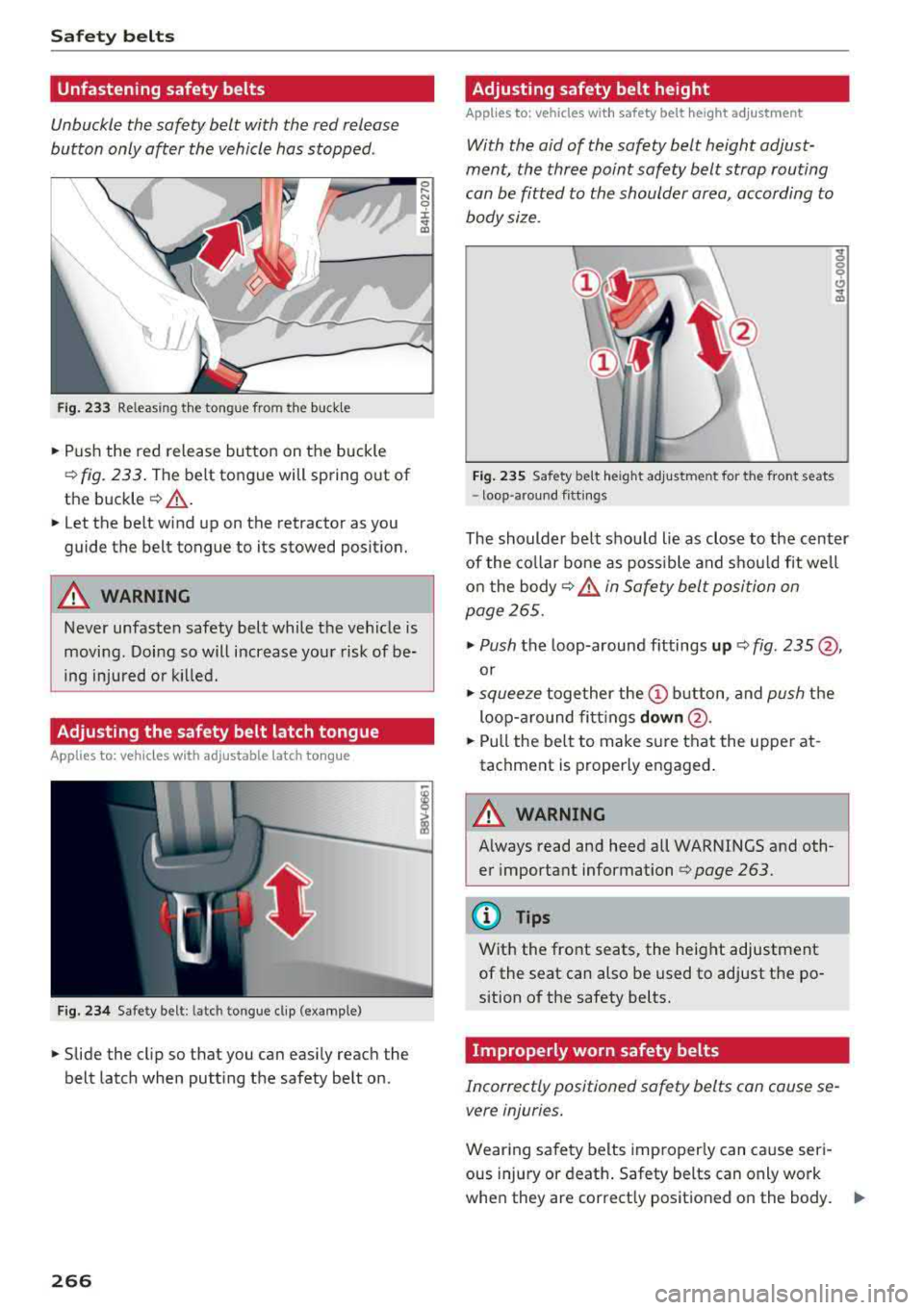
Fig. 233 Releasing the tongue from the buckle
.,. Push the red release button on the buckle
¢
fig. 233. The belt tongue will spring out of
the buckle ¢
,&.
.. Let the belt wind up on the retractor as you
guide the belt tongue to its stowed position.
A WARNING
Never unfasten safety belt while the vehicle is
moving. Doing so will increase your risk of be
ing injured or killed.
Adjusting the safety belt latch tongue
Applies to: vehicles with adjustable latch tongue
Fig. 234 Safety belt: latch tongue cl ip (example)
.. Slide the clip so that you can easily reach the
belt latch when putting the safety belt on .
266
0 i:::; 0 ± .. a,
Adjusting safety belt height
Applies to: vehicles with safety belt height adjustment
With the aid of the safety belt height adjust
ment, the three point safety belt strap routing
can be fitted to the shoulder area, according to
body size .
Fig. 235 Safety belt heigh t adjustment for the front seats
-loop-around fittings
The shoulder belt shou ld lie as close to the center
of the collar bone as possible and shou ld fit well
on the body¢
A in Safety belt position on
page 265 .
.,. Push the loop-around fittings up q fig . 235 @,
or
.,. squeeze together the (D button, and push the
loop-a round fittings
down @.
.. Pull the belt to make sure that the upper at
tachment is properly engaged.
A WARNING
Always read and heed all WARNINGS and oth
er important information¢
page 263.
(l} Tips
With the front seats, the height adjustment
of the seat can also be used to adjust the po
sition of the safety belts.
Improperly worn safety belts
Incorrectly positioned safety belts can cause se vere injuries.
Wearing safety belts imp roper ly can cause seri-
ous injury or death. Safety belts can only work
when they are correct ly positioned on the body.
IIJ,,
Page 281 of 404
LL co .... N
" N .... 0 N > co
-Yo u will also receive serious injuries and
cou ld even be killed if you are up aga inst the
airbag or too close to it when it inflates
-
even with an Advanced Airbag 9 page 269 .
More important things to know about front
airbags
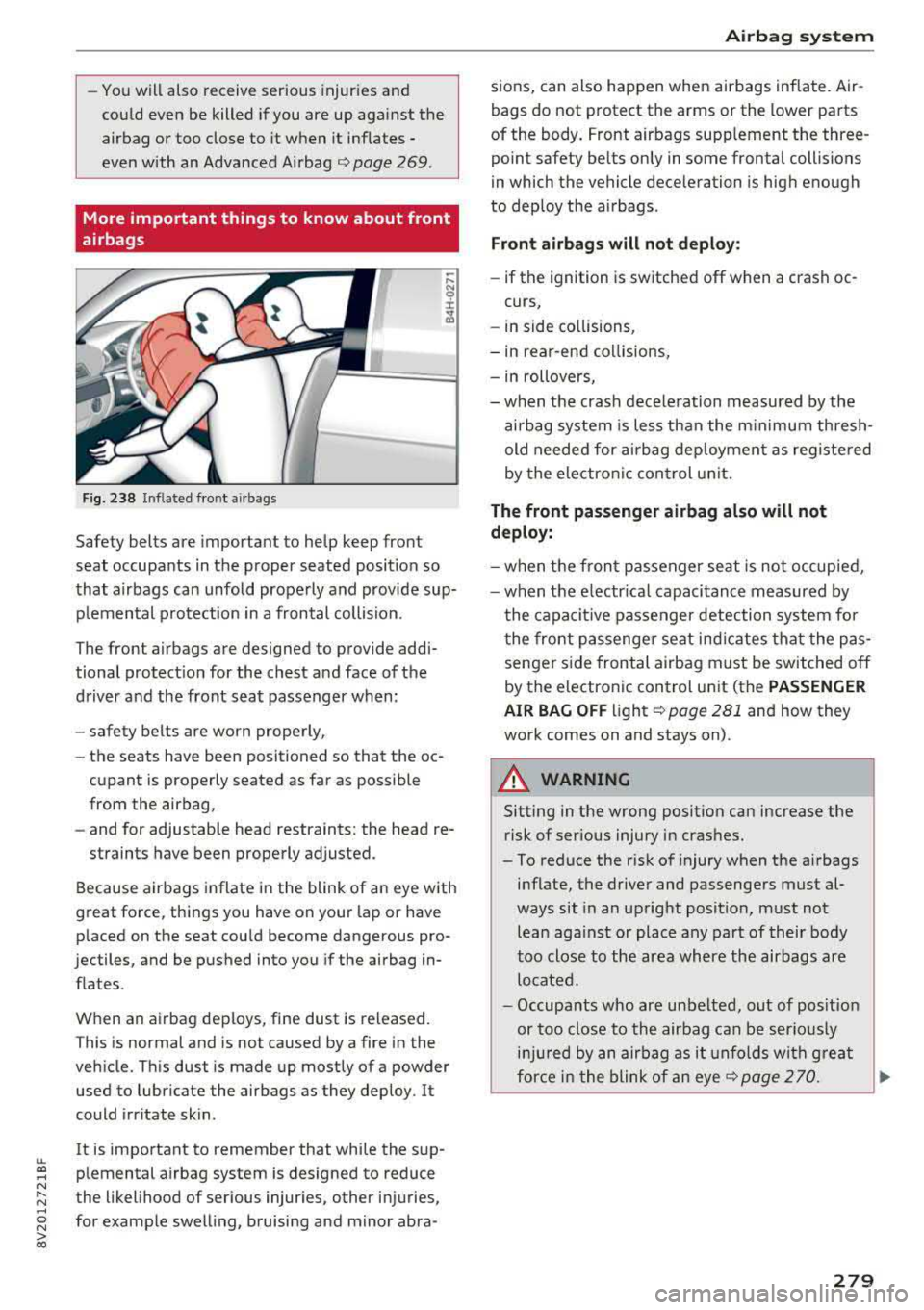
F ig. 238 Inf lated fro nt a irbags
Safety belts are important to help keep front
seat occupants in the proper seated position so
that airbags can unfold prope rly and provide sup
p lemental pro tection in a frontal collision.
The front airbags are designed to provide add i
tional protect ion for the chest and face of the
d river and the front seat passenger when:
- safety belts are worn properly,
- the seats have been positioned so that the oc -
cupant is properly seated as far as possible
from the airbag,
- and for adjustable head restraints: the head re-
straints have been properly adjusted.
Because airbags inflate in the blink of an eye with
g reat fo rce, things you have on your lap or have
p laced on the seat cou ld become dangerous pro
jectiles, and be pushed into you if the airbag in
flates .
W hen an airbag deploys, fine dust is released.
This is normal and is not caused by a fire in the
veh icle. This dust is made up mostly of a powder
used to lubricate the airbags as they deploy . It
could irr itate skin .
It is important to remember that whi le the sup
p lemental a irbag system is designed to reduce
the likelihood of ser ious injuries, other injuries,
for example swel ling, bruising and minor abra -
Airbag system
sions, can also happen when airbags inflate . Air
bags do not protect the arms or the lower parts
of the body. Front airbags supp lement the three
po int safety belts only in some frontal collisions
in which the vehicle dece leration is high enough
to dep loy the airbags .
Front airbags will not depl oy :
- if the ignition is switche d off when a crash oc-
curs,
- in side co llisions,
- in rear -end co llisions,
- in rollovers,
- when the crash decele ration measured by the
airbag system is less than the m inimum thresh
old needed for airbag dep loymen t as registe red
by the electronic con trol un it.
The front passenger airbag also w ill not
deploy:
- when the fron t passenger seat is not occupied,
- when the e lectr ica l capacitance measured by
the capacit ive passenger detection system for
t he front passenge r seat ind icates that the pas
senger side frontal airbag must be switched off
by the e lectronic control unit (the
PASSENGER
AIR BAG OFF
light c::> page 281 and how they
work comes on and stays on).
A WARNING
Sitting in the wrong position can increase the
risk of ser ious injury in crashes.
- To reduce the r isk o f injury when the airbags
inflate, the driver and passengers must al
ways sit in an upright posit ion, m ust not
lean aga inst or place any part of their body
too close to the area where the airbags are located.
- Occupants who are unbelted, out of position
or too close to the airbag can be serio usly
i n jur ed by an airbag as it unfolds with g reat
for ce in the blink of an eye
c::> page 2 70. jll,,,
279
Page 288 of 404
Airbag system
The airbag system is not a substitute for yo ur
safety belt. Rather, it is part of the overa ll occu
pant restraint system in your vehicle. Always re member that the airbag system can only help to
protect you if you are wearing your safety belt
and wear ing it properly . This is why you should
always wear your safety belt, not just because
the law req uires you to do so
q page 260, Gener
al notes.
Remember too, airbags will deploy only once and
only in ce rtain k inds of accidents
-yo ur safety
be lts are always there to offer protect ion in those
accidents in wh ich airbags a re not suppose d to
deploy or w hen they h ave already deployed, fo r
examp le when your vehicle str ikes or is str uck by
another after the firs t collision .
T his is jus t one of the reasons why an airbag is
not a subs titut e for the safety belt. The airbag
sys tem works most effec tively when used with
the safety belts. Therefore, a lways wear your
safety belts correct ly.
It is important to remember th at whi le the sup
p lemen tal knee a irbag system is des igned to re
duce the like lih ood of se rious injuries, other inju
ries, for example, swe lling, b ruising an d minor
ab rasions and friction burns can also occur when
an airbag inf lates .
The knee airbag system basically consists of :
- The elec tronic control module
- T wo infl atab le airbags (airbag a nd gas genera-
t or), one for the driver an d one fo r the fron t
passenger
- T he airbag indic ato r ligh t in the ins trumen t
pane l
The knee airbag system will not deploy:
-whe n the ignition is switched off
- in frontal collisions when the decele ration
measured by the control u nit is too low
- in s ide collisions
- in rear -end collisions
- in rollove rs
- in the eve nt o f a sys tem ma lf u nct ion (wa rning/
indicator light is on)
q page 26 .
286
A WARNING
,-
- Safety belts and the airbag system can only
provide protect io n when occupa nts ar e in
the prope r seat ing pos ition
~ page 2 79 .
-If the a irbag ind icator light ¢ page 26
comes when the veh icle is being used, have
t he system inspected immedia tely by your
author ized A udi de aler.
It is possib le th at
the air bag will i nfl at e w hen i t is no t sup
po sed to , or w ill no t in fla te w hen it sho uld .
How knee airbags work
Applies to: vehicles wi th knee airbags
The risk of injury to the leg area can be reduced
by fully inflated knee airbags.
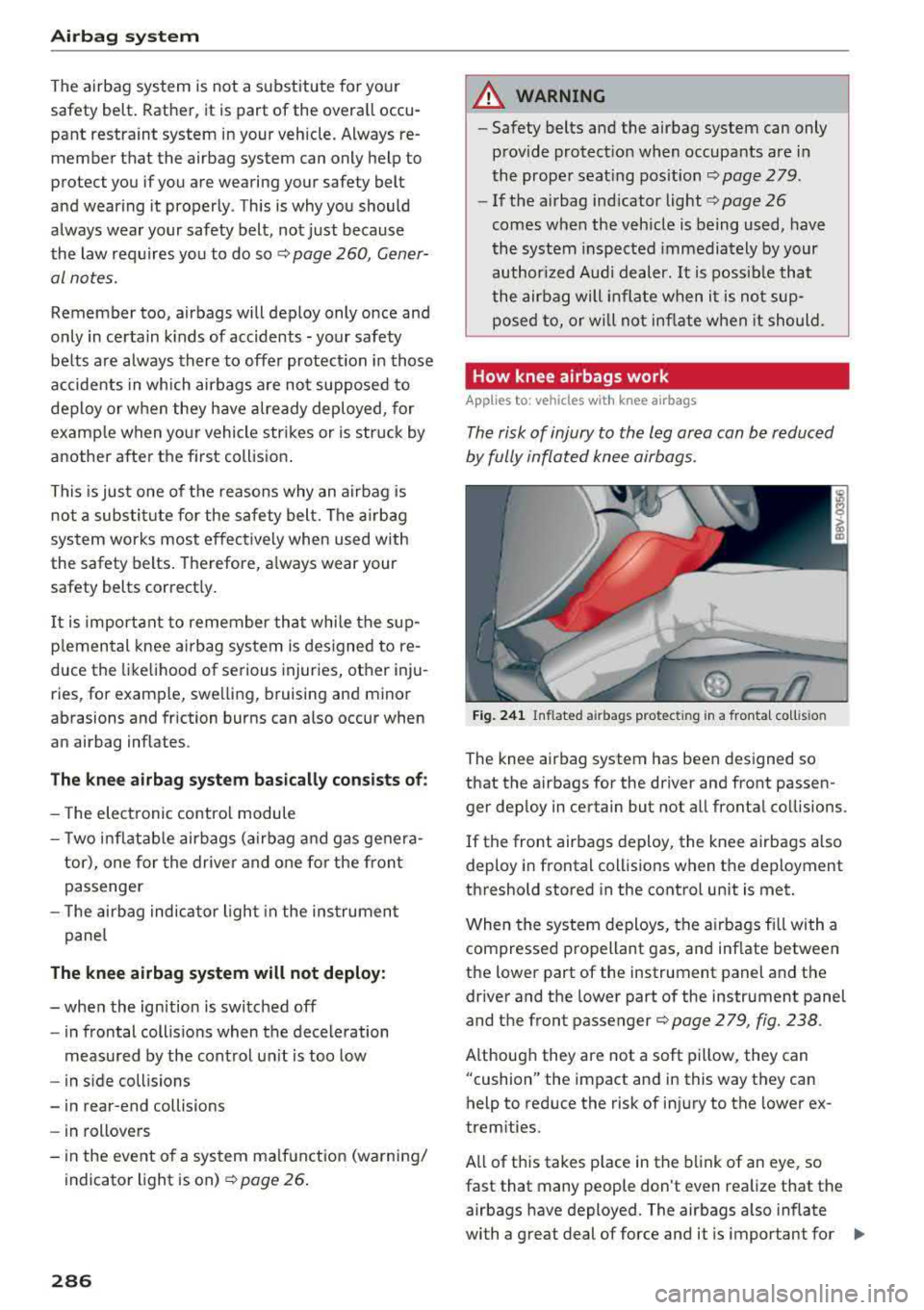
Fig. 241 Inflated a irbags protec ting in a fro nta l co llis io n
The knee airbag system has been designed so
that the airbags for the driver and front passen
ger dep loy in ce rtain but not all fronta l collisions .
If the front airbags deploy, the knee airbags also
deploy i n frontal col lisions when the dep loyment
th reshold stored in the cont rol unit is met.
When the system deploys , the a irbags f ill with a
compressed pro pellant gas, and inflate between
the lowe r part of the instrument panel and the
driver and the lower part of the instrument panel
and t he front
passenger¢ page 2 79, fig. 238 .
Althoug h they are not a soft pillow, they can
"cushion" the impact and in this way they ca n
help to red uce the risk of in jury to the lower ex
trem ities.
A ll of th is takes p lace in the b link of an eye, so
fast that many people don 't even rea lize that the
airbags have deployed. The airbags a lso inflate
with a g reat deal of force and it is important fo r
Ill-
Page 296 of 404
Child safety
Child safety
Important information
Introduction
The rear seat is generally the safest place in a
collision .
The physical principles of what happens when
your vehicle is in a crash apply also to children
¢ page 261, What happens to occupants not
wearing safety belts? .
But unlike adults and
teenagers, their muscles and bones are not fully
developed. In many respects children are at
g reater r isk of serious injury in crashes than
adults .
Because children's bodies are not fully devel
oped, they require restraint systems especially
designed for their size, weight, and body struc
ture. Many countries and all states of the United
States and provinces of Canada have laws requir
ing the use of approved child restraint systems
for infants and small children .
I n a frontal crash at a speed of 20-35 mph
(30 -56 km/h) the forces acting on a 13-pound
(6 kg) infant will be more than 20 times the
weight of the child. This means the weight of the
child would suddenly be more than 260 pounds
(120 kg) . Under these conditions, only an appro
priate child restraint properly used can reduce
the risk of serious injury. Child restraints, like
adu lt safety belts, must be used properly to be
effect ive. Used improperly, they can increase the
risk of serious injury in an accident.
All ch ildren, especially those 12 years and young
er must always ride in the back seat properly re
strained for their age and size. If you must insta ll
a child restra int on the front passenger seat in
exceptional circumstances, be sure to read and
heed the important information and warnings
¢ page 270. Infants and other chi ldren who are
properly restrained in an appropriate child re
straint that is for their si ze and age can benefit
from the protection that supplemental side air
bags provide in some kinds of crashes .
For more information please see information
provided by the:
294
- National Highway Traffic Safety Administration
(NHTSA), currently at: http://www.safe
rcar.gov (for the USA)
- Tr ansport Canada Information Centre, current-
ly at: http ://www.tc .gc.ca (for Canada)
Consult the child safety seat manufacturer's in
structions in o rder to be sure the seat is right fo r
your c hild's
size ¢ page 298, Important safety
instructions for using child safety seats .
Please
be sure to read and heed all of the important in
format ion and WARNINGS about child safety,
Advanced Airbags, and the installation of child
restraints in this chapter .
T here is a lot you need to know about the Ad
vanced Airbags in your veh icle and how they work
when infants and children in child res traints are
on the front passenger seat . Because of the large
amount of important informat ion, we cannot re
peat it all he re . We urge you to read the detailed
info rmat ion in this owner's manual about airbags
and the Advanced Airbag System in your vehicle
and the very important information about trans
porting children on the front passenger seat.
P lease be sure to heed the WARNINGS -they are
extremely important for your safety and the safe
ty of your passengers, especially infants and
small children .
A WARNING
-Accident statistics have shown that children
are generally safer in the rear seat area than
in the front seating position. Always restrain
any child age 12 and under in the rear.
- All vehicle occupants and especially children
must be restrained properly whenever riding
in a vehicle. An unrestrained or improperly
restrained child could be injured by striking
the interior or by being ejected from the ve
hicle during a sudden maneuver or impact.
An unrestrained or improperly restrained
child is a lso at greater r isk of injury or death
through contact w ith an inflating airbag.
- A suitable ch ild restraint properly installed
and used at one of the rear seating positions
provides the highest degree of protection
for infants and small children in most acci
dent situat ions.