Tire AUDI A4 2013 User Guide
[x] Cancel search | Manufacturer: AUDI, Model Year: 2013, Model line: A4, Model: AUDI A4 2013Pages: 302, PDF Size: 75.61 MB
Page 123 of 302
Parallel Parking
Applies to vehicles: with parking system (rear, with rear
view ca mera)
Use parking mode 2 to help you pork on the
edge of o street.
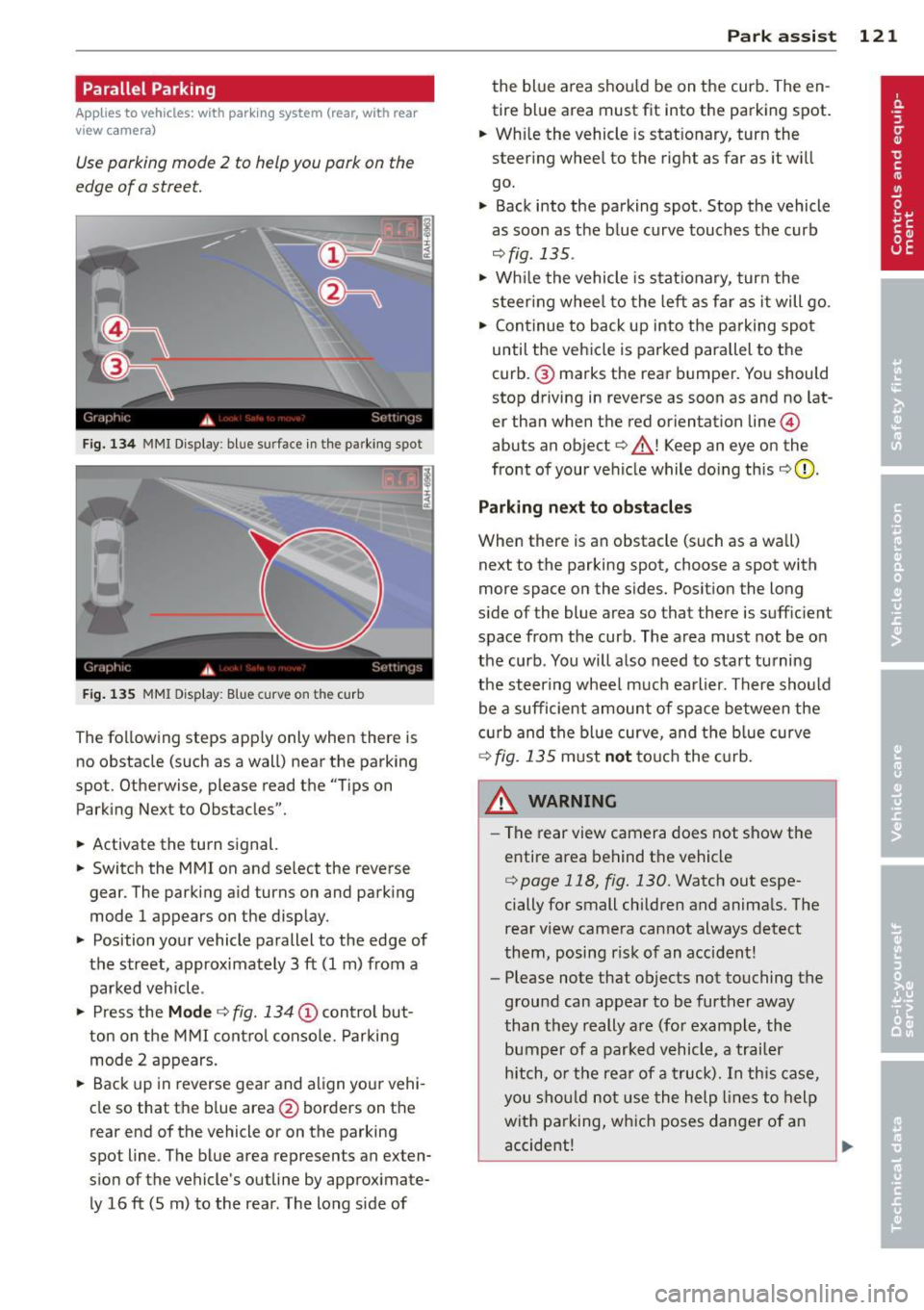
F ig. 134 MMI Display : bl ue s urface in the park ing spot
Fig. 135 MMI Display: Blue curve on t he cur b
The following steps apply only when there is
no obstacle (such as a wall) near the parking
spot. Otherwise, please read the "Tips on
Parking Next to Obstacles".
• Activate the turn signal.
• Switch the MM I on and se lect the reverse
gear. The parking aid turns on and parking
mode 1 appears on the display.
• Position your vehicle parallel to the edge of
the street, approximately 3 ft (1 m) from a parked vehicle .
• Press the
Mode ¢ fig. 134 (D control but
ton on the MMI control console. Parking
mode 2 appears.
• Back up in reverse gear and align your vehi
cle so that the blue area
@ borders on the
rear end of the vehicle o r on the parking
spot line . The blue area represents an exten
sion of the vehicle's outline by approximate ly 16 ft (5 m) to the rear . The long s ide of
Park assist 121
the blue area shou ld be on the curb. The en
tire blue area must fit into the parking spot.
• Wh ile the vehicle is stat ionary, turn the
steer ing whee l to the right as far as it wi ll
go.
• Back into the parking spot . Stop the vehicle
as soon as the blue curve touches the curb
¢ fig . 135 .
• Wh ile the vehicle is stationary, turn the
steering wheel to the left as far as it will go.
• Continue to back up into the parking spot
until the vehicle is parked parallel to the
curb .@ marks the rear bumper. You should
stop driving in reverse as soon as and no lat
er than when the red orientation line@
abuts an object¢_& ! Keep an eye on the
front of your vehicle while doing this
¢ 0 .
Parking next to obstacles
When there is an obstacle (such as a wall)
next to the parking spot, choose a spot with
more space on the sides. Posit ion the long
s ide of the blue area so that there is suff ic ient
space from the curb. The area must not be on
the curb . You will also need to start tu rning
the steering wheel much earlier. There should
be a sufficient amount of space between the
c urb and the blue curve, and the blue curve
¢ fig. 135 must not touch the curb.
&_ WARNING
- The rear view camera does not show the
entire area behind the vehicle
¢ page 118, fig. 130. Watch out espe
cially for small children and animals. The
rear view camera cannot always detect
them, posing risk of an accident!
- Please note that objects not touching the
ground can appear to be further away
than they really are (for example, the
bumper of a parked vehicle, a trailer
hitch, or the rear of a truck). In this case,
you should not use the help lines to help
with parking, which poses danger of an
accident!
.__ _____________ _J ...
Page 129 of 302
Driving Safely
General notes
Safe driving habits
Please remember -safety first!
This chapter contains important information,
tips, instructions and warnings that you need
to read and observe for your own safety, the
safety of your passengers and others . We have
summarized here what you need to know
about safety belts, airbags, child restraints as
well as child safety. Your safety is for us
priori
ty number 1.
Always observe the information
and warnings in this section - for your own
safety as well as that of your passengers.
The information in this section applies to all
model versions of your vehicle . Some of the
features described in this sections may be
standard equipment on some models, or may
be optional equipment on others. If you are
not sure, ask your authorized Audi dealer.
A WARNING
- Always make sure that you follow the in
structions and heed the WARNINGS in
this Manual. It is in your interest and in
the interest of your passengers.
- Always keep the complete Owner's Liter
ature in your Audi when you lend or sell
your vehicle so that this important infor
mation will always be available to the
driver and passengers.
- Always keep the Owner's literature handy
so that you can find it easily if you have
questions.
Safety equipment
The safety features are part of the occupant
restraint system and work together to help
reduce the risk of injury in a wide variety of
accident situations .
Your safety and the safety of your passengers
should not be left to chance. Advances in
technology have made a variety of features
available to help reduce the risk of injury in an
Driving Safely 127
accident. The following is a list of just a few of
the safety features in your Audi :
- sophisticated safety belts for driver and all
passenger seating positions,
- belt force limiters for the front seats,
- belt pretensioners for the seats,
- head restraints for each seating position,
- front airbags,
- side airbags in the front seats,
- side curtain airbags ,
- special LATCH anchorages for child re-
straints,
- adjustable steering column.
These individual safety features, can work to
gether as a system to help protect you and
your passengers in a wide range of accidents.
These features cannot work as a system if
they are not always correctly adjusted and cor
rectly used.
Safety is everybody's responsibility!
Important things to do before driving
Safety is everybody's job! Vehicle and occu
pant safety always depends on the informed and careful driver.
For your safety and the safety of your passen
gers,
before driving always:
"' Make sure that all lights and signals are op
erating correctly .
"' Make sure that the tire pressure is correct .
"' Make sure that all windows are clean and
afford good visibility to the outside.
"' Secure all luggage and other items carefully
qpage 64.
"' Make sure that nothing can interfere with
the pedals.
"' Adjust front seat, head restraint and mir
rors correctly for your height.
"' Instruct rear seat passengers to adjust the
head restraints according to their height.
"' Make sure to use the right child restraint
correctly to protect children
q page 166,
and~~fy. ~
•
•
Page 136 of 302
134 Driving Safely
A WARNING
Always make sure that the doors, all win
dows, the sunroof and the rear lid are se
curely closed and locked to reduce the risk
of injury when the vehicle is not being
used.
-After closing the rear lid, always make
sure that it is properly closed and locked.
- Never leave your vehicle unattended es
pecially with the rear lid left open. A
child could crawl into the vehicle through
the luggage compartment and close the
rear lid becoming trapped and unable to
get out. Being trapped in a vehicle can
lead to serious personal injury.
- Never let children play in or around the
vehicle.
- Never let passengers ride in the luggage
compartment . Vehicle occupants must
always be properly restrained in one of
the vehicle's seating positions.
(D Tips
- Air circulation helps to reduce window
fogging. Stale air escapes to the outside
through vents in the trim panel. Be sure
to keep these slots free and open.
- The tire pressure must correspond to the
load. The tire pressure is shown on the
tire pressure label. The tire pressure la
bel is located on the driver's side B-pillar.
The tire pressure label lists the recom
mended cold tire inflation pressures for
the vehicle at its maximum capacity
weight and the tires that were on your
vehicle at the time it was manufactured.
For recommended tire pressures for nor
mal load conditions, please see chapter
c:>page238.
-
Tie-downs
Applies to vehicles: with tie -downs
The luggage comportment is equipped with
four tie-downs to secure luggage and other
items .
Use the tie-downs to secure your cargo p rop
erly
c:> page 133, Loading the luggage com
portment .
In a collision, the laws of physics mean that
even smaller i tems that are loose in the vehi
cle will become heavy missiles that can cause
serious injury. Items in the vehicle possess en
ergy which vary with vehicle speed and the
weight of the item. Vehicle speed is the most significant factor.
For example, in a frontal collision at a speed
of 30 mph (48 km/h), the forces acting on a
10-lb (4.5 kg) object are about 20 times the
normal weight of the item . This means that
the weight of the item would suddenly be
about 200 lbs. (90 kg). You can imagine the
injuries that a 200 lbs. (90 kg) item flying
freely through the passenger compartment could cause in a collision like this.
A WARNING
-Weak, damaged or improper straps used
to secure items to tie-downs can fail dur
ing hard braking or in a collision and cause
serious personal injury.
-Always use suitable mounting straps and
properly secure items to the tie-downs in
the luggage compartment to help pre
vent items from shifting or flying for
ward as dangerous missiles.
- When the rear seat backrest is folded
down, always use suitable mounting
straps and properly secure items to the
tie-downs in the luggage compartment
to help prevent items from flying for
ward as dangerous missiles into the pas
senger compartment.
- Never attach a child safety seat tether
strap to a tie-down .
Page 139 of 302
Safety belts
General notes
Always wear safety belts!
Wearing safety belts correctly saves lives!
This chapter exp lains why safety be lts a re nec
essary, how they work and how to adjust and
wear them correctly.
~ Read all the information that fo llows and
heed all of the inst ruct ions and WARNINGS.
A WARNING
Not wearing safety belts or wearing them
improperly increases the risk of ser ious
personal in jury and death .
- Safety belts are the sing le most effective
means availab le to red uce the r isk of se
rious injury and death in a utomob ile acci
de nts . For your prot ecti on and that of
yo ur passenge rs, always co rrec tly wear
sa fe ty bel ts when the ve hicle is mov ing.
- P re g nant women, injured, or physically
imp aired perso ns must also use safe ty
belts. L ike a ll vehicle occup ants, they are
more like ly to be ser ious ly injure d if they
do not wea r safety be lts . The best way to
protect a fet us is to protect the mother -
thro ughout the entire pregnancy.
Number of seats
Your Audi has a total of five seating posit ions:
two in the front and three in the rear. Each
seating position has a safety belt.
A WARNING
N ot wea ring safety belts or wea ring the m
improperly increases the risk of ser ious
perso nal i njur y an d deat h.
- Never st rap more than one pe rson, in
cl ud ing s mall ch ild ren, into any belt . It is
e speci ally dangerous t o pl ac e a safety
bel t over a child s itting on yo ur lap.
- N ever le t mo re peo ple ride in t he ve hicle
th an there are s afety be lts availab le.
Safety belts 13 7
- Be s ure everyone riding in the vehicle is
properly restrained w ith a separate sa fe
ty belt or child restra int.
Safety belt warning light
Your vehicle has a warning system for the
driver and (on USA models only) front seat
passenger to remind you about the impor
tance of buckling-up.
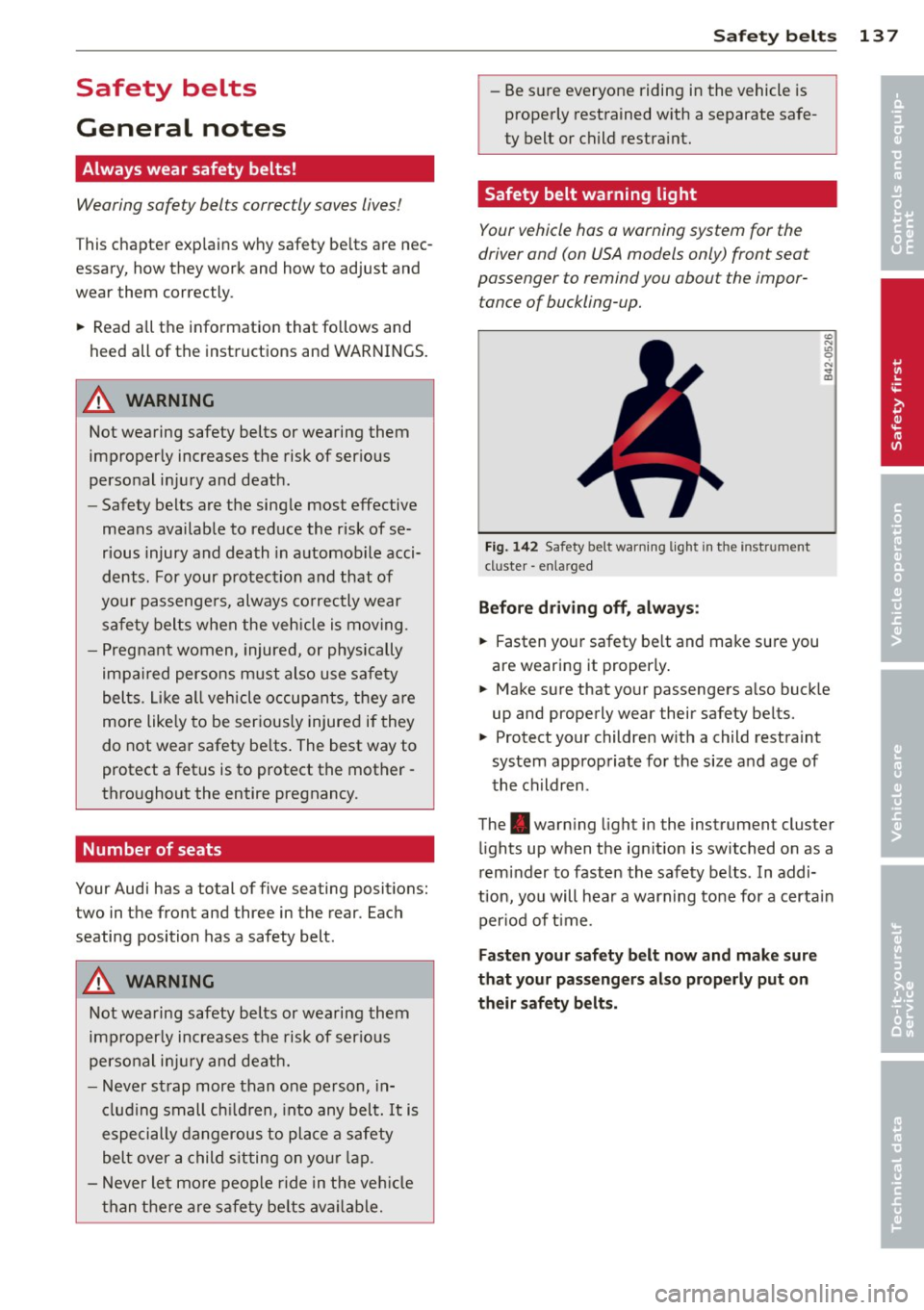
Fig . 14 2 Safety belt warni ng lig ht in the instr ument
cl uster -enla rged
Before driving off, alway s:
~ Fasten your safety be lt and make sure you
are wearing it properly .
~ Make sure that yo ur passengers a lso buck le
up and properly wear their safety be lts.
~ Protect your childre n w ith a child rest raint
sys tem app ropriate fo r the size a nd age of
t h e children.
The . warn ing light in the instrument cluster
li ghts up when the ig nit ion is switched on as a
reminder to fasten the safe ty belts. In addi
tion, you will hea r a warning tone for a certa in
per iod of t ime.
Fasten your safety belt now and make sure
that your pas sengers also properly put on
th eir safety belts.
•
•
Page 162 of 302

160 Airbag system
dealer is familiar with these re quirements
and we recommend that you have your
dea ler perform this serv ice for you.
Other things that can affect Advanced
Airbag performance
Changing the vehicle's suspension system can
change the way that the Advanced Airbag Sys
tem pe rforms in a crash. For example, us ing
tire-r im combinations not app roved by Aud i,
lowering the vehicle, changing the stiffness of
the suspension, incl uding the springs, suspen
sion struts, shock absorbers etc. can change
the forces that are measured by the airbag
sensors and sent to the electronic control
un it. Some suspension changes can, for exam
ple, increase the force levels measured by the
sensors a nd make the airbag system deploy in
crashes in w hich it would not dep loy if the
changes had not been made . Other kinds of
changes may reduce the force levels meas
ured by the sensors and prevent the airbag
from deploying when it should .
The sensors in the safety belt buckle fo r the
d river and front passe nger seat tell the elec
tronic control module if the safety belt is
latched or not.
If the safety belt is being used,
the front airbag will deploy at a slightly high
er rate of vehicle deceleration than if the safe
ty belt is not being used. Therefore, in a par
ticular collision, it is poss ible that an a irbag
will not deploy at a seating position whe re the
safety belt is being used but will inflate at the
position whe re the safety belt is not bei ng
used. It is important tha t noth ing inte rfe re
with the safety belt buckles so t hat the sen
sors can send the correct information a bout
safety belt use to the electronic contro l unit.
A WARNING
Changing the vehicle 's suspension includ
ing use of unapproved tire-rim c ombina
tions can change Advanced Airbag per
formance and increase the risk of ser ious
personal i njur y in a crash.
- Never install suspension components
that do not have the same performance characterist
ics as the components origi
na lly installed on your vehicle.
- Never use tire-rim com binations that
have not been approved by Audi.
A WARNING
= -
Items stored between the safety be lt
b uckle and the center console can cause
the sensors in the buckle to send the
wrong information to the e lectronic con
trol module and prevent the Advanced Air bag System from wo rking prope rly.
- Always make s ure that nothing can inter
fe re with the safety belt buckles and that
they are not obstructed.
Side airbags
Description of side airbags
The airbag system can provide supplemental
protection to properly restrained occupants.
F ig . 1 57 Side a irbag loca tion in t he drive r's seat
The side airbags are located in the sides of the
front seat backrests¢
fig. 157 and the rear
back rest facing the doors. They are ident ified
by the wo rd "AIRBAG".
The side airbag system basically consist s of:
- the electronic contro l modu le and external
side impact sensors
- the two airbags located in the s ides of the
front backrests and the two airbags* located
in the rear backrest
- the airbag warning light in the instrument
cluster .
T he air bag system is mon itored e lec tronically
to make ce rtain tha t it is function ing p roperly ..,.
Page 189 of 302
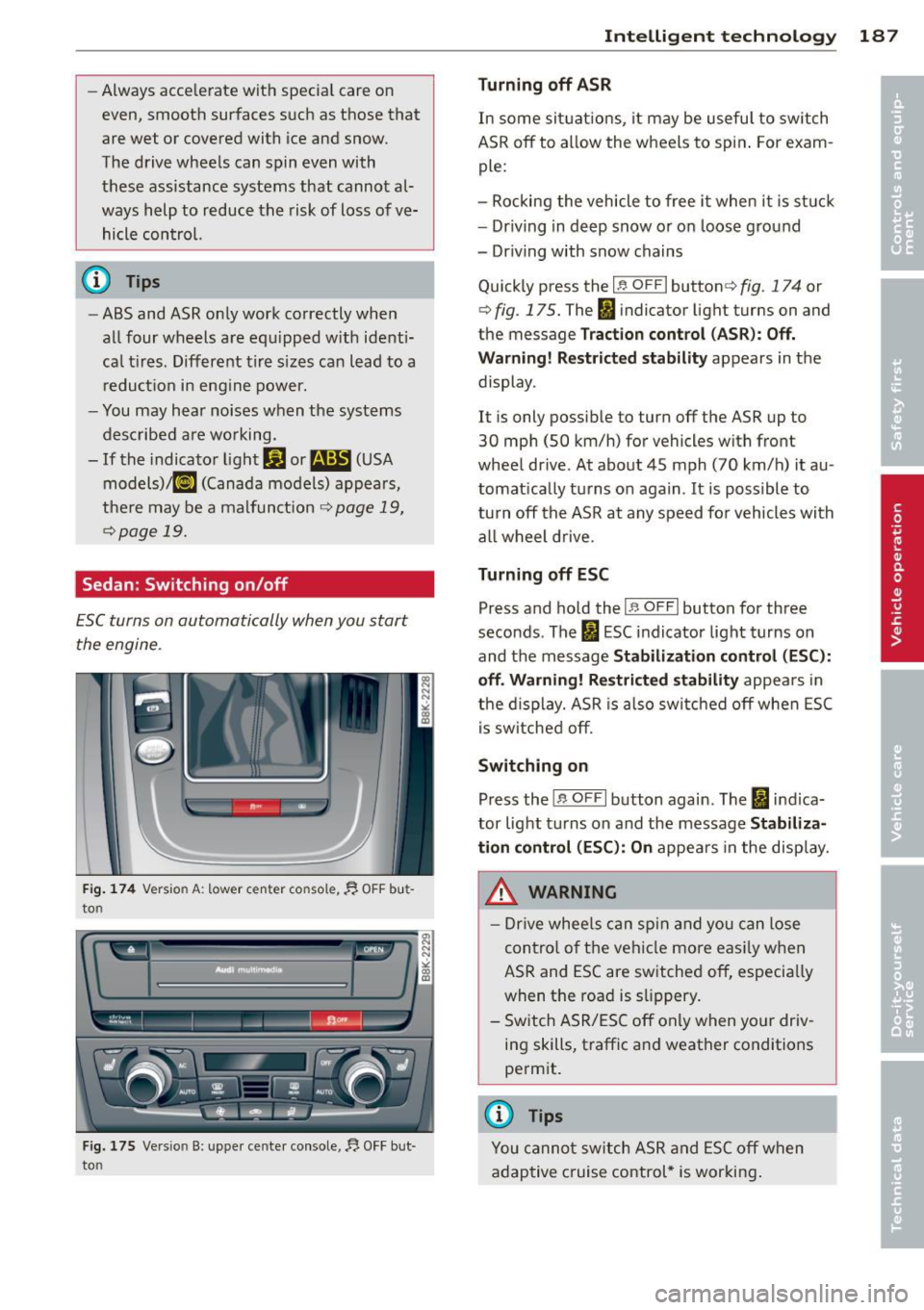
-Always acce lerate with specia l care on
even, smooth surfaces s uch as those that
are wet or covered with ice and snow.
The drive wheels can spin even with
these assistance systems that cannot al
ways help to reduce the risk of loss of ve hicle control.
(0 Tips
- ABS and ASR on ly work correctly when
all four wheels are equ ipped w ith ident i
ca l tires. Different tire s izes can lead to a
reduct ion i n eng ine power.
- You may hear noises when the systems
described are wo rking .
- If the indicator light D] or m!S (USA
models) ;tiJ (Canada models) appears,
the re may be a malfunct ion
c:> page 19,
~ page 19.
Sedan : Switching on/off
ESC turns on automatically when you start
the engine .
Fig . 174 Vers io n A: low er c en te r co nsol e, 1', O FF bu t
to n
Fig. 175 Ve rsio n B: upper ce nte r console,~ OFF bu t
to n
Intelligen t technolog y 187
Turning off ASR
In some sit uatio ns, it may be useful to switch
ASR
off to a llow the wheels to spin . For exam
ple:
- Rocking the vehicle to free it when i t is st uck
- Dr iving in deep snow or on loose ground
- Dr iving with snow chains
Qu ick ly press the
I~ O FF I button c:> fig. 174 or
c:>
fig . 175. The fil indica tor light turn s on and
t he me ssage
T rac tion control (A SR ): Off.
War ning! R estrict ed stability
appears in the
display .
It i s only possible to turn
off the ASR up to
30 mph (SO km/h) for vehicles wi th front
wheel drive . At about 45 mph (70 km/h) it au
tomat ically turns on again .
It is possible to
turn
off the ASR at any speed fo r vehicles with
all wheel drive .
Turning off ESC
Press and hold the I;; OFFI button for three
seconds . The
fl ESC indicator light turns on
and the message
Stabil ization cont rol (ESC ):
o ff . Warni ng ! Re str icted stab ilit y
appea rs in
the d isplay. ASR is also sw itched
off when ESC
i s sw itched off.
Switching on
Press the j ;; O FFI button again . The fi indica
tor light t urns on and the message
St abi liz a
t ion control (ESC ): On
appears in the disp lay.
_&. WARNING
- Drive whee ls can sp in and you can lose
contro l of the vehicle more eas ily when
ASR and ESC are switched off, especia lly
when the road is s lippery .
- Switch ASR/ESC
off only when yo ur driv
ing skills, traffic and weather conditions
permit.
@ Tips
You cannot sw itch ASR and ESC off when
adaptive cruise control* is working .
-
Page 193 of 302
@ Tips
- If the . or
fT j indicator light on ly stays
on for a short t ime, you may continue
driving.
- The dynamic steering* stability systems
are not available in the event of a system
malfunction.
- For additional information on dynamic
steering*, refer to
c:> page 113.
Driving with your
quattro ®
Applies to vehicles: with a ll-wheel drive
With all-wheel drive, all four wheels are driv
en.
Gener al inform ati on
W ith all-wheel drive, power is distributed to
all four wheels . This happens automatically
depending on your dr iving style and the road
conditions at the t ime. See also
c:> page 185.
A center different ial distr ibutes the dr iv ing
power var iably to the front and rear axle . It
works together with selective wheel torque
control, which activates when driving throug h
curves
c:> page 186. With the spo rt d ifferen
tial*, power dist ribution to the rear wheels is
variable and can be adjusted with drive select
c:> page 113.
The all-wheel drive concept is designed for
h igh engine power. Yo ur vehicle is exception
ally powerful and has exce llent driving charac
teristics both under normal driving conditions
and on snow and ice. Always read and fo llow
safety precautions
c:> A .
Winter t ir e s
When driv ing in the w inter, your veh icle w ith
all-wheel drive has an advantage,
even with
regular tires. In winter road conditions it may
be advisable to mount winter tires (or all-sea
son t ires) for improved driveability and brak
ing: these tires must be mounted on
a ll four
w heels . See also c:> page 250, Winter tires .
Intellig ent technolog y 191
Tire chain s
Where tire chains are mandatory on certain roads, this no rma lly also applies to veh icles
with all-wheel drive
c:> page 251, Snow
chains.
Replacing wheels /tires
Vehicles with a ll-wheel drive must always
have tires of t he same s ize. A lso avoid tires
with different tread depths . For detai ls see
page
c:> page 246, New tires and replacing
tires and wheels .
Off-Road driving?
You r A udi does no t have enough ground clear
ance to be used as an off-road vehicle .
It is
therefore best to avoid rough tracks and un
even terrain as much as possib le . Also refer to
c:> page 194.
A WARNING
Always adjust your dr iving to road and traf
f ic conditions. Do not let the extra safety
afforded by all-wheel drive tempt you into
taking extra risks .
- Although the all-wheel drive is very ef
fective, always remember that braking
capacity is lim ited by tire traction. You
should therefore not d rive at excessive
speeds on icy or slippe ry road surfa ces.
- On wet road surfaces, be careful not to
drive too fast because the front wheels
co uld begin to slide on top of the water
(aquaplaning) . If this should occur, yo u
will have no warning from a s udden in
crease in engine speed as w ith a front
wheel drive veh icle. Always drive at
speeds which are su ited to the road con
ditions -risk of crash.
•
•
Page 196 of 302
194 Driving and environment
Driving and
environment
The first 1,000 miles
(1,500 km) and
afterwards
New engine
The engine needs to be run-in during the first
1,000 miles (1,500 km).
For the fir st 600 miles (1,000
kilometers ):
.,. Do not use full throttle.
... Do not drive at engine speeds that are more
than 2/3 of the max imum permitted RPM.
From 600 to 1,000 miles (1 ,000 to
1,500 kilometers):
.,. Speeds can gradually be increased to the
max imum pe rm iss ible road or eng ine speed .
During and after break-in per iod
... Do not rev the eng ine up to h igh speeds
when it is cold. Th is app lies whether the
transmission is in N (Neutral) or in gear.
After the break- in period
... Do not exceed max imum eng ine speed un
der any circumstances .
... Upshift into the next higher gear
before
reaching the red area at the end of the tach
ometer scale¢
page 10.
During the first few hours of driving, the en
g ine's inter na l friction is higher tha n later
when alt the moving parts have been broken
i n. How welt this break- in process is done de
pends to a conside rable extent on the way the
ve hicl e is driven du ring the first 1,000 miles
(1, 500 kilome ters).
(D Note
E xtremely high engi ne speeds are auto
mat ica lly re duced. However, these rpm
lim its are programmed for a n engine welt
r u n- in, not a new eng ine.
{® For the sake of the environment
Do not drive with unnecessarily high en
g ine speeds - upshifting ear ly saves fuel,
reduces no ise and protects the environ
ment.
, New tires
If your vehicle is runni ng on new tires, drive
very carefully for the first 350 miles (500 kilo meters) after fitting.
_& WARNING
N ew tires tend to be slip pery a nd mus t al
so be "broken -in" . Be s ure to remembe r
this dur ing the fi rst 350 mi les (500 kilo
meters) . Brake gently . Avoid fo llow ing
closely behind other vehicles or other sit
uations that m ight require sudden, hard
braking.
Avoid damaging the
vehicle
When you a re d rivi ng on poo r roads, or over
cu rbs, ste ep ramps, etc., ma ke certai n that
low- ly ing parts s uch as spoile rs and ex ha ust
s ystem parts do not bot tom o ut and get dam
aged.
T his is espec ially true for veh icles with low
s lu ng chassis (s por ts chassis)* and fully load
ed vehicles.
Driving through water
on roads
Note th e following to avoid vehicle damage
whe n driving through water, for examp le on
flooded roads:
- The wa ter must not be any hig he r th an the
bottom of the vehicle body .
- Do not dr ive faste r than walk ing speed.
Page 200 of 302
198 Driving and en vironm ent
s uit able for the vehicl e, or w hic h ex ceed s
y ou r dr iving sk ill s. N eve r tak e an y unnec es
s a ry risks!
After driv ing offro ad
- After driving offroad, remove branches and
other debris from the rad iator grille, under
body, and whee ls. Look especia lly for objects
(stones) that have been caught in the tire
tread .
- Clean t he body and the vehicle underbody
and inspect the vehicle for possible damag
es.
- Clean off the dirty windows, headlights, tail
lights and the license plate.
- Perform a brake test (especially after driving
through water) .
A WARNING
- Be especially aware and attentive when
dr iv ing under d iff icult conditions. Dam
ages to the vehicle and injuries may oc
cur when driving at an excess ively high
speed or with incorrect driv ing maneu
vers.
- Always adjust your speed and handling
to the roads, terra in, traffic and weather
condit ions. Drive especially slow if off
road with low v is ibility.
- Please note that the wheels can spin and
the vehicle can brea k away when the ESC
Offroad Mode is switched off, espec ially
whentheroadisslipper~
- Driv ing stab ility is red uced in the ESC
Offroad mode.
@) For the sake of the environment
Avo id harming the environment and take
nature into conside rat ion.
@ Tips
Only drive where it is allowed and always
stay on the provided roads and paths.
Driver messages
App lies to veh icles : all road
There is only one right way to drive in difficult
conditions: slowly and with caution!
When driving offroad, observe the follow ing :
.. Never drive the vehicle in terrain which is
not suitab le for the vehicle, or which ex
ceeds your driving ski lls. Never take any un
necessary risks!
.. Drive slowly and caut iously!
.. Pay attention to the
ground clearanc e of
your veh icle! This may vary depending on
the load and composition of the ground and
t he environment. The d river is therefore re
sponsib le for deciding whether a veh icle can
handle a specific situation .
.. Activate the
ESC-Offroad-Mode r::;, page 187
as needed .
Difficult terrain
Never drive in areas that are not fam iliar to
you and d rive slowly when offroad and be p re
pared and expect the unexpected (e .g. pot
holes, boulders , tree stumps, etc.)
T o p reven t the veh icle from bottoming and
avo id damage to the unde rbody, yo u should
drive straight across severe bumps in the
ground with only one side of the ve hicle so
that only two of your whee ls cross the bumps.
Drive quickly th rough sandy or marshy offroad
sections and do not stop, if at all possible.
Driving through water on roads
Read the information on r::::> page 194 .
Page 202 of 302
200 Trailer towing
Tire pressure
When towing a trai le r, inflate the tir es of your
vehicle to the cold tire pressure listed under
"Full load" on the label located on the driver 's
side B-pillar (visible when the door is open).
Inflate trailer tires to trailer and tire manufac
turers' specifications.
Lights
The headlight settings should be checked with
the trailer attached before dr iving off. Check
to make sure both vehicle and tra iler lights
are working properly.
Safety chains
Be sure trailer safe ty cha ins are properly con
nected from the trailer to the hitch on the ve
hicle. Leave eno ugh slack in the chains to per
mit turning corners. When you install safety
cha ins, make sure they w ill not drag on the
road when you are driving.
The chains shou ld cross under the trai ler
tongue to prevent it from dropping in case of
separation from the hitch.
Driving instructions
Driving with a trailer always requires extra
care and consideration.
To obtain the best possible handling of vehicle
and trai ler, p lease note the following:
.,. Do not tow a loaded trailer when your car it
self is not loaded .
.,. Be especia lly careful when passing other
vehicles .
.,. Observe speed limits .
.,. Do not drive at the maximum permissible
speed.
.,. Always apply brakes early.
.,. Monitor the temperature gauge.
Weight distribution
Towing a loaded trai ler with an empty car re
sults in a highly unstable distribution of
weight . If this cannot be avo ided, drive at very
low speeds only to avoid the risk of losing
steering control. A "ba
lanced'' rig is easier to operate and con
trol. This means that the tow vehicle should be loaded to the extent possible and permissi
ble, while keep ing the trailer as light as possi
ble under the c ircumstances. Whenever poss i
ble, transfer some cargo to the luggage com
partment of the tow veh icle while obse rving
tongue load requ irements and vehicle load ing
considerations.
Speed
The higher the speed, the more d iff icu lt it be
comes for the driver to control the rig. Do not
drive at the maximum permissible speed. Re
duce your speed even more if load, weather or
wind conditions are unfavorable -pa rticularly
whe n going downhill.
Reduce veh icle speed
immediately if the trail
er shows the slightest s ign of sway ing.
Do not
try to stop the swaying by accelerating.
Observe speed limits. In some areas, speeds
for vehicles tow ing trailers are lower than for
regular vehicles .
Always apply brakes early. When driving
downh ill, shift into a lower gear to use the en
gine braking effect to slow the vehicle . Use of
the brakes alone can cause them to overheat
and fail.
Coolant temperature
The coolant temperature gauge c> page 10
must be observed carefully . If the needle
moves close to the upper end of the scale, re
duce speed immediately and/or turn off the
air conditioner.
If the coolant temperature warning light •
in the in strument cluster starts flashing, pull
off the road, stop and let the engine
idle for
abo ut two minutes to prevent heat build-up .
_& WARNING
Anyone not properly restrained in a mov
in g vehicle is at a much greater risk in an
accident. Never let anyone ride in your car
who is not p roperly wea ring the restraints
provided by Audi.
-