clutch AUDI A4 2013 User Guide
[x] Cancel search | Manufacturer: AUDI, Model Year: 2013, Model line: A4, Model: AUDI A4 2013Pages: 302, PDF Size: 75.61 MB
Page 109 of 302
Audi adaptive cru ise control and brakin g guar d 107
-Sedan: I f you switch the A SR/ESC off,
braking guard switches off automatically
¢ page 187 .
-allroad : If you switch the offroad mode
on, braking g uard switches off automati
cally
¢ page 188.
-Switch braking guard off when you are
l oading the veh icle onto a vehicle carr ier,
tra in, sh ip or other type of transporta
tion. This can prevent undesired warn i ngs from the braking guard system .
Messages
Applies to vehicles: with Audi adaptive cruise co ntrol
B rak ing guard: Off
This driver message appears if the system is
turned off via the radio/MM I*. Otherwise, if
the system is turned off, the information ap
pears every time shortly after the start of the
tr ip.
B ra king gua rd: Act ivated
This drive r message appe ars if sharp brake
pressu re was applied due to an acute warning.
•••
Three white dots appear if a setting cannot be
selected with the operat ing lever . For exam
p le, this happens if you want to raise/lowe r
the speed even though there was no p revious
l y saved speed.
AC C: D eactiv ation
The driver message appears in vehicles with
manual transmission . If the clutch pedal was
pressed down for too long, the adaptive cruise
control turns off. A chime sounds as a rem ind
er.
ACC : Sensor blocked
This message appears if the sensor view is ob
structed, for example by leaves, snow, heavy
spray or dirt. C lean the sensor ¢
page 99,
fig. 110.
ACC: not available
The drive r message appears if there is a ma l
f u nction. The adap tive cruise cont rol tu rns off. A chime sounds as a
reminder. Have the sys
tem checked by an authorized Audi dea ler or
authorized Aud i Service Fac ility.
ACC: unavailable
The driver message appears if, for example,
t h e b ra ke tempe ratu re is too hig h. T he adap
tive cru ise con trol is temporarily u nav ail able.
A ch ime sounds as a remin der .
Engine sp eed !
This dr iver message appears in vehicles with
manua l transm ission if the drive r had not up
shifted or dow nsh ifted in t ime w hile using
adaptive c ruise contro l braking or accelerat
ing, caus ing the veh icle to exceed or not reach
the pe rm itted lim it speed. The adap tive cruise
control turns off. A chime sounds as a remind
er.
Shift lev er po sition!
Vehicles with an automat ic t ransm iss ion: the
drive r message appears if the se lecto r lever is
sh ifted to the N position. The adapt ive cruise
c o ntrol is not ava ilable while in th is posit ion.
Vehicles with manua l transm ission: the driver
message appears for vehicles with manua l
transmission if there is no forward gea r en
gaged, meaning if the reverse gea r or the 1st
ge ar is engaged o r if the sele ctor leve r is i n
the ne utra l posi tion. The ad apt ive cr uise con
tro l is not available while in th is posi tion.
Stabilization control (ESC )
This message appears if the e lectronic stab ili
zation control (ESC) is taking action to stab i
liz e the veh icle. The adaptive c ruise co ntrol
turns off. A chime sounds as a reminder .
Speed too low
This message appears if the current speed is
too low
to set or to maintain the desired
speed.
T he speed being saved must be at least
20 mp h (30 km/h). The cru ise contro l is
turned off for speeds lowe r than 12 mph
(20 km/h). The adaptive cruise control re
mains turned on for speeds above 95 mph
Page 230 of 302
228 Check ing and filling
scalding from hot coolant by following
these steps .
- Turn off the eng ine and allow it to cool
down.
- Protect your face, hands and arms from escaping flu id and steam by cover ing
the cap with a large, thick rag .
- Turn the cap slowly and very carefully
i n a counter-clockwise direction while
apply ing l ight, downwa rd press ure on
the top of the cap .
- To avo id being burned, do not spi ll an
tifreeze or coolant on the exhaust sys
tem or hot engine parts . Under certain
conditions, the ethylene glyco l in en
gine coolant can catch f ire .
- Antifreeze is poisonous . Always store an
tifreeze in its or iginal container and we ll
out of the reach of children.
- If you drain the coolant, it must be
caught and safely stored in a proper con
tainer clear ly marked "poison".
@ Note
- Coolant po llutes the env ironment and
could cause an engine fire . Excess coo l
ant will be forced out through the pres
sure re lief valve in the cap when the en
gine becomes hot.
- If, in an emergency, only water can be
added, the correct ratio between water
and antifreeze
c::> page 226 must be re
stored as soon as possible .
@ For the sake of the environment
Drained coolant should not be re used. Al
ways dispose of used coolant while observ
ing all environmental regulat ions .
Radiator fan
The radiator fan switches on automatically by
itself
T he radiator fan is driven by the engine via the
V-be lt . The viscous clutch regulates the speed
of the fan accord ing to the temperature of the
coolant. An a
uxiliary electric radiator fan* switches on
and off depend ing on coolant temperature
and other vehicle operat ing condit ions .
After yo u sw itch the engine off, the aux iliary
f an can continue running for up to 10 minutes
- eve n wit h the ignit ion off. It can even switc h
on again later by itself
c::> &. , if
- t he tempe rature of the engine coo lant rises
due to the heat build -up from the engine in
the engine compartment, or
- the engine compa rtment heats up because
the vehicle is parked in i ntense sunlight.
_& WARNING
- To reduce the risk of personal injury nev
er touch the radiator fan.
- The auxiliary electric fan is temperat ure
controlled and can sw itch on suddenly
even when the engine is not running.
- The a uxiliary radiator fan sw itches on au
tomatically when the engine coo lant
reaches a certai n temperature and will
continue to run until the coolant temper
ature drops .
Brake fluid
Checking brake fluid level
The brake fluid level can be checked with a
quick glance.
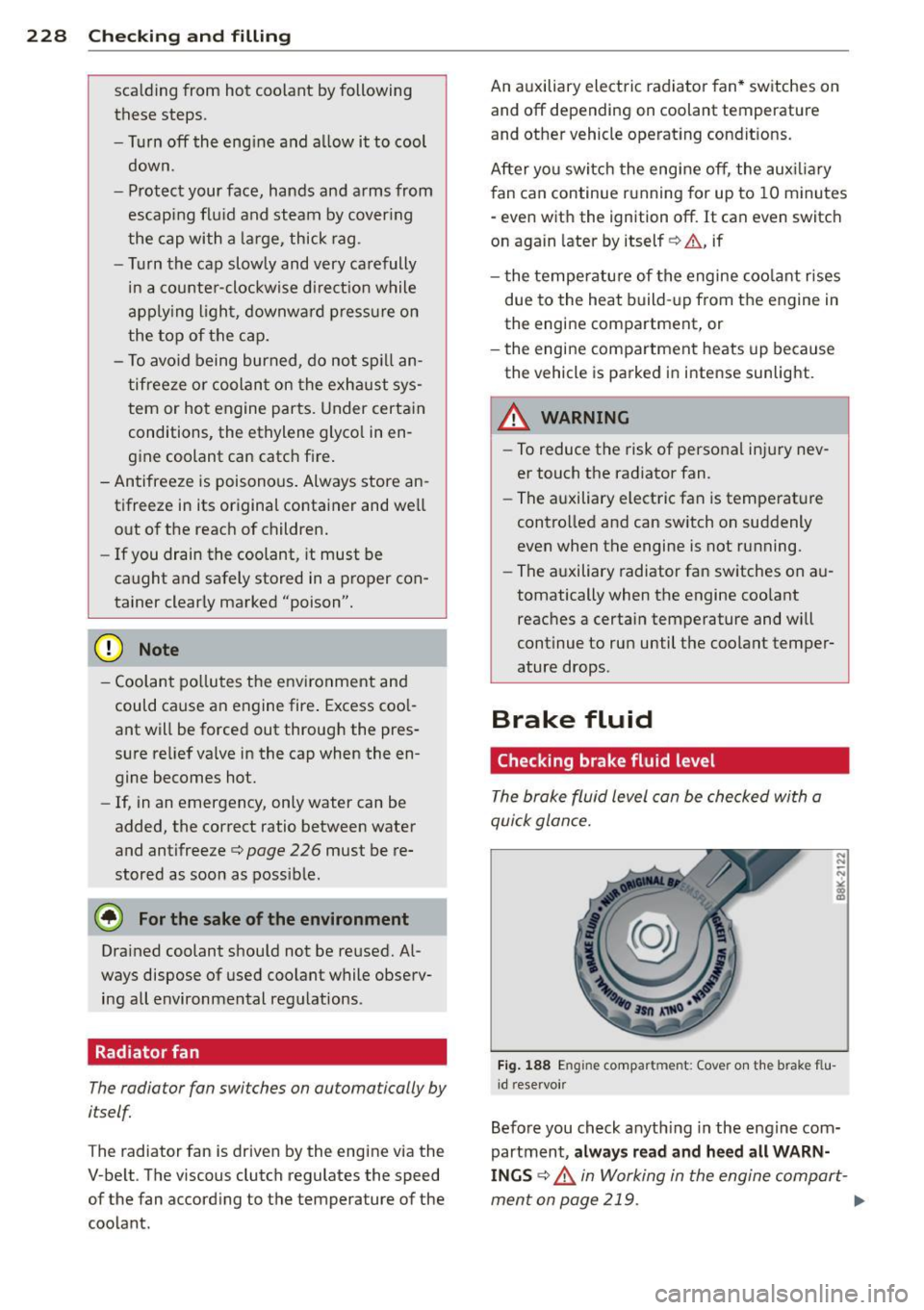
F ig . 1 88 Engin e compart men t: Cover on the b rak e flu
i d reservo ir
Before you check a nyth ing in the engine com
partment,
always read and hee d all WARN
INGS c::> .&. in Working in the engine compart-
ment on page 219 . .,..