fuel AUDI A4 2013 Owner's Manual
[x] Cancel search | Manufacturer: AUDI, Model Year: 2013, Model line: A4, Model: AUDI A4 2013Pages: 302, PDF Size: 75.61 MB
Page 199 of 302
(D Note
Do not leave engine idling unattended af
ter starting . If warning lights should come
on to indicate improper operation, they
would go unheeded. Extended idling also
produces heat, which could result in over
heating or other damage to the vehicle or
other property .
Regular maintenance
A badly tuned engine unnecessarily wastes a
lot of fuel .
.,. Have your vehicle serv iced at regular inter-
vals .
By having your vehicle regularly serviced by an
author iz ed Audi dealer helps to ensure that it
runs properly and economically . The condition
of your vehicle not only affects its safety and
ab il ity to hold its value, it also affects
fu el
c onsump tion .
C hec k your oil each tim e you fill your t ank .
The amount of oil used is related to engine
load and speed.
It is normal for the oil consumption of a new
engine to reach its lowest value after a certain
mileage has been driven.
You must d rive yo ur vehicle about 3 ,000 miles
(5,000 kilometers) be fore you can properly
assess oi l consumption.
This a lso applies to fuel consumption and en
g ine output .
0 Note
-Have your vehicle maintained properly
and in accordance wit h the service rec
ommendat ions i n your Warranty
& Main
tenance booklet . Lack of proper mainte
nance as well as improper use of the ve
hicle wi ll impair the function of the
emission control system and could lead
to damage.
Dri vin g and en vironm ent 197
-Do not alter or remove any component of
the Emission Control System unless ap
proved by the manufacturer .
- Do not alter or remove any device, such
as heat shie lds, switches, ignition wires,
valves, which are designed to protect
your vehicle's Emission Control System and other important vehicle compo
nents .
Fewer short trips
Fuel consumption will always be rela tively
high on short trips .
.,. Try to avoid driving short distances with a
cold engine.
The engine and cata lytic converter have to
reach their opt imal
op erati ng t emper ature to
reduce fuel consumpt ion and noxious emis
s ions effectively .
Just after starting, a co ld engine in a mid-size
car only achieves a fuel economy of 6-8 mi les
per gallon (30-40 l/100 km). After about a
half a mile, fuel economy climbs to 12 mpg
(20 l/100 km) . After about
2 .5 miles (4 km),
the e ngine is at its proper operat ing tempera
ture and fue l economy has reached a normal
level. So you can see that you should avo id
short trips whenever poss ible.
T he
outs ide t emp erature is also cr itical in th is
regard. Your car consumes more fue l in the
winter than in the summer.
allroad : Driving offroad
General information
App lies to vehicles : allroad
When d riving offroad, the functions for the
electron ic stabilization control (ESC) are ex
panded. The ESC -Offroad -Mode can be act ivat
ed in driving situations in which a whee l lock
o r a d iffe rential lock function is needed
~ page 188. In addition , you r Audi p rov ides
continuous all wheel drive.
Your Audi i s ho wever, no t an offroad vehicl e.
Nev er drive the vehicle in terrain which i s not
lilJJ,,
•
•
Page 204 of 302
202 Cleaning and protection
Cleaning and protect ion
General information
Regular core preserves vehicle value .
Any automobile is exposed to industrial
fumes, corrosive road salt, etc. A well cared
for Audi can look like new many years after
purchase . Regular and correct care w ill con
tr ibute to maintaining the beauty and value of
your Aud i.
Furthermore, good care may be a condition
for substantiating a warranty claim should
corrosion damage or paint defects occur.
Your author ized Audi dealer has a variety of
dedicated vehicle-care products and can ad
vise which ones to use for cleaning the exter i
or and interior of your vehicle .
Whether you use products recommended by
Audi or other commercially available clean ing
agents, please make sure you apply them cor
rectly .
A WARNING
-Cleaning agents may be poisonous. Keep
them out of the reach of children.
- Heed all caut ion labels.
- Always read directions on the container
before using any product . Follow the di
rect ions carefu lly.
- Most chemical cleaners are concentrated
and have to be diluted.
- Use spot removing fluids only in well
ventilated areas.
- Do not use gasoline, kerosene, d iesel
fuel, nail pol ish remover or other volatile
fluids. They may be toxic, flammable or
hazardous in other ways. Do not wash,
wax or dry the vehicle with the ignit ion
on or the engine running.
- Do not clean the undersides of chassis,
fenders, wheel covers, etc. without pro
tecting your hands and arms. You may cut yourself on sharp-edged metal parts. -
Moisture and ice on brakes may impair
brak ing eff ic iency
c::> page 188. Test the
brakes carefully each time you wash the
veh icle.
@ For the sake of the environment
Select on ly environ mentally friendly clean
ing products. Leftover cleaning products
should not disposed of in the household
waste .
Care of exterior
Washing
Frequent washing protects the vehicle .
The best p rotection against environmental in
fluences is
frequent washing and waxing . How
often this is required depends on:
- How much the veh icle is used
- Where the vehicle is parked (garage, in the
open under trees, etc.)
- The seasona l and weather conditions
- Environmental influences
T he longer b ird droppings, insects, tree resin,
road and industria l gr ime, tar, soot, road salt
and other materials remain on the vehicle body, the more lasting their destructive ef
fects will be . High temperatures caused by ex
posure to intense sunlight intensify the corro
sive effect, particularly when humidity is high as well.
Under certain circumstances,
weekly washing
may be necessary. Under other conditions, a
monthly washing and waxing may be ade
quate .
After the winter, the underside of the vehicle
should be thoroughly washed, preferably in a
professional car wash.
Vehicles with matte finish paint
c::> page 204.
A WARNING
-A lways read and heed all WARNINGS and
other information
c::> page 202.
Page 206 of 302
204 Cleaning and protec tio n
sponges to prevent scratches. It is best
to use soapy water .
- You should remove debris (such as in
sects) from the headlight lenses on a
regular basis, for example when refuel
ing your vehicle. Never use a dry cloth or
sponge to clean the head lights. Only use
we t cloths or sponges to prevent
scratches . It is best to use soapy water .
@) For the sake of the environment
Only wash the vehicle in facilit ies specially
designed for that purpose. Th is w ill reduce
the risk of d irty water contaminated w ith
oil from entering the sewer system . In
some areas, wash ing vehicles outs ide of
these facilities is prohib ited.
Washing your vehicle with a power
washer
Cleaning the exterior of your car with a high
pressure power washer is safe as long as you
observe a f ew simple rules.
• Before using the power w asher , make sure
yo u have read and understood the WARN
INGS
q A in General information on
page 202.
• Always fo llow the operating instructions for
the power washer.
• Make sure that the jet o n the spray hose
produces a "fan shaped spray" .
• Do
not hold the spray nozzle too close to
soft materia ls .
Keep a d is tance from soft materials such as
rubber hoses o r insulat ing mater ial as we ll as
sensors and camera lenses .
When cleaning t he vehicle wit h a power wash
er
always fo llow the operating instructions .
This applies particularly to the operating pres
sure and the spraying distance . Do not po int
the spray direc tly at the sea ls around the s ide
windows, aro und t he doors, on the re ar lid or
on the sunroof* . Likew ise, do not point it di
rectly at tires, r ubber hoses, ins ulation mate
rial or sensors
q page 205. Hold the spray nozzle at least 1.3 ft (0.4 m) away from the
vehicl e.
Do no t use a high-pressu re power was her to
remove snow and ice .
Do not use a jet which sprays water in a d irect
st ream o r one that has a rotating je t.
Water temperature should not exceed 140 °F
(60 °() .
A WARNING ,..__
Neve r wash t ires with a jet that sprays wa
ter in a direct stream . Thi s could cause in
v is ible d amage to the t ires and weaken
them, even if the spray is from a relative ly
l ong distance and for a short time . Dam
aged and wea kened tires can fail a nd cause
accidents and personal in jury.
(D Note
To avoid damaging yo ur vehicle, a lw ays
make sure tha t the re is sufficien t distance
betwee n the spray head and soft materia ls
lik e rubbe r hoses, plast ic parts and sound
deaden ing mater ia ls as well as sensors
and camera lenses. Never a im the spray
head at the same point fo r a long time.
This also app lies to cleaning headlights
and paint ed bumpers . Remembe r: t he
closer the no zzle is to the surfa ce of the
m at erial , the gre ater t he s tress on the ma
terial.
Caring for vehicles with matte finish
paint
Applies to vehicles: wit h matte finish paint
Vehicles with matt e finish paint require spe
cial care due to the characteristics of the
paint.
Washing by hand
T o avoid damaging the pain t when was hing,
fi rst remove dust and la rge particles from
yo ur vehicle . Insects, grease spots and finger
prints are best removed with a
special cleaner
for matte finish pa int .
1111>
Page 207 of 302

Apply the product using a microfiber cloth . To
avoid damaging the paint surface, do not use
too much pressure .
Rinse the vehicle tho roughly with water . Clean
the vehicle starting at the top and working to
ward the bottom using a
neutra l sh ampoo
and a soft mi crofiber cloth . Stop frequently to
rinse the cloth thorough ly.
Clean the wheels and sill panels last. Use a
clean
s pon ge on these areas .
R inse the vehicle tho roughly aga in and let i t
a ir dry. If there are any wa ter spots, they can
be removed using a
le ather cloth.
Clea n again with the sp ecial cl eaner for matt e
finish paint
i f ne cessary.
Removing stubborn dirt
B ird dropping s or tree sap a re best removed
with plenty of water and a m icrofiber cloth .
You shou ld r inse off
gasoline residue immedi
ately with plenty o f water.
A WARNING
- Wash your veh icle only when the ignition
is switched off to reduce the risk of a
c rash .
- Always read and heed all WARNINGS and
other information ¢
page 202.
0 Note
-Do not treat vehicle parts painted w ith
matte f inish paint usi ng polish ing mate
r ials or hard wax . These products could
cause damage to the appearance or sur
face that cannot be repaired.
- Never use p rotective wax. It can destroy
the matte fin ish effect .
- Do not p lace any st ickers or magne tic
s igns on vehicle parts painted with
matte finish paint. The pa int co uld be
damaged when the stickers or magnets
are removed.
- To prevent pa int damage, do not wash
the veh icle in direct sun ligh t.
Cleaning and protec tion 205
- To prevent damage to the pa int sur face,
do not use insect remova l sponges ,
rough kitchen sponges or sim ila r items .
- Yo u should remove deb ris (such as in
sects) from the headlight lenses on a
regu lar bas is, for example when refuel
ing your vehicle . Only clean the head
lights using a wet cloth or sponge, never
a dry one. Cleaning with soapy water is
recommended.
(D Tips
For more information on special cleaning
products designed for matte finish paint,
see your Aud i deale r.
, Sensors and camera lenses
- Remove snow with a hand brus h and remove
ice with a de- ic ing sp ray that does not con
t ain so lvents.
- Clean the senso rs (adaptive cruise co ntrol*,
pa rking system*) w ith a cleaning so lution
tha t does not contain so lvents and a soft
cloth .
(D Note
-If you wash your vehicle with a pressure
washer,
- make sure there is enough distance to
sensors i n the rear bumper.
- do not clean the camera lenses and the
area around them with the pressure
washer.
- Never use warm or hot water to remove
snow or ice from the camera lens. This
cou ld cause the lens to crack .
- Never clean the camera lens with abra
sive products .
Waxing and Polishing
Waxing
A good wax coating protects the vehicle paint
to a large extent against the environmental
factors listed under~
page 202, Washing and
even against s light scratches.
ii,.
•
•
Page 215 of 302
Engine compartment
Be especially careful when cleaning the en
gine compartment.
Al ways s witch off the ign ition befor e clean
ing the eng in e c:>
& .
Plenum panel
Remove leaves from the plenum pane l in front
of the windshield under the engine hood. This
prevents the water drain holes from becoming
blocked, and it prevents debris from entering
the vehicle interior through the heating and
ventilation ducts .
Corrosion protecti on
The engine compartment and transmission
have been corrosion-protected at the factory.
Good anti-corrosion treatment is very impor
tant, particular ly in the winter . If the vehicle
is frequent ly driven on salt treated roads, the
entire engine compartment and plenum panel
should be thoroughly cleaned at the end of
winter and retreated to prevent sa lt damage.
At the same time, the underside of the vehicle
should be washed as we ll.
If the engine compartment is cleaned at any
time with grease removing solut ions
1>, or if
you have the engine washed , the anti-corro
sion treatment is a lmost always removed as
well.
It is therefore essential to have a long
lasting co rrosion protection reapp lied to a ll
surfaces, seams, joints and components in the
engine compartment.
A WARNING
Be aware: The engine compa rtment of any
motor vehicle is a potentially hazardous
area.
- Before working in the engine compart
ment, be s ure to read the in format ion
c:> page 219.
- Before reaching into the front plenum
pane l, always remove the ignition key.
l ) Use o nly the co rr ect cle anin g s olu tion s. Neve r use ga s
o line or d ie sel fuel.
Cleaning and protec tion 213
Otherwise, the windshield wiper system
could un intentionally be sw itched on,
possibly caus ing personal injury from the
mov ing wiper linkage .
- Never reach into the area around or
touch the rad iator fan. The aux iliary fan
is temperature controlled and can sw itch
on suddenly - even when the ignition is
off.
- Do not wash, wax or dry the eng ine with
the engine running . Moving or hot parts
could injure you.
- Do not clean the underside of the chas
sis, fenders, wheel covers, or other ha rd
to reach pa rts without protect ing your
hands and arms . You may cut yourself on
sharp-edged metal parts .
- Always read and heed all WARNINGS and
o ther info rmation
c:> page 20 2.
•
•
Page 216 of 302
214 Fuel supply and filling your fuel tank
Fuel supply and filling
your fuel tank
Gasoline
Fuel supply
Using the righ t fuel helps keep the environ
ment cle an and preven ts engine dam age .
Fuel recommendation
The fuel recomme nded for you r vehicle is un
lead ed premium
g rade gasoline . See a lso
r::;, pag e 277, Data . Audi recommends usi ng
T OP TIER D eterge nt Gaso line wi th a mini mu m
octa ne ra tin g of 9 1 AKI (95 RON). For more
in fo rmation on TO P TI ER De tergent Gaso line,
p lease go to the officia l webs ite (www.toptier
gas.com).
Th e re commended g asoline oct ane r ating for
your engine can a lso be fo und on a label loca t
e d on the ins ide of the fue l filler flap . This rat
ing may be specified as A KI or RO N.
Your veh icle m ay also be oper ated using un
l ea ded regular g asoline with a min imum o c
tane rating of 87 AKI/91 R ON. However, using
87 AKI/91 RON octa ne f ue l w ill slightly re
d uce eng ine perfo rmance.
Use unleaded gasoline only. Unleaded g aso
line is availab le th rou gho ut the USA, Canada ,
and in most E uropean countries . We recom
mend that you do not ta ke yo ur vehicle t o
areas or countries where unleaded gasoline
may not be ava ilable.
F or mo re in format io n on refue ling your ve hi
cle, seer::;,
page 216.
Octane rating
Octa ne r ating in dicates a gaso line's abili ty to
res ist engine damagin g "knoc k" ca used by
p remature ign ition and detonation. Therefore,
buy ing the correct grade of gaso line is very
important to help prevent possible engine
damage and a loss of engine performance.
Gasoline most commonly used in the Unite d
States a nd Canada has the following octane r
at ings t hat can usu a lly be found on the fi ller
pump:
- Pre mium G ra de: 91 -9 6 A KI
- Regular Grade : 87 -90 AKI
Explanation of the abbreviations:
AKI = Anti K nock Index= (R+M) /2 = (RO N
+ MON)/2
R ON= Resea rch Octane Numb er
MON = Motor Octane Num ber .
(D Note
-Do not use a ny f ue l w it h octane rat ings
lower tha n 87 A KI or 9 1 RO N othe rwise
expensiv e engine damage w ill occur.
- Do
not use leaded gasoline . The use of
lead ed gasoline w ill severely damage
yo ur v ehicl e's catalytic co nve rter a nd its
ability to co ntrol exha ust e mission s.
Blended gasoline
Use of gasoline containing alcohol or
MTBE (methyl tertiary butyl ether)
You may use unleaded g asoline blende d with
alcohol o r MTBE (commonly re ferred to as
oxygenates) if the blende d mixture meets t he
f o llow ing criteria:
Blend of gasoline methanol (wood alcohol or
methyl alcohol)
- Anti -kno ck index mus t be 87 A KI or higher.
- Blend must contain no mor e than 3% me th-
anol.
- Blend must contain more than 2% co-sol-
ve nts .
Blend of gasoline and ethanol (grain alcohol
or ethyl alcohol)
- Anti -knoc k index must be 87 AKI or higher .
- Blend must not conta in mo re than 10%
ethanol.
- Ve hicl es w ith flexible f uel engine: blend
m ust not contain more t han 85% etha no l.
Blend of gasoline and MTBE .,.
Page 217 of 302
-Anti-knock index must be 87 AKI or higher.
- Blend must contain not more than 15%
MTBE.
Seasonally adjusted gasoline
Many gasoline grades are blended to perform
especially well for winter or summer driving. During seasonal change-over, we suggest that
you fill up at busy gas stat ions where the sea
sonal adjustment is more likely to be made in
time.
(D Note
- Fuels containing a high percentage of
ethanol such as ESO and E85 may only
be used in veh icles with flex ible fuel en
gines. Using high ethano l fuel in vehicles
not equipped with flexib le fue l engines
can cause severe engine damage .
- Methanol fuels which do not meet these
requirements may cause corrosion and
damage to plastic and rubber compo
nents in the fuel system.
- Do not use fuels that fail to meet the
specified criteria in this chapter.
- If you are unable to determine whether
or not a particular fuel blend meets the
specifications, ask your service station or
its fuel supplier.
- Do not use fuel for which the contents
cannot be identified.
- Fuel system damage and performance
problems resulting from the use of fuels
different from those specified are not
the respons ibility of Audi and are not
covered under the New Veh icle or the
Emission Control System Warranties.
- If you experience a loss of fuel economy
or driveability and performance prob
l ems due to the use of one of these fuel
blends, we recommend that you switch
to unblended fuel.
Fuel supply and filling your fuel tank 215
Ethanol fuel (Bio-ethanol)
Applies to veh icles: w it h flex ible fue l en gin e
You can recognize vehicles with a flexible fuel
engine by looking at the label on the inside of
the fuel filler flap .
Vehicles with flexible fuel engines may be op
erated with bio -ethanol fuels such as E85
(85% ethanol and 15% gasoline) or with un
leaded gasoline (91 AKI/ROZ 95) . T he vehicle
may also be operated with a mixture of these
fuels.
Your fuel consumption will increase when us
ing bio-ethanol fue ls due to the lower amount
of energy contained per unit volume in etha
nol.
Warming up the flexible fuel engine in
low temperatures
Due to the chemical composition of b io-etha
nol, a certain amount of fuel ends up in the
engine oil when driving short distances in ve ry
low temperatures. This fuel evaporates again
when the engine is warmed up.
II Ple ase warm up engine.
If the driver message appears in the instru
ment cluster disp lay, drive with a warm en
gine to reduce the oil level.
(D Note
- Never fill with methanol or with a higher
percentage of b io-ethanol than 85%
(E85). A h igher percentage of bio-etha
nol in the fuel can cause damage to the
engine or to the fue l system.
- If you use only E85, it is recommended
to fill the fue l tank complete ly w ith un
leaded premium grade gaso line every
5,000 miles.
- If you experience starting, rough id le or
hesitation driveability problems, fill the
fuel tank comp letely with unleaded pre
mium grade gasoline and dr ive it nor
mally until the gasoline is used. See your
authorized Audi dealer if the problem
pers ists.
•
•
Page 218 of 302

216 Fuel supply and filling your fuel tank
-Inform your authorized Audi dealer that
you are operating or have operated the
vehicle with E85.
- Read and follow the information and tips
about gasoline
¢ page 214.
@ Tips
I t may take longer to start the engine
when the outside temperature is very cold.
If possible, use winterized fuel if tempera
tures are below freezing.
Gasoline additives
A major concern among many auto manufac
turers is carbon deposit build-up caused by
the type of gasoline you use.
Although gasoline grades differ from one manufacturer to another, they have certain
things in common. All gasoline grades contain
substances that can cause depos its to collect
on vital engine parts, such as fuel injectors
and intake valves. Although most gasoline
b rands include additives to keep eng ine and
fuel systems clean, they are not equally effec
tive.
Aud i recommends using TOP TIER Detergent
Gasoline. For more information on TOP TIER
Detergent Gasoline, please go to the official
website (www.toptiergas .com).
After an extended period of using inadequate
f u els, b uilt-up carbon deposits can rob your
engine of peak performance.
CJ) Note
-Damage or malfunct ion due to poor fuel
quality is not covered by the Audi New
Vehicle Limited Wa rranty.
- Do not add aftermarket fuel addit ive
products to your fuel tank .
Fuel tank
Fuel filler neck
The fuel filler neck is located on the right rear
side panel behind the fuel filler flap. If the power
locking system should fai l, you
can still open the flap manua lly -for detailed
instructions see
¢page 218.
You can find the fuel tank capacity of your ve
hicle in
Technical Data ¢page 277 .
T he label on the inside of the fuel filler flap
te lls you the correct fuel for your veh icle. For
more information about fuel specifications,
see ¢
page 214.
Your vehicle fuel tank has an on-board refuel
ling vapor recovery system. This feature helps
to prevent fue l vapors from escaping from the
tank and polluting the environment while you
refuel your vehicle. In order to fi ll the tank
proper ly while protecting the environment,
please fo llow this refueling procedure careful
ly.
A WARNING "'--
Under normal operating cond itions, never
carry addit ional fuel conta iners in your car .
Gas canisters and other conta iners used to
transport fuel can be dangerous. Such con
tainers, full or empty, may leak and could
cause a fire in a collision . If you must
transport fuel to use for your lawn mower,
snow b lower, etc., be very careful and al
ways observe loca l and state laws regard
ing the use, transportation and storage of
such fuel containers. Make certain the con
tai ner meets industry standards (ANSI/
ASTM F852 -86).
(D Note
Never drive your veh icle until the fuel tank
i s completely empty. The irregular supply
of fuel can cause misfiring. Gasoline could
enter the exhaust system and damage the
catalytic converter.
Page 219 of 302
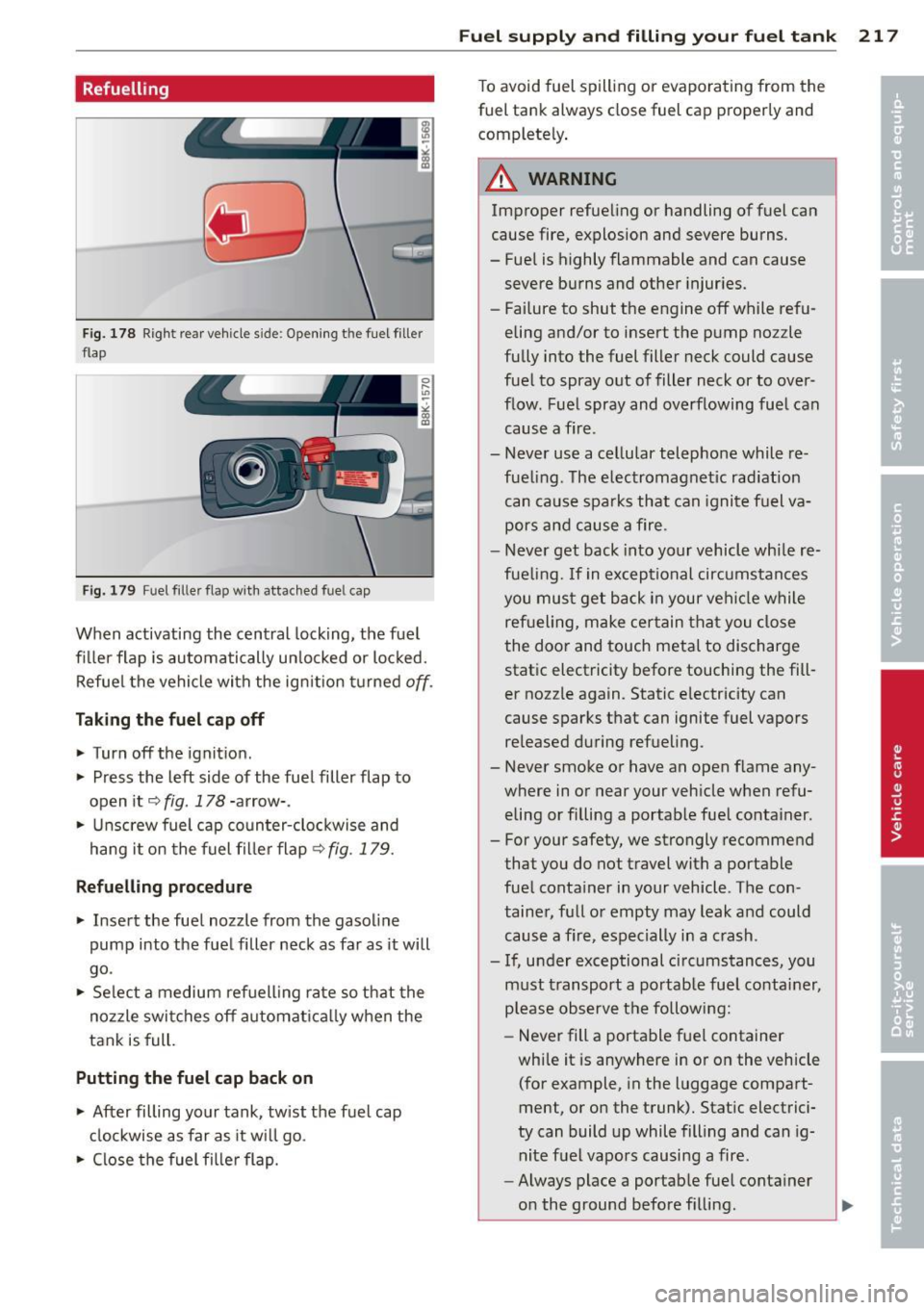
Refuelling
Fig. 178 Right rear vehicle sid e: Opening t he fuel filler
flap
Fig. 179 Fu el filler flap with attached fuel cap
When activating the central locking, the fuel
filler flap is automatically unlocked or locked.
Refuel the vehicle with the ignition turned
off.
Taking the fuel cap off
.. Turn off the ignition .
.. Press the left side of the fuel filler flap to
open it~
fig. 178 -arrow- .
.. Unscrew fuel cap counter-clockwise and
hang it on the fuel filler flap~
fig. 179.
Refuelling procedure
.. Insert the fuel nozzle from the gasoline
pump into the fuel filler neck as far as it will
go .
.. Select a medium refuelling rate so that the
nozzle switches off automatically when the
tank is full.
Putting the fuel cap back on
.. After filling your tank, twist the fuel cap
clockwise as far as it will go .
.. Close the fuel filler flap.
Fuel supply and filling your fuel tank 217
To avoid fuel spilling or evaporating from the
fuel tank always close fuel cap properly and
completely.
_& WARNING
Improper refueling or handling of fuel can
cause fire, explosion and severe burns.
- Fuel is highly flammable and can cause
severe burns and other injuries.
- Failure to shut the engine off while refu
eling and/or to insert the pump nozzle
fully into the fuel filler neck could cause
fuel to spray out of filler neck or to over
flow. Fuel spray and overflowing fuel can cause a fire .
- Never use a cellular telephone while re
fueling. The electromagnetic radiation
can cause sparks that can ignite fuel va
pors and cause a fire.
- Never get back into your vehicle while re
fueling.
If in exceptional circumstances
you must get back in your vehicle while
refueling, make certain that you close
the door and touch metal to discharge static electricity before touching the fill
er nozzle again. Static electricity can
cause sparks that can ignite fuel vapors
released during refueling .
- Never smoke or have an open flame any
where in or near your vehicle when refu
eling or filling a portable fuel container .
- For your safety, we strongly recommend
that you do not travel with a portable
fuel container in your vehicle . The con
tainer, full or empty may leak and could
cause a fire, especially in a crash.
- If, under exceptional circumstances, you must transport a portable fuel container,
please observe the following:
- Never fill a portable fuel container
while it is anywhere in or on the vehicle
(for example, in the luggage compart
ment, or on the trunk). Static electrici
ty can build up while filling and can ig
nite fuel vapors causing a fire .
- Always place a portable fuel container
on the ground before filling.
Page 220 of 302
218 Fuel supply and filling your fuel tank
-Always keep the filler nozzle complete
ly inside the portable container before
and during filling.
- If filling a portable container made of
metal , the filler no zzle must always be
in contact with the container. Th is will
help prevent static electricity from dis
charging and cause a fire .
- Never spill fuel inside the vehicle or
luggage compartment. Fuel vapors are
highly flammable .
-Always observe local and state/provin
cial laws regarding the use, storage
and transportation of fuel containers.
- Make certain the fuel container meets
industry standards (ANSI/ ASTM
F 852-86).
(D Note
If any fuel has spilled onto the car, it
should be removed immediately to prevent
damage to the paint .
@ For the sake of the environment
As soon as the correctly operated nozzle
sw itches off automatically for the first
time, the tank is full . Do not try to add
more fuel because fuel may spill out. In
addition, the expansion space in the fuel
tank will be filled -causing the fue l to
overflow when it becomes warm and pol
lute the environment.
@ Tips
-Running yo ur engine while refuelling
may cause vapors to escape or even
cause fue l to spill out of the tank . This
would then shut off the fuel nozzle be
fore the tank is full.
- Do not refuel your vehicle with the igni
tion turned on. The fuel gauge may oth
erwise not indicate the correct fuel level
after refuelling .
- The fuel filler flap of your vehicle is not locked when you lock the vehicle from
the inside .
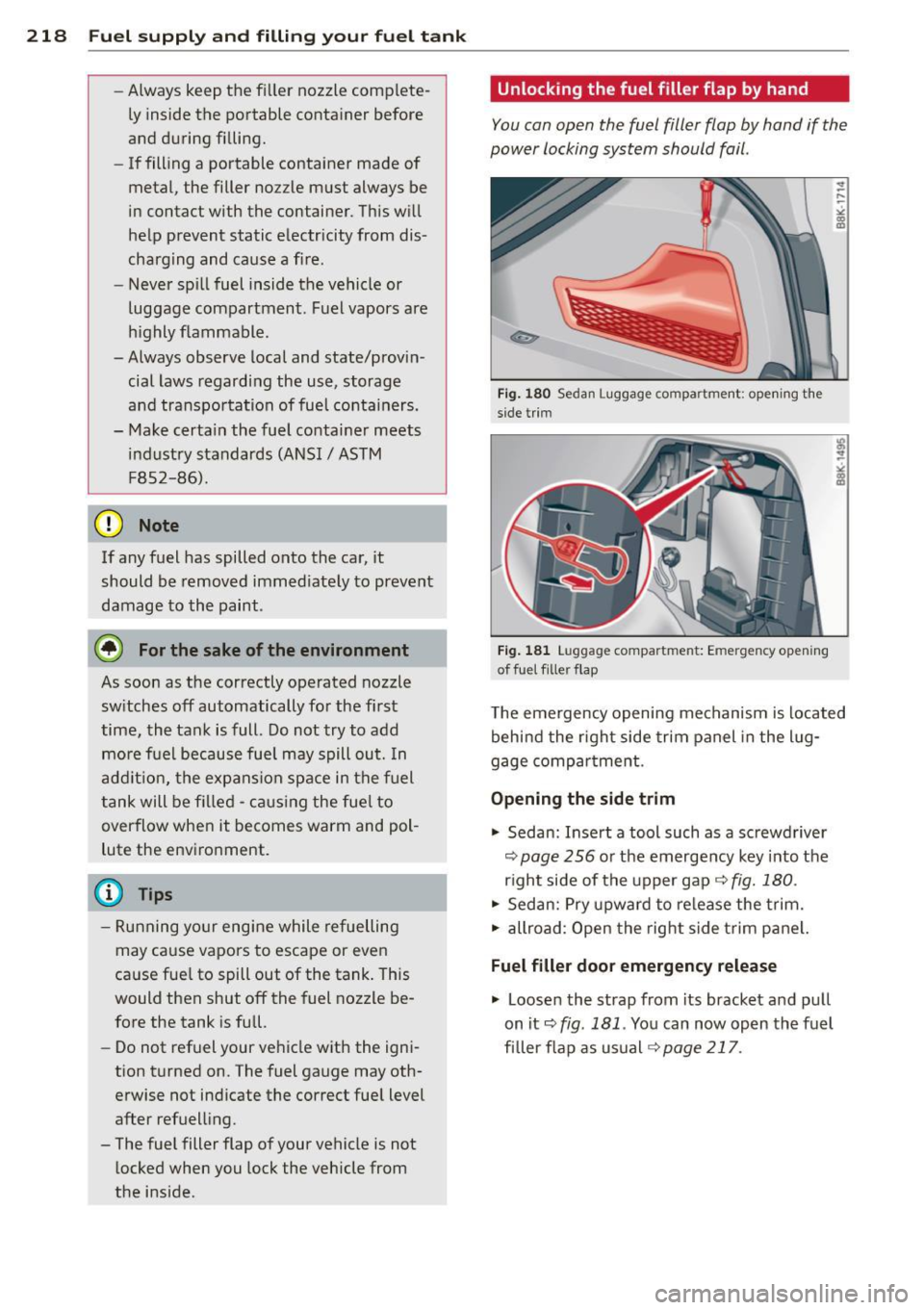
Unlocking the fuel filler flap by hand
You can open the fuel filler flap by hand if the
power locking system should fail.
Fig. 180 Sed an Lugga ge com pa rtment: op ening the
side trim
Fig. 181 Lug gag e compart men t: Em erge ncy opening
of fuel filler fla p
The emergency opening mechanism is located
behind the right side trim panel in the lug
gage compartment .
Opening the side trim
"' Sedan: Insert a tool such as a screwdriver
c:> page 256 or the emergency key into the
right side of the upper gap~
fig. 180 .
"' Sedan: Pry upward to release the trim .
.,.. allroad : Open the right side trim panel.
Fuel filler door emergency release
"' Loosen the strap from its bracket and pull
on it
c:> fig . 181 . You can now open the fuel
fi ller f lap as usual
c:> page 217.