transmission AUDI A4 2013 Owner's Manual
[x] Cancel search | Manufacturer: AUDI, Model Year: 2013, Model line: A4, Model: AUDI A4 2013Pages: 302, PDF Size: 75.61 MB
Page 98 of 302
96 Transmission
Manual shift program
Appl ies to vehicles: with multitronic/S tronic/t iptronic
Using the manual shift program you can
manually select gears .
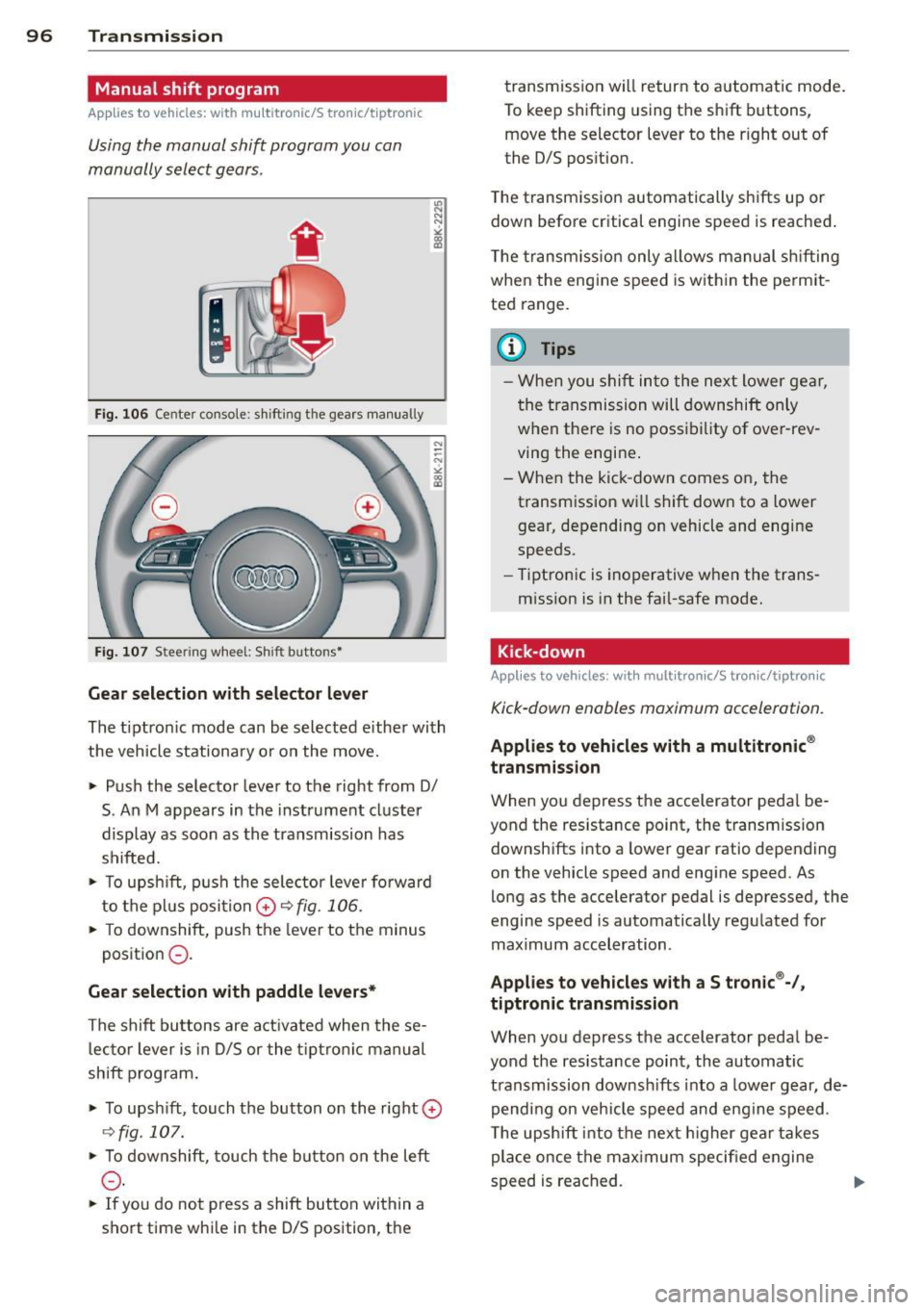
Fig . 10 6 Center co nsole: s hifting the gears manu ally
Fig . 10 7 Steer ing w heel: Shift buttons•
Gear selection with selector lever
"' N
N
~
" a> CD
The tiptron ic mode can be selected e ither with
the vehicle stationa ry or on the move.
• Push the selector lever to the right from 0/
S. An M appears in the instrument cl uster
display as soon as the transmission has
shifted.
• To upsh ift, p ush the sele ctor leve r fo rw ard
to the pl us posi tion
0 r:::,fig . 106.
• To downshift , push the lever to the minus
position
0 -
Gear selection with paddle levers*
The s hift bu ttons are act ivated when the se
l ec to r lever is in D/S or the t ip tr on ic manu al
shift program .
• To upsh ift, touch the button on th e right
0
C:, fig . 107.
• To downshift, touch the bu tton on the left
0 -
• If you do not press a shift button wi thin a
s h ort time whi le in the D/S position, t he transmission will return to a
utomatic mode .
To keep shifting using t he sh ift bu ttons,
move the selector lever to the r ight out of
the 0/S pos ition.
T he t ransm iss io n automatically sh ifts up or
down before critical engine speed is reached .
T he transm iss io n only a llows manual sh ifting
when the engine speed is w it hi n the pe rmit
ted range .
@ Tips
-Whe n you s hift into the ne xt l ower ge ar,
the transmission will downshift only
w hen the re is no poss ib ility of ove r-rev
ving the engine .
- W hen the kic k-down comes on, the
transm ission w ill shift d ow n to a lower
gear, depending on vehicle and engine
speeds.
- Tiptro nic is inoperative when the trans
m ission is in the fai l-safe mode.
Kick-down
Applies to vehicles : wit h mult itronic/S t ro ni c/tip tro nic
Kick-down enables maximum acceleration.
Applies to vehicles with a multitronic ®
transmission
W hen you depress the accelerator peda l be
yond the res istance point, the transm ission
downsh ifts into a lower gear ratio depend ing
on the vehicle speed and engine speed. As
lo ng as the acce lerator pedal is depressed, the
engine speed is automatically regu lated for
maximum acceleration .
Applies to vehicles with a S tronic ®-/,
tiptronic transmission
When you depress the accelerator peda l be
yond the resistance point, the automatic t ra nsmission downsh ifts into a lowe r gear, de
pend ing on veh icle s peed an d eng ine speed .
T he upsh ift int o th e nex t higher gea r takes
place once the max imum speci fied engine
s p eed is reached .
Page 99 of 302
A WARNING 1=
Please note that the drive wheels can spin
if kick-down is used on a smooth slippery
road - there is a risk of skidding.
Launch Control Program
App lies to vehicles: with S tronic
The Launch Control Program provides the
best acceleration possible when starting from
a stop .
Requirement : The engine must be at operat
ing temperature and the steering wheel must
not be turned .
~ Press the l.e OFFI button ¢ page 187 or
r:::> page 188 while the engine is running.
The
fsl indicator light illuminates in the in
strument cluster and
Tra ction con trol
( ASR ): Off. W arning! Re stri cted stabil ity
appears in the dr iver information system
display .
~ Move the selec to r l ever to the D/S position
or se lect the
d y nami c driving mode in drive
select*
r:::> page 114.
~ Press the brake peda l strong ly wit h your left
foot and hold it down for at least 1 second.
~ At the same time, press the accelerator
pedal down completely with your right foot
until the engine reaches and maintains a
high RPM .
~ Remove your foot from the brake peda l
within 5 seconds
r:::> .&, .
A WARNING
-Always adapt you r driving to the traffic
flow.
- Only use the Launch Control Program
when road and traffic conditions allow it
and other drivers will not be endangered
or annoyed by you r driv ing and the vehi
cle's acce leration.
- Please note that the driving wheels can
spin and the vehicle can break away
when ASR is switched off, especially
when the road is slippery.
-
Tran sm iss ion 97
-Once you have accelerated, you shou ld
sw itch the ASR back on by pressing the
l.e O FFI button.
(D Tips
- The transmission temperature may in
crease s ignificantly after using the
Launch Control Program. If that hap-
pens, the program may not be availab le
for a few m inutes. It will be ava ilable
again after a cool-down per iod .
- When accelerating using the Launch
Cont ro l program, a ll vehicle parts are
subject to heavy loads. This can result in
increased wear .
Transmission malfunction
Applies to vehicles: with multitro nic/S tronic/t iptronic
[O] Transmis sion: Pr ess brake p edal and se·
Leet gear again .
Press the brake peda l and select the desired
selector lever position again. You ca n the n
continue driving.
[O] Trans mission overhe ating: Pl ease drive
conservatively .
The transmiss ion temperature has increased
s ignificantly due to the sporty d riving manner .
D rive in a less sporty ma nner until the tem
perature returns to the normal range and the
indicato r light switc hes of.
[O] Tran smission malfunction: You can con
tinue driv ing
There is a system malfunction in the transmis
sion. You may cont inue driving. Drive to your
authorized Aud i dea ler or qualified repa ir fa
c ility soo n to have the malfunction corrected .
[O] Transm ission malfunction : Lim ited dr iv·
ing functionality
There is a system malfunction in the t ransmis
s ion . The transm ission is switching to emer
gency mode . This mode on ly shifts into cer-
ta in gears or will no longer shift at all. The en
gine may sta ll. Dr ive to your authorized Audi ..,.
Page 100 of 302
![AUDI A4 2013 Owners Manual 98 Transmission
dealer or qualified repair facility immediately
to have the ma lfunction corrected.
[O] ffl Transmi ssion malfunction: No r eve rs e
You can continue dri ving
S tron](/img/6/57563/w960_57563-99.png "AUDI A4 2013 Owners Manual 98 Transmission
dealer or qualified repair facility immediately
to have the ma lfunction corrected.
[O] ffl Transmi ssion malfunction: No r eve rs e
You can continue dri ving
S tron")
98 Transmission
dealer or qualified repair facility immediately
to have the ma lfunction corrected.
[O] ffl Transmi ssion malfunction: No r eve rs e
You can continue dri ving
S tron ic ® transmission: There is a system ma l
function in the transmission . T he transmis
sion is switc hing to emergency mode . This
mode on ly shifts into cer tain gears or w ill no
longe r shift at all. The engine may sta ll. You
cannot engage the reverse gear . Drive to your
author ized Audi dealer or qua lified repair fa
cility immediately to have the ma lf u nction
corrected.
[O] Tran smis sion malfunction : Stop veh icle
and shift to p ark.
Do not cont inue driving. Select the P se lector
leve r position and see yo ur authorized Audi
dea ler or qualified repair facility for assis
tance.
(D Note
If the transmission switches to emergency
mode, you sho uld take the vehicle to an
author ized Audi dealersh ip as soon as pos
sib le to have the cond ition corrected.
Selector lever emergency release
App lies to vehicles: with mult itronic/S tronic/tip tro nic
If the vehicle's power supply fails, the selec
tor lever can be released in on emergency.
F ig . 10 8 Fro nt ce nter conso le: Re mov ing th e ash tray
ins ert F
ig. 10 9
Se lec tor leve r em ergency re lease
"' To access the emergency re lease mecha
n ism , remove the ashtray insert @ us ing the
release sw itch
@ q fig. 108 .
"' Loosen an d remove the cap in t he asht ray
mou nt.
"' Yo u now have access to a p in . Using a sc rew
driver or simi la r object, press the pin down
and hold it in that position ¢
fig. 109 .
"' Now press the re lease button and move the
selector lever to the N posit ion.
T he selector lever can only be moved from the
P position i f the key is in the lock and the igni
t ion is switched on. If the power supply fails
(for example, the battery is discharged) and
t h e ve hicle must be pushed or towed, move
the selecto r lever to th e N position fi rst using
the emergency re lease.
Page 103 of 302

Audi adaptive cru ise control and brakin g guar d 101
Vehicles with manual transmission
App lies to vehicles: with Audi adaptive cruise control
The adaptive c ruise control is avai lab le from
the 2nd gear through the 6th gea r in the cus
tomary RPM.
When the adapt ive cruise control is turned on,
you must p ress the clutch to shift gears (as
usual) . When sh ifting normally or when press
ing the cl utch, the adap tive c ruise control re
mains turned on.
Afte r you have engaged the gear, you do
not
need to press the gas peda l. The adaptive
cru ise control accelerates automat ica lly if nec
essary.
I f you press dow n on the clutch fo r too long or
shift/coup le improperly, the adaptive cruise
control may turn off automat ically.
{D) Tips
You cannot tu rn on the adapt ive cru ise
contro l during a sh ifting operation.
Audi adaptive cruise
control
Description
App lies to vehicles: with Audi adaptive cruise control
Fig . 11 3 Detect ion range
What c an Audi adapt ive crui se cont rol d o?
The adaptive cruise control works in conjunc
tion with a radar sensor installed in the front
of the vehicle
¢page 99, fig. 110, which is
subject to desig nated system limits
<=:> page 101 . Stationary objects are disregard
ed . On open
roads with no traffic, adaptive cr uise
control works like a regular cruise contro l sys
tem. The stored speed is maintained . When
approaching a moving vehicle detected up
ahead, the adaptive cruise control system au
tomat ica lly slows down to match that vehi
cle's speed and then maintains the distance
that the dr iver previously stored . As soon as
the sys tem does not detec t a vehicle up
ahead, adaptive cruise cont ro l ac celerates
back up to the stored speed .
Which functions can be controlled?
When you switch adapt ive cruise control on,
you can set the cu rrent speed as the "contro l
speed "
¢ page 102, Switching on and off.
When dr iving, you can stop cru ise contro l
¢page 103 or change the speed ¢page 103
at any time.
You can also set the distance to t he object
ahead and set the adapt ive cru ise control driv
ing program
¢ page 104 .
Page 109 of 302
Audi adaptive cru ise control and brakin g guar d 107
-Sedan: I f you switch the A SR/ESC off,
braking guard switches off automatically
¢ page 187 .
-allroad : If you switch the offroad mode
on, braking g uard switches off automati
cally
¢ page 188.
-Switch braking guard off when you are
l oading the veh icle onto a vehicle carr ier,
tra in, sh ip or other type of transporta
tion. This can prevent undesired warn i ngs from the braking guard system .
Messages
Applies to vehicles: with Audi adaptive cruise co ntrol
B rak ing guard: Off
This driver message appears if the system is
turned off via the radio/MM I*. Otherwise, if
the system is turned off, the information ap
pears every time shortly after the start of the
tr ip.
B ra king gua rd: Act ivated
This drive r message appe ars if sharp brake
pressu re was applied due to an acute warning.
•••
Three white dots appear if a setting cannot be
selected with the operat ing lever . For exam
p le, this happens if you want to raise/lowe r
the speed even though there was no p revious
l y saved speed.
AC C: D eactiv ation
The driver message appears in vehicles with
manual transmission . If the clutch pedal was
pressed down for too long, the adaptive cruise
control turns off. A chime sounds as a rem ind
er.
ACC : Sensor blocked
This message appears if the sensor view is ob
structed, for example by leaves, snow, heavy
spray or dirt. C lean the sensor ¢
page 99,
fig. 110.
ACC: not available
The drive r message appears if there is a ma l
f u nction. The adap tive cruise cont rol tu rns off. A chime sounds as a
reminder. Have the sys
tem checked by an authorized Audi dea ler or
authorized Aud i Service Fac ility.
ACC: unavailable
The driver message appears if, for example,
t h e b ra ke tempe ratu re is too hig h. T he adap
tive cru ise con trol is temporarily u nav ail able.
A ch ime sounds as a remin der .
Engine sp eed !
This dr iver message appears in vehicles with
manua l transm ission if the drive r had not up
shifted or dow nsh ifted in t ime w hile using
adaptive c ruise contro l braking or accelerat
ing, caus ing the veh icle to exceed or not reach
the pe rm itted lim it speed. The adap tive cruise
control turns off. A chime sounds as a remind
er.
Shift lev er po sition!
Vehicles with an automat ic t ransm iss ion: the
drive r message appears if the se lecto r lever is
sh ifted to the N position. The adapt ive cruise
c o ntrol is not ava ilable while in th is posit ion.
Vehicles with manua l transm ission: the driver
message appears for vehicles with manua l
transmission if there is no forward gea r en
gaged, meaning if the reverse gea r or the 1st
ge ar is engaged o r if the sele ctor leve r is i n
the ne utra l posi tion. The ad apt ive cr uise con
tro l is not available while in th is posi tion.
Stabilization control (ESC )
This message appears if the e lectronic stab ili
zation control (ESC) is taking action to stab i
liz e the veh icle. The adaptive c ruise co ntrol
turns off. A chime sounds as a reminder .
Speed too low
This message appears if the current speed is
too low
to set or to maintain the desired
speed.
T he speed being saved must be at least
20 mp h (30 km/h). The cru ise contro l is
turned off for speeds lowe r than 12 mph
(20 km/h). The adaptive cruise control re
mains turned on for speeds above 95 mph
Page 115 of 302

Audi drive select Driving settings
Introduction
Appl ies to vehicles: wit h Audi drive select
Drive select provides the possibility to experi
ence different types of vehicle settings in one
veh icle. For instance, using the three
Com
fort, Auto and Dynamic modes, the driver can
switch from a sporty to a comfortab le driving
mode with the press of a button.
Addit ionally, in vehicles with
MM I*, the vehi
cle setup for
Individual* mode can be cus
tomized by you. This makes it possib le to
combine settings such as a sporty engine tun
ing with comfortable steering.
A WARNING
Improper use of the Audi drive select can
cause collisions, other acc idents and seri
ous personal injury.
Description
Applies to vehicles: w it h Audi drive select
The vehicle setup in each mode depends on
the vehicle's features. However, the engine,
automatic t ransmission* and steering are al
ways involved.
-
Engine and automatic transmission*
Depending on the mode, the engine and the
automatic transmission respond quicker or in
a more ba lanced manner to accelerator pedal
movements. In the sporty dynamic mode, the
automatic transmission shifts at higher RPMs .
Steering
The steering adapts in terms of steering effort
and steering ratios. Indirect steer ing that
moves easily, like the steering in comfort
mode, is best su ited to long dr ives on a high
way. In contrast, dynamic mode prov ides
sporty, direct steering.
The follow ing applies to vehicles with dynam ic
steer ing*: the steering ratio changes based on
veh icle speed in order to maintain optimum
Audi drive select 113
steering effort for the driver at all times. This
sets the steering to be less sensitive at higher
speeds in order to provide improved vehicle
control. At reduced speeds, however, steering
is more direct in order to keep the steering ef
fort as minimal as possible when the driver is
maneuveri ng the vehicle . At low and average
speeds, dynamic steering addit iona lly pro
vides more responsive steering performance.
Adaptive dampers*
The adaptive dampers* use sensors to record
information regarding steering movements,
braking and acceleration operations by the
drive r, road surface, driving speed, and load.
T his makes it possible to adapt damp ing to
the driving situation virtually i n rea l time.
Drive select also makes it possible to satisfy
the desire for sporty suspension (Dynamic)
and comfortab le suspension (Comfort) with
out giving up balanced tuning (Auto) .
Sport differential*
As a component of the all wheel dr ive system
(quattro ®)
q poge 191, the sport differential*
distributes the driving power to the rear axle
depending on the situation . The distribution
of power varies depending on the mode se lected. The goal is a high level of agility and
ability to accelerate on curves . The vehicle is
very respons ive to steering .
Audi adaptive cru ise control*
The behavior when accelerating can be adjust
ed from comfortab le to sporty, depending on
the drive select mode. Adaptive cruise control
also responds to the driving behavior of the
vehicle ahead in a more conservative or sporty
manner .
Engine sound*
The sound of the engine is adapted to the se
lected mode and ranges from subtle to sporty.
0) Tips
-In some models, the maximum vehicle
speed can only be reached in the
Auto
and Dynamic modes.
Page 191 of 302
brake pads should be checked by your a uthor
ized Audi dealer more often than specified in
the
War ranty & M aint enance booklet . Failure
to have your brake pads inspected can res ult
in reduced brake performance.
On steep slopes, you shou ld use the braking
effect of the engine . This way, you prevent un
necessary wear on the brake system. If you
must use your brakes, do not hold the brakes
down continuously . Pump the brakes at inter
vals.
Operating no ise
Noises may occur when braking depending on
the speed, braking force and outside condi
tions such as temperature and humidity.
Effect of w ater and ro ad salt
In certain sit uations, for example after driving
through water, in heavy rain, after overnight
condensation or after washing your car, the brak ing effect can be reduced by moisture or
ice on the brake rotors and brake pads. The
brakes must be dried first with a few careful
brake app lications.
At h igher speeds and with the w indshield w ip
ers turned on, the brake pads press against
the brake rotors for a short amount of time.
This occurs at regula r intervals without the
d river noticing and provides for better brake
response time under wet condit ions.
The effectiveness of the brakes can be reduced
when the vehicle is dr iven on a salt-covered
road and the brakes a re not used . L ikew ise,
you clean off a ccumulated sa lt coating from
brake discs and pads with a few ca utious ap
p lications of the brake
c:> .&. .
Cor rosion
There may be a tendency for dirt to bu ild up
on the brake pads a nd corrosion to form on
the discs if the car is not dr iven regular ly or
only for short t rips with little use of the
b rakes.
I f the b rakes are not used frequently, or if cor
r osion has formed on the discs, it is advisab le
t o clean off the pads and discs by brak ing
Int ellig ent technolog y 189
firmly a few times from a moderately h igh
speed
c:> .&. .
Faults in the brake s yst em
If you shou ld notice a sudden in crease in
brake pedal trave l, then one of the two brake
c ircuits may have fai led
c:> .&. .
Lo w brake fluid l ev el
Malfunctions can occur in the brake system if
the brake fluid level is too low . The brake flu id
level is monitored elect ro nica lly.
Brake booster
The brake booster increases the pressure that
you generate with the brake peda l. It works
only when the engine is running
.c:> .&
Brake lining wear statu s
Brake lining wear may be checked by visual in
spection of the condition of the brake pads
through the open ings in the wheel. If neces
sa ry, the wheel may be removed for th is in
spect ion
c:> page 259, Changing a wheel.
A WARNING
- New brake pads don' t have the best stop
ping power and m ust be "bro ken-in" dur
ing the initial
100 to 150 miles (150 to
200 kilometers) of normal c ity driving.
You can compensate for this by pressing the brake pedal more firmly. Th is also
applies later when new pads are instal
led.
- You should perform braking maneuvers for the purpose of cleaning the brake
system only if road conditions permit.
Other road use rs must not be put at risk -
you may ca use an accident!
- Before descend ing a steep grade, reduce
speed and sh ift transmission into a lower
gea r or l ower dr iving range . Do not ride
the brakes or hold t he pedal down too
long or too often . Th is could cause the
brakes to get hot and diminish braking
efficiency .
- Do not " ride the brakes" by res ting you r
foo t on the pedal when you do not intend .,..
•
•
Page 196 of 302
194 Driving and environment
Driving and
environment
The first 1,000 miles
(1,500 km) and
afterwards
New engine
The engine needs to be run-in during the first
1,000 miles (1,500 km).
For the fir st 600 miles (1,000
kilometers ):
.,. Do not use full throttle.
... Do not drive at engine speeds that are more
than 2/3 of the max imum permitted RPM.
From 600 to 1,000 miles (1 ,000 to
1,500 kilometers):
.,. Speeds can gradually be increased to the
max imum pe rm iss ible road or eng ine speed .
During and after break-in per iod
... Do not rev the eng ine up to h igh speeds
when it is cold. Th is app lies whether the
transmission is in N (Neutral) or in gear.
After the break- in period
... Do not exceed max imum eng ine speed un
der any circumstances .
... Upshift into the next higher gear
before
reaching the red area at the end of the tach
ometer scale¢
page 10.
During the first few hours of driving, the en
g ine's inter na l friction is higher tha n later
when alt the moving parts have been broken
i n. How welt this break- in process is done de
pends to a conside rable extent on the way the
ve hicl e is driven du ring the first 1,000 miles
(1, 500 kilome ters).
(D Note
E xtremely high engi ne speeds are auto
mat ica lly re duced. However, these rpm
lim its are programmed for a n engine welt
r u n- in, not a new eng ine.
{® For the sake of the environment
Do not drive with unnecessarily high en
g ine speeds - upshifting ear ly saves fuel,
reduces no ise and protects the environ
ment.
, New tires
If your vehicle is runni ng on new tires, drive
very carefully for the first 350 miles (500 kilo meters) after fitting.
_& WARNING
N ew tires tend to be slip pery a nd mus t al
so be "broken -in" . Be s ure to remembe r
this dur ing the fi rst 350 mi les (500 kilo
meters) . Brake gently . Avoid fo llow ing
closely behind other vehicles or other sit
uations that m ight require sudden, hard
braking.
Avoid damaging the
vehicle
When you a re d rivi ng on poo r roads, or over
cu rbs, ste ep ramps, etc., ma ke certai n that
low- ly ing parts s uch as spoile rs and ex ha ust
s ystem parts do not bot tom o ut and get dam
aged.
T his is espec ially true for veh icles with low
s lu ng chassis (s por ts chassis)* and fully load
ed vehicles.
Driving through water
on roads
Note th e following to avoid vehicle damage
whe n driving through water, for examp le on
flooded roads:
- The wa ter must not be any hig he r th an the
bottom of the vehicle body .
- Do not dr ive faste r than walk ing speed.
Page 203 of 302
Trailer towing tips
Important to know
Your vehicle hand les different ly when tow ing
a trailer because o f the addit ional weight and
d iffe ren t weight distribution . Safety, pe rform
ance and economy w ill greatly depend on how
caref ully you load your trailer and operate
your rig.
B efore you actua lly tow your trailer, pr actice
turning, stopp ing and bac king up in an area
away from traffic. Keep practicing until you have become comp lete ly fam iliar with the way
your veh icle-trailer comb ination behaves and
responds.
Backing up is d ifficu lt a nd requires practice .
Backing up with a tra iler genera lly requires
steer ing action opposite to that when backing
up your vehicle without a trailer.
M aintain a g reater distance betwee n your ve
h icle and the one in front o f you . You will need
mo re room to stop. To compensate for the
trailer, you will need a larger than normal
turning radius .
W hen pass ing, remember that yo u cannot ac
celerate as fast as yo u normally wo uld be
cause of the added load. Ma ke s ure you have
e nough room to pass . After passing , allow
p lenty o f room fo r your tra iler before chang
in g la nes aga in .
Avoid jerky starts, sharp turns or rap id lane
changes.
(D Tips
- Do not tow a tra iler during the break-in
period of you r vehicle.
- If you tow a trailer, your A udi may re
quire more frequent maintenance due to
the extra load
o page 280.
Trailer towin g 201
Parking on a slope
Do not park on a slope with a trailer . If it can
not be avoided, do so only after doing the fol lowing:
When parking:
.. App ly the foot brake.
.. Have someone p lace chocks under both the
veh icle and the tra iler wheels .
.,. With chocks in place, slowly release t he
bra kes unt il t he whee l choc ks absorb the
load .
.. Tur n the whee ls towa rds t he curb .
.,. App ly the parking brake.
.. Place an a utomat ic t ransm ission* in P, re
spectively a manual transmission in first or
reverse gear.
When restarting after parking:
.. App ly the foot br ake .
.. Sta rt t he engine.
.. Move the se lector lever to D/S, respectively
a man ual transmiss ion in first gear .
.. Release the parking brake and s low ly pull
out and away from the wheel chocks .
.. Stop and have someone retr ieve the wheel
chocks.
@ Tips
If you move the selector leve r of the auto
matic transmissio n* to P before applying
the pa rking brake and befor e bloc king the
whee ls, you may hav e to use mor e forc e
la ter to m ove the lever out of the P p osi
tion.
•
•
Page 215 of 302
Engine compartment
Be especially careful when cleaning the en
gine compartment.
Al ways s witch off the ign ition befor e clean
ing the eng in e c:>
& .
Plenum panel
Remove leaves from the plenum pane l in front
of the windshield under the engine hood. This
prevents the water drain holes from becoming
blocked, and it prevents debris from entering
the vehicle interior through the heating and
ventilation ducts .
Corrosion protecti on
The engine compartment and transmission
have been corrosion-protected at the factory.
Good anti-corrosion treatment is very impor
tant, particular ly in the winter . If the vehicle
is frequent ly driven on salt treated roads, the
entire engine compartment and plenum panel
should be thoroughly cleaned at the end of
winter and retreated to prevent sa lt damage.
At the same time, the underside of the vehicle
should be washed as we ll.
If the engine compartment is cleaned at any
time with grease removing solut ions
1>, or if
you have the engine washed , the anti-corro
sion treatment is a lmost always removed as
well.
It is therefore essential to have a long
lasting co rrosion protection reapp lied to a ll
surfaces, seams, joints and components in the
engine compartment.
A WARNING
Be aware: The engine compa rtment of any
motor vehicle is a potentially hazardous
area.
- Before working in the engine compart
ment, be s ure to read the in format ion
c:> page 219.
- Before reaching into the front plenum
pane l, always remove the ignition key.
l ) Use o nly the co rr ect cle anin g s olu tion s. Neve r use ga s
o line or d ie sel fuel.
Cleaning and protec tion 213
Otherwise, the windshield wiper system
could un intentionally be sw itched on,
possibly caus ing personal injury from the
mov ing wiper linkage .
- Never reach into the area around or
touch the rad iator fan. The aux iliary fan
is temperature controlled and can sw itch
on suddenly - even when the ignition is
off.
- Do not wash, wax or dry the eng ine with
the engine running . Moving or hot parts
could injure you.
- Do not clean the underside of the chas
sis, fenders, wheel covers, or other ha rd
to reach pa rts without protect ing your
hands and arms . You may cut yourself on
sharp-edged metal parts .
- Always read and heed all WARNINGS and
o ther info rmation
c:> page 20 2.
•
•