transmission AUDI A4 2013 Owner's Guide
[x] Cancel search | Manufacturer: AUDI, Model Year: 2013, Model line: A4, Model: AUDI A4 2013Pages: 302, PDF Size: 75.61 MB
Page 222 of 302
220 Checking and filling
-To reduce the risk of being burned, never
open the hood if you see or hear steam
or coolant escaping from the engine
compartment . Wait until no steam or
coolant can be seen or heard before care
fully opening the hood .
- Keep children away from the engine com
partment .
- Never spill fluids on hot engine compo
nents. They can cause a fire.
- Never touch the radiator fan. The auxili
ary electric fan is temperature controlled
and can switch on suddenly.
- Never open the coolant reservoir cap
when the engine is still warm. The cool
ant system is pressurized and hot cool
ant could spray out.
- Protect your face, hands and arm from
steam or hot engine coolant by placing a
thick rag over the cap when you open the
coolant reservoir .
- Do not remove the engine cover under
any circumstances. This increases the
risk of burns.
- If work on the fuel system or the electri
cal system is necessary:
- Always disconnect the battery.
- Never smoke or work near heaters or
open flames. Fluids in the engine com partment could start a fire.
- Keep an approved fire extinguisher im
mediately available.
- To avoid electrical shock and personal in
jury while the engine is running or being
started, never touch:
- Ignition cables
- Other components of the high voltage
electronic ignition system.
- If you must perform a check or repair
with the engine running:
- First, fully apply the parking brake,
move selector lever of automatic trans- mission to
"P" (Park); put manual
transmission in Neutral.
- Always use extreme caution to prevent
clothing, jewelry, or long hair from get
ting caught in the radiator fan, V-belts
or other moving parts, or from contact ing hot parts . Tie back hair before
starting, and do not wear clothing that
will hang or droop into the engine .
- Minimize exposure to emission and
chemical hazards
~ /1. .
A WARNING
=
California Proposition 65 Warning:
- Engine exhaust, some of its constituents,
and certain vehicle components contain
or emit chemicals known to the State of
California to cause cancer and birth de
fects and reproductive harm. In addition,
certain fluids contained in vehicles and
certain products of component wear con
tain or emit chemicals known to the
State of California to cause cancer and
birth defects or other reproductive harm.
- Battery posts, terminals and related ac
cessories contain lead and lead com
pounds, chemicals known to the State of
California to cause cancer and reproduc
tive harms. Wash hands after handling.
(D Note
When adding fluids, always make sure that
they are poured into the proper container
or filler opening, otherwise serious dam
age to vehicle systems will occur.
@) For the sake of the environment
To detect leaks in time, inspect the vehicle
floor pan from underneath regularly. If
you see spots from oil or other vehicle flu ids, have your vehicle inspected by an au
thorized Audi dealer.
Page 237 of 302
-Never mount used tires on yo ur vehicle if
yo u are not sure of their "previous histo
ry." Old used tires may have been dam
aged even though the damage cannot be
seen that can lead to sudden tire failure
and loss of vehicle control.
- If you notice unusual vibration or if the
vehicle pulls to one side when d riving, al
ways stop as soon as it is safe to do so
and check the wheels and tires for dam
age .
(D Note
Please note that summe r and wi nte r tires
are designed for the cond itions that are
Glossary of tire and loading terminology
Accessory weight means the comb ined weight (in excess of
those sta ndard items which may be rep laced)
of au toma tic transmission, power steer ing ,
power brakes, power windows, power seats,
radio, and heater, to the extent that these
items are availab le as factory-installed equip
ment (whether installed or not) .
Aspect ratio
means the rat io o f the height to the w idth of
the tire in percent . Numbers of 55 or lower in
dicate a low sidewall for improved steering re
sponse and better overa ll handling on dry
pavement .
Bead
means the part of the t ire t hat is made o f
steel wires, wrapped or reinforced by ply cords
and that is shaped to fit the r im.
Bead separation
means a b reakdown of the bond between
components in the bead .
Cord means the strands forming the plies in the
tire.
Tire s an d wheel s 235
typica l in those seasons . Aud i recommends
using winter tires during the winter
months . Low temperatures signif icant ly
dec rease the e lasticity of summer t ires,
which affects tract ion and brak ing ability.
If summer t ires are used i n very co ld tem
peratures, cracks ca n form o n the tread
bars , res ulting in perma nen t tire damage
that can cause loud driving noise and un
bala nced ti re s. Audi i s not respon sible for
th is type of damage .
Cold tire inflation pressure
means the t ire p ress ure recommended by t he
vehicle manufacture r fo r a tire o f a des ignated
s ize t hat has not bee n driven for more than a
coup le o f miles (k ilometers) at low speeds in
the three hour period before the tire press ure
is m easured or adjusted.
Curb weight
me ans the we ight of a motor ve hicle with
st andard equipmen t incl ud ing the max imum
capacity of fuel, oi l, and coolant, air condi
tioning and additional weig ht of optiona l
equipment.
Extra load tire
means a t ire design to oper ate a t higher load s
and at higher inflation pressures than the cor
responding standa rd tire . Extra load tires may
be identified as "XL", "x l", "EXTRA LOAD", o r
"RF" on the sidewal l.
Gross Axle Weight Rating ("GAWR")
me ans the load-ca rry ing capac ity of a single
axle system , measured at the tire -ground in
te rfaces.
Gross Vehicle Weight Rating ( "GVWR ")
mea ns the maximum total loaded we ight of
the ve hicl e. .,..
•
•
Page 261 of 302
~ Unscrew the valve stem from the spare tire.
~ Screw the tire filler hose from the compres
sor firmly onto the valve of the spare tire.
~ Insert the plug from the compressor into a
socket of the vehicle¢
page 64.
~ Switch the compressor on .
~ Let the compressor run until the value
specified on the tire pressure label is
reached
¢ page 238, fig. 192. Switch the
compressor off after running for 12 minutes
at the most -danger of overheating!
A WARNING
The compressor and the tire filler hose can
become extremely hot while they are run
ning -danger of burns!
(D Note
Switch the compressor off after running
for 12 minutes at the most -danger of
overheating! Allow the compressor to cool
down for a few minutes before you use it
again.
Changing a wheel
Before changing a wheel
Observe the following precautions for your
own and your passenger's safety when chang
ing a wheel .
~ After you experience a tire failure, pull the
car well away from moving traffic and try to
reach
level ground before you stop¢ L!)..
~ All passengers should leave the car and
move to a safe location (for instance, behind
the guardrail) ¢
A.
~ Engage the parking brake to prevent your
vehicle from rolling unintentionally ¢
A.
~ Shift into 1st gear on vehicles with manual
transmission, or move the
selector lever to
the P position
on vehicles with automatic
transmission .
~ If you are towing a trailer: unhitch the trail
er from your vehicle.
~ Take the jack¢ page 256 and the spare tire
¢ page 257 out of the luggage compart
ment.
What do I do now? 259
A WARNING
You or your passengers could be injured
while changing a wheel if you do not fol
low these safety precautions:
- If you have a flat tire, move a safe dis
tance off the road. Turn off the engine,
turn the emergency flashers on and use
other warning devices to alert other mo
torists.
- Make sure that passengers wait in a safe
place away from the vehicle and well
away from the road and traffic.
- To help prevent the vehicle from moving
suddenly and possibly slipping off the
jack, always fully set the parking brake
and block the wheel diagonally opposite
the wheel being changed with the fold
ing chocks or other objects. When one
front wheel is lifted off the ground, plac ing the Automatic Transmission in "P"
(Park) will
not prevent the vehicle from
moving .
- Before you change a wheel, be sure the
ground is level and firm. If necessary,
use a sturdy board under the jack.
- Always store the vehicle tool kit, the
jack* and the replaced tire in the luggage compartment
¢page 133.
(D Note
If you are changing the wheel on a steep
incline, use a rock or similar object to
block the opposite wheel to prevent the
vehicle from moving.
(D Tips
Obey all laws.
Changing a wheel
When you change a wheel , follow these
quence described below step-by-step and in
exactly that order.
l. Remove the decorative wheel cover* or
-
the wheel bolt caps*. For more details see..,.
•
•
Page 271 of 302
Emergency situations
General
This chapter is intended for trained emer
gency crews and working personnel who
have the necessary tools and equipment to
perform these operations.
Starting by pushing or
towing
(D Note
Vehicles with an automatic transmission
cannot be started by pushing or towing .
Starting with jumper
cables
If necessary, the engine can be started by
connecting it to the battery of another vehi
cle.
If the engine should fail to start because of a
discharged or weak battery, the battery can be
connected to the battery of
another vehicle,
using a
pair of jumper cables to start the en
g ine.
Jumper cables
Use only jumper cables of sufficiently
largecross section to carry the starter current
safe ly. Refer to the manufacturer's specifica
tions.
Use only jumper cables with
insulated termi
na l clamps which are distinctly marked:
plus(+) cable in most cases colored red
minus(-) cable
in most cases colored black .
A WARNING
Batteries contain electricity, acid, and gas.
Any of these can cause very serious or fatal
injury. Follow the instructions below for
safe handling of your vehicle's battery.
- Always shield your eyes and avoid lean
ing over the battery whenever possible.
Emergency situations 269
-A discharged battery can freeze at tem
peratures just below 32 °F (0 °C). Before
connecting a jumper cable, you must
thaw the frozen battery completely, oth
erwise it could explode.
- Do not allow battery acid to contact eyes
or skin . Flush any contacted area with
water immediately .
- Improper use of a booster battery to
start a vehicle may cause an explosion.
- Vehicle batter ies generate explosive gas
es. Keep sparks, flame and lighted c iga
rettes away from batteries.
- Do not try to jump start any veh icle w ith
a low ac id level in the battery.
- The voltage of the booster battery must
also have a 12-Volt rating. The capacity
(Ah) of the booster battery should not be
lower than that of the discharged bat
tery. Use of batteries of diff erent voltage
or substantially different "Ah" rat ing
may cause an exp losion and personal in
jury.
- Never charge a frozen battery. Gas trap
ped in the ice may cause an explosion.
- Never charge or use a battery that has
been frozen . The battery case may have
be weakened.
- Use of batter ies of different voltage or
substantially different capacity (Ah) rat
ing may cause an exp losion and injury .
The ca pa city (Ah) of the booster battery
should not be lower than that of the dis
charged battery.
- Before you check anything in the engine
compartment, always read and heed all
WARNINGS¢
page 213, Engine com
partment.
(D Note
- App lying a higher voltage booster bat
tery will cause expensive damage to sen
sit ive electronic components, such as
control units, relays, rad io, etc .
- There must be no electrical contact be
tween the vehicles as otherwise current
could already start to flow as soon as the
posit ive(+) terminals are connected. ..,. •
•
Page 272 of 302
2 70 Emergency situations
@ Tips
The discharged battery must be properly
connected to the vehicle's electrical sys
tem. When jump starting or charging the
battery, never connect the negative
ground cable to the battery negative post
because the batte ry manager system must
be able to detect the battery 's state of
charge. Always connect the negative
ground cab le to the negative ground post
of the battery manager control unit.
Use of jumper cables
Make sure to connect the jumper cable
clamps in exactly the order described below!
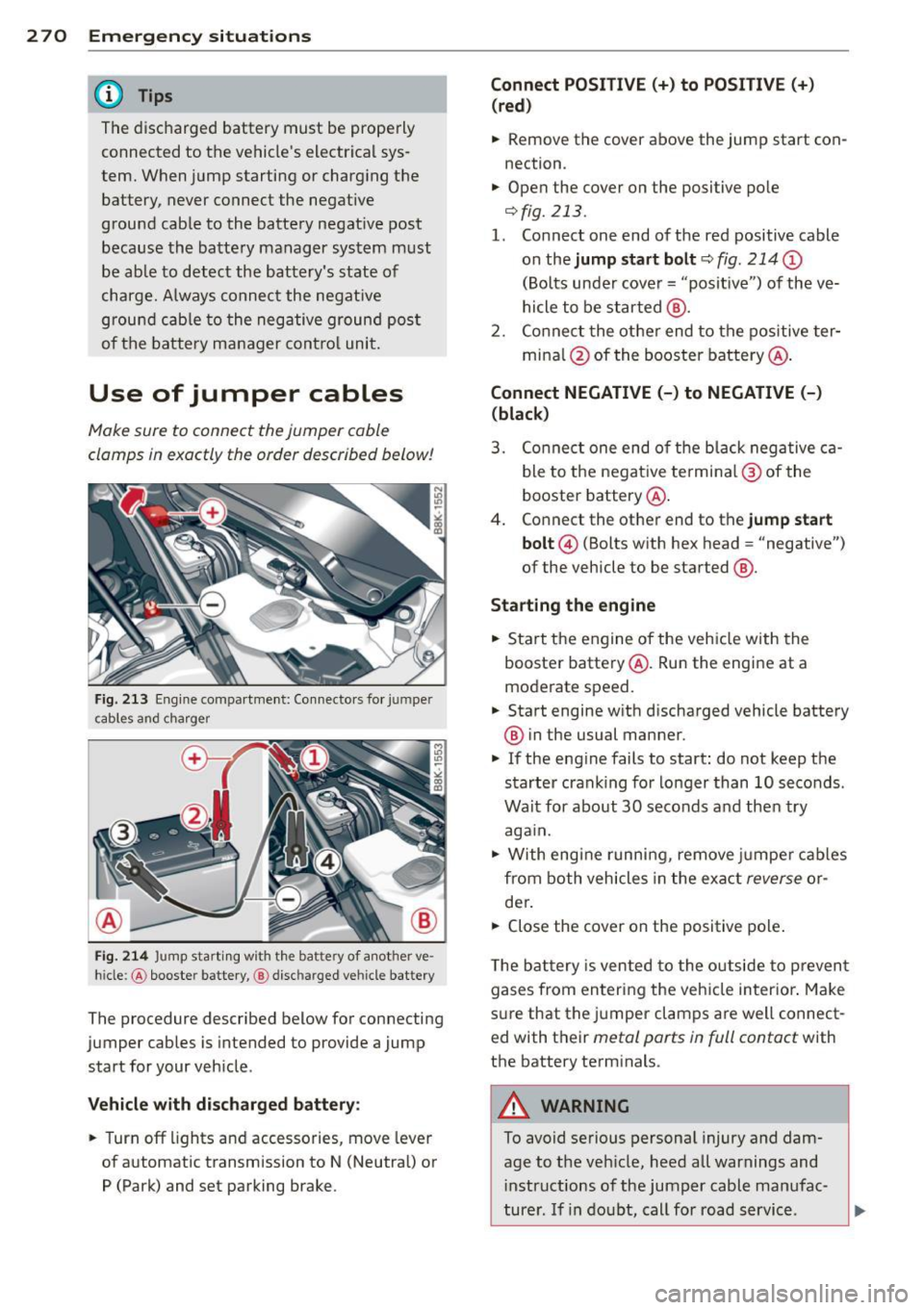
Fig. 213 Engine compartment: Connecto rs fo r jum per
cables and charger
Fig. 214 Jump sta rting wi th the battery of anot her ve ·
h ide :@ booster battery, @ disc harged vehicle battery
The procedure described below for connecting
jumper cables is intended to provide a jump
start for your vehicle .
Vehicle with discharged battery:
.. Turn off lights and accessories, move lever
of automatic transmission to N (Neutral) or
P (Park) and set parking brake .
Connect POSITIVE(+) to POSITIVE(+)
(red)
.. Remove the cover above the jump start con
nection .
.. Open the
cover on the positive pole
¢fig. 213 .
1. Connect one end of the red positive cable
on the
jump start bolt c::> fig. 214 @
(Bolts under cover= "positive") of the ve
hicle to be started @.
2. Connect the other end to the positive ter-
minal @of the booster battery@.
Connect NEGATIVE (-) to NEGATIVE (-)
(black)
3. Connect one end of the b lack negative ca
ble to the negative terminal @of the
booster battery @.
4. Connect the other end to the
jump start
bolt @
(Bolts with hex head= "negative")
of the vehicle to be started @.
Starting the engine
.. Sta rt the engine of the vehicle with the
booster battery@. Run the engine at a
moderate speed.
.. Start engine with discharged vehicle battery
@ in the usual manner .
.. If the eng ine fails to start: do not keep the
starter cranking for longer than 10 seconds .
Wait for about 30 seconds and then try
again .
.. With engine running, remove jumper cables
from both vehicles in the exact
reverse or
der .
.. Close the
cover on the positive pole .
T he battery is vented to the outside to prevent
gases from entering the vehicle interior . Make
sure that the jumper clamps are well connect
ed with their
metal parts in full contact with
the battery terminals.
A WARNING
--
To avoid serious personal injury and dam
age to the veh icle, heed all warnings and
i nstructions of the jumper cable manufac-
turer . If in doubt, call for road service . ..,.
Page 273 of 302
-Jumper cables must be long enough so
that the vehicles do not touch.
- When connecting jumper cables, make
sure that they cannot get caught in any
moving parts in the engine compart
ment.
- Do not bend over the batteries - danger
of chemical burns!
- The battery cell locking screws must be
tightened securely .
- Before you check anything in the engine
compartment, always read and heed all
WARNINGS
¢pag e 213, Engine com
partment .
(D Note
Improper hook -up of jumper cables can ru
in the generator.
- Always connect POSITIVE( +) to POSI
TIVE(+), and NEGATIVE( -) to NEGATIVE
( - ) ground post of the battery manager
control unit.
- Check that a ll screw plugs on the battery
cells are screwed in firmly. If not, tighten
plugs prior to connecting clamp on nega
tive battery terminal.
- Please note that the procedure for con
necting a jumper cable as described
above applies spec ifically to the case of
your vehicle be ing jump started. When
you are giving a jump start to another ve
hicle, do
not connect the negative(-) ca
ble to the negative( -) terminal on the
discharged battery@¢
fig. 214. In
stead, securely connect the negative(-)
cable to either a solid metal component
that is firmly bolted to the engine block
or to the engine block itse lf. If the bat
tery that is being charged does not vent
to the outside, escaping battery gas
could ignite and explode!
Emergency situations 2 71
Emergency towing
with commercial tow
truck
General hints
Your Audi requires special handling for tow
ing.
T he following information is to be used by
commercial tow truck operators who know
how to operate their equipment safely.
- Never tow your Audi, towing will cause
damage to the engine and transmission.
- Never wrap the safety chains or winch ca
ble s around the brake lines .
- To prevent unnecessary damage, your Audi
must be transported with a flat bed truck.
- To load the vehicle on to the flat bed , use
the towing loop found in the vehicle tools
and attach to the front or rear anchorage
r=:>page 272 and ¢page 272.
A WARNING
A vehicle being towed is not safe for pas
sengers. Never allow anyone to ride in a
vehicle be ing towed, for any reason.
-
•
•
Page 276 of 302
2 7 4 Emergency situations
This might happen, for e xamp le, when
h eavy components such as the engine
b lock or transmiss io n are removed.
- When removing heavy components li ke
these, ancho r vehicle to ho ist o r add cor
responding weig hts to ma inta in the cen
ter of g ravity . Othe rwise, the v eh icle
m ight tilt or slip
o ff th e hoist, caus ing
s er io us p ers on al inju ry.
(D Note
- Be awa re of the fo llowing points befo re
li fting the veh icl e:
- The vehicle should never be lifted or
jacked up from underneath the engine oil pan, the transmission housing , the
front or rear axle or the body side members. This could lead to serious
damage.
- To avoid damage to the underbody or
chassis frame, a rubber pad must be
inserted between the floor jack and
the lift points .
-Before driving over a workshop hoist,
check that the vehicle weight does not
exceed the permissible lifting capacity
of the hoist .
- Before driving over a workshop hoist,
ensure that there is sufficient clear ance between the hoist and low parts
of the vehicle.
Page 284 of 302
28 2 Con sum er Inf ormation
-Always make sure the transmission se
lector lever (automatic transmiss ion) is
in "P" (Park position) or Neutral (manual
transmission) and the park brake is firm
ly applied.
@) For the s ake of the environment
-Changing the engine settings will ad
versely affect emission levels. This is det
rimental to the environment and increas
es fuel consumption .
- Always observe environmental regula
tions when disposing of old engine oil,
used brake fluid, dirty engine coolant,
spent batteries or worn out tires.
- Undeployed airbag modules and preten
s ioners might be classified as Perchlo
rate Material -spec ial handling may ap
ply, see www.dtsc.ca .gov/hazardous
waste/perch lorate. When the veh icle or
parts of the restraint system including
airbag modules safety belts with preten
sioners are scrapped, all app licable laws
and regulations must be observed . Your
authorized Audi dealer is familiar with
these requirements and we recommend
that you have your dealer perform this
serv ice for you .
Additional accessories,
modifications and
parts replacement
Additional accessories and parts
replacement
Always consult on authorized Audi dealer be
fore purchasing accessories.
Your veh icle inco rporates the latest safety de
sign featu res ensuring a high standard of ac
tive and passive safety.
This safety could be compromised by non-ap
proved changes to the veh icle. For this reason ,
if pa rts have to be replaced , please observe
the following points when installing addition
a l accessories: Approved Audi accessories and genuine Audi
parts are available from authorized Audi deal
ers.
T hese dea lers a lso have the necessary facili
ties, tools and trained specialists to install the parts and acc essories proper ly.
A WARNING
-Using the wrong spare parts or using non-
approved accessories can cause damage to
the veh icle and ser ious personal injury.
- Use on ly accessories expressly approved
by Audi and genuine Audi spare parts
- These parts and accessories have been
specially designed to be used on your ve
h icle .
- Never install accessories such as tele
phone crad les or beverage ho lders on a ir
bag covers or within the airbag deploy
ment zones . Do ing so will increase the
risk of injury if a irbags are triggered in an
accident!
- Before you check anything in the engine
compa rtment, always read and heed a ll
WARNINGS
9 page 213 .
(D Note
-If items other than genu ine Audi spare
parts, add-on equipment and accessory
items are used or if repair work is not
performed accord ing to specified meth
ods, this can resu lt in seve re damage to
your vehicle's eng ine and body (such as
corrosion) and adversely affect yo ur vehi
cle's warranty .
- If emergency repairs must be performed
elsewhere, have the vehicle examined by
an authorized Audi dealer as soon as
possible .
- The manufacturer cannot be held liable
for damage wh ich occ urs due to failure
to comply with these stipu lations.
Page 287 of 302

A
Accessories . . . . . . . . . . . . . . . . . . . . 64, 282
AC (automatic climate control) ... .. .. .. 77
adaptive cruise control
Vehicles with manual transmission .. .
101
Adaptive cruise control ...... .. .. .. .. .. 99
C leaning sensors/camera ... ... .. .. . 205
Messages .. ................ ... ... 107
Request for driver intervention . . . . . . . 105
Setting the driving program .. .. .. .. . 104
Adaptive dampers .......... .. .. .. .. . 113
Adaptive light ................ ... ... . 47
Adaptive Light (defective) ......... .. .. 22
Adding
Engine coolant ........... .. .. .. ...
227
Engine oil .. ................ ... ... 224
Windshield washer fluid ......... .. . 233
Additional accessories
Additives 282
Engine oil .. ............. .... .. .. . 224
Adjustable steering column ... ... .. .. .. 80
Adjusting
Air distribution (automatic climate con-
trol) . . . . . . . . . . . . . . . . . . . . . . . . . . . . . .
78
Instrument illumination ... .. .. .. .. .. 50
Steering column .................... 80
Temperature (automatic climate control) 78
Airbag
Warning/indicator lights ... .. .. .. .. ..
20
Airbag system . . . . . . . . . . . . . . . . . 145, 162
Advanced Airbag System ....... ... .. 149
Advanced Airbag System components . 152
Care ... ... . .... ... ..... ..... .. ... 158
Children . .. ............. .... .. .. . 167
Child restraints ........... .. .. .. ... 168
Components (front airbags) . ... .. .. . 152
Danger of fitting a child safety seat on
the front passenger seat . . . . . . . . . . . .
146
Disposal . .. .. ........... .. .. .. ... 158
Front airbags . . . . . . . . . . . . . . . . 149, 150
How do the front airbags work? . . . . . . 154
How many airbags does my vehicle
have? ... ... ............. ...... ..
152
How the Advanced Airbag System com-
ponents work together .... .. .. .. .. .
153
Important things to know .. .. .. .. .. . 145 Index 285
Indicator light
..... ............... 156
Monitoring . ... .... ............... 156
PASSENGER AIR BAG OFF light ....... 156
Repairs ... .. .. .. ................. 158
Safety instructions ................. 158
Side airbags ..... .. ............... 160
Side curtain airbags .. .... .. .... .... 163
Weight-sensing mat ............... 167
When must the system be inspected? . 156
all-wheel drive .. .. ................. 191
Alloy wheels .. .... .. ............... 208
All wheel drive
Winter tires . .. .. .... ........... ..
250
Alternator
refer to Generator . . . . . . . . . . . . . . . . . . 17
Anti-freeze
refer to Engine coolant system ....... 226
Anti-lock braking system ............. 185
Warning/ind icator lights ........ .. .. . 19
Anti-slip regulation .. ... ....... .... . 185
Anti-theft alarm warning system ........ 32
Anti-theft systems
Electronic immobilizer .............. .
38
Armrest ...... .. .. ................. . 60
Ashtray . . . . . . . . . . . . . . . . . . . . . . . . . . . .
63
Asterisk
What does it mean when something is marked with an asterisk? . . . . . . . . . . . . . .
6
Audi braking guard
refer to braking guard ............. .. 99
Audi drive select ..... ............... 113
Adaptive dampers ................. 113
Description .. .. ...... ............. 113
Dynamic steering . ... ... .... ... .. .. 113
Setting the driving mode ............ 114
Sport differential . .. .. .. ...... .... . 113
Audi Service Repair Manuals and Litera-
ture
280
AUTO Automatic climate control .......... ..
78
Automatic headlights ............... 47
Auto Lock . . . . . . . . . . . . . . . . . . . . . . . . . . 32
Automatic belt retractor ......... .... 140
Automatic car wash
refer to Washing ... .............. . 203
•
•
Page 288 of 302
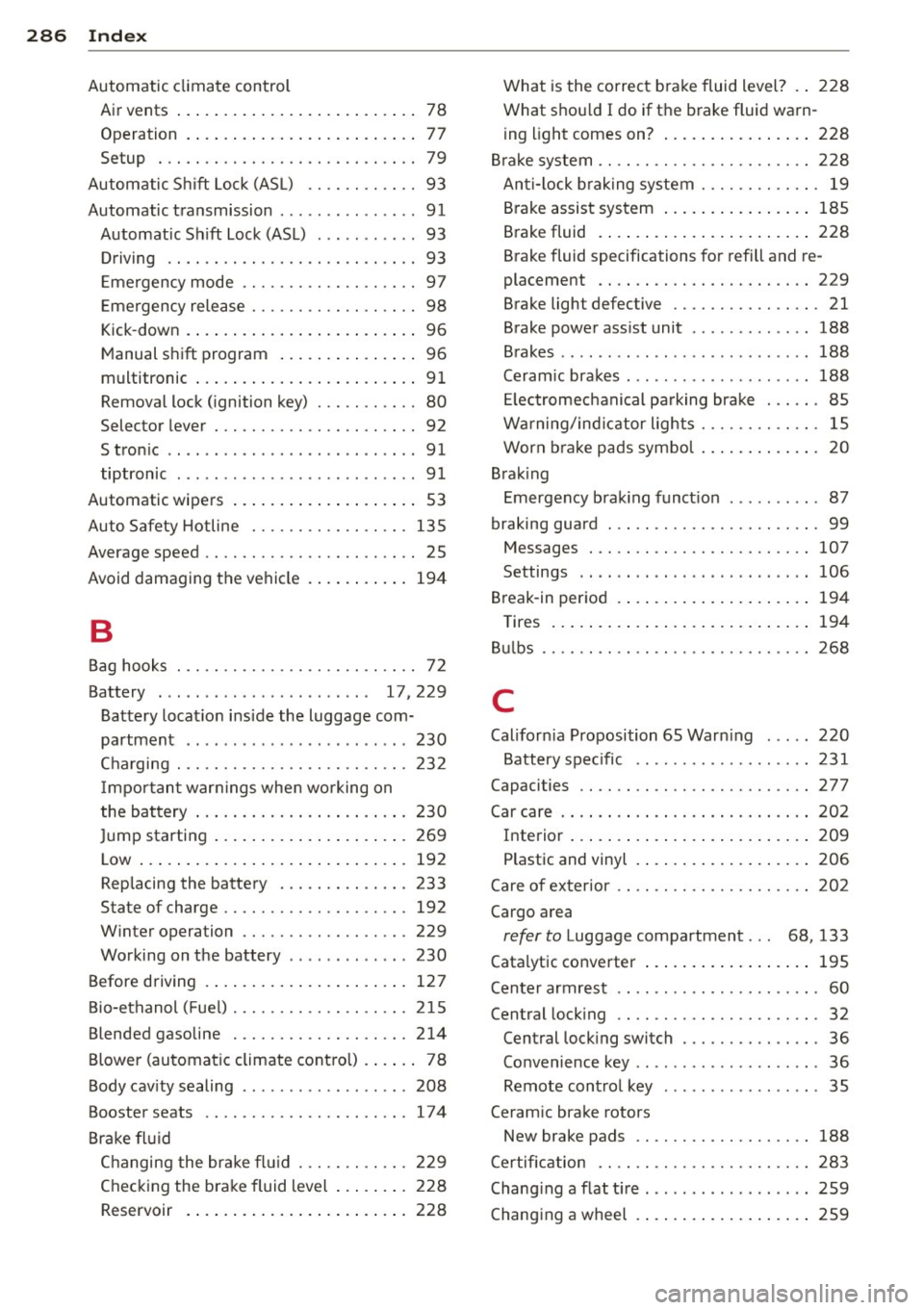
286 Index
Automatic climate control Air vents ... ............... .. .... .. 78
Operation . . . . . . . . . . . . . . . . . . . . . . . . . 77
Setup . .. ............... .. .. .... .. 79
Automatic Shift Lock (ASL) . . . . . . . . . . . . 93
Automatic transmission .......... ..... 91
Automatic Shift Lock (ASL) . . . . . . . . . . . 93
Driving .. ... ............ .. .. .. .. .. 93
Em ergency mode . . . . . . . . . . . . . . . . . . . 97
Em ergency release . . . . . . . . . . . . . . . . . . 98
K ick -down . . . . . . . . . . . . . . . . . . . . . . . . . 96
M anual shift program ....... .... .. .. 96
multitronic . . . . . . . . . . . . . . . . . . . . . . . . 91
Removal lock (ignition key) ... .. .. .. . . 80
Selector lever . . . . . . . . . . . . . . . . . . . . . . 92
S tronic .... .................. ... .. 91
tiptronic . . . . . . . . . . . . . . . . . . . . . . . . . . 91
Automatic wipers . . . . . . . . . . . . . . . . . . . . 53
Auto Safety Hotline ........ .. .. .... . 135
Average speed . . . . . . . . . . . . . . . . . . . . . . . 25
Avoid damaging the vehicle ....... ... . 194
B
Bag hooks . . . . . . . . . . . . . . . . . . . . . . . . . . 72
Battery . . . . . . . . . . . . . . . . . . . . . . . 17,229
Batter y location inside the luggage com-
partment .. ................ ... ... 230
Charging . ... ............ .. .. .. .. . 232
I mportant warnings when wo rking on
the battery ............... ... .... . 230
Jump starting ................ .... . 269
Low ..... .. ................ ..... . 192
Replacing the battery ..... .. .. .... . 233
State of charge .................... 192
Winter operation .................. 229
Working on the battery ......... .... 230
Before driving .............. ... .... . 127
Bio-ethanol (Fuel) . . . . . . . . . . . . . . . . . . . 215
Blended gasoline .......... .. .. .... . 214
Blow er (automatic climate control) . . . . . . 78
Body cavity sealing .............. ... . 208
Booster seats ...................... 174
Brake flu id
Changing the brake fluid ..... .. .. .. . 229
Checking the brake fluid level ... .. .. . 228
Reservoir . ................. ..... . 228 What
is the correct brake fluid level? . . 228
What shou ld I do if the brake fluid warn-
ing light comes on? ................ 228
Brak e system .. .. .. ............. .. .. 228
Anti- lock braking system ........ .... . 19
Brake assist system ................ 185
Brake fluid .... .. ................. 228
Brake fluid specifications for refill and re -
placement .... .. ... .......... .. .. 229
Brake light defective . . . . . . . . . . . . . . . . 21
Brake power assist unit ............. 188
Brakes ...... .. .. .. ..... ........ .. 188
Ceramic brakes . .. ................ . 188
Electromechanica l parking brake . .... . 85
Warning/ind icator lights ........ .. .. . 15
Worn brake pads symbo l . . . . . . . . . . . . . 20
Braking Emergency braking funct ion ........ .. 87
braking guard ... .. ............. .... . 99
Messages . .. .. .. ............. .. .. 107
Settings .. .. .. .. .. .... .... ... .... 106
Break-in period .... ................. 194
T ires ..... .... .. .. .............. . 194
Bulbs .......... .. ....... ......... . 268
C
California Proposition 65 Warning ... .. 220
Battery specific .. ............. .. .. 231
Capacities ......................... 277
Car care ........ .. .. .............. . 202
Interior ... .... .. .. .............. . 209
Plastic and vinyl ................... 206
Care of exterior .. .. ... .......... .. .. 202
Cargo area
refer to Luggage compartment. . . 68, 133
Catalytic converter . . . . . . . . . . . . . . . . . . 195
Center armrest . . . . . . . . . . . . . . . . . . . . . . 60
Central locking .. .. ... .......... .. .. . 32
Central locking switch .......... .... . 36
Convenience key . . . . . . . . . . . . . . . . . . . . 36
Remote control key ................. 35
Ceramic b rake rotors
New brake pads .. ............. .... 188
Certification . . . . . . . . . . . . . . . . . . . . . . . 283
Changing a flat tire . ................. 259
Changing a wheel .. ............. .... 259