light AUDI A4 2013 Workshop Manual
[x] Cancel search | Manufacturer: AUDI, Model Year: 2013, Model line: A4, Model: AUDI A4 2013Pages: 302, PDF Size: 75.61 MB
Page 95 of 302
@ Tips
-On vehicles with drive select*, you can
adjust the sporty shift characteristics in
the
Dynamic driving mode.Swill appear
in the instrument cluster display instead
ofD.
- If you accidentally select N while driving,
take your foot off the accelerator pedal
immediately and wait for the engine to
slow down to idle before selecting D/S.
- If there is a power failure, the selector
lever will not move out of the P position .
The emergency release can be used if
th is happens ~
page 98.
Automatic Shift Lock (ASL)
Applies to vehicles: with multitronic/5 tronic/tiptron ic
The Automatic Shift Lock safeguards you
against accidentally shifting into a forward or
the reverse gear and causing the vehicle to
move unintentionally.
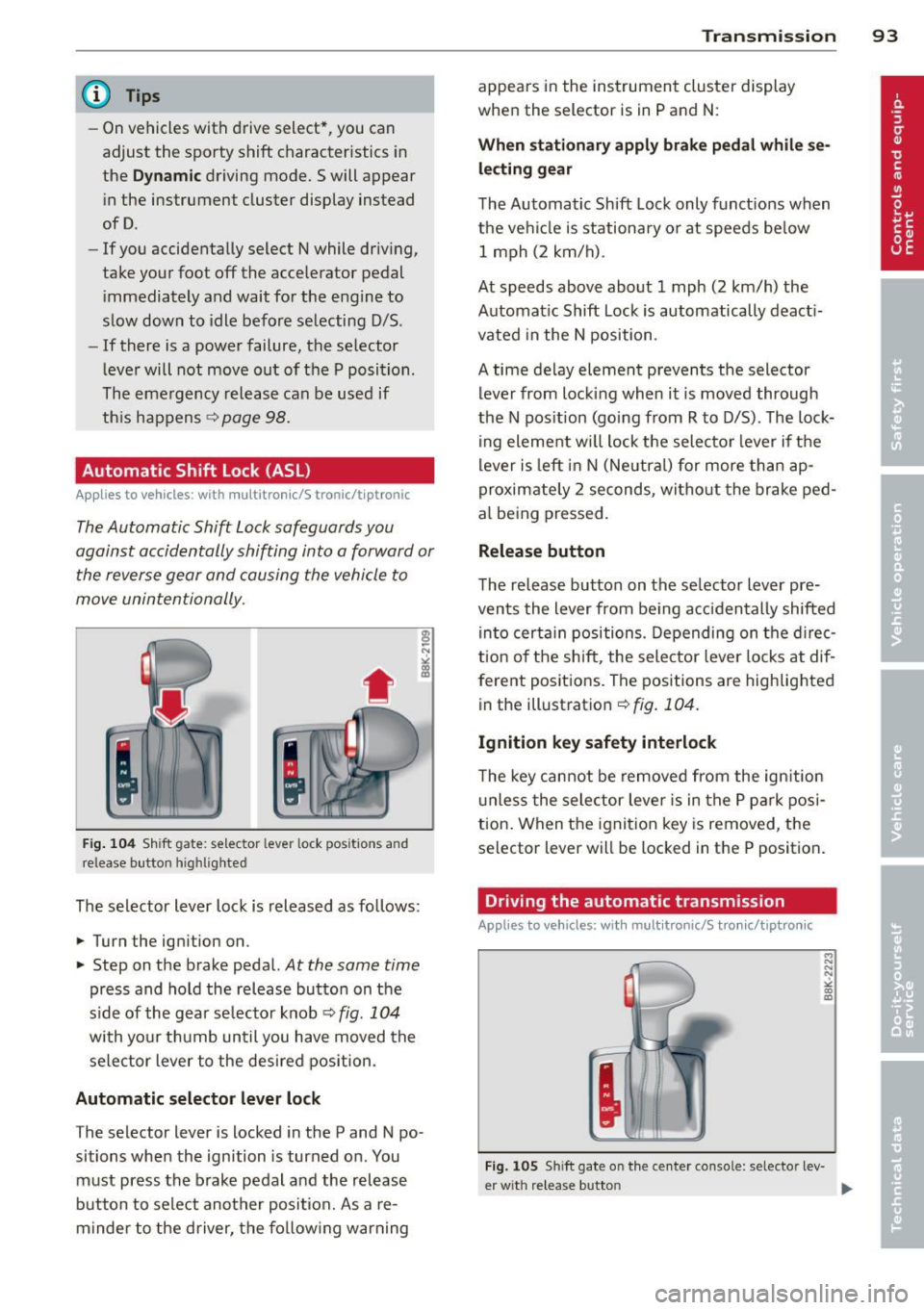
Fig. 104 Shift gate: selector lever lock positions and
release button highlighted
The selector lever lock is released as follows:
... Turn the ignition on .
... Step on the brake pedal.
At the same time
press and hold the release button on the
side of the gear se lector knob ¢
fig. 104
with your thumb until you have moved the
selector lever to the desired position.
Automatic selector lever lock
The selector lever is locked in the P and N po·
sitions when the ignition is turned on . You
must press the brake pedal and the release
button to select another position. As a re·
m inder to the driver, the following warning
Transmission 93
appears in the instrument cluster display
when the selector is in P and N:
When stationary apply brake pedal while se
lecting gear
The Automatic Shift Lock only functions when
the vehicle is stationary or at speeds below 1 mph (2 km/h).
At speeds above about 1 mph (2 km/h) the
Automatic Shift Lock is automatically deacti
vated in the N position .
A time delay element prevents the selector lever from locking when it is moved through
the N position (going from R to D/S). The lock
ing element will lock the selector lever if the
lever is left in N (Neutral) for more than ap
proximately 2 seconds, without the brake ped
al being pressed.
Release button
The release button on the selector lever pre
vents the lever from be ing accidentally shifted
into certain positions. Depending on the direc
tion of the shift, the selector lever locks at dif
ferent positions. The positions are highlighted
in the illustration¢
fig. 104 .
Ignition key safety interlock
The key cannot be removed from the ignition
unless the selector lever is in the P park posi
tion. When the ignition key is removed, the
selector lever will be locked in the P position.
Driving the automatic transmission
Applies to vehicles; with mult itronic/S tronic/tiptronic
Fig. 105 Sh ift gate on the center console: selector lev-
er w it h re lease button ..,_
Page 96 of 302
94 Transmission Starting the engine
.. The selec to r l eve r must be in P or N.
Starting off
.. Press and hold the brake pedal.
.. Press and hold the release button in these
lector lever handle, select t he des ired selec
tor lever position such as D/S and release
the b utton .
.. Wait briefly until the transmission has shift
ed (you will feel a slight movement) .
.. Remove your foot from the brake pedal and
acce lerate.
Stopping temporarily
.. Keep the vehicle stationary using the b rak
ing peda l, for examp le at traffic lights .
.. Do not press the accelerator pedal when do
ing this.
.. To prevent the vehicle from rolling when
you start dr iving, set the parking brake
when stopping on steep inclines ¢&_ .
.. The parking brake will release automatically
and the vehicle w ill start moving once you
press the accelerator peda l.
Stopping/parking
If the selector lever is not in the P position
when you open the dr iver's door, the vehicle
could roll. The message
Transmission: Car
may roll! Shift to park!
appears.
.. Press and hold the brake pedal unt il the ve
hicle has come to a complete stop .
.. Apply the parking brake¢
page 86, Park-
ing .
.. Se lect the P selector lever position ¢ &.-
Stopping on an incline
.. Always press the brake pedal to hold the ve
hicle in place and prevent it from "rolling
back"
¢ &_ . Do not try to prevent the vehi
cle from "rolling back" when a gear is en
gaged by increasing the engine speed ¢Q).
Starting on an incline
.. Activate the parking brake.
.. With the driving gear selected, press the ac
celerator pedal carefully . The parking brake will release automatically if your seat
belt is
fastened .
Under certain circumstances, such as driving
in the mountains, it may be usefu l to switch
temporarily to the manual shift program in or
der to adjust the gears to the driving condi
tions by hand ¢
page 96.
On s lopes, activate the parking brake first and
then move the selector lever to the P position .
This prevents too much stress from being
placed on the locking mechanism .
Vehicles with multitronic transmission: Your
vehicle is equipped with
hill hold assist allow
ing yo u to start while on an incline. The sys
tem is activated when the brake pedal is
pressed down and he ld
for a few seconds . The
brake pressure will hold for
a moment after
the brake pedal loosens to prevent the vehicle
from roll ing backwards w hile starting up .
A WARNING
-The vehicle can also roll when the engine
is stopped.
-Unintended vehicle movement can cause
serious injury.
- Never leave your vehicle with the engine
r un ning while in gear. If you must leave
your veh icle when the engine is running,
activate the parking brake and move the
selector lever to P.
- Power is still transmitted to the wheels
when the engine is runn ing at idle. To
prevent the vehicle from "creeping", you
must keep your foot on the brake when
the engine is running and the selector
lever is in 0/5 or R or "t iptronic" mode is
selected .
- Do not press the accelerator pedal when changing the selector lever position
while the veh icle is stationary and the
engine is running.
- Never shift into R or P while driving.
- Before driving down a steep s lope, re-
duce your speed and shift into a lower
gear with "tiptronic" .
Page 99 of 302
A WARNING 1=
Please note that the drive wheels can spin
if kick-down is used on a smooth slippery
road - there is a risk of skidding.
Launch Control Program
App lies to vehicles: with S tronic
The Launch Control Program provides the
best acceleration possible when starting from
a stop .
Requirement : The engine must be at operat
ing temperature and the steering wheel must
not be turned .
~ Press the l.e OFFI button ¢ page 187 or
r:::> page 188 while the engine is running.
The
fsl indicator light illuminates in the in
strument cluster and
Tra ction con trol
( ASR ): Off. W arning! Re stri cted stabil ity
appears in the dr iver information system
display .
~ Move the selec to r l ever to the D/S position
or se lect the
d y nami c driving mode in drive
select*
r:::> page 114.
~ Press the brake peda l strong ly wit h your left
foot and hold it down for at least 1 second.
~ At the same time, press the accelerator
pedal down completely with your right foot
until the engine reaches and maintains a
high RPM .
~ Remove your foot from the brake peda l
within 5 seconds
r:::> .&, .
A WARNING
-Always adapt you r driving to the traffic
flow.
- Only use the Launch Control Program
when road and traffic conditions allow it
and other drivers will not be endangered
or annoyed by you r driv ing and the vehi
cle's acce leration.
- Please note that the driving wheels can
spin and the vehicle can break away
when ASR is switched off, especially
when the road is slippery.
-
Tran sm iss ion 97
-Once you have accelerated, you shou ld
sw itch the ASR back on by pressing the
l.e O FFI button.
(D Tips
- The transmission temperature may in
crease s ignificantly after using the
Launch Control Program. If that hap-
pens, the program may not be availab le
for a few m inutes. It will be ava ilable
again after a cool-down per iod .
- When accelerating using the Launch
Cont ro l program, a ll vehicle parts are
subject to heavy loads. This can result in
increased wear .
Transmission malfunction
Applies to vehicles: with multitro nic/S tronic/t iptronic
[O] Transmis sion: Pr ess brake p edal and se·
Leet gear again .
Press the brake peda l and select the desired
selector lever position again. You ca n the n
continue driving.
[O] Trans mission overhe ating: Pl ease drive
conservatively .
The transmiss ion temperature has increased
s ignificantly due to the sporty d riving manner .
D rive in a less sporty ma nner until the tem
perature returns to the normal range and the
indicato r light switc hes of.
[O] Tran smission malfunction: You can con
tinue driv ing
There is a system malfunction in the transmis
sion. You may cont inue driving. Drive to your
authorized Aud i dea ler or qualified repa ir fa
c ility soo n to have the malfunction corrected .
[O] Transm ission malfunction : Lim ited dr iv·
ing functionality
There is a system malfunction in the t ransmis
s ion . The transm ission is switching to emer
gency mode . This mode on ly shifts into cer-
ta in gears or will no longer shift at all. The en
gine may sta ll. Dr ive to your authorized Audi ..,.
Page 104 of 302
102 Audi adaptive cruise control and braking guard
Switching on and off
Applies to vehicles: with Audi adaptive cruise control
Fig. 114 Se lec tor lever: switching on/off
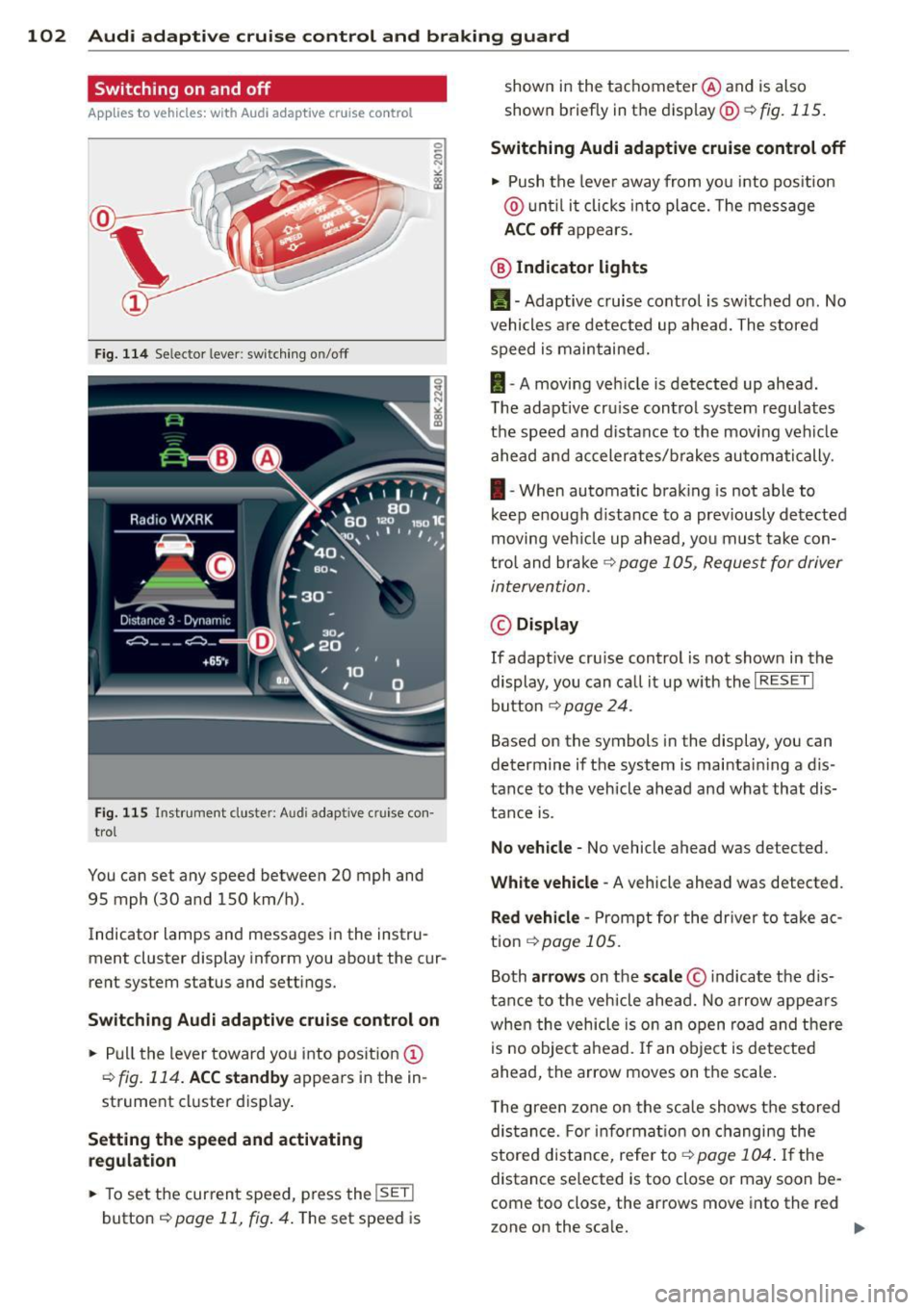
Fig. 115 Instrument clus te r: A udi adap tive c ru ise co n·
trol
You can set any speed between 20 mph and
95 mph (30 and 150 km/h).
Indicator lamps and messages in the instru·
ment cluster display inform you about the cur·
rent system status and settings.
Switching Audi adaptive cruise control on
• Pull the lever toward you into position@
r=;,fig. 114. ACC standby appears in the in ·
strument cluster display.
Setting the speed and activating
regulation
.. To set the current speed, press the !SE T!
button r=;, page 11, fig . 4. The set speed is shown in
the tachometer @and is also
shown briefly in the display@~
fig. 115.
Switching Audi adaptive cruise control off
• Push the lever away from you into position
@ until it clicks into place. The message
ACC off appears.
@ Indicator lights
11 · Adaptive cruise control is switched on. No
vehicles are detected up ahead. The stored
speed is maintained.
I-A moving vehicle is detected up ahead.
T he adaptive cru ise control system regulates
the speed and distance to the moving vehicle
ahead and accelerates/brakes automatically.
I-When automatic braking is not able to
keep e nough distance to a previously detected
moving veh icle up ahead, you must take con·
trol and brake ~
page 105, Request for driver
intervention.
© Display
If adapt ive cru ise control is not shown in the
display, you can call it up w ith the
I RESET I
button r=;, page 24.
Based on the symbols in the display, you can
determine if the system is maintain ing a d is ·
tance to the vehicle ahead and what that dis
tance is.
No vehicle· No vehicle ahead was detected .
White vehicle· A vehicle ahead was detected .
Red vehicle -Prompt for the driver to take ac
tion
,=;, page 105.
Both arrows on the scale© indicate the dis·
tance to the vehicle ahead. No arrow appears
when the vehicle is on an open road and there
is no object ahead. If an object is detected
ahead, the arrow moves on the scale .
T he green zone on the scale shows the stored
distance. For information on changing the
stored distance, refer tor=;,
page 104 . If the
distance se lected is too close or may soon be·
come too close , the arrows move into the red
zone on the sca le. .,..
Page 107 of 302

Audi adaptive cruise control and braking guard 105
Setting the driving mode for vehicles with
Audi drive select*
Refer to r=;,poge 1 14 .
(D Tips
Yo ur setti ngs a re automatically store d an d
assig ned to the remote contro l key be in g
used.
Request for driver intervention
A pp lies to vehicles: w ith Audi a daptive cruise control
Fig. 119 Inst rumen t cl uster: reques t fo r drive r in te r·
ve ntio n
In ce rtain si tuations, t he sys tem w ill prom pt
you to take actio n. This cou ld ha ppen, for ex
ample, if braking by the a daptive cr uise con
trol system is not enough to maintain enough
d istance to the vehicle ahead.
The inst rument cluste r will war n you about
the danger
r=;,fig. 119:
- A red ve hicle is pic tured in the d is pla y.
- The text
DISTANCE! appea rs in the s ta tus
b ar.
- T he r ed indi cator lig ht
I blinks .
- In add it ion, a warning tone sounds.
Audi braking guard
Description
App lies to vehicles: wi th Audi ada ptive c ruise con tro l
Fig. 120 In str um ent clus ter: approach warnin g
Brak ing guard uses a radar sensor. It also
funct ions wit hin the lim its of the system
whe n adapt ive cruise control is switched off.
What can Audi braking guard do?
When detected in time, the system can assess
situations when a veh icle ahead brakes s ud
denly or if your own vehicle is t raveling at a
high speed and approac hing a ve hicle up
ahead that is movi ng mo re sl ow ly. B raking
guard does not reac t if it cannot detec t the
s ituation.
The system advis es yo u of various s ituations:
- The
distance wa rning is given if yo u are too
close to the vehicle ahead for a long time. If
the vehicle ahead bra kes sharply , yo u will
not be ab le to avoid a collision . The ind icator
light
I in the d isp lay comes o n.
- The
approach warning is given when a de
tected ve hicle up ahead i n your lane is mov
ing m uch mo re sl owly than you are or if i t
brake s sh arp ly. W hen t his war ning is g iven,
it may on ly be poss ible to avoi d a co llision
by swe rving or b ra kin g sharp ly. The indic ator
light
I a nd indic ator in t he di spl ay w ill war n
you abo ut the d ange r¢
fig . 120. You will a l
so hear an aco ustic s ignal.
If y o u do no t rea ct fas t eno ugh o r do not r eact
at all to the si tuat ion, B rak ing guard will in
t e rvene by b rak ing and t he message
braking
guard intervention
w ill appea r.
Page 120 of 302

118 Park ass is t
Vehicles with the parking system are equipped
with a rear view c am era in addition to the
acoustic parking system.
You can choose between two modes to assist
you with park ing. For example, you can use
"parking mode 1" when parking in a parking
space or garage
c:> fig . 128. When you want to
park parallel to the edge of the street, select
"park ing mode 2"
c:> fig. 129.
The rear acoustic park assist system is inte
grated in the rear of the vehicle and the rear
view camera is integrated in the rear lid
c:>page 119.
A WARNING
- T he rear view camera has blind spots, in
wh ich objects ca nnot be detected . Be es
pecially careful to check for small ch il
dre n and an imals before back ing up .
Small ch ild ren and anima ls w ill not al
ways be detected by the sensors .
General Information
Applies to vehicles: with parking system (rear, with rear
view camera)
Fig . 130 Cove red area (!) and u ncovered a rea @ of the
rea r view ca mera
• 0
F ig . 131 Tr unk lid: Location of the rea r view camera
"'
"' "'
~
Sensors a re loca ted in the rear b umpe rs. If
these detect an obstacle, audible and visual s ignals warn you . The range at which the sen
sors begin to measure is approx imately:
To the side
2 ft (0 .60 m)
Center rear 5.2 ft (1.60 m)
Distance warn ing when reversing starts whe n
an obstacle is detected in the range of the parking assist system . As the d istance de
creases, the time interval between the audible
tones becomes shorter.
When the distance is less than 1ft
(0 .30 m),
t h e tone becomes continuous. At t his point
you should stop backing up.
If the distance to an obstacle stays the same,
the volume of the dista nce signal chime is
gradually reduced after about 4 seconds (does
not affect the contin uous signa l tone) . Ap
proaching another obstacle will cause the d is
tance signal to sound agai n at the normal vo l
ume.
R ea r v iew camera coverage area
T he M MI display shows the area covered by
the rear view camera
c:> fig. 130 (D . Objects
that are not in the area covered @are not
shown on the MMI display .
We recommend that you practice parking with
the rear view camera in a traffic-free location
or parking lot to become familiar with the sys
tem, the or ientation lines, and the ir function.
When doing this, there should be good light and weathe r cond itions.
In the MMI display, objects or vehicles appear
closer or further away if:
- you are driving in reverse gear from a leve l
surface onto an incline , or a downward
slope,
- you are driving in reverse gear toward pro
trud ing ob jects,
- the vehicle is car ry ing too much load in the
rear.
Page 125 of 302

Homelink®
Universal remote
control
Description
Applies to vehicles: with Home link
The HomeLink universal remote control con
be programmed with the remote control for
devices that ore already present.
With Home Link, you can control devices such
as the garage door, secu rity systems, ho use
lights , etc. comfortably from the inside of you
vehicle .
H omelink makes it poss ible for you to rep lace
three different remote controls from dev ices
i n your home with one universal remo te. Th is
featu re works for most garage door and exte
rior door motor signals. Programming the in
d ividual remote control for your remote con
trol takes p lace near the center of the radiator
grille. There is a control module attached at
this location .
A one-t ime programm ing of the sensor must
be performed before you are able to use sys
tems with Homelink. If the system does not activate after performing the one-t ime pro
gramming, check whether the system uses a rolling code ¢
page 126 for vehicles without
the MMI*.
,& WARNING
-
-Never use the Homelink ® transmi tter
with any garage door opener that does have not the sa fety stop and reverse fea
ture as requ ired by federa l safety stand
ards. Th is includes any garage door open
er mode l manufactured before April 1,
1982.
- A garage door opener which cannot de
tect an object, signaling the door to stop
and reverse does not meet current feder
al safety standards . Us ing
a garage door
opener without these features increases
risk of serious injury or death.
Homelink ® 123
-For safety reasons never re lease the
parking brake or start the eng ine while
anyone is standing in front of the vehicle .
- A garage door or an estate gate may
sometimes be set in motion when the Homelink ® remote control is being pro
grammed. If the device is repeatedly ac
tivated, th is can overstrain motor and
damage its e lectrical components -an
overheated mo to r i s
a fire hazard!
- To avoid possib le injuries or property
damage, please always make abso lutely
certain that no person s or objects are lo
cated in the range of motion of any
equ ipment being operated .
(D Tips
-If you would like more information on
Homelink ®, where to purchase the
Home link ® compatib le products, or
would like to purchase the Homelink ®
Home Lighting Package, please ca ll toll
free: l-800-355-3515.
- For Declaration of Compliance to United
States FCC and Industry Canada reg ula
tions¢
page 283.
- For security reasons, we recommend that
you clear the programmed b uttons be
fore selling the veh icle.
Operation
App lies to vehicles : with Homeli nk
~~''' r ·O : O ·) 1111
~
®
Fig . 1 36 Head li ner: controls
Req uirement : The buttons must be program-
med
<:!)page 124 or ¢page 125. ..,_
Page 126 of 302
124 Homelink®
• To open the garage door, press the pro
grammed button. The LED @will light up or
flash.
• To close the garage door, press the button
again.
@ Tips
To open the garage door, press the button, but do not press it for longer ten seconds
or the Homelink module will switch to
programming mode.
Programming the transmitter (version
A)
Appl ies to vehicles : wit h Home li nk
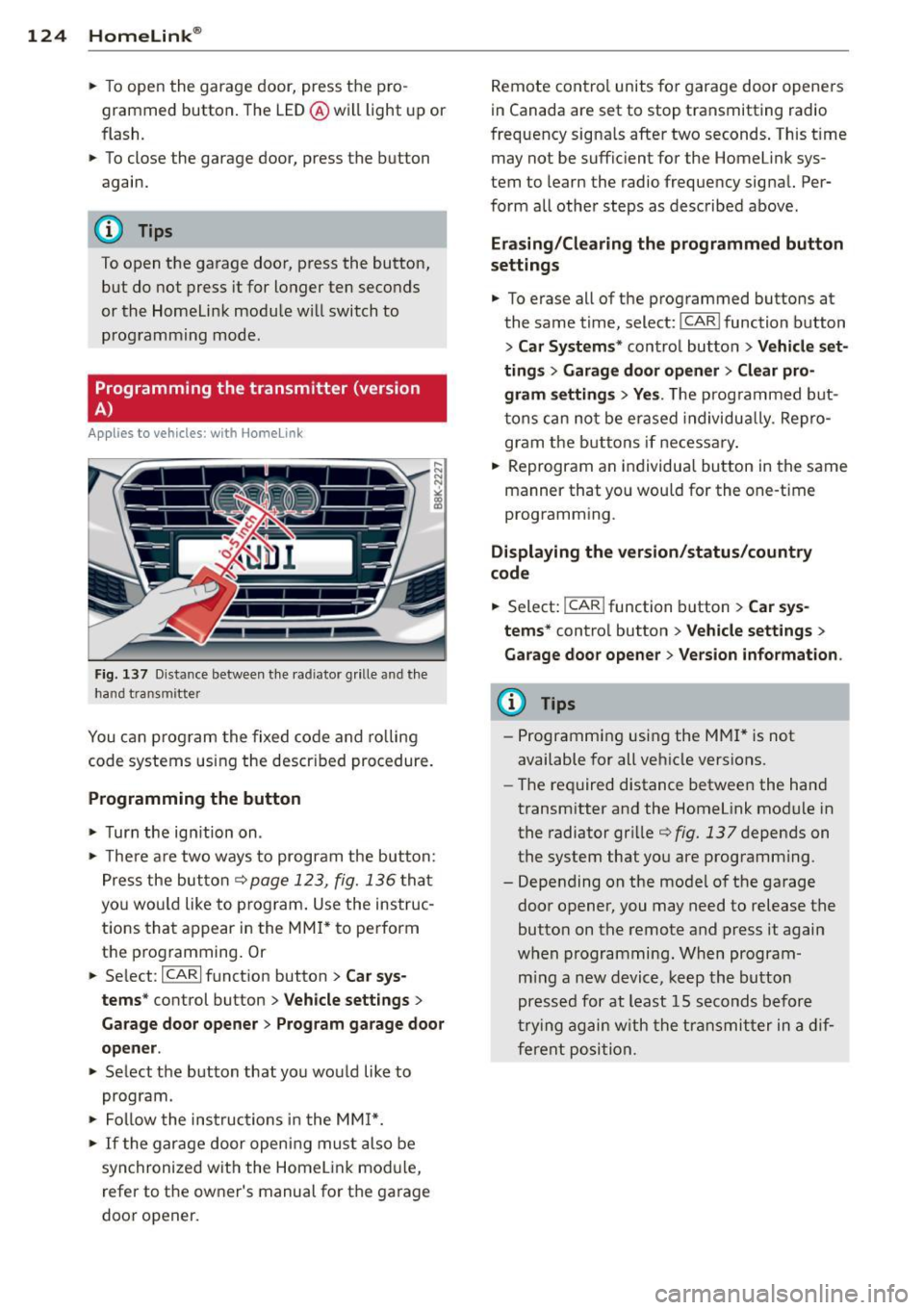
Fig. 137 Distance between the radia tor grille and the
hand transmitter
You can program the fixed code and rolling
code systems using the described procedure.
Programming the button
• Turn the ignition on .
• There are two ways to program the button:
Press the button¢ page
123, fig. 136 that
you would like to program. Use the instruc
tions that appear in the MMI* to perform
the programming. Or
• Select:
I CARI function button > Car sys
tems*
control button > Vehicle settings >
Garage door opener> Program garage door
opener .
• Select the button that you would like to
program.
• Follow the instructions in the
MMI*.
• If the garage door opening must also be
synchronized with the Homelink module,
refer to the owner's manual for the garage
door opener. Remote
control units for garage door openers
in Canada are set to stop transmitting radio
frequency signals after two seconds. This time
may not be sufficient for the Home link sys
tem to learn the radio frequency signal. Per·
form all other steps as described above .
Erasing/Clearing the programmed button
settings
• To erase all of the programmed buttons at
the same time, select:
I CAR I function button
> Car Systems" control button > Vehicle set
tings
> Garage door opener> Clear pro
gram settings > Yes.
The programmed but
tons can not be erased individually . Repro
gram the buttons if necessary.
• Reprogram an individual button in the same
manner that you would for the one-time
programming .
Displaying the version/status/country
code
• Select: I CAR ! function button > Car sys·
terns*
control button > Vehicle settings >
Garage door opener> Version information .
(D Tips
-Programming using the MMI* is not
available for all vehicle versions.
- The required distance between the hand
transmitter and the Homelink module in
the radiator grille ¢fig.
137 depends on
the system that you are programming .
- Depending on the model of the garage
door opener, you may need to release the
button on the remote and press it again
when programming. When program
ming a new device, keep the button
pressed for at least 15 seconds before
trying again with the transmitter in a dif
ferent position.
Page 128 of 302
126 Hom eli nk®
-The required distance between the hand
transmitter and the HomeLink module in
the radiator grille
c:> fig. 138 depends on
the system that you are programming.
- Depend ing on the model of the garage
door opener, you may need to release the
button on the remote and press it again
when programming . When program
ming a new dev ice, keep the button
pressed for at least 15 seconds befo re
trying again with the transmitter in a dif
ferent pos it ion. Wa tch out fo r the emer
gency flasher during that time .
Programming the rolling code
Applies to vehicles: with Home link
Additionally, a rolling code programming for
the HomeLink universal remote control is re
quired for some systems .
Identifying the rolling code
.. Press the prev ious ly programmed Homelink
button aga in and hold i t down .
.. Look at the LED@ c:>
page 123, fig. 136 . If
the LED b links quickly , the features, s uch as
the garage door opener, are equipped with
the rolling code .
.. Program the roll ing code as fo llows:
Act ivating the g arage door opener motor
unit
.. Locate the sett ing button on the garage
door opener motor unit . The exact location
and co lor of the button may vary depending
on the garage door opener manufacturer .
.. Press the sett ing button on the garage door
opener motor unit (usually th is w ill act ivate
a "sett ing light d isp lay" on the motor unit).
Now you w ill have about
30 second s time to
perform the HomeL ink button programming
on the cont ro ls.
Programming on the controls
.. Press the Home L ink button that was already
programmed and hold for two seconds . ..
To end ro lling code programm ing, press and
hold the Home link button for two seconds
aga in .
.. The Homelink button may need to be press
ed a third t ime to end the adjus tment proce
dure for some garage door openers .
After the controls have been programmed, the garage door opener should recogni ze the
Homelink signal and operate when the Home
Li nk button is pressed . Now you may program
the other buttons as needed .
(D Tips
-Programming the rolling code can be
performed quicker and more easily with
the help of a second person .
- If d iff iculties should arise when pro
gramming the rolling code, consult the
operating instructions for the garage
door opener or o ther dev ices for po ssible
solutions.
Page 129 of 302
Driving Safely
General notes
Safe driving habits
Please remember -safety first!
This chapter contains important information,
tips, instructions and warnings that you need
to read and observe for your own safety, the
safety of your passengers and others . We have
summarized here what you need to know
about safety belts, airbags, child restraints as
well as child safety. Your safety is for us
priori
ty number 1.
Always observe the information
and warnings in this section - for your own
safety as well as that of your passengers.
The information in this section applies to all
model versions of your vehicle . Some of the
features described in this sections may be
standard equipment on some models, or may
be optional equipment on others. If you are
not sure, ask your authorized Audi dealer.
A WARNING
- Always make sure that you follow the in
structions and heed the WARNINGS in
this Manual. It is in your interest and in
the interest of your passengers.
- Always keep the complete Owner's Liter
ature in your Audi when you lend or sell
your vehicle so that this important infor
mation will always be available to the
driver and passengers.
- Always keep the Owner's literature handy
so that you can find it easily if you have
questions.
Safety equipment
The safety features are part of the occupant
restraint system and work together to help
reduce the risk of injury in a wide variety of
accident situations .
Your safety and the safety of your passengers
should not be left to chance. Advances in
technology have made a variety of features
available to help reduce the risk of injury in an
Driving Safely 127
accident. The following is a list of just a few of
the safety features in your Audi :
- sophisticated safety belts for driver and all
passenger seating positions,
- belt force limiters for the front seats,
- belt pretensioners for the seats,
- head restraints for each seating position,
- front airbags,
- side airbags in the front seats,
- side curtain airbags ,
- special LATCH anchorages for child re-
straints,
- adjustable steering column.
These individual safety features, can work to
gether as a system to help protect you and
your passengers in a wide range of accidents.
These features cannot work as a system if
they are not always correctly adjusted and cor
rectly used.
Safety is everybody's responsibility!
Important things to do before driving
Safety is everybody's job! Vehicle and occu
pant safety always depends on the informed and careful driver.
For your safety and the safety of your passen
gers,
before driving always:
"' Make sure that all lights and signals are op
erating correctly .
"' Make sure that the tire pressure is correct .
"' Make sure that all windows are clean and
afford good visibility to the outside.
"' Secure all luggage and other items carefully
qpage 64.
"' Make sure that nothing can interfere with
the pedals.
"' Adjust front seat, head restraint and mir
rors correctly for your height.
"' Instruct rear seat passengers to adjust the
head restraints according to their height.
"' Make sure to use the right child restraint
correctly to protect children
q page 166,
and~~fy. ~
•
•