air condition AUDI A4 2015 User Guide
[x] Cancel search | Manufacturer: AUDI, Model Year: 2015, Model line: A4, Model: AUDI A4 2015Pages: 304, PDF Size: 74.86 MB
Page 202 of 304

200 Trailer towing
Tire pressure
When towing a trai le r, inflate the tir es of your
vehicle to the cold tire pressure listed under
"Full load" on the label located on the driver 's
side B-pillar (visible when the door is open).
Inflate trailer tires to trailer and tire manufac
turers' specifications.
Lights
The headlight settings should be checked with
the trailer attached before dr iving off. Check
to make sure both vehicle and tra iler lights
are working properly.
Safety chains
Be sure trailer safe ty cha ins are properly con
nected from the trailer to the hitch on the ve
hicle. Leave eno ugh slack in the chains to per
mit turning corners. When you install safety
cha ins, make sure they w ill not drag on the
road when you are driving.
The chains shou ld cross under the trai ler
tongue to prevent it from dropping in case of
separation from the hitch.
Driving instructions
Driving with a trailer always requires extra
care and consideration.
To obtain the best possible handling of vehicle
and trai ler, p lease note the following:
.,. Do not tow a loaded trailer when your car it
self is not loaded .
.,. Be especia lly careful when passing other
vehicles .
.,. Observe speed limits .
.,. Do not drive at the maximum permissible
speed.
.,. Always apply brakes early.
.,. Monitor the temperature gauge.
Weight distribution
Towing a loaded trai ler with an empty car re
sults in a highly unstable distribution of
weight . If this cannot be avo ided, drive at very
low speeds only to avoid the risk of losing
steering control. A "ba
lanced" rig is easier to operate and con
tro l. This means that the tow vehicle should
be loaded to the extent possible and permissi
ble, while keep ing the trai ler as light as possi
ble under the c ircumstances. Whenever poss i
ble, transfer some cargo to the luggage com
partment of the tow veh icle while obse rving
tongue load requi rements and vehicle load ing
considerations.
Speed
The higher the speed, the more d iff icu lt it be
comes for the driver to control the rig. Do not
drive at the maximum permissible speed. Re
duce your speed even more if load, weather or
wind conditions are unfavorable -pa rticularly
whe n going downhill.
Reduce veh icle speed
immediately if the trail
er shows the slightest s ign of sway ing.
Do not
try to stop the swaying by accelerating.
Observe speed limits . In some areas, speeds
for vehicles tow ing tra ilers are lower than for
regular vehicles .
Always apply brakes early. When driving
downh ill, shift into a lower gear to use the en
gine braking effect to slow the vehicle. Use of
the brakes alone can cause them to overheat
and fail.
Coolant temperature
The coolant temperature gauge c> page 10
must be observed carefully . If the needle
moves close to the upper end of the scale, re
duce speed immediately and/or turn off the
air conditioner.
If the coolant temperature warning light •
i n the i nstrument cluster starts flashing, pull
off the road, stop and let the engine
idle for
abo ut two minutes to prevent heat build-up .
_& WARNING
Anyone not properly restrained in a mov
ing vehicle is at a much greater risk in an
accident . Never let anyone ride in your car
who is not p roper ly wea ring the restraints
provided by Audi.
-
Page 207 of 304
"" N
0 ::.,: co ,...., \!) 1.1'1 ,...., 1.1'1 ,....,
Vehicle care and cleaning 205
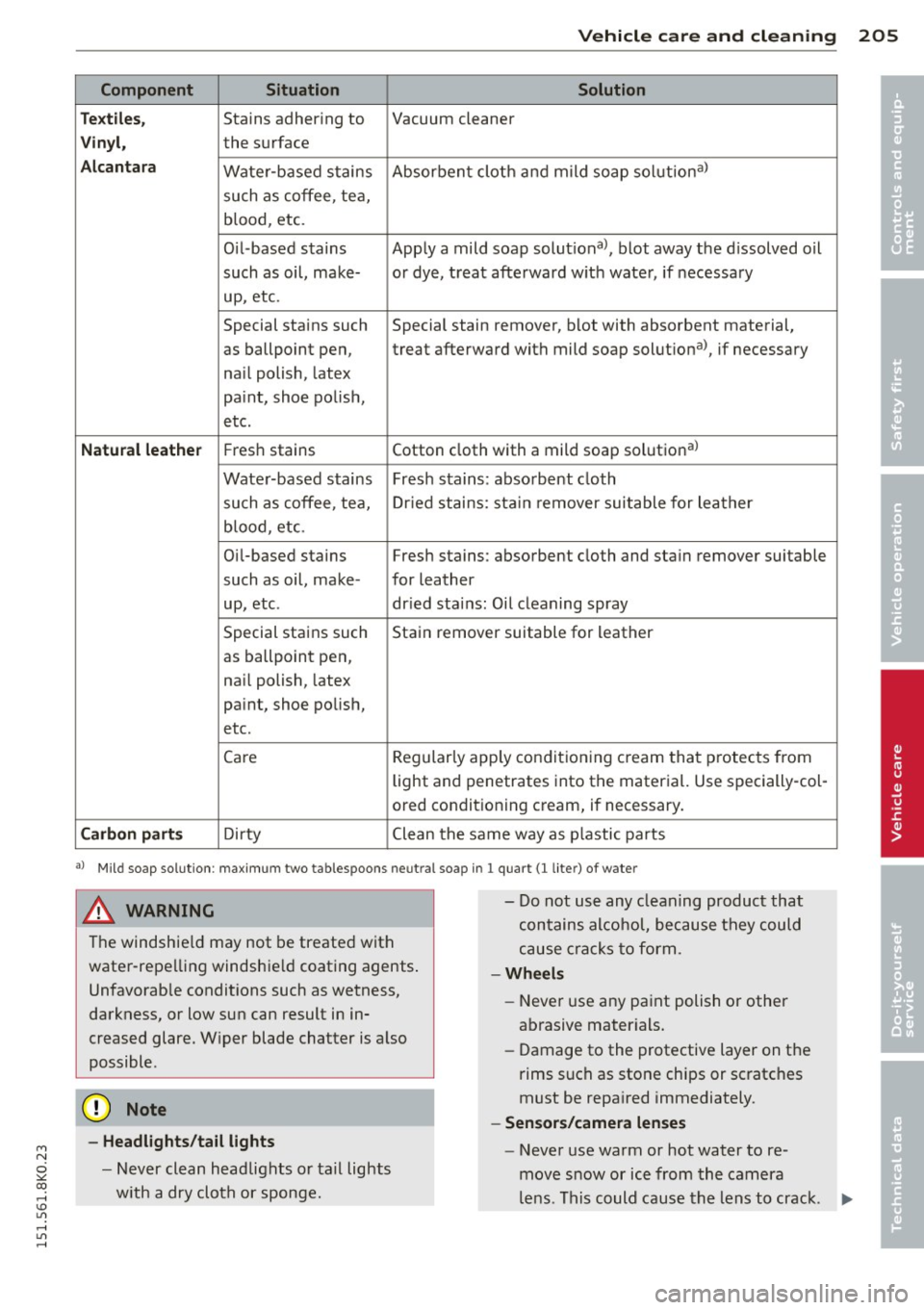
Component Situation Solution
Te xtile s,
Stains adhering to Vacuum cleaner
Vinyl, the surface
Alcantara Water-based stains Absorbent cloth and mild soap solutiona>
such as coffee, tea, blood, etc.
Oil-based stains Apply a mild soap solutiona>, blot away the d issolved oil
such as oil, make- or dye, treat afterward w ith water, if necessary
up, etc.
Special stains such Special stain remover, blot with absorbent material,
as ballpoint pen, treat afterward with mild soap solutiona>, if necessary
na il polish, latex
pa int, shoe polish,
etc.
Natural leather Fr es h stains Cotton cloth with a mild soap solutiona)
Water-based stains Fresh sta ins: absorbent cloth
such as coffee, tea, Dr ied stains: sta in remover suitable for leather
blood, etc.
Oil-based stains Fresh sta ins: absorbent cloth and stain remover suitable
such as oil, make- for leather
up, etc . dried sta ins: Oil cleaning spray
Special stains such Stain remover suitable for leather
as ballpo int pen,
na il polish, latex
pa int, shoe polish,
etc .
Care Regularly
apply conditioning cream that protects from
light and penetrates into the material. Use specially-col-
ored conditioning cream, if necessary.
Carbon parts Dirty Clean the same way as plastic parts
al Mild soap solution: maximum two tablespoons neut ral soap in 1 quart (I liter) of water
& WARNING
The windshie ld may not be treated with
water-repelling windshie ld coating agents .
Unfavorab le conditions such as wetness,
darkness, or low sun can result in in
creased glare. W iper blade chatter is also
possible.
- Headlights/tail lights
- Never clean headlights or tail lights
w ith a dry cloth or sponge. -
Do not use any cleaning product that
contains alcohol, because they could
cause cracks to form .
-Wheels
-Never use any paint polish or other
abrasive mater ials.
- Damage to the protective layer on the
rims such as stone chips or scratches
must be repaired immediately.
- Sensors/camera lenses
- Never use warm or hot water to re-
move snow or ice from the camera
len s. This could cause the lens to crack .
IJII>
•
•
Page 224 of 304
222 Check ing and filling
@ For the sake of the environment
Becau se of the pr oblem of proper disposa l
of brake flu id as we ll as the special tools
requ ired and the necessary expert ise, we
recommend that you have the brake fluid
changed by your author ized Audi dealer.
Battery
General information
Unde r normal operating conditions, the bat
tery in your Audi does not need any mainte
nance. With
high outside temperatures or
long daily dr ives we recommend that you have
the electro lyte level checked by an authorized
Aud i dea ler o r qualified workshop . The elec
trolyte leve l sho uld a lso be checked each t ime
the battery is charged ¢
page 224.
Have the battery checked when you take your
ve hicle in for service . Yo u are well adv ised to
replace a bat tery that is older tha n 5 yea rs .
W ith certa in types of a irbag deployment, t he
battery is d isconnected from the vehicle elec
tr ica l system fo r safety reasons ¢
& in Re
pair, core and disposal of the airbags on
page 157.
Disconnecting the battery terminals
Some veh icle functions (power w indow regu
lato rs, for example) are lost if the battery ter
m inals a re discon nected. These functions have
to be re lea rned after the batte ry terminals a re
connec ted agai n. T o prevent this, the battery
should o nly be d isconnec ted from the vehicle
e lec trica l syste m when absolu tely necess ary
for repairs.
Vehicles not driven for long periods
I f yo u do not drive you r vehicle over a pe riod
of severa l days or weeks, elec trical co m po
nen ts are gr adually cu t back o r swi tched off .
T his reduces energy consumption and main
tains sta rting capab ility over a lon ger period
¢ page 191.
Some o f the conven ien ce f unct ions m ay no t
ope rate, su ch as the in ter ior lights o r the power seat adjus
tment. The convenience
funct ions wi ll be available again when yo u
tu rn on the ignition and sta rt t he engine.
Winter operation
Du ring the w inte r mon ths , b att ery capac ity
tends to dec rease as temperatures drop . This
is beca use more power is a lso consumed w hile
starting, and the headlights, rear win dow de
f ogger, etc., are used more often.
Avoid unnecessa ry powe r consumpt ion, pa r
ticu lar ly in ci ty traffic o r when traveling only
sho rt distances . Let yo ur autho rized A udi
dealer check the capacity of the vehicle bat
tery before w inter sets in ¢
page 224. A well
charged battery will not on ly prevent starting
problems when the weather is cold, but will
also last longer .
@ Tips
If your vehicle is left standing for seve ral
weeks at extremely low temperatures, the
vehicle battery s hou ld be removed and
s tored w her e it w ill not freeze. This will
preve nt i t fr om be ing d amaged and having
t o be repla ced .
Working on the battery
Be especially careful when working on or near
the battery.
The battery is located in the luggage compar t
ment under the floor . Befo re you che ck any
t hi ng in the luggage co mpartment,
read and
heed all WARNINGS
¢ .&, .
Always heed the safety warnings , when work
i ng on the veh icle ba tte ry or the vehicle e le c
t ric al sys tem to p reven t inju ry.
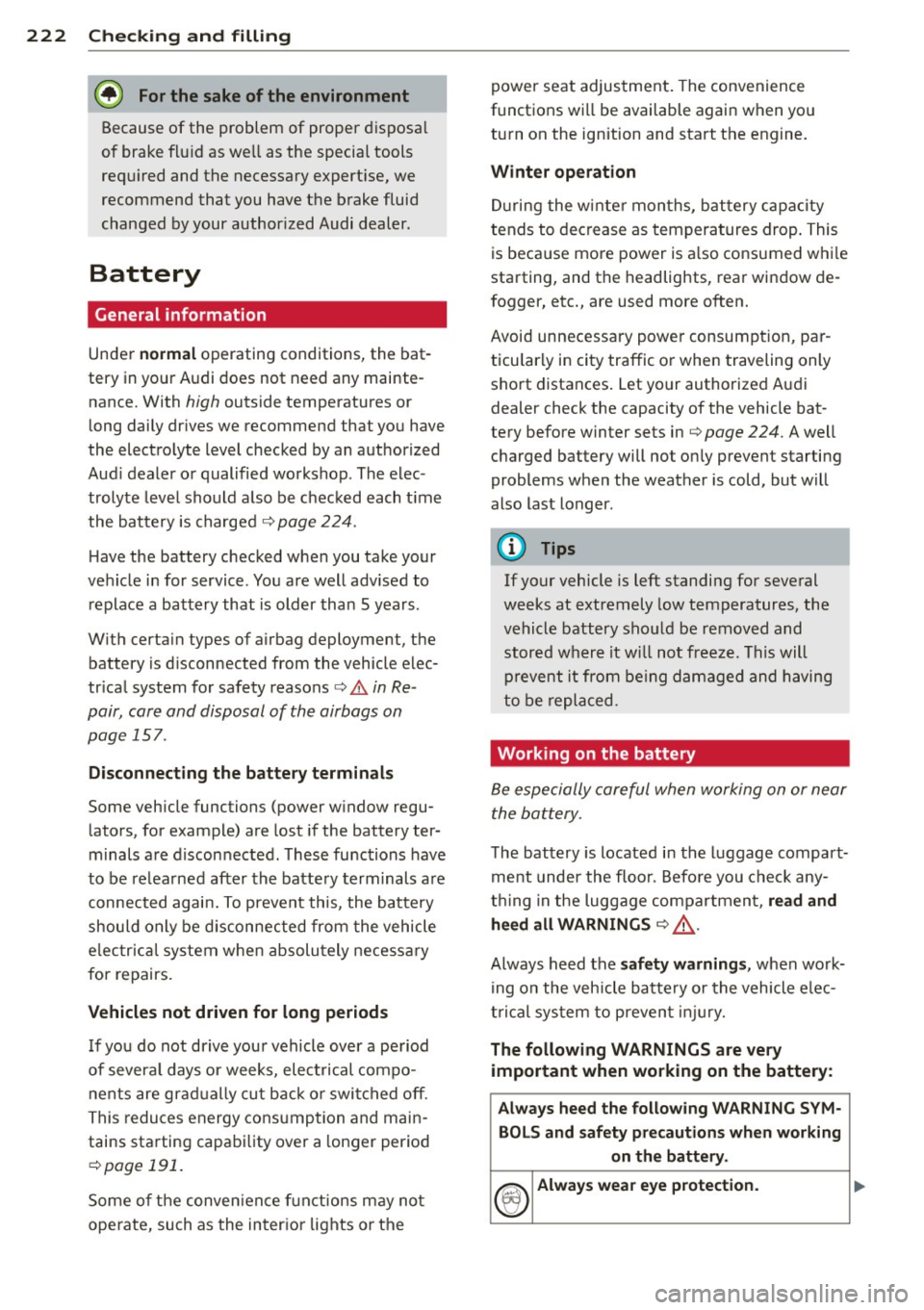
The following WARNINGS are very
important when working on the battery:
Always heed the following WARNING SYM ·
BOLS and safety precautions when working
on the battery .
®
Always wear eye protection .
Page 238 of 304
236 Tires a nd whee ls
If you wish to improve comfort See the illustration ¢ fig. 189
when operating the vehicle at for the location of the label on
normal load (up to 3 occu -driver's side B-pillar (color of
pants), you can adjust tire the actual label and exact loca-
pressures to those specified tion on the vehicle will vary
for normal vehicle load. Before slight ly) .
operat ing the vehicle at maxi -Note that the following table is
mum load, you must increase accurate a t the time of going to
the ti re pressures to those press and is subject to change .
specified for maximum vehicle In the event of discrepancies ,
load¢&. the tire p ressure labe l is locat-
Bear in mind that the tire pres- ed on the driver's side 8-pi llar
sure monitoring system* can a lways takes precedence .
on ly monitor the tire pressures
The table be low lis ts the rec -
you have sto red . The system
ommended cold tire inflation
does not recogn ize t he load
pressures for the Audi model
condition of your vehic le.
covered by your Owner's Li tera-
T he effect iveness of the tire ture at the veh icle's capac ity
p ressure mon itor ing system* weight and the tire sizes instal -
will be impaire d if you st ore led on the respect ive mode ls as
normal load press ures but then original eq uipment, or as a fac -
operate the vehicle at its max i- tory optio n.
...
mum load¢&.
Page 242 of 304
240 Tires and wheels
Therefore, be sure to check tire and luggage) for the tires on
pressures at least once a month your vehicle as listed on the on
and always before going on a your vehicle and in this manual
long trip. Make sure to take the and the kind of driving you plan
number of people and the to do.
amount of luggage into ac-
Never exceed the maximum in-
count when adjusting tire pres-flation pressure listed on the
sure for a trip -even one that tire sidewall for any reason.
you would not consider to be
Remember that the vehicle
" long ." See
¢ page 242, Tires
manufacturer, not the tire man-and vehicle load limits for more
important information. ufacturer, determines the cor-
rect tire pressure for the tires
Always use an accurate tire on your vehicle.
pressure gauge when checking It is important to check the tire
and adjusting inflation pres-
pressure when the tires are
sures. Check all of the tires and
be sure not to forget the spare cold
.
tire. If the pressure in any tire is -Read the
required tire pres-
too high when the tire is "cold", sure from the tire pressure
la-
let air out of the tire slowly bel.
The tire pressure label is
with the edge of the tire gauge located
on the driver's side B-
and keep checking the pressure pillar. The tire pressure label
until you reach the pressure lists the recommended cold
that is correct for the load (pas- tire inflation
pressures for the
sengers and luggage) and kind vehicle at its maximum capaci-
of driving you plan to do. ty weight and the tires that
If the pressure in any tire is too were on your
vehicle at the
time it was manufactured. For
low, note the difference be-
tween the pressure in the cold recommended
tire pressures
for normal load conditions,
tire and the pressure you need
please see chapter
and add the air that you need to
¢page 234. ...
reach the correct pressure for
the vehicle load (passengers
Page 256 of 304
254 Tires and wheels
@ For the sake of the environment
Dispo se of old tires in accord
ance with the local require
ments.
Uniform tire quality grading
- Tread wear
- T raction AA A B C
- T empera ture ABC
Quality grades can be found where applicable
on the tire side wa ll between tread shou lder
and max imum sect ion width
¢ page 248,
fig. 193.
For example: Tread wear 200, Tract ion AA ,
Temperature A.
All passenger car tires must conform to Feder
al Safety Requirements in addition to these
grades.
Tread wear
The tread wear grade is a comparative rating
based on the wear rate of the tire when tested
under controlled conditions on a spec ified
government test course .
For example, a t ire graded 150 would wear
one and one half (1 1/2) t imes as well on the
government course as a tire graded 100.
The relat ive performance of t ires depends
upon the actua l conditions of their use, how
ever, and may depart significantly from the norm due to var iations in dr iving habits, serv
ice practices and differences in road character
istics and climate .
Traction
The traction grades, from highest to lowest,
are AA, A, Band
C. Those grades represent the
tire's abil ity to stop on wet pavement as
measured under controlled cond it ions on
specified government test surfaces of asphalt
and concrete . A tire marked C may have poor
trac tion performance ¢&,. .
Temperature
The temperature grades are A (the highest),
B, and C, representing the tire's resistance to
the generation of heat and its ability to dissi
pate heat when tested under controlled condi
tions on a specified indoor laboratory test
wheel.
Sustained high temperature can cause the
material of the tire to degenerate and red uce
tire life, and excessive temperature can lead
to sudden tire failure
¢ &,..
The grade C corresponds to a level of perform
ance which all passenger car tires must meet
under the Federal Motor Vehicle Safety Stand
ard No. 109. Grades Band A represent higher
levels of performance on the laboratory test
wheel than the minimum required by law .
A WARNING
The traction grade assigned to this tire is
based on straight-ahead braking traction
tests, and does not include acceleration,
cornering, hydroplaning or peak traction
characteristics.
A WARNING
The temperature grade for this tire is es
tablished for a tire that is properly inflated
and not overloaded. Excessive speed, un
derinflation, or excessive load ing, either
separately or in combination, can cause
heat buildup and possible tire failure.
Winter tires -
Winter tires can improve vehicle handling on
snow and ice . At temperatures below 45 °F
(7 °C) we recommend changing to winter
tires .
In some heavy snow areas, local governments
may require true winter or "snow" tir es, those
with very deeply cut tread . These tires should
only be used in pairs and be installed on all
four wheels. Make sure you purchase snow
tires that are the same size and construction
type as the other tires on your vehicle. .,.
Page 259 of 304
'"" N
0 ::.,: co ,...., \!) 1.1'1 ,...., 1.1'1 ,....,
and handling under a variety of driving condi
tions . Ask your authorized Audi dealer for
more details.
The low aspect ratio of these tires is indicated
by a numeral of
55 or less in the tire's size
designation. The numeral represents the ratio
of the tire's sidewa ll height in relation to its
tread width expressed in percentage . Conven
tional tires have a height/width ratio of 60 or
more .
The performance of low-aspect-ratio tires is
particularly sensitive to improper inflation
pressure. It is therefore important that low
aspect ratio tires are inflated to the specified
pressure and that the inflation pressure is
regularly checked and maintained. Tire pres
sures should be checked at least once a
month and always before a long trip
¢ page 239, Checking tire pressure.
What you can do to avoid tire and rim
damage
Low aspect ratio tires can be damaged more
easily by impact with potho les, curbs, gullies
or ridges on the road, particularly if the tire is
underinflated .
In order to minimize the occurrence of impa ct
damage to the tires of your vehicle, we recom
mend that you observe the following precau
tions:
- Always maintain recommended inflation
pressures. Check your tire pressure every
2,000 miles (3,000 km) and add air if neces
sary .
- Drive carefully on roads with potholes, deep
gullies or ridges. The impact from driving
t hr ough or over such obstacles can damage
your tires. Impact with a curb may also cause damage to your tires.
- After any impact, immediately inspect your
t ir es or have them inspected by the nearest
authorized Aud i dealer. Replace a damaged
t ir e as soo n as possible .
- Inspect your t ires every 2,000 miles (3,000
km) for damage and wear . Damage is not al
ways easy to see . Damage can lead to loss of
air and underinflation, wh ich could eventu-
Tires and wheels 257
ally cause tire failure. If you believe that a
tire may have been damaged, rep lace the
tire as soon as possib le.
- These tires may wear more quickly than oth
ers.
- Please also remembe r that, while these tires
deliver responsive handling, they may ride
less comfortably and make more noise than
other choices.
Reduced performance in winter/cold
season conditions
All tires are designed for certain purposes.
The low aspect ratio, ultra high performance
tires or iginally installed on your vehicle are in
tended for maximum dry and wet road per
formance and handling. They are not suitable
for cold, snowy o r icy weather conditions. If
you drive under those circumstances, you
should equip your vehi cle w ith all-season or
winter tires, which offer better traction under
those conditions. We suggest you use the rec
ommended snow or a ll-season tires specified
for your vehicle, or their equivalent .
Refer to¢
page 254 for more detailed infor
mation regarding winter tires.
Ti re pressure
monitoring system
ill General notes
Applies to vehicles: with tire pressure monitoring system
Each tire, including the spare (if provided),
sho uld be checked monthly when cold and in
flated to the inflation pressure recommended by the veh icle manufacturer on the veh icle
placard or tire inflation pressure label. (If your
vehicle has tires of a d ifferent size than the
s ize indicated on the vehicle placard or tire in
flat io n pressure label, you should determine
the proper t ire inflation pressu re for those
tires).
As an added safety feature , your veh icle has
been equipped with a tire pressure mon itoring
system (TPMS) that illum inates a low ti re
pressure te llt ale when one or more of your
tires is significantly under-inflated. .,.
•
•
Page 261 of 304
'"" N
0 ::.,: co ,...., \!) ..,.,
,...., ..,., ,....,
-the spa re tire* /inflatable spare tire* is
mounted.
Warning symbols
[IJ Loss of pressure in at least one tire¢,&. .
Check the tire or tires and replace or repair if necessa ry. The indicator light
[IJ in the instru
ment cluster also illuminates
¢page 13.
Check/correct the pressures of all four tires
and resetTPMS via radio or MMI*.
mm (T ire Pressure Monitoring System) Ti re
pre ssure: S ystem m alfuncti on!.
1tE appea rs after sw itching the ign it ion on
or while d rivi ng and the ind icator light
[IJ in
the instrument cluster blinks for approxi mately one minute and then stays on, there is
a system malfunction. Attempt to store the
correct t ire pressure ¢
page 259. If the indi
cator light does not turn off or if it turns on
shortly thereafter, immediately drive your ve
h icle to an authorized Audi dealer or author
ized repair facility to have the malfunction
corrected.
.&, WARNING
- If the t ire pressure indicator appears in
the instrument cl uster d isplay, one or
more o f your tires is significantly under
inflated. Reduce your speed immediately
and avoid any hard steering or braking
maneuvers. Stop as soon as possible and
check the t ires and the ir pressures. In
flate the tire pressure to the proper pres
sure as indicated on the vehicle 's t ire
pressure label~
page 234 . Driving on a
significantly under-inflated tire ca uses
the tire to overhea t and can lead to tire
failure. Under-inflation also is likely to impair the vehicle 's handling and stop
ping ability.
- The driver is responsible for mainta ining
the correct tire pressures. You must check the tire pressures regularly .
- Under certain cond itions (such as a spor
ty driving style, winter conditions or un paved roads), the pressure monitor indi
cator may be de layed .
Tire s an d wheel s 259
-Ask your a uthorized Audi dea ler if run
flat tires may be used on your vehicle.
(D Tips
- The tire pressure mon itoring system may
stop working when there is an ESC ma l
function.
- Using snow chains may res ult in a system
ma lfunction.
- The tire pressure mon itor ing system on
your Audi was deve loped using tires with
the "AO" or "RO" identification on the
tire s idewall
~ page 248. We recom
mend us ing these tires.
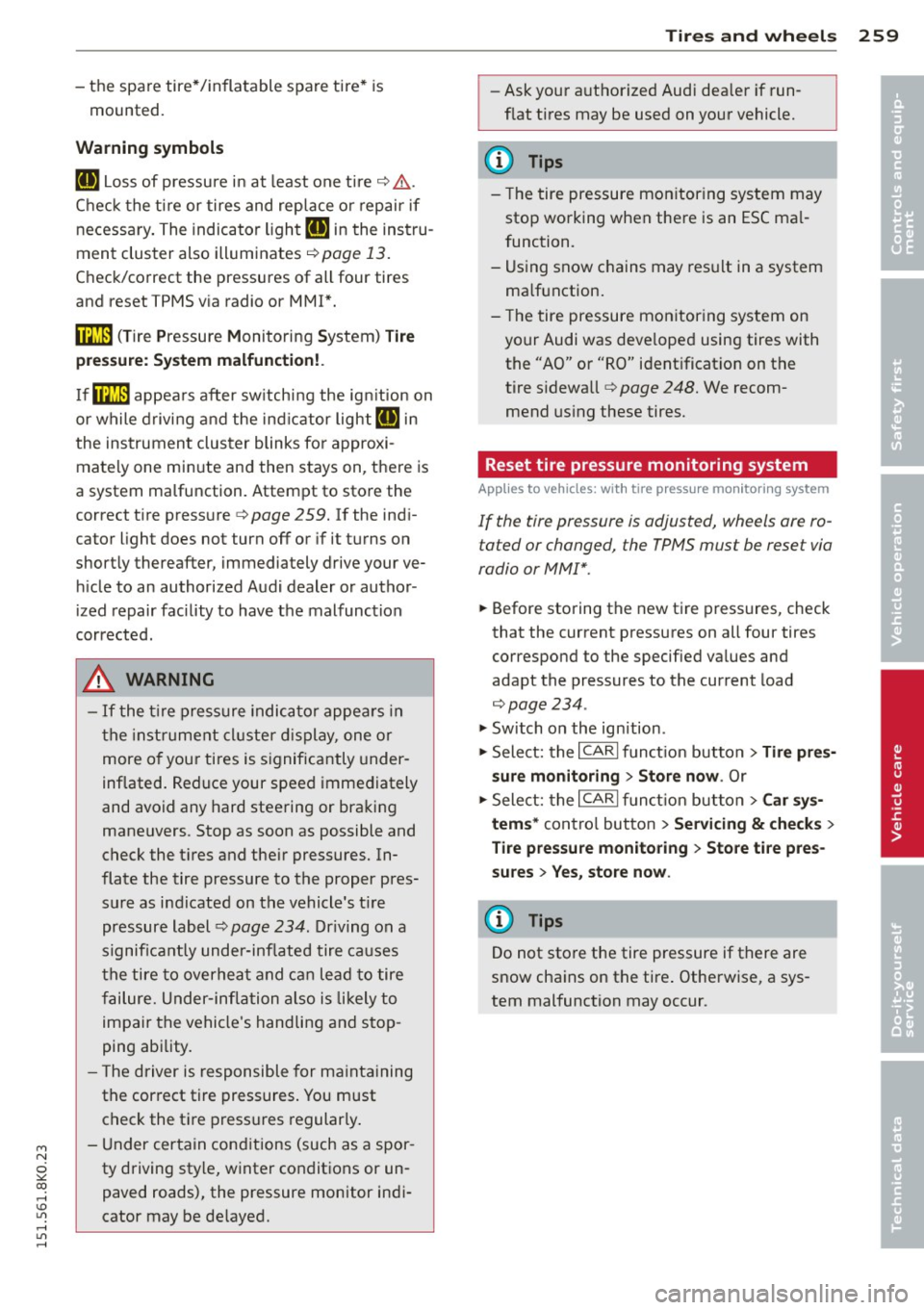
Reset tire pressure monitoring system
App lies to vehicles: with tire pressure mon itor ing system
If the tire pressure is adjusted, wheels ore ro
tated or changed, the TPMS must be reset via
radio or MMI*.
... Before storing the new tire pressures, check
that the current pressures on all four tires
correspond to the specified va lues and
adapt the pressures to the current load
¢ page 234.
.,. Switch on the ignition.
.,. Select: the
I CARI funct io n button > Tir e pre s
s ure mon itoring
> Store now . Or
.,. Select: the
I CARI fu nct ion button > Car sy s
tem s*
contro l button > S erv icing & che cks >
Tire pres sure mon itor in g > Store tire pre s
s ures
> Yes, sto re now .
(D Tips
Do not store the tire pressure if there are
snow chains on the tire . Otherwise, a sys
tem mal function may occur.
•
•
Page 285 of 304
'"" N
0 ::.,: co ,...., \!) 1.1"1 ,...., 1.1"1 ,....,
Consumer Information
Warranty coverages
Your Audi is covered by the following war
ranties :
- New Vehicle Limited Warranty
- Limited Warranty Against Corrosion Perfo-
ration
- Emissions Control System Warranty
- Emissions Performance Warranty
- California Emissions Control Warranty (USA
vehicles only)
- California Emissions Performance Warranty
(USA vehicles only)
Detailed information regarding yo ur warran
ties can be found in your
Warranty & Mainte
nance booklet .
Operating your vehicle
outside the U.S.A. or
Canada
Government regulations in the United States
and Canada require that automobiles meet
specific emission regulations and safety
standards. Therefore, veh icles built for the
U.S.A. and Canada differ from vehicles sold in
other countries .
I f you p lan to take your vehicle outside the
continental limits of the United States or Can
ada, there is the possibility that:
- unleaded fuels for vehicles with cata lytic
converter may not be available;
- fuel may have a considerably lower octane
rating . Improper fuel may cause engine
damage;
- service may be inadequate due to lack of
proper service facilities, tools or testing
equipment;
- replacement parts may not be readily availa
ble.
- Navigation systems for vehicles built for the
U.S.A. and Canada will not necessari ly work
in Europe, and may not work in other coun
tries outside of North America.
Consumer Information 283
@ Note
Audi cannot be responsible for mechanical
damage that could result from inadequate
fuel, serv ice or parts availab ility.
Audi Service Repair
Manuals and Literature
Audi Offic ial Factory Service Manuals and Lit
erature are published as soon as possible after
model introduct ion. Service manuals and lit
erat ure are available to order from the Audi
T echnical Literature Ordering Center at:
www.audi.techliterature.com
Maintenance
' General
Your vehicle has been designed to help keep
maintenance requirements to a m inimum.
However, a certain amount of regular mainte
nance is still necessary to assure your vehicle's
safety, economy and reliability . For detailed
vehicle maintenance consult your Warranty
&
Maintenance booklet.
Under difficult operating conditions , for ex
ample at extremely low outside temperatures,
in very dusty regions, when towing a trailer
very frequently, etc., some serv ice work
shou ld be pe rformed between the intervals
specified. This applies particularly to:
- oil changes, and
- cleaning or replacing the air filter.
® For the sake of the environment
By regularly maintaining your veh icle, you
help make sure that emission standards
are maintained, thus min imiz ing adverse
effects on the environment .
Important considerations for you and
your vehicle
The increasing use of electronics, sophistica t
ed fuel injection and emission contro l sys-
tems, and the genera lly increasing technica l ..,_
•
•
Page 286 of 304
28 4 Con sum er Inf ormation
comp lexity of today's automobi les, have
steadi ly reduced the scope of maintenance
and repairs which can be carried out by vehicle
owners.
Also, s afety an d e nvir onm ent al con
cerns place very strict limits on the nature of repairs and adjustments to engine and trans
miss ion pa rts which an owner can perform .
Maintenance, adjustments and repa irs usua lly
require special tools, testing devices and oth
er equipment avai lab le to specially trained
workshop personnel in order to assure proper
performance, reliab ility and safety of the vehi
cle and its many systems .
Improper ma intenance, adjustments and re
pa irs can impair the operation and reliab ility
of your vehicle and even void your vehicle war ranty. Therefo re , proof of servici ng in accord
ance w it h the ma intenance sched ule may be a
condition for upholding a possible warranty
claim made within the warran ty period.
Above all, operational safety can be adve rsely
affected, c reating unnecessary risks for you
and your passengers.
If in doubt about any serv icing, have it done
by your author ized Audi dealer or any properly
equ ipped and qu alified workshop. We strong
l y urge you to give your authorized Audi dea ler
the opportunity to perform all scheduled maintenance and necessary repairs . Your deal
er has the facilities, or iginal parts and trained
specialists to keep your veh icle running prop
erly.
Performing lim it e d m aint en anc e y ourself
The following pages describe a limited num
ber of procedures which can be performed on
you r vehicle with ordinary tools, should the
need arise and trained personnel be unavaila
ble. Before performing any of these proce
dures, always thoroughly read all of the app li
cable text and ca refully follow the instruc
tions given. Always rigorously obse rve the
WARNINGS p rovided .
Before you ch eck anything in th e engine
compartm ent, alw ays read an d hee d all WARNINGS
¢ & a
nd ¢ & in Working in the
engine comportment on page 212 .
A WARNING
--Serious personal in jury may occur as a re-
sult of improperly performed mainte nance, adjustments or repa irs.
- Always be extremely careful when work
ing on the vehicle. Always follow com
monly accepted safety pract ices and gen
eral common sense. Never r isk personal
in jur y.
- Do not attempt any of the maintenance,
checks or repairs descr ibed o n the fol
lowing pages if you are not fu lly fam iliar
with these or other procedures with re spect to the ve hicl e, or are uncerta in how
to proceed .
- Do not do any work withou t the proper
too ls and equipment . Have the necessary
work done by your authorized A udi deal
er or any properly equipped and q ualified
workshop.
- The engine compar tment o f any motor
vehicle is a potentially hazardous area. Never reach into the area around or
touch the rad iator fan. It is temperature
control led and can sw itch on suddenly -
even when the engine is off and the igni
tion key has been removed. The rad iator
fan switches on automatically when the coo lant reaches a certain tempera ture
and will cont inue to run until the coo lant
temperature drops .
- Always remove the ign ition key befo re
a nyone gets under the veh icle.
- Always suppor t your veh icle with safety
s tands if it is necessary to work under
neath the vehicle. The jack s upplied with
the vehicle is not adequate for this pur
pose and co uld co llapse causing serio us
personal injury.
- If you must work unde rneath the vehicle
with the wheels on the ground, a lways
make sure the vehicle is on leve l ground,
that the wheels are always securely blocked and that the engine cannot be
started.