change time AUDI A4 2015 User Guide
[x] Cancel search | Manufacturer: AUDI, Model Year: 2015, Model line: A4, Model: AUDI A4 2015Pages: 304, PDF Size: 74.86 MB
Page 114 of 304
112 Audi side assist
General information
App lies to vehicles: with Audi side assist
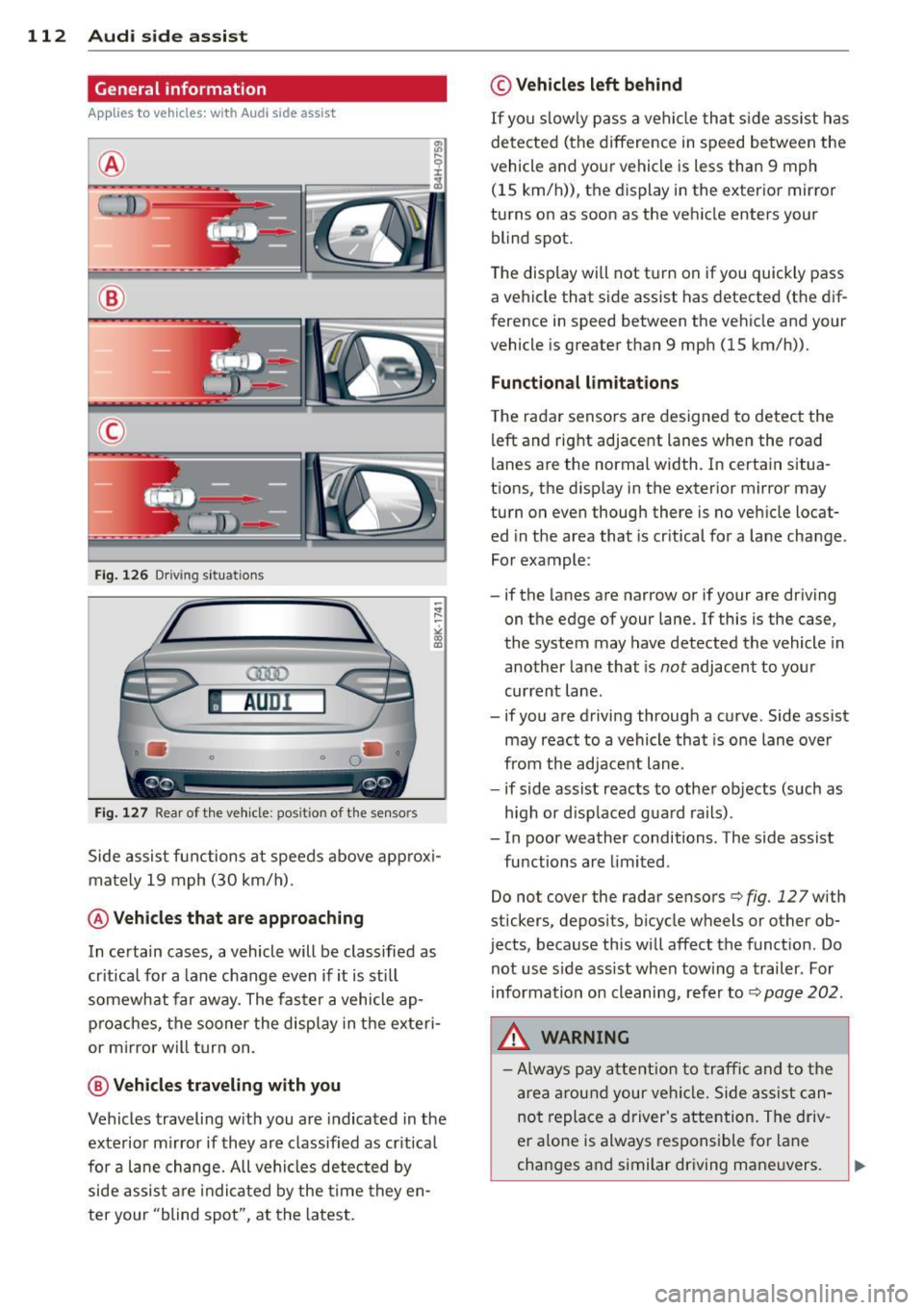
®
©
Fig. 126 Driving s it u at ions
AU Dr- l
• •
Fig . 12 7 Rea r of th e ve hicle: pos it io n of t he se nso rs
Side assis t fu nctions at speeds above ap prox i
ma tely 19 mph (30 km/h).
@ V ehicles that are approaching
In certain cases, a vehicle will be classified as
cr itical for a lane change
even if it is still
somewhat far away. The fas ter a vehicle ap
p ro aches, the sooner the disp lay in the exteri
or m irror will t urn on.
@ Vehicles traveling with you
Vehicles traveling w ith you are indicated in the
exterior m irror if they are classified as cr it ical
for a lane change. All vehicles detec ted by
side assis t are in dicated by the time they en
ter your "blind spot", at the latest.
© Vehicles left behind
If you s low ly pass a ve hicl e tha t sid e ass ist has
dete cted ( the difference in s peed between the
vehicle and you r vehicle is less than 9 mph
(15 km/h)), the display in the exter io r mirro r
turns on as soon as the vehicle enters your blind spot.
The disp lay wi ll not t urn on if you quickly pass
a vehicle that s ide assist has detected (t he d if
f erence in speed between the ve hicle and your
vehicle is greater than 9 mph (15 km/h)).
Functional limitations
T he radar senso rs are des igned to detect the
left and right adjacent lanes whe n the road
l anes a re the normal width. In certain situa
t ions, the d isp lay in the exterior mirror may
turn on
even though there is no ve hicle locat
ed in the area that is cr itical fo r a lane cha nge.
For example:
- if the lanes are narrow or if your are driving on the edge of your lane. If this is the case,
the system may have detected the vehicle in
another la ne that is
not adjacent to your
cur rent lane .
- if you a re driving through a c urve . Side assis t
may react to a vehicle that is one lane ove r
from the ad jacent lane .
- if side assist reacts to other objects (such as
high or d isp laced gua rd rails) .
- In poor weather conditions. The side assist fu nctions are limited .
Do not
cover the radar sensors c:;, fig. 127 with
stickers, depos its, bicycle wheels or other ob
jects , because this will affect the funct ion. Do
not use s ide ass ist when tow ing a trail er. For
information on cleaning, refe r to
c:;, page 202 .
&_ WARNING
-Always pay a tten tion t o traffic and to the
ar ea around your ve hicl e. Side a ssist can
no t repla ce a driver's attention. The driv
er a lone is always respons ible fo r lane
cha nges a nd similar driving mane uvers.
Page 115 of 304
M N
~ co
rl I.O
"' rl
"' rl
-Improper reliance on the side assist sys
tem can cause collisions and serious
personal injury:
- Never rely only on side assist when
ch anging lanes.
- Always check rear view mirrors to make
sure that it is safe to change lanes.
- Side ass ist cannot detect a ll vehicles un
der all cond itions- dange r of accident!
- Please note that side assist indicates
ther e ar e approaching vehicles, o r
vehicles in your bli nd spot, o nly afte r
yo ur vehicle has r eached a driving speed
o f at least 19 mph (30 km/h).
- In certain s ituati ons, the system may not
f unc tion or its funct io n may be lim ited.
For example:
- if veh icles are approaching or be ing left
behind very quick ly. The display may
not turn on in time.
- in poor weather condit ions such as
heavy ra in, snow or heavy m ist .
- on very wide lanes, i n tight curves or if
there is a rise in the road surface .
Vehicles in the adjacent lane may not
be detec ted becaus e they are outside
of t he senso r range.
(D Note
The sensors can be displaced by impacts o r
damage to the bumper, whee l housing and
unde rbody. This can affect the system .
Have your author ized Audi dealer or au
t hori zed A udi Service Fa cility check the ir
function.
(D Tips
- If the window g lass in t he d river's doo r
or front passe nger's door h as bee n tint
ed, the disp lay in the exterior m irror may
be misinterpre ted.
- Fo r De clarat ion of Compliance to Uni ted
Sta tes FCC and Indus try Canada regula
tions~
page 286.
Aud i side assist 113
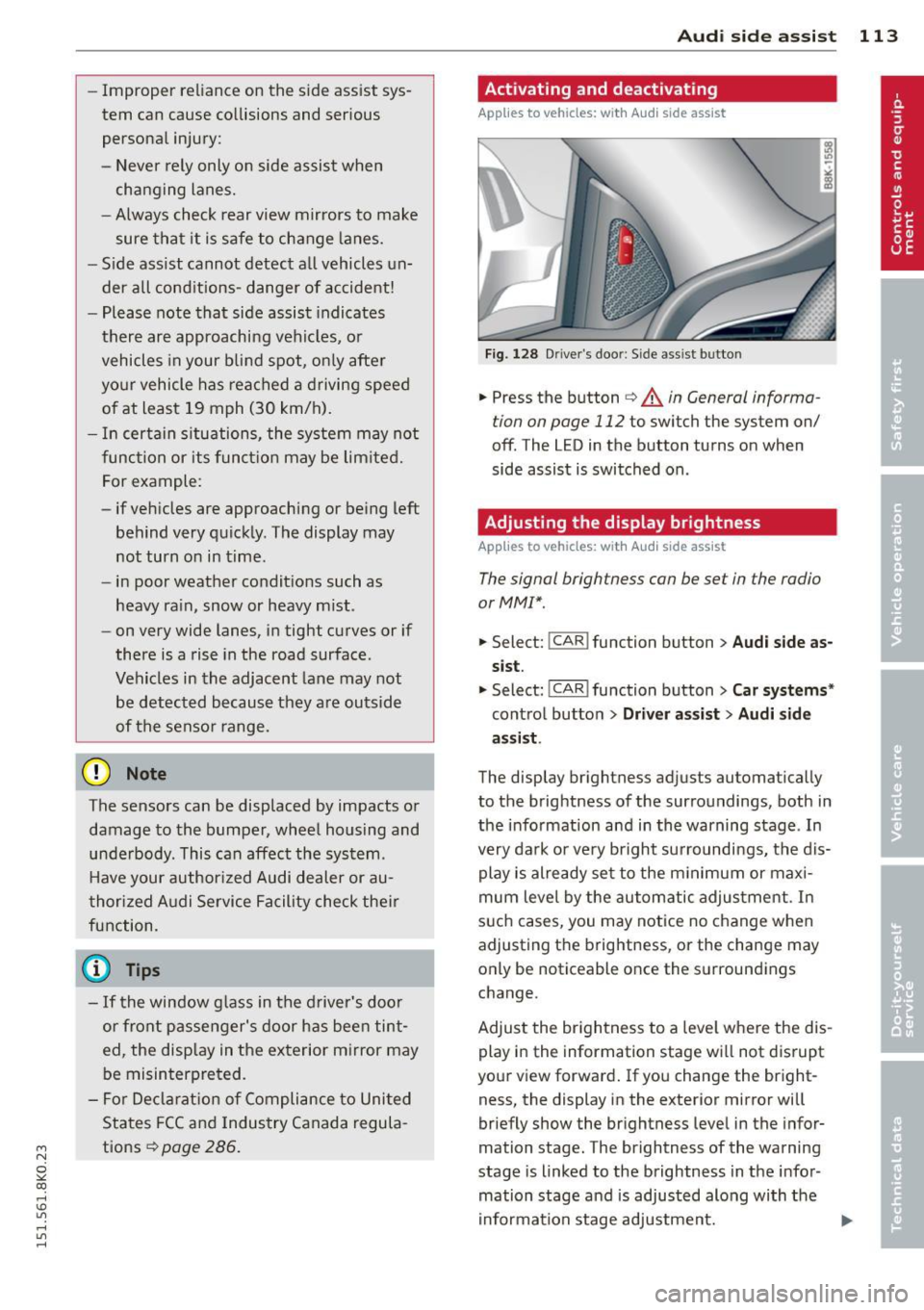
Activating and deactivating
A pp lies to vehicles : wi th Aud i side ass ist
F ig. 128 D river 's doo r: Side ass is t button
.,. Press the b utton ~ A in General informa
tion on page 112
to switch the system on/
off . The LED in the button turns on when
side assist is switched on.
Adjusting the display brightness
A pp lies to vehicles: wi th Audi side ass ist
The signal brightness can be set in the radio
orMMI* .
.,. Select: !CAR ! function button > Audi side as
sist .
.,. Select: I CAR I function button > Car systems *
control button > Driv er a ssist > Audi side
as sis t.
The display br ightness adjusts automatically
to the brig htness of the sur roundings, both in
the info rmation and in the warning stage . In
very dark or very bright su rroundings, the dis
play is already se t to the m inimum or maxi
mum level by t he autom atic adjus tme nt. I n
s uch cases, you may notice no change when
adjusting t he b rig htness, or the change may
only be noticeable once the s urroundings
change.
Adjus t the brightness to a leve l where the dis
play i n the information stage w ill not d is rupt
your view forward . If you change the bright
ness, the display in the exterior mirror will
briefly show the brightness level in the infor
mation stage. The brightness of the warning
stage is linked to the brightness in the i nfor
mation stage and is adjusted along with the
i nformation stage adjustment. ..,_
Page 117 of 304
Audi drive select Driving settings
Introduction
App lies to vehicles: with Audi drive select
Drive select provides the possibility to experi
ence diffe rent types of vehicle sett ings in one
vehicle. For instance, using the three
Com
fort, Auto and Dynamic modes, the driver can
switch from a sporty to a comfortab le driving
mode with the press of a button.
Addit ionally, in vehicles with
MM I*, the vehi
cle setup for
Individual* mode can be cus
tomized by you. This makes it possib le to
combine settings such as a sporty engine tun
ing with comfortable steering.
A WARNING
Improper use of the Audi drive select can
cause collisions, other acc idents and seri
ous personal injury.
Description
Applies to vehicles: with Audi drive select
The vehicle setup in each mode depends on
the vehicle's features . However, the engine,
automatic t ransmission* and steering are al
ways involved.
-
Engine and automatic transmission*
Depending on the mode, the engine and the
automatic transmission respond quicker or in
a more ba lanced manner to acce lerator pedal
movements. In the sporty dynamic mode, the
automatic transmission shifts at higher RPMs .
Steering
The steering adapts in terms of steering effort
and steering ratios . Indirect steer ing that
moves easily, like the steering in comfort
mode , is best su ited to long dr ives on a high
way. In contrast, dynamic mode prov ides
~ sporty, di rect steering.
0
11'5 The follow ing applies to vehicles with dynam ic ,....,
~ steer ing*: the steering ratio changes based on
~ vehicle speed in order to maintain optimum ,....,
Audi drive select 115
steering effort for the driver at all times. This
sets the steering to be less sensitive at higher
speeds in order to provide improved vehicle
control. At reduced speeds, however, steering
is more direct in order to keep the steering ef
fort as minimal as possible when the driver is
maneuveri ng the veh icle . At low and average
speeds, dynamic steering addit iona lly pro
vides more responsive steering performance.
Adaptive dampers*
The adaptive dampers* use sensors to record
information regarding steering movements,
braking and acceleration operations by the
driver , road surface, driving speed, and load.
T his makes it possible to adapt damp ing to
the driving situation v irtually i n rea l time.
Drive select also makes it possible to satisfy
the desire for sporty suspension (Dynamic)
and comfortab le suspension (Comfort) with
out giving up balanced tuning (Auto) .
Sport differential*
As a component of the all whee l dr ive system
(quattro)
~ page 190, the sport differential*
distributes the driving power to the rear axle
depending on the situation . The distribution
of power varies depending on the mode se lected. The goal is a high level of agility and
ability to accelerate on curves . The vehicle is
very respons ive to steering .
Audi adaptive cruise control*
The behavior when accelerating can be adjust
ed from comfortab le to sporty, depending on
the drive select mode. Adaptive cruise control
also responds to the driving behavior of the
vehicle ahead in a more conservative or sporty
manner .
Engine sound*
The sound of the engine is adapted to the se
lected mode and ranges from subtle to sporty.
0) Tips
-In some models, the maximum vehicle
speed can only be reached in the
Auto
and Dynamic modes.
Page 124 of 304
122 Park ass is t
Sw it c hing off
.,. Drive faster than 9 mph (15 km/h), or
.,. take the vehicle out of reverse gear. The
acoustic parking system is immediately de
activated, and the rear view camera picture
is deactivated automatically after a per iod
of about 15 seconds, or
.,. switch off the ignition.
The delay in deactivating the camera provides an uninterrupted view behind the vehicle es
pec ially when maneuvering in tight parking
spaces and prevents the picture from turning
off the every time you sh ift out of reverse .
If the warning message appears in the display but not the rear view camera picture, read and
confirm the warning message. The acoustic
d istance signal is always active .
If you press a function button on the MMI
control console, the rear view camera picture
d isappears. The rear view camera picture reap
pears the next time you park.
Further information on the warn ing message
and the MMI control console can be found in
the MMI instruction booklet .
A WARNING
-Only use the rearview camera to assist
you if it shows a good, clea r picture. For
example, the image may be affected by
the sun sh in ing into the lens, dir t on the
lens or if there is a defect .
- Use the rearview camera only with the
rear lid completely closed. Make sure any
objects you may have mounted on the
rear lid do not block the rearview cam
era .
(D Tips
-The rear v iew camera picture is ava ila b le
as soon as the MM I Display or the MM I is
switched on, or the start-up phase is
completed.
- The sensors must be kept clean and free
of snow and ice for the park assist to op
erate. -
Yo u can change the vo lume and pitch of
the s ignals as we ll as the disp lay
¢ page 124 .
-What appea rs in the disp lay is time-de
layed.
· Reverse Parking
Applies to vehicles: with parking system (rear, with rear
v iew camera}
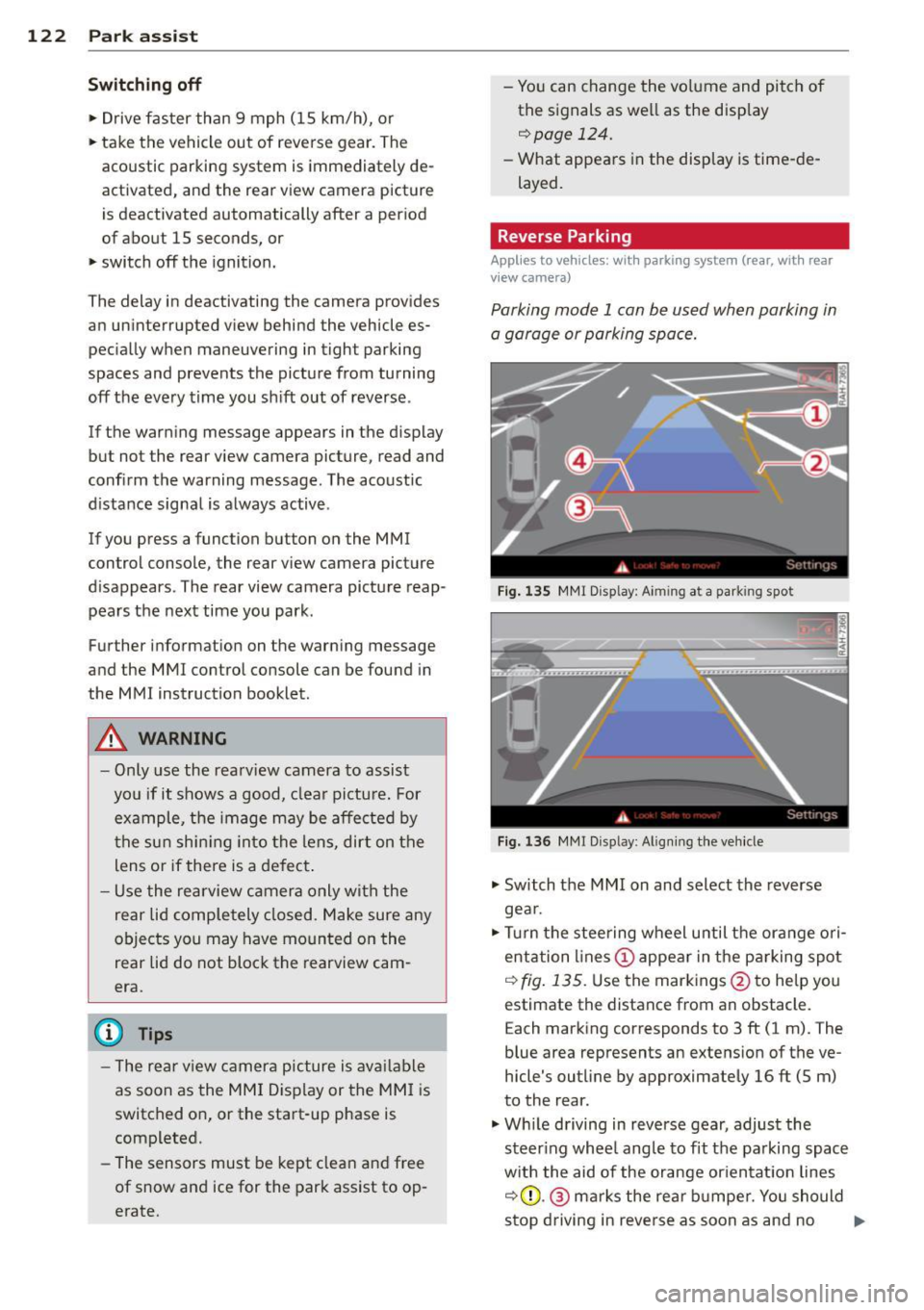
Parking mode 1 can be used when parking in
a garage or parking space.
F ig . 1 35 MMI Disp lay : A im ing a t a park ing spo t
Fig. 136 MMr Disp lay : A lig nin g the ve hicle
.,. Switch the MMI on and select the reverse
gea r.
.,. Turn the stee ring wheel u ntil the ora nge ori
entation lines(!) appea r in the pa rking spot
c:> fig . 135. Use the markings @to help you
estimate the distance from an obstacle.
E ach marking corresponds to 3 ft (1 m). The
blue area represents an extens ion of the ve
hicle's outline by approximately 16 ft (5 m)
to the rear.
.,. Wh ile driving in reverse gear, adjust the
steer ing whee l angle to fit the parking spac e
w ith the aid of the orange or ien tat ion lines
c:> (D .@ marks the rear b umpe r. You should
stop driving in reve rse as soon as and no .,.
Page 159 of 304
'"" N
0 ::.,: co ,...., \!) 1.1'1 ,...., 1.1'1 ,....,
possible that the airbag will inflate when
it is not supposed to, or will not inflate
when it should.
A WARNING
If the front airbag inflates, a ch ild without
a child restra int, in a rearward-facing child
safety seat or in a forward-facing child re
st raint that has not been properly insta lled
w ill be seriously injured and can be k illed.
- Even though your veh icle is equipped
with an Advanced Airbag System, make certain that a ll children, especially 12
ye ars and younge r, a lways ride on the
back seat properly restrained fo r their
age and size.
- Always instal l forw ard or rea r-facing
child safety seats on the rear seat -even
with an Advanced Airbag System.
- If you mus t install a rearward -facing
child safety seat on the front passenger
seat because of exceptional circ umstan
ces and the
PASSENGER AIR BAG OFF
light does not appear and stay on, imme
diately install the rear-fac ing ch ild safety
seat in a rear seating position and have
the a irbag system inspected by you r au
tho riz ed Aud i dea le r.
- A tight tether or other strap on a rear
wa rd-fac ing child restra int attached to
t h e fro nt passenger sea t can put too
much pressure on the weight-sens ing
mat in the seat and register mo re weight
than is ac tually on the seat. The heavier
weight registe red can make the system
wor k as though an adu lt were on the seat
and dep loy the Advanced Airbag when it
must be suppressed caus ing serious or
even fatal injury to the child .
- If, in exceptional circumstances, you
must install a forward -facing child re
st rain t on the front passenger seat, a l
ways move the seat into its rearmost po
sit ion in the seat's fo re and aft adjust
ment r ange, as far away from the airb ag
as possib le. The backrest m ust be adjus t
ed to an upr ight position. Make sure that
A irbag system 157
the PASSENGER AIR BAG OFF light
comes on and stays on all the time when
ever the ignition is switched on.
A WARNING
-
- If the PASSENGER AIR BAG OFF light
does not go out when an adult is sitting
on the front passenger seat after tak ing
the steps described above, make su re the
adu lt is prope rly seated and restra ined at
one o f the rea r seat ing pos itions.
- Have the airbag system inspected by
your author ized Audi dealer befo re trans
port ing anyone on the front pas senger
seat.
@ Tips
If t he weig ht-sensing mat in the front pas
senger seat detects an empty sea t, the
front airbag on the p assenger side will be
turned off, and
PASSENGER AIR BAG OFF
will stay on .
Repair, care and disposal of the airbags
Parts of the airbag system are installed at
many different p laces on your Aud i. Insta lling,
removing, servicing or repa iring a part in an
area of the vehicle can damage a part of an
a irbag system and p revent that system from
working p rope rly in a coll is ion.
There are some important t hings you have to
k n ow to make sure that the effectiveness of
t h e system w ill not be impaired and that d is
ca rded components do not cause inju ry o r pol
l ute the environment.
A WARNING
Im proper care, serv icing and rep air proce
d ur es can increase the risk of personal in
ju ry and death by preventing an a irbag
from deploying when needed or deploying
an a irbag unexpectedly:
- Never cover, obst ruct, or change the
steer ing whee l horn pad or airbag cover
or the instrument panel or mod ify them
in any way. •
•
Page 161 of 304
M N
~ co
rl I.O
"' rl
"' rl
example, increase the force levels measured
by the sensors and make the airbag system
deploy in crashes in which it wo uld not deploy
if the changes had not been made. Other
kinds of changes may reduce the force levels
measured by the sensors and p revent the air
bag from deploying when it should.
& WARNING
Changing the vehicle's suspension includ
ing use of unapproved tire-rim combina
tions can change Advanced Airbag pe r
formance and increase the risk of ser ious
personal injury in a crash.
- Never ins tall suspe nsio n components
that do not have the same per formance
characteristics as the components origi
nally insta lled on your vehicle .
- Never use ti re -rim combinations that
have not bee n approved by A udi.
A WARNING 1= -
Items stored between the safety belt
buckle and the center console can cause
the sensors in the buckle to send the
wrong informat io n to the electronic con
trol modu le and prevent the Advanced A ir
bag System from work ing proper ly.
- Always make sure that noth ing can inter-
fere w ith the safe ty belt buckles and that
they are not obst ructed.
Side airbags
Description of side airbags
The airbag system can provide supplemental
protection to properly restrained occupants .
Fig. 157 Side a irbag locat ion in the driver' s seat
A irba g sy stem 159
The side airbags are located in the sides o f the
front seat backrests
r=> fig . 157 and the rear
backrest facing the doors . They are ident if ied
by the word "AIRBAG".
The side airbag system b asically con sis t s o f:
- the electron ic cont rol module and external
side impa ct sensors
- t he two a irbags located in the s ides of the
front backrests and the two a irbags* loca ted
in the rear backrest
- the airbag warning light in the instrumen t
cluste r.
The airbag system is mon itored electronically
to make ce rtain that it is f unctioning p roperly
at all times. Each time you turn on the ign i
ti on, the airbag system ind icator light will
come on for a few seconds (se lf diagnostics).
T he side airbag system supplements the safe
ty belts a nd can help to reduce the risk of i n
jury to the driver's and front passenger's up
per torso on the s ide of the vehicle th at is
struck in a s ide collision . The airbag deploys
only in side impacts and only when the vehicle
acce lerat ion reg istered by the control unit is
high enough. If this rate is be low the refer
ence value programmed into the control unit,
the side airbags will not be triggered,
even
though the car may be badly damaged as a re
sult of the co llision .
It is not possib le to de
fine an airbag trigge ring range that will cover
every possib le ang le of impact, s ince the c ir
c u mstances will vary cons iderably be tween
one collis ion and another . Important factors
include, for example, the nature (hard or soft)
of the impacting object, the angle of impact,
vehicle speed, etc.
r::!> page 161, Important
safety instructions on the side airbag system.
Aside from their normal safety function, safe
ty belts work to help keep the driver or front
passenger in position in the event of a side
collision so that the side airbags can provide
protection .
The airbag system is
not a substitute for your
safety belt . Rather, it is part of the overall oc
cupant restraint system in your vehicle. Al-
ways remember that the side airbag system
IIJJ,
Page 187 of 304
@ Tips
Your vehicle may be equipped with Audi
connect. Your use of certain Aud i connect
features req uires wireless serv ices that are
provided by a third party wireless telecom
municat ions provider. For details regard
ing how information obtained through
Aud i connect is collected, processed,
transmitted, used, and shared, please see
your contra ct w ith the wire less telecom
municat ions provider and the "About A udi
connect" tab in your vehicle's MMI*:
!MENU ! button> Audi connect > About
Audi con nect .
Electronic Stabilization
Control (ESC)
Description
ESC helps to improve road holding and vehicle
dynamics to help reduce the probability of
skidd ing and loss of veh icle control. It works
only when the eng ine is running. ESC detects
certain difficult driv ing situations, including
when the vehicle is beginning to spin (yaw) out of cont ro l and he lps you to get the vehicle
back under control by select ively b rak ing the
wheels, and/or red ucing engine powe r and
p roviding steering assistance to help hold the
ve hicle on the driver's intended course . The in
dicator light
DJ in the instrument cluster
blinks when ESC is taking action to help you
control the vehicle.
ESC has limitations.
It is important to remem
ber that ESC cannot overcome the laws of
phys ics. It will not a lways be able to help out
under all conditions you may come up against.
For example, ESC may not always be able to
h elp you master situat ions where there is a
sudden change in the coefficient of fr iction of
the road surface. When there is a sect io n of
d ry road that is s udden ly cove red with water,
slush o r snow, ESC canno t perform the same
way it would on the dry su rface.
If the vehicle
hydroplanes (rides on a c ush ion of wate r in
stead of the road surface), ESC wi ll not be
ab le to he lp you steer the veh icle because con-
Int ellig ent technolog y 185
tact with the pavement has been interrupted
and the vehicle cannot be braked or steered .
D uring fast corner ing, particular ly on wind ing
roads, ESC cannot always deal as effectively
with difficult dr iv ing s ituations than at lower
speeds. When towing a trailer, ESC is not able
to help you regain control as it would if you
were not tow ing a trailer.
Always adjust your speed and driving style to road, traffic and weather conditions . ESC can
not override the vehicle's physical lim its, in
crease the availab le tract ion, or keep a veh icle
o n the road if road departu re is a result of
driver ina ttent io n. Instead , ESC imp roves the
poss ibility of keep ing t he vehicle under con
trol and on the road during extreme maneu
vers by using the driver's steering i nputs to
help keep the vehicle go ing in the intended di
rect ion. If you are traveling at a speed that
causes you to run off the road before ESC can
provide any assistance, you may not experi
ence the benefits of ESC.
ESC is switched on all the time. In certain sit
uat ions when you need less traction, you can
switch off ASR by pressing the butto n
[ill
~ page 187, fig. 174 or~ page 187,
fig. 175. Be sure to sw itch ASR on aga in when
you no lo nger need less traction.
The following systems are integrated in the
ESC:
Anti-lock bra king sy stem (ABS )
ABS prevents the whee ls from locking up
when brak ing. T he vehicle can st ill be steered
even dur ing hard braking. App ly steady pres
su re to the brake peda l. Do not pump the ped
al. A pulsing in the brake pedal ind icates that
the system is helping you to brake the veh icle .
Brake assi st system
The brake ass ist system can decrease braking
distance. It increases brak ing power when the
drive r presses the brake peda l quickly in emer
gency s ituations. You must press and hold the
brake pedal unti l the s ituation is over. In
vehicles wi th adap tive c rui se control*, the
brake assis t system is more sensitive if the
•
•
Page 210 of 304
208 Fuel supply and filling your fuel tank
Seasonally adjusted gasoline
Many gasoline grades are blended to perform
especially well for winter or summer driving. During seasonal change-over, we suggest that
you fill up at busy gas stations where the sea
sonal adjustment is more likely to be made in
time.
CD Note
- Fuels containing a high percentage of
ethanol such as ESO and E85 may only be used in vehicles with flexible fuel en
gines. Using high ethanol fuel in vehicles not equipped with flexible fuel engines
can cause severe engine damage.
- Methanol fuels which do not meet these
requirements may cause corrosion and
damage to plastic and rubber compo
nents in the fuel system.
- Do not use fuels that fail to meet the
specified criteria in this chapter .
- If you are unable to determine whether
or not a particular fuel blend meets the
specifications, ask your service station or
its fuel supplier .
- Do not use fuel for which the contents
cannot be identified.
- Fuel system damage and performance
problems resulting from the use of fuels
different from those specified are not
the responsibility of Audi and are not
covered under the New Vehicle or the
Emission Control System Warranties.
- If you experience a loss of fuel economy
or driveability and performance prob
lems due to the use of one of these fuel
blends, we recommend that you switch
to unblended fuel.
Ethanol fuel (Bio -ethanol)
App lies to vehicles: with flexible fuel e ngi ne
You con recognize vehicles with a flexible fuel
engine by looking at the label on the inside of the fuel filler flap.
Vehicles with flexible fuel engines may be op
erated with bio-ethanol fuels such as E85 (8S% ethanol and
15% gasoline) or with un
leaded gasoline (91 AKI/ROZ 95). The vehicle
may also be operated with a mixture of these
fuels.
Your fuel consumption will increase when us
ing bio-ethanol fuels due to the lower amount
of energy contained per unit volume in etha
nol.
Warming up the flexible fuel engine in low temperatures
Due to the chemical composition of bio-etha
nol, a certain amount of fuel ends up in the
engine oil when driving short distances in very
low temperatures . This fuel evaporates again
when the engine is warmed up.
II Please warm up engine.
If the driver message appears in the instru
ment cluster display, drive with a warm en
gine to reduce the oil level.
CD Note
- Never fill with methanol or with a higher
percentage of bio-ethanol than 85%
(E85). A higher percentage of bio-etha
nol in the fuel can cause damage to the
engine or to the fuel system .
-If you use only E85, it is recommended
to fill the fuel tank completely with un
leaded premium grade gasoline every
5,000 miles .
- If you experience starting, rough idle or
hesitation driveability problems, fill the
fuel tank completely with unleaded pre mium grade gasoline and drive it nor
mally until the gasoline is used. See your
authorized Audi dealer if the problem
persists.
- Inform your authorized Audi dealer that
you are operating or have operated the
vehicle with E85.
- Read and follow the information and tips
about gasoline
c::> page 207. .,.
Page 216 of 304

214 Checking and filling
Engine compartment
Engine compartment
These are the most important items that you can check.
Fig. 182 Typical layout for containers and eng ine o il filler cap
(D Eng ine o il filler cap ("1::::r.) . . . . . 216
@ Jump start point(+) under a cov-
er .. .. .... ... ....... .... ..
224, 275
@ Bra ke fluid reservo ir (0)) . . . . . 221
@ Coolant expansion tank (-L) . . . 219
® Jump start point(-) with hex
head sc rew ..... .......... ..
224, 275
® W indshield/headlight* washer
. (" ') container o ....... . ... .. . 225
The pos ition o f the engine o il fi lling hole
¢ fig . 182 (item @) can differ depending on
the eng ine design.
A WARNING
Before yo u check anything in the engine
compartment, always read and heed all
WARNINGS
¢ .&. in Working in the engine
compartment on page 212.
-
Engine oil
· Engine oil specifications
The engine oil used must conform to exact
specifications.
The service interval disp lay in the instrument
cluster of your vehicle will inform you when it
is time for a n oil change . We recommend that
you have your oil changed by an authorized
Audi Se rv ice Adv isor.
If you have to top off the o il between o il
changes, use the Audi o il quality standard
specified in the tab le.
Audi oil quality standard
Gasoline
VW 502 00 or
engine vw 504 00
Page 217 of 304
Using the proper engine oil is important for
the functionality and service life of the en
g ine. Your engine was factory -filled with a
h igh-quality oil which can usually be used
t h roughout the entire year.
Your Limited New Vehicle Warranty does not cover damage or ma lf u nctions due to
fa ilure to follow recommended mainte
nance and use requirements as set forth in
the Audi Owner's Manual and Warranty
&
Ma intenance booklet .
- Use only a high quality eng ine oil that ex
pressly complies w ith the Audi o il quality
sta ndard specified for your veh icle's e n
gine . U sing any other oil can cause seri
ous eng ine dam age.
- Do not m ix any l ubrica nts o r othe r addi
tives into the eng ine oi l. Doing so can
ca use eng ine damage.
I f you need to add oil and there is no ne
availab le tha t mee ts the Audi o il qua lity
s t andard your engine requires, yo u may
add a tota l of no more than 0 .5 quart/ liter
of a high -quality "synthetic"oil t hat meets
the following specifications.
- Vehicles with gaso line engine: ACEA A3
or API S M with a viscosity grade of
SAE 0W-30, SAE SW-30 or SA E SW-40.
- For more information abo ut eng ine oil
that has been app roved for your vehicle,
please contact either your a uthori zed
Audi dealer or Audi Customer Relations
at 1 (800) 822 -2834 or visit our web site
at www.a udiusa .com or
www .aud icanada .ca .
Engine oil consumption
The engine in your vehicle depends on an ade
quate amount of oil to lubricate and cool all
of its moving parts.
In order to provide effective lubrication and
cooling of inte rnal engine components, all in-
~ ternal combustion eng ines consume a certai n ,....,
Checking and fillin g 215
amoun t of oil. Oil consumpt ion varies from
engine to engine and may change significantly
over the life of the engine . Typically, engines
with a spec ified break-in period (see
¢
page 193) consume more oil during the
break -in period than they consume after o il
consumption has stabilized .
U nder normal cond itions, the rate of oil con
sumption depends on the quality and viscos ity
of the oil, the RPM (revolutions per minute) at
which the engine is operated, the ambient
temperature and road conditions. Further fac
tors are the amount of oil dilut ion from water
condensa tion or fue l resid ue an d the oxida
t ion level of the o il. As any engine is subject to
wear as mi leage b uilds up, the oil consump
tion may increase over time until replacement
of worn components may become necessary.
With a ll these variab les coming into p lay, no
standard rate of oil consumption can be es
tablished or specified. There is no alternative
to regular and frequent check ing of the o il lev
el, see
Note .
If the yellow engine oil leve l warning symbo l
El in the instrument cl uster lights up, you
sho uld check the oil leve l as soon as possib le
¢
page 216. Top off the oil at your earliest
convenience
¢ page 216.
A WARNING
Before you c heck anythi ng in the engine
compartmen t, always read a nd heed all
WAR NINGS ¢&.
in Working in the engine
c ompar tment on page 212.
(D Note
D riving w it h an insufficient o il level is like
l y to cause sever e damage to the e ngine .
(D Tips
- The oil pressure warning display. is
not an indicator of the oil level. Do not
rely on it. Instead, check the oil level in
your engine at regular intervals , pref
erably ea ch time you r efuel, and alway s
before going on a long trip . .,.
•
•