remove seats AUDI A4 2015 User Guide
[x] Cancel search | Manufacturer: AUDI, Model Year: 2015, Model line: A4, Model: AUDI A4 2015Pages: 304, PDF Size: 74.86 MB
Page 175 of 304
M N
~ co
rl I.O
"' rl
"' rl
to the backrest on the vehicle seat. Ad
just or remove the rear seat head restraint if it is difficult to inst all the
child seat with the head restraint in place
¢ page 63. Install the head restraint
again immediately once the child seat is
removed. Driving without head restraints
or with head restraints that are not prop
erly adjusted increases the risk of serious
or fatal neck injury dramatically.
- Always read and heed all WARNINGS
whenever using a child restrained in ave
hicle is being used
¢page 136, Safety
belts,
¢ page 144, Airbag system and
¢ page 165, Important things to know.
A WARNING
If exceptional circumstances require the
use of a forward-facing child restraint on
the front passenger's seat, the child's safe
ty and well-being require that the follow
ing special precautions be taken:
- Make sure the forward-facing seat has been designed and certified by its manu
facturer for use on a front seat with a passenger front and side airbag.
-Always follow the manufacturer's in
structions provided with the child safety
seat or infant carrier.
- Always move the front passenger seat in
to the rearmost position of the passen
ger seat's fore and aft adjustment range,
and as far away from the airbag as possi
ble before installing the child restraint.
- Always make sure that nothing prevents
the front passenger's seat from being
moved to the rearmost position in its
fore and aft adjustment range.
- Always make sure the backrest is in an
upright position.
- Make sure that the
PASSENGER AIR BAG
OFF
light comes on and stays on all the
time whenever the ignition is switched
on.
- If the light does not stay on, perform the
checks
¢ page 154, Monitoring the Ad
vanced Airbag System.
-
Child Safety 173
- Ta ke the child restraint
off the front pas
senger seat and install it properly at one
of the rear seat positions if the
PASSEN
GER AIR BAG OFF
light does not stay on
whenever the ignition is switched on.
Booster seats and safety belts
Properly used booster seats con help protect
children weighing between about 40 lbs. and
80 lbs. (18 kg and 36 kg) who are less than 4
ft. 9 in . (57 inches/1.45 meters) tall.
In .... N 0 ±
~
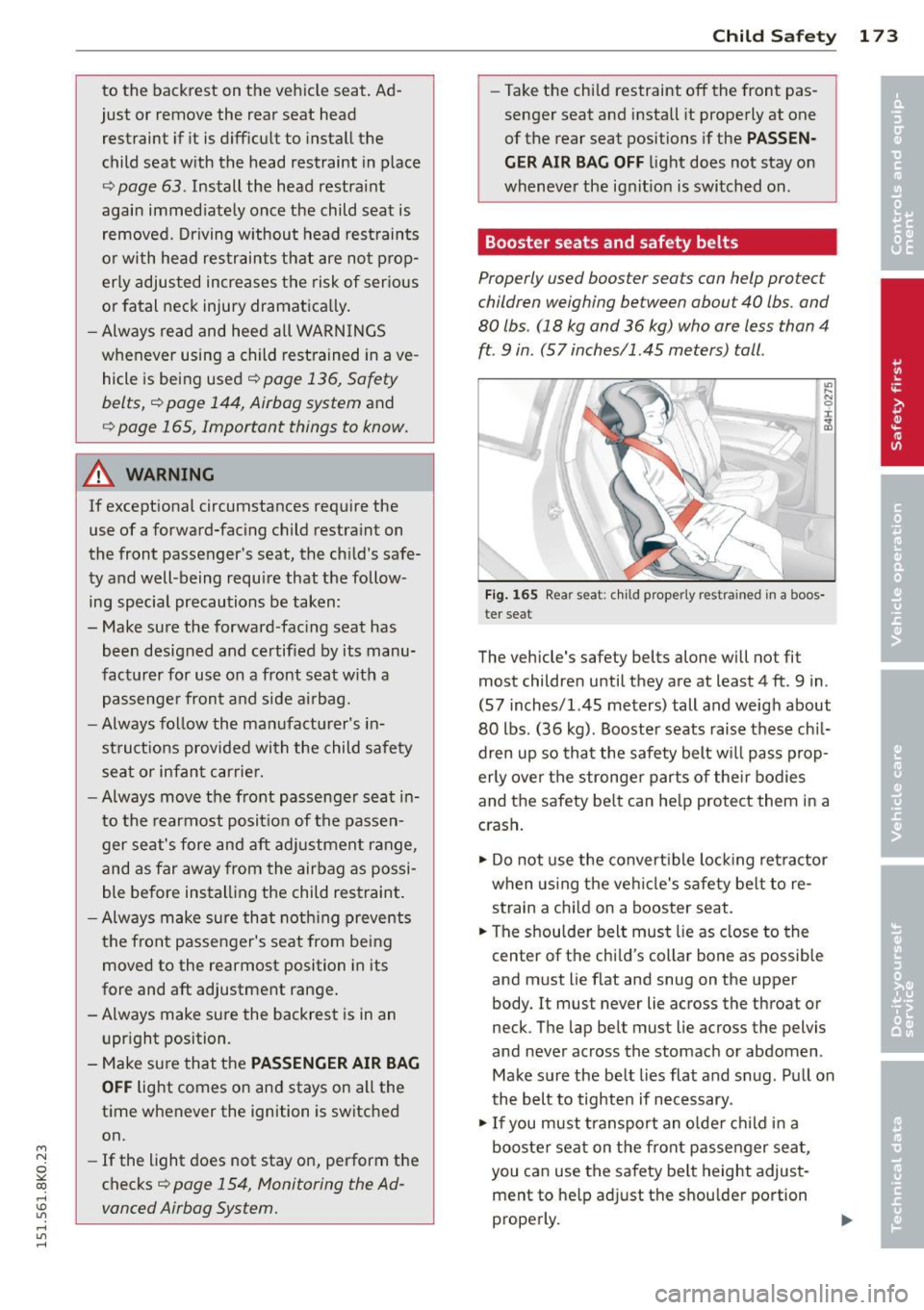
Fig. 165 Rear seat: ch ild properly res trained in a boos
ter seat
The vehicle's safety belts alone will not fit
most children until they are at least 4
ft. 9 in .
(57 inches/1.45 meters) tall and weigh about
80 lbs. (36 kg). Booster seats raise these chil
dren up so that the safety belt will pass prop
erly over the stronger parts of their bodies
and the safety belt can help protect them in a
crash.
.,. Do not use the convertible locking retractor
when using the vehicle's safety belt to re
strain a child on a booster seat.
... The shoulder belt must lie as close to the
center of the child's collar bone as possible
and must lie flat and snug on the upper
body. It must never lie across the throat or
neck . The lap belt must lie across the pelvis
and never across the stomach or abdomen .
Make sure the belt lies flat and snug. Pull on
the belt to tighten if necessary.
.,. If you must transport an older child in a
booster seat on the front passenger seat,
you can use the safety belt height adjust
ment to help adjust the shoulder portion
properly.
Page 176 of 304
174 Child Saf ety
• Secure unused safety belts on the rear seat
9 page 170 .
Children up to about 40 lbs. (18 kg) are best
p rotected in child safety seats designed for
their age and weight . Experts say that the
skeleta l structure, particular ly the pelvis, of
these children is not fully developed, and they must not use the vehicle safety belts without
a suitable ch ild restra int.
It is us ually best to put these children in ap
propriate booster seats. Be sure the booster
seat meets all applicab le safety standards.
Booster seats raise the seating position of the
child and reposition bot h the lap and sho ulder
parts of the safety belt so that they pass
across the child 's body in the right places. The
routing of the belt over the chi ld's body is very
important for the ch ild's protection, whether
or not a booster seat is used . Children age 12
and under must always ride in the rear seat.
Ch ildren who are at least 4
ft . 9 in. (S7 in
ches/1.4S meters) tall can generally use the
vehicle's three po int lap and shoulder be lts .
Neve r use the lap belt portion of the veh icle's
safety be lt alone to restrain any child, regard
l ess of how b ig the child is. Always remembe r
that c hildren do not have the pronounced pe l
vic structure required for the proper function
of lap belt portion of the vehicle's three point
lap and shoulder be lts. The child's safety ab
solutely requires that a lap be lt portion of the
safety belt be fastened snugly and as low as
possib le around the pelvis . Never let the lap
be lt po rtion of the safety belt pass over the
chi ld's stomach or abdomen.
In a crash, airbags must inflate within a blink
of an eye and with cons iderable force . In order
to do its job, the airbag needs room to inflate
so t hat it will be there to p rotect the occupant
as the occupant moves forw ard into the air
bag.
A vehicle occupant who is out of position and
too close to the airbag gets in the way of an
i n flat ing airb ag. When an occupant is too
close, he or she wi ll be str uck violen tly and will
receive se rious or possib ly even fatal in
jury .
In orde r fo r the ai rb ag to offer protect ion, i t is
i mpor tan t t hat a ll vehicle occupants, espe cial
ly any children, who m ust be in the front seat
because of exceptiona l circumstances , be
proper ly restrained and as fa r away from the
airbag as possible . By keeping room between
the child's body and the front of the passen
ger compartment, the airbag can inflate com
pletely and prov ide supplemental protection
in ce rtain frontal collisions .
.&, WARNING
Not using a booste r seat, using the boos
ter seat imp roperly, in co rrectly installing a
boos ter seat or using the vehicle sa fety
belt imp roperly increases the risk of seri
ous persona l injury and death in a collision
or other emergency situat ion. To he lp re
d uce the risk of serio us personal injury
and/or death:
- The shou lder belt must lie as close to the
center of the ch ild's collar bone as possi
b le and must lie flat and snug on the up
per body . It must neve r lie across the
throat or neck . The lap belt must lie
across the pe lvis and neve r ac ross t he
s tomach o r abdomen. Make sure t he belt
liesflat and snug.Pullon thebelt to
tighten if necessary.
- Failure to p roperly ro ute s afe ty belts
over a child's body wi ll ca use seve re inj u
ries in an accident o r other emergency
situation ¢
page 136.
-The rear side o f the child sa fety seat
should be pos itioned as close as possib le
to the backrest on the vehicle seat. Ad
just or remove the rear seat head re straint if it is diffic ult to install the ch ild
seat with the head restraint in p lace
c::;, page 63 . Install t he head rest raint
aga in immediately once the ch ild seat is
removed . D riving without head restraints
or w ith head restra ints th at ar e not prop
erly a djusted increases the risk of serious
.
or fatal neck in jury drama tically . ""