towing AUDI A4 2015 User Guide
[x] Cancel search | Manufacturer: AUDI, Model Year: 2015, Model line: A4, Model: AUDI A4 2015Pages: 304, PDF Size: 74.86 MB
Page 202 of 304

200 Trailer towing
Tire pressure
When towing a trai le r, inflate the tir es of your
vehicle to the cold tire pressure listed under
"Full load" on the label located on the driver 's
side B-pillar (visible when the door is open).
Inflate trailer tires to trailer and tire manufac
turers' specifications.
Lights
The headlight settings should be checked with
the trailer attached before dr iving off. Check
to make sure both vehicle and tra iler lights
are working properly.
Safety chains
Be sure trailer safe ty cha ins are properly con
nected from the trailer to the hitch on the ve
hicle. Leave eno ugh slack in the chains to per
mit turning corners. When you install safety
cha ins, make sure they w ill not drag on the
road when you are driving.
The chains shou ld cross under the trai ler
tongue to prevent it from dropping in case of
separation from the hitch.
Driving instructions
Driving with a trailer always requires extra
care and consideration.
To obtain the best possible handling of vehicle
and trai ler, p lease note the following:
.,. Do not tow a loaded trailer when your car it
self is not loaded .
.,. Be especia lly careful when passing other
vehicles .
.,. Observe speed limits .
.,. Do not drive at the maximum permissible
speed.
.,. Always apply brakes early.
.,. Monitor the temperature gauge.
Weight distribution
Towing a loaded trai ler with an empty car re
sults in a highly unstable distribution of
weight . If this cannot be avo ided, drive at very
low speeds only to avoid the risk of losing
steering control. A "ba
lanced" rig is easier to operate and con
tro l. This means that the tow vehicle should
be loaded to the extent possible and permissi
ble, while keep ing the trai ler as light as possi
ble under the c ircumstances. Whenever poss i
ble, transfer some cargo to the luggage com
partment of the tow veh icle while obse rving
tongue load requi rements and vehicle load ing
considerations.
Speed
The higher the speed, the more d iff icu lt it be
comes for the driver to control the rig. Do not
drive at the maximum permissible speed. Re
duce your speed even more if load, weather or
wind conditions are unfavorable -pa rticularly
whe n going downhill.
Reduce veh icle speed
immediately if the trail
er shows the slightest s ign of sway ing.
Do not
try to stop the swaying by accelerating.
Observe speed limits . In some areas, speeds
for vehicles tow ing tra ilers are lower than for
regular vehicles .
Always apply brakes early. When driving
downh ill, shift into a lower gear to use the en
gine braking effect to slow the vehicle. Use of
the brakes alone can cause them to overheat
and fail.
Coolant temperature
The coolant temperature gauge c> page 10
must be observed carefully . If the needle
moves close to the upper end of the scale, re
duce speed immediately and/or turn off the
air conditioner.
If the coolant temperature warning light •
i n the i nstrument cluster starts flashing, pull
off the road, stop and let the engine
idle for
abo ut two minutes to prevent heat build-up .
_& WARNING
Anyone not properly restrained in a mov
ing vehicle is at a much greater risk in an
accident . Never let anyone ride in your car
who is not p roper ly wea ring the restraints
provided by Audi.
-
Page 203 of 304
Trailer towing tips
Important to know
Your vehicle hand les different ly when tow ing
a trailer because o f the addit ional weight and
d iffe ren t weight distribution . Safety, pe rform
ance and economy w ill greatly depend on how
caref ully you load your trailer and operate
your rig.
B efore you actua lly tow your trailer, pr actice
turning, stopp ing and bac king up in an area
away from traffic. Keep practicing until you have become comp lete ly fam iliar with the way
your veh icle-trailer comb ination behaves and
responds.
Backing up is d ifficu lt a nd requires practice .
Backing up with a tra iler genera lly requires
steer ing action opposite to that when backing
up your vehicle without a trailer.
M aintain a g reater distance betwee n your ve
h icle and the one in front o f you . You will need
mo re room to stop. To compensate for the
trailer, you will need a larger than normal
turning radius .
W hen pass ing, remember that yo u cannot ac
celerate as fast as yo u normally wo uld be
cause of the added load. Ma ke s ure you have
e nough room to pass . After passing , allow
p lenty o f room fo r your tra iler before chang
in g la nes aga in .
Avoid jerky starts, sharp turns or rap id lane
changes.
(D Tips
- Do not tow a tra iler during the break-in
period of you r vehicle.
- If you tow a trailer, your A udi may re
quire more frequent maintenance due to
the extra load
o page 283.
Trailer towin g 201
Parking on a slope
Do not park on a slope with a trailer . If it can
not be avoided, do so only after doing the fol lowing:
When parking:
.. App ly the foot brake.
.. Have someone p lace chocks under both the
veh icle and the tra iler wheels .
.,. With chocks in place, slowly release t he
bra kes unt il t he whee l choc ks absorb the
load .
.. Tu rn the whee ls towards the curb.
.,. App ly the par king b rake .
.. Place an a utomatic transm ission* in P, re
spectively a manual transmission in first or
reverse gear.
When restarting after parking:
.,. App ly th e foot br ake .
.. Start t he en gine.
.. Move the selector lever to D/S , respect ively
a man ual transmiss ion in first gea r.
.. Release the parking bra ke and s low ly pull
out and away from the wheel chocks .
.. Stop and have someone retr ieve the wheel
chocks.
@ Tips
If you move the selector leve r of the auto
matic transmissio n* to P before applying
the pa rking brake and before blocking the
whee ls, you may hav e to use mor e forc e
l ater to m ove the le ver out of the P posi
tion.
•
•
Page 247 of 304
M N
~ co
rl I.O
"' rl
"' rl
shown on the sticker
c=> page 234, fig. 189.
4. The resulting figure equals
the available amount of car go and luggage load capaci
ty. For example, if the
"XXX"
amount equals 1400 lbs.
and there will be five
150
lbs . passengers in your vehi
cle, the amount of available
cargo and luggage load ca
pacity is
650 lbs. (1400-750
(5
X 150) = 650 lbs.)
5. Determine the combined
weight of luggage and cargo being loaded on the vehicle.
That weight may not safely
exceed the available cargo
and luggage load capacity
calculated in Step
4.
6. If your vehicle will be towing
a trailer, load from your trail
er will be transferred to your
vehicle . Consult this manual
to determine how this re
duces the available cargo
and luggage load capacity of
your vehicle .
.,.Check the tire sidewall
{c:> page 248, fig. 193) to de
termine the designated load
rating for a specific tire.
Tires and wheels 245
Tire service life
The service life of tires depends
on a lot of different things in
cluding proper installation and
balancing, correct tire pressure
and driving style.
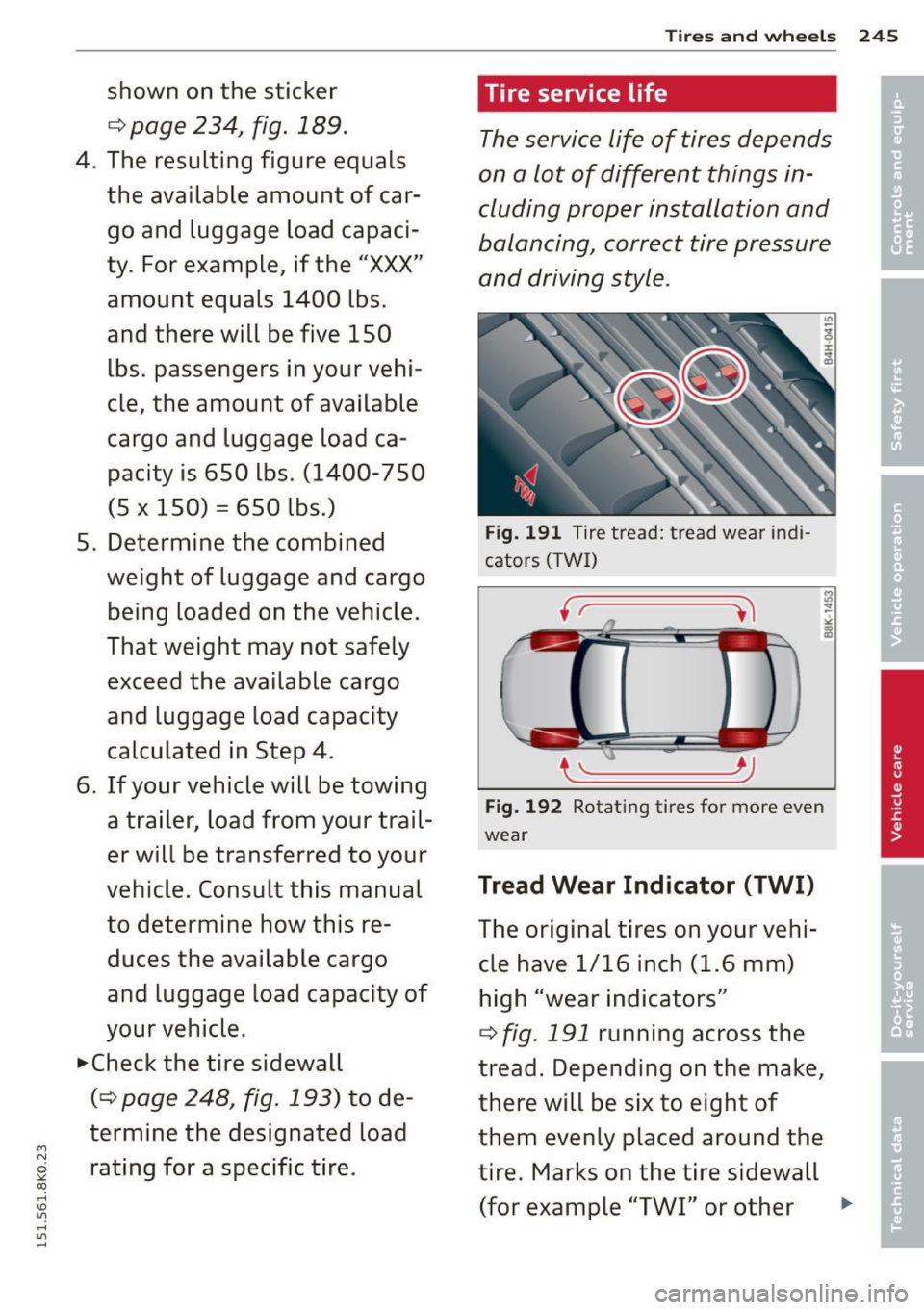
Fig. 191 Tire tread : tread wear indi
cators (TWI)
Fig. 192 Rotating tires for more even
wear
Tread Wear Indicator (TWI)
The original tires on your vehi
cle have
1/16 inch (1.6 mm)
high "wear indicators"
c=> fig. 191 running across the
tread. Depending on the make,
there will be six to eight of
them evenly placed around the
tire. Marks on the tire sidewall (for example "TWI" or other
Page 262 of 304
260 What do I do now ?
What do I do now?
Vehicle tool kit
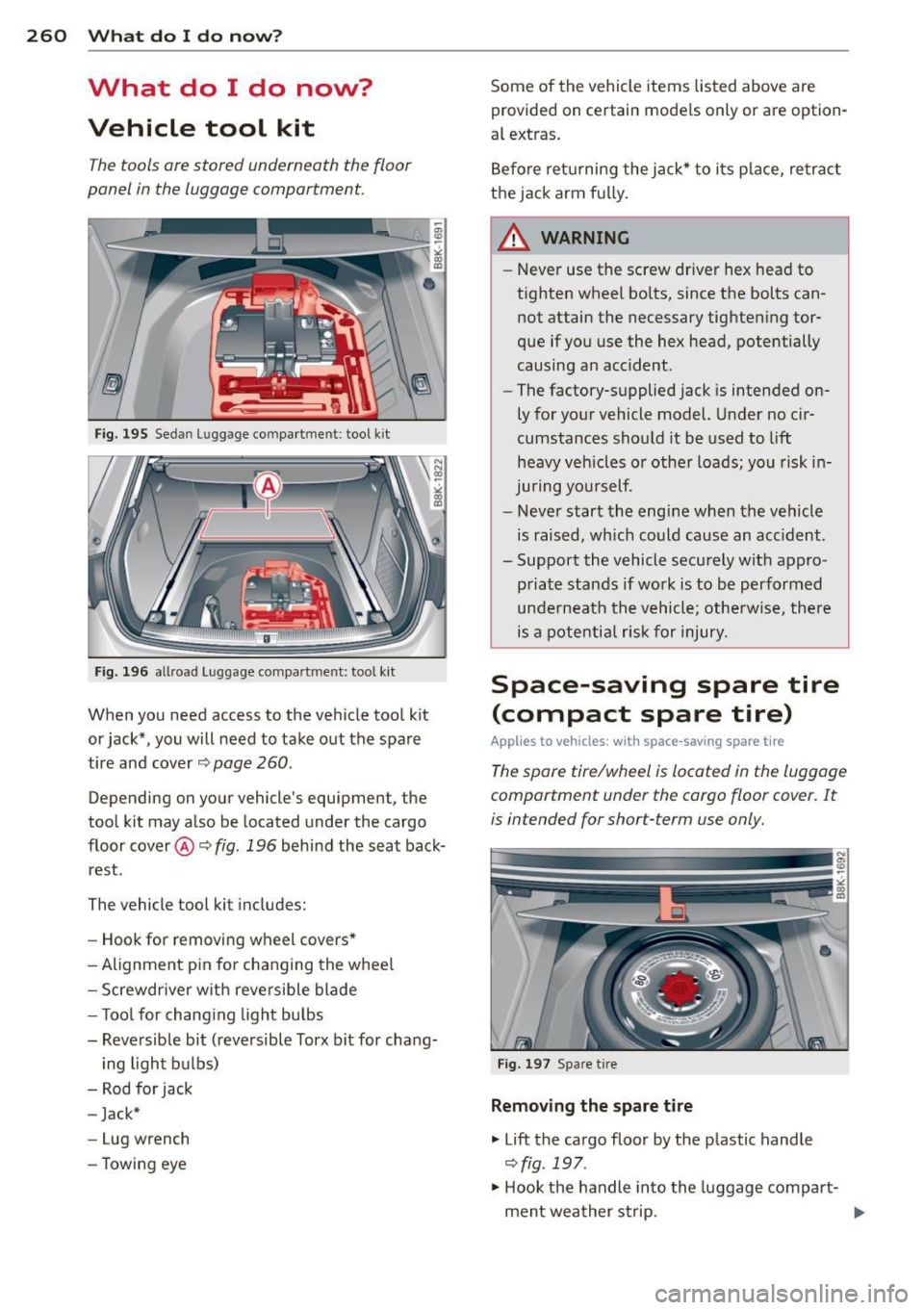
The tools ore stored underneath the floor
panel in the luggage comportment.
Fig. 195 Seda n Lu ggage compart ment : too l kit
Fig. 196 a llroa d Lu ggage compart men t: too l kit
When you need access to the vehicle tool kit
or jack* , you will need to take out the spare
tire and cover
Q page 260 .
Depending on your vehicle's equipment, the
tool kit may also be located under the cargo
floor cover @
Q fig. 196 behind the seat back
rest .
The vehicle tool kit includes:
- Hook for removing wheel covers *
- Alignment pin for changing the wheel
- Screwdriver w ith reversible blade
- T ool for changing light bulbs
- Reversible bit (reversible Torx bit for chang- ing light b ulbs)
- Rod for jack
- Jack*
- Lug wrench
- Towing eye Some of the vehicle items listed above are
provided on certain mode
ls only or are option
al extras.
Before ret urning the jack * to its p lace, re trac t
the jack arm f ully.
A WARNING
-
- Never use the screw driver hex head to
tighten wheel bo lts, since the bolts can
not attain the necessary tightening tor
que if you use the hex head, potentially
causing an acc ident .
- The factory-supplied jack is intended on
ly for your vehicle model. U nder no c ir
cumstances should it be used to lift
heavy veh icles o r othe r loads; you risk in
juring yo urself .
- Never start the engine when the vehicle
is raised, wh ich could cause an acc ident.
- Support the vehicle securely with appro
priate stands if work is to be performed
underneath the vehicle; otherwise, there
is a potentia l risk for injury.
Space-saving spare tire
(compact spare tire)
Appl ies to veh icles : w ith space -sav ing spare tire
The spore tire/wheel is located in the luggage
comportment under the cargo floor cover . It
is intended for shor t-term u se only.
F ig. 197 Spa re ti re
Removing the spar e ti re
., lift the cargo floor by the p lastic handle
Q fig. 197 .
., Hook the handle into the luggage compart
ment wea ther strip.
Page 264 of 304
262 What do I do now ?
• Always store the vehicle tool kit, the jack *
and the replaced tire in the luggage com
partment ¢
page 132.
Stowing the infl atable spare tir e
• Release the air by unscrew ing the va lve
stem.
• Screw the valve stem back in afterwards.
• Wait a few hours before p lacing the wheel in
the spare wheel well¢.&_ .
• Secure the wheel with the large screw.
• Fold the cargo floor back down.
Aft er usi ng th e inflat able sp are wh eel
The inflatable spare tire can be re-used as
long as it is not damaged and is not worn
down to the tread wear indicators¢&. .
When you let the air out of the inflatable
spare tire, it does not assume its folded shape
again for several hours . Until then, it cannot
be p laced back in the spare wheel well and
stowed securely .
A WARNING
-Never use the spare tire if it is damaged
or if it is worn down to the tread wear in
dicators.
- If the inflatable spare tire is more than 6
years old, use it only in an emergency and w ith extreme caut ion and caref ul
dr iv ing .
- The inflatable spare tire is intended only
for temporary and short-term use.
It
should be replaced as soon as possible
with the norma l wheel and tire.
- T he tire pressure value for the inflatable
spare t ire is located on the drive r's side
8 -pilla r
¢page 234, fig. 190.
-Maximum perm iss ible speed is SO mph
(80 km/h).
- Avoid full-throttle acce le rat ion, heavy
braking, and fast corner ing.
- When the air is let out of the inflatable
spare wheel, it does not ass ume its fold
ed shape for severa l hours. Until t hen, it
cannot be p laced back in the spare wheel
we ll and stowed secu rely . -
Never drive with more than one inflata
ble spare tire.
- For technical reasons, the use of tire
chains on the inflatable spare tire is not
perm itted. If it is necessary to drive with
tire chains, the inflatab le spare wheel
must be mounted on the rear axle in the
event of a f lat in a front tire . The newly
availab le rear whee l must then be instal
led in place of the front whee l with the
f lat t ire. Instal ling the tire chain before
mount ing the wheel and tire is recom
mended .
- L oose items in the passenger compart
ment can cause serious personal injury
during hard braking or in an accident.
Never store the inflatable spare tire or
jack* and too ls in the passenger com
partment.
(D Note
- The inflatable spa re tire has been deve l
oped specifically for this vehicle mode l.
It must not be exchanged or used for
other vehicle models. Sim ilarly, inflata
ble t ires from other vehicle models must
not be used.
- Normal summer or w inter tires must not
be installed on the inflatable t ire rim.
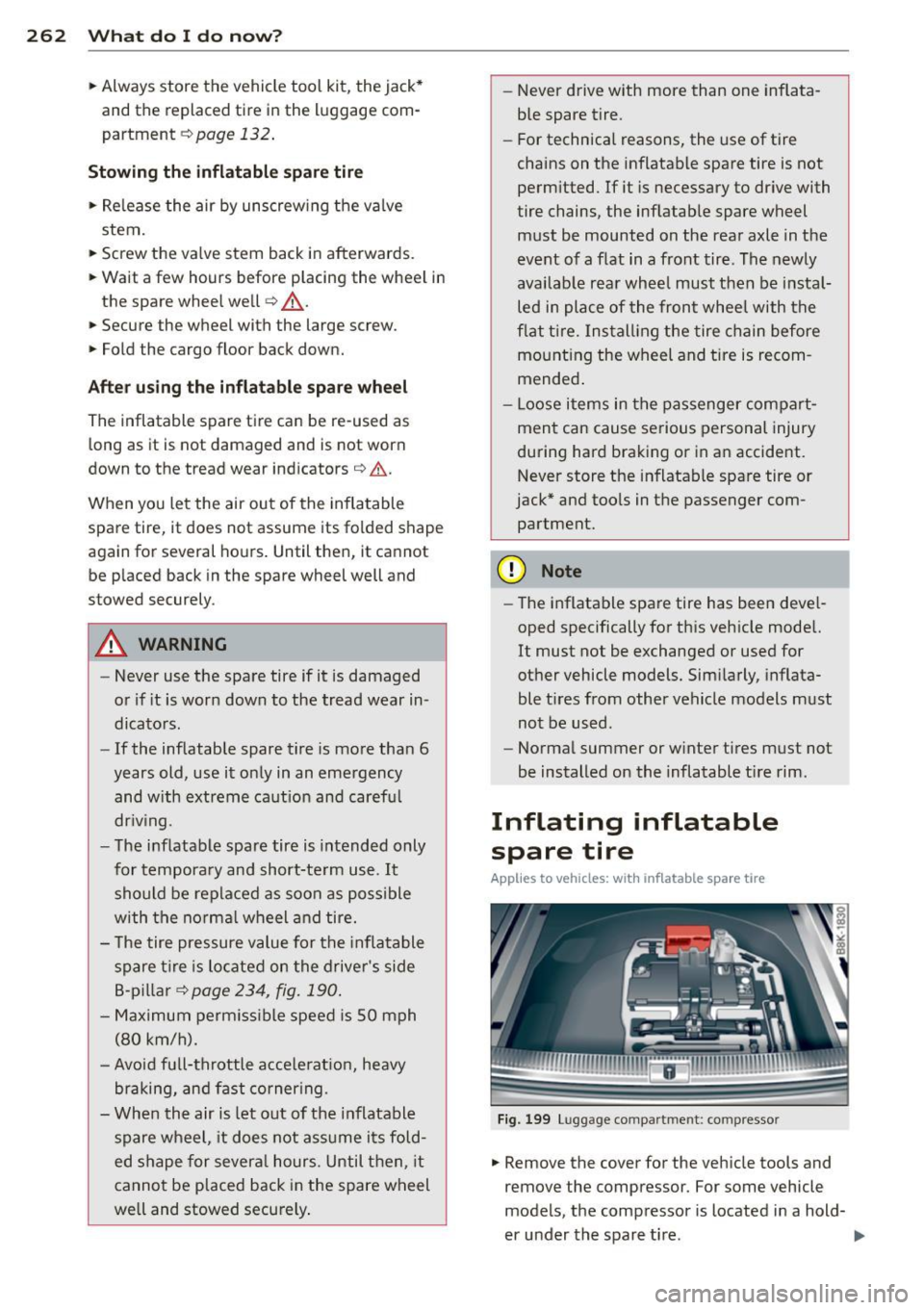
Inflating inflatable
spare tire
Applies to veh icles: w ith inflatable spare t ire
F ig. 199 Lu gg age compart ment: co mpressor
• Remove the cover for the veh icle tools and
remove the compressor. For some vehicle
models, the compressor is located i n a hold-
er under the spare tire . .,.
Page 276 of 304
2 7 4 Emergency situations
Emergency situations
General
This chapter is intended for trained emer
gency crews and working per sonnel who
have the necessary tools and equ ipment to
perform these ope rations.
Starting by pushing or
towing
Q;) Note
Vehicle s with an automati c transmission
cannot be started by pushing or towing .
Starting with jumper
cables
If necessary, the engine can be started by
connecting it to the battery of another vehi
cle.
If the engine should fail to start because of a
discha rged or wea k batte ry, the battery can be
connected to the battery o f
another vehicle,
using a
pair of jumper cables to start the en
g ine .
Jumper cables
Use only jumper cab les of sufficiently
large cross section to carry the starter cur rent
safely. Refer to the manufact urer's spec ifica
ti ons.
Use on ly jumper cables with
insulated te rmi
na l clamps wh ic h are d istinctly mar ked :
plus (+) cable in most c ases co lore d red
minu s (-) cable
in most cases colored black .
A WARNING
Batterie s cont ain e lec tricity, a cid, a nd gas.
A ny o f these c an ca use ve ry ser io us or f atal
in ju ry . F ollow the i nstruc tio ns below for
safe ha ndling of your ve hicle's bat tery.
- Alw ay s sh ield yo ur eye s and a vo id le an
ing over the batte ry w henever p ossib le . -
A discharged battery can freeze at tem
pe rat ures just below 32 °F (0 °C). Before
connecting a jumper cable, you must
thaw the fr ozen battery complete ly , ot h
e rwise it cou ld explode.
- Do not allow batte ry acid to contact eyes
or skin . Fl ush any contacted a rea wi th
wate r im media tely.
- Imp roper use of a booster battery to
s tart a vehicle may cause an explosion.
- Vehicle batter ies generate explosive gas
es . Keep sparks, flame and lighted ciga
rettes away from ba tte ries .
- Do not try to jump start a ny ve hicle w ith
a low ac id leve l in the battery .
- The vo ltage of the booster batte ry m ust
a lso have a 12-Vo lt rat ing . The capacity
(A h) of the booster batte ry should not b e
lowe r than that of the discharged bat
tery . U se o f batt erie s of d iffe ren t voltage
or subs tanti ally diffe ren t "Ah" rat ing
may c ause an exp losion and person al in
ju ry .
- N ever ch arge a fr ozen bat te ry. Gas t rap
ped in the ice may ca use an ex plosion .
- N ever ch arge o r use a batt ery th at has
been fro zen. T he battery case may have
be weakened.
- Us e of batt erie s of di ffere nt vo ltag e or
substan tially differen t ca pa city (Ah) rat
i ng may cause an exp losion and injury.
T he capac ity (Ah) of the booster battery
should not be lower than that of the dis
charged batte ry.
- Before you check anything in the engine
compartment, always read and heed a ll
W ARNI NGS¢
page 212.
(D Note
- App lyi ng a hig her voltage booste r bat
tery wi ll cause expens ive damage to sen
sitive e lectronic components, such as
cont ro l units, relays, rad io, etc.
- There must be no electrical contact be twee n the vehicles as otherwise current
co uld already start to f low as soon as t he
posi tive(+) terminals a re con nected . ..,.
Page 278 of 304
2 76 Em ergency sit uat ions
-Jumper cables must be long enough so
that the vehicles do not touch.
- When connecting jumper cables, make
sure that they cannot get caught in any
moving parts in the eng ine compart
ment.
- Do not bend over the batteries - danger of chemical burns!
- The battery ce ll locking screws must be
tightened securely .
- Before you check anything in the engine
compartment, always read and heed all
WARNINGS
9 page 212.
Improper hook-up of jumper cables can ru
in the generator.
- Always connect POSITIVE( +) to POS I
TIVE(+), and NEGATIVE( -) to NEGATIVE
( - ) ground post of the battery manager
control unit.
- Check that a ll screw plugs on the battery
cells are screwed in firmly . If not, tighten
plugs p rior to connecting clamp on nega
tive battery terminal.
- Please note that the procedure for con nect ing a jumper cable as described
above applies spec ifically to the case of
your vehicle being jump started. When
you are giving a jump start to another ve hicle, do
not connect the negat ive( -) ca
ble to the negat ive (-) term inal on the
discharged battery@)
9fig. 212. In
stead, securely connect the negative(- )
cable to e ither a solid metal component
that is firm ly bolted to the engine block
or to the engine block itself. If the bat
tery that is being charged does not vent
to the outside, escaping battery gas
could ignite and explode!
Emergency towing
with commercial tow
truck
General hints
Your Audi requires special handling for tow
ing.
T he following information is to be used by
commercial tow truck operators who know
how to operate their equipment safely.
- Nev er tow your Audi , towing will cau se
damage to the engine and tr an smi ssion .
- Ne ver wrap th e safety chain s or winch ca
ble s around the brak e lines.
- To pre vent unne ce ss ary dam age, your Audi
mus t be tr an sp o rt ed with a flat bed tru ck.
- To load th e vehicle on to th e flat b ed, use
the towing l oop found in t he vehicle to ols
a nd att ach to th e front or rea r a nchor age
c;,page 277 and c;,page 277 .
& WARNING
= -
A vehicle being towed is not safe for pas-
sengers. Never allow anyone to ride in a
vehicle being towed, for any reason.
Page 279 of 304
M N
~ co
rl I.O
"' rl
"' rl
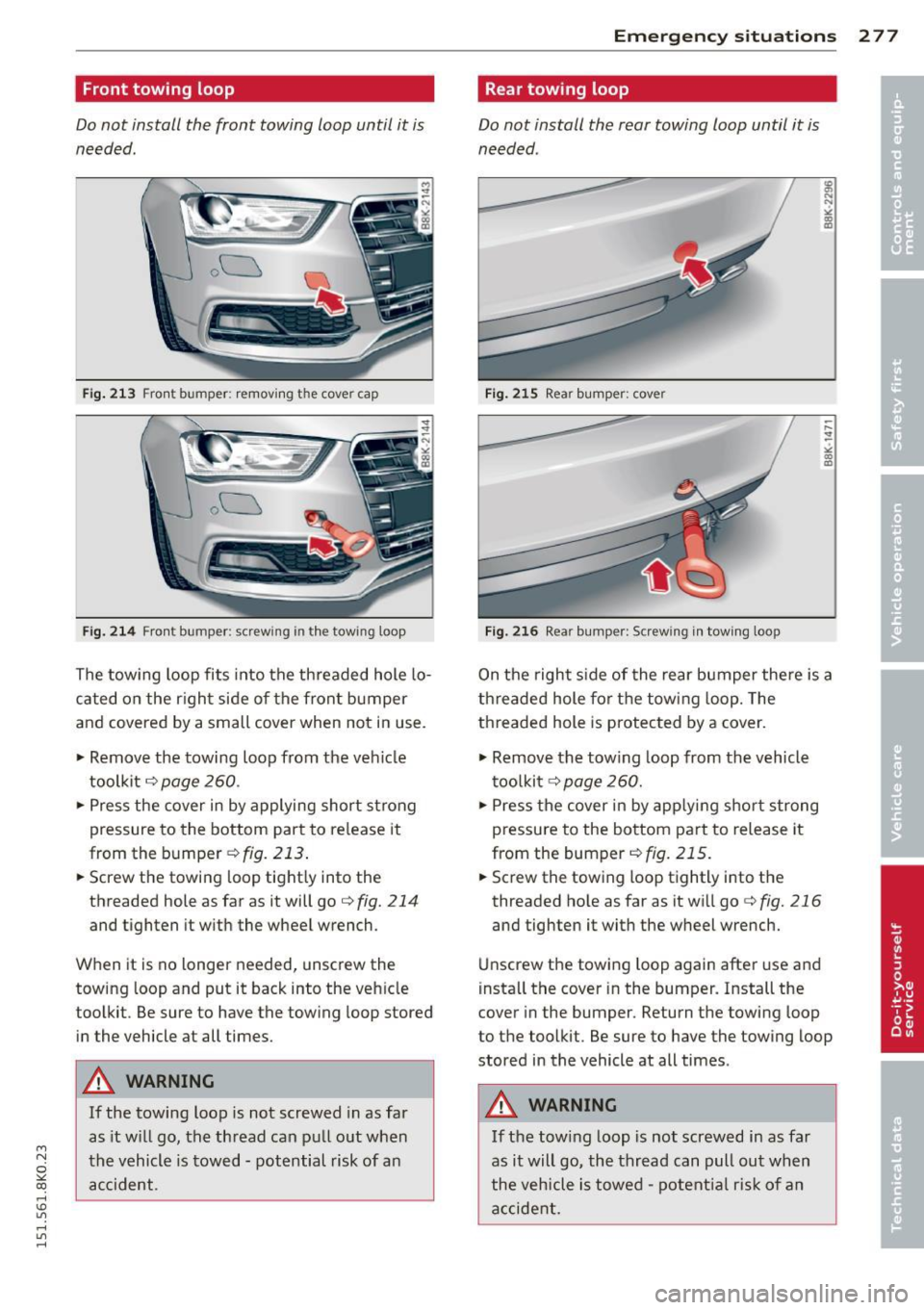
Front towing loop
Do not install the front towing loop until it is
needed.
o u
Fig . 2 13 Fro nt bumper : removing the cover cap
ou
Fi g. 21 4 Front bumper: screwing in the towing loop
The towing loop fits into the th readed hole lo
cated on the righ t side of the fron t bumper
and covered by a small cover when not in use.
"' Remove the towing loop from the vehi cle
toolkit
c:::> page 260.
"' Press the cover in by applying short strong
pressure to the bottom part to release it
from the bumper
c:::>fig. 213.
"'Screw the towing loop tight ly into the
threaded hole as far as it will go
c:::> fig. 214
and tighten it w ith the wheel wrench.
When it is no longer needed, unscrew the
towing loop and put it back into the vehicle
toolkit. Be sure to have the tow ing loop stored
in the vehicle at all times.
A WARNING
If the towing loop is not screwed in as far
as it w ill go, the thread can pull out when
the vehicle is towed - potential risk of an
accident.
-
Emergenc y situ ation s 2 77
Rear towing loop
Do not install the rear towing loop until it is
needed .
Fig . 215 Rear bu mper: cover
Fig. 216 Rear bumper: Screwing in tow ing loop
"' "' N N
"' CD CD
On the right side of the rear bumper there is a
th readed hole for the towing loop. The
threaded hole is protected by a cover.
"' Remove the towing loop from the vehicle
too lki t
c:::> page 260.
"' Press the cover in by app lying shor t strong
pressure to the bottom part to release it
from the bumper
c:::>fig. 215.
"' Screw the towing loop tightly in to the
threaded ho le as far as it wi ll go
c:::> fig. 216
and tighten it with the wheel wrench.
Unscrew the towing loop again after use and
install the cover in the bumper. Install the
cover in the bumper. Return the towing loop
to the toolkit. Be sure to have the towing loop
stored in the vehicle at all times .
A WARNING
-
If the towing loop is not screwed in as far
as it will go, the thread can pull out when
the vehicle is towed -potent ia l ris k of an
a ccide nt.
Page 285 of 304
'"" N
0 ::.,: co ,...., \!) 1.1"1 ,...., 1.1"1 ,....,
Consumer Information
Warranty coverages
Your Audi is covered by the following war
ranties :
- New Vehicle Limited Warranty
- Limited Warranty Against Corrosion Perfo-
ration
- Emissions Control System Warranty
- Emissions Performance Warranty
- California Emissions Control Warranty (USA
vehicles only)
- California Emissions Performance Warranty
(USA vehicles only)
Detailed information regarding yo ur warran
ties can be found in your
Warranty & Mainte
nance booklet .
Operating your vehicle
outside the U.S.A. or
Canada
Government regulations in the United States
and Canada require that automobiles meet
specific emission regulations and safety
standards. Therefore, veh icles built for the
U.S.A. and Canada differ from vehicles sold in
other countries .
I f you p lan to take your vehicle outside the
continental limits of the United States or Can
ada, there is the possibility that:
- unleaded fuels for vehicles with cata lytic
converter may not be available;
- fuel may have a considerably lower octane
rating . Improper fuel may cause engine
damage;
- service may be inadequate due to lack of
proper service facilities, tools or testing
equipment;
- replacement parts may not be readily availa
ble.
- Navigation systems for vehicles built for the
U.S.A. and Canada will not necessari ly work
in Europe, and may not work in other coun
tries outside of North America.
Consumer Information 283
@ Note
Audi cannot be responsible for mechanical
damage that could result from inadequate
fuel, serv ice or parts availab ility.
Audi Service Repair
Manuals and Literature
Audi Offic ial Factory Service Manuals and Lit
erature are published as soon as possible after
model introduct ion. Service manuals and lit
erat ure are available to order from the Audi
T echnical Literature Ordering Center at:
www.audi.techliterature.com
Maintenance
' General
Your vehicle has been designed to help keep
maintenance requirements to a m inimum.
However, a certain amount of regular mainte
nance is still necessary to assure your vehicle's
safety, economy and reliability . For detailed
vehicle maintenance consult your Warranty
&
Maintenance booklet.
Under difficult operating conditions , for ex
ample at extremely low outside temperatures,
in very dusty regions, when towing a trailer
very frequently, etc., some serv ice work
shou ld be pe rformed between the intervals
specified. This applies particularly to:
- oil changes, and
- cleaning or replacing the air filter.
® For the sake of the environment
By regularly maintaining your veh icle, you
help make sure that emission standards
are maintained, thus min imiz ing adverse
effects on the environment .
Important considerations for you and
your vehicle
The increasing use of electronics, sophistica t
ed fuel injection and emission contro l sys-
tems, and the genera lly increasing technica l ..,_
•
•
Page 293 of 304
"" N
0 ::.,: co ,...., \!) 1.1'1 ,...., 1.1'1 ,....,
Index 291
-----------------------------------.......
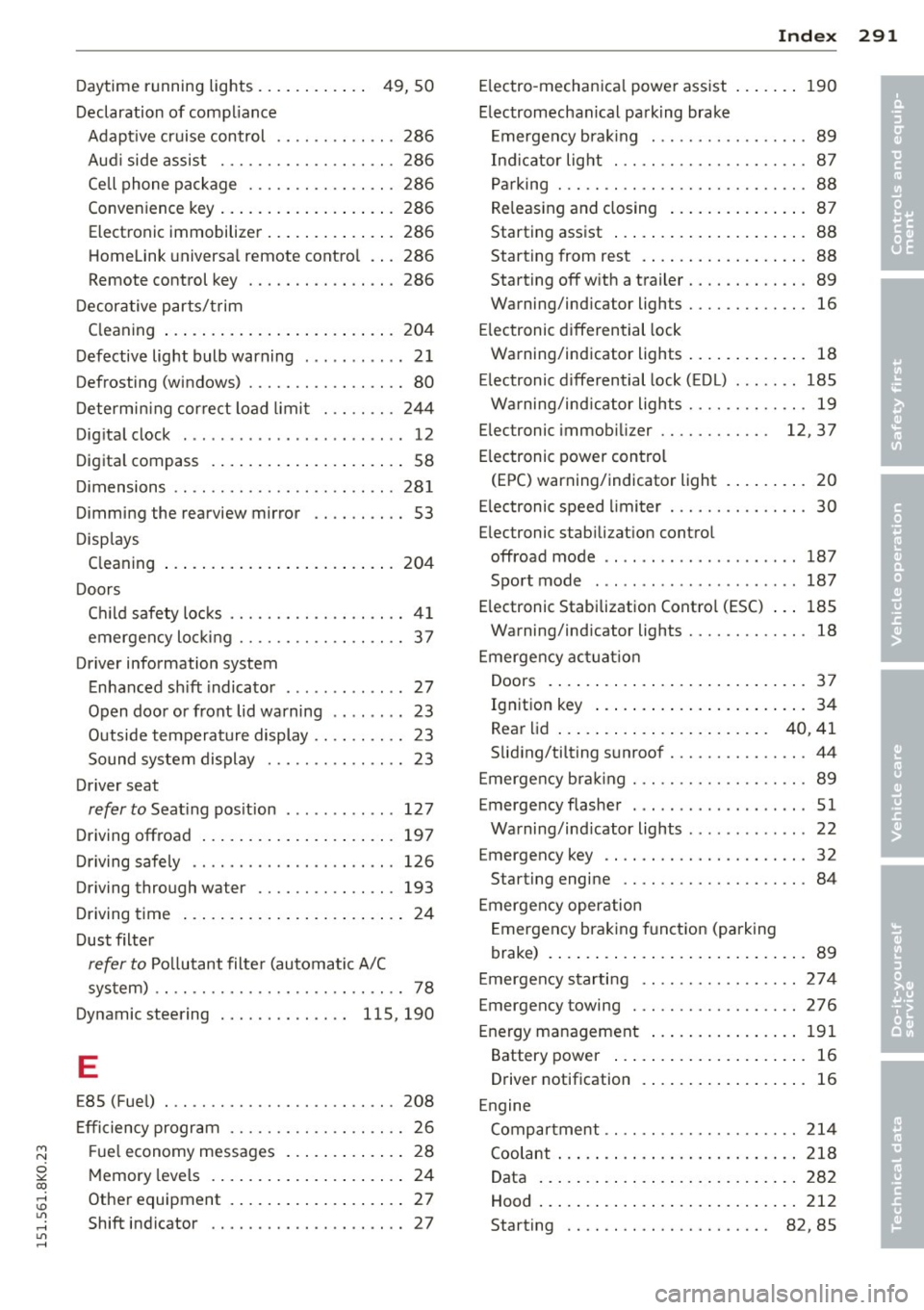
Daytime running lights. . . . . . . . . . . . 49, 50
Declaration of compliance Adapt ive cruise control .... .. .. .. .. . 286
Aud i side assist .......... .. .. .. ... 286
Cell phone pa ckage ....... .. .. .. .. . 286
Conve nience key ... .... ... .. .. .. ... 286
Elect ronic immobilizer .. ... .. .. .. .. . 286
Homelink universa l remote contro l .. . 286
Remote control key ....... .. .. .. .. . 286
D ecora tive parts/ trim
C lean ing ... .... ...... ... .. .. .. ... 204
Defective light bulb warning . . . . . . . . . . . 2 1
Defrosting (windows) ....... .. .. .. .. .. 80
D etermi ning correct load limi t ... .. .. . 24 4
Dig ita l clock ........... ...... .... ... 12
Dig ita l compass . .. ..... ... .. .. .. .... 58
D imensions .. ............. .... .. ... 28 1
Dimming the rearview mirror . . . . . . . . . . 53
D isp lays
C leaning ... .. .... .... ... .. .. .. ... 204
D oors
C hi ld safety loc ks ......... .. .. .. .. .. 41
emergency loc king ........ .. .. .. .. .. 3 7
Driver information system Enhanced sh ift indicato r .... ... ... ... 27
Open doo r or front lid warning . . . . . . . . 23
Outside temperat ure display .. .. .. .. .. 23
Sound system display . . . . . . . . . . . . . . . 23
Driver seat
refer to Seat ing pos ition 127
Driving off road ... ...... ... .. .. .. ... 197
D riving safe ly ............. .... .. ... 126
Driving through water . . . . . . . . . . . . . . . 193
D riving time . . . . . . . . . . . . . . . . . . . . . . . . 24
Dust filter
refer to Po llutant filte r (automatic A/C
system) .. .. ............. .... .. .. .. 78
Dynamic steering . . . . . . . . . . . . . . 115 , 190
E
E85 (Fue l) . .. ............. .... .. ... 208
E ffi ciency program . . . . . . . . . . . . . . . . . . . 26
Fu el economy messages . . . . . . . . . . . . . 28
M emory leve ls . . . . . . . . . . . . . . . . . . . . . 24
Othe r equipment . ..... ... .. .. .. .. .. 27
Shift indicator ........... .. .. .. .... 27 E
lectro -mechan ica l power ass ist ... .. .. 190
E lectromechanical pa rk ing brake
E mergency bra king ................ . 89
Ind icator lig ht . .. .... ........... .. . 87
Parking ... .. .. .. ................. . 88
Re leas ing and closing ... .... ... .. .. . 87
Starting assist ...... .. .. ..... ... .. . 88
Starting from rest . ... .. .... ... .. .. . 88
Starting off w ith a trailer ........ .. .. . 89
Warning/ind icator lights ............. 16
E lectronic differential lock
Warning/indicator lights ..... ... .. .. . 18
El ectronic d ifferential lock ( EDL) ... .. .. 185
Wa rning/ind icator lights ........ .. .. . 19
E lectronic immob ilizer . . . . . . . . . . . . 12, 37
E lectronic power con trol
(EPC) warning/indicator light . . . . . . . . . 20
El ectronic speed limi ter ............... 30
E lectronic stab ilizat ion contro l
offroad mode . . . . . . . . . . . . . . . . . . . . . 187
Sport mode . . . . . . . . . . . . . . . . . . . . . . 187
E lectronic Stabilization Contro l (ESC) ... 185
Warning/ind icator lights ............. 18
Emergency ac tua tion
Doors . ... .. .... ... .. .. ..... ... .. . 37
Ignition key ..... .. . .. .. ..... ... .. . 34
Rea r lid . . . . . . . . . . . . . . . . . . . . . . . 40, 41
Slid ing/ti lting s unroof ............... 44
E merge ncy br aking . .... ......... .. .. . 89
Emergency flasher ..... .. .... .... ... . 51
w . /' d' l' h arnmg m 1cator 19 ts . . . . . . . . . . . . . 22
Emergency key .. ................... . 32
Starting engine ............... .... . 84
Emergency operation Emergency bra king funct ion (parking
brake) . ... .. .... .. . .. .. ..... ... .. . 89
E mergency starti ng ................. 274
Emergency towing .................. 276
Energy management .. .. ..... ... .. .. 191
Battery power ... .. . ... .... ... .. .. . 16
Driver notification . .. .. ..... ... .. .. . 16
En gine
Compartment .. ................... 214
Coolant ... .. .. .... .. ... ..... ... .. 218
Data ... .. .. .... .. . .. .. ..... ... .. 282
Hood ... .. .. .... .. . .. .. ..... ... .. 212
Starting . . . . . . . . . . . . . . . . . . . . . . 82, 85
•
•