brakes AUDI A4 2015 Owner's Manual
[x] Cancel search | Manufacturer: AUDI, Model Year: 2015, Model line: A4, Model: AUDI A4 2015Pages: 304, PDF Size: 74.86 MB
Page 201 of 304
'"" N
0 ::.,: co ,...., \!) ..,.,
,...., ..,., ,....,
Trailer towing Driving with a trailer
General information
Your Audi was designed primarily for passen
ger transportation .
If you plan to tow a tra iler, p lease remember
that the addit ional load will affect durab ility,
economy and performance .
T railer towing not on ly places more stress on
the vehicle, it also calls for more concentra
tion from the driver.
F or this reason, a lways fo llow the operating
and driving instructions provided and use
common sense.
Technical requirements
Traile r hitch
Use a weight-carrying hitch conforming to the
gross trailer we ight. The hitch must be suita
b le for your veh icle and trailer and must be
mounted secure ly on t he veh icle's chassis at a
technically sound location . Use only a t railer
h itch w ith a removab le ball moun t. A lways
check with the tr ailer hitch man ufac tur er to
make sure that you are using the correct
hitch.
Do not use a bumper hitch.
T he hitc h must be installed in such a way that
it does not inte rfe re with the impac t-absorb
i ng b umper syst em. No modifica tions should
be made to the vehicle exhaus t and b rake sys
tems . From t ime to time, check that a ll hitch
mo unt ing bolt s remain securely fas tened.
W hen you are not tow ing a trailer, remove the
trai le r hi tch ball moun t. T h is prevents the
hi tch from causing damage sho uld your ve hi
cle be str uck from be hind
¢ &. .
Trailer brakes
If yo ur tra iler is equ ipped w it h a braking sys
tem, check to be su re that it conforms to a ll
r eg ulat io ns .
Trailer towin g 199
The trailer hyd ra ulic bra ke system must not be
direct ly connected to the vehicle's hydraulic
brake system
¢ &. .
Safety chains
Alw ays use s afety chains between your ve hicle
and t he tra ile r.
Trailer lights
Tra ile r lights m ust meet all reg ulations . Be
su re to check w ith your authorized Audi dealer
fo r c orrec t w iri ng, sw itches, and relays.
Mirrors
If you a re unable to see the traffic behind you
u sing the regula r outside m irrors, then you
must insta ll ext ended mir ro rs. It is important
t h at you
always have clea r vis io n to the rear .
.8, WARNING
- If a trai ler has elec trica l br ake s plea se
no te th at t hese bra kes are not activat ed
by the fa ctory -fit ted control unit -risk of
accident!
- After removing the t railer hi tch, do no t
s to re it in yo ur vehicle . In case of sudden
brak ing, the hitch could fly fo rward and
in ju re you or yo ur passenge rs .
Operating instructions
Maximum traile r we ight
-
A trai ler fo r you r vehicle is limited to a typical
class 1 or class 2 tra iler.
Trailer load distribution
B e sure the lo ad in the tra iler is h eld secure ly
i n p lace to p reven t it from shifting fo rward,
backward or sideways.
Never allow a passenger to ride in a trailer
¢ &. in Driving instru ctions on page 200.
Engine cooling system
T owing a t railer ma kes t he engine wor k hard
er . It is impo rta nt that the cooling system's
perfo rman ce is up to the additional load.
Make sure tha t the coo ling sys tem h as enough
f lu id . .,..
•
•
Page 202 of 304

200 Trailer towing
Tire pressure
When towing a trai le r, inflate the tir es of your
vehicle to the cold tire pressure listed under
"Full load" on the label located on the driver 's
side B-pillar (visible when the door is open).
Inflate trailer tires to trailer and tire manufac
turers' specifications.
Lights
The headlight settings should be checked with
the trailer attached before dr iving off. Check
to make sure both vehicle and tra iler lights
are working properly.
Safety chains
Be sure trailer safe ty cha ins are properly con
nected from the trailer to the hitch on the ve
hicle. Leave eno ugh slack in the chains to per
mit turning corners. When you install safety
cha ins, make sure they w ill not drag on the
road when you are driving.
The chains shou ld cross under the trai ler
tongue to prevent it from dropping in case of
separation from the hitch.
Driving instructions
Driving with a trailer always requires extra
care and consideration.
To obtain the best possible handling of vehicle
and trai ler, p lease note the following:
.,. Do not tow a loaded trailer when your car it
self is not loaded .
.,. Be especia lly careful when passing other
vehicles .
.,. Observe speed limits .
.,. Do not drive at the maximum permissible
speed.
.,. Always apply brakes early.
.,. Monitor the temperature gauge.
Weight distribution
Towing a loaded trai ler with an empty car re
sults in a highly unstable distribution of
weight . If this cannot be avo ided, drive at very
low speeds only to avoid the risk of losing
steering control. A "ba
lanced" rig is easier to operate and con
tro l. This means that the tow vehicle should
be loaded to the extent possible and permissi
ble, while keep ing the trai ler as light as possi
ble under the c ircumstances. Whenever poss i
ble, transfer some cargo to the luggage com
partment of the tow veh icle while obse rving
tongue load requi rements and vehicle load ing
considerations.
Speed
The higher the speed, the more d iff icu lt it be
comes for the driver to control the rig. Do not
drive at the maximum permissible speed. Re
duce your speed even more if load, weather or
wind conditions are unfavorable -pa rticularly
whe n going downhill.
Reduce veh icle speed
immediately if the trail
er shows the slightest s ign of sway ing.
Do not
try to stop the swaying by accelerating.
Observe speed limits . In some areas, speeds
for vehicles tow ing tra ilers are lower than for
regular vehicles .
Always apply brakes early. When driving
downh ill, shift into a lower gear to use the en
gine braking effect to slow the vehicle. Use of
the brakes alone can cause them to overheat
and fail.
Coolant temperature
The coolant temperature gauge c> page 10
must be observed carefully . If the needle
moves close to the upper end of the scale, re
duce speed immediately and/or turn off the
air conditioner.
If the coolant temperature warning light •
i n the i nstrument cluster starts flashing, pull
off the road, stop and let the engine
idle for
abo ut two minutes to prevent heat build-up .
_& WARNING
Anyone not properly restrained in a mov
ing vehicle is at a much greater risk in an
accident . Never let anyone ride in your car
who is not p roper ly wea ring the restraints
provided by Audi.
-
Page 205 of 304
'"" N
0 ::.,: co ,...., \!) 1.1"1 ,...., 1.1"1 ,....,
Vehicl e ca re a nd cl eanin g 203
& WARNING
-Only wash the vehicle when the ignition
is off and follow the instructions from
the car wash operator to reduce the risk
of accidents.
- To reduce the risk of cuts, protect your
self from sharp meta l components when
washing the underbody or the inside of
the wheel housings.
- After washing the vehicle, the braking ef
fect may be delayed due to moisture on
the brake rotors or ice in the winter . The
brakes must be dried first with a few
careful brake applicat ions .
{[) Note
-If you wash the vehicle in an automatic
car wash, you must fold the exterior m ir
rors in to reduce the r isk of damage to
the mirrors . Power folding exterior m ir
ro rs* must only be folded in and out us
i ng the power folding function.
- To prevent pa int damage, do not wash
the veh icle in direct sunl ight. -
To reduce the r isk of damage to the sur
face, do not use insect removing spong es, kitchen sponges or similar items.
- Matte finish painted vehicle compo
nents :
- To reduce the risk of damage to the
surface, do not use polishing agents or hard wax.
- Never use car wash cycles that apply
protective wax.
It can destroy the
matte fi nish effect.
- Do not place any stickers or magnet ic
signs on vehicle parts painted w ith
matte fi nish paint. The paint cou ld be
damaged when the stickers o r magnets
are removed.
@ For the sake of the environment
Only wash the vehi cle in facilities spec ial ly
designed for that purpose . This will red uce
the risk of dirty water contam inated with
oil from entering the sewer system.
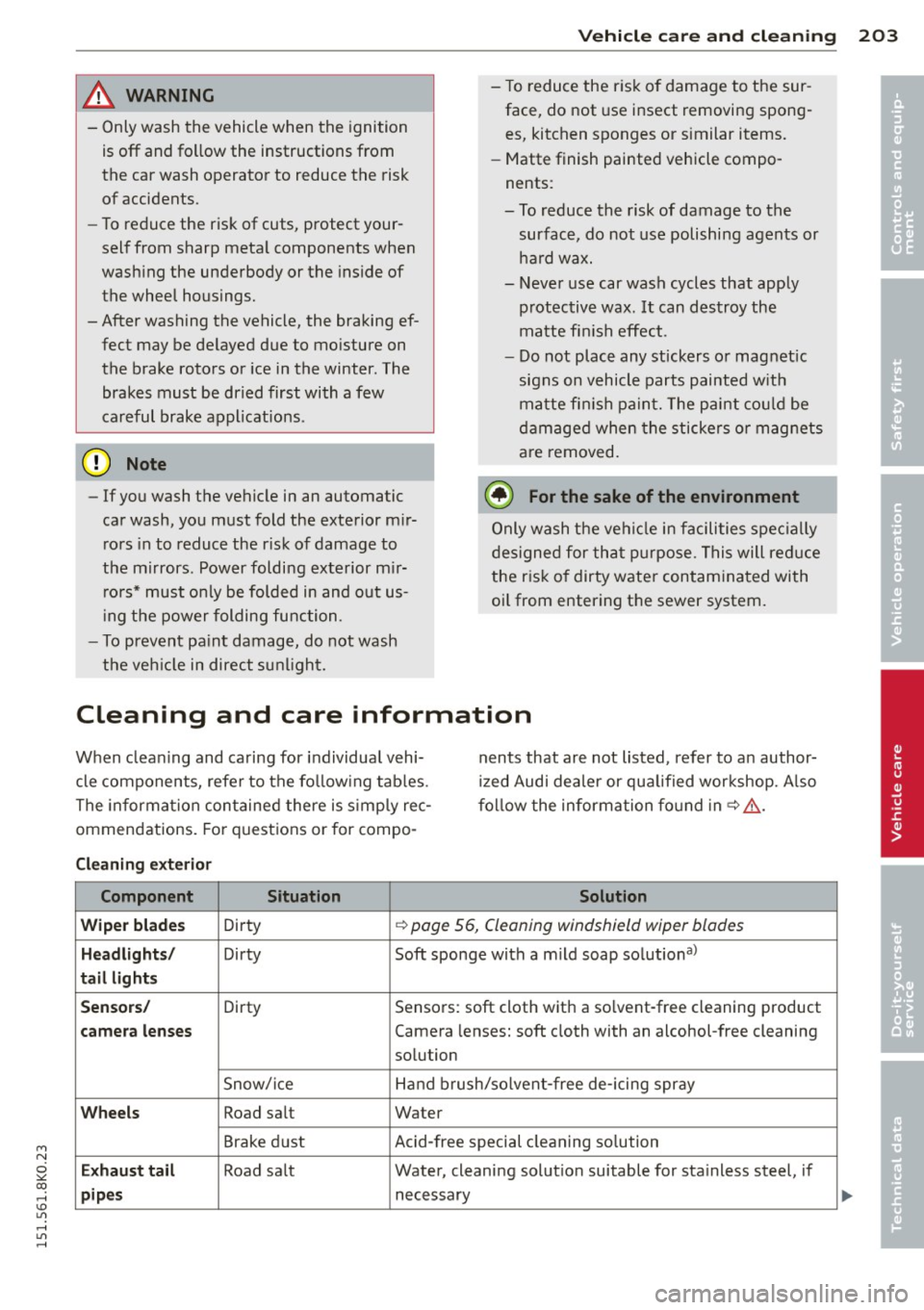
Cleaning and care information
When clean ing and caring for individua l vehi
cle components, refer to the fo llow ing tab les .
The informa tion contained there is s imply rec
ommendations. For questions or for compo- nents that are not listed
, refer to an author
ized Audi dea ler or qua lified workshop. A lso
fol low the information fo und in ¢ ,&. .
Cleanin g exte rior
Component Situation Solution
Wiper blade s
Dirty ¢ page 5 6, Cleaning windshield wiper blades
Hea dlight s/ Dirty Soft sponge with a mild soap solution a>
t a il light s
Sen sors /
Dirty Sensors: soft cloth with a so lvent-free cleaning product
came ra lens es Camera lenses: soft cloth with an alcohol-free cleaning
solution
Snow/ice Hand brush/so
lvent-free de-icing spray
Wheels Road sal t Water
Brake d ust Acid-free special cleaning so
lution
Ex haust tail Road sa lt Water, cleaning solut io n suitable for sta inless steel, if
pipe s necessary
•
•
Page 223 of 304
M N
~ co
rl I.O
"' rl
"' rl
Brake fluid
Checking brake fluid level
The brake fluid level can be checked with a
quick glance.
N
N
;:;;
" 03
"'
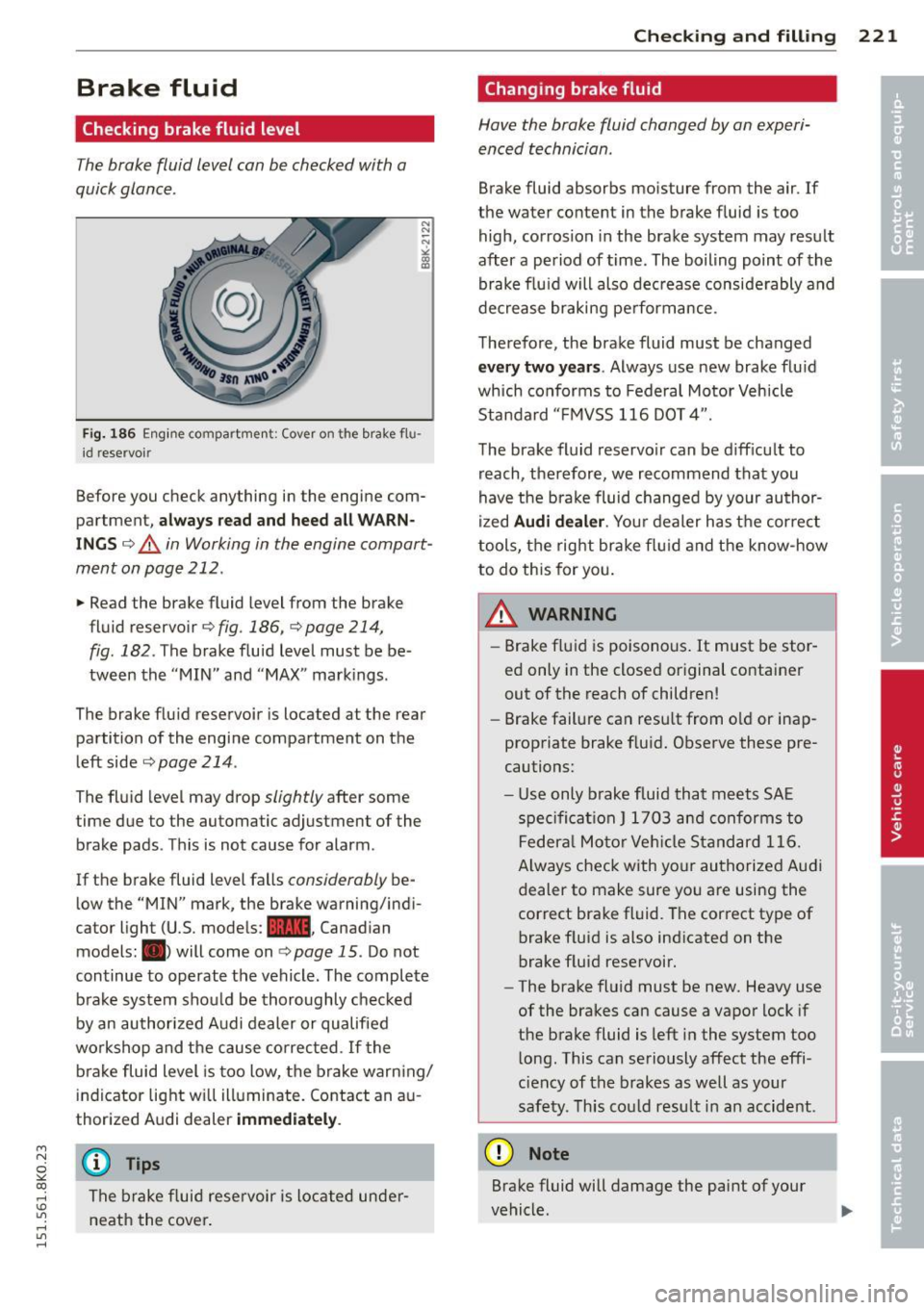
Fi g. 186 Eng ine compartment: Cover on the brake flu
id reservoi r
Before you check anything in the engine com
partment,
a lwa ys read and heed a ll W ARN
ING S c:> .&.. in Working in the engine compart
ment on page 212 .
~ Read the brake fluid level from the brake
fluid reservoir
c:> fig. 186, <=> page 214,
fig . 182.
The brake flu id level must be be
tween the "MIN" and "MAX" markings.
The brake fluid reservoir is located at the rear
partition of the engine compartment on the
left side
<::;> page 214 .
The fluid level may drop slightly after some
time due to the automatic adjustment of the
brake pads . This is not cause for alarm .
If the brake fluid level falls
considerably be
low the "MIN" mark, the brake warning/indi
cator light (U.S. models:~, Canadian
models: .) will come on
r:> page 15. Do not
continue to operate the vehicle. The complete b rake system shou ld be thoroughly checked
by an authorized A udi dealer or qualified
workshop and the cause co rrected . If the
b rake fluid level is too low, the brake warn ing/
indicator light w ill illuminate. Contact an au
thorized Audi dealer
immediately .
@ Tips
The brake f luid reservoir is located under
neath the cover .
Checking and fillin g 221
Changing brake fluid
Have the brake fluid changed by an experi
enced technician.
Brake fluid absorbs moisture from the air. If
the water content in the brake fluid is too
high, corrosion in the brake system may result
after a period of time . The boiling point of the
brake flu id will also dec rease considerably and
decrease braking pe rformance.
Therefore, the brake fluid must be changed
every two years. Always use new brake flu id
which conforms to Federal Motor Vehicle
Standard "F MVSS 116 DOT 4".
The brake fluid reservo ir can be d iff icult to
reach, the refore, we recommend that you
have the brake fluid changed by your author
i zed
Audi d ealer. Your dealer has t he correct
tools, the right brake fl uid and t he know-how
to do this for you .
A WARNING -.
-Brake fluid is poisonous . It must be stor
ed only in the closed original container
out of the reach of children!
- Brake failure can resu lt from o ld or inap
propriate brake f luid. Observe these pre
cautions:
- Use only brake fluid that meets SAE
spe cificat ion
J 1 7 03 and conforms to
Federa l Moto r Ve hicl e Standard 116.
Always check with yo ur authorized Audi
dealer to make sure yo u are using the
correct bra ke fluid. The correct type of
brake f luid is also indicated on the
brake f luid reservoir.
- The brake fluid must be new. Heavy use
of the brakes can cause a vapor lock if
the brake fluid is left in the system too
l ong. This can seriously affect the effi
c iency of the brakes as well as your
safety. Th is cou ld resu lt in an accident.
(D Note
Brake fluid will damage the paint of your
vehicle .
Page 231 of 304
-If you notice unusual vibration or if the vehicle pulls to one side when driving, al
ways stop as soon as it is safe to do so and check the
wheels and tires for dam age.
(D Note
-Please note that summer and winter tires are de
signed for the conditions
that are typical in those sea
sons. Audi recommends using winter tires during the
winter months. Low tem peratures significantly de
crease the elasticity of
summer tires, which affects
traction and braking ability.
Tires and wheels 229
If summer tires are used in
very cold temperatures, cracks can form on the tread bars, resulting in perma
nent tire damage that can
cause loud driving noise and unbalanced tires. Audi is not
responsible for this type of
damage.
-Burnished, polished or chromed rims must not be used in winter road condi
tions. The surface of the
rims does not have suffi
cient corrosion protection
for this and could be perma
nently damaged by road salt
or similar substances.
•
•
'
Glossary of tire and loading terminology
Accessory weight
means the combined weight (in
excess of those standard items
which may be replaced) of auto matic transmission, power
steering, power brakes, power
windows, power seats, radio, and heater, to the extent that
these items are available as fac
tory-installed equipment (whether installed or not).
Aspect ratio
means the ratio of the height to
the width of the tire in percent. Numbers of 55 or lower indi
cate a low sidewall for im proved steering response and
better overall handling on dry
pavement.
Page 233 of 304
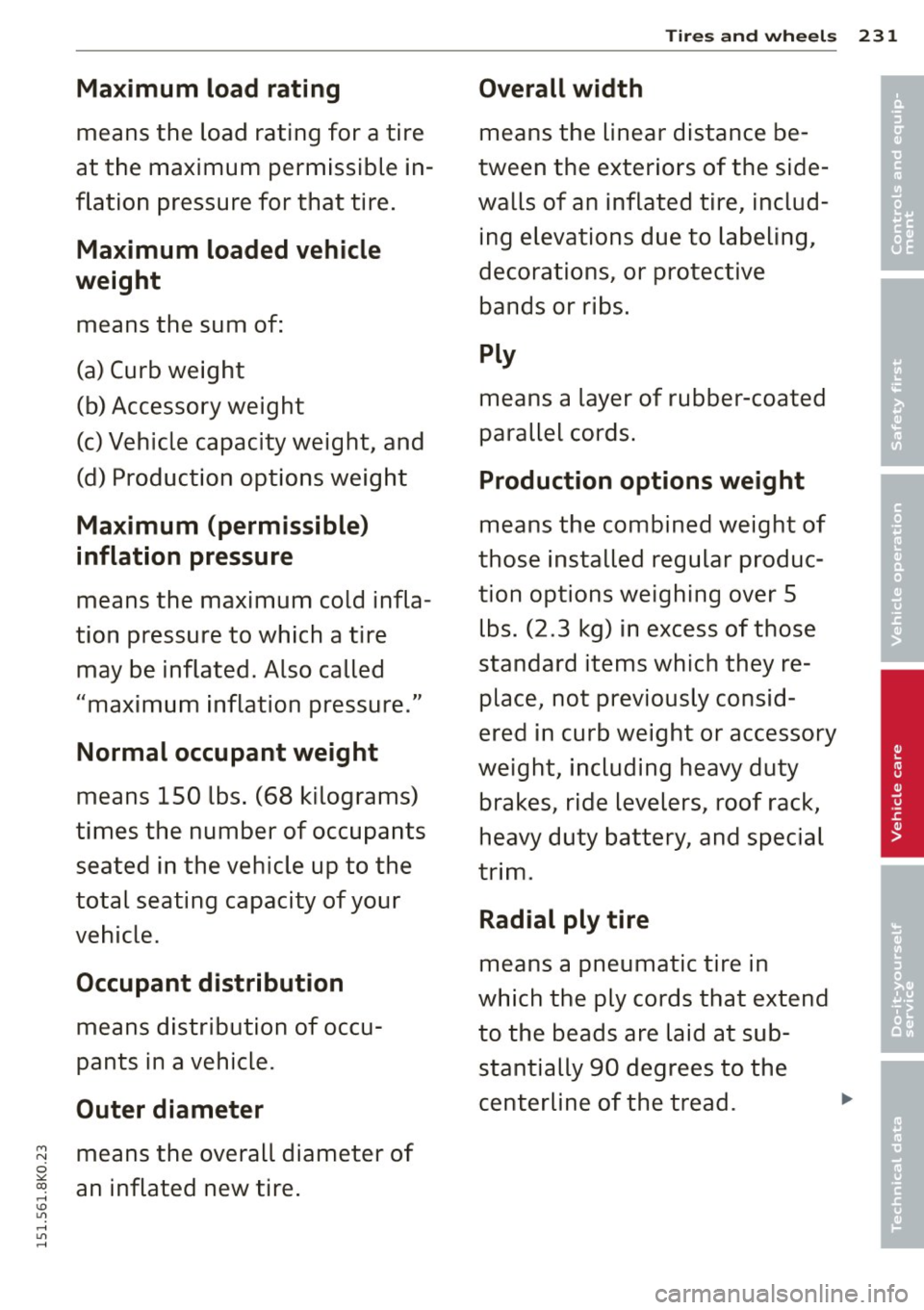
Maximum load rating
means the load rating for a tire
at the maximum permissible in
flation pressure for that tire.
Maximum loaded vehicle
weight
means the sum of:
(a) Curb weight
(b) Accessory weight
(c) Vehicle capacity weight, and
(d) Production options weight
Maximum (permissible)
inflation pressure
means the maximum cold infla
tion pressure to which a tire
may be inflated. Also called
"maximum inflation pressure."
Normal occupant weight
means 150 lbs. (68 kilograms)
times the number of occupants seated in the vehicle up to the
total seating capacity of your
vehicle.
Occupant distribution
means distribution of occu pants in a vehicle.
Outer diameter
means the overall diameter of
an inflated new tire.
Tires and wheels 231
Overall width
means the linear distance be
tween the exteriors of the side
walls of an inflated tire, includ ing elevations due to labeling,
decorations, or protective bands or ribs.
Ply
means a layer of rubber-coated
parallel cords.
Production options weight
means the combined weight of
those installed regular produc
tion options weighing over 5 lbs. (2 . 3 kg) in excess of those
standard items which they re place, not previously consid
ered in curb weight or accessory
weight, including heavy duty
brakes, ride levelers, roof rack,
heavy duty battery , and special
trim.
Radial ply tire
means a pneumatic tire in
which the ply cords that extend
to the beads are laid at sub stantially 90 degrees to the
centerline of the tread.
•
•
'
Page 240 of 304
238 Tires and wheels
else or you bought the vehicle
with different rims/tires or you bought the vehicle as a previ
ously owned vehicle.
Remember, your safety and
that of your passengers also de
pends on making sure that load
limits are not exceeded. Vehicle
load includes everybody and ev
erything in and on the vehicle.
These load limits are technical
ly referred to as the vehicle's
Gross Vehicle Weight Rating ("GVWR"). The Gross Axle
Weight Rating ("GAWR") is the maximum load that can be ap
plied at each of the vehicle's
two axles . The Gross Vehicle
Weight Rating and the Gross
Axle Weight Rating are listed
on the safety compliance stick
er label located on the driver's
side B-pillar. The tire pressure
label on your Audi lists the
maximum combined weight of
all of the occupants and lug
gage or other cargo that the ve
h icle can carry . For the location
of the tire pressure label
¢fig . 189.
.&_ WARNI NG -
Overloading a vehicle can
cause loss of vehicle control,
a crash or other accident, se
rious personal injury, and
even death.
-Carrying more weight than
your vehicle was designed to carry will prevent the ve
hicle from handling properly
and increase the risk of a
loss of vehicle control.
-The brakes on a vehicle that
has been overloaded may not be able to stop the vehi
cle with in a safe distance .
-Tires on a vehicle that has been overloaded can fail
suddenly causing loss of
control and a crash.
- Always make sure that the
total load being transported
- including the weight of a
trailer hitch and the tongue
weight of a loaded trailer - does not make the vehicle
heavier than the vehicle's
Gross Vehicle Weight Rating.
.&_ WARNI NG
-Incorrect tire pressures
and/or underinflation can
-
Page 246 of 304
244 Tires and whee ls
occupants and luggage or other
cargo that the vehicle can carry .
For the location of the label
¢ page 234, fig . 189 .
A WARNI NG
-~
Overload ing a vehicle can
cause loss of vehicle control,
a crash or other accident, se
rious personal injury, and
even death.
- Carrying more weight than
your vehicle was designed to carry will prevent the vehicle from handling properly
and increase the risk of the
loss of vehicle control.
- The brakes on a vehicle that
has been overloaded may
not be able to stop the vehi
cle within a safe distance.
- Tires on a veh icle that has
been overloaded can fail
suddenly, including a blow
out and sudden deflation,
causing loss of control and a
crash.
- Always make sure that the
total load be ing transported
- including the weight of a
traile r hitch and the tongue
weight of a loaded traile r -
does not make the vehicle heavier than the vehicle's
Gross Vehicle Weight Rat
ing.
Determining correct load
limit
Use the example below to cal
culate the total weigh t of the
passengers and luggage or oth
er th ings that you p lan to trans
port so that you can make sure
that your vehicle w ill not be
overloaded .
Steps for Determining
Correct Load Limit
1. Locate the statement "THE
COMBI NED WEIGH T OF OC
CUPANTS AND CARGO
SHOULD N EVER EXCE ED XXX
KG OR XXX LBS"on your vehi
c le's placard (tire inflation
pressure label)
¢ page 234,
fig . 189 .
2. Determine the combined
weight of the driver and pas
sengers that will be riding in
your vehicle .
3 . Subtract the combined
weight of the driver and pas
sengers from
"XXX" k ilo
grams or
"XXX" pounds
Page 255 of 304
and sudden deflation and loss of control.
-Temperature grades apply to tires that are properly in
flated and not over or un
derinflated.
-For technical reasons it is not always possible to use
wheels from other vehicles_ 1n some cases not even
wheels from the same vehi
cle model.
-If you install wheel trim discs on the vehicle wheels
I
make sure that the air flow
to the brakes is not blocked.
Reduced airflow to the
brakes can them to over
heat, increasing stopping
distances and causing a col lision.
-Run flat tires may only be used on vehicles that were
equipped with them at the
factory. The vehicle must have a chassis designed for
run flat tires and a factory
installed tire pressure moni
toring system* that indi cates a loss of tire pressure.
Incorrect use of run flat
tires can lead to vehicle damage or accidents. Check
Tires and wheels 253
with an authorized Audi dealer or tire specialist to
see if your vehicle can be
equipped with run flat tires.
If run flat tires are used
I
they must be installed on all
four wheels. Mixing tire types is not permitted.
(D Note
-For technical reasons, it is not generally possible to
use the wheel rims from
other vehicles. This can hold
true for wheels of the same
vehicle type.
-If the spare tire is different from the tires that you have mounted on your vehicle
(for example winter tires or
wide profile tires), then use
the spare tire for a short pe riod of time only and drive
with extra care. Replace the
flat tire with the tire match ing the others on your vehi
cle as soon as possible.
-Never drive without the valve stem cap. The valves could get damaged.
I),
•
•
'