fuel AUDI A4 2015 Owner's Manual
[x] Cancel search | Manufacturer: AUDI, Model Year: 2015, Model line: A4, Model: AUDI A4 2015Pages: 304, PDF Size: 74.86 MB
Page 197 of 304
'"" N
0 ::.,: co ,...., \!) 1.1"1 ,...., 1.1"1 ,....,
-Have your vehicle maintained properly
and in accordance with the service rec
ommendations in your Warranty
&
Maintenance booklet.
- Lack of proper maintenance as well as
improper use of the vehicle will impair
the function of the emission control
system and could lead to damage.
@ For the sake of the environment
Even when the Emission Control System is
operating properly, the exhaust gas can
have a sulfur-like exhaust gas smell under
some operating states. This depends on
the sulfur content of the fuel being used .
Using a different brand of fuel may help,
or filling the tank with lead-free super
grade gaso line.
Shutting down vehicle
If you wou ld like your veh icle to remain inop
erat ive for a longer period of time, contact an
Aud i or other specialized dealer. They can ad
vise you on necessary precautions e .g. corro
sion prevention, maintenance and storage. Pay attention to add itional information con
cerning the battery. Refer to¢
page 222.
Operate your vehicle
economically and
minimize pollution
General
Your personal style of driving will determine
the economy of your vehicle , as well as ex
haust and noise levels .
Fuel economy, environmental impact, and
wear on your engine, brakes and tires largely
depend on three factors:
- your persona l driving style
- operating conditions
- technical lim itations
If you anticipate what you need to do next and
drive economically, you can easily cut your
fuel cons umption by 10-15 percent. This sec-
Driving and environment 195
tion wi ll give you some tips on how you can
help the environment and your pocketbook.
(0 Tips
The consumption estimates as published
by ENVIRONMENTAL PROTECTION AGENCY
(EPA) and Transport Canada may not corre
spond to your actual consumption on the
road, which will vary depending upon vehi
cle load and speed, road and weather con
dit ions, trip length, etc.
Drive smoothly and keep a lookout
ahead
Vehicles use the most fuel when they are ac
celerating .
.,. Avo id unnecessary accelerating and brak ing.
Vehicles use the most fue l when they are ac
ce lerat ing. If you anticipate what is going to
happen next, you will need to brake less and,
thus, accelerate less . Let the vehicle coast
whenever possible -for example when you see
that the next traff ic light is red.
Avoid full throttle
Driving at moderate speeds saves fuel and
improves your mileage .
.,. Try and keep well below your car's maximum
speed.
Acce lerating gently reduces fue l consump
tion, eng ine wear, and does not disturb the
environment .
Fuel consumption, exhaust emissions and en
gine noise increase disproportionately at high
speeds. If you drive at approximately three quarters of top speed, fuel consumption will
be reduced by one half. Never drive faster
than the posted speed l imit and weather con
ditions permit.
•
•
Page 198 of 304
196 Driving and en vironm ent
Reducing unnecessary idling
Even when your car is just idling it burns up
fuel .
.,. Shut the engine off when you are not dr iving
the vehicle.
.,. Do not warm up the vehicle by letting the
engine run at idle .
It makes sense to shut
off the engine in traffic
jams, when waiting for trains to pass at ra il
road crossings, or at traff ic lights that have
l ong wa its on red . Turning the engine
off fo r
just 30-40 seconds saves more fue l than is
burned starting the eng ine again .
It takes a long time for the engine to warm up
fu lly when it is running at idle . Howeve r, wear
and nox ious em issions are especially high
when the engine is warming up. So you should
drive away as soon as you start the engine and
avoid running at high rpms while the engine is
still warming up .
(D Note
Do not leave engine idling unattended af
ter starting . If warning lights shou ld come
on to indicate improper operation, they
wou ld go unheeded. Extended idling also
produces heat, which cou ld result in over
heating or other damage to the vehicle or
other property .
Regular maintenance
A badly tuned engine unnecessarily wastes a
lot of fuel .
... Have your vehicle serviced at regular inter-
vals.
By having your vehicle regularly serviced by an
authorized Audi dealer he lps to ensure that it
runs properly and economically . The condition
of your vehicle not only affects its safety and
ab ility to hold its value, it also affects
fu el
con sumpt ion .
Check you r oil ea ch time you fill you r ta nk.
The amount o f oi l used is re lated to engine
load and speed.
It i s normal fo r the oil consump tion of a new
engine to reach its lowest value after a certa in
mileage has been d riven.
You must drive your veh icle about 3,000 m iles
(S,000 kilometers) before you can properly
assess oil consumpt ion.
This also app lies to fue l consumption and en
gine output.
(D Note
- Have your veh icle ma inta ined properly
and in accordance with the service rec
ommendations in your Wa rranty
& Main
t enance boo klet . Lack of p roper ma inte
nance as well as improper use of the ve
hicle will impair the function of the
emission contro l system and cou ld lead
to damage.
- Do not alter or remove any component of
the Emission Control System unless ap
proved by the manufacturer.
-Do not alter or remove any device, such
as heat sh ie lds, switches, ignition w ires,
valves, which are designed to protect
your vehicle's Emission Control System and other important vehicle compo
nents.
Fewer short trips
Fuel consumption will always be relatively
high on short trips .
.,. Try to avoid dr iv ing short distances w ith a
cold engine .
T he engine and cata lytic converter have to
reach their opt imal
operat ing temperature to
reduce fuel consumpt ion and nox ious emis
s ions effectively .
Just after starting, a co ld eng ine in a mid-s ize
car only achieves a fuel economy of 6-8 mi les
per gallon (30-40 l/100 km). After about a
half a mile, fuel economy cl imbs to 12 mpg
(20 l/100 km) . After about
2 .5 miles (4 km), ll>
Page 199 of 304
'"" N
0 ::.,: co ,...., \!) ..,.,
,...., ..,., ,....,
the engine is at its proper operating tempera
ture and fuel economy has reached a normal
level. So you can see that you should avoid
short trips whenever possib le.
The
outside temperature is also critical in this
regard. Your car consumes more fuel in the
winter than in the summer .
allroad: Driving offroad
General information
Applies to vehicles: atlroad
When driving offroad, the funct ions for the
e lectronic stab ilization control (ESC) are ex
panded. The ESC-Offroad-Mode can be activat
ed in driving situations in which a wheel lock
or a differentia l lock function is needed
c::> page 187. In addition, your Audi provides
continuous all wheel drive .
Your Audi is however , not an offroad vehicle.
Never drive the vehicle in terrain which is not
suitable for the vehicle, or which exceeds
your driving skills. Never take any unneces
sary risks!
After driving offroad
-After driving offroad, remove branches and
other debris from the radiator grille, under
body, and wheels. Look especially for objects
(stones) that have been caught in the tire
tread .
- Clean the body and the vehicle underbody
and inspect the vehicle for possible damag
es.
- Clean off the dirty windows, headlights, tail
lights and the license plate.
- Perform a brake test (especially after driving through water).
A WARNING
- Be espec ially aware and attentive when
dr iv ing under diff icult conditions . Dam
ages to the vehicle and injuries may oc
cur when driving at an excess ively high
speed or with incorrect driving maneu
vers.
Driving and environment 197
- Always adjust your speed and handling
to the roads, terrain, traff ic and weather
conditions. Drive especially slow if off road with low visibility.
- Please note that the wheels can spin and
the vehicle can break away when the ESC
Offroad Mode is switched off, especially
when the road is slippery .
- Driving stability is reduced in the ESC
Offroad mode .
® For the sake of the environment
Avoid harming the environment and take
nature into cons ideration.
(D Tips
Only drive where it is allowed and always
stay on the provided roads and paths.
Driver messages
Applies to vehicles : a ll road
There is only one right way to drive in difficult
conditions: slowly and with caution!
When dr iving offroad, observe the following:
... Never drive the vehicle i n terrain which is
not suitab le for the vehicle, or which ex
ceeds your driv ing ski lls. Never take any un
necessary risks!
... Drive slow ly and cautiously!
... Pay attention to the
ground clearance of
your vehicle! This may vary depending on the load and composition of the ground and
the environment. The driver is therefore re
sponsible for deciding whether a veh icle can
handle a specific situation.
... Act ivate the
ESC -Offroad-Mode c::> page 18 7
as needed.
Difficult terrain
Never dr ive in areas that are not familiar to
you and drive slowly when offroad and be pre
pared and expect the unexpected (e.g. pot
holes, boulders, tree stumps, etc.)
To prevent the vehicle from bottoming and avo id damage to the underbody, you should
drive straight across severe bumps in the
IJII>
•
•
Page 206 of 304
204 Vehicle care and cleaning
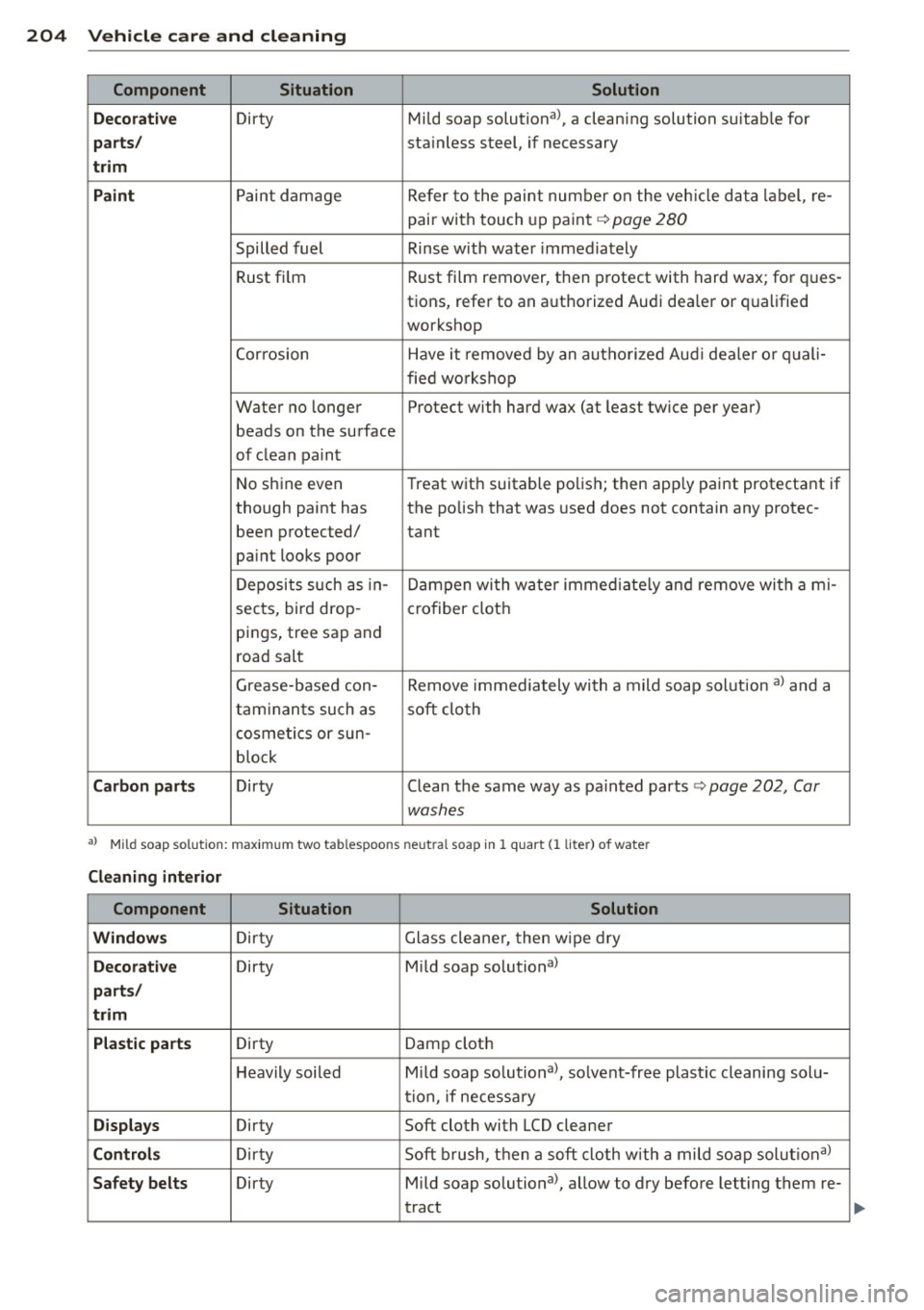
Component Situation Solution
Decorative
Dirty Mild soap solutional, a cleaning solution suitab le for
parts/ sta inless steel, if necessary
trim
Paint
Paint damage Refer to the paint number on the vehicle data label, re-
pair with touch up paint¢
page 280
Spilled fuel Rinse with water immediately
Rust film Rust
film remover, then protect with hard wax; for ques-
tions, refer to an authorized Audi dea ler or qualified
workshop
Corrosion Have it removed by an autho rized Aud i dealer or quali-
fied workshop
Water no longer Protect with hard wax (at least twice per year)
beads on the surface
of clean paint
No shine even T
reat with suitable polish; then app ly paint protectant if
though paint has the polish that was used does not contain any protec-
been protected/
tant
pa int looks poor
Deposits such as in- Dampen with water immed iate ly and remove with a mi-
sects, bird drop- crofiber cloth
pings, tree sap and
road salt
Grease-based con- Remove immediately with a mild soap solution a) and a
taminants such as soft cloth
cosmetics or sun-
block
Carbon parts Dirty Clean tlhe same way as pa inted parts ¢ page 202, Car
washes
a l Mi ld soap so lution: maximum two tab lespoons neut ra l soap in 1 quart (1 lite r) of water
Cleaning interior
Component Situation Solution
Windows
Dirty Glass cleaner, then wipe dry
Decorative Dirty Mild soap solutional
parts/
trim
Plastic parts
Dirty Damp cloth
Heavily soiled Mild soap solutional, solvent-free plast ic cleaning solu-
t ion, if necessary
Displays Dirty Soft cloth with LCD cleaner
Controls Dirty Soft brush, then a soft cloth with a mild soap solutional
Safety belts Dirty Mild soap solutional, allow to dry before letting them re-
tract
Page 209 of 304
'"" N
0 ::.,: co ,...., \!) 1.1'1 ,...., 1.1'1 ,....,
Fuel supply and filling
your f uel tank
Gasoline
Fuel supply
Using the right fuel helps keep the environ
ment clean and prevents engine damage.
Fuel recommendation
The fuel recommended for you r vehicle is un
l e aded premium
g rade gasoline. A udi recom
mends using TOP TIER De tergent Gaso line
w ith a m inimum octane ra ting of 91 A KI (95
RON) . Fo r more informa tion on TOP TIER De
tergent Gasoline, please go to the off ic ial
website (www.toptie rgas .com) .
The re commended gasoline octane rating for
your eng ine can also be fo und o n a label loca t
ed on t he ins ide of the fuel filler flap . This ra t
ing may be specif ied as AKI or RO N.
Your veh icle may also be operated using un
l e aded regular g asoline w ith a min imum o c
tane rating of 87 AKI/91 RO N. However, using
87 AK I/91 RON octa ne fue l w ill sli ghtly re
d uce eng ine perfo rmance .
Use unleaded ga solin e only. Unleaded g aso
line is available th rougho ut the USA, Ca nada,
and i n most E uropean countries . We recom
mend that you do not ta ke yo ur vehicle to
areas or co untries where unleaded gasoline
may not be ava ilable.
F or mo re information on refue ling your ve hi
cle, see~
page 209.
Octane rating
Octane rati ng ind icates a gaso line's abili ty to
r es is t engi ne da maging "knoc k" ca use d by
p remature ign ition and detona tion. Therefore,
buying the correct grade of gaso line is very
i mportant to he lp prevent possible engine
damage and a loss o f engine performance .
Gasoline mos t common ly used in the Unite d
States an d Canada has the following octane
ratings that ca n usually be fo und on the filler
pump :
Fuel supply and filling your fuel tank 207
-Premium Grade: 9 1 -96 AKI
- Regular Grade: 87 -90 AKI
Explanation of the abb reviations :
AKI = Anti Knock Index = (R+ M)/2 = (RO N
+ MON)/2
RON = Research Octane Num ber
MON= Motor Octane Number.
@ Note
- Do not use a ny fue l w ith octane rat ings
lower than 87 AKI or 9 1 RO N othe rwise
expensive engi ne damage w ill occu r.
- Do
not use leaded gasoli ne. The use of
leade d gasoline w ill severely damage
yo ur vehicle's cata ly tic co nve rter and i ts
a bili ty to con trol exh aust emi ssion s.
Blended gasoline
Use of gasoline containing alcohol or
MTBE (methyl tertiary butyl ether )
You may use unleaded gasoline blende d with
alcohol or MTB E (commonly referred to as
oxygenates) if the blended m ixture meets the
fo llow ing criter ia:
Blend of gasoline methanol (wood alcohol or
methyl alcohol )
-Anti -knoc k index mus t be 87 A KI or higher.
- Blend mus t contain no more t han 3% me th -
a nol.
- Blend must contain more than 2% co-sol-
vents.
Blend of gasoline and ethanol (grain alcohol
or ethyl alcohol)
- Anti-knock index must be 87 AKI or higher.
- Blend must not conta in more than 15%
ethanol.
- Ve hicles w ith flexibl e fu el e ngine : blend
m ust not contain more than 85% ethanol.
Blend of gasoline and MTBE
- Anti-knoc k index must be 87 A KI or higher.
- Blend must contain no t mo re tha n 15%
MTBE.
•
•
Page 210 of 304
208 Fuel supply and filling your fuel tank
Seasonally adjusted gasoline
Many gasoline grades are blended to perform
especially well for winter or summer driving. During seasonal change-over, we suggest that
you fill up at busy gas stations where the sea
sonal adjustment is more likely to be made in
time.
CD Note
- Fuels containing a high percentage of
ethanol such as ESO and E85 may only be used in vehicles with flexible fuel en
gines. Using high ethanol fuel in vehicles not equipped with flexible fuel engines
can cause severe engine damage.
- Methanol fuels which do not meet these
requirements may cause corrosion and
damage to plastic and rubber compo
nents in the fuel system.
- Do not use fuels that fail to meet the
specified criteria in this chapter .
- If you are unable to determine whether
or not a particular fuel blend meets the
specifications, ask your service station or
its fuel supplier .
- Do not use fuel for which the contents
cannot be identified.
- Fuel system damage and performance
problems resulting from the use of fuels
different from those specified are not
the responsibility of Audi and are not
covered under the New Vehicle or the
Emission Control System Warranties.
- If you experience a loss of fuel economy
or driveability and performance prob
lems due to the use of one of these fuel
blends, we recommend that you switch
to unblended fuel.
Ethanol fuel (Bio -ethanol)
App lies to vehicles: with flexible fuel e ngi ne
You con recognize vehicles with a flexible fuel
engine by looking at the label on the inside of the fuel filler flap.
Vehicles with flexible fuel engines may be op
erated with bio-ethanol fuels such as E85 (8S% ethanol and
15% gasoline) or with un
leaded gasoline (91 AKI/ROZ 95). The vehicle
may also be operated with a mixture of these
fuels.
Your fuel consumption will increase when us
ing bio-ethanol fuels due to the lower amount
of energy contained per unit volume in etha
nol.
Warming up the flexible fuel engine in low temperatures
Due to the chemical composition of bio-etha
nol, a certain amount of fuel ends up in the
engine oil when driving short distances in very
low temperatures . This fuel evaporates again
when the engine is warmed up.
II Please warm up engine.
If the driver message appears in the instru
ment cluster display, drive with a warm en
gine to reduce the oil level.
CD Note
- Never fill with methanol or with a higher
percentage of bio-ethanol than 85%
(E85). A higher percentage of bio-etha
nol in the fuel can cause damage to the
engine or to the fuel system .
-If you use only E85, it is recommended
to fill the fuel tank completely with un
leaded premium grade gasoline every
5,000 miles .
- If you experience starting, rough idle or
hesitation driveability problems, fill the
fuel tank completely with unleaded pre mium grade gasoline and drive it nor
mally until the gasoline is used. See your
authorized Audi dealer if the problem
persists.
- Inform your authorized Audi dealer that
you are operating or have operated the
vehicle with E85.
- Read and follow the information and tips
about gasoline
c::> page 207. .,.
Page 211 of 304
"" N
0 ::.,: co ,...., \!) 1.1'1 ,...., 1.1'1 ,....,
@ Tips
It may take longer to start the engine
when the outside temperature is very cold.
If possible, use winterized fuel if tempera
tures are below freezing.
Gasoline additives
A major concern among many auto manufac
turers is carbon deposit build-up caused by
the type of gasoline you use.
Although gasoline grades differ from one manufacturer to another, they have certain
things in common. All gasoline grades contain
substances that can cause deposits to collect
on vital engine parts, such as fuel injectors
and intake valves. Although most gasoline
brands include additives to keep engine and
fuel systems clean, they are not equally effec
tive.
Aud i recommends using TOP TIER Detergent
Gasoline. For more information on TOP TIE R
Detergent Gasoline, please go to the officia l
website (www.toptiergas .com) .
Afte r an extended pe riod of using inadequate
fuels, built-up carbon deposits can rob your
engine of peak performance.
CD Note
- Damage or malfunction due to poor fuel
quality is not covered by the Audi New
Vehicle Limited Warranty.
- Do not add aftermarket fuel additive
products to your fuel tank.
Fuel tank
Fuel filler neck
The fuel filler neck is located on the r ight rear
side panel behind the fuel filler flap.
If the power locking system should fail, you
can sti ll open the flap manually - for detailed
instructions see
c:> page 211.
You can find the fue l tank capacity of your ve
hicle in
c:> page281.
Fuel supply and filling your fuel tank 209
The label on the inside of the fuel fi lier f lap
te lls you the correct fue l for your vehicle. For
more information about fuel specifications,
see
c:> page 207.
Your vehicle fue l tank has an on -board refue l
ling vapor recovery system. This feature helps
to prevent fuel vapors from escaping from the
tank and polluting the environment while you
refuel your vehicle. In order to fill the tank
proper ly while protecting the environment,
please follow this refueling procedure careful
ly.
_&. WARNING
Under normal operating conditions, never
carry additional fuel containers in your car.
Gas canisters and other containers used to
transport fuel can be dangerous. Such con
tainers, fu ll or empty, may leak and could
cause a fire in a collision. If you must
transport fuel to use for your lawn mower,
snow blower, etc., be very careful and al
ways observe local and state laws regard
ing the use, transportation and storage of
such fuel containers. Make certain the con
tainer meets industry standards (ANSI/
ASTM F852 - 86).
CD Note
Never drive your veh icle until the fuel tank
i s completely empty. The irregu la r supply
of fue l can cause misfiring. Gasoline cou ld
enter the exhaust system and damage the
catalytic converter.
•
•
Page 212 of 304
210 Fuel supply and filling your fuel tank
Refuelling
Fig. 176 Right rear vehicle side: Open ing t he fuel filler
flap
F ig. 177 Fu el filler flap with attached fuel cap
When activating the central lock ing, the fuel
fi ller flap is automatically un locked or loc ked.
Refuel the vehicle with the ig nition turned
off.
Taking the fuel cap off
~Turnoff the ignition .
~ Press the left side of the fuel filler flap to
open it
c::> fig. 176 -arrow- .
~ Unscrew fuel cap counter-clockwise and
hang it on the fuel filler flap
~ fig. 177.
Refuelling procedure
~ Insert the fuel nozzle from the gasoline
pump into the fuel filler neck as far as it will
go.
~ Select a medium refuelling rate so that the
nozzle switches off a utomatica lly when the
tank is full.
Putting the fuel cap back on
~ After filling your tank, tw ist the fuel cap
clockwise as far as it will go.
~ Close the fuel filler flap. T
o avoid fuel spilling or evaporating from the
fuel tank always close fuel cap properly and
completely .
A WARNING
-Im proper refueling or handling of fuel can
cause fire, explosion and severe burns.
- Fuel is highly flammable and can cause
severe burns and other injuries.
- Failure to shut the engine off while refu
eling and/or to insert the pump nozzle
fully into the fuel filler neck could cause
fuel to spray out of filler neck or to over
flow. Fuel spray and overflowing fuel can cause a fire .
- Never use a cellular telephone while re
fueling. The electromagnet ic rad iat ion
can cause sparks that can ignite fuel va
pors and cause a fire.
- Never get back into your vehicle whi le re
fue ling.
If in exceptional circumstances
you must get back in your vehi cle while
refueling, make ce rtain that you close
the door and touch metal to discharge
static electricity before touching the fill
er nozzle again. Static electricity can
cause sparks that can ignite fuel vapors released during refueling.
- Never smoke or have an open flame any
where in or near your vehicle when refu
eling or filling a portable fuel conta iner.
- For your safety, we strongly recommend
that you do not travel with a portable
fuel conta iner in your vehicle . The con
tainer, full or empty may leak and could
cause a fire, especially in a crash.
- If, u nder exceptional cir cumstances, you
must transport a portable fuel conta iner,
p lease observe the following:
- Never fill a portable fuel container
whi le it is anywhere in or on the vehicle
(for example, in the luggage compart
ment, or on the trunk). Static electrici
ty can build up while filling and can ig
nite fuel vapors causing a fire .
- Always place a portable fue l conta iner
on the ground before filling.
Page 213 of 304
M N
~ co
rl I.O
"' rl
"' rl
-Always keep the f iller nozzle complete
ly inside the portable conta iner before
and during filling.
- If filling a portable container made of
metal, the filler nozz le must always be
in contact with the container. Th is w ill
he lp prevent static electricity from dis
charg ing and cause a fire .
- Never sp ill fuel inside the vehicle or
luggage compartment. Fue l vapors are
h ighly f lammable .
- Always observe local and state/provin cial laws regarding the use, storage
and tra nspo rta tion of fuel containers.
- Make certa in the fuel conta iner meets
industry standards (A NSI
I ASTM
F852-86).
(D Note
If any fuel has spilled onto the car, it
should be removed immediate ly to prevent
damage to the paint.
@ For the sake of the environment
As soon as the correctly operated nozzle
sw itches off automatically for the fi rs t
time, the tank is full. Do not try to add
more f ue l because fuel may spill out. In
add it ion , the expans io n s pace in the fuel
t ank will be fi lled -ca using the fue l to
overflow when it becomes warm and pol
lute the env iro nment.
@ Tips
- Runn ing yo ur engine while re fuelling
may ca use vapors to escape o r even
ca use fue l to spill out of the tank . This
would then shut off the fuel nozzle be
fo re the tank is fu ll.
- Do not refuel your ve hicle w ith the igni
tion t urned on. The fuel gauge may oth
erwise not ind icate the correct fue l level
after refuel ling.
- The fuel filler flap of your vehicle is not locked when you lock the vehicle from
the i nside.
Fu el suppl y and filli ng your fuel t ank 211
Unlocking the fuel filler flap by hand
You can open the fuel filler flap by hand if the
power loc king system should fail .
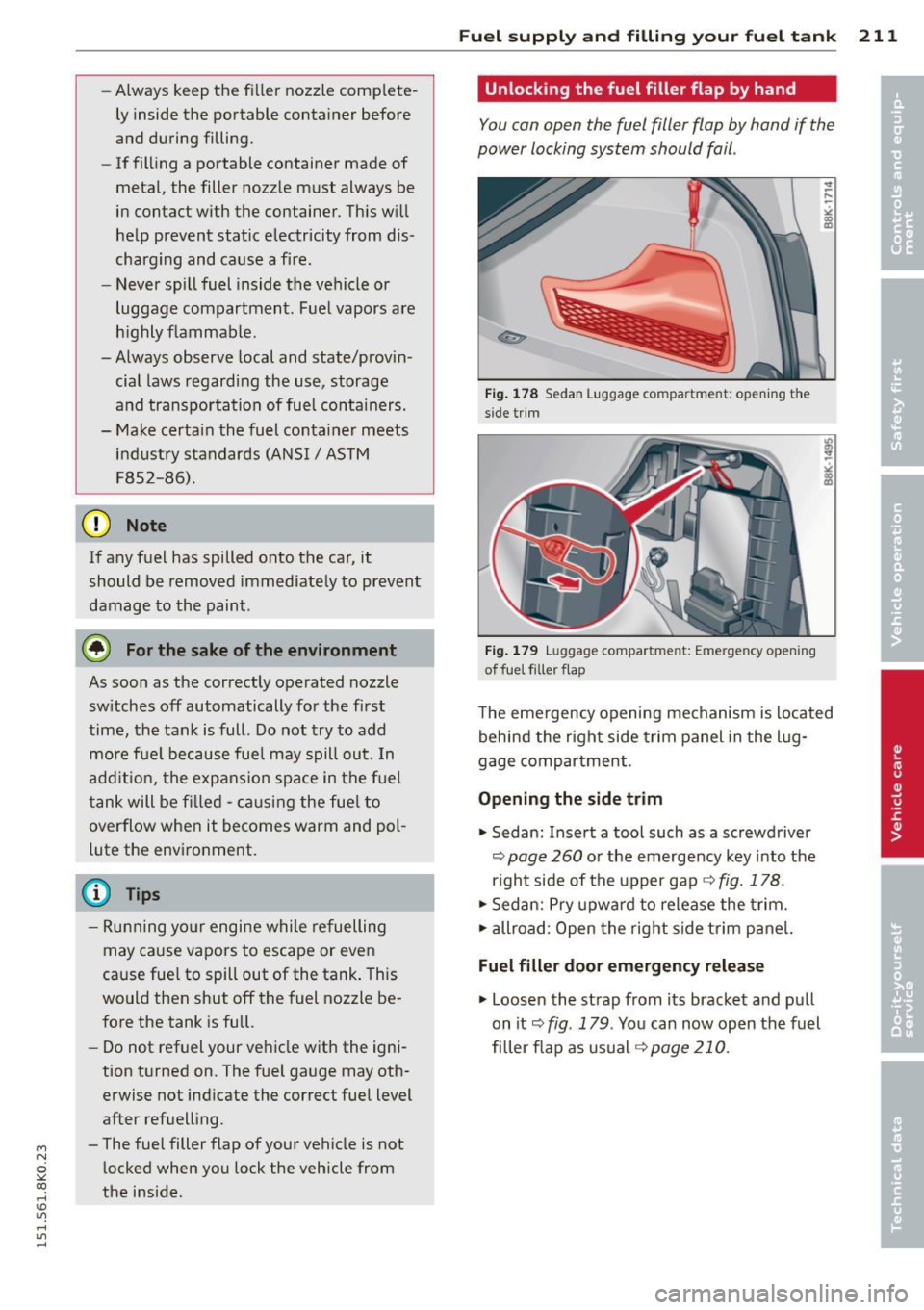
Fig. 1 78 Sedan L uggage compartment: ope ning the
si de t rim
Fig. 17 9 Luggage com partme nt: Eme rge ncy o pen ing
of fue l
fi lier flap
The emergency opening mechanism is located
behind the r ight side trim panel in the l ug
gage comp artment .
Opening the side trim
.,.. Sedan: Insert a tool such as a sc rewdriver
<=:> page 260 o r the emergency key into the
r ight side of the upper gap ¢
fig. 178.
.... Sedan: Pry upwar d to release the trim.
.,.. allroad: Open the rig ht side trim pane l.
Fuel filler door emergency release
.,.. Loosen the st rap from its bracket and p ull
on it
i=:> fig . 179 . You can now op en the fuel
filler flap as usual ¢
page 210.
Page 215 of 304
"" N
0 ::.,: co ,...., \!) ..,.,
,...., ..,., ,....,
-To reduce the r isk of being burned, never
open the hood if you see or hear steam
or coolant escaping from the engine
compartment . Wait until no steam or
coolant can be seen or heard before ca re
fully opening the hood .
- Keep children away from the engine com
partment.
- Never spill flu ids on hot engine compo
nents. They can cause a fire .
- Never touch the radiator fan. The aux ili
ary e lectr ic fan is temperature controlled
and can switch on suddenly .
- Never open the coolant reservoir cap
when the eng ine is still warm . The cool
ant system is pressur ized and hot coo l
ant could spray out.
- Protect your face, hands and arm from
steam or hot eng ine coolant by placing a
thic k rag over the cap when you open the
coolant reservoir.
- Do not remove the engine cover under
any c ircumstances. Th is increases the
risk of bu rns.
- If wo rk on the fuel system or the electri
cal sys tem is ne cessary:
- Always disconnect the battery.
- Never smoke or work near heaters or
open flames . Fluids in the engine com
partment co uld start a fire.
- Keep an approved fire extinguisher im
mediately ava ilable.
- To avoid electrical s hock and persona l in
jury while the engine is running or being
started, never touch:
- Ignition cables
- Other components of the high voltage
electronic ignition system.
- If you must perform a check or repa ir
with the engine running:
- Fir st, fully apply the parking brake,
move se lector lever of a utomatic trans-
Checkin g and fillin g 213
mission to "P" (Park); put manual
transmission in Neutral.
- Always use extreme caution to prevent
clothing, jewe lry, or long hair from get
ting caught in the radiator fan, V-be lts
or other moving parts, or from contact i ng hot parts . Tie back hair before
starting, and do not wear clothing that
will hang o r droop into the engine .
- Minimize exposure to emission and
chemical hazards~&. .
A WARNING
California Proposition 65 Warning:
- Engine exhaust, some of its const ituents,
a nd certain vehicle components contain
or emit chemicals known to the State of
Ca lifornia to cause cance r and birth de
fects and reproductive harm. In addition, certain fl uids contained in veh icles and
certain products of component wear con
tain or emit chemica ls known to the
State of California to cause cancer and
birth defects or other reproductive harm.
- Battery posts, terminals and related ac
cessories conta in lead and lead com
pounds, chemicals known to the State of
California to cause cancer and reproduc
tive harms. Wash hands afte r handling.
Q) Note
When adding f lu ids, always make sure that
they are poured into the proper conta iner
or f iller opening, otherwise serious dam
age to vehicle systems w ill occur .
@ For the sake of the environment
To detect leaks in time, inspect the vehicle
floor pan from underneath regular ly . If
you see spots from oil or other veh icle flu
i ds, have your vehicle inspected by an au
thorized Audi dealer. •
•