fuel AUDI A4 2015 Owner's Guide
[x] Cancel search | Manufacturer: AUDI, Model Year: 2015, Model line: A4, Model: AUDI A4 2015Pages: 304, PDF Size: 74.86 MB
Page 217 of 304
Using the proper engine oil is important for
the functionality and service life of the en
g ine. Your engine was factory -filled with a
h igh-quality oil which can usually be used
t h roughout the entire year.
Your Limited New Vehicle Warranty does not cover damage or ma lf u nctions due to
fa ilure to follow recommended mainte
nance and use requirements as set forth in
the Audi Owner's Manual and Warranty
&
Ma intenance booklet .
- Use only a high quality eng ine oil that ex
pressly complies w ith the Audi o il quality
sta ndard specified for your veh icle's e n
gine . U sing any other oil can cause seri
ous eng ine dam age.
- Do not m ix any l ubrica nts o r othe r addi
tives into the eng ine oi l. Doing so can
ca use eng ine damage.
I f you need to add oil and there is no ne
availab le tha t mee ts the Audi o il qua lity
s t andard your engine requires, yo u may
add a tota l of no more than 0 .5 quart/ liter
of a high -quality "synthetic"oil t hat meets
the following specifications.
- Vehicles with gaso line engine: ACEA A3
or API S M with a viscosity grade of
SAE 0W-30, SAE SW-30 or SA E SW-40.
- For more information abo ut eng ine oil
that has been app roved for your vehicle,
please contact either your a uthori zed
Audi dealer or Audi Customer Relations
at 1 (800) 822 -2834 or visit our web site
at www.a udiusa .com or
www .aud icanada .ca .
Engine oil consumption
The engine in your vehicle depends on an ade
quate amount of oil to lubricate and cool all
of its moving parts.
In order to provide effective lubrication and
cooling of inte rnal engine components, all in-
~ ternal combustion eng ines consume a certai n ,....,
Checking and fillin g 215
amoun t of oil. Oil consumpt ion varies from
engine to engine and may change significantly
over the life of the engine . Typically, engines
with a spec ified break-in period (see
¢
page 193) consume more oil during the
break -in period than they consume after o il
consumption has stabilized .
U nder normal cond itions, the rate of oil con
sumption depends on the quality and viscos ity
of the oil, the RPM (revolutions per minute) at
which the engine is operated, the ambient
temperature and road conditions. Further fac
tors are the amount of oil dilut ion from water
condensa tion or fue l resid ue an d the oxida
t ion level of the o il. As any engine is subject to
wear as mi leage b uilds up, the oil consump
tion may increase over time until replacement
of worn components may become necessary.
With a ll these variab les coming into p lay, no
standard rate of oil consumption can be es
tablished or specified. There is no alternative
to regular and frequent check ing of the o il lev
el, see
Note .
If the yellow engine oil leve l warning symbo l
El in the instrument cl uster lights up, you
sho uld check the oil leve l as soon as possib le
¢
page 216. Top off the oil at your earliest
convenience
¢ page 216.
A WARNING
Before you c heck anythi ng in the engine
compartmen t, always read a nd heed all
WAR NINGS ¢&.
in Working in the engine
c ompar tment on page 212.
(D Note
D riving w it h an insufficient o il level is like
l y to cause sever e damage to the e ngine .
(D Tips
- The oil pressure warning display. is
not an indicator of the oil level. Do not
rely on it. Instead, check the oil level in
your engine at regular intervals , pref
erably ea ch time you r efuel, and alway s
before going on a long trip . .,.
•
•
Page 232 of 304
230 Tires a nd whee ls
Bead Extra load tire
means the part of the tire that means a tire design to operate
is made of steel wires, wrapped at higher loads and at higher
or reinforced by p ly cords and inflation pressures than the
that is shaped to fit the rim . corresponding standard tire .
Bead separation Extra load tires may be identi-
fied as "XL", "xl", " EXTRA
means a breakdown of the bond LOAD", or "RF" on the sidewall.
between components in the
bead .
Gross A xle Weight Rating
(" GAWR ")
Cord
means the load-carrying capaci-
means the strands forming the ty of a single axle system,
p lies in the tire .
measured at the tire-ground in-
Cold tire inflation pressure terfaces.
means the tire pressure recom-
Gross Vehicle Weight Rating
mended by the vehicle manu-( "GVWR ")
facturer for a t ire of a designat-
means the maximum total
ed size that has not been driven loaded weight of the vehicle.
for more than a couple of miles
Groove
(kilometers) at low speeds in
the three hour period before means the space between two
the tire pressure is measured or adjacent tread ribs.
adjusted.
Load rating (code )
Curb weight
means the max imum load that
means the weight of a motor a tire
is rated to carry for a giv-
vehicle with standard equip -en inflation pressure
. You may
ment including the maximum not find th
is information on all
capacity of fuel, oil, and cool- tires because it is not required
ant, air condit ioning and addi- by law.
...
tional weight of optional equip-
ment.
Page 244 of 304
242 Tires and wheels
-Only when all tires on the
vehicle are filled to the cor rect pressure, the tire
pressure monitoring sys
tem* can work correctly.
-The use of incorrect tire
pressure values can lead to
accidents or other damage.
Therefore it is essential that
the driver observe the speci
fied tire pressure values for
the tires and the correct pressures for the function of
the tire pressure monitoring
system*.
-Always inflate tires to the
recommended and correct
tire pressure before driving off.
-Driving with underinflated
tires bend more, letting
them get too hot resulting
in tread separation, sudden
tire failure and loss of con
trol.
-Excessive speed and/over
loading can cause heat
build-up, sudden tire failure
and loss of control.
-If the tire pressure is too
low or too high, the tires
will wear prematurely and the vehicle will not handle
well.
-If the tire is not flat and you
do not have to change a
wheel immediately, drive at
reduced speed to the near
est service station to check
the tire pressure and add air
as required.
(D Note
Driving without valve stem
caps can cause damage to
the tire valves. To prevent
this, always make sure that
factory installed valve stem
caps on all wheels are secure
ly mounted on the valve.
@ For the sake of the environment
Underinflated tires will also
increase the fuel consump
tion.
Tires and vehicle load limits
There are limits to the amount
of load or weight that any vehi
cle and any tire can carry. Ave
hicle that is overloaded will not
handle well and is more diffi
cult to stop. Overloading can not only lead to loss of vehicle
control, but can also damage
important parts of the vehicle
...
Page 245 of 304
Tires and wheels 243
and can lead to sudden tire fail- The Gross Axle Weight Rating •
ure, including a blowout and ("GAWR") is the maximum load • '
sudden
deflation that can cause that can be applied at each of
the vehicle to crash. the vehicle's two axles.
Your safety and that of your The Gross Vehicle Weight Rat- passengers also depends on ing and the Gross Axle Weight
making sure that load limits are Rating are listed on the safety
not exceeded. Vehicle load in- compliance sticker label locat-
eludes everybody and every- ed on the driver's side B-pillar.
thing in and on the vehicle. Your Audi has 5 seating posi-
These load limits are technical- tions, 2 in the front and 3 in the ly referred to as the vehicle's rear for total seating capacity
Gross Vehicle Weight Rating of 5. Each seating position has
("GVWR"). a seat belt¢
page 136~ Safety
The "GVWR" includes the belts.
weight of the basic vehicle, all The fact that there is an upper
factory installed accessories, a limit to your vehicle's Gross Ve-
full tank of fuel, oil, coolant hicle Weight Rating means that
and other fluids plus maximum the total weight of whatever is
load. The maximum load in- being carried in the vehicle (in-
eludes the number of passen- eluding the weight of a trailer
gers that the vehicle is intend- hitch and the tongue weight of
ed to carry ("seating capacity") the loaded trailer) is limited.
with an assumed weight of The more passengers in the ve- 150 lbs. (68 kg) for each pas- hicle or passengers who are
senger at a designated seating heavier than the standard
position and the total weight of weights assumed mean that
any luggage in the vehicle . If less weight can be carried as
you tow a trailer, the weight of luggage. the trailer hitch and the tongue The tire pressure label on your
'"" weight of the loaded trailer N
Audi also lists the maximum 0 ::.,:
must be included as part of the co .... combined weight of all of the \!) 1.1'1
vehicle load . .... 1.1'1 ....
Page 257 of 304
"" N
0 ::.,: co ...... \!) 1.1'1
...... 1.1'1 ......
Your vehicle is equipped with all whee l drive,
this will improve traction during winter driv ing, even with the standard tires. However, we
strongly recommend that you a lways equ ip a ll
four wheels on your veh icle w ith correctly fit
ted wi nte r tires or all -season tires, when w in
ter road conditions are expected. This also im
p roves the vehicle 's braking performance and
reduces stopping distances.
Summer tires provide less grip on ice and
snow .
W inter tire s (snow t ires) must always be fitted
on all four wheels.
Ask your authorized Audi dea ler o r qualified
workshop for permitted
w inter t ire sizes. Use
only radia l winter tires .
Winte r ti res lose thei r effectiveness when the
tread is worn down to a depth of
0 .15 7 inch
(4 mm) .
On ly drive with winter tires under winter con
d itions. Summer tires hand le better when
there is no snow or ice on the roads and the
temperature is above 45
°F (7 °().
If yo u have a flat tire, see notes on spare
wheel ¢ page 248 .
Pl ease always remembe r th at w inte r ti res may
have a lower speed rating tha n the t ires origi
n all y ins talled on your veh icle at the t ime i t
was manufactured . Please see ¢ page 250,
Speed roting (letter code) for a Listing of the
speed rat ing letter codes and the maximum
speed at wh ich the t ires can be driven .
The speed rating letter code( ¢ page 232) is
on the side wall of the tire ¢ page 248.
A WARNING
Winter tires have maximum speed limits
that may be lower than your vehicle's max
imum speed. Always know the maximum
speed befo re driving off . Never drive faster
than the speed permitted for your specific
w inte r tir es . This will cause damage to the
ti res leading to an ac cident and se rious
pe rsonal i njury to you and yo ur p assen
gers .
Tire s an d wheel s 255
A WARNING
Driving faster than the maximum speed
for which the winter tires on your ve hicle
were designed can cause t ire fail ure in
cluding a blowout and sudden deflation,
l oss of cont ro l, crashes and ser ious per
sona l injuries. Have wo rn or damaged ti res
replaced immedia tely.
- Wi nte r tires h ave maxim um speed ra ting
that may be lower than yo ur vehicle 's
maxim um speed.
- Never d rive fas ter than the speed for
whi ch the w inter or othe r ti res installed
on yo ur vehicle are rated.
A WARNING
=
A lways ad just yo ur driving to t he roa d and
traffic conditions. Never let the good ac
celeration of the winter tires and a ll wheel
drive tempt you into taking extra risks. Al
ways remember:
- When braking, an all wheel drive vehicle handles in the same way as a front drive
veh icle.
- Drive carefully and reduce your speed on
icy and slippery roads, even w inter t ires
cannot help under black ice conditions.
@ For the sake of the environment
Use summer tires when weather condi
tions permit. They are qu ieter, do not wear
as quickly and reduce fuel consumpt ion.
Snow chains
-
Snow cha ins may be fitted only to the fro nt
whee ls, and on ly to certain tire sizes . Ask your
autho rized Aud i dea le r o n whi ch tire sizes
snow chains can be used.
The snow chains must have low-p rofile links
and must not be th icker than
0 .53 inch
(13 . 5 mm) , in cl ud ing t he lo ck.
Remove wheel center covers and trim discs
before putt ing snow cha ins on your veh icle
¢ 0 . For safety reasons cover caps must then ..,.
•
•
Page 260 of 304
258 Tires and wheels
Accordingly, when the low tire pressure tell
tale illuminates, you should stop and check
your tires as soon as possible, and inf late
them to the proper pressure. Driving on a sig nificantly under-inflated tire causes the tire to
overheat and can lead to tire failure. Under-in
flation also reduces fuel efficiency and tire
tread life, and may affect the vehicle's han
dling and stopp ing ability.
Please note that the TPMS is not a subst itute
for proper tire maintenance, and it is the driv
er's responsib ility to ma inta in correct tire
pressu re, even if under- inflation has not
reached the level to trigger illumination of the
TPMS low tire pressure telltale.
Your veh icle has also been equ ipped with a
TPMS malfunction indicator to indicate when
the system is not operating properly. The
TPMS malfunction indicator is combined with
the low tire pressure telltale . When the sys
tem detects a malfunction, the te lltale will
f lash for approximately one minute and then
remain cont inuous ly illuminated. This se
quence will continue upon subsequent vehicle
start-ups as long as the ma lfunction ex ists .
When the malfunct ion indicator is illuminat
ed, the system may not be able to detect or
signal low t ire pressure as intended. TPMS
malfunctions may occur for a variety of rea
sons, includ ing the installat ion of replace
ment or a lternate tires or whee ls on the veh i
cle that prevent the TPMS from functioning
p rop erly. Always check the TPM S malf unct ion
tellta le after replacing one o r more t ires or
wheels on your vehicle to ensure that the re p lacement or a lternate tires and wheels allow
the TPMS to continue to function properly. Tire pressure indicator appears
App lies to vehicles : wi th tire p ress ure mo nito rin g system
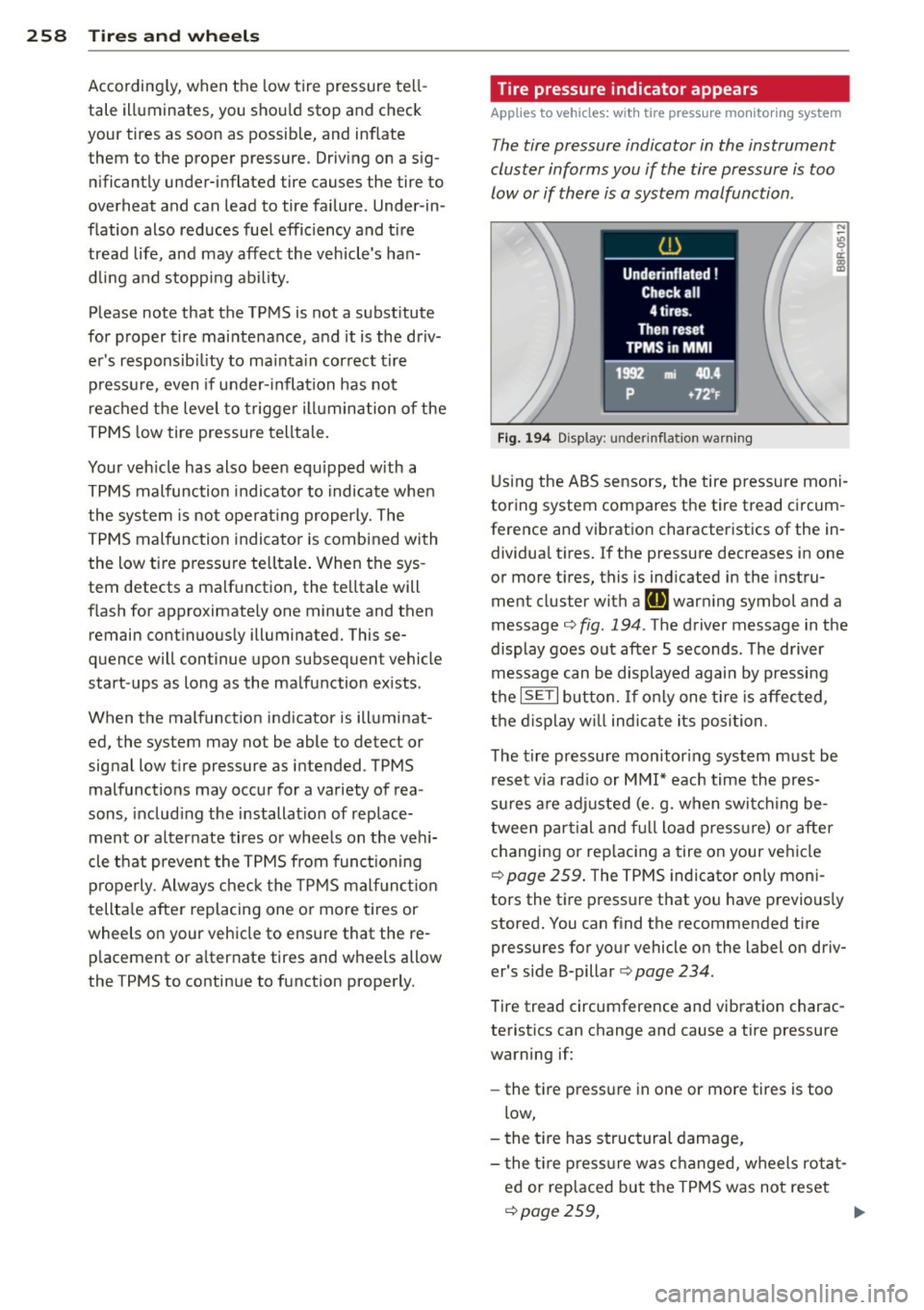
The tire pressure indicator in the instrument
cluster informs you if the tire pressure is too
low or if there is a system malfunction .
Fig. 194 Display: u nde rinfla tion warning
Using the ABS sensors, the tire pressure moni
toring system compares the tire tread circum
ference and vibration characteristics of the in
dividua l tires.
If the pressure decreases in one
or more t ires, this is indicated in the instru
ment cluster with a
RI] war ning symbol and a
message¢
fig . 194 . The driver message in the
display goes out afte r 5 seconds . The driver
message can be displayed again by pressing
the
ISETI button. If o nly one tire is affec ted,
the display will ind icate its position.
The tire pressure monitoring system must be
reset via rad io or MMI* each time the pres
sures are adjusted (e.g. when switching be
tween partial and full load pressure) or after
changing or replacing a tire on your ve hicle
¢
page 259. The TPMS indicator only moni
tors the tire pressure that you have previous ly
stored. You can find the recommended tire
pressures for your vehicle on the label on driv
er's side 8-pillar ¢
page 234.
Tire tread circumference and vibration charac
teristics can change and cause a tire pressure
warning if:
- the tire pressure in one or more tires is too
low,
- the tir e has structural damage,
- the tir e pressure was changed, wheels rotat-
ed or rep laced but the TPMS was not reset
¢page 259, ..,_
Page 272 of 304
2 70 Fuses and bulbs
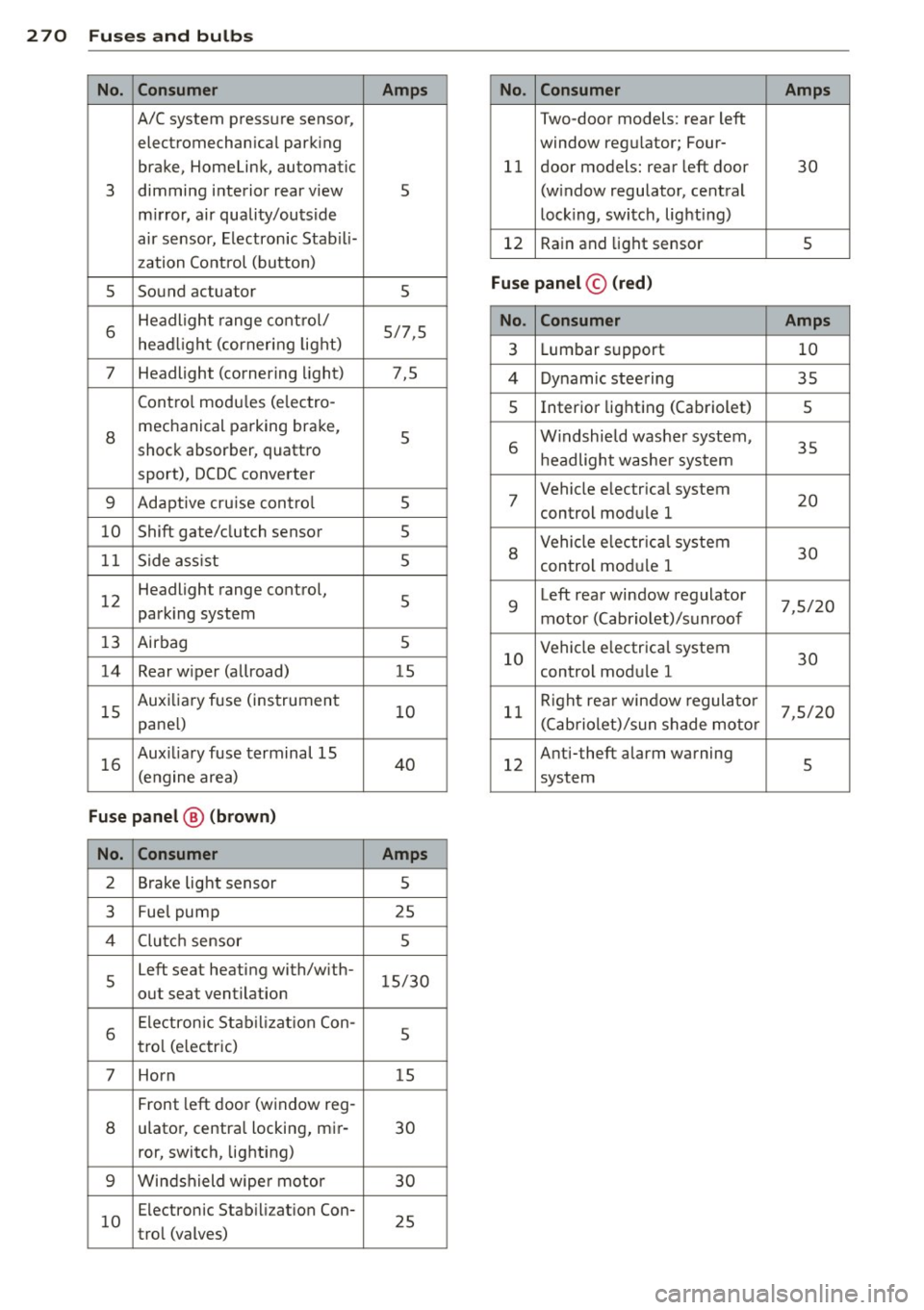
No. Consumer Amps No. Consumer Amps
A/C system pressure sensor, Two-door models: rear left
electromechanical parking window regulator; Four-
brake, Homelink, automatic 11 door models: rear
left door
30
3 dimming interior rear view
5 (window regulator, central
m irror, air quality/outside locking, switch, lighting)
air sensor, Electronic Stab ili-
12 Rain
and light sensor
5
zation Control (button)
5 Sound actuator 5
Fuse panel© (red)
6 Headlight
range control/
5/7,5
head light (corner ing light)
No . Consumer Amps
3 Lumbar support 10
7 Headlight (cornering light) 7,5
4 Dynamic steering
35
Contro l modu les (electro-
5 Interior lighting (Cabriolet)
5
8 mechanical parking brake,
5
shock absorber, quattro
sport), DCDC converter
9 Adaptive cruise control 5 6
W
indshield washer system,
35
headlight washer system
7 Vehicle electrical system
20
control module 1
10 Shift gate/clutch sensor
5
11 Side ass ist 5
8
Vehicle electr ica l system
30
control module 1
12 Headlight range control,
5
parking system 9 Left rear window regulator
7,5/20
motor (Cabriolet)/sunroof
13 Airbag 5
14 Rear wiper (allroad) 15 10
Vehicle e
lectrica l system
30
control module 1
15 Auxiliary fuse (instrument
10
pane l) 11 Right
rear window regulator
7,5/20
(Cabriolet)/sun shade motor
16 Aux
iliary fuse terminal 15
40
(engine area) 12 Anti-theft alarm warning
s system
Fuse panel
@ (brown)
No. Consumer Amps
2 Brake light sensor 5
3 Fuel pump 25
4 Clutch sensor 5
5 Left seat heating with/with-
15/30
out seat ventilation
6 Electronic Stabilization
Con-
5
trol (electric)
7 Horn 15
Front left door (window reg-
8 ulator, centra
I locking, mi r-
30
ror, switch, lighting)
9 Windshield wiper motor 30
10 Electronic Stabi
lization Con-
25
trol (valves)
Page 282 of 304
280 Technical Dat a
Technical Data
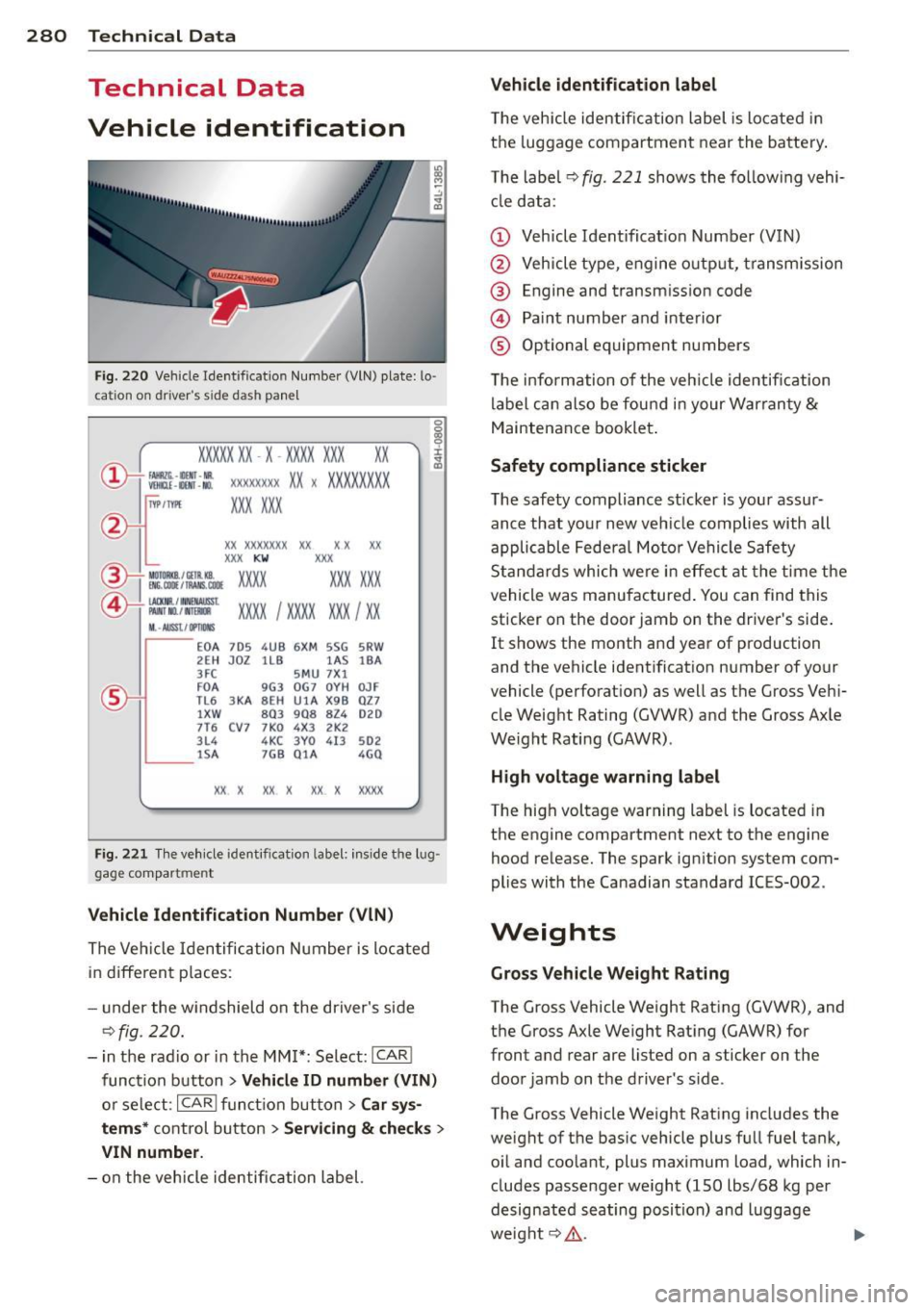
Vehicle identification
F ig. 220 Vehicle I dent ifica tion Num be r (VlN) pla te: lo·
cat ion on driver 's side dash pane l
XXXXX XX · X -XXXX XXX
r,"\__l f~ -11!111 · NII. ~ V!Hlll -llllll . NO.
xx
XXXXXXXX XX X XXXXXXXX
XXX XXX IYP IT'fl'E
XX XXXXXXX XX X X XX
XXX
KW XXX
®i ~~:f :l~~ XXXX XXX XXX
@+ ~~r= XXXX I XXXX XXX I XX M ,. AIIISl./ lflllllS
EOA 7D5 4 UB 6XM SSG 5RW
2E H JDZ llB l AS lBA
3FC 5MU 7Xl
FO A
9G3 OG7 O
YH OJF
TL6 3
KA BEH
UlA X9B QZ 7
l XW
8Q3 9Q8 82 4 020
7T6 CV 7 7KO 4X3 2K2
3L4 4 KC 3YO 4I3 502
lS A 7GB Q1A 4GQ
XX X
XX X XX X XXXX
Fig. 221 Th e ve hicle identi ficat ion labe l: ins ide the lu g
gage compart men t
Vehicle Identification Number (VlN )
The Ve hicle Identific ation Number is located
in different p laces :
- under the w indshield on the dr iver's s ide
~fig . 220.
- in the rad io or in the MM !": Select: I CAR !
func tion button >
Vehicle ID number (VIN)
or se lect: ICAR !f unct ion button> Car sys
tems* control button > Servicing & check s >
VIN number .
-on the veh icle identific ation label.
Vehicle identification label
T he veh icle identification label is lo cate d in
the luggage compartment near the ba ttery .
T he labe l~
fig. 221 shows the fo llowing vehi
cl e dat a:
(D Vehicle Identificat ion Number (VIN)
@ Vehicle type, engine o utp ut, transmission
@ Engine and transm iss ion code
@ Pa int number and inte rior
® Optional equipment numbers
T he information of the veh icle identification
l a bel ca n also be fou nd i n your War ran ty
&
Maintenance booklet .
Safety compliance sticker
The safety compliance sticker is you r assur
ance that yo ur new ve hicle complies with all
applicable Federa l Motor Vehicle Safety
S tan dards which we re in effect at the t ime the
vehicle was manufactured . You can find this
sticker on the door jamb on the driver's side .
It shows the month and year of production
and the vehicle ident ificat ion number of your
vehicle (perforation) as well as th e Gross Veh i
cle Weight Rating (GVWR) and the Gross A xle
Weight Rating (GAWR) .
High vo ltage warning label
The high voltage warning label is located in
the engine compartment next to the engine
hood release. The spark ignition system com
plies with the Ca nadian standard ICES-002 .
Weights
Gross Vehicle Weight Rating
The Gross Vehicle Weight Rating (GVWR), and
the Gross Axle Weight Rat ing (GAWR) for
front and rear are listed on a sticker on the
doo r jamb on the driver 's side .
The Gross Vehicle Weight Rating includes the
weight of the basic vehicle plus fu ll fuel ta nk,
o il and coolant, plus max imum load, which in
cludes passenger weight (150 lbs/68 kg per
designated seating posi tion) and luggage
we ight~ _&.
Page 283 of 304
'"" N
0 ::.,: co ,...., \!) 1.1'1 ,...., 1.1'1 ,....,
Technical Dat a 281
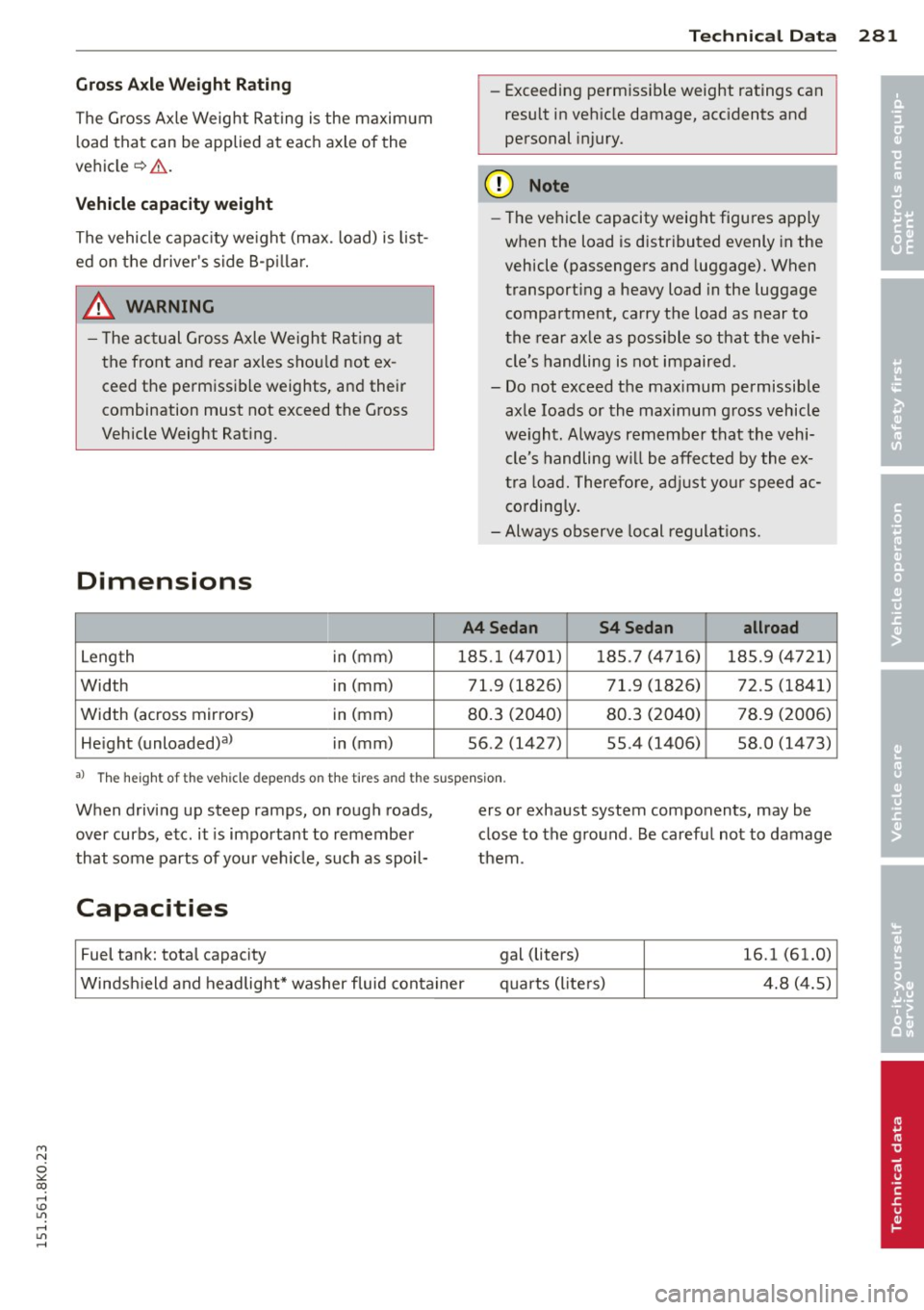
Gros s Axle We ight Rating
The G ross Axle Weight Rating is the maxim um
l oad that can be applied at each axl e of the
vehicle
c::> &. .
Vehicle capacity weight
The vehicle capac ity we ight (max. load) is list
ed on the d river 's side 8-p illar.
_& WARNING
- T he ac tual Gross Axle Weight Rat ing at
t he front and rea r axles sho uld not ex
ceed the perm issible weights, a nd their
combination must not exceed the G ross
Vehicle Weight Rat ing .
Dimensions
Leng th in (mm)
Width in (mm)
Width (across mir rors) in (mm)
He igh t (unloaded) a) in (mm)
-
-Exceeding perm iss ible weight ratings can
resu lt in ve hicle damage, acc idents and
pe rsonal injury.
([) Note
-Th e ve hicl e capacity weig ht figu res app ly
when the load is d istr ibuted evenly in the
vehicle (passengers and luggage). When
transport ing a heavy load in the luggage
compartment , carry the load as near to
t he rear ax le as poss ible so that the vehi
cle's handling is not impaired .
- Do not exceed t he maximum permissible
ax le loads or the maximum g ross vehicl e
we ight. A lways remember that the v ehi
cl e's handling w ill be affe cted by the ex
t ra lo ad. Therefo re, adju st yo ur speed ac
c o rding ly.
- Alway s observe loc al regulat io ns.
A4Sedan
S4Sedan allroad
1
85 .1 (4701) 185.7 ( 47 16 ) 1 85.9 (47 21)
71.9 (1826) 71.9 (1826) 72 .5 (1841)
80.3 (2 040) 80.3 (2 040) 78 .9 (2 006)
56 .2 (1427) 55 .4 (1406) 58 .0 (1473)
a l T he heig h t of t he ve hicle depe nds on t he tir es and the s usp en sion .
When drivi ng up steep ramps , on rough roads,
over curbs, etc. it is impo rtant to r emembe r
that some parts of your ve hicle, such as spoil-
Capacities
Fuel tank: total capacity
Winds hield and headligh t* washer fluid con ta iner ers o
r exhaust system components, may be
close to the g ro und . Be carefu l not to damage
them .
gal (liters) 16.1 (61.0)
quarts (lite rs) 4 .8 ( 4.5)
•
•
Page 284 of 304
282 Technical Dat a
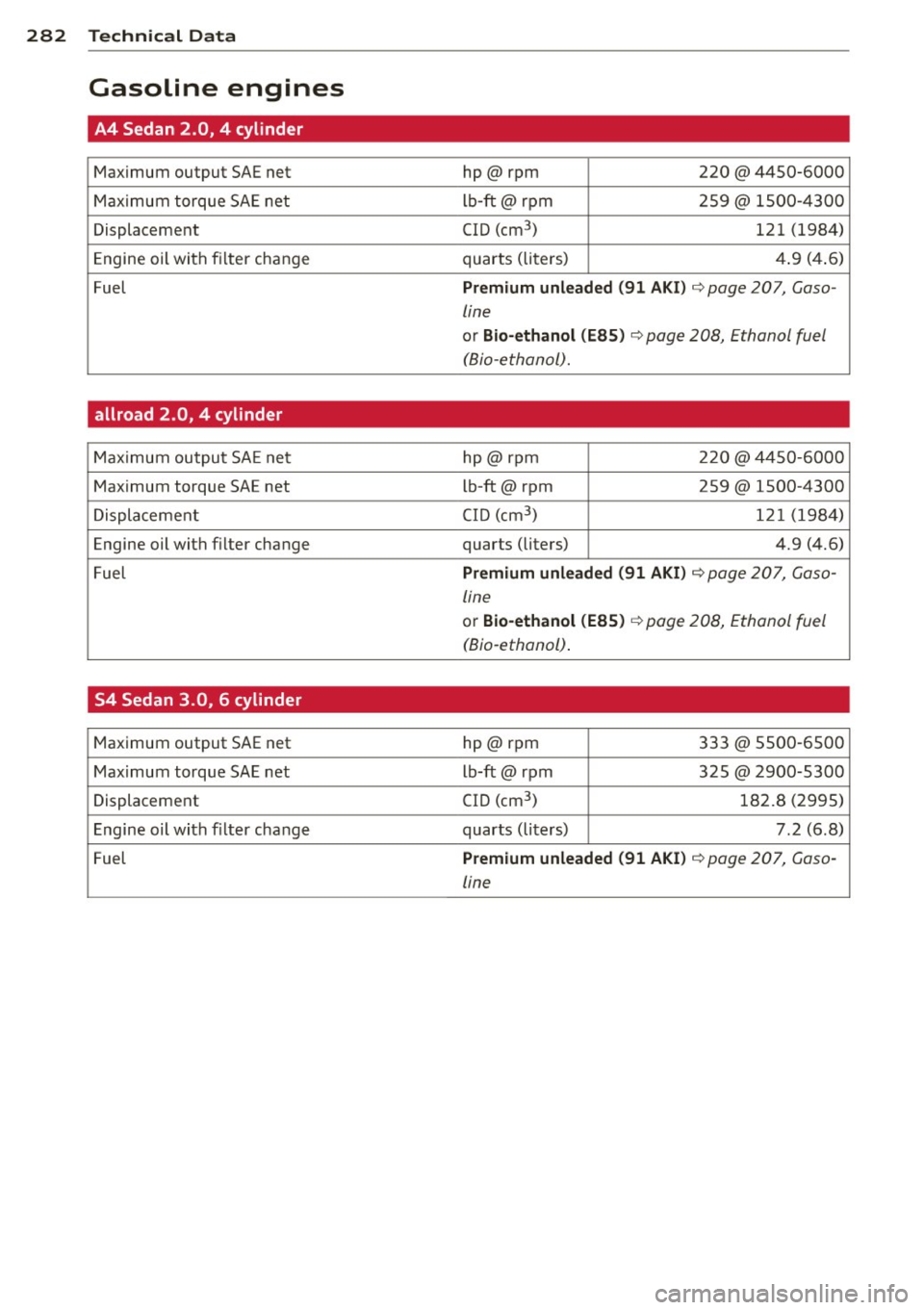
Gasoline engines
A4 Sedan 2.0, 4 cylinder
Maximum output SAE net hp@rpm 220 @ 4450-6000
Max imum torque SAE net Lb-ft@ rpm 259@ 1500-4300
Displacement CID (cm
3
) 121 (1984)
E ngine oil with f ilter change quarts (liters)
4.9 (4 .6)
Fuel
Premium unleaded (91 AKI) ¢page 207, Caso-
line
or Bio-ethanol (E85 ) ¢ page 208, Ethanol fuel
(Bio-ethanol).
allroad 2.0, 4 cylinder
Max imum outpu t SA E net hp@rpm 220 @ 44 50-6000
Maximum torque SAE net Lb-ft@ rpm 259@ 1500-4300
Displacement C
ID (cm
3
) 12 1 (198 4)
Engine oil with filter change quarts (liters) 4.9 (4.6)
F uel
Premium unleaded (91 AKI) ¢ page 207, Caso-
line
o r Bio-ethanol (E85 ) ¢ page 208, Ethanol fuel
(Bio-ethanol) .
S4 Sedan 3.0, 6 cylinder
Maximum output SAE net hp@rpm 333@ 5500-6500
Max imum torque SAE net Lb-ft@ rpm 325@ 2900-5300
Displacement CI
D (cm
3
) 1 82.8 (2995)
E ngine oil with f ilter change quarts (liters) 7
.2 (6.8)
Fuel
Premium unleaded (91 AKI) ¢ page 207, Caso-
line